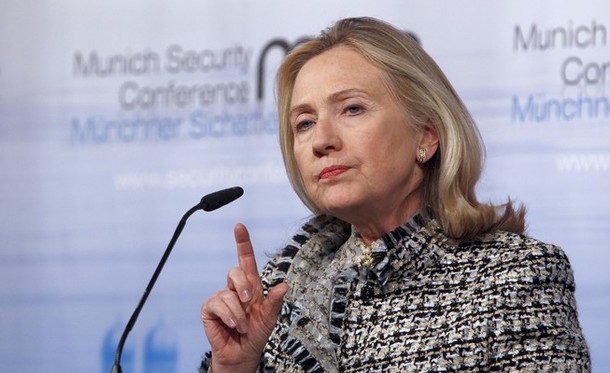
And to conclude the round of premiers is the fact that also this year for the first time do we have the pleasure of welcoming the President of the European Council, a position which was created with the Treaty of Lisbon. It is a great event today to have you, Herman von Rompuy, be with us and speak to us after the Secretary. (Applause.)
I would like to, before we get started, to remind you all that we will have at – around 6:00 this afternoon a special hour on the events in the Arab world in Egypt, et cetera, and will be tacked onto the program, and you will have terrific versions of the program heading out over the next hour or more. So without further ado, it’s my great pleasure to offer the floor to you, Mrs. Secretary. (Applause.)
I’m also delighted to be sharing this session with the President. I’m looking forward to our discussion and will be meeting later with Lady Ashton who has become an indispensible partner on so many issues during the last 14 months.
I want to make remarks on two important subjects briefly. First, America’s enduring commitment to Europe and European security and then how we view the recent upheaval in the Arab world. The events unfolding on Europe’s doorstep remind us that in today’s interconnected world, rapid change is the new norm. The past several years have been difficult on both sides of the Atlantic. The United States face down the most serious financial crisis since the 1930s. We have broken the back of the recession, but we are still challenged by high unemployment in debt.
In Europe, the financial crisis has caused deep pain and anxiety about the health of the Euro-zone. And I know that from time to time, on your side of the Atlantic, critics worry that America is preoccupied with its domestic problems or distracted by Afghanistan and other global issues.
On our side, critics fear Europe’s fiscal difficulties and political constraints will prevent it from remaining a robust partner in promoting global security. But the contents of my inbox tell a very different story. They show a strategic partnership between Europe and the United States that has never been stronger.
On the economic front, the ties between us run deep. The transatlantic economy accounts for more than half of world trade, and when it comes to investment, the numbers are higher still. Now, these figures will change over time. And emerging markets are, indeed, promising. But our partnership is proven, and it must endure if we are to promote sound market-driven economic policies in countries around the world, level playing fields, and fight protectionist forces in an increasingly globalized economy.
[In Progress]
AMBASSADOR WOLFGANG ISCHINGER: I have to apologize to many who wanted to be on the speaker's list. I have to close the list, because we are really running out of time. So I will call on the following three: Volker Pertis, Philip Stevens, and Joe Rialta, and that has to be it. Volker, you are next.
QUESTION: My question is to President Van Rompuy. I was encouraged by what you said about the EU wanting to support the change in Egypt and Tunisia. And I guess, given the strong American involvement in Egypt, we in Europe have a particular responsibility for Tunisia. Also because we see that Tunisia's neighbors will not really be helpful. So they can only look north. They can look to Europe.
And I would like to ask you, and probably ask you to elaborate a little bit, whether we can do more than employ our political instruments here. It is certainly important that we give help for the election process, or help the Tunisians to build free parties. But there are also two other instruments which Europe has, and the one is opening our borders for trade, including agricultural products from Tunisia fully, and making it easier for Tunisians to get visa to Europe. And I wonder whether you can convince your colleagues, the leaders, particularly of the southern European states, to open a little bit in this respect, in order to stabilize a new Tunisia. Thank you very much.
AMBASSADOR ISCHINGER: Thank you. Philip?
QUESTION: Thank you. Philip Stevens, from the Financial Times. It's sometimes seen over the last 10 days that the West has offered support for those in Egypt seeking a more pluralist society, only to the extent that we don't destabilize other autocratic regimes in the country. There has been a hesitation.
Now, Secretary Clinton has said this morning that this is a view of the world that must apply across the Middle East. But I wonder whether she could say that it's a policy that is now going to be applied consistently to allies, good allies, as well as potential adversaries, and something that is going to sort of going to outlive the moment, as it were.
Secondly, a lot of people have begun to say -- and we've heard it from Israel -- that the instability in Egypt is perhaps a reason for Israel not to make peace with the Palestinians. It's too risky. My own view is that the opposite is true, but I would be very interested in the Secretary's view.
AMBASSADOR ISCHINGER: Okay. And last question from Joe.
QUESTION: Madam Secretary, I'd hate to be in your shoes today and the shoes of any other Western leader, as we face the revolutions in the Maghreb. I would spend sleepless nights thinking about the Khomeini and the Hamas analogy. Jimmy Carter, in 1978, kind of more or less told the Shah to go. And, as a result, we had a regime that was as -- I think it was Truman who said, "He's our son of a bitch." But as a result, we got another son of a bitch who was a lot worse, and was not ours. And in the Hamas case, it was one man, one vote, one time, and what we have is a highly destabilized regime on the southern -- between Egypt and Israel.
So, Mrs. Merkel, earlier this morning, said it's very hard to go in and tell the revolutionaries or the opposition what to do. And my question to you is, what -- how do you fine-tune a revolution so we get to the point that everybody has been invoking here, which is a peaceful transition, good governance, institutions, judiciary, et cetera, et cetera. How do we do this?
And then you get them (inaudible).
AMBASSADOR ISCHINGER: Thank you very much. I think we will go in reverse order, President Van Rompuy first, and Secretary. Is that okay?
PRESIDENT VAN ROMPUY: So I have no -- I have less specific questions than the Secretary. On Egypt and Tunisia, it is not a coincidence that the minister of foreign affairs of Tunisia will visit Brussels this week at his first visit after the events. The -- and this is not a coincidence, because they are looking at Europe, and we have to engage a lot in the new Tunisia.
You can't compare the situation in Tunisia with that in Egypt. They are totally different situations. As in other, many other countries in the Maghreb and in the Arab world. So, we will look after what we can do more than we did, strengthening the new institutions, because there is a transition period, and seeing what we can do also on the economy and on free travel. We can't decide it overnight, of course, but we are very happy that Tunisia is looking at what Europe can do, and we are very pleased that we can bring some added value to the situation in Tunisia.
For what the other countries in the region is concerned, of course, as Secretary said -- and I told her that's also -- Angela Merkel said it this morning -- you can't have the same patterns of solutions, and we can't have the same attitude towards all the countries in the region. So what we are saying -- literally, yesterday, with the 27 heads of state and our government -- is this. European Council saluted the peaceful and dignified expression by the Tunisian and Egyptian people for their legitimate, democratic, economic, and social aspirations, which are in accord with the value the European Union promotes for itself and throughout the world. The Council emphasized that the citizens' democratic aspirations should be addressed through dialogue and political reforms with full respect to human rights and fundamental freedoms, and to free and fair election. It called on all parties to engage. This is for the region, as a whole.
But I think that we have to speak with each of our partners and each of our allies on political and social reforms. Of course we can't take decisions in their place. We can give testimony of our will, and we can defend our values. But history is not in our hands. And what happened in Tunisia and in Cairo -- the same happened in Tehran a few -- a year ago. But this is an event, but this may not happen in the same circumstances in other countries. So we have to talk with all the friends and the partners, that they have to be ready to gradual reform and to gradual transform of country. Otherwise, what seems like stability will, at a certain moment, be unsustainable.
And so, it is a process. It is not a copy-paste that we can have in each country. But we have to speak with each country, as we are doing now, already, on how we can implement political and social reforms (inaudible) country going in the right direction. Speed is not the most important thing. Direction is the most important thing.
AMBASSADOR ISCHINGER: Thank you. Madam Secretary, before you conclude our session, let me inform our participants that we just received a report that there has been an attempt on the life of the vice president of Egypt, with apparently several people killed, which underlines the severity of the situation, as it evolves. We will keep you posted as -- the news coming in, I'm sure, over the next several minutes or so.
Madam Secretary?
SECRETARY CLINTON: Well, I think that news report certainly brings into sharp relief the challenges that we are facing as we navigate through this period.
And I will quickly respond to the Japanese state secretary. We appreciate very much Japan's commitment to disarmament. As you know, President Obama, in a very historic speech in the Czech Republic in Prague, set forth what should be a goal of zero nuclear weapons. But we understand completely that that is an aspirational goal that has to be worked toward over time.
But we appreciate your kind words for the START Treaty -- you were uttering them exactly at the moment that Minister Lavrov walked into the room with his impeccable timing -- because it is something that the United States and Russia, together, are working on to set an example. We still have more than 90 percent of the world's nuclear weapons. We understand the responsibility that that imposes on us. And we will continue to discuss ways that, through our own negotiations, and through reaching out to other nations around the world, including, as we recently did at the nuclear nonproliferation treaty meeting at the UN, as the Secretary General knows, continue to make progress. And so we appreciate the Japanese interest and commitment.
I think the third and fourth question kind of encapsulated the different points of view. How do we offer support to Egypt for its transition to a pluralistic democracy? How do we make sure that there is not greater instability? How do we persuade, as I heard the question, Israel to move forward on the peace track, despite the concerns it understandably has about what is going on on the border with Egypt? And then, the fourth question, hate to be in my shoes -- thank you for the sympathy -- we are very well aware of the difficulty of the decisions that we confront. And you recited some history about what happens when these kinds of events that are transformational events occur, and how do we try to do as much as we can to bring about a peaceful transition that actually results in a better life for the people of countries like Egypt and Tunisia.
Well, I would imagine every decision-maker in this conference today is struggling with these questions. As you heard from Herman, What is the contribution that the EU will make? What is the contribution that individual countries will make? I have had excellent meetings already today with Prime Minister Cameron and Chancellor Merkel and Foreign Minister Davutoglu about what each of our countries are doing, and how we can cooperate more effectively to support this peaceful transition.
But there are forces at work in any society, and particularly one that is facing these kinds of challenges, that will try to derail or overtake the process to pursue their own specific agenda, which is why I think it's important to support the transition process announced by the Egyptian Government, actually headed by now Vice President Omar Suleiman, who was the target of the attack that Wolfgang apparently just learned of, and that it be a transparent, inclusive process to set forth concrete steps that people who are engaged in it and looking at it can believe is moving forward the outcomes that will permit an orderly establishment of the elections that are scheduled for September. And that takes some time.
I mean there are certain things that have to be done in order to prepare. In fact, Chancellor Merkel reminded me in my conversation with her what it was like in 1989, when the Berlin Wall fell, and when there was all kinds of changes that had to be addressed. And it takes time to think those through, to decide how one is going to proceed. Who will emerge as leaders? The principles are very clear. The operational details are very challenging.
And at this point, where President Mubarak has announced he will not stand for reelection, nor will his son, where he has given a clear message to his government to lead and support this process of transition, where there is a beginning discussion -- negotiation, if you will -- about constitutional reform, about setting up and legitimizing these peaceful political parties that do not intend to exercise coercion or use violence to achieve their end, that is what the government has said it is trying to do. That is what we are supporting, and hope to see it move as orderly but as expeditiously as possible, under the circumstances.
I think that this is such a difficult set of decisions for any government to carry out and do so in a way that results in the outcome we are all seeking, but it will become immeasurably harder if there is not restraint by government and security forces -- and we thankfully saw that yesterday with the very large but peaceful demonstration -- and if there is not a rejection of violence by other sources in the country.
There is a great economic pressure building up inside Egypt. In addition to the news that Wolfgang shared, there is also reports of one of the major pipelines being sabotaged. There are a lot of actions that are out of anyone's control in any position of responsibility in leadership inside Egypt and outside Egypt. And part of what we have to do is to send a consistent message supporting the orderly transition that has begun, urging that it be not only transparent and sincere, but very concrete, so that the Egyptian people and those of us on the outside can measure the progress that is being made. But ultimately, as Herman said, as all of us have been saying, this is going to be up to the Egyptian people, themselves.
Those of us who are trying to make helpful offers of assistance and suggestions for how to proceed are still, at the end, on the outside looking in. And it is our hope that this proceeds peacefully, that it proceeds with specific goals being achieved, so that people can see that their voices have been heard, and that there be an election with international observers and with sufficient preparation and performance that it will be viewed as free, fair, and credible when it is finally held.
It is also important to support the institutions of the state, something that Foreign Minister Davutoglu and I were discussing. There are respected institutions that are functioning and effective within Egypt that need to be maintained. The army is a respected institution. The business sector, particularly the banking sector. There are many different parts of the society that will be essential for the kind of peaceful, orderly transition that we are all hoping for. So, I hope that we will see positive movement in that direction without violence, non-violent civil disobedience, restraint, and support for that from the military and security forces, and a willingness by the leaders and representatives of constituencies in Egypt to come together and set forth this road map, and then follow it to the transition that we are all supporting.
AMBASSADOR ISCHINGER: Let's offer a round of applause to our distinguished panel. (Applause.) Thank you very much, both of you. Thanks a million.
And, as Secretary and President leave the podium, may I invite you, Minister Lavrov and Senator McCain, to join me here. We will continue without interruption, so stay in your seats. Thanks.