Remarks at the U.S.-India Strategic Dialogue
Remarks
Hillary Rodham Clinton
Secretary of StateIndian Foreign Minister S.M. KrishnaBenjamin Franklin RoomWashington, DCJune 13, 2012
SECRETARY CLINTON: Good morning, and welcome to the Third Annual U.S.-India Strategic Dialogue. Minister Krishna, a warm welcome to you and your distinguished delegation. It is a pleasure to repay the hospitality you have shown me so often, most recently this past month in Delhi, and to have this opportunity to bring together so many experts and officials from our two countries. The strategic fundamentals of our relationship – shared democratic values, economic imperatives and diplomatic priorities – are moving us closer to an understanding and a trust that reflects the convergence of values and interests. To grow and prosper, we both need open, free, fair, and transparent global economic systems. We both seek security and stability in South Asia and the Asia Pacific. And we understand the critical importance of a coordinated international response to violent extremism and other shared global challenges.
As a result, under President Obama’s and Prime Minister Singh’s leadership, we are forging a new and more mature phase in our critical bilateral relationship, one defined by near-constant consultation aimed at advancing the interests and values we share, and working through the inevitable differences. There is less need today for the dramatic breakthroughs that marked earlier phases, but more need for steady, focused cooperation. This kind of weekly, sometimes daily, collaboration is not always glamorous, but it is strategically significant. And it is exemplified by this dialogue.
Reflected around this table are a wide range of participants representing the many topics we are working on together. And we are committed to not only expanding our bilateral relationship, but to furthering the work we do regionally and globally. In fact, later this week we will co-host an important Global Health Conference on child mortality.
The quantity of meetings ultimately matters less than the quality of the results produced. And the effectiveness of our partnership hinges on our ability together to convert common interests into common actions. It’s not enough just to talk about cooperation on issues ranging from civilian nuclear energy or attracting more U.S. investments to India or defending human rights or promoting women’s empowerment; we have to follow through so that our people – citizens of two great pluralistic democracies – can see and feel the benefits.
I think we are making progress. Let me quickly highlight five areas.
First, trade and investment. We’ve come a long way together: Bilateral trade and investment may exceed $100 billion this year, up tenfold since 1995 and up more than 40 percent since 2009 when we launched the Strategic Dialogue. There’s a lot of room, however, for further growth, and we need to keep up the momentum. We look forward to working to advance negotiations on the Bilateral Investment Treaty, to further reduce barriers to trade and investment in areas like multi-brand retail, and to create hospitable environments for each of our companies to do business in the other’s country.
Second, on science and technology. We have significant accomplishments: a new Partnership to Advance Clean Energy; more than $1 billion mobilized for clean energy projects; progress on the Joint Clean Energy Research and Development Center; and yesterday, Westinghouse and India’s Nuclear Power Corporation signed an agreement committing both sides to work toward the preliminary licensing and site development work needed to begin construction of new reactors in Gujarat. There is still a lot of work to be done, including understanding the implications of nuclear liability legislation, but this is a significant step toward the fulfillment of our landmark civil nuclear cooperation agreement.
Third, on education and people-to-people ties. Yesterday in our Higher Education Dialogue, we discussed in depth how to increase educational exchanges and strengthen the ties between our universities. Indians and Americans are among the most innovative people on this planet, and we have so much to learn from each another. But making the most of this potential will require investments from both sides and a strong focus on areas such as job training and digital learning, where we can make a big impact.
Fourth, on security and defense cooperation. Over recent years we’ve expanded coordination and information sharing in the fight against violent extremism. Our militaries are participating in joint exercises and are increasingly cooperating to combat piracy, patrol vital sea lanes, and protect freedom of navigation. Bilateral defense trade has surpassed $8 billion over the last five years. We are convinced this partnership can grow in the future to include joint research, development, and co-production of defense systems. And in our discussions today, I hope we can focus in particular on the need to deepen cooperation on cyber security, which is a growing concern for both of us.
And let me add, on the critical security challenge of Iran’s nuclear program, we can see habits of cooperation paying off. The United States appreciates that India has made it clear it understands the importance of denying Iran a nuclear weapon and supports the efforts to ensure Iran’s compliance with international obligations. And India has taken steps to diversify its sources of imported crude by reducing purchases of Iranian oil – a fact that I officially reported to our Congress. The United States recognizes India’s growing energy needs, and we’re working together to ensure not only stable oil markets but additional areas of cooperation to help India attain greater energy security.
And finally, we are cooperating in South and East Asia. The United States welcomes India’s contributions toward building a stable, secure, and prosperous Afghanistan, including its more than $2 billion in assistance. We hope the conference later this month in New Delhi will galvanize more international investment. And together we must continue laying the groundwork for the long-term vision of a New Silk Road that connects markets, businesses, and consumers from the Caspian to the Ganges and beyond. Both the United States and India have signed strategic partnership agreements with Afghanistan to demonstrate our enduring commitment, and I hope we can move toward a formal trilateral consultation among our three nations.
The United States continues to support India’s Look East policy. Both our countries have significant stakes in the future of the dynamic Asia Pacific region, and we need to expand our work both bilaterally and through multilateral institutions such as the East Asia Summit and the ASEAN Regional Forum to work to build a regional architecture that will boost economic growth, settle disputes peacefully, and uphold universal rights and norms.
And I think that these are just five of the significant areas in which the strategic fundamentals of our relationship are progressing. I’m very excited and appreciative for all the work that has been done by members of both of our governments, only some of whom are represented here today, to move our Strategic Dialogue further and to broaden and deepen our cooperation.
Let me again thank Minister Krishna for his leadership, and let me now turn and invite him to speak.
FOREIGN MINISTER KRISHNA: Thank you, Madam Secretary Hillary Clinton, distinguished members of the United States delegation, it’s a great pleasure for me to join you in chairing the Third India-U.S. Strategic Dialogue. I would like to thank you profusely for hosting the dialogue, and for the warmth and hospitality. And we also sincerely appreciate the efforts that your team and our embassy here have put in to making this literally an India-United States fortnight in Washington. With all the other bilateral meetings scheduled in the past two weeks, it speaks to the depth of our relationship and the diversity of our engagement.
Madam Secretary, I am particularly honored to be joined by my distinguished ministerial colleagues: Mr. Ghulam Nabi Azad, Minister for Health and Family Welfare; Mr. Montek Ahluwalia, Deputy Chairman, Planning Commission; Mrs. Krishna Tirath, Minister of State for Women and Child Development; Mr. Ashwani Kumar, Minister of State for Planning, Science and Technology and Earth Sciences; and Mr. Sam Pitroda, Public Information, Infrastructure and Innovation Advisor to Prime Minister. I am also pleased to be joined by several of our most senior officials in the Government of India.
Even by the high standards of India-U.S. relationship, we have had an unprecedented intensity of engagement over the past years. Yet the Strategic Dialogue is a unique opportunity to bring together all the threads of our cooperation that constitute the extraordinarily rich tapestry of our relationship. Madam Secretary, our two sides have a shared vision that our global strategic partnership could be one of the most important defining relationships of the 21st Century.
In July 2009 in Delhi, we started a new chapter in an already exciting study of India-U.S. ties. Our bilateral engagement as well as global developments over the past three years has only strengthened our mutual commitment to this partnership. In every field – political, strategic, security, defense, intelligence, nuclear cooperation, space, trade and investment, energy, science and technology, higher education and empowerment – we are making tangible and continuous progress. What was once novel and unprecedented in our relationship is now almost routine and normal. In the process of our engagement, we have built something more precious: friendship, goodwill, trust, mutual confidence, candor, and belief in the importance of a successful partnership.
Sometimes there are questions and doubts about the relationship. They are inevitable in something so unique and new. But I believe that having settled the question of whether India and the U.S. can or should work towards a close relationship, the question we ask now are how to harness the full potential of that relationship. If we go by the investments that the two governments are making and the energy and enterprise of our people, we are, Madam Secretary, on the right track. But as I say, we have reasons to be satisfied but not complacent. So we hope, in the course of today, we will chart the course ahead both for the immediate future and the long term. (Inaudible) I think the dialogue process will start.
Thank you.
SECRETARY CLINTON: Thank you very much, Minister.
Wednesday, June 13, 2012
Secretary Clinton at the U.S.-India Strategic Dialogue
Tuesday, July 19, 2011
Secretary Clinton's Remarks at U.S.-India Strategic Dialogue

- US Secretary of State Hillary Rodham Clinton, left and Indian Prime Minister Manmohan Singh, during a meeting at the Prime Minister's Office in New Delhi, Tuesday, July 19, 2011. U.S. Secretary of State Hillary Rodham Clinton said Tuesday that the United States was "encouraged" by the ongoing talks between nuclear-armed rivals India and Pakistan and promised to give full support to Indian efforts to protect itself from terror. Clinton's visit to India came less than a week after a triple bombing killed 20 people in India's financial capital of Mumbai, the worst terror strike in the country since 10 Pakistan-based gunmen rampaged through the city in 2008. (AP Photo/Saul Loeb, Pool)
Remarks at the Opening Session of the U.S.-India Strategic Dialogue
RemarksHillary Rodham Clinton
Secretary of StateAs Prepared for DeliveryNew Delhi, IndiaJuly 19, 2011
Minister Krishna, members of the Indian Government, friends and colleagues:
It is a pleasure to be back in India.
I have been looking forward to this visit—not only for the chance to spend time in India, a nation for which I have a great deal of personal affection—but also to continue the important work we are doing together in this Strategic Dialogue.
Before I go further, however, I want to express our sympathy and outrage over the terrorist attack in Mumbai last week. The United States condemns this attack in the strongest possible terms. We send our deepest condolences to the families of the victims. And we pledge our support the Indian government however we can in protecting its cities and citizens from future harm. We are allies in the fight against violent extremist networks. And homeland security is a high priority and a source of increasing partnership.
That’s why we signed the Counterterrorism Cooperative Initiative to increase our cooperation on the investigation of crimes, law enforcement, border management and cyber security. And in May, U.S. Secretary of Homeland Security Janet Napolitano came to New Delhi to launch with you the first-ever U.S.-India Homeland Security Dialogue, to bring order and urgency to our shared efforts. The events in Mumbai have driven home how important it is that we get results.
And that’s true across every aspect of our engagement. The United States joined India in this Strategic Dialogue because we believe—as President Obama has said—that the relationship between India and the United States will be a defining partnership in the 21st century. The stakes are high. So it is critical that this dialogue lead to concrete and coordinated steps that each of our governments take to produce real results that make a difference in our people’s lives. Because that’s ultimately what this is all about—joining forces to protect our citizens and help every man, woman, and child live up to their God-given potential.
Today, we will review what we have achieved together across a range of issues. On some, like education, energy, and science and technology, we have recently begun new projects or are about to do so. On others—in particular, trade and investment, security cooperation, and our civil nuclear agreement—we have made progress and, if we redouble our efforts, we are poised to go even further.
Let me briefly discuss these three issues.
With regard to trade and investment, the ties between our countries are strong and growing stronger. The United States is proud to be one of India’s largest trading partners and direct investors, and we welcome India’s investment in the United States, which is rapidly on the rise. This is a good news story—but we would be remiss if we didn’t strive to make it even better. Each of our countries can do more to reduce barriers, open our markets, and find new opportunities for economic partnership. Taking these steps is in our mutual interest. We can improve millions of lives and increase both of our nations’ economic competitiveness.
On the matter of security cooperation: again, we have made progress. But we can do more to strengthen the security of our nations and this region as a whole. I’ve already mentioned our cooperation on counterterrorism. Maritime security is also a major concern, as we seek to protect sea lanes, combat piracy, and defend freedom of navigation. We applaud India’s leadership on fighting piracy in the Indian Ocean, including your decision last week to chair the 2012 plenary of the piracy contact group. And on another issue—defense technologies—the United States expects to continue developing and selling the world’s most competitive products. We view these sales as important on their own terms, but also as a means to facilitate the work that the Indian and American militaries can do together—whether patrolling the seas or providing relief to the victims of natural disasters.
And third, our civil nuclear agreement has been a joint investment by our countries, not just in the field of nuclear energy but also in our relationship. But to reap the benefits of that investment and to see returns on the political capital that has been spent on both sides, we need to resolve remaining issues so we can reap the rewards of a robust civil nuclear energy partnership. I look forward to the day when the computers of a school in Gujarat are powered by a reactor designed in America.
I have singled out these three issues—trade and investment; security cooperation; and the completion of our civil nuclear agreement—because each is so consequential for our prosperity and security. And on each, our countries have already come so far. But on both sides, we need to do more to translate momentum from this Dialogue into consistent and effective cooperation at every level of our governments, every day of the year.
Let us not forget the broader regional and global context. There was a time when India’s role as a leading nation was discussed as something that would happen at some point in the distant future. But that is no longer the case. India is a global leader. And the United States wholeheartedly supports this development and sees great benefits in our growing partnership. That’s why we support initiatives like the trilateral forum we are establishing with India and Japan; why we’ve stood in favor of a stronger role for India in forums like the G-20; and why we look forward to a reformed UN Security Council that includes India as a permanent member.
I’ll speak at greater length about our view on India’s role in the region and world tomorrow in Chennai. My point today is this: India’s rise is directly connected to what we are working to achieve through this Dialogue. The cooperation we are forging here should build habits of cooperation and bonds of trust as we strive to make both of our countries stronger, more prosperous, and better equipped to address the challenges we face.
So let’s make the most of our time together in New Delhi to review our progress to date, recognize the gains we have made—and then become even more determined to turn the aspirations of this Dialogue into real results for our people and our nations.
Thank you.
Thursday, June 3, 2010
Photos: U.S.-India Strategic Dialogue Reception Hosted by Hillary Rodham Clinton
I just added these next six. They just came up and are so cute! Her fixing Krishna’s note! Aw! She’s such a mom! And Hillary walking, in that pantsuit – so pretty!


Video: Hillary Clinton Hosts Reception In Honor of the U.S.-India Strategic Dialogue
I know it's not just me. Between 12:00 and 13:25 she has the sexiest laugh! I am just going to leave it at that.
Remarks At Reception Honoring the U.S.-India Strategic Dialogue
Hillary Rodham Clinton
Secretary of StateRemarks with Indian External Affairs Minister S.M. Krishna
Ben Franklin Room
Washington, DC
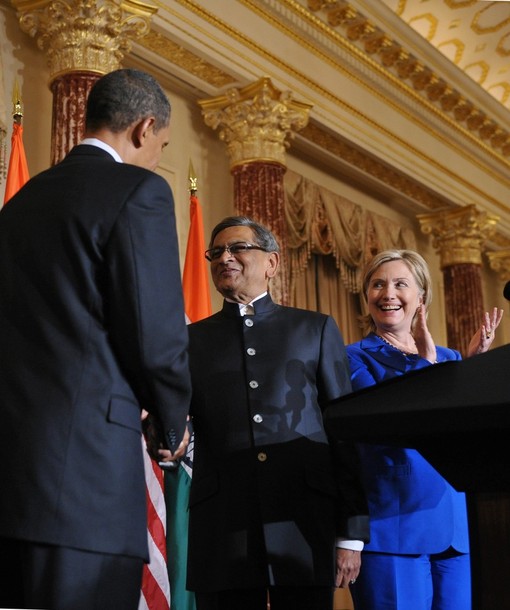
June 3, 2010SECRETARY CLINTON: Well, welcome to all of you who are joining us for this reception here at the State Department in the Ben Franklin Room. And it is a particular honor for us to welcome not only a great leader but someone who has a strong personal commitment to the U.S.-India relationship, President Barack Obama. (Applause.)
Mr. President, we’ve worked hard today and we’ve actually been working hard ever since this Strategic Dialogue was agreed to between you and Prime Minister Singh. Many of the people you see before you are the people who are actually doing the work that make Minister Krishna and I look like we’re fulfilling our responsibilities. (Laughter.)
But we so value this relationship. And I came across a quote which I think summarizes what we feel. Mark Twain once wrote, “India is the cradle of the human race, the birthplace of human speech, the mother of history, the grandmother of legend, and the great-grandmother of tradition.” And I love the fact that it’s mothers that – (laughter).
Well, given the talent, the expertise, and the enthusiasm in this room, not only from our distinguished delegation from India and all of the people here in our Government who have worked so hard, but Indian-Americans who themselves embody the importance of this relationship. We are so excited as we broaden and deepen this extraordinary partnership. And now the real work begins. We’re turning our ideas and our aspirations into actions and results and working to unleash the tremendous potential that exists for even greater opportunity, prosperity, and peace for the people of India and of the United States and of the world.
Let me now introduce Minister Krishna, who has been a wonderful colleague and, ever since we announced this strategic dialogue during my visit last year, has been so supportive and enlisted the commitment of so many of the distinguished ministers and officials from the Government of India.
Please, join me in welcoming Minister Krishna. (Applause.)
MINISTER KRISHNA: Mr. President, last year you and Prime Minister Manmohan Singh launched a new phase in the India-U.S. global strategic partnership. I bring to you from Prime Minister Dr. Manmohan Singh, who spoke with you last week. He has asked me to reiterate the importance he attaches to this Strategic Dialogue and his personal commitment to it as an instrument for strengthening of our bilateral cooperation. He recalls very warmly his meeting with you at the successful Nuclear Security Summit in April 2010. He and over one billion citizens of India look forward to welcoming you and your family later this year.
I am grateful for the warmth and gracious hospitality that has been extended by Secretary Clinton to me and to my colleagues and officers. Her commitment and involvement in working for a positive transformation of India-U.S. relations has been a key factor in the achievement of the global strategic partnership that we have established today.
Mr. President, we consider our mutually beneficial relationship with the United States to be one of our foremost foreign policy priorities. There are few relationships in the world that have so much potential as India-U.S. relations because I believe that our cooperation is not only for mutual benefit but is destined to have a strong impact on global peace, prosperity, and stability in the 21st century.
Mr. President, as India regains the momentum of her economic growth, new opportunities are emerging to empower rural communities, especially women. Time and again, we have seen in other developing countries – for example, in the pioneering efforts of Ann Soetoro, your late mother – Mr. President, to Indonesia, the transformational impact of innovation and microfinance, that is our hope for transforming our economy and society in an equitable, inclusive and sustainable manner.
My colleagues and I have had very productive meetings yesterday and today in our Strategic Dialogue. We reviewed progress in all areas of our ongoing cooperation and also focused on our vision and the roadmap for the future. We also discussed how we would work together to realize the immense potential of our cooperation across the spectrum of human endeavors, from strategic cooperation to sustainable growth and economic and developmental partnerships, to achieve real benefits for our peoples and for the world.
Mr. President, we are pleased that you, with your deep personal links with the Asia-Pacific region, are taking strong interest in the future of this rapidly evolving region. We look forward to a stable, secure, prosperous future for this region, defined by cooperation, openness, and inclusion. A peaceful and stable South Asia is critical for our development and security. We believe that India can be a dependable anchor of the region’s growth. We are supporting economic development and increasing trade and investment in several of our neighboring countries.
We remain committed to Afghanistan’s development and supporting the Afghan people in their efforts to build their capacity and assume the rightful responsibilities for governance, security, and development. With international support, they will succeed in their efforts. The United States have made great sacrifices in Afghanistan and invested in – heavily in Afghanistan and Pakistan. These are no ordinary commitments for the American people as they promote the cause of peace and resist the evils of terrorism.
My prime minister has consistently believed in the need for dialogue to seek a future of peace and cooperation with Pakistan. I will meet the foreign minister of Pakistan in Islamabad in the month of July. The trust deficit in relations between India and Pakistan needs to be specifically addressed. The continuing threat of terrorism is a cause of great concern for us in India.
Mr. President, our agenda is rich and extensive. I thank you once again for your belief in and commitment to this relationship, and look forward to your visit to India, where a very warm and heartfelt welcome awaits you and the family. Thank you so much, Mr. President. (Applause.)
SECRETARY CLINTON: Well, Mr. President, we love having you come to the State Department. And have this chance to see all of these people who have worked so hard on these people who have worked so hard on this Dialogue is for us a very great honor. And we thank you for your personal commitment, as Minister Krishna outlined, to broadening and deepening this critical relationship between India and the United States.
Ladies and gentlemen, please welcome the President of the United States.
# # #
Video & Text: Secretary Clinton's Remarks With Indian Minister of External Affairs S.M. Krishna After Their Meeting
Remarks With Indian Minister of External Affairs S.M. Krishna After Their Meeting
Hillary Rodham Clinton
Secretary of StateTreaty RoomWashington, DCJune 3, 2010
SECRETARY CLINTON: Good afternoon, everyone, and let me again warmly welcome all of our Indian guests, most particularly Minister Krishna, here to the State Department. It is indeed an honor to host this inaugural Strategic Dialogue between India and the United States, and this makes good on plans that Minister Krishna and I announced in India last summer and it advances the vision of partnership articulated by President Obama and Prime Minister Singh. I know that President Obama is looking forward to joining us later today and underscoring his personal commitment to strengthening the U.S.-India relationship.
India is an indispensable partner and a trusted friend. We believe that a rising India is good for the United States and good for the world.
Our two nations – great democracies, dynamic and interconnected economies, and engines of progress – understand that our fortunes in this new century are increasingly linked. Our people are more connected today than ever before, and we face complex global challenges that will be difficult to solve without the United States and India working together. And we also face opportunities that can only be seized by tapping the talents and innovation of both the Indian and American peoples.
Today, we’ve had a series of very productive discussions about a wide range of our common concerns, touching on bilateral, regional, and global issues.
First, on security. Both India and the United States have seen our cities and our citizens targeted by violent extremists, and we share concerns about the continuing threat of terrorism and we share concerns about the dangers of nuclear proliferation. For our peoples, security is more than a priority; it is an imperative. And it was a prime topic of discussion today.
Minister Krishna and I discussed the importance of India’s leadership to promoting security, stability, and prosperity across Asia and beyond. We are collaborating on a Counterterrorism Cooperation Initiative to improve information sharing and capacity building, and we agreed to expand cooperation in cybersecurity. We are deepening our already extensive military-to-military partnership.
And I thanked Minister Krishna for India’s generous contributions in Afghanistan. And I was delighted to learn at lunch how deep the ties between India and Afghanistan go back, and it is clear that what India has been doing in development projects are very significant and we look forward to finding ways to collaborate.
Charting an energy future that is secure and sustainable is a crucial challenge for both of us. I am pleased that we have completed a nuclear reprocessing agreement nearly six months ahead of schedule, underlying our commitment to the civil nuclear accord of 2008. We are building on the Partnership to Advance Clean Energy established by President Obama and Minister Singh, including by expanding our work together on energy efficiency, smart grids, forest management, and so much else. And we are committed to working on an action plan on shale gas cooperation prior to President Obama’s trip to India. We have launched a new dialogue on climate change, discussing how to continue the progress made in Copenhagen, and work more closely together.
On the economy, we discussed the importance of capitalizing on the doubling of our trade over the last five years, bringing together experts from across our governments to focus on macroeconomic policy, financial sector reforms, and infrastructure financing. U.S. and Indian cabinet secretaries and ministers will meet on June 22nd in Washington with the members of the US-India CEO Forum to hear recommendations on specific steps our two governments can take to expand trade and investment.Now, we know that innovation is a source of growth and dynamism, and we discussed greater collaboration on technology, including exchanging delegations of high-tech innovation leaders later this year and developing new partnerships and cross-cutting solutions. Passage of legislation allowing foreign universities to open campuses in India would be a significant step forward, and I am pleased that a number of U.S. institutions have already expressed an interest.
One of the areas where we intend to have closer scientific collaboration is food security, boosting the productivity of our farmers and giving more people in more places the tools they need to feed themselves and their communities. Our new Memorandum of Understanding on Agricultural Cooperation and Food Security is part of this important effort. And we agreed to establish working groups to develop concrete proposals for the U.S. and India to enhance food security in third countries, strengthen farm-to-market links and food processing in India, and develop an initiative to expand weather and crop forecasting.
On all these issues, we have stayed relentlessly focused on how to deliver results that will make a difference in people’s lives. After all, that is what this is supposed to be about. We want to help people in India and in the United States feel more secure, more prosperous, and more able to fulfill their own God-given potential.
We will meet again next year in Delhi to resume this high-level discussion. But between now and then, we will work every day to translate our shared goals into concrete actions. And the dialogue must extend beyond these official channels to our homes, our businesses, our communities, our universities – every aspect of our respective societies – to build mutual understanding and respect between our peoples.
I am very proud to be part of this process and to join with Minister Krishna and other leaders and experts we have convened from both sides to help deepen this defining partnership.
Thank you so much, Minister.
FOREIGN MINISTER KRISHNA: Thank you, Secretary Clinton. Good afternoon, ladies and gentlemen. I am particularly pleased to be co-chairing this dialogue with Secretary Clinton, whom we consider as a dear and longstanding friend. She’s a true believer in the vast potential of the India-U.S. partnership.
I want to thank her for her gracious hospitality and the splendid cooperation by her colleagues that has no doubt gone into the preparations for this inaugural meeting of the Indo-U.S. Strategic Dialogue. This dialogue, as Secretary Clinton said, is a unique forum that really brings together the different threads of our extraordinarily wide agenda and allows us to look at the entire relationship in an integrated strategic fashion.
I would like to emphasize the importance that Prime Minister Manmohan Singh attaches to India-U.S. Strategic Dialogue and to Indo-U.S. relationship. He and President Obama reaffirmed, when they last met, their commitment to taking this relationship to a new level of coordination and cooperation, a global strategic partnership for the 20th century – 21st century between India and the United States. We consider our strategic partnership with the United States as one of our key foreign policy priorities. The United States is the largest economy in the world and India is emerging as one of the largest and one of its fastest growing economies.
The relationship rests on a solid bedrock of shared values. There are few relationships in the world that have so much potential as India-U.S. relations. Therefore, I believe that our cooperation is not only for great mutual benefit, but we can work together to make a significant contribution to global peace, prosperity, and stability in the 21st century.
Secretary Clinton and I, joined by senior colleagues, have had a very comprehensive and productive discussion today. Our discussions covered a broad range of global economic and security issues. We agreed to continue the practice of close and regular consultation and to remain sensitive to each of others’ interests and concerns. We expressed the hope that the G-20 meeting in Canada later this month will stimulate further coordinated international efforts for economic recovery and stabilization and to safeguard our goal of balanced and sustainable development. We had a very good exchange of views on reforms necessary not only in the international economic architecture, but also in the global political and security architecture, including the UN Security Council, so as to reflect contemporary global realities, as President Obama’s national security strategy also points out.
We shared concerns about developments in Asia, including on the Korean Peninsula. We have a common interest in advancing security and stability across Asia. We shared our perspectives on South and Central Asia, East and Southeast Asia, and the Middle East and the Indian Ocean region. India and the United States have a shared convergent goal of a stable, peaceful, pluralistic and democratic Afghanistan, which protects the rights and dignity of all sections of Afghan society. India and the United States are partners in achieving these goals. I conveyed our view that these goals can be best advanced through sustained international commitment in Afghanistan by building Afghan capacities for governance and security through initiatives that are led and controlled by Afghans themselves.
We agreed on the importance of avoiding choices that lead us to the dark alleys of the 1990s and the importance of safeguarding the gains and progress that have been made since then, especially with regard to the position and rights of women in Afghanistan. Our dialogue has further increased our understanding on the nature and source of terrorism that threatens both of our societies. We agreed that terrorism, terrorist groups, operate as a syndicate, leveraging each others’ assets and strength, and are increasingly converging together on motivation and targets.
Hence, a segmented approach towards terrorism, especially in our neighborhood, could not succeed. We are pleased with the way our counterterrorism cooperation has progressed, and today we have agreed to intensified (inaudible). We discussed the steps that we should take to further deepen our growing defense and security cooperation, including defense trade and collaboration, which has grown rapidly in recent years.
We had, again, a very good discussion on economic cooperation, high technology exports to India, cooperation in higher education, healthcare, science and technology, empowerment, agriculture, climate change, and energy. In each of these areas, there is immense opportunities for mutually beneficial cooperation that will make a significant contribution towards creating jobs and prosperity in both countries.
I am pleased that there is a strong balance and momentum in trade and investment in both directions. Secretary Clinton and I agreed that we have to go beyond multiplying our trade and investments. We are two innovative societies with a proven track record of success in partnerships for innovation. India is making a modest but meaningful contribution, based on its experience and expertise on (inaudible) resources, to development efforts in other countries. This is an area where we have a lot to learn from each other, and we had a very useful discussion on these issues today.
In short, our dialogue was wide-ranging. We have identified the areas of our strategic priority and a roadmap for cooperation in each of these areas. Secretary Clinton and I have agreed to monitor the progress and meet again in 2011, and we look forward to warmly welcoming President Obama and the family in India later this year.
I would like to thank my distinguished colleagues, Shri Kapil Sibal; Dr. Montek Singh Ahluwalia, deputy chairman, planning commission; Shri Prithviraj Chavan, minister for science and technology, and other senior officers who ably assisted us here in Washington, after having held a series of meetings with their U.S. counterparts for this Strategic Dialogue today.
Madam Secretary, thank you again, once again.
SECRETARY CLINTON: Thank you, Minister. Thank you so much.MR. CROWLEY: We have time for two questions on each side. We’ll begin with Jill Dougherty from CNN.
QUESTION: Thank you very much. Thank you, Madam Secretary. I have a question on the flotilla clash. What can you tell us about the Turkish American who was killed in that clash? Does his death make it more likely that an American will participate in any investigation? And also, Prime Minister Netanyahu is now saying that he is willing to evaluate new ideas on the blockade of Gaza. Do you have – does the United States have any new ideas in this regard?
SECRETARY CLINTON: Well, Jill, we can confirm that a U.S.-Turkish dual national, Mr. Furkan Dogan, was among those killed in the raid on the flotilla. Our ambassador to Turkey, Ambassador Jim Jeffrey, has been in contact with the family. We’ve offered not only our heartfelt condolences but any kind of consular assistance that the family might need at this time.
We are still gathering information about what happened. We know that there was another American citizen injured on one of the ships. There is also a third American who was injured during a subsequent protest and remains hospitalized.
Protecting the welfare of American citizens is a fundamental responsibility of our government and one that we take very seriously. We are in constant contact with the Israeli Government, attempting to obtain more information about our citizens. We have made no decisions at this point on any additional specific actions that our government should take with respect to our own citizens.
But as we have stated continuously, we expect the Israeli Government to conduct a prompt, impartial, credible, and transparent investigation that conforms to international standards and gets to all the facts surrounding this tragic event. We are open to different ways of assuring that it is a credible investigation, including urging appropriate international participation.
With respect to Gaza, we are evaluating ways of expanding the flow of humanitarian assistance to the people of Gaza while protecting Israel’s legitimate security interests. There’s a great deal of consultation going on as well as work in our own government to determine ideas that we would share with the Israelis and other international partners, because as I have said before, we have to deal with the situation in Gaza in a way that both protects Israel’s legitimate security interests and fulfills the needs of the people of Gaza. And that is what we’re seeking.
QUESTION: Could I just ask one clarification? When you talk about international participation in that investigation, again, do you believe that a U.S. – an American should be part of that investigation?SECRETARY CLINTON: Well, Jill, we haven’t made any decision on that. That was part of the presidential statement that came out of the United Nations Security Council on Monday night, and we are engaged in broad-based discussions with the Israelis and others.
MR. CROWLEY: Lalit Jha from the Press Trust of India.
QUESTION: Thank you, P.J. Mr. Minister, as you conclude your first Strategic Dialogue with United States, which went beyond your scheduled time here today, can you give us a sense of the U.S.-India relations now and the way forward? And what are the takeaways for India from this meeting?
And Madam Secretary, you spoke about India’s being an indispensable partner and trusted friend. So what is holding United States from endorsing India as a member of – permanent member of the United Nations Security Council?
Thank you.
FOREIGN MINISTER KRISHN: Well, this is a uniquely structured Strategic Dialogue which has taken place. The idea was first (inaudible) by Secretary Clinton when she visited New Delhi last summer. Since then, we have been working towards this all-important Strategic Dialogue.
United States and India share so many commonalities. We are nations which truly believe in democracy and in democratic values. We both are pluralistic societies. We both respect human rights. And we both believe that together we can play a very constructive role in shaping the global events, in stabilizing peace and tranquility, and perhaps this partnership, this relationship between our two countries, will go a long way in sending out a message clear and loud that these are two democracies which believe in equality, which believe in equal respect, and which also believes that we have a bigger role to play in shaping the destinies of humankind. And this Strategic Dialogue is moving in that direction.
SECRETARY CLINTON: I would just thank the minister for that very elegant and eloquent description of the overarching framework of these dialogues, because that’s exactly how seriously we take the importance of this interaction. And of course, there are many specific actions that are being worked on by our respective governments, and we will be making a report – I to President Obama and Minister Krishna to Prime Minister Singh – detailing all of the work that has been accomplished. And I hope that our press on both sides will focus on it because we really are committed to trying to invigorate the actions that will demonstrate exactly what Minister Krishna talked about: our commitment to advancing humankind.
So I know that it won’t necessarily get headlines in either one of our media, but working to expand access to higher education is a huge deal. Working to better coordinate on science, technology, and innovation, exchanging scientists, supporting centers of excellence – who knows what benefits will flow from that. Working to improve the productivity of agriculture, exchanging views on how best we can deal with health issues that are going to overwhelm our respective health systems – I mean, there’s just so much, so much richness, so much of a commitment. And I’m very much looking forward to this continuing work.
As to your specific question, I said in my opening remarks that we don’t have any way forward yet on Security Council reform, but we are obviously very committed to considering India. At this point, as you probably know, there is no consensus in the world and that is the challenge of dealing with multilateral organizations. I think as Minister Krishna said at another point in our meeting today, once you get to multilateral negotiations it slows down considerably. But we are definitely committed to the consideration of India.MR. CROWLEY: Andy Quinn from Reuters.
QUESTION: Madam Secretary, Mr. Minister, Afghanistan is obviously a big focus for both countries. And President Karzai’s peace jirga has recently concluded and endorsed his proposal to begin reaching out to the Taliban, and indeed many of them are saying they should be reaching out not only to foot soldiers, but even up to the leaders of Taliban to try to bring them into peace talks.
So my question to both of you is: How do both of you see the end game moving forward in Afghanistan? How do India and Pakistan balance their interests in the country? And what do we see for the Taliban as a potential future partner there?
SECRETARY CLINTON: Well, I will begin. I don’t think that the consultative peace jirga has concluded. I think it is in the midst of very intense discussions. As I understand it, there have been more than 50 discussion groups that are underway, and reports are being made at the end of each day. And then the leaders of the jirga will be reporting to President Karzai, and all of that will be taken into account.
We’ve been very clear in our approach that we think that there is a basis for reintegrating Taliban fighters back into society, but we do not believe anyone should be either reintegrated or reconciled on a political basis without renouncing al-Qaida, renouncing violence, committing to live by the laws and constitution of the nation of Afghanistan.
There is no military solution to most conflicts. This is not unique in that regard. There have to be political decisions that go along with military actions. And we have told President Karzai, most recently on his visit, that we understand that, and we support his efforts. But of course, we want to be kept fully informed and we want to be able to work with him. And it is clear that there are some people who call themselves Taliban who already are coming off the battlefield, they want to return home, they have no ideological commitment. And then there are others who tried to blow up the peace jirga.
So this is not something that you can have a blanket statement about. This is painstaking work to try to identify those with whom there may be the opportunity for some political reconciliation, and others for whom there is no prospect and they have to be defeated and deterred from their continuing violence against the people of Afghanistan, against our troops, and they have to be rooted out of their safe havens in Pakistan where they are being a very grave threat to the Government of Pakistan now. So this is a matter that crosses borders, poses a transnational threat, as we have seen on numerous occasions, and must be undertaken with full awareness of that.
FOREIGN MINISTER KRISHNA: Well, we made our position very clear when the London conference convened by (inaudible) on Afghanistan. There we spelled out that anyone, any group of persons who disassociate themselves from various terrorist outfits, and who are willing to go along, accepting the Afghan constitution and then the Afghan-led Government by President Karzai, then we should not have any problems in dealing with them and then in bringing to the mainstream of Afghan society.
India and Afghanistan have a very close relationship. It is not yesterday’s, it’s the day before yesterday’s, at one of our morning session, there was a mention that there are Kabulis – that means who reside in Kabul – in almost every (inaudible) center in India. And then our ambassador was mentioning about the Kabuliwala, the movie, which was centered around Kabul. So this historical and civilizational affinity that we have with Afghanistan makes us to think about Afghanistan and then Afghan brothers and sisters, you know. And then especially, I know how deeply Secretary Clinton feels about the women and the children.
The last time when I had the opportunity of exchanging views on Afghanistan with her, she was so happy mentioning to me about the number of children who are back in schools in Afghanistan. I think that the kind of Afghanistan that we all would like to think about and look forward to. And anything India can do in trying to lift Afghanistan towards that frontier, that frontier of children going back to schools, mothers being able to freely communicate with their relatives and friends without fear, I think that is the kind of society for which we are working. And then our contribution in Afghanistan is a very constructive nature. It is not military driven. It is development driven. And we are concentrating, in spite of the price that we have had to pay – there have been a series of attacks on our mission.
I would like to – I visited Kabul twice, and then I have conveyed to those who are working under such difficult circumstances where India has been the target of attack. And we know the reason, you know. And, well, knowing the reason, knowing the motives, we are going to stay in Afghanistan to defeat these terrorist (inaudible).
QUESTION: Madam Secretary --
MR. CROWLEY: No, no. Goyal, no, no. We can finish up (inaudible).
QUESTION: Mr. Minister, last week the White House released its National Security Strategy in which the Obama Administration identified India, along with Russia and China, as emerging powers with which it wanted to deepen and strengthen its relationship. Now, where does India place the United States in this context with regards to its strategic and national interest?
And Madam Secretary, to you, to what – this is called the Strategic Dialogue, and to what extent does it represent any change in strategy at a sort of a macro level versus continuity? And if does, could you just give us some details on what that change is? Thank you.
FOREIGN MINISTER KRISHNA: President Obama’s strategy statement is a very welcome development from India’s point of view. Well, we have always felt comforted with our association with United States. Our partnership has gone through various vicissitudes but one thing stands out very clear, that it is an enduring partnership. And we would like to continue that partnership. And while doing so, we do appreciate the enormous responsibilities that partnership (inaudible) on India, perhaps on the United States also. Well, India is willing to discharge its part of the responsibility and we are thankful to President Obama for the kind of strategy statements that have been made on his behalf and, well, needless for me to say that millions of Indians are looking forward to President Obama’s visit later this year to India.SECRETARY CLINTON: I believe that our current partnership represents both continuity and change. As Minister Krishna said, we have a long, enduring relationship with India, going back to independence. We have had many partnerships that have proven beneficial to both of our countries, going back through that time. Certainly, the Green Revolution, which was an American-Indian project, stands as one of the great achievements of the 20th century, or perhaps all of human history. So the continuity that was evidenced by my husband’s efforts to reach out to India, evidenced by President Bush’s continuing efforts, and a commitment to a tangible demonstration of the modern state of our relationship with the civ nuclear deal, has now come to a point where we wish to both continue and deepen the enduring relationship.
But we want to broaden the base of that relationship. So the comprehensive agenda that is encompassed by this Strategic Dialogue goes far beyond one project or one visit or any single aspect. Instead, we are committed to not only working government-to-government, as we have been today and as we have for the last year, but also building on the very strong foundation that exists between the Indian and American peoples. This is an affair of the heart, not just of the head. The relationship between India and the United States and between our peoples is rooted in common values, shared aspirations.
We know we have different historical experiences, we have different cultural perspectives; we understand that. But underneath it, in addition to our common humanity, there is this commitment to democracy and diversity, to the rule of law, to the empowerment of people, that sets the United States and India apart. We often talk about how India is the largest democracy, we’re the oldest democracy, we’re the largest economy, India is making rapid progress and moving up with its economic growth.
So this is a relationship that is so rooted in our values, and that’s why I think it stands the test of time despite the vicissitudes that come between any two great countries or any two people, for that matter. But persisting and understanding and working through on a basis of mutual respect is how we intend to build an even stronger relationship through the mechanism of this Strategic Dialogue in the years ahead.
Thank you.
MR. CROWLEY: Minister Krishna has a meeting at the White House, so we have to end it here. Thank you very much.
SECRETARY CLINTON: Thank you all, very much.
MINISTER KRISHNA: Thank you.
Video & Photos: Secretary Clinton at the Opening of the U.S.-India Strategic Dialogue **UPDATED WITH TEXT**


Opens the Plenary Session of the U.S.-India Strategic Dialogue With Indian External Affairs Minister S.M. Krishna
Hillary Rodham Clinton
Secretary of StateBen Franklin Room
Washington, DC
June 3, 2010
SECRETARY CLINTON: Good morning, and welcome to the Benjamin Franklin Room here on the eighth floor of the State Department for this very important dialogue between the United States and India.
On behalf of President Obama, his Administration, and the American people, it is my great pleasure to welcome External Affairs Minister Krishna and his distinguished colleagues from the Indian Government to the State Department for this first-ever Strategic Dialogue at this high level between our two countries.
Minister Krishna and I announced this dialogue in India last summer with the intention of bringing together senior officials from across our governments to attest to the commitment we both feel to our relationship. And here today we have United States Secretary of Commerce Gary Locke; FBI Director Robert Mueller; Deputy Secretary of Energy Daniel Poneman; USAID Administrator Raj Shah; Dr. John Holdren, the director of the Office of Science and Technology Policy in the White House; Deputy National Security Advisor Mike Froman; our ambassador from the United States to India, Tim Roemer; and other distinguished and – may I add, Minister Krishna – very hardworking members of the Obama Administration under the leadership of Under Secretary Bill Burns and Assistant Secretary Bob Blake. And we are very pleased that President Obama will be joining us later today.
We meet at a pivotal moment. For nearly two decades, India and the United States have worked intensively to build a strong, positive relationship, one that has delivered benefits to Indians, Americans, and people worldwide. This dialogue is an effort to build on that history and deepen our cooperation so that we can together solve common challenges and evoke the full talent and energy of our people.
Now, while this dialogue marks a new stage in the U.S.-India partnership, it is rooted in exchanges already taking place. Our governments collaborate on nearly any issue you can name, from fighting terrorism to empowering women to eradicating disease to monitoring the weather to improve crop forecasting. Last year, $66 billion in trade flowed between our nations, more than 10 times our trade level in 1990. And the United States is very proud to be home to nearly three million Americans of Indian descent, one of the fastest-growing and most accomplished immigrant communities in our country, as evidenced by Administrator Shah, who you will hear from later.
Indeed, India holds a very special place in the hearts of many Americans, including me. My first trip to India 15 years ago was a transforming experience for me and for my daughter, and then for my husband when he was able to go in the year 2000. I’ve returned since, including last July, to witness for myself India’s cutting-edge leadership in energy, agriculture, education, and business.
Today, the United States stands with India, not only because of what India means to us, but what India contributes to – and represents to – the world. We’ve said it many times, but it cannot be said too often: India is the world’s largest democracy, its second-fastest growing economy, and a rising power, not only in Asia but globally. It has vibrant democratic institutions, a very free press, a robust civil society, and an innovative private sector. It is also a model of democratic development that is lifting millions of people out of poverty by widening access to tools of opportunity, such as education, healthcare, food, water, and jobs.
India’s rise is a defining storyline of the early 21st century. And the US-India partnership will help shape the rest of this century. To quote Prime Minister Singh during his recent visit to Washington in November, “As two leading democracies, India and the United States must play a leading role in building a shared destiny for all humankind.” Well, Prime Minister Singh said it beautifully. And that mission is worthy of our best efforts. To fulfill it, we must not only build on areas of agreement but, frankly, address doubts that remain on both sides, doubts among some Indians that the United States only sees India or mainly sees India in the context of Afghanistan and Pakistan, or that we will hasten our departure from Afghanistan, leaving India to deal with the aftermath; doubts in America that India has not fully embraced its role in regional and global affairs or will not make the economic reforms needed to foster additional progress.
So with this dialogue and the level of confidence that we have established between ourselves, we will confront these concerns directly and candidly. And both of our governments will hold ourselves accountable to our respective people by making sure our conversations lead to concrete actions. Next year, when this dialogue meets in Delhi, we should be able to point to real results.
Let me just briefly review some of the topics of the dialogue. Security is a top priority because both of our nations have been seared by acts of terrorism on our home soil. Together, we will discuss how to increase our cooperation on counterterrorism by better sharing intelligence and training first responders to make our own homelands more secure.
The Civil Nuclear Cooperation Initiative provides the foundation for a strong partnership on another security challenge: nuclear proliferation.
We will also discuss our continued partnership in the area of defense. And we have Under Secretary Michelle Flournoy here today. The United States is committed to the modernization of India’s military, as demonstrated by our defense trade. Our military holds more exercises with India than with any other country. I think that might be a surprise to people in both of our countries. And we are both committed to training peacekeepers worldwide. And I want to recognize India’s long tradition of peacekeeping, which includes a squadron of Indian women peacekeepers serving in Liberia, whom I visited with when I attended a class of police recruits in Monrovia last August.
We will also address another urgent challenge: climate change. And I want to commend India, which has taken important steps, helping shape the Copenhagen Accord and pledging to lower its greenhouse gas emissions by up to 25 percent by 2020. And we have our climate envoy, Todd Stern, here with us. Through our Partnership to Advance Clean Energy, Indian and American scientists will together develop and deploy technologies that reduce our dependence on fossil fuels. This collaboration taps into a strength we share: our capacity for scientific innovation.
And connected to climate change is food security, a major initiative of the Obama Administration. India and the United States are working to strengthen agriculture worldwide through our Feed the Future Initiative, to replicate the successes of India’s green revolution in places where food is still too difficult to grow, buy, or sell.
India’s growing global role requires us to reassess institutions of global governance. India’s rise will certainly be a factor in any future consideration of reform of the United Nations Security Council. But India is not only a rising global power; it already is a regional power. And in this dialogue we will confront regional concerns – most urgently, securing Afghanistan’s future.
India, the United States, and countries worldwide have a stake in a stable Afghanistan. And India’s contributions to Afghanistan’s future – including $1.3 billion in assistance – have been positive and significant. India is building Afghanistan’s new parliament building. And Indian and American groups are working together to help Afghan engineers bring greater source of electricity to Kabul.
Beyond Afghanistan, India wants to work with – India and United States want to work together to create an open and inclusive regional architecture that makes it possible for countries throughout Asia to rise and prosper and gives India a greater room to participate and lead. So we must address regional priorities together – for example, the need to protect vital sea and air routes that foster trade and to respond swiftly to natural disasters, as India did in its response to the tsunami.
Our ability to tackle regional and global challenges together rests on our bilateral relationship, which we must continue to strengthen. And one key is education. More than 100,000 Indian students now study in the United States. And we want an equal number of Americans to study at Indian universities, so they can be steeped in India’s history, culture, and languages. To that end, our governments have tripled the number of Fulbright-Nehru Fellowship scholars. The new Obama-Singh 21st Century Knowledge Initiative will develop partnerships between Indian and American universities. And we hope that India will pass legislation now under review that would allow foreign universities to open campuses in India in accordance with appropriate regulations, of course. A number of U.S. institutions have expressed interest in opening Indian campuses and working with Indian scholars and students, whose talents are internationally renowned.
Education is vital to our economic partnerships, which are multiplying rapidly. India’s economic progress in recent years, even during this terrible economic downturn, has been remarkable, and we have seen the effects as millions have been boosted into the middle class. And we’ve seen the result of globally competitive industries. But while Mumbai and New York are humming with enterprise and entrepreneurialism, Washington and New Delhi have lagged behind. Together, we must reduce barriers to trade and investment going in both directions. And we urge India to reduce or ease caps on investment in critical sectors, which would help open markets and create millions of jobs in both countries.
So through this dialogue, we will discuss these issues and many more, honestly and respectfully, with admiration for each other and each other’s accomplishments, but with acceptance of our historic and cultural differences, but trust in our long and enduring friendship.
An expanded partnership between India and the United States can be and should be a signature accomplishment of our governments. I consider it a personal priority. Together, I believe the discussions that we have in these dialogues will help shape the future of our own nations and improve the lives of millions of Americans and Indians and help also to determine the course of the world in this century. This is both our opportunity and our responsibility.
Now it is my great personal pleasure to introduce External Affairs Minister Krishna, who has been a wonderful partner and a very gracious counterpart during my time and his in our respective jobs.
Minister Krishna.
FOREIGN MINISTER KRISHNA: Thank you very much, Secretary Clinton, for those very warm words. I know that since you became the Secretary of State for the United States you have been one of the most positive influences on the relationship between our two countries. India has always recognized that. And let me compliment you and let me thank you for the positive manner in which you have always looked towards India, and I’m sure that India will come up to your expectations.
I’m indeed happy to meet you at this inaugural round of the Strategic Dialogue. As I said, you are a champion of a strong and vibrant India-U.S. partnership. And your dynamism and unflinching support have substantively contributed to this process. I’m joined here by my esteemed colleagues from various ministries, which underscores the importance that we attach to this dialogue and vividly express the vibrant nature of our relationship.
Before coming on this very important mission to the United States, I met with the prime minister and the prime ministers conveys his greetings to President Obama and to you, Secretary Clinton, and to the people of the United States for the warm reception that they extended to him when he visited last in November. And he looks forward to a deepening and enlarging relationship between our two democracies.
Before I proceed, I would like to introduce the delegation which is accompanying me. I have with me the Minister for Human Resource Development Honorable Kapil Sibal, who is guiding the destinies of the education of which you so eloquently talked about in your introductory remarks. And we have the Deputy Chairman of the Planning Commission Dr. Montek Singh Ahluwalia, who is no stranger to the United States, and he has been the czar of the Indian planning process – (laughter) – and while under his guidance, we have been moving decisively forward. And we have the Minister of State for Science & Technology Mr. Prithviraj Chavan, who himself is a scientist in his own right. As a result of that, Dr. Manmohan Singh, the prime minister, has charged him with the responsibility of guiding the Ministry of Science and Technology in the new government.
And of course, we have the foreign secretary, about whom I – (inaudible) doesn’t need any introduction to you, Secretary Clinton. And we have the secretary in the Ministry of Environment and Forest, who has been applying his mind and then finding – trying to find solutions to the climate change, about which you referred to in your introductory remarks. And we have also the secretary who is in charge of biotechnology, and we have the secretary in the prime minister’s office. We have the ambassador of India in United States, Mrs. Meera Shankar. And we have my advisor, Mr. Shastry. And we have the deputy chief of mission, embassy of India and joint secretary who deals with the United States America, Shrimati Gaitri.
Secretary Clinton, the relationship with the United States is one of the most important bilateral relationships for India. Since the visit of President Clinton a decade ago, our two countries have been able to transform the relationship fundamentally as India moves ahead to achieve our priority tasks of economic and social transformation to allow our people to realize their full potential.
We have an increasing and well-justified stake in a stable international order. We are committed to working with the international community to find solutions to the pressing global challenges of the day. Today, our two countries share an increasing convergence of interests on a whole range of global issues. Our two nations have been shaped by enduring foundation values of openness, pluralism, and tolerance. These inspirational values and interests provide us the opportunity to work together to meet the challenges of the 21st century.
I truly believe that ours is a relationship of limitless opportunities for mutual benefit. This confidence comes from not just the improvement in the relations between our two governments but also from the vibrant, cross-cutting, and dynamic linkages between our energetic and dynamic peoples. Indeed, the creativity, the imagination, and the enterprise of our two peoples has contributed immensely to the improvement of our relations. I believe that our discussions today will build upon these successes and strengthen our multifaceted relationship.
The institution of our Strategic Dialogue is a reflection of the deepening and broadening of our relations. I am particularly satisfied to note that we have, together since your visit to India last year, made tangible progress on every aspect of our expanded agenda of dialogue and cooperation. That includes not just bilateral issues but other global challenges. We both have an abiding interest in a stable international order and in the maintenance of peace and stability in Asia and beyond. And a tremendous opportunity is now before us to work together to achieve this all-important objective.
The global nature of the security challenges that we face today, particularly the threat posed by transnational terrorism, requires us to cooperate more closely than ever before. Though the epicenter of this threat lies in India’s neighborhood, it reaches far and wide all across the world, as we have seen time and again and most recently a few weeks back in Times Square. Given the fact that the groups who preach the ideology of hatred and violence are increasingly coalescing, sharing resources, and operating as one, it is incumbent upon all of us to focus our efforts laser-like on every one of them. Targeting only one out of such groups would only provide false comfort in the short term and will not assure in long term stability.
I am happy to note the tremendous progress that we have made in strengthening our counterterrorism cooperation, particularly since the Mumbai terror attack. We value the support we have received from the U.S. Government in our investigations. In this regard, access to our authorities to persons who have been apprehended by your government in connection with Mumbai terror attack is perhaps the logical next step. We are confident that our continued cooperation will lead to realization of this objective.
The conclusion of the negotiations on arrangements and procedures for reprocessing has taken us closer to realizing our objective of commencing commercial collaboration in nuclear energy with United States companies.
Another key area of our bilateral dialogue is cooperation in high technology. I am glad that we are working together to pave the way for liberalizing export control restrictions that are applied to India. Given the strategic nature of our partnership, and particularly at the conclusion of the Civil Nuclear Initiative, these controls are not only anomalous but also a hindrance to furthering trade and investment in this particularly significant sector of our economies. We look forward to early steps in this direction.
Our two countries have enormous opportunities to deepen cooperation in trade and investment and creating jobs and opportunities. I am happy, therefore, that we have launched a new financial and economic partnership as well as a framework for cooperation on trade and investment that should help us to reach new heights in bilateral trade and investment.
There is tremendous potential for scientific and commercial collaboration in green technologies. The Clean Energy Memorandum of Understanding that you and I signed last November enables us to move forward in creating a strong bilateral partnership in this area. I look forward to an early implementation of the joint research centers envisaged in the MOU. This is where our partnership to promote balanced and sustainable economic development for the benefit of every man, woman, and child in each of our countries can have great significance.
Madam Secretary, agriculture is another key sector of our cooperation and we look forward to an increase in cooperation in agricultural research, human resources capacity building, natural resource management, agribusiness and food processing, weather forecasting for agricultural production, and collaborative research for increasing food productivity. Given India’s experience and expertise, there is also an opportunity for both of our countries to pool our resources and work together for global food security.
Educational exchanges have since long contributed to strengthen our people-to-people linkages and also fostering greater S&T collaboration. Our two peoples, through their innovation and entrepreneurship, have cooperated in the past, especially in the area of information technology. As we in India (inaudible) with our educational reforms, there is an opportunity for us to enhance such academic exchanges and collaboration. The spirit of innovation and intellectual quest should define our exchanges in these fields and chart new frontiers in our relationship.
In addition, we have also identified new areas of cooperation, including in health and women’s empowerment. I am happy that the first meeting of women’s empowerment dialogue took place last week here in Washington itself. The empowerment of women and the recognition of their potential for immense contribution to the national cause as we look to the future is a core policy priority of the Government of India. And I know that this is also a key policy priority for the U.S. Administration.
Secretary Clinton, we have a truly broad-based agenda with wide-ranging opportunities. I look forward to our discussions this morning and reviewing the achievements of the last 20 years, while charting of a course for the year ahead of us.
Thank you very much.
SECRETARY CLINTON: Thank you so much, Minister Krishna. And we do indeed have a very broad agenda and we will now get about discussing it. The press will be departing. We will be seeing them later. But as they depart, let me again thank all of you for coming, and we will begin to move forward on the agenda and the concrete steps that we wish to take in order to achieve our shared goals.