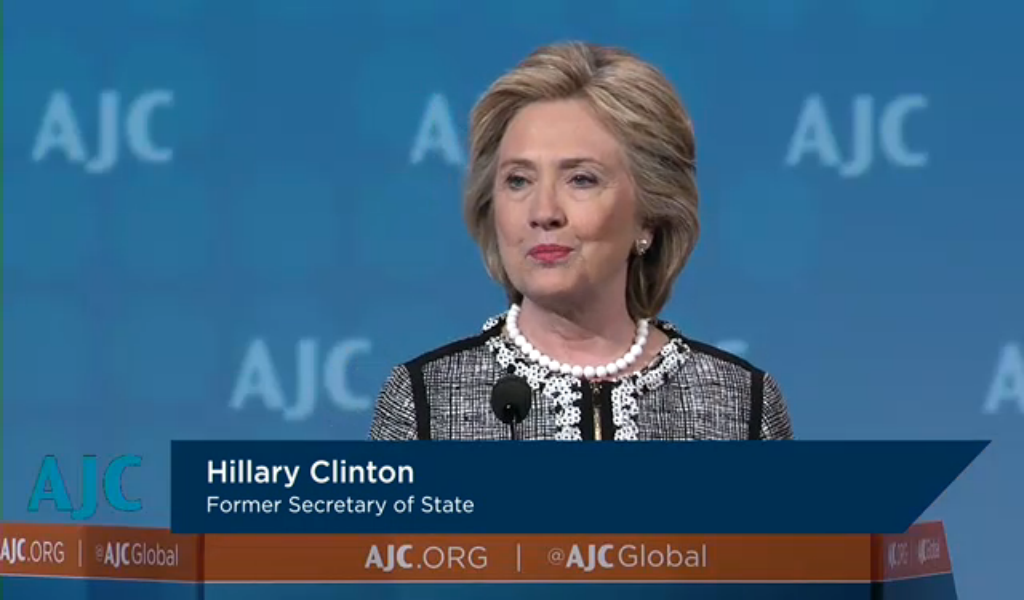
Remarks At the American Jewish Committee Annual Gala Dinner
Hillary Rodham Clinton
Secretary of State
Grand Hyatt Hotel
Washington, DC
April 29, 2010
SECRETARY CLINTON: Thank you all. Well, it is wonderful to be back here at the American Jewish Committee and I thank David for that introduction. What he was really trying to say was that it was very dull in Chappaqua before we came to town. (Laughter.) David is an extraordinary leader. He inspires your confidence and your trust and your affection, and I thank him for his decades of service to this important work.
I also want to thank Richard Sideman, Bob Elman, all the leaders and staff and members who make the American Jewish Committee a force for peace and progress here at home and around the world. And I am delighted – (applause) – yes, give yourselves a round of applause. (Applause.)
I am delighted to be here with three of my colleagues and three of my friends. Many of you know one or more of them, but it is a pleasure to be appearing before you with Minister Verhagen from the Netherlands, someone whom I have worked closely with over the last 15 months; Miguel Angel Moratinos, the very experienced foreign minister of Spain and someone who is just absolutely tireless in his efforts on behalf of his country and now as the holder of the presidency of the European Union as well; and my longtime friend Ehud Barak, who has had nearly as many incarnations in public service as I have. (Laughter and applause.) Ehud and I had a wonderful meeting the other day here in Washington and covered a lot of ground. And as friends do, much was said and much didn’t need to be said. So I’m delighted that he is here with us as well.
This organization for more than a century has been a voice for the aspirations of the Jewish people for a secure and democratic homeland. We saw the pictures flashing before us on the screen – the faces of those who have made Israel their home and those who have made America our home. You have fought for the core values that make this country great –equality and religious freedom, civil rights and women’s rights, a freer, fairer nation in which every child has the opportunity to live up to his or her God-given potential.
So let me first thank you, thank all of you, for everything you do on behalf of the United States of America and our ideals and values. Because at the core, our relationship with Israel is premised on those values. (Applause.)
There are so many ways that the American Jewish Committee has advanced and spoken to the enduring bond between the United States and Israel. AJC recognizes that we are two nations woven together with our stories, our stories of struggle and triumph, of hope and disappointment. We are beacons for pilgrims and people yearning to be free. We are lands built by immigrants and exiles, given life by democratic principles, and sustained by the service and sacrifice of generations of patriots. We have seen our cities and our citizens targeted by terrorists. And Americans and Israelis alike have met these threats with unyielding resolve.
For all of our similarities, though, we know that Israel faces unique challenges. A nation forced to defend itself at every turn, living under existential threat for decades. We Americans may never fully understand the implications of this history on the daily lives of Israelis – the worry that a mother feels watching a child board a school bus or a child watching a parent go off to work. But we know deep in our souls that we have an unshakable bond and we will always stand not just with the Government of Israel but with the people of Israel. (Applause.)
Since our first day in office, the Obama Administration has made the pursuit of peace and secure and recognized borders for Israel a priority because that is, we believe, the best way to safeguard Israel’s long-term future as a democratic Jewish state. (Applause.) As President Obama has said, a strong and secure Israel – and an Israel at peace with its neighbors – is critical not only to the interests of Israelis and Palestinians, but vital to our own strategic interests.
That is why the United States is fighting against anti-Semitism in international institutions – our special envoy for anti-Semitism is traveling the world as we speak, raising the issue at the highest levels of countries from one end of the world to the next. It is why we led the boycott of the Durban Conference. (Applause.) It is why we repeatedly and vigorously voted against and spoke out against the Goldstone Report. (Applause.) And it is why we have worked to ensure Israel’s qualitative military edge, providing nearly $3 billion in annual military assistance. When I became Secretary of State, I asked my longtime defense and foreign policy advisor from my years in the Senate, Andrew Shapiro, to personally manage our defense consultations with Israel. And today, I am proud to say our partnership is broader, deeper, and more intense than ever before. (Applause.)
So our commitment to, and our belief in and our interest in, a strong and secure Israel is also why the President and I asked Senator George Mitchell to serve as our Special Envoy for Middle East Peace. He is working toward the goal of restarting good-faith negotiations between the parties and moving toward an outcome of two states, living side by side in peace and security, with a comprehensive regional peace that brings an end to the conflict between Israel and Syria, and Israel and Lebanon, and normal relations between Israel and all the Arab states. (Applause.)
President Obama noted recently that there has been some of what he called “noise and distortion” about this Administration’s approach in the Middle East. Over the past month, we have attempted to remove any ambiguity. The President and this Administration have repeatedly reaffirmed our commitment to Israel’s security in word and in deed.
And last month at AIPAC’s national conference, I spoke about the challenge that continuing conflict poses to Israel’s future as a Jewish and democratic state. How dynamics of ideology, technology, and demography make the status quo unsustainable for the long term and make the pursuit of peace a necessity. And two weeks ago at the Daniel Abraham Center for Middle East Peace, I highlighted the urgency of the struggle between those in the region, especially in the Palestinian territories, who seek peace and progress and those who seek to perpetuate conflict.
Well, tonight I want to focus on the regional threats to Israel’s security and the imperative of reaching a comprehensive regional peace that will help defuse those threats. Because without a comprehensive regional peace, the Middle East will never unlock its full potential, and Israel will never be truly secure. Pursuing peace between Israel and the Palestinians, and Israel and its neighbors can be a mutually reinforcing process, and today it is more essential than ever to make progress on all tracks.
Israel is confronting some of the toughest challenges in her history, in a region where too many still reject Israel’s right to exist.
Israelis have always guarded their borders vigilantly. But because of the ever-evolving technology of war, Israeli families now face dangers from far beyond their borders. Hamas and Hezbollah continue to trumpet the false and intolerable claim that a Palestinian state can somehow be achieved someday through violence. They have stockpiled tens of thousands of increasingly sophisticated rockets in Gaza and southern Lebanon – rockets they aim at Israeli homes and civilians. Now Hamas has circulated a hateful video mocking the family of Gilad Shalit. It is cruel and it is an outrage. And in the face of this inhumanity, we say again, as we have many times before: Gilad Shalit must be released immediately and returned to his family. (Applause.)
We have spoken out forcefully about the grave dangers of Syria's transfer of weapons to Hezbollah. We condemn this in the strongest possible terms and have expressed our concerns directly to the Syrian Government. Transferring weapons to these terrorists – especially longer-range missiles – would pose a serious threat to the security of Israel. It would have a profoundly destabilizing effect on the region. And it would absolutely violate UN Security Council Resolution 1701, which bans the unauthorized importation of any weapons into Lebanon.
We do not accept such provocative and destabilizing behavior – nor should the international community. President Assad is making decisions that could mean war or peace for the region. We know he's hearing from Iran, Hezbollah, and Hamas. It is crucial that he also hear directly from us, so that the potential consequences of his actions are clear. That’s why we are sending an ambassador back to Syria. There should be no mistake, either in Damascus or anywhere else: The United States is not reengaging with Syria as a reward or a concession. Engagement is a tool that can give us added leverage and insight, and a greater ability to convey strong and unmistakably clear messages aimed at Syria’s leadership. (Applause.)
Iran, with its anti-Semitic president and hostile nuclear ambitions, also continues to threaten Israel, but it also threatens the region and it sponsors terrorism against many. The United States has worked with the international community to present the leaders in Tehran with a clear choice: Uphold your international obligations and reap the benefits of normal relations, or face increased isolation and painful consequences. At every turn, Iran has met our outstretched hand with a clenched fist. But our engagement has helped build a growing global consensus on the need to pressure Iran’s leaders to change course. We are now working with our partners at the United Nations to craft tough new sanctions. The United States is committed to pursuing this diplomatic path. But we will not compromise our commitment to preventing Iran from developing nuclear weapons. (Applause.)
So these threats to Israel’s security are real, they are growing, and they must be addressed. And we are working closely with our Israeli partners to do so.
The United States continues to support the development of Israeli air and missile defense systems, including the Arrow Weapon System for long-range ballistic missile threats and David’s Sling for short-range ballistic missiles. We first deployed Patriots to Israel during the Gulf War. And today we are working with Israel to upgrade its Patriots. We have also deployed an advanced radar system to provide early warning of incoming missiles. The Obama Administration is committed to ensuring that Israel has all of the tools it needs to protect and defend itself.
I have spoken with families whose homes are threatened by rockets. People who live according to the wail of bomb alerts and sirens. I have met with the victims of terrorism. In their hospital rooms I’ve held their hands, I’ve listened to the doctors describe the shrapnel lodged in a leg, an arm, or a head. Guaranteeing Israel’s security is more than a policy position for me; it is a personal commitment. (Applause.)
I know you share this commitment. You feel it at your core. And all of us who are dedicated to Israel’s future must recognize that a comprehensive regional peace that isolates the terrorists, ends the conflicts with Israel’s neighbors, brings normal relations with all the Arab states is far better than any missile shield or defensive battery.
Regional peace must begin with the recognition by every party that the United States will always stand behind Israel’s security and, as President Obama put it recently, “no wedge will be driven between us. Now, we will have our differences, but when we do, we will work to resolve them as close allies.” (Applause.) Israel’s right to exist, and to defend itself, is not negotiable. (Applause.) And no lasting peace will be possible unless that fact is accepted.
But similarly, Palestinians must have a state of their own. They must be able to travel, conduct business, govern themselves, and enjoy the dignity of a sovereign people. (Applause.) There can be no equivocating on this either.
And the only way to achieve a two-state solution is through negotiations between Israelis and Palestinians. So we will do everything we can to support such negotiations. We are literally working around the clock to move forward with proximity talks, which we hope then will set the stage for a resumption of direct negotiations on all permanent status issues as soon as possible.
We believe that through good-faith negotiations the parties can agree to an outcome which ends the conflict and reconciles the Palestinian goal of an independent and viable state based on the ‘67 lines, with agreed swaps, and Israel’s goal of a Jewish state with secure and recognized borders that reflect subsequent developments and meet Israel’s security requirements. (Applause.)
The United States recognizes that Jerusalem is a deeply, profoundly, important issue for Israelis and Palestinians, for Jews, Muslims, and Christians. And we believe that through good-faith negotiations the parties can agree on an outcome that realizes the aspirations of both parties for Jerusalem and safeguards its status for people around the world.
Now, simultaneously moving toward a broader regional peace will help set the conditions for that outcome. As I’ve said, these are mutually reinforcing tracks.
But this will not be easy – and I recognize the frustration after years of false starts and failed hopes. But peace is possible. Think back. In 1978, after years of conflict, Egypt and Israel put away their guns and they made a peace that has stood the test of time. And in 1994, I watched as King Hussein of Jordan and Prime Minister Rabin of Israel signed a treaty in the desert that effectively ended decades of war.
These were clear-eyed, realistic, hard-headed leaders who recognized that war would not serve their nations’ long-term interests and brought their people along. As Yitzhak Rabin said on that blistering hot afternoon, “Leaders should clear the path, should show the way, but the road itself must be paved by both peoples.” The peace they made that day has held. As has the peace of Sadat and Begin. Israel, Egypt, and Jordan are all better off – and the goal of a comprehensive peace more likely as a result.
For the Arab states, pursuing peace with Israel is the best way to help achieve the goal of an independent Palestinian state. For everyone who proclaims their support of the legitimate aspirations of the Palestinian people, who cares more about the results than the rhetoric, there is no other path.
Around the world, people who have never been to Israel and never met a Palestinian are waiting for an end to the conflict in the Middle East. When I traveled the world as a First Lady, in a time of hope for the peace process, it was rare to hear people in places far from the region even mention the issue. But now, I have to tell you, wherever I go, it invariably is the first, second, or third concern on every agenda. And in every country, my answer is the same: Become part of the solution. Support the peacemakers and condemn the rejectionists. Invest with those who seek to build credible institutions and find common ground. Close your doors to those who traffic in violence and hate. All of us who care about the future have a responsibility to help shape it. (Applause.)
Because as Yitzhak Rabin said, ultimately, the leaders and the people of the region must provide the vision for peace and the will to realize it. The Arab Peace Initiative offers such a vision, a vision of a better future for all of the people of the Middle East. It rests on the bargain that peace between the Israelis and Palestinians will bring recognition and normalization from the Arab states. It is time to advance this proposal with actions, not just words.
We do not expect the Arab states to move forward in a vacuum. Israel must do its part by respecting the legitimate aspirations of the Palestinian people, stopping settlement activity, addressing the humanitarian needs in Gaza, and supporting the institution-building efforts of the Palestinian Authority.
And Palestinians must continue their efforts to take responsibility and accountability for security in the West Bank. They must be vigilant in their work to stop incitement and prevent violence and terror. And they must press forward with the institutional and economic reforms under President Abbas and Prime Minister Fayyad’s leadership, which we support.
And both sides should refrain from unilateral statements and actions that could undermine trust or prejudge – or appear to prejudge – the outcome of negotiations.
So we will continue to emphasize the responsibilities of Israelis and Palestinians, who must ultimately themselves negotiate a two-state solution. But there are also clear expectations of the Arab states. They have an interest in a stable and secure region. And they should take steps that show Israelis, Palestinians, and their own people that peace is possible and there will be tangible benefits if it is achieved.
First, all states must stop supplying weapons to terrorist groups such as Hezbollah and Hamas. (Applause.) Every rocket smuggled into southern Lebanon or Gaza sets back the cause of peace.
Second, the Arab states can and should continue to provide President Abbas with the support he needs to negotiate in good faith with Israel.
Third, they could do more to support the Palestinian Authority budget and its two-year development plan. The long-term success of President Abbas and Prime Minister Fayyad’s efforts to build the institutions of a future Palestinian state depend on a larger, steadier, and more predictable source of financial support from the international community. The United States has done our part – (applause). We have become the Palestinian Authority’s largest bilateral donor, and Europe also has stepped up to help. Arab states need to share a greater portion of these responsibilities. (Applause.) The two-year plan to build a Palestinian state that provides security, good governance, and economic opportunities is an essential investment in the future and a necessary foundation for peace and security.
Fourth, as negotiations proceed between the Israelis and the Palestinians, and mutual confidence increases, Arab states should reach out to the Israeli public, demonstrating that Israel’s isolation in the region is ending, and all states should resume multilateral discussions on critical regional issues. We would hope to see such concrete steps like the opening or reopening of commercial trade offices and interest sections, overflight rights, postal routes, and more people-to-people exchanges that build trust at the grassroots level. All the people of the region need concrete evidence of the benefits that peace will bring.
Because there are benefits. One durable multilateral partnership that grew out of the Oslo years is the Middle East Desalination Research Center. It brings together Arab states, the Palestinian Authority, and Israel to develop practical solutions to regional water challenges. Together, they are exploring new, greener production methods, including solar desalination, and working to reduce costs so more people across the region have access to fresh water. The United States and a number of our international partners are proud that we helped launch this project, and we appreciate the partnership of the American Jewish Committee in this effort. (Applause.) I understand that the director and deputy director of the Center are both here with us tonight. This project is an example of the shared dividends that cooperation can yield. It is proof that Israelis, Palestinians, and Arabs can put aside differences and work together.
Nearly a year ago in Cairo, President Obama called for a new spirit of partnership in the region and beyond, with broader engagement on education, economic development, health, science and technology. This week in Washington, the Administration hosted entrepreneurs, investors, civil society leaders and academics from more than 50 nations for a summit geared toward building those new partnerships.
Peace, both between Israel and the Palestinians and between Israel and her neighbors, will take us one step closer to fulfilling that vision. It will open so many new avenues of cooperation, from conserving scarce natural resources to promoting broad-based and sustainable economic development to preventing the looming threat of a nuclear-armed Iran. There are so many common challenges and common interests that the people of this region share.
And perhaps most of all, the people deserve an end to the culture of fear and hostility that has dominated their lives for decades. Israelis deserve to live in a secure and democratic Jewish state. Palestinians deserve a state to call their own, with dignity and opportunity. A two-state solution coupled with a regional peace promises a future of prosperity. The status quo promises only more violence and failed aspirations.
The Obama Administration will continue making this case forcefully and frequently. We know we cannot and will not impose a solution. It is up to the parties themselves. (Applause.) They must negotiate, compromise, and ultimately resolve this conflict. (Applause.) That is the only path that leads to security and prosperity. But the United States is committed to being an active partner for peace every step of the way.
The American Jewish Committee has been such a partner for so many years, and I thank you for that. And I want you to know that we will be with you, those Americans and Israelis who believe in this future that I have described. And may God bless you, may God bless Israel, and may God bless the United States of America. (Applause.)