Addressing
the United Kingdom’s “Brexit” vote to leave the European Union for the
first time today, Hillary Clinton said that while many middle-class
Americans are frustrated, they “don’t want empty promises, they want
solutions”–and she is the one who can deliver those solutions as
President. Clinton promised she would work to create more good-paying
jobs by building an economy that works for everyone, not just those at
the top.
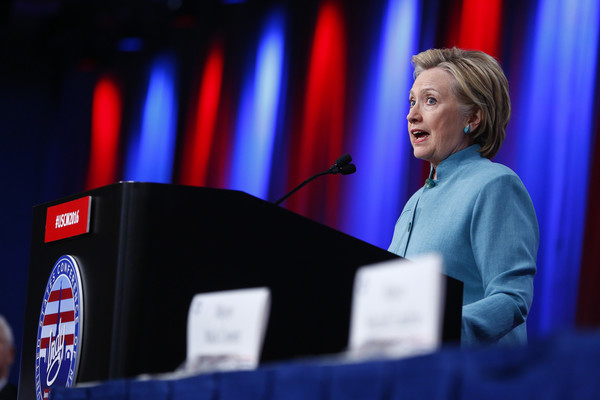
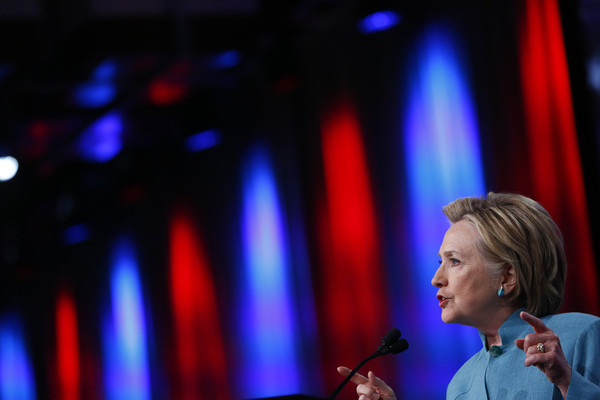
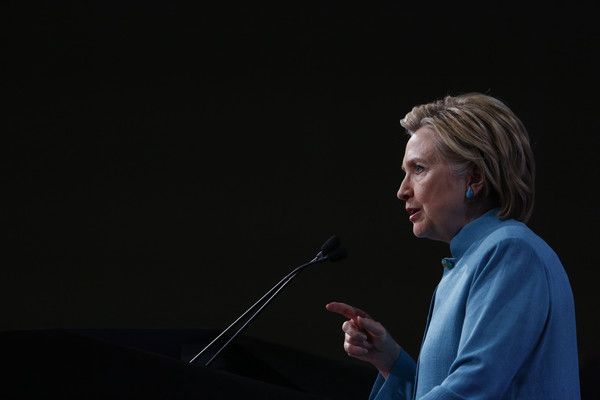
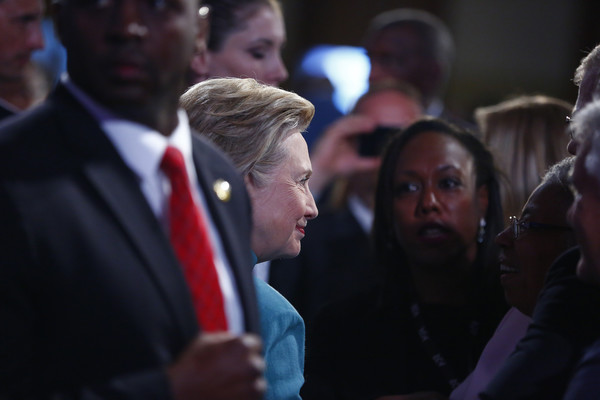
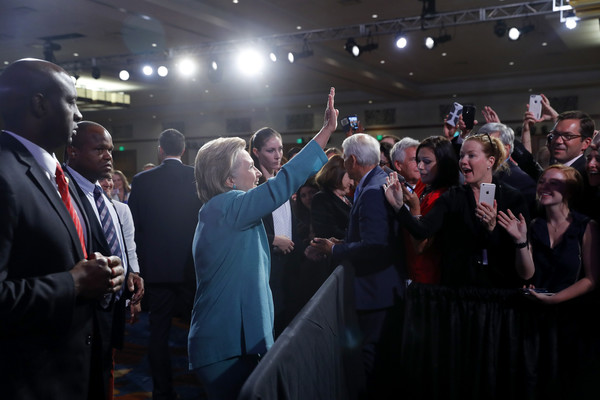
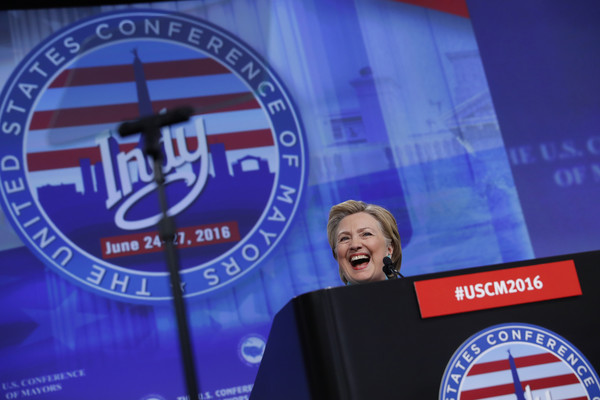
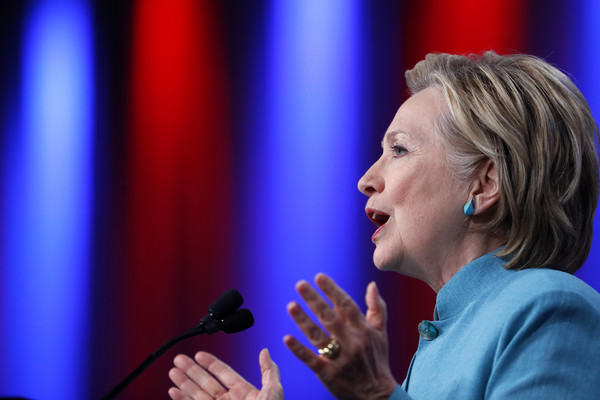
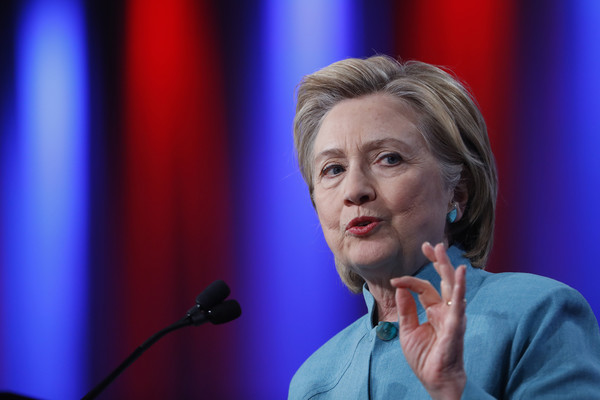
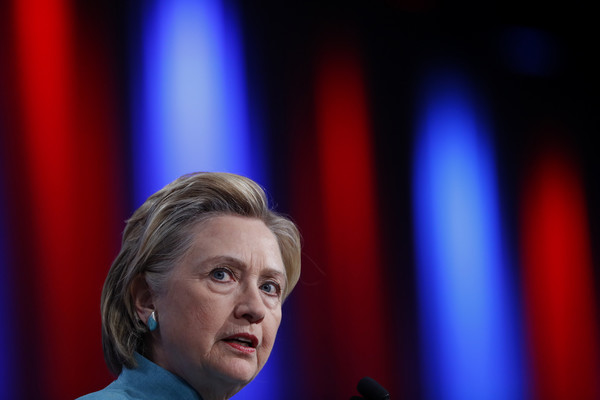
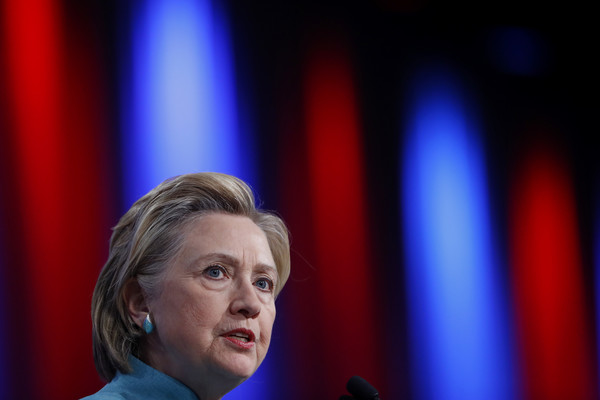
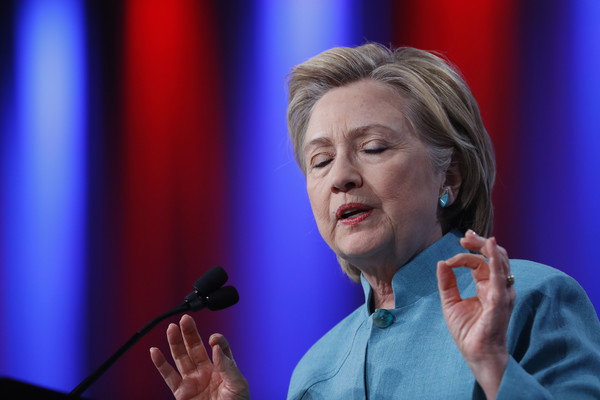
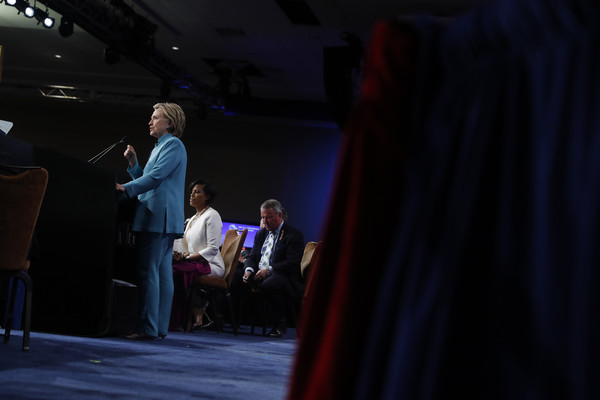
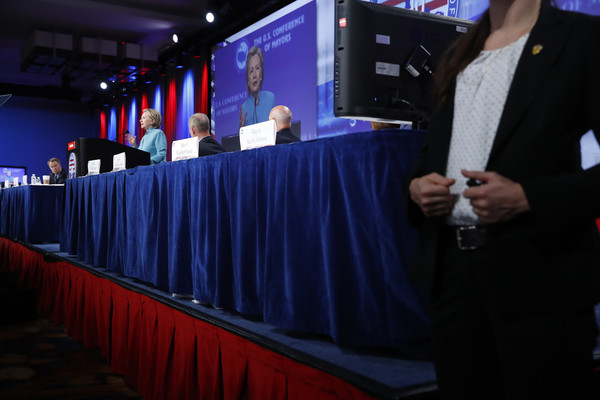
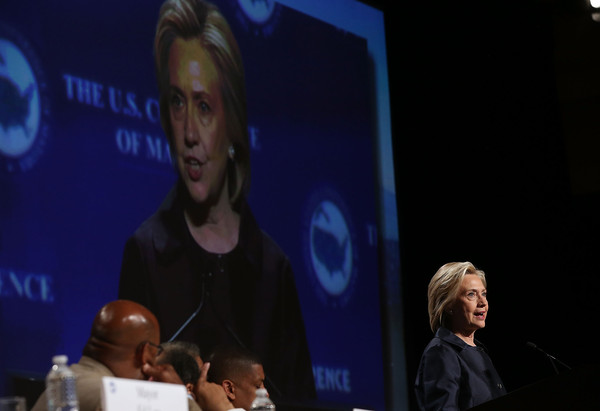
Speaking at the U.S. Conference of Mayors conference in
Indianapolis, Clinton also addressed Donald Trump’s response to the
“Brexit” vote, saying “steady, experienced leadership is so important at
times like these” and that “bombastic comments in turbulent times can
actually cause more turbulence.”
In her remarks, Clinton also reaffirmed her commitment to addressing the scourge of gun violence in our country. Clinton’s remarks, as transcribed, are below:
“Good
afternoon, everyone. Thank you so much. I am absolutely delighted to
be here with all of you, among so many friends. A lot of the mayors
here have been laboring in the vineyards of your cities and your states
and working to provide better lives for the people you represent, and
only America’s mayors could find a way to put Lady Gaga and the Dalai
Lama on the same program. I’m really impressed by that.
I want to
thank your president, Mayor Stephanie Rawlings-Blake, for her
leadership of this organization. It’s always great seeing a woman
serving as president. And I want to – I want to add a special word of
greeting. Stephanie told me that her mother, Dr. Rawlings, is here.
And I’m kind of partial to mothers showing up to see their even grownup
sons and daughters perform official functions with such grace and
dignity. So, Dr. Rawlings, congratulations to you as well.
And I
want to acknowledge your next president, Mayor Mick Cornett. And I have
followed with great interest a lot of your creative ideas in Oklahoma
City, and I really look forward to your leadership of this organization,
Mayor. And thanks to a longtime friend, the mayor of Indianapolis,
hosting us here. Thank you so much, Mayor Joe Hogsett. And Joe, as I’m
sure you have already realized, even though he is a relatively new
mayor, comes in with so much energy and ideas, and I thank you for your
leadership of this great American city.
Before I begin addressing
some of our common issues and challenges, I want to say a few words
about what we have seen happening in Britain. A lot of Americans woke
up on Friday to alarming headlines from across the Atlantic, and they are wondering what this decision in Britain means for us.
I’m
sure everyone in this room with retirement savings asked the same
question. In the day after the vote, Americans lost $100 billion from
our 401(k)s. Now, we are resilient, and we will bounce back from this
and from all of the other shocks that are in the system. But it is a
reminder that what happens around the world has consequences that can
hit home quickly and affect our lives and our livelihoods.
Our
priority now must be to protect American families and businesses from
the negative effects of this kind of tumult and uncertainty. And that’s
why steady, experienced leadership is so important at times like these.
We
need leaders like yourselves at the local and state and federal level,
who understand how to work with other leaders to manage risks; who
understand that bombastic comments in turbulent times can actually cause
more turbulence; and who put the interests of the American people ahead
of their personal business interests. And we need leaders who recognize
that our alliances and partnerships are among our greatest national
assets, now more than ever.
Working with our allies has been a
cornerstone of American foreign policy under Democrats and Republicans
alike, because it makes America safer and more prosperous. And it
should continue to guide us now. And we’ve got to be clear about this.
No one should be confused about America’s commitment to Europe – not an
autocrat in the Kremlin, not a presidential candidate on a Scottish
golf course.
We have to reaffirm that the United States and the
United Kingdom are different countries in many important ways –
economically, politically, demographically. But we still have a lot of
common interests and values. Just as we have seen there are many
frustrated people in Britain, we know there are frustrated people here
at home too. I’ve seen it, I’ve heard it, I know it. That’s why I’ve
worked hard to find solutions to the economic challenges we face. It’s
why I’ve put forward real plans to create good-paying jobs, raise wages,
reduce student debt, bring down costs for college and prescription
drugs, and so much else. People across America know that they don’t
want empty promises, they want solutions. And that is what, working
with you, I hope to offer to them.
Now, a big reason why our
economy isn’t working for everyone the way it should is because of
political dysfunction. We’ve got to get Washington working again. And
just as I’ve heard so many mayors over the years say, there’s not a
Republican or Democratic way to fix the streets or plow the snow or
create more economic opportunities. We do what works. We do what we
need to serve our people.
And that means the work you are doing
and in many ways the solutions you are pioneering in America’s cities
are even more important. We are all, and especially me, counting on
you, our mayors, to get stuff done. And that’s one of the reasons I
wanted to be here today.
It is a special personal honor to follow
to the podium a man who has shown extraordinary leadership in recent
weeks, Orlando Mayor Buddy Dyer. And like so many of you, I watched
those press conferences coming from Orlando, and I watched the mayor
being very collected, very clear about what was happening, what he knew,
what he didn’t know, but with an overriding message that his city, the
city that he loves and serves, would persevere. So Mayor Dyer, please
know that all of our hearts are with you, and with the LGBT and Latino
communities, the people of your city.
The attack in Orlando was
the worst mass shooting in American history. Sadly, several mayors here
today have had to respond to similar tragedies that included mass
shootings or, in your case, Mayor Cornett, a horrific bomb explosion.
When I was last with the mayors at the conference last year, it was just
days after the massacre in Charleston. There are more mass shootings
in the United States than in any other country in the world. It is not
even close. I do not think Americans are more violent, are worse human
beings. I believe we cannot accept this, not now and not ever.
As
Congressman John Lewis said a few days ago, ‘How many more mothers, how
many more fathers, need to shed tears of grief before we do something?’
No person should be gunned down while learning, teaching, praying, or
dancing. It is time for us to come together to strengthen our gun laws
and keep dangerous weapons out of the hands of dangerous people. And
here is what I know.
I know we can respect the Second Amendment
and make common-sense reforms. Yet Congress is paralyzed. Not a
filibuster in the Senate, not a sit-in in the House, could convince the
leadership to move forward. I really believe the American people
deserve better. In fact, every survey I’ve looked at shows that there
is a very big majority of Americans who favor this path, and a
considerable majority of gun owners who agree.
Now, of course it
is not just about guns. Leaders in Congress refuse to act on a wide
range of issues that really matter to American working families. Last
week’s split Supreme Court ruling on immigration could lead to the
tearing apart and deporting of millions of people, breaking up
families. It would not have happened, I don’t believe, if Congress had
done its job and passed comprehensive immigration reform. Remember, we
had a bipartisan bill that passed the Senate. The House leadership
would not let it come to the floor for a vote. I think it’s fair to say
they did not because they were playing to the loudest voices instead of
the most people because I believe it would have passed the House if
there had been a chance to vote on it.
We also know that in this
Senate, Senators have not done their job and held a hearing for Judge
Merrick Garland, President Obama’s nominee for the Supreme Court. And I
have no way of knowing how Judge Garland, who is highly qualified and,
before he was nominated for the Supreme Court, respected on both sides
of the aisle – I have no way of knowing how he would have voted. I
would not pretend to presume that. But we’ve never had a situation like
this where we lose a justice of the Supreme Court, where the President,
in my view, is obligated under our constitution to nominate a
successor, and where the Senate flat-out refuses even to hold a hearing
to consider. They could vote down Judge Garland. But instead, they
refuse to act.
I think that is part of what it driving the
frustration on the part of so many Americans. Let’s have a vote. We’re
a democracy. Either vote somebody up or vote somebody down. Either
vote on guns or vote them down. And contrast that with what you do every
day. Mayors show up. You do your job. The American people show up
and do their job. We should expect nothing less from the United States
Congress.
And I’m sure that many of you, regardless of party
affiliation – I know some are Republican, some are Democrats, and some
in your systems are nonpartisan, nonaffiliated – I’m sure many of you
are running out of patience. When you look to Washington from
predictability, for decisions, maybe smart investments in affordable
housing, schools, and transportation, you don’t get the help you seek.
Instead, like other Americans, you see grandstanding. You hear threats
to default on our nation’s debt or to shut down our government. Instead
of solving problems, Washington is too often making them worse.
Now,
make no mistake. There are still many passionate, committed people in
Congress fighting the good fight every day on both sides of the aisle. I
was providing to serve in the Senate for eight years. Some of that
time I was in the majority and some of that time I was in the minority.
But I got up every day looking for ways to work with my colleagues to
make something happen for the people I represented, and that was
especially important after 9/11, where I needed to make the case about
rebuilding New York, helping the families whose loved ones had been
murdered on that terrible day.
So I know that we can build
relationships and we can find common ground. I take inspiration from
those who get up every day in the Congress and keep working to solve
problems. They don’t get cynical and they don’t give up, just like
you. You’re on the front lines every day as well. And the people you
serve are more than just your voters. They’re your neighbors. You see
them in the supermarket. You see them when you worship. You see them
at your kids’ games. You see them. They tell you their problems and
their ideas, and they count on you to help move your city forward. You
can’t respond with a snarky tweet. You’ve actually got to deliver
results because you know you’re going to see them at the supermarket and
at your kids’ ball games and everywhere else in the city.
That’s
why more and more cities are where things are happening and getting
done, and I want to thank you. You are taking the lead in investing in
early childhood education, cutting carbon emissions to tackle climate
change, ending veteran homelessness, implementing innovative
transportation projects that connect affordable housing to job
opportunities, and so much more.
Some experts have actually said
this could be the decade of the city because our urban areas are growing
twice as fast as they were in the last decade. Cities are the major
reason why our country has come back from the worst financial crisis
since the Great Depression, with more than 14 million private sector
jobs created over the last six and a half years. So you know what we
have accomplished, and you know how much more we have to do.
Your
constituents are already working harder and longer just to keep their
heads above water. Too many of our urban neighborhoods are plagued by
poverty that persists from generation to generation. Communities of
color still face barriers of systemic racism. Wages are still too low,
and inequality is too great. Jobs in many parts of our country are
booming, and in other parts they are still too hard to come by. So
these challenges are serious, but you give me hope that together we can
overcome them. I believe with all my heart that our nation is at our
best when we are rising together, when those who have been left out and
left behind get a fair chance to lift themselves up. And that’s when
communities, cities, and regions grow stronger, and our entire country
is better off.
Last week in North Carolina I laid out a five-step
plan to build an economy that works for everyone, not just those at the
top. First, within my first 100 days as president, I will work with
both parties to pass the biggest investment in job creation since World
War II. This will be particularly important for America’s cities.
Second, let’s make college debt-free for all and transform the way we
prepare Americans for the jobs for the future. Third, let’s rewrite the
rules so more companies share profits with employees and fewer ship
profits and jobs overseas. And fourth, let’s make sure Wall Street
corporations and the super-rich pay their fair share of taxes. And
fifth, let’s put families first and match our policies to how families
actually live and work in the 21st century.
Focusing for a minute
on jobs, I have this old-fashioned belief: Anyone willing to work hard
in America should be able to find a good job that pays enough to support
a middle class life, and a job that provides dignity and pride. So the
heart of my plan will be a big commitment to infrastructure. And the
public investment will be aided by a new National Infrastructure Bank
that will bring private sector dollars off the sidelines and be put to
work in rebuilding America. We’re going to set some big, ambitious
goals.
I have to say when I was growing up, one of the things that
my parents just drilled in me was not only loving my country, but that
we could do anything we set our minds to. Anything, because we were
Americans. Well, let’s set some goals again, and let’s hold each other
accountable for achieving them, like connecting every household to
broadband by the year 2020. If you have, like I have, traveled across
our country, you know there is a digital divide. You know there’s even a
cell telephone divide. You know that there are kids going to school
and small businesses struggling to succeed who do not have a fast
connection to broadband, and they are being shut out of the global
marketplace.
Let’s set a goal to build a cleaner, more resilient
power grid with enough renewable energy to power every home in America.
And I feel strongly about this because some country will be the 21st
century clean energy superpower. We invent most of the technologies and
products, but if we don’t have a plan and set these goals, it’s more
likely to be China or Germany than […] It needs to be us. We need to
have a public-private partnership to succeed.
We’re also going to
invest in public transit; fix failing water systems like the one that
poisoned children in Flint – renovate our public schools so every child
in every community has access to safe, high-tech classrooms,
laboratories, and libraries.
I used to have the ‘Chelsea test’
when I was First Lady of Arkansas, and then when I was First Lady of the
United States. And I would go into schools around our country and the
first thing I would think is, ‘Is this a school,’ just by looking at it
and meeting the staff, ‘that I would send Chelsea to?’ Now I’ve got the
Charlotte and Aidan test. My new – my granddaughter and grandson. And
I’m asking the same question: Is this a school that I would send – and
you know, a lot of public schools, the answer was a resounding yes; in a
lot of them, no. Schools that were literally falling down, filled with
mold, no books in the library – which I actually saw myself.
So
when we want to live up to what we all say about our next generation,
our children are really the treasure of our country, we need to pay
attention to where they spend most of their waking hours, and what kind
of message that sends to them and their families.
Now, investments
like these will help your cities unlock more economic potential and
compete in the increasingly competitive global marketplace. So our goal
should be full employment in a full-potential economy. And that means
we have to make sure the good new jobs of the future reach the
neighborhoods that need them the most – from urban cities to rural
areas.
We’re going to have to target billions of dollars to help
young people in underserved communities find a job, maybe a first job,
because in the absence of that first job, getting them into the
workplace is really difficult. They need the attitudes of what goes
with a good work ethic as well as the skills and the preparation, so
that they can start to build financial stability, gain those skills, the
confidence, and the experience to build and pursue their own career.
We
need to direct billions of dollars to support small businesses in
hard-hit communities where investment is scarce, so entrepreneurs have a
real chance to turn their ideas into growing enterprises that will put
people to work. After all, most of the new jobs – two-thirds of them –
will come from small businesses. And right now, we are falling backward
in the creation of small businesses because we don’t have the credit,
the access to credit, that we used to. It hasn’t come back after the
Great Recession. And we need to do more to help people start those
businesses and succeed.
And we need to focus on second chance
reentry programs so that people returning from prison have a fair chance
to reestablish their lives and strengthen their communities.
Now,
there are some programs that I will shamelessly borrow from. For
example, we need to push for initiatives like an expanded New Markets
Tax Credit program – something that my husband introduced on a
bipartisan basis toward the end of his second term. And everywhere I go
across the country, I see projects, I see revitalization because of the
New Markets Tax Credits. I want us to explore Jim Clyburn’s,
Congressman Jim Clyburn’s 10-20-30 plan to direct more federal
investment into underserved areas – those neighborhoods where we have
generational poverty that need extra help to be able to get themselves
up and going. And I want us to be measured by how much incomes rise for
hardworking families, not how much higher CEO bonuses can go. We’ve
been on that path, and now we need to move toward really investing in
everybody again.
I want to see how many children climb out of
poverty, how many urban communities can give their residents a better
future. I think that’s what it means to have an economy that works for
everyone, not just those at the top.
Now, to make this happen,
there’s no question we’ve got to get Washington to work much better, and
that starts with getting unaccountable money out of politics. We’ve
got to take –we’ve got to take on Citizens United and get rid of the
secret money that is rigging the system.
Now, I think it’s fair to
say many of you in city and state elections run under tighter
regulations, or at least disclosures, than we now do on the federal
side. I don’t say this as a Democrat, I say this as an American: I
think we are really skating on thin ice. It’s getting to the point
where we have no idea where money is coming from. It’s not being
disclosed. It could be foreign government money. It could be criminal
cartel money. You don’t have to say; we’ll never know.
So this is
about how we make government work and restore confidence and trust in
it. And I think it will clear the way to actually get something done.
If you look around at the people here, both of the sides of the
political divide came together to create the bipartisan ‘Mayor’s Compact
for a Better America’ plan. That’s the kind of cooperation we want to
see more of, across the board.
And I can imagine that some of our
Republican friends here today may have questions about whether you can
really work with a Democrat or work with me personally. Now, we will
disagree. I disagree with some of my Democratic friends. But I think
there’s much more we can agree on. And for me, as someone who worked
across the aisle as First Lady, as Senator, as Secretary of State, I
know we can’t get big things done unless we work together.
So I
intend to push for an agenda that I think would really help the people
of this country – our cities – and create economic opportunity, bring us
back together. But I will also always listen. I think that is a lost
art.
I want to gather people together and figure out how we’re
going to solve problems. It’s what I’ve always done. I helped create
the Children’s Health Insurance Program when I was First Lady, working
with senators and members of Congress on both sides. It now covers 8
million kids a year.
When I worked with Republicans and Democrats
and Independents across New York State, I knew and I said no political
party has a monopoly on good ideas. And the federal government doesn’t
either.
I want to give you the tools you need to get things done.
At last year’s conference, I talked about an approach we’re calling
‘flexible federalism,’ recognizing that the needs and opportunities in
each city differ from others. There is no one-size-fits-all solution.
We need to listen and respect one another.
That is why I will
never plan for you. I hope we will plan with you to respond to your
priorities to get more funding, whether it’s infrastructure or housing
or second chance programs, and then give you more flexibility, cutting
through all the silos in the federal government so you can make the most
use, as you see it, of these dollars.
So I have a very
old-fashioned idea that we do work better when we’re listening and
cooperating, and we do work better when we have the local level really
helping to lead the way, when we get a partnership not only between
federal, state and local governments, but between the private and the
not-for-profit sectors along with government.
So that is my hope.
That is what I am intent upon doing. It’s what I will talk about
during this election. It’s what I hope to do if I am so fortunate
enough to be your president. We are more effective when federal and
local governments see each other as allies, not adversaries. That’s why
I’m not just asking to be your president. I’m asking to be your
partner.
Now, I’ve heard there’s a running joke in this
organization, Tom, that my husband took office as a president but left
as a mayor, because he spent so much time with your predecessors and
actually some of you were there then. Well, I’m here to tell you I will
build on that.
Just like you have the backs of the people you
serve, I will have your backs every day. So be ready. I intend to be
calling you and asking you for advice, working with you nonstop,
visiting to see what you’ve done that works that we can bring to scale
and make available for others around our country.
And I want us
always to have an open line of communication. I’m excited by what we
can do together. Despite all of the griping and the gridlock, I’m
excited, because I think the time is ripe. I think people are tired of
the partisanship and the extreme scapegoating and finger-pointing. And I
think we all enter public service because we want to get things done.
That is my hope and that is my promise to you.
You deserve a
president who gets that – who recognizes all the good work you’re doing
in your cities and who sees our cities as proof that America’s best days
are still ahead of us. There is no challenge too great and no barrier
too high for us to overcome together.
Thank you all very, very much.”
At the U.S.
Conference of Mayors 83rd Annual Meeting as in San Francisco, Saturday,
Hillary addressed specifically the tragic attack on congregants at the
Mother Emmanuel A.M.E. Church in Charleston and generally the problem of
racism in the U.S. She sent out this email
As a mother, a grandmother, and a human being, my heart is bursting for the people of Charleston.
Once again, bodies are being carried out of a black church. Once again, racist rhetoric has metastasized into racist violence.
This
is a history we wanted so desperately to leave behind, but we can’t
hide from hard truths about race and justice in America. We have to name
them, own them, and ultimately change them.
In America today,
blacks are nearly three times as likely as whites to be denied a
mortgage. Our schools are more segregated than they were in the 1960s.
Black children are 500 percent more likely to die from asthma than white
kids -- how can that be true?
We must address these issues as a
nation, and we must also address them as individuals. Cruel jokes can’t
go unchallenged, offhand comments about not wanting “those people” in
the neighborhood can’t be ignored, and news reports about poverty and
crime and discrimination can’t just evoke our sympathy -- even empathy
-- they must also spur us to action and prompt us to question our own
assumptions and privilege.
We have to embrace the humanity of
those around us, no matter what they look like, how they worship, or who
they love. Most of all, we have to teach our children to embrace that
humanity, too.
As all of us reeled from the news in Charleston, a
friend of mine shared his reflection on the hearts and values of those
men and women at Mother Emanuel:
“A dozen people gathered to pray.
They’re in their most intimate of communities and a stranger who
doesn’t look or dress like them joins in. They don’t judge, they just
welcome. During their last hour, nine people of faith welcomed a
stranger in prayer and fellowship.” “I was hungry and you gave me food, I was thirsty and you gave me drink, I was a stranger and you welcomed me.”
That’s
humanity at its best. That’s America at its best. And that’s the spirit
we need to nurture in our lives and our families and our communities.
Thank you,
Hillary
Here are her words.
Hillary Clinton: We can’t hide from hard truths on race
In
San Francisco, Hillary Clinton spoke at the 83rd Annual Meeting of the
United States Conference of Mayors on the need to address systemic
racism in the wake of the shooting in Charleston.
Thank you! Thank you all so much.
It’s
great to be here with all of you. I’m looking out at the audience and
seeing so many familiar faces, as well as those here up on the dais.
I want to thank Kevin for his introduction and his leadership of this organization.
Mayor Lee, thanks for having us in your beautiful city.
It
is for me a great treat to come back to address a group that, as you
just heard, I spent a lot of time as senator working with — in great
measure because of the need for buttressing Homeland Security, as well
as other challenges within our cities during the eight years I served in
the Senate.
And it was always
refreshing to come here because despite whatever was going on in
Congress or Washington with respect to partisanship, a conference of
mayors was truly like an oasis in the desert. I could come here and be
reminded of what Mayor LaGuardia said, “There’s no Republican or
Democratic way to pick up the garbage. You pick it up, or you don’t pick
it up.” And I loved being with people who understood that.
I’ve
learned over the years how important it is to work with city hall, to
try to make sure we are connected up as partners and to get whatever the
priorities of your people happen to be accomplished.
So it pays. It pays to work with you, and I am grateful to have this opportunity to come back and see you.
When
I was Senator from New York, I not only worked with the mayor of New
York City, of course, I worked with creative and committed mayors from
Buffalo to Rochester to Syracuse to Albany and so many other places.
And
I was particularly happy to do so because they were always full of
ideas and eager to work together to attract more high-paying jobs, to
revitalize downtowns, to support our first responders, to try to close
that skills gap.
And I want you to be
sure of this, whether you are a Democrat, a Republican or an
Independent: If I am president, America’s mayors will always have a
friend in the White House.
Now, as I was preparing to come here, I couldn’t help but think of some of those who aren’t with us today.
Tom Menino was a dear friend to me, and to many in this room, and I certainly feel his loss.
Today,
our thoughts are also with our friend Joe Riley and the people of
Charleston. Joe’s a good man and a great mayor, and his leadership has
been a bright light during such a dark time.
You
know, the passing of days has not dulled the pain or the shock of this
crime. Indeed, as we have gotten to know the faces and names and stories
of the victims, the pain has only deepened.
Nine faithful women and men, with families and passions and so much left to do.
As
a mother, a grandmother, a human being, my heart is bursting for them.
For these victims and their families. For a wounded community and a
wounded church. For our country struggling once again to make sense of
violence that is fundamentally senseless, and history we desperately
want to leave behind.
Yesterday was
Juneteenth, a day of liberation and deliverance. One-hundred and fifty
years ago, as news of President Lincoln’s Emancipation Proclamation
spread from town to town across the South, free men and women lifted
their voices in song and prayer.
Congregations long forced to worship underground, like the first Christians, joyfully resurrected their churches.
In Charleston, the African Methodist Episcopal Church took a new name: Emanuel. “God is with us.”
Faith has always seen this community through, and I know it will again.
Just
as earlier generations threw off the chains of slavery and then
segregation and Jim Crow, this generation will not be shackled by fear
and hate.
On Friday, one by one,
grieving parents and siblings stood up in court and looked at that young
man, who had taken so much from them, and said: “I forgive you.”
In its way, their act of mercy was more stunning than his act of cruelty.
It
reminded me of watching Nelson Mandela embrace his former jailers
because, he said, he didn’t want to be imprisoned twice, once by steel
and concrete, once by anger and bitterness.
In these moments of tragedy, many of us struggle with how to process the rush of emotions.
I’d
been in Charleston that day. I’d gone to a technical school, Trident
Tech. I had seen the joy, the confidence and optimism of young people
who were now serving apprenticeships with local businesses, Black,
white, Hispanic, Asian, every background. I listened to their stories, I
shook their hands, I saw the hope and the pride.
And then by the time I got to Las Vegas, I read the news.
Like many of you, I was so overcome: How to turn grief, confusion into purpose and action? But that’s what we have to do.
For
me and many others, one immediate response was to ask how it could be
possible that we as a nation still allow guns to fall into the hands of
people whose hearts are filled with hate.
You
can’t watch massacre after massacre and not come to the conclusion
that, as President Obama said, we must tackle this challenge with
urgency and conviction.
Now, I lived in
Arkansas and I represented Upstate New York. I know that gun ownership
is part of the fabric of a lot of law-abiding communities.
But
I also know that we can have common sense gun reforms that keep weapons
out of the hands of criminals and the violently unstable, while
respecting responsible gun owners.
What I
hope with all of my heart is that we work together to make this debate
less polarized, less inflamed by ideology, more informed by evidence, so
we can sit down across the table, across the aisle from one another,
and find ways to keep our communities safe while protecting
constitutional rights.
It makes no sense
that bipartisan legislation to require universal background checks
would fail in Congress, despite overwhelming public support.
It
makes no sense that we wouldn’t come together to keep guns out of the
hands of domestic abusers, or people suffering from mental illnesses,
even people on the terrorist watch list. That doesn’t make sense, and it
is a rebuke to this nation we love and care about.
The
President is right: The politics on this issue have been poisoned. But
we can’t give up. The stakes are too high. The costs are too dear.
And
I am not and will not be afraid to keep fighting for commonsense
reforms, and along with you, achieve those on behalf of all who have
been lost because of this senseless gun violence in our country.
But today, I stand before you because I know and you know there is a deeper challenge we face.
I
had the great privilege of representing America around the world. I was
so proud to share our example, our diversity, our openness, our
devotion to human rights and freedom. These qualities have drawn
generations of immigrants to our shores, and they inspire people still. I
have seen it with my own eyes.
And yet, bodies are once again being carried out of a Black church.
Once again, racist rhetoric has metastasized into racist violence.
Now,
it’s tempting, it is tempting to dismiss a tragedy like this as an
isolated incident, to believe that in today’s America, bigotry is
largely behind us, that institutionalized racism no longer exists.
But despite our best efforts and our highest hopes, America’s long struggle with race is far from finished.
I
know this is a difficult topic to talk about. I know that so many of us
hoped by electing our first Black president, we had turned the page on
this chapter in our history.
I know
there are truths we don’t like to say out loud or discuss with our
children. But we have to. That’s the only way we can possibly move
forward together.
Race remains a deep fault line in America. Millions of people of color still experience racism in their everyday lives.
Here are some facts.
In America today, Blacks are nearly three times as likely as whites to be denied a mortgage.
In 2013, the median wealth of Black families was around $11,000. For white families, it was more than $134,000.
Nearly
half of all Black families have lived in poor neighborhoods for at
least two generations, compared to just 7 percent of white families.
African
American men are far more likely to be stopped and searched by police,
charged with crimes, and sentenced to longer prison terms than white
men, 10 percent longer for the same crimes in the federal system.
In America today, our schools are more segregated than they were in the 1960s.
How
can any of that be true? How can it be true that Black children are 500
percent more likely to die from asthma than white kids? Five hundred
percent!
More than a half century after
Dr. King marched and Rosa Parks sat and John Lewis bled, after the Civil
Rights Act and the Voting Rights Act and so much else, how can any of
these things be true? But they are.
And
our problem is not all kooks and Klansman. It’s also in the cruel joke
that goes unchallenged. It’s in the off-hand comments about not wanting
“those people” in the neighborhood.
Let’s
be honest: For a lot of well-meaning, open-minded white people, the
sight of a young Black man in a hoodie still evokes a twinge of fear.
And news reports about poverty and crime and discrimination evoke
sympathy, even empathy, but too rarely do they spur us to action or
prompt us to question our own assumptions and privilege.
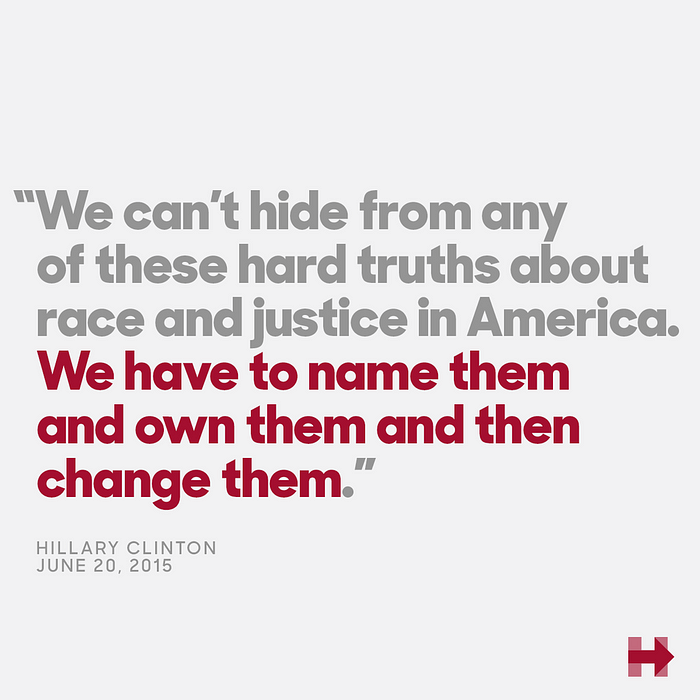
We
can’t hide from any of these hard truths about race and justice in
America. We have to name them and own them and then change them.
You
may have heard about a woman in North Carolina named Debbie Dills.
She’s the one who spotted Dylann Roof’s car on the highway. She could
have gone on about her business. She could have looked to her own
safety. But that’s not what she did. She called the police and then she
followed that car for more than 30 miles.
As
Congressman Jim Clyburn said the other day, “There may be a lot of
Dylann Roofs in the world, but there are a lot of Debbie Dills too. She
didn’t remain silent.”
Well, neither can
we. We all have a role to play in building a more tolerant, inclusive
society, what I once called “a village,” where there is a place for
everyone.
You know, we Americans may
differ and bicker and stumble and fall, but we are at our best when we
pick each other up, when we have each other’s back.
Like
any family, our American family is strongest when we cherish what we
have in common, and fight back against those who would drive us apart.
Mayors
are on the front lines in so many ways. We look to you for leadership
in time of crisis. We look to you every day to bring people together to
build stronger communities.
Many mayors
are part of the U.S. Coalition of Cities against Racism and
Discrimination, launched by this conference in 2013. I know you’re
making reforms in your own communities, promoting tolerance in schools,
smoothing the integration of immigrants, creating economic
opportunities.
Mayors across the country also are doing all they can to prevent gun violence and keep our streets and neighborhoods safe.
And
that’s not all. Across our country, there is so much that is working.
It’s easy to forget that when you watch or read the news. In cities and
towns from coast to coast, we are seeing incredible innovation. Mayors
are delivering results with what Franklin Roosevelt called bold and
persistent experimentation.
Here in San
Francisco, Mayor Lee is expanding a workforce training program for
residents of public housing, helping people find jobs who might have
spent time in prison or lost their driver’s license or fallen behind in
child support payments.
South of here in
Los Angeles and north in Seattle, city governments are raising the
minimum wage so more people who work hard can get ahead and support
their families.
In Philadelphia, Mayor
Nutter is pioneering a new approach to community policing to rebuild
trust and respect between law enforcement and communities of color.
In
Houston, Louisville and Chicago, the mayors are finding new ways to
help workers train and compete for jobs in advanced industries.
Cities like Cleveland and Lexington are linking up their universities and their factories to spur a revival of manufacturing.
In Denver and Detroit, city leaders are getting creative about how they raise funds for building and repairing mass transit.
Providence
is helping parents learn how to become their children’s first teachers,
and spend more time reading, talking, and singing to their babies at
critical stages of early brain development.
Kevin
Johnson, who has led both Sacramento and this conference so ably, calls
this renaissance of urban innovation “Cities 3.0,” and talks about
“open-source leadership” and mayors as pragmatic problem-solvers.
That’s what we need more of in America.
And
Kevin is right, we need to reimagine the relationship between the
federal government and our metropolitan areas. Top-down,
one-size-fits-all solutions rarely work.
We
need what I’ll call a new Flexible Federalism that empowers and
connects communities, leverages their unique advantages, adapts to
changing circumstances. And I look forward to working with all of you to
turn this vision into a reality.
I’ve put Four Fights at the center of my campaign:
First, to build an economy for tomorrow not yesterday;
Second, to strengthen America’s families, the foundation of everything we are;
Third, to harness all of our power, our smarts, and our values to continue to lead the world;
And fourth, to revitalize our democracy back here at home.
Mayors
are vital for all four of these efforts. You know what it takes to make
government actually work, and you know it can make a real difference in
people’s lives.
But you also know that
government alone does not have the answers we seek. If we are going to
re-stitch the fraying fabric of our communities, all Americans are going
to have to step up. There are laws we should pass and programs we
should fund and fights we should wage and win.
But
so much of the real work is going to come around kitchen tables and
over bedtime stories, around office watercoolers and in factory break
rooms, at quiet moments in school and at work, in honest conversations
between parents and children, between friends and neighbors.
Because
fundamentally, this is about the habits of our hearts, how we treat
each other, how we learn to see the humanity in those around us, no
matter what they look like, how they worship, or who they love. Most of
all, it’s about how we teach our children to see that humanity too.
Andy Young is here, and I want to tell a story about him because I think it’s as timely today as it was all those years ago.
You
know, at the end of the 1950s the South was beginning to find its way
into the modern economy. It wasn’t easy. There were determined leaders
in both government and business that wanted to raise the standard of
living and recruit businesses, make life better.
When
the closing of Central High School in Little Rock happened, and
President Eisenhower had to send in federal troops to keep peace, that
sent a message of urgency but also opportunity.
I
remember Andy coming to Little Rock some years later, and saying that
in Atlanta when folks saw what was going on in Little Rock and saw some
of the continuing resistance to enforcing civil rights laws, opening up
closed doors, creating the chance for Blacks and whites to study
together, to work together, to live together, Atlanta made a different
decision.
The leadership of Atlanta came
together, looked out across the South and said, “Some place in the
South is really going to make it big. We need to be that place.” And
they adopted a slogan, “the city too busy to hate.”
Well,
we need to be cities, states and a country too busy to hate. We need to
get about the work of tearing down the barriers and the obstacles, roll
up our sleeves together, look at what’s working across our country, and
then share it and scale it.
As all of
us reeled from the news in Charleston this past week, a friend of mine
shared this observation with a number of us. Think about the hearts and
values of those men and women of Mother Emanuel, he said.
“A
dozen people gathered to pray. They’re in their most intimate of
communities and a stranger who doesn’t look or dress like them joins in.
They don’t judge. They don’t question. They don’t reject. They just
welcome. If he’s there, he must need something: prayer, love, community,
something. During their last hour, nine people of faith welcomed a
stranger in prayer and fellowship.”
For
those of us who are Christians, we remember the words of the scripture:
“I was hungry and you gave me food. I was thirsty and you gave me drink.
I was a stranger and you welcomed me.”
That’s
humanity at its best. That’s also America at its best. And that’s the
spirit we need to nurture our lives and our families and our
communities.
I know it’s not usual for
somebody running for president to say what we need more of in this
country is love and kindness. But that’s exactly what we need more of.
We need to be not only too busy to hate but too caring, too loving to ignore, to walk away, to give up.
Part
of the reason I’m running for president is I love this country. I am so
grateful for each and every blessing and opportunity I’ve been given.
I
did not pick my parents. I did not decide before I arrived that I would
live in a middle class family in the middle of America, be given the
opportunity to go to good public schools with dedicated teachers and a
community that supported me and all of the other kids.
I came of age at a time when barriers were falling for women, another benefit.
I came of age as the Civil Rights movement was beginning to not only change laws but change hearts.
I’ve
seen the expansion of not just rights but opportunities to so many of
our fellow men and women who had been left out and left behind.
But we have unfinished business. And I am absolutely confident and optimistic we can get that done.
I
stand here ready to work with each and every one of you to support your
efforts, to stand with you, to put the task of moving beyond the past
at the head of our national agenda. I’m excited about what we can
accomplish together.
I thank you for what you’ve already done and I look forward to all that you will be doing in the future.
Thank you. God bless you, and God bless America.
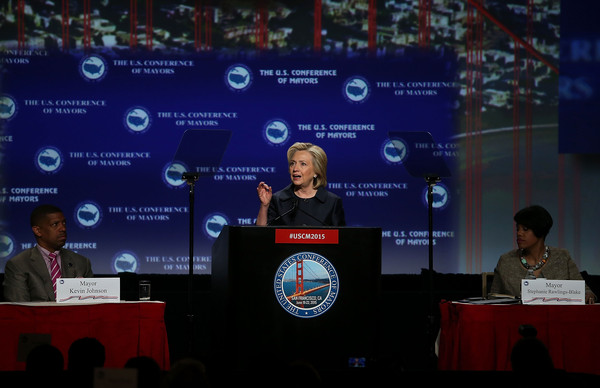
Sacramento,
Calif. Mayor Kevin Johnson takes a photograph as Democratic
presidential candidate Hillary Rodham Clinton speaks at the U.S.
Conference of Mayors 83rd Annual Meeting as in San Francisco, Saturday,
June 20, 2015. (AP Photo/Mathew Sumner)
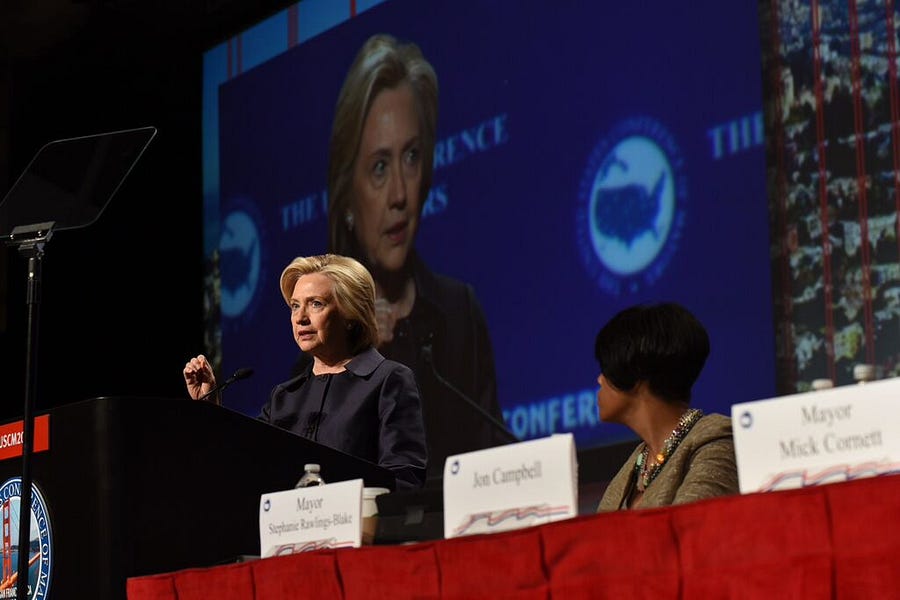
Democratic
presidential candidate Hillary Rodham Clinton talks with Baltimore
MayorStephanie Rawlings-Blake at the U.S. Conference of Mayors 83rd
Annual Meeting in San Francisco, Saturday, June 20, 2015. (AP
Photo/Mathew Sumner)
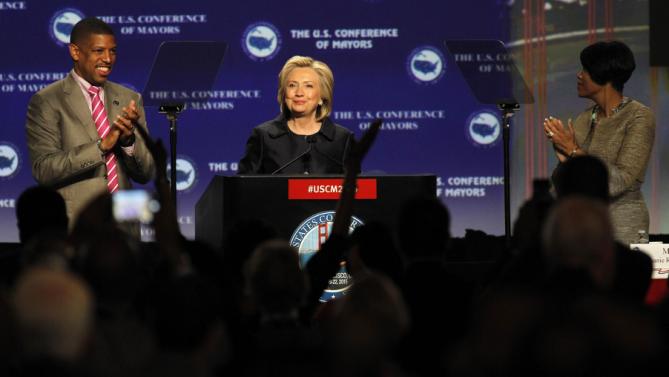
Democratic
presidential candidate Hillary Rodham Clinton is applauded by US
Conference of Mayors President, Sacramento, Calif. Mayor Kevin Johnson,
left, and Conference Vice President, Baltimore Mayor Stephanie
Rawlings-Blake, Saturday June 20, 2015, at the U.S. Conference of Mayors
83rd Annual Meeting in San Francisco. (AP Photo/Mathew Sumner)
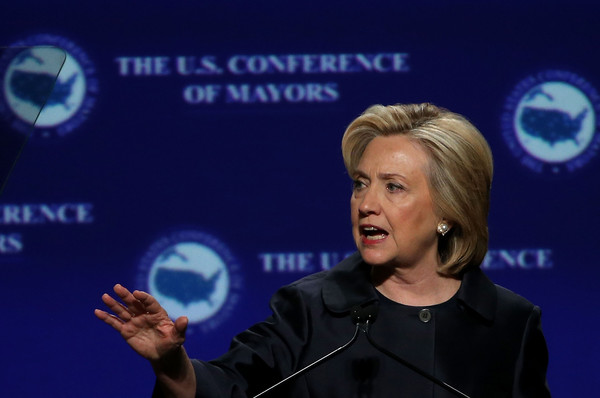
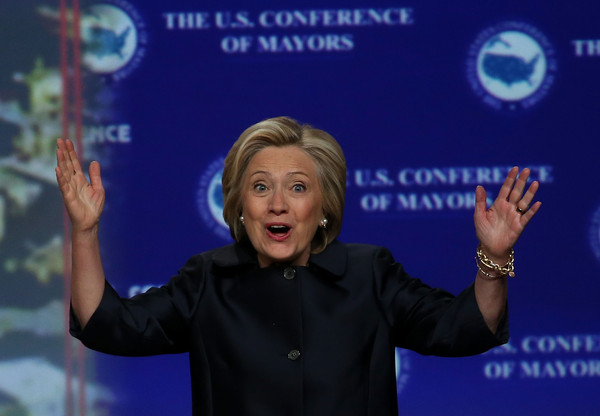
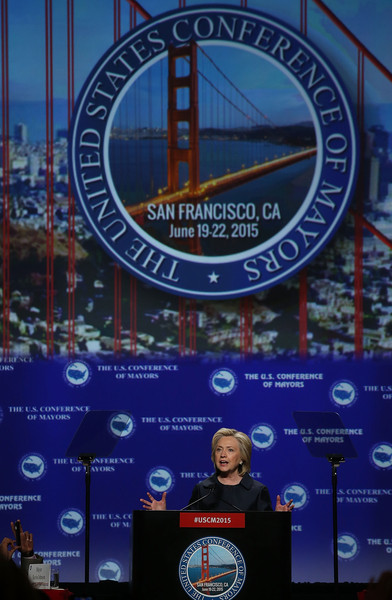
Democratic
presidential candidate Hillary Rodham Clinton speaks at the U.S.
Conference of Mayors 83rd Annual Meeting in San Francisco, Saturday,
June 20, 2015. (AP Photo/Mathew Sumner)
We all can help to get her leadership into the White House!