1,000 Days: Change a Life, Change the Future
Hillary Rodham Clinton
Secretary of StateInterContinental HotelNew York CitySeptember 21, 2010
SECRETARY CLINTON: Well, let me welcome all of you to this very important event, 1,000 Days: Change a Life, Change the Future. You see before you some of the partners who have come together to reduce child undernutrition, and you will hear from each of them during the course of the program. Secretary General Ban, who is very committed to this endeavor, is on his way here, and as everything in what we call “UNGA Week” is running a little bit behind time. So what we would like to start with, then, is a short film that captures the seriousness of this issue and the scale of the opportunity that we hope to seize working with so many of you in the audience, as I look out at the representatives of other nations, of NGOs, and we’re grateful for the private sector involvement as well. So if we could, we’ll now watch this short film.
(Film shown.)
(Applause.)
SECRETARY CLINTON: I want to thank the filmmakers for such a vivid and memorable description of the problem that we are confronting today, and thanks to each and every one of you for joining us to build momentum for the global fight against undernutrition. I particularly want to thank Minister Martin and his colleagues in the Irish Government for their commitment, really their passion, to fighting hunger, which has saved lives and improved health for millions of people worldwide. The Irish people and the Irish Government knows what hunger means from their own history and, as a result, they have been really the world’s leader in working to harness public and private resources in the fight against hunger, and now undernutrition.
I also want to recognize Sam Kutesa, Uganda’s Minister of Foreign Affairs. And thank you very much, Minister Kutesa, because the Ugandan Government is taking the lead in building a better future for its own people by making significant investments in the key fields of agriculture, health, and nutrition, which is the intersection of both. And I look forward to seeing President Museveni later today to thank him in person.
We have a number of representatives from other governments and also from outside government, because solving the challenge of undernutrition requires action from people and groups from every sector of society lending their expertise and reaching out to their constituencies.
And I want to thank those who are here from the private and nonprofit sectors who will be speaking today. First, Muhtar Kent from Coca-Cola. Coca-Cola has a global reach and has demonstrated a real commitment to corporate responsibility, and under Mr. Kent’s leadership is not only doing work on its own behalf, but serving as a catalyst for creating alliances and partnerships, and we thank you and Coca-Cola very much. Maria Eitel from the Nike Foundation, another company whose foundation is on the cutting edge of problem solving. We all appreciate the direct donations that companies and their foundations make, but I think we’ve moved into a new era of business philanthropy where businesses are partnering to help us work together. Tom Arnold from Concern Worldwide, a long-committed partner in the hunger fight, and, of course, David Beckmann from Bread for the World, one of the premier international organizations in this fight.
We have a full agenda, so let me, if I can, just emphasize just a few points.
When I talk about nutrition, people are often surprised to learn that undernutrition is major problem for which we have basic, affordable solutions, such as vitamin and mineral supplements, fortified foods, and nutrition education. And I see Tony Lake, the new head of UNICEF. And of course, UNICEF has been, for many decades, a leader in the fight against childhood malnutrition and now undernutrition.
We also know enough about the science of nutrition to know these interventions have the biggest impact when they occur during the first 1,000 days of a child’s existence. That begins with pregnancy and continues through a child’s second birthday. Interventions after that second birthday make a difference, but often cannot undo the damage that was done because of the undernutrition during the first 1,000 days. So we can be very targeted with our investments to save and improve the greatest number of lives.
But while we have life-saving solutions, they remain out of reach for hundreds of millions of people worldwide. And it also is a problem that even when we have such solutions, when it comes to delivering them – particularly to rural communities – the last mile is the longest.
There have been a number of positive developments over the last year. The commitments from many nations at the L’Aquila conference and the G-20 meeting to the hunger and food security programs have been significant. Individual countries have launched their own programs. That’s all good news, but we have a distance to go.
We have to be ready in our partnerships to increase our support for countries struggling with undernutrition , and we have to align our programs and our funding with their plans instead of creating parallel programs. Dr. Raj Shah, our administrator at USAID – and I talk about this all the time: It is time for us truly to partner with countries to help build their capacity. When the donors are gone and the donor dollars have been used, what remains? And our humanitarian impulses, our generosity, are very important, but the hard work of capacity building is what should be our focus. And we have to deliver both short-term results and long-term progress.
Currently, donors have programs in more than half of the 36 countries where the vast majority of children suffering from chronic undernutrition live. And I’m pleased to report that in the past few days, several of those countries have taken the significant step of inviting a closer partnership with donors in order to develop and implement rigorous, evidence-based national plans and programs. Most donors have agreed that this kind of closer partnership is the right way forward and have agreed to take joint action to scale up nutrition, and we will be there with them.
And guided by the SUN roadmap, we can advance a culture of coordination that helps make these programs more effective, sustainable, and higher impact. This sense of agreement about the ultimate goal of ending nutrition and increasingly about the ways to achieve that is a clear sign of progress. And we hope that this meeting inspires more alliance building. And I want to recognize all of the developing countries’ governments that have shown such leadership.
But we’ve got to do more to leverage not only governmental commitment, but the contributions of the private sector and civil society. Whether it’s a company like Coke that has perfected the science of delivering products to remote locations, or an organization like Bread for the World that has mobilized millions of citizens to urge their governments to fight hunger, we have to have more such partners. And we have to hold ourselves and others accountable. That means we have to track our progress through rigorous monitoring and evaluation systems. Let’s not just measure the resources we spend, but the results we achieve.
And let today be the first of our own 1,000 days – 1,000 days of focused, concerted efforts to translate our common knowledge and vision into concrete action and then build momentum. So I challenge all of us, including my own government, to commit to make progress toward the goals outlined in the SUN roadmap by hitting specific benchmarks during the next 1,000 days, supporting those champions of nutrition who can help us get there.
And then let’s come back a year from now at UNGA to report on how we have aligned our programs with country strategies, and to come back two years from now with evidence that we are reaching more pregnant women and young children, and to come back at the end of our own 1,000 days having achieved a measurable impact on national undernutrition indicators.
I want especially to thank InterAction, the Global Alliance for Improved Nutrition, Save the Children, The Hunger Project, and others for launching the 1,000 Days website. And it is at thousanddays.org. And I thank Goodspot for making the film featured in it. This website will give organizations, civil society groups, and citizens an easy access point to join this movement. We know we can save lives, we can strengthen health, we can improve education, decrease poverty, increase prosperity, even create jobs, as well as giving every child the chance he or she deserves to make the most of his or her God-given potential.
So I look forward to working with you, and now it is my great pleasure to introduce a friend and a leader. It is always a pleasure to work with the Irish because they always make it fun. (Laughter.) We have a huge fun deficit in the world right now along with all of our other deficits. But please welcome Micheal Martin, Ireland’s minister for foreign affairs. (Applause.)
FOREIGN MINISTER MARTIN: Thank you, Secretary Clinton, for those kind words about the Irish, but also for your inspiring words about the challenge that lies ahead and that is the focal point of this gathering here this morning. And we thank your people who have worked so hard behind the scenes with Irish Aid and with my colleague, Minister Power, Peter Power, Minister of State Peter Power, in terms of the organization of this partnership with its focus on undernutrition.
And I also want to take the opportunity to articulate our gratitude to Secretary General Ban Ki-moon for his commitment to this program and indeed his intervention, and we endorse his call for action on Scaling Up Nutrition.
As Secretary Clinton noted, it is of both historical and contemporary importance to Ireland and the United States that we join together at this critical juncture in the battle against hunger and undernutrition. Our two countries are bound together by our shared history, a history that witnessed hundreds of thousands of Irish people fleeing hunger at home and finding refuge in this country, where they built new lives. It is Ireland’s own history of famine that echoes through the generations and drives our commitment to fighting poverty and hunger. And it is appropriate that Ireland and the United States build on our shared past and walk in partnership with the developing world.
Two years ago, almost to the day, we launched the Irish Government’s Hunger Task Force Report here in the United Nations. This seminal report set out the practical steps we can take to eradicate hunger. Simply put, it called for action to support smallholder farmers, to target maternal and infant undernutrition, and to generate political leadership and action. By doing all three, the report told us that we can accelerate progress on MDG-1, to halve extreme hunger and poverty by 2015.
We meet this week as a global community to review the progress that we are making towards the Millennium Development Goals, and in particular the fight against hunger and undernutrition. We know that a failure to address the hunger dimension of MDG-1 will erode all our efforts across the full range of the MDGs. The short film we have just watched communicates powerfully the challenges and the real difference we can make to a child’s life if we act decisively in the first 1,000 days.
Undernutrition remains one of the world’s most serious –but least addressed – problems. And yet proven and low-cost interventions do exist. Today, we heard how the 1,000 Day Movement and the Scaling Up Nutrition roadmap would provide us all with an historic opportunity to realize MDG-1, and through it, all of the MDGs. The 1,000 Day Movement will focus on those countries and regions which are making least progress. Today, we are launching in this most inclusive way a new partnership process. We recognize the central role of the UN Secretary General and the SUN initiative. His leadership in this process is vital, and we welcome him to the podium and thank him for his presence. (Applause.)
Ireland, Secretary, will play its part. We are determined to work with our partners to deliver this action plan. We will support plans and actions that are owned and led by our partner countries. We will encourage the scale-up of national programs. And we will review our own development programs through the lens of nutrition. Today, we accept the 1,000 day challenge to change lives and to change the future. We must recognize that mothers and fathers and their households are at the heart of this change. We must build partnerships to support them – partnerships that bring together community organizations, the private sector, civil society, local authorities, and national governments. In the Irish language, we say, “Ní neart go cur le chéile,” which means, “Strength in unity.” Let us approach our work this morning in this spirit.
I would now take this opportunity – I think we might have a slight change in the order – before my good colleague, Mr. Sam Kutesa, the minister of foreign affairs of Uganda, comes to the podium, I think I will ask Secretary-General Ban Ki-moon to now address us, and thank him very much indeed for taking the time out of an extraordinarily busy schedule to be here to endorse this initiative, and also to articulate the leadership that he has shown on the MDGs since he came to office.
Secretary Ban. (Applause.)
SECRETARY GENERAL BAN: Secretary of State Clinton; Minister Martin; Minister Kutesa, Mr. Jean Ping, chairperson of African Union Commission; Mr. Tom Arnold, chief executive officer of Concern Worldwide; Mr. David Beckmann, president of Bread For The World; Ms. Maria Eitel, president of Nike Foundation; Mr. Kent, president and chief executive of Coca-Cola; excellencies, distinguished ministers, ladies and gentlemen, it’s a great pleasure. First of all, I apologize to be late, but I’ve been running during this not to be late. But I am very glad to be given this opportunity. And just the two, three minutes I was feeling how it would be like to be walking as minister of foreign affairs of Ireland, sitting in his seat. It was good to feel that. (Laughter.) I hope you are not feeling threatened. (Laughter.)
But I’m not here to threaten anybody’s job. I am here to talk with you about how we can strengthen our cooperation and our leadership role to mobilize necessary resources and to raise the awareness on this food crisis. In fact, since April 2008, when this crisis has erupted, I immediately established a High-Level Task Force on Global Food Crisis. Until last week, I have been chairing this High-Level Task Force 14 times and I am proud and I can tell you that we have been able to work as one team, whole worldwide. This High-Level Task Force comprises of all the United Nations specialized agencies, related specialized agencies, and funds and programs, and also beyond the United Nations we have OECD, and then again, World Bank and IMF and African Development Bank, and all have been there, all have been there as one team. And I really thank Secretary of State Clinton and Minister Martin for the initiative in organizing this meeting. This is very important complementary work.
Hundreds of million people depend on us. Food insecurity and poor nutrition weaken the fabric of (inaudible) humanity. Two years ago, the world received a harsh wakeup call. Food prices escalated and food-related instability erupted in many places. During the crisis, Prime Minister Brian Cowen of Ireland and I launched the report of the Irish Government’s Hunger Task Force. And one year ago, together with the Secretary of State Hillary Clinton and I co-chair most successful event highlighting the importance of partnership between governments, businesses, and civil society, including farmers organizations.
And in L’Aquila, Italy, 26 nations agreed on the Comprehensive Food Security Initiative under the very strong leadership of President Obama. The world is moving on food security. The L’Aquila initiative, which draws on the African Union’s Comprehensive Africa Agriculture Development Program, organizes smallholder farmers, sustainable agriculture, the links between climate change and agriculture, and interest of women both as farmers and as care providers. It highlights the importance of safety nets and social protection. It is a recipe for people to enjoy their right to food, long-term increases in food production, stable food supplies and prices, universal access to essential nutrition. We are making progress in bringing the initiative to life. Such progress gives me hope, hope that we can better coordinate agriculture, health, and social protections, and improve links between research and investment to achieve long-term results.
This year, I have visited at least 12 African countries and I have seen for myself how African leaders and people are committed to increase their agriculture productivity, food productivity. In some countries like Malawi, they have transformed themselves from famine-stricken countries just three years ago to food-surplus countries. I have seen again in the bank, in the grain bank, a lot of stocks of grains. Numerous food security partnerships have been started, including U.S. Government’s Feed the Future Initiative, and many countries are implementing long-term investment plans. Last year’s G-20 meeting in Pittsburgh called for a global agriculture and food security program to help finance these partnerships. Funds were received from several sources, including Ireland and the United States, and the first five grants were awarded in June of this year. Many more countries are preparing applications. Let us work to expand the pool of donors and increase the resources that are available.
Today, we focus on two important – two initiatives, the SUN roadmap for Scaling Up Nutrition and the 1,000 Day Movement, which will increase political attention to this essential element of the food security equation. I strongly support both initiatives. They can help us to make significant headway on MDG-1. SUN shines the light on our most precious and vulnerable resources. Undernourished children are more likely to get sick, they cannot concentrate in school, and often earn less as adults. They pay the price throughout their lives. Poor women don’t get enough nutrient-rich food in pregnancy, nor are such foods readily available to their newborn children. Furthermore, women who are poor can often be too busy working in the fields and markets to breastfeed or provide the care a baby needs.
SUN proposes a set of effective nutrition interventions from the start of each pregnancy until a child reaches the age of two. We call this the 1,000-day window of opportunity. These interventions are extremely cost-effective. They prioritize the interest of women and the importance of nutritious diets for mothers and babies. If overall development (inaudible) are sensitive to the importance of the 1,000-day window, we can make a big difference to undernutrition. The SUN framework has been endorsed by more than 100 key stakeholders. It
gives us a unique opportunity to bring the sun into young lives everywhere. Today, I encourage leaders to ensure that each decision they make helps reduce the risk of undernutrition.
Secretary Clinton and Minister Martin and distinguished leaders here, I thank you for your support across this agenda. Please know that I am glad to be counted as a global nutrition leader. Thank you very much. Thank you. (Applause.)
SECRETARY CLINTON: Thank you very much, Secretary General Ban. We know how extremely busy you are this week and we thank you for making the extraordinary effort to join us this morning. And I want to applaud the leadership that you and your team have shown on this issue. The Scaling Up Nutrition roadmap, the so-called SUN roadmap, that is unveiled today will be a critical tool for coordinating our efforts, and it will be up to us to follow that roadmap to our destination.
It is now my great honor to introduce Mr. Sam Kutesa, minister of foreign affairs of Uganda. Uganda is demonstrating great leadership on nutrition at the national level. It is integrating nutrition into its agriculture and health strategies and its development plan. So, Minister, could you share with us the vision of your government to improve nutrition for Ugandan women and children? (Applause.)
MINISTER KUTESA: Thank you, Secretary Hillary Clinton; Secretary General who has come and gone; Minister Martin, minister of foreign affairs of Ireland; chairman of Coca-Cola, president Muhtar Kent; President of Nike Foundation, Ms. Eitel; Tom Arnold, Concern Worldwide; and Mr. Beckmann, president of Bread for the World.
First of all, ladies and gentlemen, I’d like to take this opportunity to thank Secretary Clinton and Minister Martin for organizing this event and for giving me an opportunity to participate. I come from a continent which I think is probably one of the most affected by malnutrition, the continent of Africa. And therefore, an opportunity like this, and an initiative like this I think is very important for Africa and for my country, Uganda. So I’m delighted to be here and I want to take this opportunity to thank you so very much for organizing this and this initiative.
I also want to thank the people who made this small film that we saw at the beginning which shows us that we can do a lot in a thousand days. We saw how we could build a car in a thousand days; we saw how we could draw – make drawings of an administrative building; we saw how we could do so many things in a thousand days. But I think nothing is greater than saving a life in those 1,000 days. And so I want to thank you for this short film, because it brings our focus, I think, to what is extremely important, to life.
Uganda endorses the 1,000 Days effort and the UN Scaling Up of Nutrition framework, because malnutrition, during very early life, can adversely and irreversibly impact on child growth and development. Malnutrition – children who have suffered from malnutrition die. Those who do not die do not grow well and eventually will not become productive; hence the impact on the growth of the economies of our countries. It is estimated that hunger leads to between 6 to 9 percent in gross domestic losses due to low labor productivity. And you can imagine in countries like Africa where it is so prevalent, even those who do not die soon after being born, but continue to be – suffer from malnutrition don’t become productive and eventually, this affects production, productivity, and also impacts on poverty.
So it’s a complete cycle. If you are not – if you don’t deal with malnutrition, then you are, in a way, not fighting poverty in your own right. So it’s one way if you deal with it, therefore, the converse is true, that you will be impacting on the fight for poverty in Africa.
The causes of malnutrition in particular and undernutrition are multiple, and therefore require multiple dimensional and (inaudible) approaches to tackle them. And therefore, the Government of Uganda encourages and welcomes the (inaudible) and world stakeholder coordination at country levels to address and scale up intervention for maternal and the young child feeding and provision of malnutrition.
The Government of Uganda has just launched the National Development Plan 2010-2015, which emphasizes improvement of quality of life through investment in nutrition and agricultural production to increase food supply, drive economic growth, and reduce hunger. Uganda successfully passed its food national – food nutrition policy, and now we have a new bill in parliament which will be passed to deal with nutrition.
Government is committed – our government is committed to increasing the budget for nutrition intervention as a percentage of health spending. We are working through the three stages of country participation that outline the Scaling Up Nutrition roadmap. The first is for national authorities to take stock of the national nutrition situation and of existing strategies institutions, actors, and programs. This will be followed by a national authority of developing their plans for Scaling Up Nutrition and concluding with rapid scaling up of programs with domestic and external financing. We will request – we will call upon the government patrons, including donors, to generate in support of Uganda’s effort to scale up nutrition. I encourage other countries to do the same in Africa so that we can all scale up our investment in nutrition.
We believe that we cannot do this alone –as a government. Therefore, we welcome the initiative of the private sector and civil society participating in this. And I think, as Secretary Clinton told us earlier, what is important is to develop the capacity that will sustain this even after donor money has gone. It is of critical importance that capacity in countries like mine and in Africa as a whole and the third world is created, because that’s the only way we can have sustainability. Money comes and money goes, or it’s finished, spent, and gone. But once we have the local capacity and institutions to carry out these programs, then we have sustainability.
I wish to conclude – in conclusion, to inform you that we are committed to preventing all forms of malnutrition. We shall focus on strengthening public-private partnership in the agriculture sector and production of nutrition food and support implementation of (inaudible), and policies to improve agriculture performance. We will scale up programs to strengthen nutrition awareness and effective nutrition services at the community level in order to encourage food diversification and household levels. Undernutrition in Uganda and in Africa is a price too high for us to neglect.
I believe that not only (inaudible) in the 1,000 days, yes, let’s focus on mothers and children, but you can also do a number of packages after the 1,000 days. I believe that there are many other strategies, many policies and programs that African governments have successfully put in place. We have all embarked on universal primary education across Africa successfully. In my own country, enrollment jumped from 2.5 million to 90 million just in one year after introducing universal primary education. And those are children that could never have seen school, but because governments were able to do that, such a dramatic figure came back to school.
We are beginning to experience school dropout because, simply, there is no lunch at school. I think with this fortified food, with this other nutrition beyond just the 1,000 days, we do not only achieve the objective of nutrition beyond the 1,000 days of the children, but we also maintain school attendance. And also some of the products that make this food are also grown in these countries. So in some (inaudible) area, alleviating poverty within those homes. I think there are synergies in all these, and if we come together, we can built a nutrition – a malnutrition-free Africa, we can build universal primary education successfully, and we can also eliminate poverty.
I would like to thank you for your kind attention. Thank you very much.
(Applause.)
SECRETARY CLINTON: Well, in the interest of time – because I know that there’s a very busy agenda here, but there’s also an exciting part two that we hope you will stay for to get into the details of this program – Micheal and I will sit here to introduce our next speakers.
Thank you very much, Sam, for that excellent address.
And now it’s my great privilege and pleasure to welcome Muhtar Kent, the chairman and CEO of the Coca-Cola Company, who has become a very welcome and present force on behalf of corporate philanthropy and building sustainable alliances and partnerships. Thank you so much.
MR. KENT: Thank you very much, Secretary Clinton, and also Minister Martin and Minister Kutesa. And it’s a great honor and privilege this morning to share the dais with such respected panelists, and also to share with you some views about the role of business in addressing this critical issue around the world. And thank you again for giving me this opportunity here.
Let me start by saying that business, and in particular large business, can play a tremendous role in advancing this very essential work and also bringing about positive change. And it’s not about just consumer product companies like mine or food and beverage companies, but it’s also any companies from any industry. All industries can make a difference here. We all have a significant stake in ensuring that we can improve and make progress on this issue. Our businesses are only as healthy and sustainable as the community that we serve all around the world, and in our case, we serve 206 countries around the world.
Indeed, the future health of our global economy is very directly tied to the health and wellbeing of the people of the world. And it’s no coincidence that the world’s most stabile and affluent and competitive nations today also have, actually, the lowest infant mortality rates. And we should all actually be encouraged by the recent UN report which cited that the number of undernourished people in the world has declined for the first time in 15 years. Progress is being made thanks to the leadership of all who are on the dais today, thanks to the leadership of Secretary General Ban. Progress is being made, but the challenge is, by no means, behind us. Our challenge together is to help bring more nations and more children into this fold. Business brings, actually, a lot to the table.
Unlike many problems – unlike many other problems that we face at the moment, undernutrition actually has readily available and, actually, low-cost solutions, many of which can be delivered effectively by business. Today, the supply chains, the distribution networks of businesses reach every corner of the globe. The research and innovation acumen is transferable across all geographies. And certainly in our case, our marketing know-how and consumer insights are vast and very deep. We have a clear desire to be part of the solution.
We also know, like all of you know, that none of us can do it alone. The only way we are going to actually have a profound, sustainable, lasting impact is by working with our friends in government, working with civil society, and us – I call that the golden triangle – to pool our collective expertise and to ensure that we can deliver on our commitments. I’ve seen the – firsthand that this collaboration works very effectively. Just let me cite an example from the Philippines.
Working with the Government of the Philippines, with the minister of education of the Philippines, we created a new nutritional beverage with enhanced nutritions, Vitamin A and C, as well as iron, to fight anemia amongst the Filipino elementary school children. And our collaboration with local education departments and the National Department of Science and Technology has resulted in tens of thousands of low-income elementary school children getting access to this highly nutritional beverage. We’re a marketing company, so I’ll show you what that actual beverage looks like. (Laughter.) It’s in pouches, very low cost, and it’s being actually delivered to all the schools through this collaboration, through this golden triangle, as I have mentioned.
Last week, we started working with the ministry of health of Tanzania and the Global Fund, that wonderful organization called the Global Fund, to fight AIDS, tuberculosis, and also malaria. And we’re working together to maximize the ability to get vital medicine, medicinal supplies to the people that need them the most. And we’re sharing our supply chain expertise with the medical storage department in Tanzania for a six-month pilot. I expect that this will be a sustainable project going forward.
So we welcome the opportunity to partner with and learn from all of you, from all of my distinguished panelists, as we scale up these type of partnerships, and we intend to scale them up. As members of GAIN Business Alliance, we are challenging ourselves to think through how we can harness our core capabilities to apply our expertise to be part of the solution. Just next year alone, we have identified a – many other countries where we can launch these new nutritional beverages, countries like Brazil, Colombia, Indonesia, Uganda, South Africa, Kenya, to name a few that we are going to expand on our know-how, learn from best practices in countries like the Philippines, and expand this project.
So today, we at Coca-Cola proudly join Secretary-General Ban and Secretary Clinton, Minister Martin, Minister Kutesa, and calling on all companies, governments, and civil society to join forces to solve this most pressing challenge. This morning, I call – I make this call and we look forward to being part of this very important critical initiative, and we hope that our involvement will also inspire others. So together, we believe we have the power to change lives, power to improve societies, and grow in sustained economies and business everywhere.
So thank you very much for your attention this morning. Thank you. (Applause.)
FOREIGN MINISTER MARTIN: Thank you very much indeed, Muhtar, and for that very, I think, interesting insight into the contribution private sector companies can play in this endeavor. And now, I’d like to invite Maria Eitel, president of the Nike Foundation, to the podium.
MS. EITEL: Thank you, Minister Martin, and thank you, Secretary Clinton, and fellow panelists. I am honored to speak on behalf of 600 million adolescent girls in poverty today. In 1952, there was an American bank robber, Willie Sutton – he was quite famous – and he was asked, “Why do you rob banks?” And the answer was, “Because that’s where the money is.” (Laughter.) So why does the Nike Foundation focus exclusively on adolescent girls in poverty? That’s because that’s where the opportunity is.
The best proxy for an adolescent girl undernutrition is anemia. Forty percent of girls, adolescent girls in poverty, are anemic and 70 percent of them are out of school – 70 percent of out-of-school children are girls. When you combine these two factors with pregnancy, the results are tragic. Once a girl is pregnant, anemia increases the risk of still or premature birth, low birth weight, prenatal and maternal mortality. When an adolescent girl becomes an adolescent mother, she is ill-equipped and uneducated. The results are hunger, malnutrition, and her life becomes a series of dead ends.
Yet that adolescent girl can do something no one else in the world can do. She can break the cycle of intergenerational poverty. There are two things we must do if we are to solve the problems of malnutrition and hunger – not just for girls, but for everyone. The first has to do with urgency. The clock is ticking for girls. When she reaches puberty, it is only a question of when she will become pregnant. It is our first job to delay that moment as long as possible.
Job number two – once that clock is ticking, once she is pregnant, we have that very limited 1,000 days to get to her, keep her healthy, and teach her how to keep her children healthy. We must reach adolescent girls if we wish to achieve the goals we are here talking about today. But there is a very serious problem. We, all of us here in this room, are not investing sufficiently in adolescent girls. We assume that she is reached by services in place for women, youth, or community. We assumed she is addressed and this is dangerous and simply not true.
Each of us is here to make a commitment. The Nike Foundation’s commitment is to join with the UK’s DFID and the Government of Rwanda to implement a country-wide program called 12-Plus. 12-Plus addresses the pernicious adolescent girl gap in the global health system. It is a bridge for girls from childhood to adulthood. If we reach a girl before puberty, she has got a chance. We cannot continue to scotch-tape on girls onto strategies. Whatever your commitment is today, please make sure that adolescent girls are very specifically and very measurably included in what you will do. This will amplify any effort that we undertake.
My dad always told me, “Maria, you can do anything you want as long as you really work hard.” I told this to my daughter for 19 years. Unfortunately, for an adolescent girl in poverty, this is actually a very cruel statement; it’s a lie. It is up to us to make this statement true for the 600 million girls in poverty today. We must act quickly because the clock is ticking for girls. Thank you. (Applause.)
SECRETARY CLINTON: Thank you so much, Maria, and thank you for your leadership and the work that the Nike Foundation is doing to bring a very, very needed bright spotlight on these adolescent girls and their needs. Thank you.
Now I’d like to turn to Tom Arnold from Concern Worldwide, and that’s a very apt description of Tom and the organization, because they truly are concerned about the world.
MR. ARNOLD: Thank you very much, Secretary. It’s really an honor to contribute to this meeting, and I’d like to use my time to focus on the contribution that civil society, at a national and international level, can make in working towards this goal of reducing hunger. Minister Martin has repeated Ireland’s commitment to provide leadership in advocating for hunger elimination. And Irish civil society organizations strongly support this, and we are working closely with Irish Aid towards this goal.
I’ve long advocated that Ireland, because of its unique historical tradition, should seek to be what I call the Norway of hunger. Norway is internationally recognized as a country with the political commitment and the practical capability to prevent and resolve conflict. I believe Ireland should play a similar role in relation to hunger, and today’s meeting is a great example of giving life to this idea.
Well, today’s meeting is important in two other respects. The first is the very sharp focus on the importance of the 1,000 days. The evidence is compelling. Undernutrition in early childhood leads to physical and mental stunting. Stunting compromises the futures of individuals, economies, and nations. So the message is simple and clear: The public can understand it and will* support it. And at a political level, the fact that you, Secretary Clinton, care deeply about this as a priority is of real importance, both here in the United States and internationally.
The second important aspect is that today, the key players across the UN family, governments, private sector, civil society are here to acknowledge the contribution they can make to improve early childhood nutrition. So we have the political momentum at international level, but what – this has to be married to practical solutions on the ground and action at national level in the countries suffering from hunger.
The SUN roadmap provides the framework for implementing this range of practical solutions, but we must build on progress already made. In the last decade, there has been significant progress in finding new ways to deal with severe acute malnutrition. The development of community-based management of severe acute malnutrition, which was pioneered by valid international and concern and supported by Irish Aid, was a real breakthrough, and it needs to be scaled up wherever it’s needed.
Similar innovation needs to be found to deal with chronic malnutrition, which accounts for over 90 percent of the world’s hungry. Concern is engaged in an important piece of action research on what we call realigning agriculture with nutrition. The acronym for this is RAIN, which is a good acronym for any research associated with an Irish organization. (Laughter.)
But the serious point is that agriculture production needs to contribute to improve nutrition, and this research is part of an interesting public-private partnership involving Concern IFPRI, and the Kerry Group, and again supported by Irish Aid. The roadmap stresses the critical importance of having an inclusive process at national level, and it’s vitally important that national civil society organizations are included, and that the voices and concerns of women, the major producers and preparers of food, are heard.
International NGOs have a key role in partnering and supporting civil – national civil society groups in these national SUN processes, and also in keeping pressure on politicians in developed countries to deliver on their commitment to end hunger. I’m delighted to share this platform with my friend, David Beckmann. And he and I and the organizations we lead are deeply committed to advance the cause of eliminating hunger, and David will speak in more detail about what we plan to do together.
I want to conclude with a quote from Shakespeare’s Julius Caesar: “There is a tide in the affairs of men which, taken as a flood, leads on to fortune.” I think we have a unique alignment of forces in place at the moment, a tide in the affairs of men. We have political leadership and momentum. We have a simple, powerful idea of the thousand days which, if implemented properly and on a widespread basis, will bring massive short and long-term development gains. And in the SUN roadmap, we have the basis of a realistic and practical plan. But each of us in this room has the responsibility and an opportunity to make it happen. Thank you very much. (Applause.)
FOREIGN MINISTER MARTIN: Thank you very much indeed, Tom, for that, I think, inspiring address, and we thank you for your ongoing and persistent commitment to the issue of hunger. Now, I would like to invite our final speaker, David Beckmann, of Bread For The World, to the podium.
MR. BECKMANN: I am deeply grateful for the powerful leaders who have come together in this room. We have new evidence about what nutrition programs have the biggest impact. And that new knowledge has made it possible for many multilateral, bilateral civil society organizations to agree on a common strategy – the highest-impact interventions.
You can summarize it in six sentences. So, most importantly, focus on babies the first thousand days. Help parents understand basic nutrition practices, the things like the importance of washing your hands with soap. Then you get a few key micronutrients to everybody. You help communities identify severely undernourished kids and get supplemental help to them. You let local people design country programs. And you make sure that you’re paying attention to nutrition in broader programs of agricultural and health development. This meeting now brings additional political support to this cause, and the 1,000 Day Movement is a chance to mobilize people all over the world.
I’m here as a representative of U.S. civil society to express our support, our enthusiasm. Organizations like Save the Children, World Vision, Helen Keller, CARE, these organizations are deeply involved on the ground. InterAction has taken the lead in putting together the website, thousanddays.org, that will help to engage nutrition leaders all over the world. And the Alliance to End Hunger will help to engage diverse U.S. institutions. Bread for the World is a faith-based advocacy movement. We will educate our members. We will recruit religious leaders to be nutrition leaders. We will urge our Congress to provide the money we need.
Tom Arnold and I have also agreed that Bread for the World and Concern Worldwide will together convene a meeting in Washington in June. We think it would be helpful. That’ll be nine months from now. We think it would be helpful to bring together some of you – leaders from around the world – to check in on what we’ve achieved, what next needs to be done. We think that will make the meeting that Secretary Clinton and Minister Martin have so graciously offered to convene here next year, that will make that meeting all – much more effective.
I’m a minister, a Christian minister, but in a room like this we’ve got lots of ideas about God. But one thing we all know is that providing nutrition to a malnourished baby is sacred work. And we have a chance together to provide nutrition to tens of millions of malnourished babies. (Applause.)
SECRETARY CLINTON: Thank you so much, David. As always, you ended exactly where we needed to be inspired and sent forth. And we’ve done a lot during this past year to highlight the importance of food security, but now we really have to put some meat on the bone, so to speak. And when those of us on the podium depart momentarily, our places will be taken by so many of the people who are on the ground and leading organizations and directing governments’ development budgets toward the goals that the 1,000 Days initiative represents.
We have a great opportunity here because people ask me: “Well, what’s new about this? We’re always against hunger. I mean, it’s something that we’ve been against forever. And we have Josette Sheeran, the executive director of the World Food Program. The World Food Program has been around a long time. It does wonderful work. What’s different?”
I think there is a unique convergence of the science and research about what works and what needs to be invested in. The understanding of the business community worldwide that this is in their interest, as Mr. Kent so eloquently described; the strategic forward-leaning effort that this and the SUN roadmap represent – thanks to the work of all the people here; and of course, the political will – all of it has come together. And so it is now time for us to get into action to do this sacred work that David mentioned.
So I want to thank all of you and all who have been working so hard on this. And Minister Martin will have the final word, and I hope people will stay and really get into the meat of the conversation, so to speak, about what we do to actually fulfill the promise that we are describing today.
Micheal.
FOREIGN MINISTER MARTIN: Thank you very much indeed, Hillary. And just to say that I would like to thank all of the speakers for your contributions this morning, for your insight, and for your support for the 1,000 Day Challenge. It’s the political momentum that’s demonstrated here this morning that must now go beyond this room, and as has been said, translate into policies and real concrete actions on the ground, change that is measurable and change that is deliverable.
And what do we need to do now? Well, we need to translate this energy and momentum into actions on the ground. As I said, we need more countries to step forward with plans to scale up nutrition. We need to support those countries. We need critically to build alliances on the ground between governments, donors, civil society, the private sector, and critically, the research community, who I think have a fundamental role to play in the Scale Up Nutrition initiative and the fundamental challenge of undernutrition in the first 1,000 days. We need to see results in the lives of children and we need to act fast.
For Ireland’s part, we are committed – we are committing 20 percent of the Irish Aid program to reducing hunger. So we are realigning our program – (applause) – to the fundamental objectives. We will work with our partners in our program countries to identify innovative ways of addressing undernutrition. We will build our support for agricultural research to help farmers grow nutritious foods for their families. We will focus more effectively on pregnant women and on maternal health. We will identify opportunities for cooperation with the private sector to improve access to fortified foods. And we stand ready to work with those of you in this room and beyond who share our determination to take up the 1,000 Day Challenge.
Ladies and gentlemen, this has been for me a great morning and a great privilege to be here. We will now hand over the floor to Administrator Shah and Minister Power, who will explore with you how we can take this initiative forward. Thank you very much indeed. (Applause.)

RESIST, INSIST, PERSIST, ENLIST.” - HILLARY RODHAM CLINTON
Showing posts with label Micheal Martin. Show all posts
Showing posts with label Micheal Martin. Show all posts
Tuesday, September 21, 2010
Video & Text of Hillary Clinton 1,000 Days: Change a Life, Change the Future


Monday, August 23, 2010
Upcoming: On Hillary Clinton's Agenda
Well, the Irish are all excited about this even if the American press does not think it is worthy of attention. September is a New York month for the Secretary of State. It is the month of UNGA and of the Clinton Global Initiative. I am guessing that this event will dovetail with those since that is when all the principals would be in town.


The Irish love Hillary and everything she does. They would elect her to any office she wanted if they could. Americans would do well to take a closer look at Hillary Clinton and everything she does. We have a treasure in her, and we should take serious note. This conference, in fact, should be resonating in the media right now with this massive egg recall going on. As usual, though, I have to go to the Irish Press to know what my own Secretary of State is doing. Shameful!Food security expected to top agenda at hunger conference in New York
CONOR LALLY
MINISTER FOR Foreign Affairs Micheál Martin and US secretary of state Hillary Clinton are to co-host an international hunger conference in New York next month to which up to 190 nations have been invited.
Read more>>>>
Tuesday, March 16, 2010
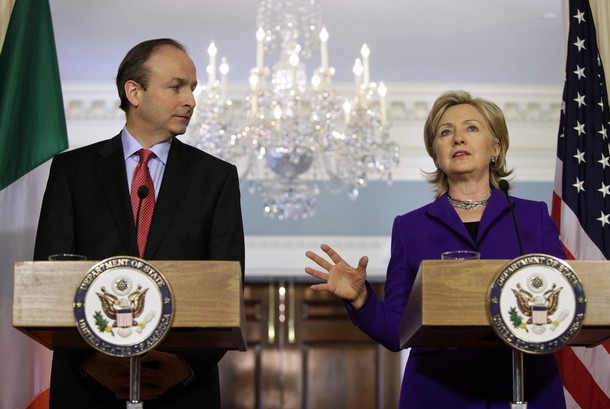
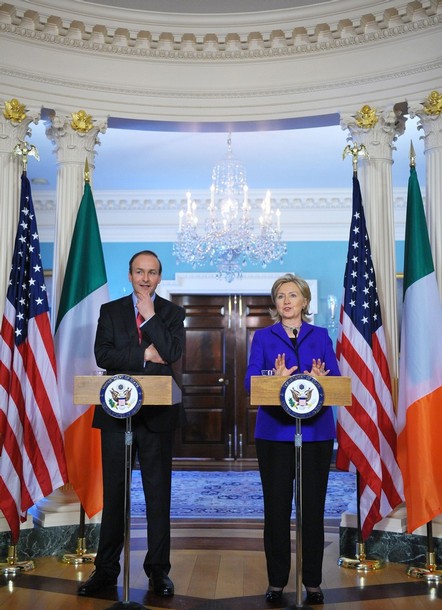
**UPDATED**Video & Text: Secretary Clinton's Remarks With Irish Foreign Minister Micheal Martin
Remarks With Irish Foreign Minister Micheal Martin
Hillary Rodham Clinton
Secretary of StateWashington, DCMarch 16, 2010
SECRETARY CLINTON: Well, I am delighted to be standing here with the foreign minister. Because of our personal relationship and because of the close relationship between our two countries, we always look forward to these visits. And I’m also going to be meeting later with other friends and particularly looking forward to seeing the Taoiseach tonight at the American-Ireland Fund gala.
It may go without saying, but I’ll say it anyway, that the United States and Ireland have a close historic, cultural, familial relationship. Millions of Americans trace their ancestry back to Ireland and are very proud to do so, not just on St. Patrick’s Day but all year long. And because our two nations are linked by common values and aspirations for the peaceful, prosperous future that we want to see for our people, I’ve had the great pleasure of visiting Ireland many times, including last Fall as Secretary of State. And I think Ambassador Rooney, our excellent ambassador, is here and entertained me very well when I was with him.
And I’ll actually spend, we hope, about an hour in Shannon tomorrow night celebrating St. Patrick’s Day en route to Moscow. That’s our goal. I believe that may be a first for me, which I will proudly claim.
But this year’s commemoration and celebration comes at a particularly auspicious time. On March 9th, the Northern Ireland Assembly voted to complete the process of devolution, an important step toward realizing the promise of the Good Friday Agreement and the St. Andrews Agreement, and achieving a full and lasting peace for the people of Northern Ireland. Foreign Minister Martin and his government played a vital role in helping the parties come together to take this step. I know for a fact that he was there for long days and sleepless nights during the Hillsborough negotiations because I spoke to him during the two-to-three-hour a.m. period during one of those nights.
And I know that he and the Taoiseach and not only the government but the people of Ireland will continue to support the leaders of Northern Ireland as they shoulder these new responsibilities. So I thank you, Minister, for your leadership and persistence, and we will be discussing the way forward, as we just have in our meeting, during today and tomorrow, as well as a range of other issues of common concern.
I am particularly looking forward to the upcoming Millennium Development Goals summit in September around the time of the United Nations General Assembly. The United States and Ireland have agreed to co-host a sidelines event highlighting global hunger, food security, and nutrition. I want to commend Ireland for its commitment to devoting 20 percent of its assistance budget to meet the urgent challenge of global hunger. This is a priority for both of our governments, but it’s a historical passion and cause for Ireland.
Ireland is already helping to increase food security in Malawi, Ethiopia, Tanzania, and other places. They are targeting maternal and infant malnutrition. Ireland’s great famine looms large in the history of both of our countries, and we understand what a destabilizing and destructive force hunger still is in too many places around our globe. And I appreciate, particularly during these very difficult economic times, the commitment and generosity of the Irish people.
On this and so many other fronts, Ireland is a valued partner. Ireland was among the first nations to accept and resettle detainees from Guantanamo Bay, which was an important step and vote of confidence in President Obama’s policy to close Guantanamo. We continue to honor the service of Irish troops in Afghanistan and the very considerable role that Ireland has played in helping move our policy there forward. We stand side-by-side against extremists who threaten peace-loving people everywhere.
So again, Minister Martin, thank you for all that you personally are doing, thank you for your friendship, and thank you for representing the close relationship between our two countries.
FOREIGN MINISTER MARTIN: Well, Secretary Clinton, it’s a great privilege and pleasure for me to meet with you again this St. Patrick’s week and to say how much we appreciate the time that you have made available for us to discuss a whole range of issues. And 12 months ago, I think we met here and the key issue on that occasion was prospects for the completion of devolution of policing and justice in Northern Ireland. And we spent some time discussing the North at that meeting.
I want to thank you for the constant personal engagement of yourself and your Administration to that issue. I think you have injected leadership and momentum to the process, and particularly during critical times. And getting that call at 3:00 a.m. in the morning was a very welcome one, may I say. And – but nonetheless, I think the – as I said earlier, it is important that American dimension has been consistent, it has added value to the peace process in Northern Ireland. And in the context of the Hillsborough Agreement, it added significant value to facilitate a resolution of the issues between the parties in Northern Ireland.
So we thank you very much for that, to President Obama and his predecessors as well, for their contribution to peace in Ireland. We also work well, and as I said during our meeting, we appreciated the appointment of Declan Kelly, your economic envoy to Northern Ireland, and the work he has engaged in with the many private sector interests and business interests on the island of Ireland, and particularly Northern Ireland, with a view to advancing the economic dimension.
As I said during the meeting, reconciliation between communities remains a key priority of ours, between the communities in Northern Ireland. And in particular, I think it’s fair to say we still have some way to go to make sure that we can bring the benefits of peace to hard-to-reach communities. I’m talking about areas where the health indices are not what they should be, where school completion rates may not be what they should be.
And I think we’ve discussed the prospect of the International Fund for Ireland being remanded, if you like, with a view to new terms of reference and new focus on that issue, so that on the ground in communities, that we can ensure the dividend of peace reaches them and that we can take efforts to try and support economic opportunity for young people in such communities. And so that’s a key issue for us going forward.
The Secretary said, and I also spoke, of course, about the issue of comprehensive immigration reform and the operation of the working holiday visa agreement, which is a very important bilateral agreement in terms of maintaining engagement and linkage between young people in the U.S. and in Ireland, and I think we’ve both agreed to work on that particular agreement with a view to enhancing opportunities, again, for young people from the U.S. to go to Ireland and young students in Ireland to come to the U.S.
We’re very pleased to be co-hosting that meeting in New York next September on hunger and nutrition, and we again appreciate the opportunity to do that with you. And I know our officials who work on that in the coming weeks to put flesh on that and to ensure a substantive meeting that can add value to the countries that we are assisting, particularly in terms of food, crop production, and enhancing the lot of small landholders in Africa who do need our assistance and indeed our help.
We reviewed a number of areas from Afghanistan to the Middle East, and I took the opportunity to share my recent experience in Gaza with the Secretary of State. And I think we also took the opportunity – I took the opportunity again, to again put on record our appreciation for the priority that you have given to the Middle Eastern question – challenging, complex, difficult, but your commitment and prioritization of the issue has been constant and consistent. And of course, we do know that your (inaudible) Senator George Mitchell, of course, who played such a valuable role in Northern Ireland, has applied himself diligently with great attention to detail. We know his patience, his legendary patience in situations like this.
And as we have said at many international fora, we in Ireland have great confidence in his capacity and your capacity to see this through. And we appreciate the strong and active U.S. leadership on this issue that you’re giving. I look forward to joining Taoiseach to his meeting with President Obama at the White House tomorrow to mark St. Patrick’s Day. We’re honored again by your facilitation of that and by the U.S. Administration. And may I say, I could not think of a better place to have St. Patrick’s Day than in Ireland prior to an engagement with your Russian colleagues afterwards. (Laughter.) So maybe an Irish coffee can warm the situation --SECRETARY CLINTON: That’s true. That’s true.FOREIGN MINISTER MARTIN: -- as you move to Russia later tomorrow. Thank you very much.
SECRETARY CLINTON: Thank you so much, Micheal.
MR. CROWLEY: We’ll begin with Jill Dougherty from CNN.
QUESTION: Thank you. Madam Secretary, we – on the Mideast, which you both have spoken about, we know that you’re expecting some type of response from Israel, Mr. Netanyahu. Can you tell us how and when that might happen? Could it be Mr. Mitchell who might go to the region to get that response or is it you personally? And then also, what does Israel need to do to restore confidence in their devotion to the peace process and also to the U.S. relationship?
And Mr. Minister, if I could ask you, you have just been to the region. Your own Irish peace process is coming to the end. Mr. Mitchell was very instrumental in that, and he is now in the Mideast. What is your assessment? You’re just back from Gaza. What’s your assessment of the prospects for peace negotiations right now under these difficult circumstances? Thank you.
SECRETARY CLINTON: Well, Jill, we are engaged in a very active consultation with the Israelis over steps that we think would demonstrate the requisite commitment to this process. And it’s been a very important effort on our part as well as theirs, because we know how hard this is. This is a very difficult, complex matter, as the foreign minister just said.
But the Obama Administration is committed to a two-state solution. We are committed to the resumption of negotiations between the parties. We think that George Mitchell’s legendary patience will win the day as the process gets started again, because there’s just too much at stake for both the Palestinians and the Israelis. But when we have something to say, we will, of course, share it with you. But our goal now is to make sure that we have the full commitment from both our Israeli and our Palestinian partners to this effort.
FOREIGN MINISTER MARTIN: I would simply say, as well, that our own lessons from Northern Ireland would indicate that where there’s a political will on behalf of all parties to a conflict or to a dispute, there can be resolution, and the prospects can – for resolution can be good. And it seems to me, having come back from the region, that we – that the initiative on the proximity talks is the correct pathway. It’s one that we have supported.
And we do believe that the proximity talks should commence as quickly as possible, and then, that if confidence-building measures can follow quickly in relation to that, and – our view along the way is that the voices of moderation should be supported at all times and that conditions on the ground should be such as to enhance those who want the path of peace. And I think we’ve made those points at international fora and so on. So one can never despair about any particular conflict situation. We know, ourselves, that the Northern Ireland peace process wasn’t built in a day. It’s a long, long process taking, I think, 20 odd years –
SECRETARY CLINTON: That’s right.
FOREIGN MINISTER MARTIN: -- before we’ve arrived at where we’ve arrived at. And it still needs a lot of attention, focus, and application.
MYLES GEIRAN: (Inaudible.) Senan Molony – Irish Daily Mail
QUESTION: Thank you. Madam Secretary, the plight of the undocumented Irish is still a hot issue at home, and I was wondering whether you could cast any light on the progress toward general immigration reform. And secondly, I was also wondering if, in light of your own tremendous reception in Ireland and that of your husband to which you have alluded, you have been maybe bending the ear of President Obama about a visit to Ireland.
SECRETARY CLINTON: (Laughter.) Well, first, the issue of the undocumented is one that President Obama is very committed to addressing. Just this past week, even in the midst of all of his work on the healthcare reform legislation, he held, I think, two meetings about immigration reform and he is committed to moving forward with legislation. He knows that people have to be willing to get out there and defend, what is to us, a very sensible approach of resolving these ongoing immigration challenges.
As you know, I served as a senator from New York for eight years and have spent a lot of time on immigration issues and a particular – with a particular emphasis to the Irish undocumented, many of whom, as you know, live in New York. I don’t think I’m telling the immigration people anything they don’t know. (Laughter.) And I miss going to those rallies and hearing Joe Crowley sing and Niall O’Dowd hold forth and your ambassador come.
So we’re – I’m out of politics, domestic politics. So I can only say that President Obama is committed and understands, very much, the importance of comprehensive immigration reform. And I can also, without fear of contradiction, tell you he would love to come to Ireland. It’s just a question of trying to manage all of these important challenges at once. He has a very full domestic policy agenda which he is chipping away at and making progress on, but believe me, Ireland is near the top of the list. Dan Rooney wouldn’t have it any other way. (Laughter.)
FOREIGN MINISTER MARTIN: The only think I can say is that we have many challenges at home as well.
SECRETARY CLINTON: Yeah, I’ve heard.
FOREIGN MINISTER MARTIN: But a presidential visit is one we could accommodate. (Laughter.)
SECRETARY CLINTON: Well, I will mention that to him.
MR. CROWLEY: (Inaudible.) Lee Ross from Fox.
QUESTION: Madam Secretary, there has been great concern expressed from Capitol Hill about the reaction from you and the Administration towards the situation in Israel. Some are calling it spats, family feud. One even said that the reaction from the Administration was irresponsible and the concern that that reaction is doing more harm than good moving forward on the peace process, and not just towards Israel; the concern that this family feud is presenting a bad portrait towards Iran seeing a disunified front.
And then also, if I could ask if you could give some reaction to the suggestion that the U.S.-Israeli relations are the worst that they’ve been in 35 years.
SECRETARY CLINTON: Oh, I don’t buy that. I’ve been around not that long, but a long time. We have an absolute commitment to Israel’s security. We have a close, unshakable bond between the United States and Israel and between the American Israeli people. We share common values and a commitment to a democratic future for the world and we are both committed to a two-state solution. But that doesn’t mean that we’re going to agree. We don’t agree with any of our international partners on everything.
And with respect to the announcement that occurred when the Vice President was there, we’ve expressed our dismay and disappointment. And we have, as I have said earlier, engaged in consultations with our partners in the peace effort, the Israelis and the Palestinians, about the way forward, because we are very committed to achieving the two-state outcome that is the goal. But I think we’ll see what the next days hold and we’re looking forward to Senator Mitchell returning to the region and beginning the proximity talks.
MYLES GEIRAN: (Inaudible) Lara Malone – Irish Times.
QUESTION: Madam Secretary, you – Minister Martin said he discussed his visit to Gaza with you. A few days ago in an interview with the Irish Times, Minister Martin compared Sinn Fein with Hamas and said that sooner or later, there will have to be engagement. He also said that what he called the inhumane and unacceptable siege of the Gaza Strip must end. Is Minister Martin right? Thank you.
SECRETARY CLINTON: Well, we discussed Gaza because the United States has expressed on numerous occasions our concerns about the humanitarian crisis in Gaza. And we have made it clear in international settings as well as in our bilateral engagements with not only
Israel but the Palestinian Authority, Egypt, and others, that we seek to help alleviate the suffering of the people in Gaza.
At the same time, we have made clear – and it’s not only the United States making clear but the international community through the Quartet, which consists of the European Union, the United Nations, the United States, and Russia – what the conditions would be for Hamas to enter a political process. If Hamas renounces violence, recognizes Israel’s right to exist, pursues a responsible political path, they would certainly be recognized as having a role to play. But in the absence of that, you cannot have an armed resistance group that continues to call for the elimination of Israel as part of a peace process. It’s a contradiction. But they know what they must do, and we have certainly made that clear on numerous occasions.
I don’t think there’s any disagreement between the minister and myself. We want to alleviate the suffering in Gaza and we want to see a political solution to the conflict between the Israelis and the Palestinians. But the Palestinian Authority made the decision to deal with Israel, to move forward on a path to peace some years ago, and we would welcome Hamas making the same decision.
FOREIGN MINISTER MARTIN: Just to add to that, I mean, we’ve been very clear and it’s interesting you’ve raised the situation with Sinn Fein. I mean, the fundamental trigger for the engagement back a long time ago was the renunciation of violence, the ceasefire that the IRA declared to facilitate engagement and participation in the overall process. And I made that clear and we’ve consistently made it clear publicly that there has to be a renunciation of violence and there has to be a recognition of Israel. Now, of course, in terms of the Northern peace process is a useful template to look at in terms of how you bring people into a process that ultimately leads to a resolution.
And secondly, I’ve made the point very clearly that, from our perspective, when I mentioned earlier about ensuring that the voice of moderation is enhanced and given strength, it seems to me from my visit to Gaza, as for that, the voice of extremism, to a certain extent, is enhanced and strengthened by the blockade and by the siege. And I think there are other issues in terms of the release of Gilad Shalit, which is very important and should happen as well, which would help to unlock the situation in Gaza. And all parties are working towards that end. But it was clear to me that the voices of moderation are being undermined now, at the moment, within Gaza, and that’s something we need to be very conscious of.
SECRETARY CLINTON: Thank you all very much.
FOREIGN MINISTER MARTIN: Thank you.



Monday, March 15, 2010
Northern Ireland FM Martin prepares to meet with Hillary Clinton as St. Patrick's Day approaches
Ah! The Luck O' The Irish! What better way to spend the run-up to St. Patrick's Day than with this pretty colleen who works so hard for peace in the north?
READ THE REST HERE>>>
belfasttelegraph.co.uk
Martin set for talks with Clinton
Tuesday, 16 March 2010
Foreign Minister Micheal Martin will meet US Secretary of State Hillary Clinton during a series of political and economic engagements in the run-up to St Patrick's Day.
The minister will discuss political developments in the north and current economic issues during the talks in Washington DC.
He will also accompany Taoiseach Brian Cowen for his St Patrick's celebrations with US President Barack Obama and meet members of the Global Irish Network, formed after last year's Global Economic Forum in Farmleigh.

READ THE REST HERE>>>
Sunday, October 11, 2009
Secretary Clinton Meets With the Taoiseach

Today, Secretary Clinton met with Irish Prime Minister, or Taoiseach, Brian Cowen at Farmleigh House in Dublin.
Remarks With Ireland Prime Minister Brian CowenHillary Rodham Clinton
Secretary of StateFarmleigh House, Dublin, Ireland
October 11, 2009MINISTER COWEN: We’re delighted to be here to welcome Secretary Clinton to (inaudible) of Ireland. And as recently as last March, we met together to celebrate St. Patrick’s Day in the White House with President Obama. And I’m delighted she’s taken time to visit us here today. I also would like to take this opportunity to recognize and congratulate President Obama on being awarded the Nobel Peace Prize. Secretary Clinton has been fundamental, and has been fundamental at the new U.S. Administration’s commitment and massive efforts to build a better world to tackle global problems in a cooperative, multilateral framework. The award of the Nobel Peace Prize is an early and truly well deserved recognition of those efforts.
The fruits of Secretary Clinton’s efforts are already clear and progress on issues that are impacting the global economic crisis, on nuclear disarmament, on climate change, on poverty and disease in the developing world, and on relations between the United States and the European Union and major powers such as Russian and China. That international multilateral approach is, of course, a cornerstone of our own Irish foreign policy. The recent overwhelming verdict of the people and our relationship with the European Union and the Liston Treaty referendum serves to reaffirm that point. It sent a clear signal around the world about Ireland sees herself as a modern outward-looking partner, active in the international community.
Today, the minister of foreign affairs and I look forward to discussing a range of international issues, as well as the close bilateral relationship between Ireland and the United States with the Secretary of State. We will also take the opportunity to review progress in Northern Ireland, a place transformed in no small part due to the efforts of the Clinton Administration and with Secretary Clinton herself in a crucial period at the start of the peace process.
I’m optimistic that we will see definitive progress on the issue of devolution of (inaudible) and justice in the coming days. That will, in turn, lay the platform for a concentration of all of our efforts on the economic and social issues that matter most to the people, including our joint investment in building an all-island economy as an essential component of a common future and an economic recovery for our people both north and south.
I know that Hillary Clinton will continue to work closely with us in support of the peace process and indeed she has found great inspiration from her work here as she works for peace elsewhere in the world.
SECRETARY CLINTON: Taoiseach, thank you so much. And it’s wonderful to be back here in Dublin. I wish to congratulate your government on the resounding vote in the Lisbon treaty referendum, and also to thank you for the kind words about President Obama. I know our commitment to working with like-minded friends, such as Ireland, means that we’ll be seeing a lot of each other and consulting often about what more we can do to provide the conditions for peace, security, and prosperity.
I just came, of course, from a day yesterday in Geneva where the hard work of diplomacy and multilateral engagement was on display to try to work on another difficult conflict, but I think that’s what diplomacy and international relations calls for today. But there is no greater joy than to come back to Ireland to be in Dublin today. I said to Brian, I wish we could just sort of take a day off, wander around this beautiful park and enjoy some of the hospitality that I have experienced before. Bill and I feel such a special connection to Ireland and, of course, we are not alone – millions of Americans feel the same.
But it’s not only ties of family and culture and history and heritage. It is because we have built a strong partnership. Our diplomats and our aid workers collaborate together to resolve conflicts, fight hunger, poverty and disease, our businesses invest in trade to create new jobs and wider prosperity, education, innovation, and productivity have made Ireland a great place to do business, and Americans have leapt at the opportunity. At the end of last year, U.S. foreign direct investment in Ireland ran into the tens of billions of dollars per year.
Now, we know that we’ve had some challenging economic times. That has been apparent, both here in Ireland, the United States, and really around the globe. As we grapple with this global economic downturn, we are aware of the difficulties that people are suffering, people who are losing jobs, people who are unable to pursue their dreams. But Ireland has moved aggressively to stabilize its financial markets, to jumpstart its economy. And we will continue to work with our Irish friends because they understand that we live in an interconnected and interdependent world. It has been a hallmark of Ireland’s history. The Irish may have gone into the world as exiles and immigrants, but they also (inaudible) poets and speechmakers as entrepreneurs and innovators, and we see that still today.
I want to thank the Government of Ireland for your pledge to commit 20 percent of your foreign assistance by 2012 to eradicating hunger around the world, with the aim of cutting that number of hungry in half by 2015. As a people whose history is scarred by famine, the Irish understand that this is an extraordinary global challenge that requires a commitment of that measure.
I was very pleased that Minister Paul participated in our hunger summit at the UN during the United Nations General Assembly in New York. Ireland, truly does, punch above its weight on the big issues of the day from climate change to nonproliferation. Irish peacekeepers have saved lives and provided crucial stability in troubled lands from Kosovo to Liberia to East Timor. And we are grateful for their service and their sacrifice.
Here in Phoenix Park, whose name symbolizes renewal, I am absolutely in accord with former President Kennedy, that Irish future is as promising as your past is proud. And it is a future that we will share together. I will leave here to go to Belfast to continue work that our countries have done together, that I have been very committed to for a number of years, in which the people of the north, as well as the entire island, have made so much progress on together.
So thank you again, for welcoming me here.
QUESTION: Secretary of State, Tommy Garlan from RTE. The name Clinton is synonymous with Ireland’s peace speech process. Today, we have one parliamentary group saying this war is over, but at the same time, political relationships in Northern Ireland power-sharing administration remains fragile. How would you characterize the state of Ireland’s peace process today?
MINISTER COWEN: Well, our peace process is known to many parts of the world where there is conflict of the great example of what can be achieved through (inaudible) determination, through working not only in terms of the political resolution of conflict, but seeing the support that economic investment and the economic dividend that (inaudible) peace can bring to afflicted communities who have been affected by this conflict for over three decades. And we are very clearly of the view that we move now towards the devolution of (inaudible) and injustice in Northern Ireland is a critical factor in completing the process that (inaudible) agreement and (inaudible) agreement have set out in great detail. And culminating in that process will be the means by which decisions can be taken locally in these matters as they are in other matters. And that itself provides the basis for (inaudible) reconciliation (inaudible).
And the challenge to all of who are working in the peace process is to ensure that both that effort and the spirit of using agreements (inaudible) by which we can resolve our problem.
SECRETARY CLINTON: I agree that the step of devolution for policing and justice is an absolutely essential milestone. Clearly, there are questions and some apprehensions, but I believe that due to the concerted effort of the British Government, the Irish Government, the support of friends like us in the United States, that the parties understand that this is a step they must take together.
I will have the distinct honor of speaking at Stormont tomorrow. I will certainly provide as much encouragement and support as I can. We have appointed another economic envoy to Northern Ireland, Declan Kelly, who is here with me. He is already hard at work. So, as the Taoiseach said, there are so many dividends for peace, and they’ve already been evidenced in Northern Ireland, but there’s more to come. Yet it will take the leaders of both communities working together, not only to continue the devolution, but as the Taoiseach said, then to make day-to-day governing a reality. And I’m confident that that is within reach.
QUESTION: Mark Landler of The New York Times. A question for you on the economic situation. Few countries in the world were as hit by the bursting of the housing bubble as Ireland, and it was a crisis that originated in the United States. I know the G-20 has held a number of meetings to talk about new arrangements for the global economic structure. Are you satisfied, as a small country that is extremely vulnerable, that you’ll be protected and that this type of thing won’t happen again.
And Madame Secretary, one follow-up to RD question: What, in concrete terms, can you offer the Northern Irish beyond moral support? You alluded to investment. I wonder whether you’d give us a few more details. And secondly, on the economic question, what can you tell the Taoiseach about his country which has suffered so much, and what the U.S. can do?
MINISTER COWEN: Well, I’d say, first of all, as members of the European Union, we’re very supportive of the whole effort that is being made going across the globe (inaudible) the global financial system to make sure it’s regulatory regime is efficient to meet the financial requirements of stability in the future. And that’s come across very clearly in how the European Union has been working through the G-20 to bring that about. There is no doubt in our minds that, from an Irish point of view, internal economic growth and worldwide is critical to an export-led economy like ours. Where there is (inaudible) and more demand for our growth and services, the backwash economically of our economy has been quite severe, as you say.
The government here, as well, is taking corrective action. (Inaudible) five percent of GNP in terms of the adjustment this year, and next year we are committed to further correct – stabilize our public finances. We have a high debt currently, but we also have a low debt in overall (inaudible). So that head room is available to us now to make the adjustments in coming years. And we have (inaudible) to do that by the end of 2013. We have met these sort of challenges before in this country. And I will be working with everyone now in the coming weeks to make sure that a maximum effort is brought about whereby you will take further policy initiatives in our domestic policy as to (inaudible) budget that meets the requirements of (inaudible).
But I emphasize again, that we (inaudible) economic growth will effect the (inaudible) probably more quickly here. And as you know, we are about to complete the enactment of our asset (inaudible) legislation, and that will provide more (inaudible) on (inaudible).
SECRETARY CLINTON: And of course, the Obama Administration took immediate action upon the President taking office last January. Obviously, the situation, as it stood when we came into office, was very challenging and the crisis could have gone even deeper with greater and longer lasting costs for not just the United States but for the world economy and countries like Ireland. We’re beginning to see some positive signs, but we’re very conscious of the fact that the United States must right its own economic boat, in order to lead the global recovery. And I don’t think a day goes by that this Administration, particularly the President and the economic team, are not focused on what more we can do.
So the responsibility that our country and our government has assumed is one that we will continue to see through. It is certainly a concern to us that good friends, like Ireland, have suffered the negative growth that the Taoiseach just referred to, but it is also very heartening to see the positive steps that this government has taken to begin to deal with the underlying economic challenges.
With respect to Northern Ireland, there are really three points. I mean, one, yes, it is a moral issue. As the Taoiseach said, many people who are despairing over the prospects of peace look to Northern Ireland. They think to themselves that if it could be done there, then perhaps we, too, have a chance to try to cross that border between conflict and peace and chart a different future for ourselves and our children. And it’s been an example, and it certainly is an encouragement to me – I’m one of those who refer to it often in conversations with those engaged in other conflicts.
Secondly, I think the day-to-day realities of peace have been not only good for the people of Northern Ireland, but they have recognized that it makes a difference, if your husband goes off to work in the morning, you don’t have to worry about whether he comes home at night. Or if your son goes off to the pub at night, you don’t have to worry whether he’s going to make it back. There is a sense of relief at the end of the troubles and a commitment to a different way forward. That doesn’t mean it’s been easy or that it will be easy. This is – like so many other deeply held conflicts that have to be worked at and constantly moved toward a different outcome.
But that brings me to the third point, which is that the United States has been committed in a very active way since 1993. We remain committed. It has been bipartisan. It has now spanned three administrations. And we are going to continue to work with the parties, with the Irish and the British governments, and the appointment of a special economic envoy is a very tangible signal that we want to invest in the peace dividends that will come with the final devolution of power and authority and the full acceptance of responsibility by the people of Northern Ireland themselves. So we – we’re very hopeful and we’re going to keep committed until we see the fruits of all of this extraordinary hard work by so many who really yearn for a durable, lasting peace.
QUESTION: (Inaudible) INN radio news. (Inaudible) about 20 – 25 years on from one of the biggest outflows of immigrants from this country to this United States, I think about 50,000 or so undocumented in the United States, and they’ve reached the stage where (inaudible) they can’t came home for funerals and so on. Can I ask you, what is the current status of the Irish lobbying of the United States Government in dealing, first of all, with the un-document – there’s no documented (inaudible) immigrants of the future?
MINISTER COWEN: I think it’s important to point out that we continue to engage with the Hill, Congress, with the Administration and (inaudible) to this matter. This is a very difficult and sensitive issue and (inaudible) within the United States itself, and we respect and understand that. So therefore, the Irish issue must be dealt with that broader context. And we are, of course, in constant contact through our ambassador and through our staff, that in the United States and New York and Boston and Chicago as well as in Washington, D.C., San Francisco and other parts of the United States, with those groups who are seeking to find a solution here. But that’s is something, as I said, that we need to work on. It is a priority for our government. But it is something that we have to address in the context of the wider (inaudible).
SECRETARY CLINTON: Well, I can attest that the lobbying is very effective. It is well organized. As a senator from New York, I was deeply involved in the comprehensive immigration reform on behalf of so many – but I must say that the lobby for immigration reform from the Irish community was always persistent and usually a good time as well as all of the serious work. I can’t think of a rally I went to that there wasn’t a lot of singing as well as speechmaking.
But the Taoiseach is right. I mean, this is an issue that we have to deal with in the overall need for comprehensive immigration reform, which we are hoping to do. The President has made that very clear.
QUESTION: Hi. Janine Zacharia from Bloomberg News. Taoiseach, Ireland has taken two detainees from Guantanamo Bay, how is the resettlement going? And do you believe European colleagues should assist President Obama with the closure of the facility by taking some of those detainees?
Madame Secretary, the United States faces problems in finding places, especially for a hundred Yemenis at the facility. The Saudis are not willing to accept them. What is the status of those negotiations? Thank you.
MINISTER COWEN: Yes, well, obviously our government has indicated, as I did, when I met President Obama on St. Patrick’s Day, we are obviously prepared to take some of the detainees as agreed and we are proceeding with that. We’ve had some experience in this area before with respect to the Palestinian personnel on a number of occasions. So our government is capable of arranging (inaudible) takes place. (Inaudible) being pursued (inaudible). We’re happy to do so in an effort to assist a friend in dealing with an issue which we very much welcome the fact that the present administration (inaudible) in this area is to close Guantanamo in due course.
SECRETARY CLINTON: And we’re very grateful to Taoiseach, to the government and to the people of Ireland for accepting the detainees. Obviously, we have worked closely with the Irish Government to effectuate this transfer. And we’re not only appreciative, but quite admiring of the approach that this government has taken. We are working every day to find placements for those detainees who can be appropriately transferred, as the two coming here have been, but we are also well aware that it will be difficult with certain populations. And we’re looking at a variety of options. There are three categories of detainees. There are those who are going to be tried for crimes that we believe they’ve committed and we believe that we can put the evidence forward without, in any way, endangering national security or sources and methods of intelligence.
We also believe that there are some who cannot be tried and cannot be freed, and we are seeking a different placement for them. You know the debate back home about where they will go, under what circumstances. And then there are those who we believe can be appropriately and safely transferred, and we’ve been very pleased at the response that we’ve gotten from around the world. And we’re going to continue to work out that important task.
MINISTER COWEN: Thank you very much.
PRN: 2009/T13-3
Subscribe to:
Posts (Atom)