The Plot to Subvert an Election, from New York Times reporters Scott Shane and Mark Mazzetti, does not contain everything we know about the Russian incursion into our culture and our 2016 election. This compilation is, however, comprehensive enough to provide a good, quick survey course on the subject.
Because, as Rachel Maddow pointed out this week, Hillary Clinton was relentlessly in the bull's eye of the Russian efforts, the entire anthology should be of interest to her 2016 supporters and voters and to Democrats in general. We know it has not stopped. We know they are still doing this in the run-up to the primaries that are almost upon us. Worse, we know that the primaries are not and will not be the prime target. 2020 will be. The presidential election will be - once again. We had better be prepared.
The Russian leader thought the United States, and Hillary Clinton, had sought to undermine his presidency.
The Russian leader believed the United States had relentlessly sought to undermine Russian sovereignty and his own legitimacy. The United States had backed democratic, anti-Russian forces in the so-called color revolutions on Russia’s borders, in Georgia in 2003 and Ukraine in 2004. It had funded pro-democracy Russian activists through American organizations with millions in State Department grants each year.
With little evidence, Mr. Putin believed this American meddling helped produce street demonstrations in Moscow and other cities in 2011, with crowds complaining of a rigged parliamentary election and chanting, “Putin’s a thief!”
And Mrs. Clinton, then secretary of state, cheered the protesters on. Russians, she said, “deserve the right to have their voices heard and their votes counted, and that means they deserve free, fair, transparent elections and leaders who are accountable to them.”
The two tangled again the next year when Mr. Putin pushed for a “Eurasian Union” that would in effect compete with the European Union. Mrs. Clinton sharply dismissed the notion, calling it a scheme to “re-Sovietize the region” and saying the United States would try to block it.
We must remain wary of social media presences that play to the disaffected. What we saw, among many other ploys from Russia in 2016, were seemingly American accounts admonishing Bernie Sanders supporters not to vote for Hillary Clinton. Also from the article:
The Russian operation also boosted Jill Stein, the Green Party candidate who had dined with Mr. Putin in Moscow, to draw votes from Mrs. Clinton. It encouraged supporters of Mr. Sanders to withhold their votes from Mrs. Clinton even after he endorsed her.
If you are a disaffected Hillary voter, I caution you to be wary of "Hillary supporters" masquerading as Americans on social media. Typically, they praise HRC to the skies but also embed lies within their posts and/or the comment threads, e.g. claiming that Guccifer was not Russian (refuted in the Mueller July 13 indictmentand in this article) or that Russian organized crime deals exclusively in politics and not in weapons or drugs. (They will sell you a mothballed USSR military submarine to transport drugs, if you have the money. With a nuclear weapon if you have even more money. This is documented.)
There are several writers of varied levels of English Language Proficiency (ELP). The "ops," i.e. sock puppets, troll, bot controllers, access content from databases on cloud platforms as outlined in the July 13 Mueller indictment. The ultimate plan is very likely to skew the 2020 top line vote in ways that would dismay Hillary Clinton and re-elect Donald Trump.
This is not a short read, but it can be taken in episodes if necessary for a weekend read. It is rich with graphs, stats, videos. It is well worth the time. You will not likely find this much information on the subject all in one piece. It is probably also well worth a bookmark.
Have a lovely weekend. Fall is coming.
I have no intention of buying or reading Amy Chozick's account of her 10 years following Hillary Clinton. I have my own 10 years archived here. The excerpt in yesterday's New York Times provides an interesting insight, for what that is worth, to how the campaign was covered in the media.
While it is perhaps laudable that Chozick takes some responsibility for the effect of reportage on the election outcome, she seems to have missed the most important fault. Emphasis below is mine. From the article:
She did a whole riff on making lists. “I have a plan for just about everything,” she said. “You know, maybe this is a woman thing. We make lists, right? I love making lists. And then I love crossing things off!”
SNIP
And they were The Times and me and all the other journalists who covered those stolen emails.
It was not only eternally and ever the emails or the failure to ascribe importance to the source (Wikileaks) of the leaked DNC and Podesta emails. It was the abdication of the primary duty of a campaign reporter: to inform the public of the plans.
Yes, Hillary did have a plan for just about everything. They were good plans. Unfortunately, like blueprints, plans are not especially sexy or exciting. That those plans got shunted off into dusty corners of office cubicles (Amy's and others') is, I would argue, the single most significant failure of reportage in the campaign.
As mea culpas go, meh. More a Greek apologia. Chozick writes, "She went through the motions." No! She did the homework! You dropped the ball. The ball was those plans.
Hillary Clinton, flanked by Bill Clinton, left, and Tim Kaine, giving her concession speech in Manhattan the day after Election Day in 2016. Credit Ruth Fremson/The New York Times.
NEW
YORK CITY, NY — Hillary Clinton will be in New York City next week, but
not to announce her rumored interest in this year's mayoral race. The
former New York Senator and Secretary of State will be speaking at
Lincoln Center for the eight annual Women in the World Summit.
Clinton
will headline the summit's April 6 programming when she is interviewed
live by New York Times columnist Nicholas Kristof at Lincoln Center's
David Koch Theater, according to the summit's website. There's no
indication as to which topics the conversation between Clinton and
Kristof will cover, but it's safe to say politics and women's issues
will likely dominate the discussion.
Since Clinton's shocking loss
to Donald Trump in last year's presidential election the former first
lady has kept a low profile, but has become more politically active
recently. During a speech on St. Patrick's day Clinton said the was
“ready to come out of the woods," alluding to a viral photo of Clinton
hiking near her Chappaqua home after the election defeat, reported the New York Times. Read more >>>>
In case you were wondering exactly how this Electoral College vote
rolls out, here is a helpful summary from Emmarie Huetteman at the New
York Times.
The Electoral College Is Meeting on Monday. Here’s What to Expect. On Monday, 538 people will meet to determine who will be the next president.These meetings of the Electoral College,
convened in every state and in the District of Columbia just shy of six
weeks after Election Day, have long been little more than a formality. But
the victory of Donald J. Trump, who lost the popular vote but is
projected to win the most electoral votes, has thrust the Electoral
College into the spotlight once more. President Obama on Fridaydescribed the Electoral College
— originally a compromise between those who wanted Congress to choose
the president and those who favored a popular vote — as a “vestige.”
Here is a rundown of what comes next. Who are the electors? In
short, the electors are people chosen by their state political parties
to cast votes for president and vice president. Electors can be state
party leaders or elected officials; sometimes they are individuals with a
personal connection to a presidential candidate. Bill Clinton, for
instance, is a New York elector this year. The
number of electors each state has is equal to its number of
representatives and senators in Congress; there are 538 in total,
including three from the District of Columbia. What happens on Monday? Electors
will meet in their states, typically at the capitol, where they will
cast two votes: one for president and one for vice president. They
will then prepare what is called a “certificate of vote” with the
results, which is mailed or delivered via courier to the National
Archives, where it becomes part of the nation’s official records, and to
Congress. Do electors have to vote according to popular vote results in their states? Not necessarily. At least one elector has said he will buck his party
and not vote for Mr. Trump. Nothing in the Constitution, or in federal
law, binds electors to vote a particular way. There are some state laws
that bind them to choose according to the popular vote in that state;
others are bound by more informal pledges to their party. Under
some state laws, so-called faithless electors who vote against their
state’s results may be fined or even disqualified and replaced. No
elector has been prosecuted for doing so, but then again, almost every
elector has voted with his or her state’s results in the past. The
Supreme Court has not weighed in on whether pledges and the related
penalties are constitutional. And that’s it? Not
quite. At that point, Vice President Joseph R. Biden Jr., as the
departing president of the Senate, will ask if there are any objections,
and lawmakers can challenge either individual electoral votes or state
results as a whole. If
an elector has chosen to vote against state results, that is the moment
lawmakers can petition to throw that vote out.Objections must be in
writing and signed by at least one member of the House and one member of
the Senate. If
there are any objections, the House and Senate then immediately split
up to consider them and have just two hours to decide whether they
support the objection or not. Both
chambers will then reconvene and share their decisions; if both the
House and the Senate agree with the objection, they will throw out the
votes in question. But Congress has never sustained an objection to an
electoral vote. After any and all objections have been resolved, the results are considered final. The next step is to swear in the winner on Jan. 20.— EMMARIE HUETTEMAN
In
any normal election year, we’d compare the two presidential candidates
side by side on the issues. But this is not a normal election year. A
comparison like that would be an empty exercise in a race where one
candidate — our choice, Hillary Clinton — has a record of service and a
raft of pragmatic ideas, and the other, Donald Trump, discloses nothing
concrete about himself or his plans while promising the moon and
offering the stars on layaway. (We will explain in a subsequent
editorial why we believe Mr. Trump to be the worst nominee put forward
by a major party in modern American history.)
But
this endorsement would also be an empty exercise if it merely affirmed
the choice of Clinton supporters. We’re aiming instead to persuade those
of you who are hesitating to vote for Mrs. Clinton — because you are
reluctant to vote for a Democrat, or for another Clinton, or for a
candidate who might appear, on the surface, not to offer change from an
establishment that seems indifferent and a political system that seems
broken.
Running down the
other guy won’t suffice to make that argument. The best case for Hillary
Clinton cannot be, and is not, that she isn’t Donald Trump.
The best case is, instead, about the challenges this country faces, and Mrs. Clinton’s capacity to rise to them.
American
voters have a clear choice on Nov. 8. We can elect an experienced,
thoughtful and deeply knowledgeable public servant or a thin-skinned
demagogue who is unqualified and unsuited to be president. Donald J. Trump,
a billionaire businessman and television personality, is the latter.
He has never held elected office and has shown himself temperamentally
unfit to do so. He has run a divisive, belligerent, dishonest campaign,
repeatedly aligning himself with racists, strongmen and thugs while
maligning or dismissing large segments of the American public. Electing
Trump could be catastrophic for the nation.
By contrast, Hillary Clinton is
one of the best prepared candidates to seek the presidency in many
years. As a first lady, a Democratic senator from New York and secretary
of State in President Obama’s
first term, she immersed herself in the details of government, which is
why her positions on the issues today are infinitely better thought-out
than those of her opponent.
There is no dearth of kennel imagery at the Republican National
Convention. There are plenty of "dog-whistle" remarks. Last night, in
the post mortem of Ted Cruz's speech, a commentator said, "Its not like
he killed a puppy!" Cruz himself, in refusing to endorse Trump, has
said he will not be a 'servile puppy dog.'
If
you have the general impression that the Grand Old Party is going to
the dogs, however, you need look no further than the nominee himself
whose running mate told the convention last night that we do not abandon
our friends just before the candidate himself told the New York Times, well ... not exactly.
In an interview with David E. Sanger and Maggie Haberman,
Trump said he might, as president, not honor NATO commitments if
nations have not 'fulfilled their obligations to us.' Foreign policy
experts and even members of his own party are reeling.
Jeffrey Goldberg, in The Atlantic, takes the issue one step beyond, likening Trump to Vladimir Putin.
Fulfilling
what might be the Russian autocrat’s dearest wish, Trump has openly
questioned whether the U.S. should keep its commitments to NATO.
Jeffrey Goldberg
The
Republican nominee for president, Donald J. Trump, has chosen this week
to unmask himself as a de facto agent of Russian President Vladimir
Putin, a KGB-trained dictator who seeks to rebuild the Soviet empire by
undermining the free nations of Europe, marginalizing NATO, and ending
America’s reign as the world’s sole superpower.
I am not suggesting that Donald Trump is employed by Putin—though his campaign manager, Paul Manafort, was for many years
on the payroll of the Putin-backed former president of Ukraine, Viktor
Yanukovych. I am arguing that Trump’s understanding of America’s role in
the world aligns with Russia’s geostrategic interests; that his
critique of American democracy is in accord with the Kremlin’s critique
of American democracy; and that he shares numerous ideological and
dispositional proclivities with Putin—for one thing, an obsession with
the sort of “strength” often associated with dictators. Trump is making
it clear that, as president, he would allow Russia to advance its
hegemonic interests across Europe and the Middle East. His election
would immediately trigger a wave of global instability—much worse than
anything we are seeing today—because America’s allies understand that
Trump would likely dismantle the post-World War II U.S.-created
international order. Many of these countries, feeling abandoned, would
likely pursue nuclear weapons programs on their own, leading to a
nightmare of proliferation.
Trump’s sympathy for Putin has not
been a secret. Trump said he would “get along very well” with Putin, and
he has pleased Putin by expressing a comprehensive lack of interest in
the future of Ukraine, the domination of which is a core Putinist
principle. The Trump movement also agrees with Putin that U.S. democracy
is fatally flawed. A Trump adviser, Carter Page, recently denounced—to
a Moscow audience—America’s “often-hypocritical focus on
democratization, inequality, corruption and regime change.” Earlier this
week, Trump’s operatives watered down
the Republican Party’s national-security platform position on Ukraine,
removing a promise to help the Ukrainians receive lethal aid in their
battle to remain free of Russian control. Read more >>>>
When
your only character witnesses are your own kids and the rest of the
support speeches at the convention must rely on demonizing your opponent
rather than advancing your image, you have a problem. When foreign
policy experts align you with our arch adversary, one for whom you have
expressed a certain admiration, it should render you radioactive.
It
is high time for the media to start holding a magnifying glass over
Donald Trump. There has been a lot of screaming about Hillary: three
emails with little embedded (c)s and a server that was more secure that the government servers, persistent lies about what she did and said during and after the attacks in Benghazi.
When
Donald Trump entertains the notion of compromising NATO, the golden
fleece of the 20th century, an alliance that kept the world safe in the
wake of two world wars, he endangers national security. When he says
something is going on and we need to find out what, he is correct.
Something is going on ... with him. We may not know what, exactly, but
it is very clear that he is in no way qualified or predisposed to lead
the free world.
It should not be difficult to figure out what to do.
HFA Senior Policy Adviser Jake Sullivan released the following statement on Donald Trump’s latest comments about NATO and his view of America’s role in the world:
“Tonight, Mike Pence said Donald Trump would stand with our allies. Tonight, Donald Trump flatly contradicted him.
For
decades, the United States has given an ironclad guarantee to our NATO
allies: we will come to their defense if they are attacked, just as they
came to our defense after 9/11. Donald Trump was asked if he would
honor that guarantee. He said… maybe, maybe not.
Ronald Reagan
would be ashamed. Harry Truman would be ashamed. Republicans, Democrats
and Independents who help build NATO into the most successful military
alliance in history would all come to the same conclusion: Donald Trump
is temperamentally unfit and fundamentally ill-prepared to be our
Commander in Chief.
The President is supposed to be the leader of the free world. Donald Trump apparently doesn’t even believe in the free world.
Over
the course of this campaign, Trump has displayed a bizarre and
occasionally obsequious fascination with Russia’s strongman, Vladimir
Putin. And he has the policy positions – and advisors – to match. Just
this week, we learned that the Trump campaign went to great lengths to
remove a plank from the GOP platform about aid to Ukraine that would
have offended Putin, bucking a strongly held position within his own
party. Previously, he celebrated the Brexit vote, and in turn, casually
predicted the disintegration of Europe. And now, he won’t even commit to
protecting our NATO allies against a Russian invasion. It is fair to
assume that Vladimir Putin is rooting for a Trump presidency.
More
broadly, Trump has apparently decided that America lacks the moral
authority to advance our interests and values around the world. He has
adopted the logic and positions of China, Russia, and Iran. And there
will be plenty of time in the days ahead to address his strategy to
strengthen our coalition against ISIS, which apparently can be summed up
in one word, ‘meetings.’
The choice in this election is clear.
Hillary Clinton will defend our allies. She will protect our people. And
she will uphold a bipartisan tradition of American foreign policy that
has made us the greatest force for peace, progress, and prosperity the
world has ever known.”
Given the title, I dove into Mark Landler's How Hillary Clinton Became a Hawk prepared for fury - mine. How, I wondered, can the New York Times,
which endorsed her, feature such an article on the eve of five - count
'em - important primaries in the east? But titles can be deceiving.
They are meant to draw. I have been advised many times that my titles
are not snappy enough, but it's hard to evoke snap when you have also been
advised that titles lacking Hillary's full name are less likely to be
gathered by internet crawlers that aggregate news about her. If you want
the traffic, you have to dull it down to mundane Google-bait.
In
the flurry of interviews that preceded the New York primary, there was
one - and I forget which one now - in which Hillary was asked if she is a
hawk. She responded very carefully by differentiating hawkishness
from support of the military and emphasizing that she is running to be
commander-in-chief, a position that presupposes support of the
military. Judging from the title of Landler's piece I was prepared for a
polemic asserting her hawkishness. What I found instead was a
chronological analysis of her core attitude toward the military. It is
fascinating, enlightening, and endearing.
Landler provides
behind-the-scenes glimpses into military questions that played out
partially in the public eye on the news and largely behind the secure
walls of the Situation Room and other recesses of state. To know that
Hillary, as a Senator, took the time and trouble to visit every military
base in New York state and assess the impact on the wider civilian
population of closing any of them is testament to her gritty approach to
any work we, as her constituents, assign her.
While the article
focuses on Hillary's relationship with the military, its implications
are wider in scope. Her style as a leader leaps from the page. She is a
go-getter. She gets the the people, the information, and the materials
and briefs she needs to decide a position and then to make her case.
This is how she operates, and it is impressive.
If you love
Hillary - or think you do - from what you know now, you will love her
even more when she goes to Fort Drum, home of the Army’s 10th Mountain
Division (where my dad trained), takes off her shoes, puts her feet on
the coffee table and asks a General where a gal can get a cold beer.
That is my commander-in-chief! That's our Hillary!
So I strongly
recommend, even though we all have a load of work to do over the next
few days, that you plan to take a quiet break at some point, put your
feet up, andread this article. You will be glad for the information it provides, ammo for the battles we face, and for the pleasure of the read.
IS
Hillary Clinton a hawk? This sentence says it all, and we have heard
her say this in town halls when asked: "She would look at military force
as another realistic option, but only where there is no other option."
Throughout her career she has displayed
instincts on foreign policy that are
more aggressive than those of President
Obama — and most Democrats.
Hillary
Clinton sat in the hideaway study off her ceremonial office in the
State Department, sipping tea and taking stock of her first year on the
job. The study was more like a den — cozy and wood-paneled, lined with
bookshelves that displayed mementos from Clinton’s three decades in the
public eye: a statue of her heroine, Eleanor Roosevelt; a baseball
signed by the Chicago Cubs star Ernie Banks; a carved wooden figure of a
pregnant African woman. The intimate setting lent itself to a
less-formal interview than the usual locale, her imposing outer office,
with its marble fireplace, heavy drapes, crystal chandelier and ornate
wall sconces. On the morning of Feb. 26, 2010, however, Clinton was
talking about something more sensitive than mere foreign affairs: her
relationship with Barack Obama. To say she chose her words carefully
doesn’t do justice to the delicacy of the exercise. She was like a
bomb-squad technician, deciding which color wire to snip without blowing
up her relationship with the White House.
First among the big New York papers to endorse Hillary Clinton was the New York Times.
Hillary won New York, and she won it big. Nothing will prevent the
forever antipathetic MoDo from mounting her screeds against Hillary and
the Clintons, but that is OK since her CDS was diagnosed long ago. We
know she has a condition.
Prior to the endorsement, we saw NYT attacks on Hillary
in the course of the campaign aside from MoDo's predictable volleys.
Not since the endorsement has there been anything as personal,
unmerited, and outrageous as Timothy Egan's assault on Hillary's
personality here.
It
is fair enough to quote her own self-assessment as not a natural
politician. But to feed a false portrayal of Hillary Clinton, and that
is clearly the intent, as removed, insulated, and awkward is editorial
malpractice.
Anyone who has had the privilege to encounter Hillary
Clinton can attest to her undivided attention and sincere interest in
their words. People say that Bill Clinton makes you feel like the only
person in the room. Hillary has that effect as well. Hand to hand,
face to face, eyeball to eyeball she locks onto you and stays with you
for as long as it takes. She listens. She remembers. She takes
action.
People with big issues who have spoken with her know
this. Their problems have generated policies in the Senate and policy
plans in this campaign. Hillary Clinton, far from being distant and
defensive as she is often portrayed, is one of the most open, engaging,
and attentive people you can ever hope to meet.
Timothy Egan makes
some good points in his piece, but to end it with an indictment of
Hillary's personality goes way beyond the pale. What does he really know
about her personality? How does he know? Hillary Clinton is a
sincere, hardworking, and very warm person who deserves better treatment
than this from a paper that endorsed her.
Freddie
Graves walked with her daughter a few blocks from her house to the
Wilson-Gray YMCA on Albany Avenue Thursday and entered the Hillary Clinton town hall undecided between the former secretary of state and Sen. Bernie Sanders.
She
agrees with what Sanders says and likes the tone of his rhetoric, but
doesn't think he has the political chops to turn it into results. As for
Hillary, she has long viewed the Clintons as a unit, and held against
her the 1994 omnibus crime act, "the law to incarcerate African
Americans at a higher rate," as Graves calls it.
Graves lingered in the YMCA gym long after the crowd was gone, and thought about her new resolve.
"I'm
convinced now. I just like her message and I like her sincerity,"
Graves said. I'm looking at Hillary as her own person and I'm glad that I
came. ... I was putting her in her husband's shoes until today."
Voters have the chance to choose one of
the most broadly and deeply qualified
presidential candidates in modern history.
By THE EDITORIAL BOARD JAN. 30, 2016
For
the past painful year, the Republican presidential contenders have been
bombarding Americans with empty propaganda slogans and competing,
bizarrely, to present themselves as the least experienced person for the
most important elected job in the world. Democratic primary voters, on
the other hand, after a substantive debate over real issues, have the
chance to nominate one of the most broadly and deeply qualified
presidential candidates in modern history.
Hillary Clinton would be
the first woman nominated by a major party. She served as a senator from
a major state (New York) and as secretary of state — not to mention her
experience on the national stage as first lady with her brilliant and
flawed husband, President Bill Clinton. The Times editorial board has
endorsed her three times for federal office — twice for Senate and once
in the 2008 Democratic presidential primary — and is doing so again with
confidence and enthusiasm.
Hillary began March on a date with Bill Clinton to see the musical Hamilton, then playing Off-Broadway. It since has moved to The Great White Way and is a huge hit.
The Clintons were here tonight.
So that's presidents #1, 2#, #3 and #42 accounted for. (Maybe #45?)
#HAMILTONpublic
The media, and particularly the New York Times, launched
what would become a season or more of attacks based on Hillary's use of
a private email server. These were regularly deflected by the State
Department, Media Matters, and members of Hillary's own team who came to
her defense. Hillary herself addressed the issue several times and
insisted that she wanted the public to see her emails. Since that time, many have been released by the State Department and news sources continue to pour over them.
Hillary
continued her active public speaking career with participation in CGIU,
a No Ceilings event with Chelsea and Melinda Gates, the annual U.N.
Women's Empowerment event (where the media paid far more attention to a
brief presser she gave on the sidelines about - yep - her emails), a
surprise visit to eBay execs in San Jose, California, and what was to
become the final professional speaking engagement for the duration
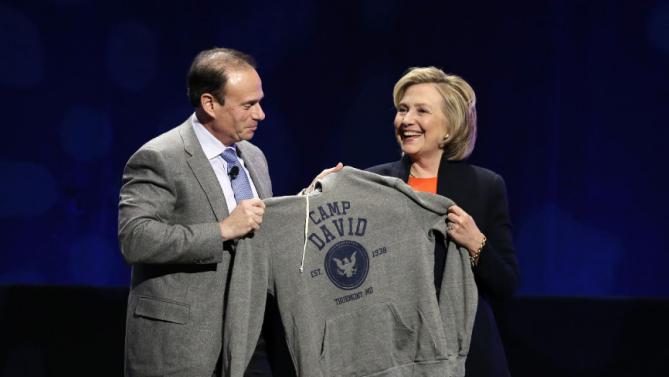
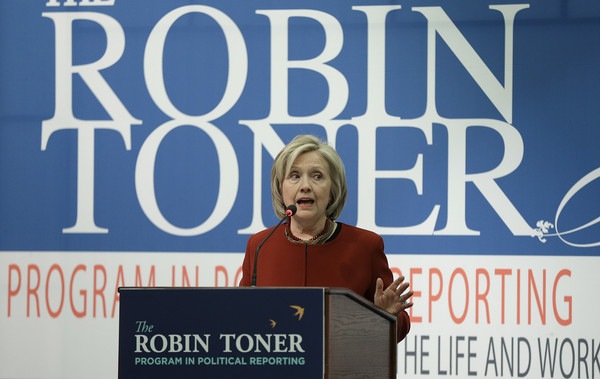
addressing camp professionals in Atlantic City, New Jersey. Near the
end of March, she keynoted the Toner Award event in D.C.
Hillary
also continued being recognized with awards and honors. Emily's list
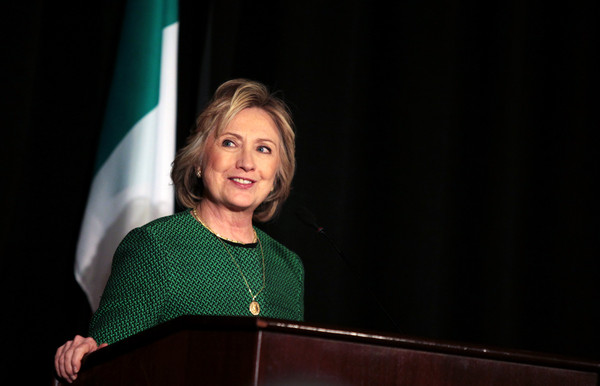
bestowed their We Are Emily Award on her and Irish America Magazine
inducted her into their Hall of Fame.
Over
the course of the month, Hillary became very active on Twitter
speaking out on a variety of issues. This attention to current events
on social media added to the weaning off of scheduled paid speaking
events signaled that change was in the air. Meanwhile the House Select
Committee on Benghazi continued beating their drums and ended the month
insisting that she testify in private rather than publicly. It was
becoming clear that there was an impending campaign and the Republicans
in Congress intended to head it off or inflict damage by using their
sworn sacred duty for dirty political purposes. That was lost on no one here or
anywhere in the Hillary world.
Like many of Hillary Clinton's supporters, I subscribe to a variety
of news feeds to keep up with our "Energizer Bunny" on the campaign
trail and elsewhere. I receive alerts from the New York Times
at intervals day and night. About to sign off for the night awhile
ago, I found this compilation from them among the alerts in my email.
Generally these alerts consist of one to maybe three or four stories.
This alert is very different. They have taken the time and trouble to
collect her policy positions on a dozen issues.
We know that we can go to her website and find this information because we are her team.
It seems extraordinary to me that a publication has gone through the
process of compiling all of this material on a single candidate.
Hillary has put forth the most complex, integrated, and complete plans of any candidate in this 2016 race. She tells us not only what she will do but also how she will do it and how any particular fits into the general schema.
The
policies and plans form a platform so strong, solid, beautifully
joined, and well-constructed that no other candidate approaches her
craftsmanship. It is a work of art and many sciences. Most
exceptionally, she is not finished yet! There is more to come!
Thank you, New York Times for sharing Hillary's positions with all who might otherwise have missed them.
(Please note that I have altered the format - not the content - to fit this blog platform.)
Hillary Clinton on Climate Change Read the latest updates from Mrs. Clinton.
***********************************************************************************************
2.
Hillary Clinton on ISIS Read the latest updates from Mrs. Clinton.
***********************************************************************************************
3.
Hillary Clinton on the Death Penalty Read the latest updates from Mrs. Clinton.
***********************************************************************************************
4.
Hillary Clinton on Syria Read the latest updates from Mrs. Clinton.
***********************************************************************************************
5.
Hillary Clinton on Immigration Read the latest updates from Mrs. Clinton.
***********************************************************************************************
6.
Hillary Clinton on Gun Control Read the latest updates from Mrs. Clinton.
***********************************************************************************************
8.
Hillary Clinton on Israel Read the latest updates from Mrs. Clinton.
**********************************************************************************************
9.
Hillary Clinton on the N.S.A. Read the latest updates from Mrs. Clinton.
*********************************************************************************************
12.
Hillary Clinton on Same-Sex Marriage Read the latest updates from Mrs. Clinton.
*********************************************************************************************


 Hillary Clinton, flanked by Bill Clinton, left, and Tim Kaine, giving her concession speech in Manhattan the day after Election Day in 2016. Credit Ruth Fremson/The New York Times.
















 INTERACTIVE