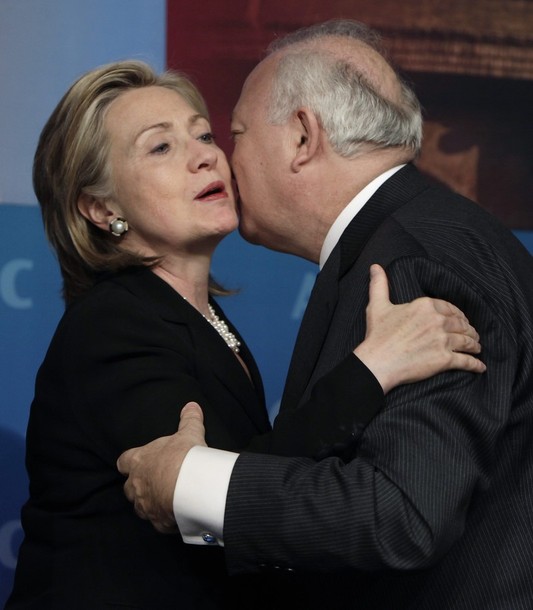
The Secretary of State is busily turning out text. This op-ed, co-written with Cathy Ashton and Miguel Moratinos, pictured with her below from an April event, addresses a rededication of the U.S. and E.U. to help reconstruct the Balkans. Next week in Sarajevo, a rededication compact will be formalized. Any one who watched the Olympics in Sarajevo and then saw those venues devastated by war would agree. The Balkans deserve this.
The Balkans Deserve This
Op-Ed By Hillary Clinton, Catherine Ashton and Miguel Angel Moratinos
Washington, DC
May 30, 2010
In Sarajevo the region can embrace the new dynamic of European and Atlantic integration
Almost a century ago, a war that changed European history began in Sarajevo. Nearly 20 years ago, the city was the centre of another violent conflict that ended only with the 1995 Dayton Accords. And 10 years ago, with the memory of the Yugoslavian wars still fresh, the European Union affirmed the crucial role of Euro-Atlantic multilateral institutions in the security and stability of the Balkans. Today Sarajevo is at peace, a symbol of rebirth and reconciliation, representing all the opportunities and challenges of European and Euro-Atlantic integration.
On Wednesday the EU Spanish presidency will host a ministerial meeting in Sarajevo attended by senior leaders from EU member states, the western Balkans, the US, Russia and Turkey to reaffirm our shared commitment to the security of the Balkans through integration into European and Euro-Atlantic institutions. Integrating the western Balkans remains one of the last challenges to building a democratic and unified Europe. In Sarajevo EU ministers will recommit themselves to the Balkans' place in Europe. Ministers from the region will reaffirm their commitment to implement the reforms necessary to meet the aspirations of their people and to move their countries on the path to the Euro-Atlantic community.
As we have seen in the past two decades, the perspective of integration into the EU and NATO is a powerful driver of reform, economic prosperity and the rule of law. It means a seat at the table in European decisions, free movement of goods and people and a guarantee of security. The reforms required are also transformative. The people of the region want and deserve transparency and accountability in their governments, a level playing field for business and the opportunity to raise their children in peace and security. This is also what we want for them. The pace of global change is such that none of us can afford stagnation and "business as usual". Commitments on both sides have to be real, not rhetorical.
The rationale for this new path is clear: to replace the old dynamics of disintegration with the new dynamic of European integration. The Lisbon Treaty embodies the ambition of the EU to become a more effective global actor, and the Balkans represent an important test for the success of this ambition.
The leaders of the Balkans will have our full support as they confront the challenges of reform. Beyond complying with the political and economic Copenhagen criteria, they must commit to reconciliation among ethnic and religious communities and political groups to build a new national consensus.
The EU and the US have spared no effort in the course of these months to tackle the many fronts in the process of stabilising and "Europeanising" the Balkans, and anchoring the rule of law and good governance. The Obama Administration is committed to remain engaged in the region through completion of our shared vision.
A little over a year ago, Joe Biden, the US Vice President, and Javier Solana, the EU High Representative, visited Sarajevo with a message of hope: the doors to Euro-Atlantic institutions remain open to all the countries of the Balkans, once they meet the requirements for accession. The compact with the region, to which the EU and US will rededicate ourselves at Sarajevo on Wednesday, remains firm: we stand ready to assist the citizens and leaders of the region in building a better future together.
Hillary Clinton is the US Secretary of State; Catherine Ashton is the High Representative of the European Union for Foreign Affairs and security policy; Miguel Angel Moratinos is Spain's Minister of Foreign Affairs
Finally, I have caught up with the two bilaterals from yesterday!
Remarks With Kuwaiti Deputy Prime Minister Muhammad al-Sabah After Their Meeting
Hillary Rodham Clinton Secretary of State Treaty Room Washington, DC April 30, 2010
SECRETARY CLINTON: Good morning. Well, once again, it is an honor to welcome His Excellency the deputy prime minister to the State Department. I first met Dr. Muhammad when he was serving as Kuwait’s ambassador to Washington back in the 1990s, and it is such a pleasure to work with him. Today as always, we had a very productive and constructive exchange of views that covered a wide range of common concerns.
Kuwait is a trusted and valued partner of the United States. Our countries share a bond forged during the U.S.-led liberation of Kuwait in 1991 and strengthened by years of partnership and mutual respect. We appreciate Kuwait’s leadership as the chair of the Gulf Cooperation Council. We look forward to continuing to work with Kuwait on our shared goals of peace, stability, and prosperity in the region and beyond.
The deputy prime minister and I discussed recent political developments in Iraq and the ongoing process of forming a new government. The security and stability of Iraq is critical to the security and stability of Kuwait, but of indeed the entire region. The United States recognizes that there is still work to be done to address some of the outstanding issues related to the Iraq-Kuwait relationship, and we are committed to working with Kuwait and the new Government of Iraq and the United Nations in the months ahead.
I also updated the deputy prime minister on our ongoing efforts, along with our international partners, to secure a United Nations Security Council resolution on Iran. We discussed the importance of diplomatic efforts to encourage Iran to abide by its international nuclear obligations. On Monday, I will attend the conference in New York reviewing the Nonproliferation Treaty and we will be underscoring once again the importance of all nations upholding their responsibilities.
We also discussed our shared goal of achieving a comprehensive peace in the Middle East. As I said last night at the American Jewish Committee, the Middle East will never realize its full potential, Israel will never be truly secure, the Palestinians will never have their legitimate aspiration for a state, unless we create the circumstances in which positive negotiations can occur. We are also seeking not only a two-state solution negotiated by the parties, but a regional peace between Israel and Syria, between Israel and Lebanon, and normal relations between Israel and the Arab states. We believe that through good faith negotiations, the parties can mutually agree to an outcome which ends the conflict and reconciles the Palestinian goal of an independent and viable state based on the ’67 lines with agreed swaps and Israel’s goal of a Jewish state with the secure and recognized borders that reflect subsequent developments and meet Israel’s security requirements.
Simultaneously moving toward a broader regional peace will help set up the conditions for that outcome. I commend Kuwait for its support of the Arab peace initiative, which offers a vision of a better future for all of the people of the Middle East. And I look forward to seeing it advanced by actions as well as words.
Now, we are very committed – deeply committed – to a prosperous, secure, democratic future for the people of Kuwait. We will continue working together to broaden the partnership between our governments and deepen the friendship between our people. We are very grateful for Kuwait’s support of our efforts with our troops and the many difficult challenges that have faced our ongoing actions in Iraq. And Kuwait has been a stalwart supporter and friend. So thank you again.
DEPUTY PRIME MINISTER AL-SABAH: Thank you, Madam Secretary. It’s always great being back to the States and especially to the State Department. I value your friendship and your advice. We – I think I don’t have to, again, say what we have discussed because that has been fully covered by the Secretary’s statement. But I would like also to emphasize the kind of bilateral relations that we emphasized in our discussion. I also raised the issue of Kuwait’s desire to acquire nuclear technology for peaceful purposes, and we are going to work very closely with the United States on that issue.
Also, we have raised the issue of our detainees in Guantanamo, and this is an area that is – present continuous hardship, I think both for the United States Government and the Kuwaiti Government and the people of Kuwait. And we have agreed on a ways to resolve this issue in the near future.
I thank you very much, Secretary Clinton, for your friendship and I look forward to work with you on all the issues that you have mentioned.
SECRETARY CLINTON: Thank you. Thank you so much.
DEPUTY PRIME MINISTER AL-SABAH: Thank you.
MR. CROWLEY: (Inaudible.) We have time two questions. One (inaudible).
QUESTION: Madam Secretary, the Palestinians said they received a letter from President Obama about the peace process. And I’m wondering can you tell us if the U.S. is making any new commitments to President Abbas to get him back to the negotiating table, and are you confident that proximity talks may start again soon?
And for the deputy prime minister, Secretary Clinton last night made a pretty strong call for more help from the Arab states to get the peace process on track. I’m wondering from your perspective what you think the Arab states can do in order to get the proximity talks underway.
Thank you.
SECRETARY CLINTON: Well, Andy, I’m not going to comment on any correspondence between President Obama and President Abbas. I think we’ve been very clear in our efforts that the resumption of talks is absolutely essential for the progress we seek toward a two-state solution. We will be starting with proximity talks next week. Senator Mitchell will be going back to the region. And we look forward to the meeting of the Arab follow-up committee in Cairo tomorrow night to support the commitment by President Abbas to move forward with these talks.
Ultimately, we want to see the parties in direct negotiations and working out all the difficult issues that they must – they’ve been close a few times before. I remember very well the Camp David experience, and I know that President Abbas negotiated with former Prime Minister Olmert. So we are looking to see the resumption of those discussions.
DEPUTY PRIME MINSTER AL-SABAH: Well, the United States has indicated that peace in our region is of national security interest to the United States. We are strategic partners and strategic allies to the United States, so it is incumbent on us to help the United States achieve that. This is something that would benefit us and the people in the region as a whole. We have supported the proximity talks during early March. Unfortunately, the response from Israel was an announcement to build 1,600 houses in East Jerusalem, as if it was a response to our support for the proximity talks. Yet we did not be discouraged by that during the Arab summit in Tripoli where we confirmed our commitment to the proximity talk to help United States achieve this strategic objective by resuming the discussion on the parameters that was stated by President Obama during his speech to the United Nations. I think this is something that we all support, and that we support fully the position that the United States has taken.
MR. CROWLEY: (Off-mike.)
QUESTION: My question is (inaudible) statement – my question is: Can you specifically say to the people of the region what the United States is (inaudible) of the (inaudible) about the peace and stability of this region, taking into consideration this threat (inaudible)? Thank you.
SECRETARY CLINTON: Thank you.
QUESTION: Another question after that (inaudible)?
SECRETARY CLINTON: Well, do you want to ask that question, sir, and then you want to ask the question to the deputy prime minister?
QUESTION: Yes.
SECRETARY CLINTON: You know, as the deputy prime minister said, Kuwait and the United States are strategic allies and we work together to address the challenges and threats that our strategic ally faces. There’s no doubt that a great deal of concern is merited within the region concerning Iran – Iran’s pursuit of nuclear weapons, Iran’s efforts to support terrorism, Iran’s unfortunate behavior undermining governments across the region and beyond.
So we know that we have to work together and we are doing so. We are working to isolate Iran through the United Nations. We’re in the midst of negotiations over a Security Council resolution that will impose consequences on Iran for its unwillingness to follow the IAEA or the United Nations Security Council requirements about its nuclear program. We are working to support the defense and territorial integrity of our partners and allies in the Gulf, and we consult closely.
The deputy prime minister will be also meeting with Secretary Gates. I mean, our whole government is committed to working with Kuwait to provide Kuwait with the support it needs to deal with any of the challenges or threats it faces.
QUESTION: (In Arabic.)
(Via interpreter) Your Excellency, there are many issues that you have discussed with the U.S. Secretary of State, Secretary Clinton. Are there any new positions? Are there any new views or it is just a recurrence of all the point of views put forth again?
DEPUTY FOREIGN MINISTER AL-SABAH: (Via interpreter) I believe that we have discussed with Secretary Clinton many very important issues that have been on the agenda of the region for a very, very long time. I believe that the ideas that were put forth were those ideas of President Obama during his speech at UNGA, at the UN General Assembly, last September in his remarks to that institution. And I believe that these ideas reflect the Arab ideas.
What is needed is peace. We need to bring about peace, a peace that is based on a two-state solution for an independent and viable Palestinian state with its capital, East Jerusalem, and a state that would live in peace and security with its neighbor.
SECRETARY CLINTON: Thank you all
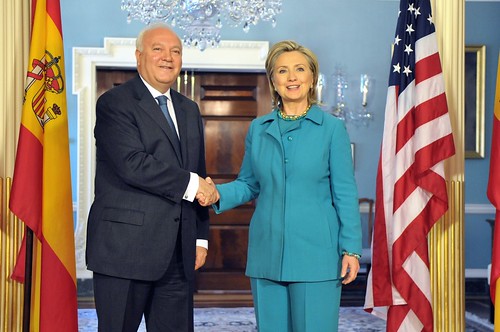
Remarks With Spanish Foreign Minister Miguel Angel Moratinos Before Their Meeting
Hillary Rodham Clinton Secretary of State Treaty Room Washington, DC April 30, 2010
SECRETARY CLINTON: Oh, I’m delighted and I’m going to tell the world how delighted I am –
FOREIGN MINISTER MORATINOS: Absolutely.
SECRETARY CLINTON: -- to have my friend, the Foreign Minister of Spain, here. I was with him last night at an event here in Washington where he spoke, and I just am delighted that we get to see one another on a regular basis and work on so many important issues.
FOREIGN MINISTER MORATINOS: Well, I’m very happy again, just today, we worked together to push forward in the Obama Administration-Hillary Clinton leadership for moving forward on the Middle East. I think – I hope that the things are going to be on track. And of course, Spain and European Union are going to work hand-by-hand in order to make it possible. And of course, we have been on bilateral level excellent relations, opportunity to discuss other issues of interest for both side – the Western Balkans, Latin America, so many issues.
Having been negligent about posting here, I now find myself having to catch up with a whole long trip the intrepid, indomitable and inexhaustible Secretary of State has been on Since March 31. Barely had her feet hit the ground in D.C. after her Mexican excursion, when she once again mounted the "Big Blue Plane" and took off for Europe. Here's her journey.
She touched down in Amsterdam for a Conference of Afghanistan at The Hague. Here we see her with Dutch Foreign Minister Maxime Verhagen.
Of course she spoke.
Remarks at The International Conference on Afghanistan
Speech
Hillary Rodham Clinton Secretary of State
The Hague, Netherlands
March 31, 2009
Thank you
very much, Minister Verhagen, and Secretary-General Ban Ki-moon,
Special Representative Kai Eide, President Karzai, Minister Spanta,
friends and colleagues, I want to thank all of you, and especially the
United Nations and the Government of the Netherlands for hosting us. I
also want to acknowledge the extraordinary contribution of the
government and people of the Netherlands to the mission in Afghanistan.
And
I want to also acknowledge President Karzai, who fills a critical
leadership role in his nation, and whose government helped to shape the
shared comprehensive and workable strategy that we are discussing today.
We
are here to help the people of Afghanistan prevail against a ruthless
enemy who poses a common threat to us all. Afghanistan has always been a
crossroads of civilization, and today we find our fate converging in
those plains and mountains that are so far and yet so near in this
interconnected world to all of us.
Thanks to the efforts of the
international community, the perpetrators of the horrific terrorist
attacks of 9/11 – attacks which killed citizens from more than 90
countries – were driven from Afghanistan, and the Afghan people made a
promising start toward a more secure future. But since those first
hopeful moments, our collective inability to implement a clear and
sustained strategy has allowed violent extremists to regain a foothold
in Afghanistan and in Pakistan, and to make the area a nerve center for
efforts to spread violence from London to Mumbai.
The range of
countries and institutions represented here is a universal recognition
that what happens in Afghanistan matters to us all. Our failure to bring
peace and progress would be a setback not only to the people of
Afghanistan, but to the entire enterprise of collective action in the
interest of collective security. Our success, on the other hand, will
not only benefit Afghanistan, Pakistan and the region, but also the
blueprint for a new diplomacy powered by partnership and premised on
shared interests.
So as we recommit ourselves to meet our common
challenge with a new strategy, new energy, and new resources, let us be
guided by an ancient Afghan proverb, “patience is bitter, but its fruit
is sweet.”
The plan I outline today is the product of intensive
consultations with nations that have donated troops and support;
Afghanistan’s neighbors and international institutions that play a vital
role in Afghanistan’s future. The results of these consultations are
clear: Our strategy must address the challenge in Afghanistan and
Pakistan; it must integrate military and civilian activities and support
them with vigorous international diplomacy; and it must rest on the
simple premise that while we can and will help, Afghanistan’s future
ultimately rests with the Afghan people and their elected government.
Security is the essential first step; without it, all else fails.
Afghanistan’s army and police will have to take the lead, supported by
the International Security Assistance Force.
President Obama has
announced that the United States will deploy 17,000 more soldiers and
4,000 additional military trainers to help build up Afghan security
forces. The international community will also have to help. We should
provide every army and police unit in Afghanistan with an international
partner that can provide training and help build capacity. Our
collective goal should be standing up an army of at least 134,000
soldiers and a police force of at least 82,000 officers by 2011. These
steps will provide the people of Afghanistan with an opportunity to
fight and win their own battle for their nation’s future.
We must
also help Afghans strengthen their economy and institutions. They know
how to rebuild their country, but they need the raw material of progress
– roads, public institutions, schools, hospitals, irrigation, and
agriculture. The United States is supporting the Government of
Afghanistan’s National Development Strategy, the National Solidarity
Program, and other initiatives that help Afghans improve their lives and
strengthen their own communities.
In consultation with the
Afghan Government, we have also identified agriculture – which comprises
70 percent of Afghanistan’s economy – as the key for development. In
the 1970s, Afghans exported food to their neighbors. They were often
called the garden of Central Asia. Today, this sector lags far behind,
and its problems feed the deadly malignancy of the narcotics trade. The
United States is focusing its efforts on rural development in provinces
near the Afghan-Pakistan border, and we hope that others gathered here
will heed the United Nations’ and Afghan Government’s call for help
throughout the country with job creation, technical expertise,
vocational training, and investments in roads, electrical transmission
lines, education, healthcare, and so much else.
As we work with
the Afghan people to supply these building blocks of development, we
must demand accountability from ourselves and from the Afghan
Government. Corruption is a cancer as dangerous to long-term success as
the Taliban or al-Qaida. A government that cannot deliver accountable
services for its people is a terrorist’s best recruiting tool.
So
we must work with bodies such as Afghanistan’s Independent Directorate
of Local Governance to ensure that the government at all levels is
responsible and transparent. The international community, gathered here,
can help by providing auditors and governance experts and training a
new generation of civil servants and administrators.
To earn the
trust of the Afghan people, the Afghan Government must be legitimate
and respected. This requires a successful election in August – one that
is open, free, and fair. That can only happen with strong support from
the international community. I am, therefore, pleased to announce today
that to advance that goal, the United States is committing $40 million
to help fund Afghanistan’s upcoming elections.
We must also
support efforts by the Government of Afghanistan to separate the
extremists of al-Qaida and the Taliban from those who joined their ranks
not out of conviction, but out of desperation. This is, in fact, the
case for a majority of those fighting with the Taliban. They should be
offered an honorable form of reconciliation and reintegration into a
peaceful society if they are willing to abandon violence, break with
al-Qaida, and support the constitution.
Just as these problems
cannot be solved without the Afghan people, they cannot be solved
without the help of Afghanistan’s neighbors. Trafficking in narcotics,
the spread of violent extremism, economic stagnation, water management,
electrification, and irrigation are regional challenges that require
regional solutions.
The United Nations has a central role in this
effort to coordinate with the Government of Afghanistan and neighbors
in the region to make sure that programs are properly prioritized and
well focused. We are committed to working with Secretary-General Ban
Ki-moon and UN Special Representative Kai Eide to achieve that goal. The
United States Special Representative for Afghanistan and Pakistan,
Ambassador Richard Holbrooke, will lead American efforts as we move
forward, and we welcome the appointment of special representatives by
other countries.
If we are to succeed, we will need the help of
all the nations present here. As President Obama has pointed out, “the
world cannot afford the price that will come due if Afghanistan slides
back into chaos.” While there is great temptation to retreat inward in
these difficult economic times, it is precisely at such moments that we
must redouble our effort. And as we make commitments and contributions,
we must ensure they are flexible enough to respond to immediate needs
and evolving opportunities. And we all must be willing to coordinate
those efforts together.
The challenge we face is difficult,
but the opportunity is clear if we move away from the past. All too
often in the past seven years, our efforts have been undermanned,
under-resourced and underfunded. This goal is achievable. We know we
have made progress where we have made adequate investment and worked
together.
The status of Afghanistan’s army, the lives of women
and girls, the country’s education and health systems are far better
today than they were in 2001. So if all of us represented here work with
the government and people of Afghanistan, we will help not only to
secure their future, but ours as well.
Now the principal focus
of our discussions today is on Afghanistan, but we cannot hope to
succeed if those who seek to reestablish a haven for violence and
extremism operate from sanctuaries just across the border. For this
reason, our partnership with Pakistan is critical. Together, we all must
give Pakistan the tools it needs to fight extremists within its
borders.
The Obama Administration has made a strong
commitment through our support for legislation called the Kerry-Lugar
assistance program. And in a few weeks, we will have a chance to join
together in Tokyo for a meeting of the Friends of Democratic Pakistan to
provide the support that the Pakistani Government and people need. I
urge the nations here today in support of Afghanistan to join us in
Tokyo on April 17th to help the people of Pakistan.
This
effort has already required great sacrifice and it will require more.
But in Afghanistan and Pakistan, we face a common threat, a common
enemy, and a common task. So let us use today, this conference, to renew
and reinvigorate our commitment and our involvement, and to lay a firm
foundation for a safer region and a safer world. It is in the interests
of all of the people who we represent as we sit around this conference
table here in The Hague, and for the kind of world that we wish to help
create.
Thank you very much.
That's Maxime Verhagen behind her in these, too.
Remarks With Dutch Foreign Minister Maxime Verhagen
Remarks
Hillary Rodham Clinton Secretary of State
The Hague, Netherlands
March 31, 2009
FOREIGN MINISTER VERHAGEN:
Madame Secretary, ladies and gentlemen, I want to extend a warm welcome
to Secretary Clinton for her visit to the Netherlands, especially
because we want to celebrate this year, 400 years of friendship between
our two countries. Maybe not in a big tent we are today, but in a place
big enough to host all the delegations, all the people who are involved
in the future of Afghanistan, and who know that we have a stake in the
future of Afghanistan.
The United States and the Netherlands
and over 80 other countries and organizations are today meeting in The
Hague. We have serious choices to make today. In recent years, NATO and
its partners have reduced the threat of terrorists who once found a free
haven in Afghanistan and planned attacks on peaceful citizens all over
the world. But our work in Afghanistan is still far from done. And
Secretary Clinton and I discussed our analyses of the situation and the
possible ways forward. And the Netherlands welcomes the outcome of the
policy review conducted by the United States.
As the review
makes clear, Afghanistan and the region cannot be made safe by military
force alone. Diplomacy and development are equally important. Afghan
citizens as well as our own citizens need to know what our strategy will
be. And I hope today in The Hague, we will start working on a new deal
for Afghanistan, a common contract, a new Afghan bond. Achieving respect
for human rights, good governance, and social and economic progress are
equally important. And I’m sure that the United States and the
Netherlands agree that such an Afghan bond must reflect a comprehensive
and integrated approach.
In the province of Uruzgan in the
south of the country, Dutch diplomats, development workers and military,
together with our allies, are learning to do just that. And although
the situation is far from irreversible, the number of security incidents
is stable and development is picking up. So the Netherlands very much
welcomes the American commitment to the training of the Afghan army and
police, because this will enable the international community to proceed
from implementing to assisting.
In the end, the Afghan people
themselves have to be able to provide security and to lead the
development of their country. And this conference proves the
international community as a whole stays and is wanting to stay
committed to the Afghan people.
Madame Secretary, thank you very much and I hope that we will have a very fruitful conference today. SECRETARY CLINTON:
Well, thank you so much, Minister, and I am confident that this
conference will make a great difference. And I am very grateful to you
personally and to the Dutch Government for making this conference
possible in such a short period of time. It was less than a month ago
that we first discussed this together in Brussels. And once again, the
Dutch Government is at the forefront of the work done on behalf of the
global community, and I appreciate that.
You know, as the
minister said, Dutch troops are leading the effort in Afghanistan. In
Uruzgan Province, as the minister referenced, the success of the
policies implemented by the Dutch forces is remarkable. At the center of
our efforts is a courageous military commitment by the Dutch people and
their government, and it has proven results. It is not a surprise that
the three Ds that the Dutch have pursued in their mission in Afghanistan
– defense, diplomacy and development – are ones that I personally
believe is exactly the right framework.
More than 80 nations
and organizations have been brought together here in The Hague. And this
conference is critical to our way forward. The Dutch people have played
a vital role in advancing security and spreading opportunity far beyond
your borders. And this time in particular, our commitment going forward
in Afghanistan has great consequences for all of our people, all free
people, all people who share the values that the Dutch and the Americans
share. I will be speaking later at the conference about the Obama
Administration’s strategy for Afghanistan. It is based on collaboration
and consultation with our friends and partners.
I looked to
the Netherlands not only because of the work that has been done in
Afghanistan, but the unsurpassed commitment to fighting poverty and
promoting development worldwide. The Netherlands has been a key ally for
many decades. The fact that this country is the sixth most generous
contributor to international development assistance says volumes about
the values of the Dutch people. We will continue to seek your advice and
your ideas, your guidance as we work together.
Now the ties between our two countries have a long history. This year, we celebrate the 400th
anniversary of Henry Hudson’s legendary voyage which took him from
Amsterdam to New Amsterdam. And it marked the beginning of a great
chapter in American history and American and Dutch cooperation. I know
that the people of New Amsterdam, Minister, a city that is very dear to
my heart, have already begun to celebrate this anniversary. I look
forward to welcoming you to the United States in a few weeks, where I
hope that we can bring even greater attention to the ties that join us
and to the values that extend beyond time. And I look forward to many
centuries of friendship and partnership between the American and Dutch
people.
Thank you very much. FOREIGN MINISTER VERHAGEN: Thank you. QUESTION: Madame Secretary (inaudible) after 2010, what do you think can be the role for the Netherlands after that period? SECRETARY CLINTON:
Well, that is, of course, up to the Dutch Government and the Dutch
people. But I think the people of the Netherlands should know, certainly
from my perspective, the extraordinary contribution and leadership that
your mission in Afghanistan has provided. We understand very well the
sacrifices, the individual sacrifices as well as the collective ones
that such a mission demonstrates. But it has been extraordinarily
successful. And in fact, our strategic review is building on many of the
ideas and the principles that were brought to bear by the Dutch in
Afghanistan. But of course, any decision in the future is up to the
people of the Netherlands and their government.
Thank you.
When the conference ended, she hopped the Channel and met up with British Foreign Minister Davis Milibrand with whom we've seen her form a fast friendship. Her Daily Schedule as issued by the State Department stated simply that she was on foreign travel with the President who was in London for an Economic Summit.
Here Hillary and David are in front of 10 Downing Street where the Prime Minister, Gordon Brown resides. Looks like they were happy to catch a few rays. (Just enough for your daily dose of vitamin D, Hilly! Don't damage your pretty skin, please).
Along with other Foreign dignitaries, Hillary attended a reception by the Queen. She wore a lovely black pantsuit (looks like silk) with a beautiful ruffled blouse beneath. Very pretty, as you can see. She is being greeted by a Lady-in-waiting to the Queen, Mrs. Jennifer Gordon-Lennox.
Of course in these pictures you will recognize Queen Elizabeth II and Nicholas Sarkozy, President of France who is gripping Hillary in the second picture. (Be careful, Nick. Don't break her). We have seen the men drawn to Hillary like bees to honey. Apart from what we see in pictures, her beautiful, cheerful smile, her pretty figure in beautiful colors, her pretty hair, we know she has a great sense of humor, is a wonderful listener (men love that), and has very soft hands and always smells great!
Here she is with Charles and Camilla and with President Obama and Treasury Secretary, Timothy Geithner in a meeting.
From London, it was on to Baden Baden, Germany, and Strasbourg, France for a NATO Summit. Upon arrival at Baden Baden, she was warmly greeted By German Foreign Minister Frank-Walter Steinmeier and German Chancellor, Angela Merkel.
She wore this elegant out fit to a working dinner that night. We see her here with Spanish Foreign Minister Miguel Angel Moratinos.
Laughing with NATO Secretary General, General Jaap de Hoop Scheffer. As I said, she has a great sense of humor. I wonder what she said!
Her European journey ended in Prague. Here she is in a group picture with all the NATO Foreign Ministers. Pretty in pink. Magnetic and adorable. (Whom are you flirting with, Hills?)
She flew back yesterday (Sunday) as did Michelle Obama. Hillary hosted the Joint Session of the Antarctic Treaty Consultative Meeting and the Arctic Council, 50th Anniversary of the Antarctic Treaty this morning. It was HUGE!
Whew! I am worn out just getting this all down. And look at Hillary! Fresh and pretty as a spring blossom, and she smells as good, too - we know!
Secretary of State Hillary Rodham Clinton and Spanish Foreign Minister Miguel Angel Moratinos Before Their Meeting
Remarks
Hillary Rodham Clinton
Secretary of State
Washington, DC
February 24, 2009
SECRETARY CLINTON: Good morning. FOREIGN MINISTER MORATINOS: Good morning. QUESTION: Madame Secretary, can you say a few words about what you plan for the Gaza donors’ conference? SECRETARY CLINTON:
Well, we are still working on that. We have made no decisions, and we
are working across the government to determine what our approach will
be. And I’m looking forward to attending. But you know, there’s still a
lot of work to do. Thank you all very much.
Photo Opportunity with Secretary Clinton and Timor-Leste President Jose Ramos-Horta
Photo Opportunity
Hillary Rodham Clinton
Secretary of State
Treaty Room
Washington, DC
February 24, 2009
View Video
SECRETARY CLINTON: Good afternoon. I’m so pleased to welcome you, Mr. President. PRESIDENT RAMOS-HORTA: Thank you. SECRETARY CLINTON: It’s such a pleasure to have you here. PRESIDENT RAMOS-HORTA: Thank you. QUESTION: So, Madame Secretary, what will be your title for Dennis Ross? Is it a special advisor on Iran? (Laughter.) SECRETARY CLINTON: You know, there is so much work we’re doing, I’m so pleased to have so many good people helping me. QUESTION: Thank you. SECRETARY CLINTON: Thank you.
Photo Opportunity with Secretary Clinton and Canadian Minister of Foreign Affairs Lawrence Cannon
Hillary Rodham Clinton
Secretary of State
Secretary Clinton and Canadian Minister of Foreign Affairs Lawrence Cannon Before Their Meeting
Treaty Room
Washington, DC
February 24, 2009
SECRETARY CLINTON:
Hello. This is a big week for Canada, and I just expressed the
appreciation that we feel for the wonderful welcome and hospitality that
President Obama received on his visit. And I’m delighted to have you
here. FOREIGN MINISTER CANNON: Well, I am very pleased to be
here, Madame Secretary, and particularly after that great visit in
Canada. And hopefully, we’ll have you there in Canada very shortly to be
able to match that. SECRETARY CLINTON: You know, I -- FOREIGN MINISTER CANNON: I’m sure you’re going to be very well received as well. SECRETARY CLINTON:
Thank you. I’m looking forward to it. I’ve always enjoyed my visits to
Canada, and I had one memorable visit when we had a state visit, and I
got to skate on the canals in Ottawa. That was a personal highlight, so
thank you all very much. FOREIGN MINISTER CANNON: Thank you. QUESTION: Happy Mardi Gras. SECRETARY CLINTON: Now, Matt, I am so happy to know that you’re on top of what’s going on. (Laughter.) QUESTION: The most important things. SECRETARY CLINTON:
It is the most important thing. I’m just surprised you’re here covering
this instead of out celebrating. (Laughter.) Nice to see you all.
Remarks With Pakistani Foreign Minister Makhdoom Shah Mehmood Qureshi
Remarks
Hillary Rodham Clinton
Secretary of State
Washington, DC
February 24, 2009
SECRETARY CLINTON:
Good afternoon. I was very pleased to welcome the minister and his
delegation here to the State Department. As you know, we are consulting
very closely with the Government of Pakistan on our strategic review of
our way forward. And I’m very grateful for the minister’s advice and
counsel, and I look forward to further discussions and to having him
back here tomorrow night for dinner along with his counterparts from
Afghanistan.
Thank you, Mr. Minister. FOREIGN MINISTER QURESHI: Thank you. SECRETARY CLINTON: Thank you. It was a pleasure. Thank you all very much. QUESTION:
Mr. Minister, do you have any concerns that the 17,000 troops announced
by President Obama going into southern Afghanistan will push the
Taliban further into areas of Pakistan like Baluchistan? And Secretary
Clinton, did you assure the minister that you’ll work with Pakistan on
that? SECRETARY CLINTON: Well, we’re going to save our
comments for when we have something to say about the results of our
joint efforts. And there is a very open and fully consultative – a full
consultative process which we will be working on, and many of these
issues will be discussed among us.
Thank you all very much. FOREIGN MINISTER QURESHI:
We had an excellent meeting. There’s a convergence between us, there’s a
willingness to work together, and I see a lot of hope in the new
Administration, the new leadership. And Pakistan is willing to work with
the American Administration to fight extremism and terrorism. We are
determined to defeat terrorism in all its forms and manifestations.





 SECRETARY CLINTON: Good afternoon. I’m so pleased to welcome you, Mr. President.
 SECRETARY CLINTON:
Hello. This is a big week for Canada, and I just expressed the
appreciation that we feel for the wonderful welcome and hospitality that
President Obama received on his visit. And I’m delighted to have you
here.
SECRETARY CLINTON:
Hello. This is a big week for Canada, and I just expressed the
appreciation that we feel for the wonderful welcome and hospitality that
President Obama received on his visit. And I’m delighted to have you
here. SECRETARY CLINTON:
Good afternoon. I was very pleased to welcome the minister and his
delegation here to the State Department. As you know, we are consulting
very closely with the Government of Pakistan on our strategic review of
our way forward. And I’m very grateful for the minister’s advice and
counsel, and I look forward to further discussions and to having him
back here tomorrow night for dinner along with his counterparts from
Afghanistan.
SECRETARY CLINTON:
Good afternoon. I was very pleased to welcome the minister and his
delegation here to the State Department. As you know, we are consulting
very closely with the Government of Pakistan on our strategic review of
our way forward. And I’m very grateful for the minister’s advice and
counsel, and I look forward to further discussions and to having him
back here tomorrow night for dinner along with his counterparts from
Afghanistan.


