Hillary Clinton and NYC First Lady Chirlane McCray held a surprise
event in Brooklyn today. Hillary, obviously, was in her element!
Wednesday
Apr 01
2015
Too Small to Fail Releases “Talking is
Teaching Community Campaign Guide” to Activate and Enhance Local Word
Gap Campaigns Nationwide
New York — Too Small to Fail released
today its “Talking is Teaching Community Campaign Guide,” a how-to
roadmap for local leaders across the country to initiate and enhance
on-the-ground efforts to help close the word gap and boost young
children’s early brain development. The guide and corresponding free
materials and resources can now be found on www.toosmall.org/community.
The Community Campaign Guide builds off the success and lessons learned from Too Small to Fail’s
local campaign efforts in Tulsa, Oklahoma and Oakland, California. The
local campaign, titled “Talking is Teaching: Talk, Read, Sing,” launched
in these communities in 2014. Since then, Too Small to Fail has
worked within these communities to engage trusted messengers — such as
pediatricians, faith-based leaders, child care providers and librarians —
to educate parents and deliver high-quality tools that can help them
engage in meaningful interactions with their young children starting at
birth.
The guide offers adaptive Talking is Teaching creative
content and resources that encourage parents to talk, read, and sing
with their children during everyday routines — from waiting for the bus,
to making dinner, to giving a bath; ideas for engaging the business
community and other allies to raise awareness; and suggestions about
elevating community messages through local media. The free multimedia
assets can be easily tailored to respond to the individual needs of a
community.
The “Talking is Teaching Community Campaign Guide” is designed to inform local efforts underway
across the country, as well as the one launched today in New York City.
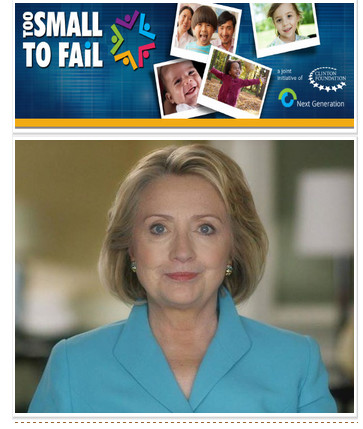
Today, at SCO FirstStepNYC Early Childhood Center in Brooklyn, former
Secretary of State Hillary Rodham Clinton joined First Lady of New York
City Chirlane McCray and local parents to launch New York City’s “Talk
to Your Baby, Their Brains Depend on It” public awareness campaign. This
campaign will distribute 100,000 toolkits to parents which will include
a “Talking is Teaching” resource for families, jointly developed by Too Small to Fail and
Sesame Street. New York City will partner with organizations such as
Reach Out and Read and the Administration for Child Services EarlyLearn
sites for distribution.
“This is a conversation we want to have
with as many people as we can reach because everybody needs to be
creative and smart about how we better prepare our kids for the future,”
said Secretary Clinton.
For more information about the “Talking is Teaching Community Campaign Guide”, visit Too Small to Fail online (www.toosmall.org/community), on Facebook (www.facebook.com/2smalltofail), or on Twitter (www.twitter.com/2smalltofail).
Photos from today’s event can be found at here.
###
Closing the Word Gap, One Community At a Time
Not long after we launched our community campaigns in Tulsa and
Oakland last year, we heard from many passionate individuals and
business leaders across the country who were eager to spread the word in
their own communities about the power of talking, reading, and singing
with young children to boost early brain development. Encouraged and
inspired by these messages, Too Small to Fail co-hosted a one-day conference on the word gap with
the White House last October, where we committed to producing a guide
with information, resources, and tools about how community leaders could
launch or enhance word gap campaigns that would meet their specific
community needs.
Now, we’re delighted to share that our new “Talking is Teaching Community Campaign Guide” is live on toosmall.org.
In it, interested community leaders will find the latest research on
early brain development, important information on launching a local word
gap campaign, and related advice from Too Small to Fail and our partners. We have also provided creative campaign assets for producing toolkits and paid media.
We’re excited to join new and existing partners across the country,
each committed to promoting early learning for young children where
they live, and empowering parents to take action to boost their
children’s language and brain development. Our hope is that communities
that are ready to join this effort will find these materials and
resources useful as they determine the best strategy to close the word
gap in in their hometowns.
Resources for Sharing:
- Learn about Too Small to Fail advisory council member Dr. Dana
Suskind’s Thirty Million Words Initiative in Chicago, Illinois in this article by the Hechinger Report.
- Our friend, Mayor Angel Taveras launched the innovation Providence Talks program in this city. Find out more about it in this New Yorker article.
Video
Don’t miss our special campaign trailer to learn more about how we’re
working with our partners in Tulsa and Oakland to promote early brain
and language development. >>


Here are the March newsletters from
Too Small to Fail.
Reading Aloud With Children For Learning and Fun
“You’re never too old, too wacky, too wild, to pick up a book and read to a child.” —Dr. Seuss
Reading
aloud to children has many benefits for both parents and children.
Books that rhyme can be especially fun to read aloud, and help children
better understand the natural rhythm and sounds of language. Perhaps few
children’s books have been as loved by both parents and children as
those written by Dr. Seuss. His books—from
Fox in Socks to
Green Eggs and Ham—are meant to be read aloud, and parents and children of all ages delight in them.
But even if parents are not comfortable reading aloud, there are other ways that they can introduce rhyming to young children.
As highlighted in
an earlier newsletter,
rhyming is an important tool for building language skills, and is used
by cultures around the world. Rhyming helps build memory, strengthen
language skills and introduce musical timing to words. When parents read
aloud or recite nursery rhymes and poetry to young children, they
expose their children to speech patterns that can improve future reading
and verbal skills. In addition, rhyming introduces playfulness to the
act of reading, which encourages a love of reading, and improves bonding
between children and adults.
Reading aloud provides an easy and
effective way for children to hear a variety of words that may not be
used in everyday life. Parents and caregivers can practice reading
rhyming and other books aloud to their babies in any language, from the
moment their children are born. But if parents are not comfortable
reading aloud, they can use singing, nursery rhymes, and even rapping to
help their children recognize patterns of speech and inspire a love of
language in their children.
Resources for Sharing:
Video
Watch these singers, elected leaders, writers, and other local West Virginia celebrities read
Oh, The Places You’ll Go! by Dr. Seuss.
>>
Even Singing Off Key Can Bring a Smile to Children’s Faces
If
YouTube videos are
any indication, most babies love music and singing. From a very early
age, children enjoy hearing silly songs, soothing lullabies and even fun
rock songs if those songs are sung by their favorite people—parents and
caregivers! New brain research continues to confirm the importance of
singing to children, and is revealing how even the simplest melodies can
contribute to early brain development.
Singing—much like
rhyming—is a special form of language that improves children’s memory,
and teaches them rhythm and melody. Brain research has shown that when
children are sung to, both the left and right sides of their brains are
activated, strengthening their neural connections. Singing can also
teach children new vocabulary words.
But children don’t get the
same benefits from listening to a CD or musical video. According to
Sally Goddard Blythe, director of the Institute for Neuro-Physiological
Psychology, the benefits to brain development occurs best when a parent
or caregiver sings directly to, and with, a young child.
Even if a
parent or caregiver feels that they can’t carry a tune, young children
appreciate the effort! Parents and caregivers can sing during everyday
activities—like at bath time or before bed—to help their babies and
toddlers develop important language and communication skills, and bring
love and joy to every day activities. Don’t know the words? Adults can
make up the words to a familiar tune, or insert a baby’s name into a
song in order to spark their interest.
Resources for Sharing:
- This blog post discusses research on the importance of music and singing to the early learning of children.
- This article from Psychology Today explains the science behind the power of singing.
- Many ideas for including singing and music into everyday activities, from Reading Rockets.
- Five songs here to help parents and caregivers sing along with their babies and toddlers!
Video
This
talented mom tries singing a few different songs to this
four-month-old, until he finally hears the one he likes. Check it out!
>>
Appreciation for Math Starts at Home!
Young
children often show a thirst for knowledge that helps their brains
develop. This thirst presents a good opportunity for parents to
encourage an early appreciation for math, which improves brain growth,
and serves as a foundation for math skills learned later in school. And
the really good news is that early math learning can be fun for both
parents and children!
While older children can learn math skills
like multiplication and algebra in school, an appreciation for and
understanding of math actually begins much earlier in a child’s life.
Stanford University professor and early math expert
Deborah Stipek explains that
math learning—like all learning—begins in infancy. Parents can begin
teaching math concepts to babies by pointing out shapes, quantities, and
the sizes of things around them. These early math concepts serve as
building blocks for later learning that will include more complicated
math principles. And the more parents talk with their babies about math
during the years their brains are rapidly expanding language, the more
likely their children are to understand, and be comfortable with, “math
talk” later on.
Parents and caregivers can use everyday, fun
activities to establish an early appreciation for the math that is all
around us. For example, parents can set up different size containers for
babies and toddlers to play with—pointing out the shapes of each and
their sizes. They can also point out the order of items on a grocery
store shelf (“first”, “second”, “next to”, “last”), to help children
learn numerical order. Even if a parent isn’t comfortable with math
problems, they can help set their children up for future success by
playing simple board games that improve counting and other math skills.
Resources for Sharing:
- This article from
PBS Parents explains why encouraging a love of math in children early
on helps them when they enter school, and beyond—and check out these fun math games for babies and toddlers!
- Our factsheet offers ideas for how parents and caregivers can talk, read and sing about math with their children every day.
- Videos, tips for parents and math games for children of all ages can be found on the website, Math at Play!
Video
Don’t
know how to begin teaching young children about math? Use the furniture
in your home! Check out this video on how to use a child’s environment
for early math learning.
>>
Good Food for Thought
Nutritious
food is important to the normal development of very young children.
From brain growth to physical strength, healthy food provides the fuel
that babies and toddlers need to thrive. But offering healthful food to
young children doesn’t have to be stressful for parents and caregivers.
There are many ways that parents can help their children enjoy healthy
eating—even among picky eaters!
According to
decades of clinical studies,
good nutrition during the first few years of life are important to
normal brain development—providing essential vitamins, minerals, fats
and proteins that the brain needs to make new neural connections.
Healthful food also provides young children with the energy and strength
they need to develop motor skills, language, and even social and
emotional skills. Studies of malnourished children show that without the
right kinds of nutrition, children have difficulty concentrating, show
poor interest in learning and may exhibit behavior problems.
Parents
and caregivers can ensure the good nutrition of their young children by
establishing healthy food habits, and offering a wide variety of
healthful foods that contain a proper balance of nutrients. Even picky
toddlers often enjoy meals that allow them to choose from a variety of
nutrient rich foods, and incorporate interesting shapes or colors.
Regardless
of how much food gets into children’s mouths, meals together are great
times to establish good habits and strengthen family bonds. When parents
talk with their children about the food they’re eating or about their
days—even if their children can’t yet talk back—young children learn
that meal times can be fun and loving experiences that fuel the body and
the mind.
Resources for Sharing:
- Good nutrition for toddlers takes many forms, as explained in this article from the San Francisco Chronicle.
- This article explains the kinds of nutrition that benefit toddlers and preschoolers.
- Print out these tips for ways to improve your young child’s early nutrition!
Listen
This
podcast from ZERO TO THREE’s “Little Kids, Big Questions” series
explains why nurturing healthy eating habits from the start is
important.
>>


