With Hillary Clinton out of public office a mere month, her absence
has not silenced media voices hungry for Hillary news. As reported
here
recently, and no news to anybody - probably including inhabitants of
the space station - 2016 fever hit early and has remained a news item.
Earlier this month, the
news broke that Hillary had signed on as a speaker with the
Harry Walker Agency,
where she appears in all her glory beside her handsome spouse.
Reactions to her $200,000 per appearance fee fueled internet headers
galore.
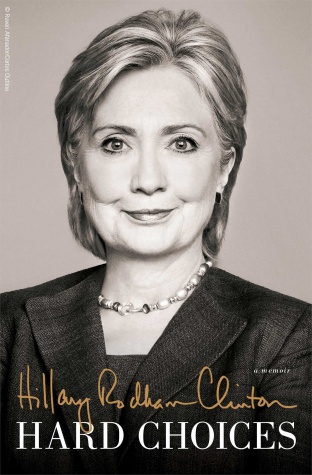
We knew early on, from the time Hillary made it clear
that one four-year term as SOS would be her limit, that writing was in
her future, and as her term drew to a close a book was clearly in the
offing. Lightheartedly,
Washington Post held a contest
inviting readers to provide Hillary with appropriate titles. More
serious speculation surrounded the amount she would be offered as an
advance.
Thursday, 28 Feb 2013 01:51 PM
By Dale Eisinger
When
Hillary Clinton signed her second book deal in 2000 for "Living
History," she got an $8 million advance from Simon & Schuster. When
she recently announced she would be writing a third memoir, speculation
began flying about how large that advance will be.
At the time of
"Living History," the New York Times speculated it was the
second-largest advance in history, edged out by $8.5 million to Pope
John Paul II in 1994 for his memoir.
"Yes, I will write a memoir,"
Clinton told her audience in an online town hall interview. "I don't
know what I'll say in it yet."
While her loyalists and fans hope she will top the advance offered
Lena Dunham - a cool
$3.5 million (despite the many times she counted to eight and multiples
of eight last night, even as Judy Collins crooned "Someday Soon'), the
money is not the issue.
Hillary has worked long and hard, and if
organizations want to pay her more for one speech than she was paid per
year as SOS, fine! For as hard as she worked, she deserves it. If a
publisher wants to give her a big advance, great. Any book by her will
pull in far more. The real question is what she will say in it, and
that may well depend on a date of release.
If two articles from
today are any indication, her book could be a bombshell exposing insular
and naïve foreign policy processes with a decidedly political agenda
stunning no one who has followed Ulsterman's journals. At
Foreign
Policy today, Vali Nasr, handpicked by Richard Holbrooke as an advisor to
Holbrooke's office of Special Representative for Afghanistan and
Pakistan (SRAP) and plucked from a tenured position at Tufts to occupy
the first floor domain Holbrooke carved out for himself at Foggy Bottom, portrays a White House with access to the best
of expertise, specialists, and resources, stubbornly resistant to policy
wisdom while habitually turning to political cronies installed in the
White House who consistently worried about how actions would play out in
the polls and on the evening news. It is a good read, and in fact,
worth bookmarking for future reference. Here is a snip.
"My time in the Obama administration turned out to be a deeply disillusioning experience."
...
Holbrooke knew that Afghanistan was not going to be easy. There were
too many players and too many unknowns, and Obama had not given him
enough authority (and would give him almost no support) to get the job
done. After he took office, the president never met with Holbrooke
outside large meetings and never gave him time and heard him out. The
president's White House advisors were dead set against Holbrooke. Some,
like Lt. Gen. Douglas Lute, were holdovers from George W. Bush's
administration and thought they knew Afghanistan better and did not want
to relinquish control to Holbrooke. Others (those closest to the
president) wanted to settle scores for Holbrooke's tenacious campaign
support of Clinton (who was herself eyed with suspicion by the Obama
insiders); still others begrudged Holbrooke's storied past and wanted to
end his run of success then and there. At times it appeared the White
House was more interested in bringing Holbrooke down than getting the
policy right.
We can speculate that this piece
is part of a larger opus that might emerge later. Certainly a nod to a
large opus foreshadowed by
this in-depth interview, is this article from a different point of view but alluding to similar White House practices in forming foreign policy.
By Marcus Baram | March 04 2013 2:14 PM
Like so many of his predecessors, the new American president made a key mistake in his bid to achieve Mideast peace.
Flush
with confidence from his historic election victory and eager to
capitalize on his mandate, Barack Obama sought to bring Israeli and
Palestinian leaders to the negotiating table as one of his first steps
soon after taking office in 2009. But the new president was frustrated
by Israeli Prime Minister Benjamin Netanyahu’s hardline attitude -- so
his top aides advised him to take a tough approach, and pressure “Bibi”
to freeze settlements in the West Bank in order to encourage Palestinian
President Mahmoud Abbas to agree to negotiate directly with the
Israelis.
Then-White House Chief of Staff Rahm
Emanuel, who had served in Israel’s armed forces, “advised Obama to be
tough on Netanyahu and show him, immediately, who the superpower was …
and he actively pushed for the freeze to top the agenda,” writes BBC correspondent Kim Ghattas in her new book, “The Secretary: A Journey With Hillary Clinton From Beirut to the Heart of American Power.”
Read more >>>>
The Ghattas book comes from the perspective of a seasoned journalist specializing in foreign
policy. Kim Ghattas was on Hillary Clinton's Big Blue Plane from her
earliest through her final stops as Secretary of State, and her story,
if this short insight from Baram is an indication, appears to parallel
what Nasr relates.
Is this the story Hillary Clinton will
tell? Will she, having stepped back from the administration's shadow
tell the story of the battles within the Sit Room? Or will she relate
background to her many on-the-ground encounters with officials, civil
leaders, women's groups, students, and marketplace entrepreneurs? Some
of that depends on the release date. If it arrives close to or after
2016, it can tell the inside story. If it comes earlier, it is likelier
to focus on her own agendas with folks she encountered and why those
agendas are important.
It is hard to
imagine Hillary Clinton writing a tell-all. It can be perceived as
treacherous, and Hillary is loyal to a fault. It is unlikely, then that
we will hear from her of the struggles between her experts at DOS and
the political wall at the White House, but no matter. Apparently there
are witnesses out there more than capable of writing that book.