Showing posts with label Portugal. Show all posts

Tuesday, September 27, 2011

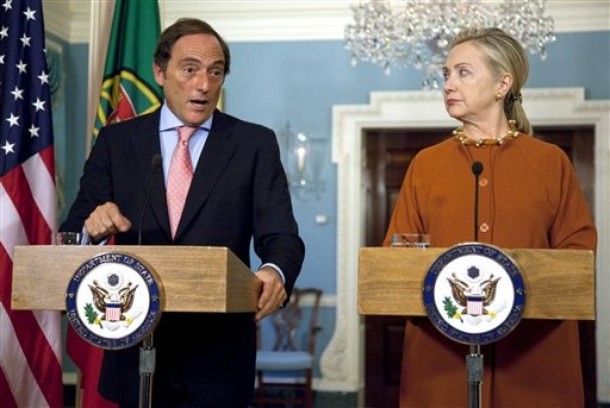
Video: Secretary Clinton with Portuguese FM Portas


Joint Press Availability with Portuguese Foreign Minister Paulo Portas After Their Meeting


Press Availability
Hillary Rodham Clinton
Secretary of State
Treaty Room
Washington, DC
September 27, 2011


SECRETARY CLINTON: Well, good afternoon, everyone. And let me begin by welcoming the foreign minister and his delegation here to the State Department. This is his first visit as foreign minister, but he has been here many times, and we’re always glad to welcome you back to Washington.

I was in Lisbon last when Portugal hosted several major meetings, including the NATO Summit and the U.S.-EU Summit. It was an extremely productive visit, and I must say that our bilateral relationship is very strong. Portugal has been a friend and an ally to the United States, and we greatly appreciate all the work that we do together around the world on key issues, and today the foreign minister and I discussed a number of those.

We discussed the economic challenges now facing Portugal and Europe. And I want to say very clearly that the Portuguese people and the Government of Portugal have demonstrated impressive resolve in putting aside political differences to implement difficult austerity measures that are helping to stabilize the Portuguese economy, but also to set it up for long-term economic success. As I expressed to the foreign minister, the United States will stand with Portugal as it continues to make economic reforms that return Portugal to a path of growth and sustainable opportunity for the Portugal – Portuguese people.

But even during this time of economic challenge, Portugal has continued to work with the United States and NATO ISAF to help stabilize and secure Afghanistan. Portuguese troops serve in Afghanistan, helping to train and mentor Afghan security forces, a high priority for our mutual mission there.

Portugal has also played a key diplomatic role in North Africa and the Middle East during the democratic transitions of the Arab Awakening. As head of the UN Libya Sanctions Committee, and as a member of the UN Security Council, Portugal has overseen the release of more than $16 billion in frozen assets to help fund UN and humanitarian activity in Libya and to allow the Transitional National Council to provide basic security and public services to the Libyan people.

And with respect to Syria, Portugal has worked diligently with its EU partners to roll out the seventh round of EU sanctions this past week. And we both hope that this strong message will compel Asad and his regime to change course and cease killing and detaining Syrians who wish to have a better life.

On these and many other critical issues of global security, prosperity, and peace, Portugal is a leader and a valued partner. And let me express my appreciation to the foreign minister for the work that he has done personally and to the work that his government has undertaken. I met him in Istanbul about two weeks after he took office. He was thrown into the midst of everything as we were meeting with the Libya Contact Group, and we’ve had a number of occasions since to trade impressions and look at what we needed to be doing together. And it’s a pleasure to have you here.

FOREIGN MINISTER PORTAS: Thank you very much.

SECRETARY CLINTON: Thank you.

FOREIGN MINISTER PORTAS: Portugal and the United States are old and very good friends. This visit reinforced our cooperation. In addition, it’s a pleasure to meet again Secretary Clinton, who’s a distinguished stateswoman. We had an overview over major global issues as well on the – our bilateral relationship. Allow me to highlight some of those issues.

First, I explained to Secretary Clinton what Portugal is overcoming – is doing – what Portugal is doing to overcome its economic and financial constraints. We are a very specific case, and our attitude as country – as a nation, as a government is as follows: to meet our goals on the fiscal consideration and economic reform, to honor our commitments to the international institutions, to fulfill the program with the European Union and the IMF. In the end of this very tough program, Portugal will be a success story. And we want Portugal seen in the international scene as unique story: Portugal delivers. Portugal honors its word and is making a tremendous effort to recover its autonomy.

We also spoke about Middle East and Palestine issue. As you know, Portugal is standing for a European consensual position. We believe in a two-state solution and we care about the security of everybody, namely the security of Israel. The Quartet’s statement was a very relevant one. The Quartet’s statement must be seen as a good framework to go to a table of negotiations. Both parties, both leaders must prepare their peoples to negotiations. To negotiate is to compromise. They must do their job on this issue.

So as you know, we don’t believe in recognition without negotiations, but we think that negotiations are the way, the right way, to peace and a two-state solution where the Palestinians have the state they deserve and the Israelis the security they deserve.

Those were, namely, some of the issues we were talking about. And thank you very much, Hillary. It’s really a pleasure. Thank you much – very much.

SECRETARY CLINTON: Thank you. Thank you very much.

MS. NULAND: We have time for two questions today. The first one on the American side, Andy Quinn.

QUESTION: Madam Secretary, hi. Good afternoon. Madam Secretary, were you surprised by Israel’s announcement today that it had approved 1,100 new settlement units for the West Bank? Does the timing of this announcement so soon after the Quartet urged both sides against provocative acts disturb you at all? And what is your message to the Palestinians who say it is precisely this kind of activity which makes resuming negotiations impossible?

And for the minister, if I heard you right, you just said that you, as Portugal, believe that there should be no recognition without negotiation. Are we to understand that Portugal would vote against recognizing Palestinian statehood if a vote was taken at the Security Council?

Thank you.

SECRETARY CLINTON: Well Andy, first, let me say that we believe that this morning’s announcement by the Government of Israel approving the construction of 1,100 housing units in East Jerusalem is counterproductive to our efforts to resume direct negotiations between the parties.

As you know, we have long urged both sides to avoid any kind of action which could undermine trust, including, and perhaps most particularly in Jerusalem, any action that could be viewed as provocative by either side. And we’ve been here before over many years, as you know, and I think it only reinforces what the foreign minister was saying: Our focus must remain on working to convince the parties to return to direct negotiations, because in the absence of direct negotiations, nothing changes on the ground. If there are negotiations that delineate borders, questions of where anybody builds are settled. But in the absence of such negotiations, there are going to continue to be perceptions on both sides that the other side is not willing to negotiate. So that’s why the Quartet, of which, as you know, the United States is one of four members, called on Friday for a return to negotiations and set forth a timetable, and that is what we would like to see happen.

FOREIGN MINISTER PORTAS: Answering you, let me say as follows: after the declaration of the Quartet, you have a real chance to negotiations. And when you have a real chance to negotiations, you avoid hostile measure to negotiations. That means the settlements decision is not a good one.

The second point, I would love to – I would like to express is another one: you have the declarations of the Quartet. The Quartet is specifying that in 30 days, Israelis and Palestinians should be at table. This is my scenario: Negotiations to solve everything that must be solved. So I think it is the chance of a negotiation, and the chance is given by United Nations, European Union, United States, and Russia, who are the members of the Quartet, who are the key story in this moment.

Obviously, if there is a chance for negotiations, if there is a will to negotiations, as my prime minister said in the General Assembly, we could consider an upgrade of the Palestinian position in the United Nations as a sign of goodwill to negotiate. But, I repeat, the chance all the world and the Israelis and Palestinians they first have now is to become members of a negotiation, parts of a negotiation towards a peace treaty. And this is what interest to the world.

MS. NULAND: Last question, Paula Santos, SIC TV.

QUESTION: (Inaudible), Madam Secretary. Recently, President Obama said that the United States would help Portugal and Greece in which the crisis – the financial crisis is concerned. I’d like to know if you agree that Portugal and Greece are – stand on the same line in this crisis. And I also can – would like to remember you – President Obama’s words from yesterday, when he said that the Europe – the crisis in Europe is scaring the world, and that he believed that the political leaders in Europe have not taken the measures good enough to deal with the crisis. I’d like to know if you are scared with the crisis too.

And for the Portuguese minister, I’d like to ask your comment on these words of President Obama, and I would like to know specifically if you think it’s fair to say that the world is being frightened in any way, scared with the crisis in Europe.

SECRETARY CLINTON: Well, as I said, we discussed these issues today, and we applaud Portugal’s actions. In fact, my information is that approximately 85 percent of the Portuguese Parliament approved the prime minister’s program for the next four years. That is a resounding show of support under difficult circumstances that included a package of austerity measures that actually went beyond what the IMF and the EU had demanded in the original agreement.

So we know that these are difficult decisions for governments to make, and we encourage countries to continue reform measures that will bring about renewed growth and improve competitiveness for the future. But as I said in my opening statement and as I repeat today, we think that Portugal is on the right track. Portugal has been given a very positive report in August by the so-called troika – the IMF, the EU, the ECB – following its first quarterly review. So it has already taken steps that has put it on the right path.

Other countries and governments are still working to take such paths, and we expect European leaders to continue to ensure that the response to this crisis is strong, flexible, and most importantly, effective. The United States, through our Treasury officials and State Department officials, have been in close touch with our European counterparts to discuss these matters.

So I think that, of course, it’s a challenging time, and it does raise concerns on the part of everybody, first and foremost the Europeans themselves. But no one should doubt that we have the ability to get through this, and I personally have confidence in our partners to make the tough decisions that will enable them to weather this crisis, and that it will add to a renewed level of economic recovery and activity around the world.

We’re facing a lot of the same challenges here in the United States, and I’ve heard European leaders say, “What is the United States doing?” Are we going to be able to return to growth, which is the engine that really propels the global economy forward. And we strongly support the common sense effective efforts that we see being taken here under President Obama and in Europe by various leaders. We just want to make clear that we have to continue down this path. There are no shortcuts. And it’s not going to be easy, but it will, in my view, result in a return to economic prosperity in the future if we’re willing to do now what is required of us.

FOREIGN MINISTER PORTAS: Let me tell you that’s why it’s so relevant to tell the Portuguese story in a detailed way to everybody who counts in the world. Portuguese is different story because of the attitude that we have as a country, as a nation, and as a government. And that attitude is to fulfill the program, to honor our word, to accomplish our commitments to the international community, and that means credibility. Tough efforts, but we know the goal is a better society, a better economy, and we’ll win this battle against the debt. We’ll win this battle against the debt.

The second point I would answer you is about economic transatlantic relations. We have in Europe a strong transatlantic link with the United States. In the past, we win huge battles against terrible enemies. We can win together the battle for a better economy, for jobs creation, and economic growth. We can reinforce our cooperation. My view is together – we can do it together, and I think we’ll do it.

SECRETARY CLINTON: Thank you all.

FOREIGN MINISTER PORTAS: Thank you very much.


Friday, June 5, 2009

Hillary Clinton's Bilaterals Today

Remarks With Korean Foreign Minister Yu Myung-Hwan


Remarks
Hillary Rodham Clinton
Secretary of State, Secretary of State
Treaty Room
Washington, DC
June 5, 2009

SECRETARY CLINTON: Well, Minister, you and I just concluded a very productive meeting. We’ve obviously had the opportunity to meet before and speak on a regular basis concerning the many issues that we’re working on together, and I am very grateful to him and to his government for our close cooperation.
FOREIGN MINISTER YU: Thank you very much.
SECRETARY CLINTON: Thank you. Thank you all very much.

Remarks With Portuguese Foreign Minister Luis Amado


Remarks
Hillary Rodham Clinton
Secretary of State, Secretary of State
Treaty Room
Washington, DC
June 5, 2009

Date: 06/05/2009 Description: Secretary Clinton shakes hands with Portuguese Foreign Minister Luis Amado after signing the U.S.-Portugal Extradition and Mutual Legal Assistance Treaties. © State Department photo by Michael Gross SECRETARY CLINTON: Well, good – I guess it’s good afternoon now. Well, I am very pleased to be here with someone who has a long and very important list of contributions not only in his own country, but with respect to the very strong Euro-Atlantic partnership that we both support so vividly.
The foreign minister and I discussed a wide range of issues. Today, we are going to be signing an agreement that takes another crucial step toward putting into effect our treaties on extradition and mutual legal assistance. These treaties give police and prosecutors in both nations the tools that they need to bring criminals to justice. They form part of an important network of similar agreements that the United States has reached with countries of the European Union.
The United States values our friendship with Portugal. We see the people and Government of Portugal as strong partners on an array of vital issues. And we will continue to look for ways that we can cooperate together. We welcome Portugal’s contribution to supporting the people of Afghanistan by helping to build the Afghan Government’s capacity to provide for security and other basic needs. We share the objective of helping people everywhere in places like Afghanistan, but beyond to ensure that violent extremists do not hold sway.
And we will continue to work together to achieve peace in another region, particularly the Middle East. We are pressing forward to turn rhetoric into results and to establish a comprehensive and durable peace between Israel and its neighbors, focused on creating two states for two people.
Having said that, we know we have a lot of work ahead of us. We have to cooperate on economic matters, particularly during this global economic crisis. And there are just so many important issues that the foreign minister and I discussed that we will continue to work on. But I particularly welcome him here today and thank him for the strong partnership that he and his government have provided.
FOREIGN MINISTER AMADO: Thank you very much. I want to thank you for the opportunity you gave me to discuss with you some of the most important issues that we have in our agendas, and the opportunity also to express my strong commitment and the strong commitment of the Portuguese Government to strengthen our bilateral relations with the United States. We are old and very loyal allies on the bilateral. We will have the opportunity to get another step forward in our deep cooperation. And in the context of the European Union and NATO, we have been trying to contribute to the strengthening of our transatlantic relations.
In the new face of the world politics, so demanding with so many challenges, and I strongly believe, as you do, that if the United States and Europeans are able to reinvent this relationship in the perspective of the challenges that we face together, we will be able to give peace and stability to the world. If we are not able and if we fail, it will be the beginning of the failure of the international system; such a responsibility we have in the stability of the world today.
So we have an important discussion, and I have the possibility at the European Union level to continue some of the issues that we discussed together, trying to create conditions so that the European Union can become a much more important interlocutor of the U.S. policies. Thank you very much.
SECRETARY CLINTON: Thank you, Minister Amado.
FOREIGN MINISTER AMADO: Madame Secretary, thank you.
SECRETARY CLINTON: Thank you very much.
FOREIGN MINISTER AMADO: My pleasure.
(The document was signed.)
SECRETARY CLINTON: Thank you so much. I look forward to meeting with you again soon. Thank you. Thank you all.
QUESTION: Secretary Clinton, on North Korea, can we ask you a quick question? An update, if you would, on the situation with the journalists? And also, is the U.S. open to using a special representatives? And then finally, if this all ends positively, how will this affect the overall tense relationship?
SECRETARY CLINTON: Jill, we’re going to have a press avail later, and I promise you that you will be able to ask and I will answer those three questions. Thank you.


Remarks With Turkish Foreign Minister Ahmet Davutoglu


Remarks
Hillary Rodham Clinton
Secretary of State, Secretary of State
Treaty Room
Washington, DC
June 5, 2009

Date: 06/05/2009 Description: Secretary Clinton meets with Turkish Foreign Minister Ahmet Davutoglu. © State Dept Photo by Michael Gross SECRETARY CLINTON: Good afternoon. Minister Davutoglu and I just had a very productive, broad-ranging, comprehensive discussion. And it is a great privilege to welcome him here to the State Department within the very first weeks of his having been appointed foreign minister. Of course, I was very honored to have gone to Turkey very early in my term as Secretary of State, and President Obama had a wonderful visit to Turkey.
And all of that is to confirm the strength and importance of o ur partnership and alliance. We have a lot of work to do together. Turkey, the United States, and the entire global community certainly face a great number of challenges, but we also see opportunities. So our message coming out of the meeting today and our prior meetings is that we’re going to deepen and strengthen our cooperation on an ongoing basis, because we believe that both Turkey and the United States have unique roles to play.
Now, we obviously already collaborate. Not only are we both members of NATO, but we are working with the G-20 to respond to the global economic crisis, we’re exploring ways to enhance our trade and commerce between our two countries, we’re working to develop new energy sources, including resources from the Caucasus and Central Asia. We’re partners in the fight against global terrorism. We share the goal of a stable Pakistan and Afghanistan, and to deny al-Qaida safe haven that can threaten our countries and many others. We support Turkey in its fight against the terrorist activities of the PKK, which has been a very important cooperation.
And I underscored again today the United States’ strong support for Turkey’s bid to become a member of the European Union. Turkey has made significant progress toward membership. It’s been in a process of reform that is generated by its own internal decisions but which has certainly responded to many of the concerns regarding the strength of the bid that Turkey had. And so we applaud what Turkey has already done and pledge our efforts to continue working with Turkey.
And so we ranged across a broad number of issues, and I want to just make a special note. As President Obama said yesterday in Cairo, the United States is committed to broad engagement with Muslims everywhere across the globe based on mutual interests and mutual respect. We believe strongly in the freedom of religion and expression, in vibrant civil societies, and we know that those are values that Turkey shares.
And I want to thank the minister and his government for the role that Turkey plays as a force for peace and stability. This is important, and it’s already been demonstrated in the work that Turkey has done for a number of years and continues with respect to comprehensive peace in the Middle East. And we are strongly supportive of the Turkish efforts to normalize relations with Armenia, and we are also very strongly supportive of the efforts to resolve the Nagorno-Karabakh conflict.
We discussed Cyprus, which is an issue that the President also addressed when he was in Turkey in April. The two Cypriot leaders have an opportunity through their commitment to negotiations under the United Nations Good Offices Missions, and the United States is willing to help the parties. We want to work toward a settlement that reunifies Cyprus into a bi-zonal and bi-communal federation.
We discussed many, many concerns, and I’m just grateful for the commitment by the minister and by his government to play an active role in our dynamic world. Our relationship is not just about security; it is about seizing these opportunities, and I look forward to working with you.
FOREIGN MINISTER DAVUTOGLU: Thank you very much, Secretary Clinton. It’s a great honor and pleasure for me to meet with Secretary Clinton today in a very historic time after the speech of President Obama yesterday and the new commitment of United States for regional and global peace everywhere. We know of her wisdom, her approach, and we always appreciate and admire her approach to all the issues regarding to our bilateral, regional, and global issues.
Basically, the purpose of my visit was to follow up her historic visit to Turkey immediately after the new Administration in March and President Obama’s historic visit in April. So these historic visits showed the strength of our bilateral relations. So I came here in my first month of my duty in this – as minister to follow up all the contents, all the issues regarding our relations. We had a very constructive meeting. I am grateful for that. And we went through all the issues regarding the depth and scope of our agenda. We decided to have a much more broader comprehensive approach in our bilateral relations, not only security issues but economy, energy security, cultural issues. Also on the main regional issues like Middle East, Iraq, Afghanistan, Pakistan, Caucasia, (inaudible) and all the relevant issues we have as common agenda we went through. And I am very happy to see that we have very identical, similar approaches to many of these issues.
On global affairs also, we agreed together that our cooperation should not be limited only by regional efforts, but there is a big potential between Turkey and the United States to work together on global issues like relations between civilizations, Alliance of Civilizations, like G-20 and economic – the situation after economic crisis, like our cooperation in United Nations Security Council. As you know, Turkey took over the presidency a few days ago. And I was in New York yesterday for the first formal meeting of UN Security Council.
As Turkey – as minister of foreign affairs of Turkey, and as the Government of Turkey, we are ready to cooperate with the United States in all these significant issues for achieving regional and global peace. That is our contribution to the (inaudible). Thank you very much.
SECRETARY CLINTON: Very well said, Minister.
MR. WOOD: The first question will be from Jill Dougherty of CNN.
QUESTION: Thank you. Madame Secretary, what is the U.S. doing to free the journalists being held in North Korea? And how open are you to using a special negotiator/envoy, perhaps former Vice President Gore?
And also, if I could, just one very quick question. Any update on the situation of the Goldman boy in Brazil?
SECRETARY CLINTON: Well, Jill, the concern that we feel for these two young women who are in prison in North Korea has been driving our efforts. We want to strike the right balance between expressing our deep concerns, our belief that these two young women should be released immediately. The trial which is going on right now we consider to be a step toward the release and the return home of these two young women.
I personally have spoken with a number of foreign officials who have influence through various channels with the North Koreans. The State Department has had direct contact with the North Koreans through the channel by which we communicate. The Swedish ambassador has been extremely helpful. He has actually met with the two young women on three occasions. He’s helped to facilitate the delivery of materials and the passing of messages. So we are incredibly concerned on both a diplomatic and, on my behalf, a personal basis. I have met with their families, and I share the grave anxiety that they feel about the safety and security of these two young women.
We call again on the North Korean Government to release them and enable them to come home as soon as possible. We have explored other approaches, including the use of special representatives strictly for this humanitarian mission. But as things stand now, we know that they’re in the middle of a trial in Pyongyang, and we hope that the trial is resolved quickly and that the young women are released.
With respect to Sean Goldman, we were very pleased when the Brazilian courts reached the conclusion they reached earlier this week. And we were very disappointed when a hold was placed on the release of this young boy and his return with his father to the United States. We will continue to support Mr. Goldman in his efforts to speak out on behalf of the family relations that is at the core of this legal case, and to urge the Brazilian Government and judiciary to release Sean and enable him to return to his father now that the legal decision has been rendered.
QUESTION: This is Umit Enginsoy with Turkish NTV television. Madame Secretary, since the release in April of Turkish, Armenian, and Swiss statements about joint intention for normalization of ties, have you observed any progress toward that end, and also toward resolution of the Nagorno-Karabakh problem? And are you hopeful that these could be resolved in the not-too-distant future? Thank you.
SECRETARY CLINTON: Well, I have been very encouraged by the progress that has been made and by the commitment of the governments involved. Certainly, Turkey and Armenia, with the assistance of the Swiss Government, have committed themselves to a process of normalization. We’re well aware that this is difficult. It requires patience and perseverance. But we have seen no flagging of commitment.
The minister and I discussed this at length. He brought me up to date on developments. And we are continuing to encourage the parties to proceed on the path which they themselves have set. We are supportive, but it is up to the Turkish and Armenian governments and people to realize the great opportunity this poses. The normalization of relations not only continues what I have seen from the Turkish Government, which is a desire to actually solve problems, and I applaud that, but we think it will bring great benefits to the region.
Similarly, with the ongoing negotiations over Nagorno-Karabakh, the Government of Azerbaijan and of Armenia are proceeding and working together. They were just in a recent meeting in St. Petersburg. So we believe that a lot of progress has been made in a relatively short period of time to resolve issues that are of long standing.
What’s important is the commitment to get to a point of resolution of these conflicts, and I see that commitment. Now are there problems along the way? Of course. There is in any difficult undertaking. But I do not doubt the commitment, and I certainly appreciate the very strong position that the Turkish Government has taken. And perhaps, Minister, you would like to add to that?
FOREIGN MINISTER DAVUTOGLU: I would like to express also my thanks to Secretary Clinton because of her personal and American Government’s support for these two processes. We are very optimistic. We want to achieve a prosperous, peaceful Caucasia. And in that sense, we are fully committed to our normalization process with Armenia, and also, we are fully committed and we are ready to work together with United States and other co-chairs of Minsk Group for the resolution of Armenian-Azeri issues.
And I was very impressed and I want to repeat my thanks for the commitment of Madame Secretary Clinton in this sense, and we will be working together. There is a strong will politically by Turkish side to continue all the efforts to achieve our common goal of creating a prosperous, peaceful Caucasia together.
MR. WOOD: Next question will be from Arshad Mohammed of Reuters.
QUESTION: Secretary Clinton, how seriously is the United States considering imposing either multilateral or unilateral financial sanctions on North Korea and its banks? And what makes you confident that such a step wouldn’t be counterproductive? When the sanctions were imposed on BDA, it essentially froze the process for months on end until the United States effectively removed them and returned the money.
And a small – well, a separate thing, maybe not small. Dov Weissglas, the former Israeli chief of staff to former Prime Minister Sharon, argues publicly this week that Israel had understandings with the Bush Administration, under which it was permitted to continue so-called natural growth under the Roadmap, that it could continue building within the construction line. Do you believe that there were such understandings or agreements between Israel and the Bush Administration? Do you feel bound by them?
SECRETARY CLINTON: Well, Arshad, let me start with North Korea. As you know, the United States is working very hard in the Security Council, now chaired by Turkey, to come up with a resolution that would represent the will of the international community with respect to North Korea’s actions that are viewed with considerable concern on the part of not just the United States or South Korea or Japan, but also China, Russia, and many other countries internationally.
We’ve made considerable progress in devising the kinds of actions that would represent consequences imposed upon the North Koreans by the international community. I have personally spoken with a number of the foreign ministers, our ambassador to the United Nations Susan Rice and her team are involved on a hour-by-hour basis, because we want to come up with the strongest possible resolution.
And I think we’ve learned a lesson. One of the lessons we’ve learned is that with the North Koreans, it’s never over till it’s over, that if there are effective sanctions that we believe can be imposed, an arms embargo and other steps to be taken, we need to see real results. We, along with other neighbors in Northeast Asia as well as the international community, stand ready to resume negotiations with the North Koreans over their nuclear program. Our goal remains to have a denuclearized Korean Peninsula. So I am quite heartened by the progress that we’re seeing in the United Nation Security Council. And when we believe we’ve gotten the strongest possible resolution we can get, we will table it and then proceed.
With respect to the conditions regarding understandings between the United States and the former Israeli government and the former government of the United States, we have the negotiating record. That is the official record that was turned over to the Obama Administration by the outgoing Bush Administration. There is no memorialization of any informal and oral agreements. If they did occur, which, of course, people say they did, they did not become part of the official position of the United States Government. And there are contrary documents that suggest that they were not to be viewed as in any way contradicting the obligations that Israel undertook pursuant to the Roadmap. And those obligations are very clear.
QUESTION: Foreign Minister Davutoglu, how do you evaluate President Obama’s speech to the Muslim world in Cairo? And Secretary Clinton, after President Obama’s visit to Turkey, what is the state of Turkish-American relations?
FOREIGN MINISTER DAVUTOGLU: Thank you very much. President Obama’s speech yesterday in Cairo is a speech of wisdom, a speech of vision, and a speech of peace. And we share the insight with Secretary Clinton as well. We share this vision and we are ready to cooperate. I am sure you remember President Obama’s visit and his speech in Turkish parliament. And when you look at the substance of two speeches, you can see an integrated approach, the continuation and follow-up of many issues that are very important principles for regional issues as well as global order in general. And it is a good message, clear message to the Muslim world that the future relations between the United States and the Muslim world, as well as between different cultures will be bright, based on a mutual understanding of coexistence, living together, sharing all human values in all fronts. And therefore, we share that vision and we will continue to work to realize this vision as a program and project together.
SECRETARY CLINTON: Well, I appreciate the minister’s perceptive remarks about President Obama’s speech yesterday. Clearly, the President is laying out a vision, and it is a vision that invites all people of good faith to come together, to work together, to recognize that we may have differences of experience, differences of background, of religion and race, but that we are all part of common humanity. And we have an opportunity in the 21st century to work toward realizing that vision. And I applaud the Turkish Government for taking a practical, hands-on approach to solving problems, to clear away the obstacles that prevent people from living up to their own God-given potential, of countries breaking the bounds of the past so that they can have a better future.
And I think the relationship between Turkey and the United States is extremely strong. We have a durable bond that goes back many decades, but we’re exploring new ways of expanding and deepening that strong relationship. And that was the purpose of our meeting today is to begin to look at how we can take our shared vision of what Turkey and the United States can do to further humanity’s quest for peace and prosperity and progress, recognizing and respecting our legitimate differences of culture and religion, but making it clear that we’re going to share this increasingly interdependent world. And we can either have positive or negative interdependence. And Turkey and the United States believe in a positive future.
So I could not be happier and more optimistic about the relationships and what we together can do for the future.
Thank you all very much.
FOREIGN MINISTER DAVUTOGLU: Thank you.