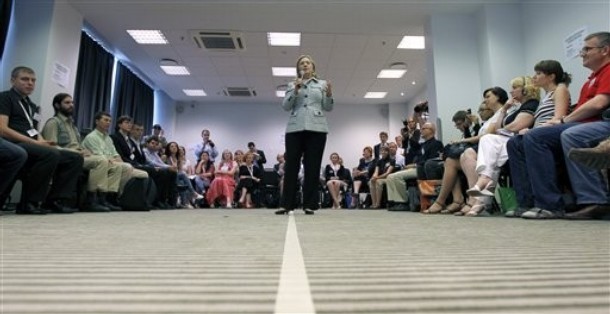
The image is not from this event If relevant images come in, or better yet, a video, I will replace this.
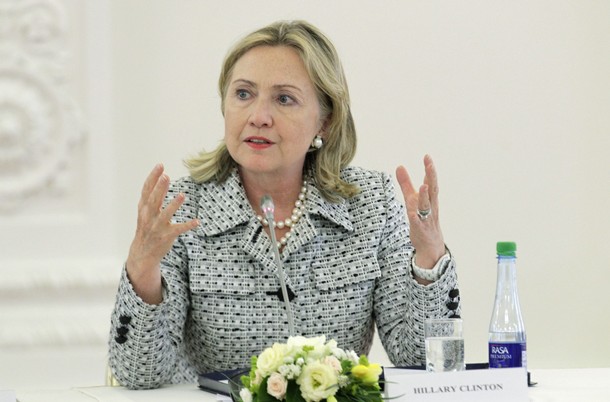
Remarks On Strategic Dialogue with Civil Society
RemarksHillary Rodham Clinton
Secretary of StateRadisson Hotel LietuvaVilnius, LithuaniaJune 30, 2011
Thank you very much, Minister Azubalis, and thank you for Lithuania’s leadership with the Community of Democracies and with the OSCE. It’s a real privilege for me to be with all of you this evening for this Civil Society Strategic Dialogue. I know that around this table and in this audience are men and women of extraordinary courage and commitment. And as the minister said, we thought it was important to expand our dialogues beyond governments, and in fact to engage in an ongoing discussion with civil society at the same level that we do with governments around the world.
The foreign minister joined me in Washington for this launch of a Strategic Dialogue with Civil Society in February. And I want to introduce the team of people who have helped to lead this effort with me: our Assistant Secretary of State for Democracy, Human Rights and Labor, Michael Posner; Tomicah Tillemann, our Special Advisor on Civil Society and Emerging Democracies; and others from our State Department in Washington, because what we hope is that this is an ongoing networking and discussion that can assist those of you who are on the front lines, doing the hard work of creating space for freedom, democracy, and opportunity.
In Krakow last July, when we met with the Community of Democracies, I spoke then about the critical importance of civil society and the many challenges facing civil society, but I don’t think – I’ll speak for myself; I certainly did not foresee all of the changes that would occur in just half a year. We saw in Tunisia the beginning of a great movement for freedom, and we saw one of the most efficient authoritarian regimes give way to citizens demanding their basic rights. In Egypt, we saw a peaceful movement based on simple ideas of dignity and democracy, and a call for transformative change. And yet, at the same time, we have seen governments unleash brutal waves of repression against civil society around the world. We’ve seen staggering violence directed against activists in Syria and other parts of the Middle East. From Belarus to Bahrain to Burma, we’ve seen crackdowns and arrests. And there have been numerous efforts to enact regulations and legislation to restrict and even eliminate your work.
I know that some of you are here at great personal risk, and I know you have left behind family, friends, and colleagues who continue that work at great personal risk. We come together today with our own causes and interests but as part of a community of shared values and a common commitment to human rights and freedoms. Because you are on the front lines, you understand better than any of us what is facing you, what you need from us, what tools could help you do the work that lies ahead. So for the next hour, I want to hear from you.
In Krakow last year, we made specific commitments to strengthen civil society and we’ve made some progress. Together, we have refocused the UN Human Rights Council on Defending Civil Society by seeing the passage of a historic resolution creating the first special rapporteur on freedom of assembly and association. We’ve convinced regional organizations like the Organization of American States to take up this cause. We’ve made strides in marshalling diplomatic pressure around the world to stand against civil society being put under threat. Canada has led a working group in the Community of Democracies, and five times we’ve come together when draft legislation anywhere threatened civil society, and five times the laws were not enacted.
Because technology both empowers and endangers your work, we are giving activists new tools to try to circumvent the many obstacles that governments are putting in your way. The United States has invested $50 million in supporting internet freedom and we’ve trained more than 5,000 activists worldwide. Right next door, there’s another one of our so-called tech camps, where we are training several dozen activists from around the world to be able to use technology and avoid being shut down by governments using technology against them. We are also increasing our funding to the International Center for Not-for-Profit Law so that when countries propose repressive laws, civil society has access to world class legal expertise. And finally, together with a consortium of NGOs, led by Freedom House and involving a dozen other countries, we created a fund called Lifeline. This fund will provide legal representation, cover medical bills arising from abuse, facilitate visits to activists in jail, and help replace equipment that is damaged or confiscated as a result of harassment.
So those are some of the promises we made and the promises we’ve kept, but we know there’s so much more to be done. You are changing your countries from within, and our priority is to do all we can to support you. So I look forward to hearing about what’s working and what’s not working, what we can do better, what we should stop doing, what we should do more of. And I thank you all for being with us as we take this time to take stock of where civil society is across the world.
And let me now turn it over to Assistant Secretary Posner.