Showing posts with label Haiti Donors. Show all posts

Friday, October 10, 2014

Hillary Clinton’s ‘Hard Choices’ Retrospective Part Six Chapter 23 Haiti: Disaster and Development

This chapter is an intensely personal one for me.  Like anyone who has ever lived there, I remember exactly where I was - sitting in my car at an intersection I was at daily on my way home from work - when I heard the news of the earthquake on the radio.  As soon as I heard the magnitude, I knew what the number 7 meant.  I looked at the Getty station on the corner where I was waiting for the green light and imagined it crumbled.  I knew that many buildings I knew, loved, had been in, had lived, studied, and worked in had been destroyed.  I knew that people I cared for, had taught or studied with were gone. I was not prepared for this.

Haiti_National_Palace_before_after_2010_Haiti_Earthquake

No, I had never been in the National Palace, but like the Getty station I had been next to when I heard the news, it was a building I passed four times daily on my way to and from work at the Haitian-American Institute where I taught English.  That link goes to a whole new building.  The building where I taught was an old mansion on the east end of the Champs-de-Mars on Rue Capois.  Like the National Palace, it had collapsed - probably while evening classes were going on at the busiest time of day there.

original building
On July 4,1942, Haitians and Americans founded a bi-national center to reinforce friendship and cultural ties between their two countries. Located in the heart of Port-au-Prince, the Haitian-American Institute has enjoyed decades of continuous community service and remains faithful to the ideal of its founders.
The Haitian-American Institute itself stands on a landmark site. The original building was the house that once belonged to former Haitian President Elie LESCOT. This building, pictured in the pen and ink drawing at the top of this page, was destroyed in the January 12, 2010 earthquake.
It is a bi-national center run partially by the State Department.  It's great to see this grand new facility!
In the old building,  I loved teaching at six in the morning in the classroom on that very top floor.  You could see the city waking up.  I would walk up the many flights of stairs early just to go out on that balcony and watch for a few minutes before the students arrived.  When Dr. Ainslie Minor was director,  as was his position as Cultural Affairs officer at the embassy, he was often on the front steps to greet me and the arriving students prior to the early morning classes.  We all loved him!  He loved the institute and everything about it.  We teachers were disdained by some subsequent directors until Millie McCoo arrived.  She, too, loved the institute, the students, and the teachers.

Passing the palace, on my way to work, I was usually on foot.   I nodded to the guards in the guardhouse every day - several times a day.  I later learned that the police headquarters adjacent to the palace had also crumbled to the ground.  I was in there regularly on my annual trek through the ministries to renew my visas.

All of those ministries were gone.  So were the people in all of them.  All the people in all of those buildings.  My HAI and all of the government buildings.

It was beyond my imagination, much the way the collapse of the twin towers had been on 9/11.  I heard the news only one traffic light away from where, that September morning, I had heard that a plane had flown into One World Trade.

How could it be?  Who could have survived this?  How on earth could my poor, dear Haïti Chérie recover?

As I had over those "green weekends" in June 2009 when the Iranians were protesting their elections, I took to Twitter.  A girl had texted, trapped in rubble beneath a supermarket that I knew.  One where I had shopped.  Many of us continually retweeted her location (and many others).  24 hours later, on the news,  I saw her pulled out alive and well and wept.  The reporter said they had found her from the tweets.

That tarmac, where I had boarded and disembarked so many, many times was the tarmac where Hillary landed only five days after the worst disaster in memory in that country - the very first high foreign official to set foot on Haiti's shaken soil after the quake.  This was no photo op or campaign junket.  Hillary's visit was from her heart.  It was dangerous, responsive, and crucial.

That, and much more was in my heart as I started reading this chapter and Hillary's words about landing at the airport that, when I lived there,  was named for François Duvalier and had undergone a major upgrade just before I left the country for good.

****************************************************************************************

Hillary was in Hawaii on her way to Asia when the quake - that came to be known as "Haitiquake" - occurred.

Hillary Clinton: “… it is Biblical…”


Hillary had to change her plans.  She flew back to D.C. immediately.

Hillary Headed Home to Manage Help For Haiti


She was at the White House the next morning and the pain was in her face ... the terrible pain.
I  followed her progress to Haiti partially thanks to Greta Van Susteren who tweeted generously from the plane where she sat beside Andrea Mitchell and less so thanks to the old State Department Twitter that went by the handle "Dipnote," which, in retrospect,  was not so bad and pretty democratic.
When Hillary landed I thought of her as really and truly "superwoman."   I am sure the Americans at the airport waiting to be evacuated thought of her that way too - or as an angel of mercy.

She was landing on menacingly shaky ground. People who demand further service from her ought to consider the risks she has already taken, the sacrifices she has already endured,  the time in the air and on sometimes dangerous foreign soil,  away from her family.  When does this "superwoman" get a chance to step back and let someone else take the reins?

Hillary Clinton, Angel of Mercy: Her Press Conference & Details on her trip to stricken Haiti

The guy with the argumentative comment on that post was wrong.  She did come in by military transport, as I had predicted. She brought needed supplies and left the press entourage behind to bring injured Americans out.  The purpose of her visit was to get an agreement from the President of Haiti to allow American military to take over the airport operations so that aid - waiting and blocked - could begin to flow.  Sometimes, in a disaster, you must, judiciously, let one important visitor in for the greater good.  Haiti was no textbook case.  Who knew there was such a thing as a portable airport control tower?  That is what the FAA sent and that would not have happened without Hillary's intervention and visit, i.e.  sometimes more is more.

Video: Hillary Clinton’s Press Briefing about her trip to Haiti

Hillary Clinton is Wheels down in Haiti (MSNBC)

Video: Hillary Clinton Arriving in Haiti

Hillary to the rescue!

Video: Hillary Clinton Speaks to The Haitian People

Over the course of some of those posts I heard from some aircraft experts that I had misidentified the plane as a C-130, but Hillary, in her book, validates me.  Sometimes it takes years to be validated!  My dad was an aircraft expert, not I.  He built them and knew anything that was in the air that was not flapping its own wings.  But once you have been floating on the Hudson River and seen a C-130 over your head on its way to Newburgh, you know one when you see one.  It's sort of like the Queen Mary over your head.

Hillary Clinton in Haiti: Some Images From Today

01-16-10-17

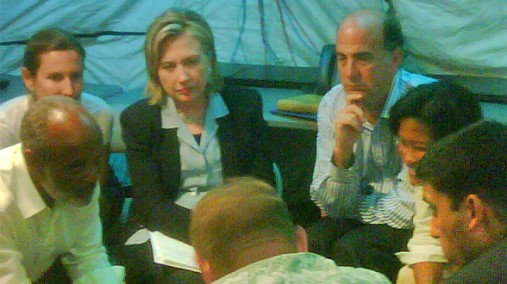
Hillary was accompanied by Cheryl Mills and USAID Director Rajiv Shah (2nd and 1st on the right respectively above).  Cheryl, from what Hillary says, must have been the one who got the "people-finder" set up as well as the text system for sending donations easily from your cell phone.

Rajiv was on the ground at the Champs-de-Mars in front of the collapsed National Palace where it seemed much of the Port-au-Prince population was camping out.  I remember him finding some enterprising young folks who had managed to have two car batteries and one car.  They had set up an enterprise allowing people, for a fee, to charge cell phones off one car battery while another of the crew ran a taxi service to charge the other battery.   It was so Haitian!

Secretary Clinton Announces Launch of State.Gov Person Finder Tool for Those Missing in Haiti

So this is where she starts - on the tarmac which is serving as the seat of government largely because it is flat and open and if you sit in a tent and there is a big aftershock you won't be crushed.  Most roads were impassable and for the first 48 hours, planes could not land at the airport.

Secretary Clinton’s Daily Appointments Schedule for January 15, 2010

Hillary reminisces at this point about her honeymoon trip to Haiti when she and Bill went to one of Max Beauvoir's voudou shows at Le Péristyle in Mariani and saw TonTons Macoutes  (VSN) and Jean-Claude Duvalier en route somewhere.  1975 was the first Christmas that I came back home - well to Florida where my sister was living. -  or maybe I would have met them.
After the earthquake, President Préval told Cheryl Mills that he really needed Hillary and needed her now!  He was Hillary's friend.  He needed help.  I perceived him as a nice guy, but not as a strong leader.

Hillary Clinton is NOT the President of Haiti!

In retrospect and fairness, and after having had my own house blown apart by Sandy, I have to say that at the time I probably did not appreciate Préval's state of mind with his house having collapsed before his eyes (and thankfully not over his head) just as he and his wife were about to enter.  With most of his government officials missing or already known dead, the poor guy must have been in deep shock. When you go through something like that having a buddy like Hillary - well - yes, I would call her, too.  If I needed to pull my country together after something like that - yes, I too would call her.  But Hillary also sees that there was a need for him to go out among the people camping on the Champs-de-Mars and everywhere.   Their question/complaint at the time was "Where is our president?"
When you run for the office, before you even win, you need to consider this kind of situation and how you will react - even if you did just miss having your house fall on top of you.  That is the role you assume as leader of a country.

Try to imagine the White House or the Capitol this way.  This is what happened to Haiti.


When Hillary arrived,  injured Americans were being cared for by a devoted embassy nurse who worked non-stop.  Our Cultural Affairs officer, Victoria DeLong,  had been killed when her house collapsed on her.  I had been in that house several times on very happy occasions.  Dr. Ainslie Minor and his lovely wife, and later Millie McCoo had generously invited the teachers to barbeques and parties.  I had danced the merengue under that roof and met Millie's sister and brother-in-law, Marilyn McCoo and Billy Davis Jr.,  there.  Now that roof had killed a Foreign Service officer.

There was a massive and effective U.S. response. Hillary remarks that U.S. military felt so refreshed at being welcomed somewhere.

One year we had no electricity from the last night of Carnaval in early February until about mid-June.  The lights went out when Carnaval ended at midnight. From then on sectors got one hour of electricity a day on a rotating weekly basis.  If you needed to do anything that required power, you needed to be home at your hour for that week.  If you were working at that time ... too bad.  From Boutillier, the mountaintop above the city, you could see a sector darken and another light up on a clockwork schedule.

Then the United States Marines arrived with generators and I don't know what all else.  I would be leaving my early morning classes at the institute (we taught from 6 -9 a.m. and from 3 - 6 p.m. or 4 - 7 p.m.) and they would be on the steps of the Hotel Plaza waiting to be picked up.  We cheered them every time we passed them.  "Thank you!"  Our electricity was returning.  Nice that after the earthquake the troops got the same reception.  We have a sort of edgy relationship with Haiti as far as troops go. Americans built the best roads there - during the occupation.

In this case, the distrust engendered by the history of the occupation could have been Préval's political enemy.  Yet to unblock the shipments of aid at the airport and seaports,  someone needed to be in charge - not to take over the country - just to lubricate the flow of aid.  Hillary got Préval to sign an agreement that U.S. military would, temporarily in the emergency,  administer the airport and seaports.

Hillary Clinton is Wheels Up!


The plan was to establish camps.  Préval worried that putting displaced people in camps would make camps permanent.  The U.N. contended that camps provided the best efficiency for necessary distribution of aid.

To my mind, and this is just me, the camps were newer, safer, cleaner than the neightborhoods some people had come from,  like Cité Soliel, but many were not from those slums, so there was something to be said on each side of the argument.

For Haiti, the approach would involve both short-term aid and long-term plans for development that had already been in the incubator.

Bill Clinton Arrives on Mission to Haiti (CBS/AP)

On-the-Record Briefing on Consular Services Being Provided to American Citizens in Haiti and in the United States in the Aftermath of the Earthquake

U.S. Government Response to the Haiti Earthquake

Secretary Clinton’s Update on Haiti

The outpouring of support and assistance from around the world has been extraordinary, and I’ve been very proud to see generous Americans from every corner of our country open their hearts in solidarity with the Haitian people. These are the times when we remember our common humanity, when we pull together across cultures and borders to help those suffering and in need.
Hilary Rodham Clinton

Secretary Clinton at the Ministerial Preparatory Conference on Haiti 01.25.2010

Today, Secretary Clinton announced that she will run an International Haiti Donors Conference in March at the U.N. You may remember her words at the Haiti Donors Conference last April in D.C. That speech was simply spot-on.

Secretary Clinton’s Remarks to Haiti Earthquake Volunteers

From U.S. Department of State: Some Details on the Upcoming International Donors’ Conference Towards a New Future for Haiti

Secretary Clinton’s Remarks at the International Donors’ Conference Towards a New Future for Haiti

We have had over 140 nations working to support the Government of Haiti in delivering food, temporary shelter, and medical care to thousands of survivors. But the emergency relief is only the beginning of what will be a long road to recovery, as the Secretary General just pointed out; one that will require global support.
Some people wonder, “Why Haiti? Why this great outpouring of international humanitarian concern and commitment to Haiti’s future? Why is Haiti’s fate of such consequence to the region and the world that it deserves sustained help? Why should we hope that this time, with our collective assistance, Haiti can achieve a better future?” These are questions that deserve answers and I believe that this conference will begin to do so...
Before the earthquake, Haiti was on a path to progress. The government, led by President Preval, had started enacting critical reforms. Haiti’s economy grew by nearly 3 percent last year. Two international chains launched new hotels, a sign of a rising tourism industry. New factories were opening and others had been contracted to begin production. But with the earthquake, the results of much of this hard work were wiped away. But the people of Haiti never gave up. As they mourn their losses, they gathered the resources they had left and began working around the clock to put their lives and their country back together. They relied on the strength and the spirit that have carried them through tough times before. But they need our help. They cannot succeed without the support of the global community, and we need Haiti to succeed. What happens there has repercussions far beyond its borders.

Hillary sees development as a key component in national security and USAID as an essential agency which played a huge role in addressing long-term plans to assist Haiti.  She recounts the war against USAID waged by Jesse Helms and celebrates this initiative which she and Rajiv Shah initiated in 2011 and she proudly saw launched earlier this year.

Hillary Clinton at U.S. Global Development Lab Inauguration


A year after the earthquake, Hillary returned to see the progress of the response (including to the subsequent cholera epidemic) and met with the presidential candidates.   There remained many challenges but things looked greatly improved.

Hillary Clinton in Haiti

"Shifting our focus from aid to development ... The United States was not abandoning traditional aid ... especially as part of an emergency response ... we sought to break the cycle of dependence that aid can create .... Aid chases need; investment chases opportunity." (Hard Choices)

Hillary Clinton’s Remarks at the Caracol Industrial Park Opening Ceremony in Haiti (with Bill Clinton!)


She recounts a personal moment with Préval after the disputed elections and credits him for being the exemplar - the first in Haitian history - to turn over the reins of leadership peacefully to  a successor not of his backing but chosen by the people.  When she speaks of the toughness of democracy, the danger of the running and the peril of the vote,  my memory rewinds to the Aristede election when Haitians literally risked their lives at the polling places and some were, in fact attacked and killed just for trying to vote.  This time, indeed, there was progress, and despite everything Préval might not have been, he, maybe, is their John Adams in some ways.

These images of the former and current presidents, Préval and Martelly, celebrating at the Caracol opening together were historic.

Rene Preval And Michel Martelly At Caracol Industrial Park Inauguration
Haiti - Politic : Martelly gives the brace to René Préval (speech)

In the book,  Hillary provides a thorough and fair accounting of what has worked and what has not in the aftermath of this disaster.  Shortly after she returned to the department following her health crisis in late 2012, this report was issued.

Haiti Three Years After: What Hillary Clinton’s State Department Has Done

Helping other nations build, profit, and rise among the economic powers on the globe is to everyone's advantage, Hillary posits.  Especially our own.  In the case of Haiti's disaster, the U.S. was, it cannot be disputed, the indispensable nation, but we were certainly not alone in the aid or in the investment, and that, Hillary points out, makes all the difference.
__________________________________________________________

Hillary Clinton’s ‘Hard Choices’ Retrospective: Introduction

Access other chapters of this retrospective here >>>>

__________________________________________________________
####

Friday, January 11, 2013

Haiti Three Years After: What Hillary Clinton's State Department Has Done

The Secretary called her return to Foggy Bottom to close down her operations "bittersweet."  Indeed it is for those of us who have closely followed her tenure. Many will remember how, notified of the earthquake in Haiti,  she cancelled a trip to Asia and flew back to D.C. from Hawaii three years ago.  She was the first foreign official on the ground in Port-Au-Prince just days after the quake.  On this third anniversary of the earthquake that devastated  a country dear to Secretary Clinton's heart, the State Department issued this amazing fact sheet of what her State Department has done to help.

U.S. Government Investments in Haiti's Rebuilding and Renewal


Fact Sheet
Office of the Haiti Special Coordinator
January 11, 2013


In early 2009, Secretary of State Hillary Rodham Clinton made Haiti a foreign policy priority and committed to working to change the way we partnered with Haiti. For more than three and a half years, the U.S. Government (USG) has worked closely to be a good partner to the government and people of Haiti. After the devastating earthquake of 2010, the U.S. worked to support the Government of Haiti (GOH) and meet the most immediate life saving and life sustaining needs on the ground. For some time the U.S. pursued two tracks of engagement and has ensured that they complement one another: the first to address immediate humanitarian and emergency aid needs; and the second to continue to pursue a strategy to promote long-term sustainable development in Haiti.
Below is a high-level overview of some of the U.S. contributions to help Haiti on a path to economic prosperity and political stability.
Government Stability and Capacity Building: The United States and other donors supported the Government of Haiti’s free and fair presidential and legislative elections in late 2010 and early 2011. These elections paved the way for the complete re-establishment of all three branches of government. The U.S. provided capacity building support, including the provision of experts to work within the Government of Haiti and the provision of temporary office space. As a result, the Government of Haiti has been able to lead more effectively in many areas of governance, including efforts to: combat crime; prepare for emergency responses to Hurricanes Tomas, Tropical Storms Isaac and Sandy; collect taxes; increase transparency; alleviate housing shortages; promote foreign direct investments; and expand basic services for Haitians, including in education and health services.
Energy: Only 12 percent of the population has regular legal access to electricity. The Martelly Administration has made access to energy one of its priorities and views it as a necessary step in Haiti’s economic development.
  • The U.S. Government, through USAID, is funding the services of an experienced management firm to help improve the commercial and operational sustainability of Haiti's electric utility EDH. The firm is working with the utility to expand active customers by a third. Progress to date shows significant improvements in the utility’s financial performance and service delivery, having added over 20,000 households and business as active customers.
     
  • The USG is helping to improve the reliability of electricity in Port-au-Prince through renovation of five electricity sub-stations. The project is expected to be complete by the end of February 2013.
     
  • The USG commissioned a 10 mega-watt power plant in the north, contributing to reliable power for the tenants of the Caracol Industrial Park as well as houses around the park. The first households in the northern town of Caracol, which never had electricity before, were connected to the grid of the power plant in October 2012, designed to provide reliable power to residences and industry.
     
  • The USG also launched a competitive tender in December 2012 [available online at www.FBO.gov] to design, build, and operate Haiti’s first industrial scale solar facility. This is part of an ongoing effort to work with Haitian partners to harness renewable energy opportunities.
Housing: The United States has worked to address immediate shelter needs, including the removal of rubble to make space for shelter, as well as the construction of permanent housing settlements.
  • To date, the Government of Haiti, the international community, private firms, and individual households have removed approximately 7.4 million cubic meters of rubble, or 74 percent of the rubble created by the earthquake. The USG has removed one third of this total. USAID-funded programs helped some 65,700 households (roughly 328,000 individuals) find safer housing through the construction of temporary shelters (29,000), rental vouchers, and housing repairs (6,000).
     
  • The United States is currently constructing two new settlements, with construction underway of 750 homes in the north near Caracol and 156 homes near Port-au-Prince in the Saint Marc region. The next five settlements of approximately 1,250 houses, where all engineering designs, environmental studies and water tests have been completed and tenders are due to be launched shortly, will be developed together with a diverse set of partners such as the Qatar Haiti Fund, the Inter-American Development Bank, and the American Red Cross, enabling the United States to leverage resources for greater impact.
Business and agricultural loans: Eighty percent of the credit available in Haiti is used by only ten percent of the borrowers.
  • The United States has partnered with Haiti’s existing banks, credit unions, and other lenders to provide credit guarantees and help design new ways to lend to entrepreneurs and farmers.
     
  • The United States has supported efforts to computerize data and processes for loan officers, in order to support approximately $21.7 million in loans disbursed to over 6,500 businesses.
Agriculture: With more than 60 percent of Haitians reliant on agriculture for income, the United States has expanded its support in the sector through its global food security initiative, Feed the Future.
  • To date the United States has worked with more than 9,700 farmers, introducing improved seeds, fertilizer, and technologies.
     
  • 2012 results include a 58 percent increase in rice yields, 341 percent increase in corn, 100 percent increase in bean yields, and 21 percent increase in plantain yields. Our goal is to increase incomes for 100,000 farmers in three geographical focus regions over five years.
     
  • Additionally, Feed the Future just launched the bean planting season at a cost of another $1 million, which will provide farmers with seeds and other inputs.
Transformation of Haiti’s North: The United States is partnering with the Government of Haiti, the Inter-American Development Bank, and the private sector to create access to jobs, housing, electrification, transportation, and agricultural development in Haiti’s north. These types of investments, when married with the entrepreneurial spirit of the Haitian people, are helping to catalyze growth in the region. As part of this partnership, by 2015, the United States will have helped create:
  • New housing settlements for over 13,000 people complete with electricity, water, social services, and job opportunities nearby;
     
  • 15,000 new formal jobs at the Caracol Industrial Park, one of the Caribbean’s largest industrial parks, which is projected to grow to 20,000 jobs by 2016;
     
  • Reliable electricity to up to 100,000 people and businesses that currently have none; and,
     
  • Rehabilitated health clinics and reference hospitals in regional towns.
The first tenant of the Caracol Industrial Park, Sae-A, one of the largest garment manufacturers in the world, already has 1,300 employees, most of them women who have never had a formal sector job before. Many are graduates of a new, nearby vocational training center that the USG built and supports. Sae-A is on track to reach the goal of creating 20,000 jobs by 2016. A second tenant, a Haitian company, has moved in September of 2012 and a third tenant is due to start operations shortly. Additionally, a new U.S.-funded power plant opened this year to serve the industrial park and surrounding communities. Nine buildings, including factories, warehouses, and offices, have been built. At least twelve new buildings are scheduled for completion in 2013, more than doubling the industrial park’s capacity.
Health Services: Prior to the earthquake, the United States was providing access to health care for approximately 50 percent of the Haitian population; after the earthquake, the United States has been able to maintain this level of care. The United States provides a basic package of health services (primarily maternal and child health) and more sophisticated HIV/AIDS prevention and treatment services.
  • The Haitian Ministry of Health and Population is working to achieve a sustainable network of health facilities. To help them realize this goal, the United States entered into the Health Partnership Framework with the Haitian government, which promotes sustainability by emphasizing country ownership and leadership, and includes a five-year plan that encompasses contributions of the government, civil society, the private sector, and other donors.
     
  • The United States supports 251 primary care and 52 secondary care sites nationwide.
     
  • The United States increased the number of eligible patients on anti-retroviral (ARV) treatment from 60 percent in March 2012 to 65 percent in June 2012. We are working with the Global Fund to Fight HIV/AIDS, tuberculosis, and malaria to reach universal coverage of ARVs for all eligible patients by June 2015.
     
  • The United States recently convened the two largest umbrella networks of disabled people organizations to coordinate a single national strategy and move forward with plans to strengthen local advocacy groups. In addition, work is underway to establish four to six disabled service centers nationwide and to build government capacity to promote inclusion of people with disabilities in policy and legislation.
     
  • Through June 2012, the United States provided expertise and more than $95 million during the emergency phase of the cholera response.
Education: President Martelly has identified free and universal education as one of the key priorities of his administration.
  • Since January 2010, the United States has constructed more than 600 semi-permanent furnished classrooms and provided teaching and learning kits enabling more than 60,000 children and 1,200 teachers to return to school.
     
  • Over the next two years, the United States will partner with the Haitian Ministry of Education to develop and test an instructional model in over 300 schools, reaching 28,000 students, and training 900 teachers.
Improving Access to Justice and Legal Assistance: The rule of law, as supported by justice and security institutions, is a basic foundation of citizen security and economic growth. The United States is committed to supporting a responsive, just, and effective Government in Haiti. Our efforts include:
  • Supporting the formation of the Superior Judicial Council (CSJP), a new body which will provide oversight of the judiciary – a major step towards judicial independence in Haiti;
     
  • Providing legal assistance to over 2,700 individuals in Cite Soleil, Martissant, Saint-Marc, and Petit-Goave since October 2011;
     
  • Renovating corrections facilities; and
     
  • Providing equipment and technical assistance to reduce pre-trial detention and improve case management in targeted jurisdictions.
Strengthening the Security Sector: The Haitian National Police (HNP) is Haiti’s sole indigenous security force. Improving and expanding the capacity of the HNP is critical to the Government of Haiti’s ability to maintain public order and protect vulnerable populations.
  • The United States is supporting the recruitment and training of new officers, bolstering the counternarcotics unit, and providing communications equipment.
     
  • The UN Stabilization Mission in Haiti (MINUSTAH) also helps promote a secure and stable environment in Haiti. U.S. support includes 100 UN police officers, 10 corrections officers, and nine military officers seconded to MINUSTAH.
Protecting Human Rights and Vulnerable Populations: Increasing protection of human rights and vulnerable populations is key to U.S. assistance in Haiti. The United States is funding a number of initiatives to provide services to victims of abuse, and empower vulnerable populations. Efforts include:
  • Supporting economic opportunities for women and survivors of sexual violence through microcredit and short-term jobs programs; and
     
  • Providing job skills training, health services, and reintegration and repatriation assistance to Haitian migrants.

Wednesday, September 26, 2012

Hillary Clinton at UNGA: Dancing As Fast As She Can

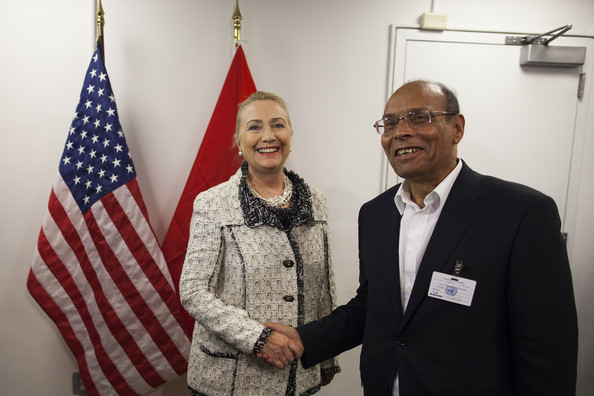
If you looked at Mme. Secretary's schedule today, you saw that between major speaking events this morning on UNAIDS and Sahel and her address at the Security Council on Middle East Peace and Security, there were three bilaterals: one with her Turkish counterpart, Foreign Minister Davutoglu, and two with heads of state, Jordanian King Abdullah, and Tunisian President Marzouki, pictured below. 


I was able, this afternoon, to watch the webcasts of her address to the Security Council followed immediately by her remarks at the Somalia meeting.   There was zero extra time between these.  She had the leave the Security Council in order to make the next event.  Subsequently she had two more bilaterals with Burmese President Thein Sein and Palestine's Mahmoud Abbas respectively. 

Wearing two hats takes some juggling, and she has been doing that very gracefully and well.  She is covering her own scheduled events as SOS but also squeezing in these bilaterals with heads of state that normally would fall to the president who is so busy campaigning.   But it is understandable that some frustration might ensue, and evidently it did  this morning when her meeting with Davutoglu had to be cut short due to scheduling.  According to a senior State Department official, she and her Turkish counterpart did not manage, in the 25 minutes allotted, to address all the intended issues.  "They both left somewhat frustrated that they didn’t get through their full agendas...."   The official speculated that they may be able to catch up with each other at a few shared events on Friday. 

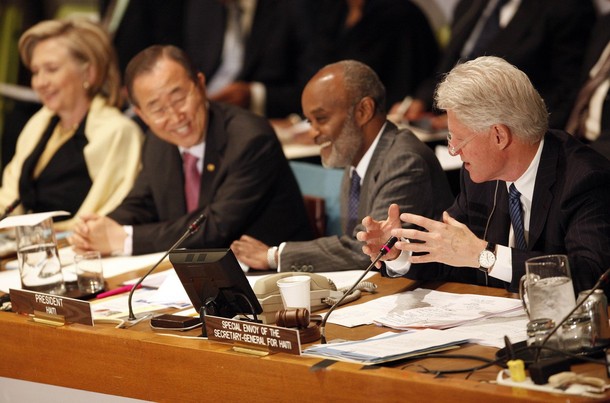
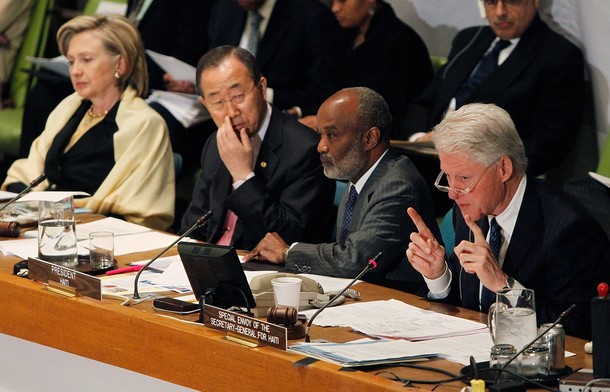
In a separate briefing directly following the first, some background was shared regarding tomorrow's Haiti Partners Ministerial where progress following last year's elections and earthquake recovery will be on the agenda.  Perhaps we will once again see both Clintons active as we did at this event on March 31, 2010.  (The official did not say we would, but we can hope.)


Sunday, January 9, 2011

Haiti: One Year Later

While we are waiting for news of the Secretary's trip to the Persian Gulf, the major networks and cable news sources have sent their anchors packing back to Haiti to cover conditions a year after the earthquake that devastated that country. The anniversary of that event is coming up on Wednesday, and we all have heard criticisms of the flow of aid. The State Department held a briefing on Friday with Cheryl Mills and Rajiv Shah, USAID Administrator, both of whom can be considered the two U.S.-based officials most familiar with our operations there.


In addition, the Department has issued Fast Fact Sheets regarding operations in Haiti as follows.


Finally, this event will be live-streamed in Dipnote tomorrow.

Conversations with America - Haiti in 2011: The Way Forward


Media Note
Office of the Spokesman
Washington, DC
January 7, 2011


Haiti Special Coordinator Thomas Adams and President and CEO of InterAction Sam Worthington will discuss the continued U.S. support to the Haitian Government and people in response to the January 2010 earthquake and the way forward in the coming year on Monday, January 10, 2011 at 10:30 am (EST).

This discussion, moderated by Assistant Secretary of State Philip J. Crowley, will be streamed live on DipNote, the Department of State’s official blog. Members of the general public will have the opportunity to participate through the submission of questions, some of which will be selected for response during the live broadcast.

This is the eighth in the Conversations with America video series coordinated by the Bureau of Public Affairs, in which the State Department's senior leadership hold monthly conversations live, online, with leaders of prominent non-governmental organizations. Discussion topics include foreign policy and global issues, and provide a candid view of how leaders from civil society engage the Department on pressing foreign policy issues.


Tuesday, January 26, 2010

Secretary Clinton's Radio Interviews From January 25 In Montreal

The State Department has released two radio interviews that Secretary Clinton gave while in Montreal yesterday. Here are the transcripts.


Interview With April Ryan of American Urban Radio Networks


Hillary Rodham Clinton
Secretary of State
Montreal, Canada
January 25, 2010

QUESTION: Secretary of State Hillary Clinton, thank you so much for your time, and talking to us about issues of Haiti. We are here at this ministerial preparatory conference. You are setting the outline, I guess, for the Haitian donors conference.

Could you talk to me, first of all, about the positives that came out of this conference, and what you see down the road for Haiti?

SECRETARY CLINTON: Well, April, first of all, thank you for following this story and coming to this conference in Montreal, because I think we established a good framework for how we are going to move forward. It's only been 12 days since this horrible disaster occurred. But already we have a set of principles about how we want our work to be shaped. We have some long-term strategic objectives, and we have the beginnings of a road map for reconstruction and development.

It is really heartening, and I think your listeners would find it so, that people from across the world are showing their hearts on behalf of Haiti. But it's not enough that we show compassion. It's not enough that we contribute to a good charity, or that we bless the use of our tax dollars to help the people of Haiti. We have to have a plan that we can execute on, that we can demonstrate results from on behalf of the people of Haiti.

So, we will be having the next conference, which will try to set all of this in place, in New York in March. Because the United States has a great commitment to the people of Haiti. President Obama and I had already been working on a plan to try to assist the people of Haiti before the earthquake. So we are going to build on that, and we are going to come up with some workable, practical approaches to give the Haitians a better future.

QUESTION: Now, am I correct in understanding that, from this press conference with the ministerial leaders, that it will be 10 years -- you have a 10-year plan -- correct?

SECRETARY CLINTON: I think that the time frame that everyone is talking about is 10 years, because we look at other disasters -- take, for example, the recent tsunami in Asia over Christmas of 2004 into the new year then. So that's been five years. And a lot of good work has been done, but there is still work to be completed.

But, for example, in the terrible impact of the tsunami in Indonesia, it didn't affect the Government of Indonesia. So the Government of Indonesia and most of the country was unaffected. What happened here was so much more devastating, because it just wiped out government buildings, records, public services from schools and hospitals and police stations. The penitentiary was unfortunately damaged, and therefore, all the criminals got out.

So I think most experts believe that we're talking about, on the low end, a 5-year, on the upper end, a 10-year -- of sustained commitment. And then, hopefully, we will have put the Haitian people on a strong foundation.

One other example I would use is think about the terrible genocide in Rwanda. Yet now, about 15 years later, Rwanda is recovering. I mean they lost 800,000 people. It was the worst kind of terrible evil. And yet now their economy is growing, because they had a plan. And the international community stood with them while they implemented that plan.

QUESTION: Well, you speak of that, and Haiti is a whole different -- in a whole different boat than many of these other countries: the poorest country in the Western Hemisphere. You know, I went there and, I mean, I saw beauty in poverty, because people wanted to survive. And now they are trying to reorganize that survival, and change how they lived before.

And that brings me to something that I found out this week. I talked to Mayor Ray Nagin of New Orleans, and he said his city, five years in, still has a lot of problems. And he says typically it takes a city or a community, to rebuild, 10 to 15 years. You're talking 10. And New Orleans had buildings that at least met code. They had certain infrastructures that were in place. Haiti doesn't.

So, do you realistically think 10 years, or maybe even beyond? And, if so, it's going to go beyond the billions and billions, and maybe into trillions, correct?

SECRETARY CLINTON: I don't think so, and here is why. I think every disaster is different. There is no doubt that what has happened to Haiti is extraordinarily damaging. If we do this right, though -- the countryside was largely unaffected -- if we can get economic activity going in the countryside, the farmers able to once again plant and harvest and have markets for their food, there is an opportunity here which is unique, because Haiti has been studied to death. Everybody has an opinion about what needs to be done in Haiti. The problem has been there has never been the political will matched with the resources and the pressure to follow through, as there is now.

So, that's why 10 years is a time when we will be able to assess how much has happened. Of course, there will continue to be problems and challenges beyond that. But Haiti had those before the earthquake. And part of what we have to do here is to create a different mind set among Haitians themselves. The people in the establishment in Haiti have to understand that their country and their fellow men and women can do better if they are more generous, and share the results of success. The people out in the country have to grasp education as a true vehicle for personal achievement.

So, there is a lot to be done. But I am always struck by how, when Haitians leave their country, come to the U.S. or Canada or France, they are very successful. They are doctors and nurses and teachers and business leaders. And there is no reason that they cannot see that success back in Haiti, if we get the attitudes of people to match the development agenda.

QUESTION: You talked about the countryside. Let's go beyond Port-au-Prince. What is happening now to help those who are beyond the Port-au-Prince borders who are affected right now? We know that roads are still impassible. But what is this administration doing to help those?

SECRETARY CLINTON: Well, actually, we are helicoptering in food, water, supplies into areas where there has been an increase in population because people are leaving Port-au-Prince. Many experts, including the prime minister, Prime Minister Bellerive, today said that this is an opportunity that should not be missed.

Port-au-Prince got too big for the size of Haiti, in part, because previous governments did not invest in the countryside. And, therefore, if we can reverse some of that in-migration to Port-au-Prince, and as people are leaving Port-au-Prince to go back to their family homes, if we can provide opportunity back there, then we will have a better chance to develop Port-au-Prince in a more thoughtful way.

QUESTION: Well, let's talk about migration. You have heard the calls. Many people, to include the NAACP, CBC, they are looking for an extension into the temporary status, the protected status, for many that are here for 18 months. And they are saying it may need to happen beyond. What are your thoughts?

SECRETARY CLINTON: I certainly think we have to stay open to that. I think that the immediate need to provide temporary protected status to the people who are here without documentation was necessary, and the Obama Administration did it. But we have to watch this carefully. You cannot return people until there is some sense of stability and security and opportunity. And I don't think 18 months is a magic number. So we are going to have to evaluate this as we go forward.

QUESTION: And also, Congresswoman Maxine Waters wants the United States to forgive or help the -- get the help from the United States to forgive the debt to the IMF, the World Bank. Is that something that is feasible, especially now, since they need you, they need all your money, all your support?

SECRETARY CLINTON: Absolutely, it's feasible. We are looking at that. We heard presentations today from all three of those -- those two organizations, plus the Inter-American Development Bank. They all recognize the need that they face in trying to work through a program for the forgiveness of debt. It's just unrealistic to think that Haiti would ever, in the far foreseeable future, be able to repay that.

QUESTION: And lastly, housing and security. What are you going to do on the ground there? And how is the U.S. really going to get involved with security over time? Because that is a major issue. And the housing, trying to house these people as they are rebuilding to a new standard, a new building code standard?

SECRETARY CLINTON: Well, two things. One, as you know, we have sent thousands of our troops -- soldiers and Marines -- to assist in the delivery of humanitarian supplies, and also to support the UN troops on the ground in providing security. The UN troops have done a good job. The UN mission, led by a Brazilian general, has really made enormous progress in providing law and order, in working on corrections, and many of the other aspects of law enforcement. But they are overwhelmed, and the UN personnel probably will, when it's all said and done, suffer more than 300 losses. So, this is a big burden for them to assume. But the Security Council has expanded the number of forces that they can take, in both the police training and the units of soldiers to support those that are already there.

So, we are going to work closely with them, because security is paramount, and it has to be in the streets. And, as I said, we have all these people who broke out of the penitentiary. So we have, unfortunately, more than our share of dangerous criminals wandering around now that have to be disarmed and subdued and returned to a prison. But we are really committed to working on the immediate needs of shelter and housing.

We talked today in our meeting about how we can come up with 200,000 tents so that people will have some shelter. We are racing against the clock, because the rainy season starts in a couple of months, and the hurricane season will also return. So we just have to do everything we can, and everyone is committed to that.

QUESTION: And lastly, have you been able to talk to some of these leaders here about what many around the world are saying, this heavy-handedness by the United States in helping? They don't want the military there, a strong military presence. It's almost like you're hearing the same thing with the African Union when there was a concern about bringing AFRICOM there. People don't want the U.S. military there. What are your thoughts about that? And have you talked to these world leaders about that?

SECRETARY CLINTON: Well, I have not only talked with them, I have followed the international press very closely. That's a minority opinion. The much greater majority opinion is that the United States is using its power in a way that everyone can see helps people. We have made it clear we are not there for the long term, this is solely to assist the Haitian Government and the international community and support the UN.

But, boy, are people glad to see us. And I have lots of pictures of Haitians embracing our soldiers, waving at our helicopters, expressing their thanks. So we know that some want to draw some historical parallel that is not applicable, but we are not paying any attention to that. Our goal is to help as many Haitians as possible, and our military is absolutely instrumental in doing that.

QUESTION: Last note, last word from you?

SECRETARY CLINTON: Just thank you for following this. This is something that, just as it's a long-term effort on the ground, we need Americans involved for the long term. And there will be roles and opportunities for people to volunteer, to contribute, to do the kinds of things that America does better than anyone. When we come out with our heart showing in the face of these kinds of catastrophes, it's the best example of who we are, and the values that we live by.

QUESTION: Thank you so much, Secretary Clinton. You are awesome. Thanks for having me with you, and doing this interview. You keep your promises.

SECRETARY CLINTON: Yes, ma'am. I try. As you know, we have known each other a long time, April.

QUESTION: A very long time. Take care.

SECRETARY CLINTON: Thank you.


Interview With Michele Kelemen of NPR


Hillary Rodham Clinton
Secretary of State
Montreal, Canada
January 25, 2010


QUESTION: So, you have this meeting coming up in March. What do you expect to have by then? Do you want to have that mechanism in place, some overarching thing in place? And what numbers are you looking at for commitments, then?
SECRETARY CLINTON: Michele, we are trying to do this in a very careful way, sequencing steps that are necessary before we move to the next step.
So, for example, the World Bank, the United Nations, the U.S., we're doing needs assessments in Haiti. The UN and the World Bank will have their assessment, we hope, by the conference. Obviously, we're going to time the conference to make sure we have that needs assessment. We are starting to do a lot of technical planning. There will be some technical conferences that will look at how we quickly move on some of these very big demands in health and education, security, and the like, and we will be working, in the lead-up to the conference, to try to decide on how we will organize ourselves. I am looking at all kinds of models as to what has worked in other settings, what hasn't worked. What can we learn from even successful models?
Most people think that the international response following the tsunami was quite successful, but there are some lessons to be learned from that. We are really trying to do this in a practical way. So let's figure out what we need to do, let's have a plan to figure out how we can get everybody on board. Let's set up kind of an executive mechanism to actually execute with accountability, transparency, benchmarks, results. And there seems to be a great willingness on the part of everyone to actually do that and then, by the conference in New York, be able to present how we intend to proceed.
QUESTION: But 10 years? I mean, do you see people ready to make that sort of commitment?
SECRETARY CLINTON: I do. And I think it's not up to any one country, or one organization. And right now we don't know how much money will be needed.
But just step back a minute and think about all the money that was going into Haiti before the earthquake. Our government gave a lot of money to Haiti. If we were to aggregate all of the charitable contributions and work from NGOs, from churches and other religious organizations, it's a big number. My goal is that we will be better organized and focused, so that we can get more results from what we were putting in in the past, and then see what additional gaps exist.
I think that if you look at, say, Rwanda, terrible human catastrophe. It didn't affect the physical infrastructure, but when more than 800,000 people are murdered in a genocide, who would have thought that Rwanda would now be seeing economic increases in their GDP and be viewed as a real success story?
Or take Indonesia after the tsunami. The hardest hit part of Indonesia was Aceh. There was an insurrection going on in Aceh. It was a devastating blow when the tsunami came in and took tens of thousands of people and destroyed for miles into the land what was there. Now, it's really come back. It is, what, five years since the tsunami? There is still work to be done.
But I think with the proper planning, and with relentless execution, we can see progress. But I'm not going to sugar-coat it. It's going to be a very challenging time, because the Haitian Government knows it has to change. The prime minister was very clear about that in his remarks in our meeting: the people's mindsets about education and the importance of choosing it, participating in democracy, all of those attitudes that they know they have to have a positive view towards.
So, I think we are going to see a good effort. And, ultimately, it's up to the Haitian people. But there is a great willingness by the international community to help.
QUESTION: And you talk about partnering, rather than being a patron of Haiti, or a patronage. How do you do that, when the government was decimated in this, with this earthquake?
SECRETARY CLINTON: Well, we have, I think, some positive work to build on. Because when I became Secretary of State, I talked with President Obama about the need to have a concerted effort, with respect to Haiti. He agreed, gave me the go-ahead. I put my chief of staff in charge. So, for the past year, we have been working closely with the current Haitian Government. We know them, they know us. We had plans already in place to follow through on agriculture, energy, security, and the like.
When I went down to see President Preval a week ago Saturday, we talked, of course, about the immediate crisis, and everything that had to be done to get supplies in and deal with the airport and the port, and so much else. But he very clearly said, "But we cannot lose all the work we have done. We need to take that work and make it better, and build on it."
So, we come into this period of crisis with some very solid thinking that has already been done. We can't just take what we had and slap it on to where we go next. We have to be thoughtful about what might need to change or be amplified. But I think we are in a good position to work with the Haitian Government.
QUESTION: But even getting the government back on its feet, I mean the U.S., I guess, is offering some space, some work space?
SECRETARY CLINTON: We are. We are offering some space, we are offering communications ability, we are offering security. And we have been, ever since the earthquake. The Haitian Government is pulling itself together, coming up with its own ideas, taking the work that we had done for this past year off the shelf, looking at it. So I think we are going to be in a very positive position, working with the rest of the international community, to get prepared for the donors conference in New York.
QUESTION: You turn your attention later this week to some other very long-term development needs in Afghanistan, in Yemen. What are you hoping to get out of that conference in London? I mean, more commitments?
SECRETARY CLINTON: Well, these are not donor conferences. They are planning and implementation conferences. The meeting on Yemen isn't really even a conference, it's a meeting of countries that have been involved in Yemen, have a commitment to Yemen. They are coming together to discuss security and development. One without the other doesn't work. We will be making clear to the representatives of the Government of Yemen what we expect and how we intend to work with them.
With Afghanistan, it certainly is farther advanced. We already have a lot of commitments for not just military assets, but a lot of development work. President Karzai will be there. He is coming with some very good plans that he has been working on with his new government. So I think you will see what they say at conferences are deliverables, in other words, really tangible commitments coming out of the conference by many different parties who will attend.
QUESTION: One of the things he is talking about is this reconciliation with some Taliban, trying to divide the insurgency, as David Miliband put it recently. What does the U.S. think about that?
SECRETARY CLINTON: Well, we believe that ultimately, in any conflict, there has to be a political resolution. And we support the Government of Afghanistan as it is taking steps. We are obviously concerned about specific actions. We want to have a thorough understanding of everything that President Karzai is planning. We want to know the conditions.
There are two end states that are being discussed. One is called reintegration, which has done a lot on the battlefield. Our military did this in Iraq, they will do it again in Afghanistan with the same kind of approach, because a lot of the people who are foot soldiers for the Taliban are there because they get paid, or there because they were essentially volunteered up by their village elders. They have no other real alternatives, so we want to help the Government of Afghanistan provide that alternative.
Then there is reconciliation, which is the longer term political agenda, which would really look at seeing whether or not any level of leadership of the Taliban would be willing to re-enter the political system inside Afghanistan, eschewing violence, turning away from al-Qaida, basically determining to compete peacefully inside of the society.
It's way too soon to tell whether we can expect any positive developments, but it is an important part of our overall strategy.
QUESTION: And something you will be hearing about from Karzai.
SECRETARY CLINTON: Yes, I will. I will.
QUESTION: Thank you very much for your time.
SECRETARY CLINTON: Good to talk to you, as always.

Monday, January 25, 2010

Video & Text: Secretary Clinton's Remarks with Canada's PM Stephen Harper

Aha! This just became available!


Remarks With Canadian Prime Minister Stephen Harper After Their Meeting

Hillary Rodham Clinton
Secretary of State
Montreal, Canada
January 25, 2010

PRIME MINISTER HARPER: Well, first of all, Secretary Clinton, welcome to Montreal. We’re delighted to have you in Canada representing the Administration and I should just say as well delighted with the work you’ve been doing with us and delighted – very pleased at the fact that President Obama has taken such (inaudible) very regularly on this. And of course, on the ground, our people have been collaborating very closely and we always appreciate that.

Let me be clear about why we appreciate this. As your closest neighbors and friends, we understand not simply the scale of American involvement in Haiti and in these kinds of circumstances, but we understand what drives them, although it’s not simply American power and capability, but the fundamental generosity of the American people, our great neighbors and friends. We always take great heart from that and look forward to working together.

And we – of course, we also had some good discussions on our other (inaudible) involvements in issues like Afghanistan and climate change, and, of course, our economic (inaudible).

(In French.)

SECRETARY CLINTON: Well, I appreciate greatly the very warm welcome, Prime Minister, but I also applaud you and your government for your leadership with respect to Haiti. Canada has been a very generous donor to Haiti over many years, and once again Canada and the generous people of Canada are leading the way.

This conference, which has been put together very quickly to bring together those who are already committed to Haiti to begin the process of planning the reconstruction along with our Haitian partners, is absolutely critical.

As you say, we talked about other matters that are of great concern and interest to both of our countries, and we appreciate your partnership, your friendship. You are not only a neighbor, but a true ally on so many of the important matters that we confront in the world today.

So thank you again; I’m always happy to be in Montreal any time of year, and I look forward to our continuing collaboration.

MODERATOR: (Inaudible.)

QUESTION: Yes, I’d like to ask you about a comment that the Haitian prime minister made this morning when she said that the strategy for the recovery and rebuilding effort needs to be rethought and retooled in light of the fact that so many people have fled the capital and gone into the countryside. I’m wondering if you see it that way also, and what are the implications for that kind of a change in direction?

SECRETARY CLINTON: Well, Bob, this was a very important point that Prime Minister Bellerive made, because one of the problems that the Haitians themselves recognize, as well as other outside experts, is that over the last several decades, the population of Port-au-Prince has swollen exponentially. Services did not and could not keep up. The countryside was depopulated in ways that were contrary to the future economic growth and prosperity of the entire country.

So I was quite heartened to hear the prime minister say that as part of our multilateral efforts to assist Haiti, we should look at how we decentralize economic opportunity and work with the Haitian Government and people to support resettlement, which they are doing on their own as people leave Port-au-Prince and return to the countryside from which most of them came. Agriculture has not gotten the attention that it deserves as being one of the pillars of the economy in Haiti. In fact, this past year, as we were working on our own bilateral plan with Haiti, agriculture was our principal emphasis.

And so we are prepared, working with partners like Canada, to assist in caring for those who leave Port-au-Prince, working to provide not only assistance, but sources of livelihoods, and seeing the entire country as in need of assistance which will help what we do in Port-au-Prince be more successful.

PRIME MINISTER HARPER: I agree with that. I would just say I thought it was an interesting observation. Obviously, we’re in – I think the truth is we’re in the very early stages of thinking longer-term here, in what the rebuilding strategy really is. So I think it’s a useful observation, one that, we can adapt to it. I think, as Secretary Clinton said, it really would help with development going forward with a more balanced and (inaudible) development.

At the same time, I think it does also indicate to us the need for us to work closely with the Haitians, who do understand the conditions on the ground maybe a little better than some of us with high intentions but a little bit farther away here. So I think it’s a useful observation as we go forward.

QUESTION: Madame Secretary, Prime Minister, there’s been a lot of discussion here today about accountability and the need to make that part of the overall plan going forward. What specifically is going to be done to ensure that the money which the international community invests there is spent properly and gets to where it’s going? Who will follow the money and how will it be done? Prime Minister, when you respond, please respond in French as well.


PRIME MINISTER HARPER: Just say that we discussed some of the specifics of (inaudible). Obviously, this is a wider discussion that’s going to go on with all of the countries here. But as Secretary Clinton said, I think we’re going to look around the world at some recent examples of multilateral recovery efforts, how those can be best coordinated, and how those can be done in a way to ensure accountability and ensure effectiveness. And there, I think we’re developing as the years go by some (inaudible) models of what works and what does not work. Obviously, a big part of this is working through credible international organizations that are capable of coordinating donors and also capable of tracking money and tracking the effectiveness of their efforts. So that would be a big part of it going forward, but I wouldn’t want to get into too much detail because, obviously, it will prejudice the discussion here, but as I say, we’ll look at the models that haven’t worked.

(In French.)

SECRETARY CLINTON: Well, I would emphasize what the prime minister said about the importance of effectiveness and responsibility. As we work together to design the mechanism that will be used to deliver assistance and create the conditions for sustainable development, we bear a responsibility to our taxpayers to assure that the money that our government commits will be well spent, transparently, and with results on the ground for the Haitian people. I think that is also true for all of the private donations that will be joined with government funds, through NGOs, so that together, we can point to the outcomes that everyone is hoping to achieve on behalf of this reconstruction and redevelopment effort.

And finally, I would just say a thank you to everyone here in Canada, certainly in my own country, who have seen that here in our hemisphere, we have a near neighbor in such great distress, who wish to help, who want to be part of the longer-term reconstruction of this country, but who look to people like the prime minister, President Obama, and myself to make sure that what we do makes sense, that it can be explained and justified, and that we can, along with our Haitian partners, put the money that is being provided to good use.

PRIME MINISTER HARPER: Thank you very much.