Showing posts with label South Korea. Show all posts

Saturday, September 29, 2012

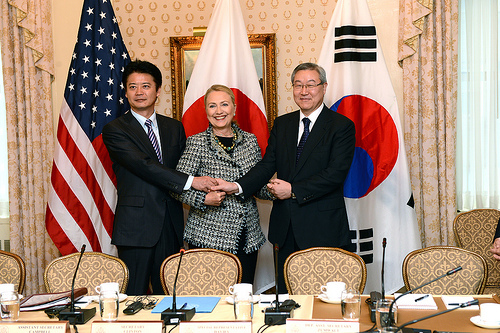
Sidelines at UNGA: Hillary Clinton with Japanese FM Gemba and Korean FM Kim


Remarks With Japanese Foreign Minister Koichiro Gemba and Korean Foreign Minister Kim Sung-hwan Before Their Meeting


Remarks
Hillary Rodham Clinton
Secretary of State
Waldorf Astoria Hotel
New York City
September 28, 2012


SECRETARY CLINTON: Welcome, all of you here, and thank you for coming. As you can tell, we have a lot of people and a very, very small room. But we are with two close allies united by so many common interests and values. This is the fourth meeting that we’ve had in the past two years, including most recently this summer on the margins of the ASEAN Regional Forum in Phnom Penh, Cambodia.
Our three nations share a strong interest in the peaceful, verifiable denuclearization of the Korean Peninsula. We will discuss today what further steps we can take toward that goal. We will also discuss how every nation in the region has a responsibility to work to resolve disputes peacefully, lower tensions, promote regional security and stability.
Our alliances with Japan and the Republic of Korea are cornerstones of peace and prosperity in the region and each of these countries represent an enormous success story about what can happen when nations are focused on peace and stability and giving more opportunities to their own people and developing good relationships with their neighbors. We will maintain close cooperation between the three of us. That is a top priority for the United States, and I’m delighted to be here with my friends and colleagues. Both ministers, Minister Gemba and Minister Kim, are people with whom I work closely, and I look forward to our discussion today.
Thank you.

Wednesday, November 30, 2011

SECRETARY HILLARY RODHAM CLINTON: Public Schedules for November 29 and 30, 2011

For what it is worth, here is yesterday's schedule,  just posted by DOS,  followed by today's.


Public Schedule for November 29, 2011


Public Schedule
Washington, DC
November 29, 2011


SECRETARY HILLARY RODHAM CLINTON:
Secretary Clinton is en route to foreign travel in Busan, Republic of Korea to participate in the Fourth High-Level Forum on Aid Effectiveness. She is accompanied by Counselor Mills, Assistant Secretary Campbell and Director Sullivan. Click here for more information.

PM LOCAL Secretary Clinton arrives in Busan, Republic of Korea.
(MEDIA DETERMINED BY HOST)


Public Schedule for November 30, 2011


Public Schedule
Washington, DC
November 30, 2011


SECRETARY HILLARY RODHAM CLINTON:
Secretary Clinton is on foreign travel.

Tuesday, November 29, 2011

Hillary Clinton Issues Fact Sheet on Gender Equality in Busan


Dressed (beautifully and appropriately) in pink, our girl issued the following fact sheet on empowering women and girls at the Fourth High Level Forum on Aid Effectiveness at Busan today.

The Special Session on Gender at the Fourth High Level Forum on Aid Effectiveness at Busan

Fact Sheet
Office of the Spokesperson
Washington, DC
November 29, 2011

A panel discussion hosted by Hillary Rodham Clinton, U.S. Secretary of State, and Kum-lae Kim, Korea’s Minister for Gender Equality and Family, and moderated by Michelle Bachelet, Executive Director, UN Women.
Why gender equality for development effectiveness?
Achieving our internationally agreed development goals requires accelerated progress on gender equality and women’s empowerment. A growing body of evidence shows that empowering women and reducing gender gaps in health, education, labor markets, and other areas is associated with lower poverty, higher economic growth, greater agricultural productivity, better nutrition and education of children, and a variety of other outcomes.
Participants in this session include representatives of partner countries, donors, women’s organizations, private sector and mulitlateral organizations, and development banks. They will discuss ways to translate evidence into action at the country level, and their support for gender related commitments in the Busan Outcome Document and “building blocks.”
Evidence and Data for Gender Equality (EDGE):
  • The Evidence and Data for Gender Equality (EDGE) Initiative is a new initiative to improve the availability and use of statistics that capture gender gaps in economic activity. It capitalizes on the United States’ call to action at the May 2011 OECD Ministerial Session on Gender and Development and builds on recommendations of the UN International Agency and Expert Group on Gender and Statistics.
     
  • Working in close cooperation with international organizations and government statistical agencies, the UN Statistics Division and UN Women will lead and manage the Initiative from 2012-2015, which will include: 1) the development of an online database for a harmonized set of indicators on education, employment, and entrepreneurship, among others, and 2) a set of common, pilot activities in a small number of partner countries to develop protocols and data collection methods for sex-disaggregated data on entrepreneurship and assets, two areas with large data gaps.
The Busan Joint Action Plan for Gender Equality and Development:
  • The Joint Action Plan captures commitments to gender equality and women’s empowerment made at the Fourth High Level Forum on Aid Effectiveness, and identifies actions to improve foreign assistance to achieve inclusive and sustainable development.
     
  • The plan commits to accelerating a results-focused agenda that will promote greater gender equality and women’s empowerment, addressing the factors underlying women’s lower economic, political and social status. This requires accurate information, rigorous analysis, coordinated action, partnerships, improved capacity, investment and monitoring of gender equality commitments.

Hillary Clinton: Wheels Down Busan


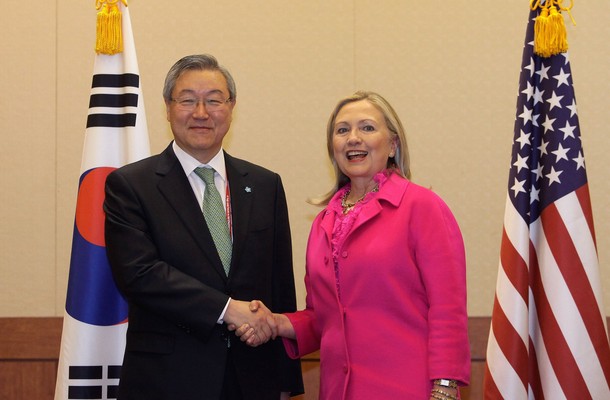
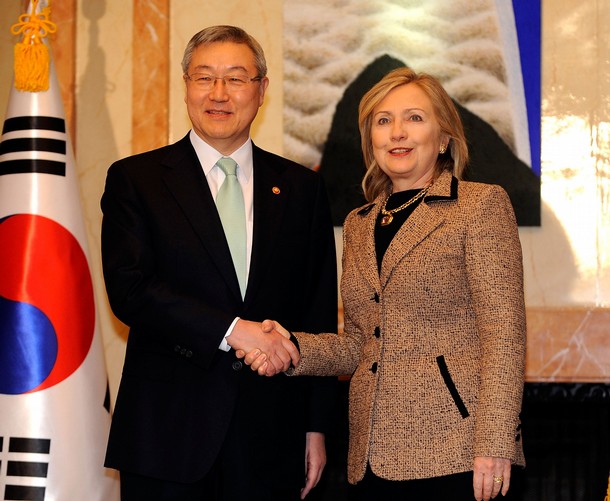
Here is a short statement from today's press briefing along with a few pictures of Secretary Clinton with South Korean Foreign Minister Kim Sung-hwan during a meeting before the fourth High-Level Forum on Aid Effectiveness in Busan, South Korea.  Mme. Secretary looks downright lyrical! 


Daily Press Briefing - November 29, 2011

Mark C. Toner
Deputy Spokesperson
Daily Press Briefing
Washington, DC
November 29, 2011


TRANSCRIPT:

1:04 p.m. EST
MR. TONER: Welcome to the State Department. I can report that the Secretary has arrived this evening in Busan. And tomorrow, which is our evening, she’ll attend the opening ceremony of the Fourth High Level Forum on Aid Effectiveness, where, as you know, she’ll give the keynote speech. Obviously, as we discussed yesterday in the phone backgrounder, the Secretary’s participation is a reflection of her commitment not only to development for its impact on our national security objectives, but also to demonstrate the need for all countries to put development on their national agendas.

Wednesday, November 23, 2011

Secretary of State Hillary Rodham Clinton's Travel to the Republic of Korea and Burma


Secretary of State Hillary Rodham Clinton's Travel to the Republic of Korea and Burma


Press Statement
Mark C. Toner
Acting Spokesperson, Office of the Spokesperson
Washington, DC
November 23, 2011


Secretary of State Hillary Rodham Clinton will travel to the Republic of Korea and Burma, November 30 - December 2, 2011.
Secretary Clinton will travel to Busan, Republic of Korea November 30 to attend the Fourth High-Level Forum on Aid Effectiveness. Secretary Clinton’s participation reflects the United States' strong political commitment to development as key pillar of global security, prosperity, and democratic progress. The Busan Meeting represents a landmark opportunity for world leaders to take stock of recent changes in the development landscape and chart a new course for global cooperation. Her visit also underscores the breadth and depth of the U.S.-ROK partnership.
Secretary Clinton will then travel to Nay Pyi Taw and Rangoon, Burma, from November 30 - December 2. This historic trip will mark the first visit to Burma by a U.S. Secretary of State in over a half a century. Secretary Clinton will underscore the U.S. commitment to a policy of principled engagement and direct dialogue as part of our dual-track approach. She will register support for reforms that we have witnessed in recent months and discuss further reforms in key areas, as well as steps the U.S. can take to reinforce progress. She will consult with a broad and diverse group of civil society and ethnic minority leaders to gain their perspectives on developments in the country. Counselor Cheryl Mills, Assistant Secretary Kurt Campbell, Assistant Secretary Michael Posner, Special Representative and Policy Coordinator for Burma Derek Mitchell, and Policy Planning Director Jake Sullivan will accompany her.

Thursday, October 13, 2011

Video and Pics: Luncheon to Honor President Lee


Remarks at the State Luncheon in Honor of the State Visit of Republic of Korea President Lee and Mrs. Kim Yoon-Ok


Remarks

Hillary Rodham Clinton
Secretary of State
Ben Franklin Room
Washington, DC
October 13, 2011


Please be seated and welcome to the Ben Franklin Room here on the eighth floor of the State Department for this celebratory state lunch in honor of President Lee, Mrs. Kim, and the Korean delegation. It is especially fitting that President Lee is here for the first state visit by a Korean president in 13 years. Our alliance has never been stronger and the enduring partnership that we have built over decades of cooperation is a symbol of security, stability, peace, and prosperity. And President Lee’s vision for a global Korea is strengthening and deepening our relationship in new areas from peacekeeping to antipiracy, from stemming climate change to ending nuclear proliferation.
And I’m proud to announce another new venue for cooperation: The United States will host a pavilion at the 2012 Yeosu World Expo in partnership with Philippe Cousteau, Jr. (Applause.) This pavilion would not be possible without the support of our partners and generous sponsors, so I want to thank everyone involved.
And finally, of course today we celebrate the passage of one of our most important joint achievements, the U.S.-Korea Free Trade Agreement. (Applause.) This landmark agreement will spur economic growth in both our countries, bringing our nations even closer together. It is another clear example of the United States commitment to the Asia Pacific region. We are a resident military, diplomatic, and economic power and we are in Asia to stay. (Applause.)
And now it is my great pleasure to introduce a stalwart advocate of the relationship between our two countries and an eloquent spokesperson for the importance of building strong ties, Vice President Biden. (Applause.)
The photos show President Lee's arrival on the White House lawn this morning as well as the festivities at the State Department luncheon.


SECRETARY HILLARY RODHAM CLINTON: Public Schedule for October 13, 2011

Public Schedule for October 13, 2011


Public Schedule
Washington, DC
October 13, 2011


SECRETARY HILLARY RODHAM CLINTON

8:00 a.m. 
Secretary Clinton delivers remarks to the U.S.-India Higher Education Summit, in Washington, DC.
(OPEN PRESS COVERAGE)

Click here for more information. Watch live here.

9:00 a.m.  Secretary Clinton participates in the State Visit Arrival Ceremony of Republic of Korea President Lee Myung-Bak, at the White House.
(MEDIA DETERMINED BY WHITE HOUSE)


10:00 a.m.  Secretary Clinton joins President Obama’s bilateral meetings with Republic of Korea President Lee, at the White House.
(MEDIA DETERMINED BY WHITE HOUSE)

1:15 p.m.  Secretary Clinton, Vice President Biden and Dr. Jill Biden co-host a State Luncheon in honor of the State Visit of Republic of Korea President Lee and Mrs. Kim Yoon-Ok, at the Department of State.
(POOLED PRESS COVERAGE FOR OPENING REMARKS)

2:15 p.m. 
Secretary Clinton, Vice President Biden, President Lee and Foreign Minister Kim celebrate the announcement of U.S. participation in the Expo 2012 Yeosu, at the Department of State.

(POOLED PRESS COVERAGE)

3:30 p.m. 
Secretary Clinton meets with Ambassador to Afghanistan Ryan Crocker, at the Department of State.
(CLOSED PRESS COVERAGE)

4:15 p.m. 
Secretary Clinton joins Deputy Secretary Burns’ meeting with Shane Bauer, Joshua Fattal, Sarah Shourd and their families, at the Department of State.
(POOLED CAMERA SPRAY)

7:00 p.m. 
Secretary Clinton attends President and Mrs. Obama’s State Dinner in honor of Republic of Korea President Lee and Mrs. Kim Yoon-Ok, at the White House.
(MEDIA DETERMINED BY WHITE HOUSE

Monday, July 25, 2011

Videos: Secretary Clinton on Relationships with China, Japan, and Korea at ASEAN

This evening the State Department posted these three short videos from Mme. Secretary's sojourn in Asia. Two of them were around sideline meetings at ASEAN, and one is of her remarks at the beginning of the summit. Enjoy!


Friday, June 24, 2011

Video: Secretary Clinton's Remarks With Korean Foreign Minister Kim Sung-Hwan


Remarks With South Korean Foreign Minister Kim Sung-Hwan After Their Meeting


Remarks
Hillary Rodham Clinton
Secretary of State
Benjamin Franklin Room
Washington, DC
June 24, 2011


SECRETARY CLINTON: Before we begin, let me comment on today’s House votes concerning Libya. We would have preferred a different outcome on the Hastings resolution, but ultimately we are gratified that the House has decisively rejected efforts to limit funding for the Libyan mission.

The United States has entered into this mission along with our NATO allies and other international partners with the intent to protect civilians and under the strong authority and encouragement of the United Nations and the Arab League. We need to stand together across party lines and across both branches of government with the Libyan people and with our friends and allies and against Qadhafi.

We have a plan that we are executing for achieving our mission in Libya. It is on track and we need to see it through. Time and history are on our side, but only if we sustain the pressure. And so I am pleased that a very important statement was made today by the House on a bipartisan basis that recognizes the need for us to continue this important mission.

It is good for me once again to see my friend and colleague, Foreign Minister Kim. I had the privilege of meeting him at his very lovely home in Seoul, and this is our fourth meeting here today in Washington.

Tomorrow marks the 61st anniversary of the start of the Korean War, and I want to take this opportunity to honor the men and women of our armed forces who have served and sacrificed together. For 61 years, our security alliance has supported regional security and prosperity. Today, we reaffirmed our continued commitment to work side by side to achieve lasting peace on a denuclearized Korean Peninsula. Our position has not changed. While we remain open to direct engagement with North Korea, we remain firm in our resolve and our shared position that Pyongyang must improve its relations with the Republic of Korea. We are coordinating to hold another trilateral meeting on this issue later this summer with Foreign Minister Kim and Japanese Foreign Minister Matsumoto.

Our partnership truly has gone global. Today, we spoke about Korea’s plans to host the next Nuclear Security Summit in 2012. We spoke about our cooperation in Afghanistan, where Korea has deployed a Provincial Reconstruction Team and is supporting the training of the Afghan security forces, and so much else.

Because our relationship, which is essential, is more than just the challenges we face. We have opportunities that we are seizing together. First, we are both committed to passing and implementing the Korea-U.S. Free Trade Agreement. The trade agreement will create tens of thousands of new jobs in both our countries, and it will send a powerful message that the United States and the Republic of Korea are strategic partners for the long term, and that America is fully embracing our continuing role as a Pacific power.

Second, as we have just witnessed, the United States and Korea are partners in development as well. It has been inspiring to watch Korea’s rise within my own lifetime. I have commented on that several – on several occasions, including just yesterday. This was a poor, war-torn country that has risen to become the world’s 12th largest economy and a very vibrant, effective democracy.

We applaud Korea’s pledge to triple its development budget by 2015 and its leadership in hosting the fourth High-Level Forum on Aid Effectiveness. Korea approaches development with a unique credibility, as one of the great success stories of the 20th century, and we were delighted to sign the Development Assistance MOU today and to partner with Korea as it has moved from being an aid recipient to an important donor nation.

So this is an exciting moment in one of our most dynamic and important relationships, and the Republic of Korea is an exemplary country fulfilling its responsibilities at home and abroad, and also an exemplary friend. So I thank the foreign minister for this visit, and I look forward to seeing him again next month at the ASEAN Regional Forum.


Thank you, sir.

FOREIGN MINISTER KIM: (Via interpreter) I would like to first express my gratitude to Madam Secretary of State for her kind words and warm welcome. We had just had an extremely valuable meeting on the full range of issues of common interest. The Republic of Korea and the United States share common values and mutual trust, and our two countries are maintaining the strongest alliance relationship ever. Despite a series of North Korea’s provocation last year, we were able to respond jointly with robust combined defense capabilities based on close consultation.

With regards to North Korea, ROK and U.S. agreed to pursue dialogue with North Korea despite North Korea’s recent provocative statements. We concurred that as the essential first step there needs to be a sincere and constructive inter-Korean dialogue on denuclearization. In addition, Secretary Clinton and I reaffirmed that the Six-Party Talks, once resumed, should yield substantive progress in denuclearization. To this end, we reaffirmed that North Korea must demonstrate its sincerity towards denuclearization through concrete actions.

We also share the view that at this juncture, close Korea-United States coordination is more important than ever in dealing with North Korea and its nuclear issues. We will continue to communicate closely through various channels at each level and cooperate with other participants of the Six-Party Talks based on our common position.

Republic of Korea and the United States are implementing alliance readjustment projects, including the wartime operational control transfer and relocation of U.S. Forces Korea bases. We also share the view that the issue of Agent Orange in Camp Carroll is a grave concern to the health and safety of both the Korean people and the U.S. forces in Korea and have conducted the joint investigation in a thorough and transparent manner.

Secretary Clinton and I have agreed to continue our efforts to complete the ratification of the Korea-U.S. FTA within this summer both in Korea and the United States. Two countries – in our countries, the understanding on the economic and strategic benefits of the FTA is widely shared. We hope that this ratification of Korea-U.S. FTA will enter into force in the near future so that it brings economic benefits, including more jobs and more trade to both countries.

Two countries, based on a comprehensive strategic alliance of the 21st century have cooperated on global issues, including Afghanistan, Middle East, nonproliferation, and development, and is making contribution to international peace and stability. The two countries are closely cooperating for the successful hosting of the 2011 Forum on Aid Effectiveness, 2012 Nuclear Security Summit, and 2012 Yeosu Expo.

We have just signed the statement of intent to cooperate on global development, and this we believe will further strengthen our bilateral cooperation in the development area. I look forward to meeting Secretary Clinton once again during the ASEAN Regional Forum. Thank you very much.

MODERATOR: We will now have one question from the American side and one question from the Korean side. From the American side, Jill Dougherty, CNN.

QUESTION: Okay. Thank you very much. Madam Secretary, you were talking about the Libya vote, but I have another issue which is out there. That is this flotilla that says that it will be moving toward Israel.

The Americans who are in that say that the State Department actually should not be condemning them, that it should be supporting them and protecting them because they are American citizens. What is your message to them, and potentially how serious could this be if there were violence?

And then just one on North Korea. Sorry, this is not very loud. On North Korea, the – is there any discernible movement on talks with North Korea? How concerned are you that the longer this goes on, the more destabilizing it becomes?


Thank you.

SECRETARY CLINTON: Well, first, Jill, we have made our views very clear about the flotilla that is currently heading toward Gaza and any others that might consider doing the same. We don’t think it’s useful or productive or helpful to the people of Gaza. We believe that a far better approach is to support the work that is being done through the United Nations that the United States is supporting to ensure that the people of Gaza get access to materials and humanitarian assistance in a safe and timely way.

So we have certainly encouraged that American citizens not participate in the flotilla, and we are urging that all precautions be taken to avoid any kind of confrontation.

The United States is a very generous donor to the Palestinian people, and that includes the people of Gaza, who are unfortunately the victims of the decisions that have been made over the past years by Hamas. The contrast between the rising standard of living and economic opportunity and educational and health services in the West Bank compared to Gaza, I think tell a very compelling story. So we hope that there will be changes in the governing and management of Gaza from within, and we will do all we can to support that and we would urge Americans to do the same.

With respect to North Korea, I think as Minister Kim said, both the United States and the Republic of Korea are firmly committed to the peaceful denuclearization of the Korean Peninsula. We are pursuing a dual-track approach to North Korea that includes a willingness to engage but only under circumstances that properly acknowledge the role that both the North and the South have to play in resolving their own concerns and disputes between them; and of course, we remain committed to a sanctions regime to prevent the further development of a nuclear program by the North and the proliferation of nuclear materials.

This certainly is a longstanding policy, and I think we have reiterated it again today.

MODERATOR: (Off-mike.)

QUESTION: (Via interpreter) Thank you very much. I would like to ask a question to each minister. First, I would like to ask Secretary Clinton; recently a team of U.S. officials and experts visited North Korea for the assessment of food situation in North Korea. It seems that the decision is being delayed somewhat. Is it because of the assessment that the situation in North Korea is not as dire, and when do you think a decision on food aid will be made?

The next question is for Minister Kim. It seems that there is some ambiguity whether South Korea starts linking theCheonan and Yeonpyeong Island incidents with the resumption of the Six-Party Talks. So what is the government’s exact position? Would it be possible to resume the Six-Party Talks without North Korea’s apology?

SECRETARY CLINTON: With respect to your question about food aid, I want to begin by saying that of course, the United States is deeply concerned about the well-being of the North Korean people. But we have made no decision about providing food aid to North Korea at this time. Any such decision must be based on legitimate humanitarian needs, competing needs elsewhere around the world, and our ability to ensure and monitor that whatever food aid is provided actually reaches the people who are in need. And therefore, North Korea must address our serious concerns about monitoring and outstanding issues related to North Korea’s suspension of previous food aid programs before we can consider any decision.

It’s also important that the United States’ longstanding position through administrations of both Republican and Democratic presidents that we do provide humanitarian assistance be separated from political and security concerns. They are not considered in the same category at all. So what we are looking at is whether there’s a real need, what the competing needs are, because we are living at a time of rising food insecurity in many places in the world, and whether we can put into place sufficient monitoring mechanisms so that the food that is delivered actually gets to the people who need it.

FOREIGN MINISTER KIM: (Via interpreter) Regarding the apology about the Cheonan and Yeonpyeong Island incident, you are saying that the Korean Government position is somewhat ambiguous. The Cheonan incident is a North-South Korean issue, and Six-Party Talks is a denuclearization issue. Under the situation, we believe that denuclearization is also involved with South Korea, so we cannot turn our eyes away from it. So that is – that would be my answer to the question.

SECRETARY CLINTON: Thank you all.


Thursday, June 23, 2011

Tomorrow: On Hillary Clinton's Agenda

United States and South Korea Sign the U.S.-ROK Development Cooperation


Notice to the Press

Office of the Spokesman
Washington, DC
June 23, 2011


Secretary of State Hillary Rodham Clinton, Republic of Korea (ROK) Foreign Minister Kim Sung-hwan, USAID Administrator Rajiv Shah, and Korea International Cooperation Agency (KOICA) President Park Dae-won will sign the U.S.-ROK Development Cooperation Memorandum of Understanding (MOU) on June 24 at approximately 2:35 p.m., in the Benjamin Franklin Room at the Department of State.

Secretary Clinton and Foreign Minister Kim will hold a joint press availability immediately following the signing.

The MOU is another milestone of the U.S.-ROK global partnership and recognizes the ROK’s growing emergence as a donor country. As the newest member of the OECD Development Assistance Committee, the ROK has made impressive strides to expand its official development assistance (ODA) programs and has pledged to triple its ODA budget by 2015. The MOU will enhance policy coordination between both sides to promote the impact and efficiency in aid delivery within mutually agreed priority areas such as global hunger and food security, maternal and children’s health, and climate change. The U.S. and ROK have a mutual interest in working more closely together as both sides recognize that the scope of today’s development challenges require concerted efforts to expand development resources. The MOU puts into place a meaningful partnership to expand the reach of development assistance and help encourage the shift from aid to sustained economic growth and prosperity.

Tuesday, May 3, 2011

Secretary Clinton Wishes Happy Children's Day to Japan and South Korea

Thursday will be Children's Day in Japan and South Korea. Mme. Secretary is scheduled to leave for two days in Rome for talks on Libya, but she would never leave without commemorating Children's Day, and I could not pass up an opportunity to re-post these photos. Here are her words.


Japan's Children's Day

Press Statement

Hillary Rodham Clinton
Secretary of State
Washington, DC
May 3, 2011

On behalf of President Obama and the people of the United States, I am pleased to send warmest wishes to the people of Japan as you celebrate Children’s Day this May 5.

On this Children’s Day we take time to reflect on the devastating earthquake and tsunami that affected so many children in Japan. Last month, I saw firsthand the resilience of the Japanese people. From all corners of the country, Japanese citizens are standing up and building communities back anew. I want all the people of Japan – especially children – to know that you are not alone in this trying time. Throughout the United States men and women have been working with their communities and schools to donate money and food, send care packages and letters, and encourage children in the affected areas as you rebuild your lives.

During this time of rebuilding and renewal, know that the United States stands with you. We are committed to creating a brighter future filled with opportunity and prosperity for the children of Japan and for all children around the world.


Republic of Korea's Children's Day

Press Statement
Hillary Rodham Clinton
Secretary of State
Washington, DC
May 3, 2011

On behalf of President Obama and the American people, I am delighted to send best wishes to the children of Korea on Children’s Day this May 5.

On my visit to Korea last month I saw the promise of Korea’s future. Korea’s investment in education has given countless children opportunities and experiences considered impossible only a generation ago. The unique perspectives that your children now carry with them help cement our partnership for years to come.

We all share the responsibility to give our children a world that is cleaner, healthier, and more prosperous than the one we inherited. On this special day, as we reflect on the future of our children, know that the United States is your partner and ally in this important cause.

Sunday, April 17, 2011

Hillary Clinton in Seoul Today: Slideshow

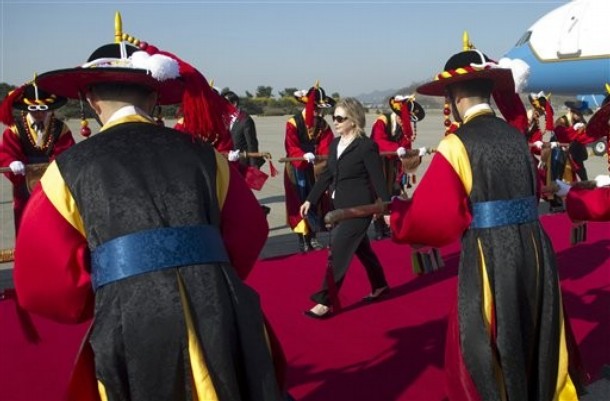
It was a busy day that began in Seoul, and the pictures are lovely, so I thought a slideshow might be in order. We see Mme. Secretary meeting with President Lee. Accompanying her is Ambassador Stephens. South Korea gives her a red carpet upon arrival and departure along with a colorful military guard. She looks very presidential!

Saturday, April 16, 2011

Secretary Clinton's Remarks at the American Chamber of Commerce Breakfast in Seoul


Remarks at the American Chamber of Commerce Breakfast


Remarks

Hillary Rodham Clinton
Secretary of State
Grand Hyatt Hotel
Seoul, South Korea
April 17, 2011

SECRETARY CLINTON: Thank you. Thank you very much, and good morning. It is a beautiful day in Seoul, and I am delighted to see all of you here this morning. Thank you for coming out on an early Sunday morning. I want to thank Ambassador Stephens, who has done such a wonderful job on behalf of the United States here, as our ambassador; Assistant Secretary Kurt Campbell, who is responsible for the East Asia-Pacific region, which is quite a large part of the world. I want to also recognize Frank Little, your chairman, and Amy Jackson, your president.

I wanted to come by to express our strong commitment to ratifying, through our Congress, the Korean free trade agreement by the end of this year. That is our goal. That is our commitment. And we need your help in order to achieve it. We are very committed to expanding jobs in the United States and in our trading partners. We think that what is happening here is vital to America's economic renewal. East Asia is home to 4 of our 10 largest trading partners. And the Asia Pacific, as all of you know so well, represents, by far, our fastest-growing export market.

I have championed American jobs and American businesses as Secretary of State. I have been very honored and privileged to speak out on behalf of Americans who are doing business around the world. And I have championed American economic engagement in Asia, advocating for our workers and our businesses, looking for a level economic playing field on which to compete. And that is why I, along with the rest of the Obama Administration, have made it a diplomatic priority to advance the rules and principles of open, free, transparent, fair competition for everyone.

As you probably know, President Obama announced the national export initiative last year to double American exports. And we know that one of the ways you do that is by opening up trade. We are also working to strengthen Asia's regional economic architecture. We will be hosting the 2011 APEC summit in Hawaii later this year. We are pushing to advance economic integration, remove trade barriers, and make sure that our national regulations line up in a way that encourages trade. We are also working hard on the trans-Pacific partnership, a cutting edge regional free trade agreement that would eventually cover an area responsible for over 40 percent of global trade.

Now, across Asia -- in fact, across the world -- we are looking for opportunities to open more markets and unleash the talents of people everywhere to improve their own lives and the lives of their families and societies, and to drive economic growth in a way that provides prosperity broadly to as many people as possible.

Now, the U.S. and Korea already have one of the most vibrant trading relationships in the world, one that accounted for nearly $88 billion last year. Korea is our seventh largest trading partner, and the United States is South Korea's third largest trading partner. Our $38.8 billion in exports to Korea already support approximately 230,000 American jobs, a point that I make often with our friends back home.

But the truth is we know we can do more and create more jobs if we can lower the barriers to trade between our countries. I know that many of you in this audience, American and Korean alike, have long been supporters of KORUS, because you know it will deliver significant benefits. The tariff cuts alone will increase exports of American goods by $11 billion, supporting tens of thousands of American jobs. And the South Korean ministry of knowledge economy estimates that within a decade KORUS alone will grow South Korea's economy by six percent. KORUS also contains very strong protections on labor standards, the environment, intellectual property rights, and regulatory due process. We believe all of those are essential to creating a level playing field and making sure that trade actually delivers for people.

Now, of course the benefits of KORUS go far beyond the economic bottom line. Ratifying KORUS is profoundly in our strategic interest, as well. We have such a deep and broad relationship between our two countries. We are allies, partners, and friends. And, of course, I am well aware of how important it is that we constantly make sure that our relationship is as strong as it possibly can be. I am happy to report that I think it is at the strongest point that one can look back in history and account for.

So, getting this done on behalf of KORUS is another powerful message that we are working together, of course, for our own countries, but also in a strategic relationship that is beneficial to the region and the world. I know how Korea has become, in many ways, a global power: hosting the G20, hosting the nuclear security summit next year, really stepping out very impressively on the world stage in so many areas. And we want to be your partner. And we believe that this agreement is one of the most tangible benefits of and evidence of that strong partnership.

I am pleased to report that KORUS is currently ready for review by the United States Congress. This is a high, if not a top -- I think it is probably one of my top priorities for the next months. We are determined to get it done, and I believe we will. We will need your help. It will be important to keep making the case to both of our respective legislative bodies.

When one looks at South Korea's rise within my own lifetime from a poor nation, devastated by war and having lived through so many decades of difficulties and troubles to being one of the most dynamic societies and economies anywhere in the world, it is a very impressive story. I am optimistic that we are on the cusp of a new era of even greater global leadership and closer ties between our two nations. We are well positioned to continue rising together, delivering peace, prosperity, and progress to the Korean and American people. And I greatly appreciate the opportunity to work on behalf of this very important goal.

So, thank you for everything you have done. I know that this particular body has been instrumental in making the case. So don't flag now; we need your last-minute push. You cannot talk -- at least speaking for my own congress, having been a member of the Senate for eight years -- you cannot talk often enough to make the case. And I hope that you will not flag in our efforts to be sure that we see the realization of this very important goal this year.

Thank you all very much.

Secretary Clinton's Remarks With South Korean Foreign Minister Kim Sung-hwan


Remarks With South Korean Foreign Minister Kim Sung-hwan Before Their Meeting


Remarks

Hillary Rodham Clinton
Secretary of State
Foreign Minister's Residence
Seoul, South Korea
April 16, 2011


SECRETARY CLINTON: Foreign Minister Kim, let me thank you for your gracious hospitality on a Saturday night. But I must say it is a special treat for me to be here in the residence and also on a beautiful day in Seoul. The sun was shining. I cannot take credit for that but if there's any credit to be extended, I won't reject it. I agree completely with you. We have worked so closely together and I'm very encouraged and determined about the passage of the Free Trade Agreement. We will be consulting and making the case together to our respective legislatures and I am very confident that there will be a positive outcome that will benefit both of our countries. I also appreciate this opportunity to consult on global issues. We have worked closely together and will continue to do so on non- proliferation. We are looking forward to the Nuclear Security Summit next year that you will be hosting and we are very grateful for that. We are working closely together on development issues and of course on - you were the first to respond in the terrible wake of disasters that struck Japan. And I look forward to hearing your views on that as well. There is much to be worked on together. Our partnership, our friendship our alliance, I think after two years of effort under this administration, is stronger than ever. But it is important that we are meeting in the home stretch of the Korea Free Trade Agreement and that is going to be a singular accomplishment of both of our presidents and will contribute so much to the broadening and deepening of our relationship [inaudible].


Hillary Clinton: Wheels-down in Seoul!


She always gets a royal reception in South Korea, and I love that. She deserves all of this honor and respect for all of the hard work she does for us and for people everywhere!

Friday, April 15, 2011

Hillary Clinton: Wheels-up for Seoul

Wheels-up from Berlin. I believe the next destination is Seoul. She will also make a stop in Tokyo, as you know.

Sunday, April 10, 2011

Upcoming: On Hillary Clinton's Agenda

This comes from a South Korean source. Like the original report of the trip to Japan, this is unconfirmed by State Department sources. Since the Japan trip seems pretty firm, this probably will also be a leg of that trip.

Clinton may visit S. Korea later this month: sources

SEOUL, April 11 (Yonhap) -- U.S. Secretary of State Hillary Clinton may visit South Korea as part of her global tour later this month, diplomatic sources said Monday.

The visit, if made, would be her first trip to the Asian ally since July of last year, coming amid international efforts toward the resumption of six-nation talks aimed at denuclearizing North Korea.

Read more>>>>

Monday, December 6, 2010

Hillary Clinton's Bilaterals and Trilateral Images of the Day

Secretary Clinton did not have much of a weekend. She arrived home from her Central Asia trip and hit the ground running to host her annual Kennedy Center Honors dinner at the State Department where, despite all the traveling, she simply glowed. But a very heavy Monday was ahead with meetings regarding the activities along the North-South Korean border forming the core of her day. She had a bilateral each with the foreign ministers of South Korea and Japan followed by a trilateral with both. There was more to her day, but the State Department did not bother to post a public schedule for today.

It is clear that Mme. Secretary throws all of herself into her work for the good of our country. It is very serious and difficult work. Her efforts are very much appreciated here at this blog.

Here, in no particular order, are some images of her day.

Video: Secretary Clinton's Remarks with Japanese Foreign Minister Seiji Maehara and South Korean Foreign Minister Kim Sung-hwan


Remarks with Japanese Foreign Minister Seiji Maehara and South Korean Foreign Minister Kim Sung-hwan


Remarks
Hillary Rodham Clinton
Secretary of State
Remarks following trilateral meeting
Washington, DC
December 6, 2010


SECRETARY CLINTON: Good afternoon. I am delighted to have both Minister Maehara of Japan and Minister Kim of the Republic of Korea here for these consultations and this historic trilateral meeting that underscores the strength of our shared commitment to advancing regional peace, prosperity, and stability. These discussions illustrate the importance of the deep bilateral relationships that the United States has with Japan and South Korea, as well as the value of the partnership between Japan and South Korea. Such strong relationships are the foundation for the unified position that our countries are taking with respect to North Korea.

We all agree that North Korea’s provocative and belligerent behavior jeopardizes peace and stability in Asia. We are deeply concerned by its unprovoked attack on the island of Yeonpyeong, resulting in the loss of South Korean lives. On behalf of the American people, I would like to convey our sympathies to the victims and their families. Our thoughts and prayers are with you. We want the people of South Korea to know that we are standing shoulder-to-shoulder with you, and we are deeply committed to your defense.

The minister and I share the view that the attack by the North Koreans violates the Armistice Agreement of 1953; that North Korea’s provocative and belligerent behavior threatens us all, and that it will be met with solidarity from all three countries.

The attack is the latest in a series of North Korean provocations. It has disclosed a uranium enrichment program that violates UN Security Council Resolutions 1718 and 1874, as well as North Korea’s commitments under the September 2005 Joint Statement of the Six-Party Talks. And the sinking of the Cheonan, killing 46 South Korean sailors, deepened North Korea’s international isolation.

From day one of the Obama Administration, we have made clear that North Korea needs to change. The international community has repeatedly presented North Korean leadership with a path toward greater engagement and integration, but thus far they have chosen the path of confrontation and isolation. The path to a better relationship and a secure and prosperous future is still open to North Korea if it makes the right choices. We remain committed to seeking opportunities for dialogue. But we will not reward North Korea for shattering the peace or defying the international community.

This trilateral meeting reaffirmed the steps that North Korea must take in order for a resumption of Six-Party Talks to produce results. North Korea must improve relations with the Republic of Korea and cease its provocative behavior. North Korea must also comply with its international obligations and take concrete steps to implement its denuclearization commitments under the September 2005 Joint Statement.

As part of our comprehensive strategy going forward, Chairman of the Joint Chiefs of Staff Admiral Mullen will lead a delegation to South Korea tonight to enhance coordination on strategic deterrence. He will then visit Tokyo. Next week, I will be sending a high-level team to Asia to follow up on today’s meeting.

The ministers and I are also in close consultation with China and Russia. I have emphasized to my Chinese colleagues that China, as a vital partner in maintaining regional stability, a country with unique and strong ties with North Korea, and chair of the Six-Party Talks, has a special role to play in helping to shape North Korea’s behavior. We will continue to work closely with Beijing, Moscow, and the rest of the international community to fully implement UN Security Council Resolutions 1718 and 1874.

Last night, President Obama spoke with Chinese President Hu. They reaffirmed the importance of a denuclearized Korean Peninsula. And we appreciate Beijing’s initiative to propose an emergency Six-Party gathering. However, we first need an appropriate basis for the resumption of talks. Any effort, of course, must start with North Korea ceasing all provocative and belligerent behavior.

The U.S. treaty alliances with Japan and the Republic of Korea have been the foundation for peace and stability in Asia for decades, and the Japan-South Korea partnership helps form a triangle of stability and cooperation. The ministers and I reaffirmed our steadfast commitments under our respective defense treaties. In addition, on Friday, the Republic of Korea and the United States, completed negotiations on a landmark Korea-U.S. Free Trade Agreement that will further strengthen the bonds between our two countries.

These strong bilateral relationships are now enhancing our trilateral cooperation, as well as all of our countries’ relationships with China. The United States is encouraged by steps that China, Japan, and the Republic of Korea have taken to deepen their bilateral ties, because we believe that strong relationships among all four countries are an essential element of peace and stability in Asia.

The ministers and I also released a joint trilateral statement that provides a framework to enhance regional cooperation and collaboration. It articulates key principles for expanding trilateral cooperation not only on the Korean Peninsula, but in the Lower Mekong, supporting Middle East – the Middle East peace process, enforcing UN sanctions to counter Iran’s nuclear ambitions. And most importantly, we are in agreement to continue working closely together and to hold additional regular trilateral interactions. There is a lot at stake and we are committed to working through all the challenges that we face together.

Let me please now turn this over to Minister Maehara.

FOREIGN MINISTER MAEHARA: (Via interpreter) Secretary Clinton, thank you very much. A spate of incidents that has been shaking the region and following that spate of provocations, the United States Government and especially Secretary Clinton has organized this meeting, and I would like to express my special gratitude to Secretary Clinton.

Recent shelling to – of Yeonpyeong Island where unarmed citizens live, this armed attack by North Korea – there is no reason for us to – we can find no reason to legitimize that attack, and we’d like to express our heartfelt condolences to the people of Korea who have been attacked. And I would like to express our strong support for the very calm and restrained response that the government and people of the Republic of Korea have taken in spite of such attack. And I would like to also very strongly condemn North Korea for having taken such an act. And I also seek the action on the part of DPRK in the first place to deal with the situation.

We also share great concern with regard to the uranium enrichment program that was unveiled. This plan is a clear violation of the UN Security Council Resolutions 1714 and 1874 and also is a clear violation of the joint statement of the Six Parties of 2005. DPRK – we strongly condemn North Korea for their clear violation of the Security Council resolutions and the joint statement, and also we demand North Korea to sincerely act in accordance with the commitment they made for the denuclearization of the peninsula.

I would call on DPRK to comply with the Security Council resolutions and the joint statement of the Six-Party Talks. And we also agree that there’s a need for concrete action by DPRK. Also, the three countries agree that we would hope that China, which chairs the Six-Party Talks, to play an even greater role in relation to North Korea. We also agree to step up coordination and cooperation with the international community, including China and Russia. At this meeting, we confirmed that Japan, U.S., and ROK will, with a strong determination, keep up their close coordination in order to prevent further escalation of the situation from the perspective of peace and stability of Northeast Asia.

Last but not the least, I would like to express our respect to U.S. and ROK for finally achieving agreement on the bilateral trade agreement – free trade agreement after negotiations.

FOREIGN MINISTER KIM: (Via interpreter) First of all, I would like to express appreciation to Secretary Clinton for inviting Minister Maehara and myself to Washington, D.C., and for a warm welcome. This is my first visit since I came into office, and I believe my meeting with Secretary Clinton and Minister Maehara were most timely in meeting the challenges posed by North Korea. I also wish to thank the two ministers for expressing their sincere condolences to the victims of the attack on – of the Yeonpyeong Island.

The ministers of our three countries firmly share the view that North Korea’s armed attack poses a grave threat to the peace and security of not only the Korean Peninsula, but also the entire Asian-Pacific region, and agree to enhance collaboration and consultation on North Korean policy.

We, the three ministers, agreed that North Korea’s shelling of Yeonpyeong Island is an unlawful act in clear violation of the UN charter, Korean Armistice Agreement of 1953 and basic agreement, and call on North Korea to cease its provocative behavior. We also share the view that North Korea will face severe consequences if it engages further provocations. We also underscored that North Korea’s uranium enrichment program is a clear violation of UN Security Council resolution as well as the joint statement of the September 2005, and reaffirmed that we will continue our efforts to realize the common goals of complete and verifiable denuclearization of North Korea. We also reaffirmed that in order for the heads of delegations of the Six-Party Talks to get together, the appropriate circumstances must be put in place first, such as North Korea’s demonstration of its sincerity towards the continued denuclearization with action.

Based on close coordination among the Republic of Korea, U.S., and Japan in dealing with North Korea, including the nuclear issue, the ministers agreed to make efforts to closely cooperate with other members of the Six-Party Talks. Building on the outcomes of today’s meeting, I look forward to having close consultations with our partners on various levels, as well as further enhancing our trilateral cooperation. Thank you.

SECRETARY CLINTON: Thank you very much, Minister Kim.

MR. CROWLEY: Well, we have time for only one question on each side. We’ll begin with (inaudible).

QUESTION: Hi, Madam Secretary. Can you hear me?

SECRETARY CLINTON: Yes.

QUESTION: Hi, Madam Secretary, Mister Ministers. A question for all of you on China: You’ve all spoken about the need for China to take some strong measures. What specifically would you like China to do? And what does it say to China that they were not invited here today? And how do you expect to get this done without them here?

And a question for the Secretary, if I may: Today, Wikileaks published a cable in which it published a list of sensitive national security sites around the world. What are the ramifications for that release? And what involvement does the United States have in shutting down Wikileaks’s financing? Thank you very much.

SECRETARY CLINTON: Well, first, China and Russia continue to be our partners in the Six-Party Talks. We have been in very close contact with them. The trilateral ministerial is a meeting with our Northeast Asia treaty allies, and we look forward to China playing a vital role in regional diplomacy. They have a unique relationship with North Korea. And we would hope that China would work with us to send a clear, unmistakable message to North Korea that they have to demonstrate a seriousness of purpose in ending their provocative actions. And there are many ways that that they can do that, and we will be focused on trying to work with our allies and our partners in the Six-Party Talks to deliver that message.

I’ll let each minister answer, and they I’ll come back to your question.

FOREIGN MINISTER MAEHARA: (Via interpreter) I think the framework of the Six-Party Talks is very important. And through the Six-Party Talks, the joint statement was issued in 2005 that North Korea should give up all nuclear development program and commit to the denuclearization of the Korean Peninsula. To realize this, not just the three countries but other countries that are participating in the Six-Party Talks, especially China, has an important role to play. And I think this perception is shared by Russia.

This is not a mechanism of a dialogue for the purpose of dialogue. The Six-Party Talks is a framework to implement the 2005 joint statement, and we confirmed what we negotiate together, seek for that purpose. And I think it is extremely important that the three countries together make this call to the DPRK.

FOREIGN MINISTER KIM: (Via interpreter) In relation to the question, as you’ve heard from the two ministers, until now, in order to contain North Korea’s provocation, there has been – China has done some and has done – made some contribution, and it is continuing. However, we would like China to have a more clear stance in giving warning to North Korea and to contain these provocative actions by North Korea because these provocations is not at all helping the security of the region and the peninsula, so we would like China to play a more important role. And regarding this, we will consult closely with the United States and Japan.

SECRETARY CLINTON: As I have said on numerous occasions, the illegal publication of classified information poses real concerns and even potential damage to our friends and partners around the world. I won’t comment on any specific alleged cable, but I will underscore that this theft of U.S. Government information and its publication without regard to the consequences is deeply distressing. And we continue to address all of the challenges it presents and call on countries around the world and businesses to assist us in preventing any of the consequences that could either endanger individuals or other interests internationally.

MR. CROWLEY: On the Japanese side, (inaudible).

QUESTION: (Via interpreter) (Inaudible) with (inaudible) Shimbun. A question for Minister Maehara: At the foreign ministers meeting, what was the point that Japan stressed the most and for what reason? I believe a future response will be very important. Uranium enrichment and the shelling – following this uranium enrichment and shelling, how – what sort of specific action are you going to take? Will it ask for a response at UN Security Council? What specific measures will you seek for denuclearization?

A third point: You referred to the role of China, and I wonder what specific views Japan has with regard with the role that China can play?

And last point: Secretary Clinton said that Admiral Mullen and other high officials of the government will be sent very soon to Korea and Asia, and I wonder what role they’ll be playing.

FOREIGN MINISGTER MAEHARA: (via interpreter) A major purpose of the meeting this time is for Japan and Korea, which are allies of the United States, to get together and in this tripartite format to discuss in response to this unforgiveable attack on Yeongpyeong and the revelation of uranium enrichment, together condemn North Korea, and instead of escalating the situation, call on DPRK to act on their own responsibility to comply with the armistice agreement on the peninsula and take specific actions.

As far as Japan is concerned, how are we to act on the Six-Party Talks? We exchanged views on this question. Also, I expressed Japan’s position. We will, of course, continue to make use of the United Nations. The uranium enrichment is something that will be a threat not just to Japan and the ROK, but to the international community, and I explained that how we need to respond to that also as an international community. There was a question about China building on these tripartite discussions. Minister Saiki, who is the director general of the Asian Affairs Bureau of the Japanese foreign minister, who also heads Japan’s team to Six-Party Talks, will be sent soon to China to explain what is on Japan’s mind and what Japan intends to do, so that the five parties will together be dealing with DPRK instead of creating a situation of three countries versus three.

MR. CROWLEY: (Off-mike.)

QUESTION: Thank you, P.J. (Inaudible) from Yonhop News Agency. So Madam Secretary and Minister Kim, you are rejecting China’s proposal for emergency meeting of chief nuclear envoys this month. And are you considering bringing North Korea’s attack on South Korean Yeongpyeong Island and its uranium project to the UN Security Council?

Also, what do you think of the criticism that unlike Clinton Administration, the Obama Administration closely follows the Bush Administration’s hard-line policy on North Korea, maybe a bit stronger policy, to prompt North Korea to increase its nuclear arsenal and other provocations?

And my last question is: Have you discussed anything on Korea FTA’s ratification today? Thank you.

SECRETARY CLINTON: First, let me say that with regard to an emergency meeting with members of the Six-Party Talks, North Korea first needs to take concrete steps to demonstrate a change of behavior. The Six-Party Talks cannot substitute for action by North Korea to comply with its obligations.

As you’ve already heard, North Korea should abide by the terms of the armistice, fulfill its requirements under the joint statement, and comply with all of its obligations under United Nations Security Council resolutions. They need to demonstrate a seriousness of purpose in ending their provocations and let the world know that they are now ready to come to the table and fulfill the commitments that they have already made. Because the Six-Party Talks cannot substitute for specific actions by North Korea to comply with all of its obligations.

We have discussed a range of all the issues connected with our actions going forward. We’re in consultation at the United Nations with members there, and we certainly did discuss the very important Korean Free Trade Agreement, because we think it’s so much in the interests of both of our countries, and we are going to be working together to expedite it with our respective governments and legislatures as quickly as possible.

FOREIGN MINISTER MAEHARA: Thank you very much.

SECRETARY CLINTON: Thank you very much.

FOREIGN MINISTER KIM: Thank you.