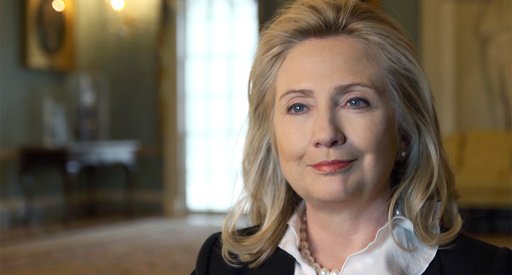
QUESTION: Well, Secretary Clinton, this is your – first of all, thank you for letting us come and talk to you.
SECRETARY CLINTON: Of course. I’m so happy to see you again.
QUESTION: This is your last television interview as Secretary of State.
SECRETARY CLINTON: Hard to believe, Cynthia. It feels like the time has just flown by.
QUESTION: In Moscow three years ago, you told me, “I have
absolutely no interest in running for president, none.” Two years ago
you said the exact same thing in Australia. And yet in the past few
days, a PAC called Ready for Hillary has been launched. Can you still
say with a straight face that you have – that there’s no way you would
consider running for president?
SECRETARY CLINTON: Sitting here right now, that is certainly
what I believe. And I am still the Secretary of State, so I’m not in
politics. I’m going to be focusing on my philanthropy and my charities,
my writing and speaking. So I am looking forward to having something
resembling a kind of normal life again.
QUESTION: And yet are we up to maybe?
SECRETARY CLINTON: (Laughter.) That’s very good, Cynthia.
Well, of course, of course I am flattered and honored. I didn’t even
know about some of these things that are happening now. But I am really
not focused on that at all. I have no plans or intentions. I don’t know
how else to say it, but I am going to get back into my life again, see
how it feels not having a schedule, waking up and being able to go back
to sleep if I choose for a while. I have been working or attending
school fulltime since I was 13, and this is going to be new for me. I
don’t know how I’m going to react to it, to be honest.
QUESTION: When you conceded defeat in the primary, you made a
famous speech in which you said that there were 18 million cracks in the
glass ceiling.
SECRETARY CLINTON: Right.
QUESTION: If, in the course of the next couple of years it
appears, as it does appear right now, that you might be the person who
could actually break through that glass ceiling and become the first
female president of this country, would you feel a certain obligation to
seize that mantle?
SECRETARY CLINTON: Well, I’m very conscious of how important
it is for us to shatter that glass ceiling in my country, a country that
has done so much for so many women and really has set the standard for
women’s rights and responsibilities. And I do want to see that glass
ceiling shattered. I don’t think it has to be any particular person; it
just has to be a convergence of the right candidate and historical
forces. So I don’t think one person is the only way to do that. I think
there are a lot of people that are in the pipeline and moving to a
position where they might be able to as well.
QUESTION: But there’s never been a woman who really had a
credible chance, and it looks as if you might just be that person. And I
know how seriously you take commitment and obligation and how seriously
the women’s issue is to you.
SECRETARY CLINTON: Right. But I’m not making any commitments
or obligations because I do take them seriously. And I did an interview
with President Obama the other night, and obviously I know how important
this is to the press, to journalists, journalists like yourself, but
it’s not what I’m thinking about. It’s not anything that I’m planning or
giving the okay to others to plan. I have so many things I’m interested
in doing and that’s what I am focused on right now.
QUESTION: Well, it’s good to see you looking so healthy.
SECRETARY CLINTON: Thank you, thank you.
QUESTION: It really was a serious health scare.
SECRETARY CLINTON: Well, it was a big surprise to me because
I’ve been so healthy for my entire life. I’ve been in a hospital once
when I had my daughter and – oh, when I broke my elbow. But other than
that, I’ve been very fortunate. So when I got sick and fainted and hit
my head, I was so surprised. And I thought, well, I’ll just get up and
go to work. And then, thankfully, I had very good medical care and
doctors who said no, we better do an MRI and we better do this, we
better do that.
I feel very lucky, Cynthia, because I know now how a split second of
being beset by a virus and dehydrated, what it can do to you. So I’m
getting fully recovered and I will be back to full speed, but I am
grateful for the excellent care I got.
QUESTION: So as one woman who wears glasses to another, I’ll tell you what happens if I take mine off. I can’t see my questions.
SECRETARY CLINTON: Right.
QUESTION: If you take yours off right now --
SECRETARY CLINTON: Right. Well, that would have been true even
before I had a concussion. If I take mine off, I’ve been nearsighted
since I was nine but I’ve worn contacts for so many years except at
night when I put my glasses on. But I’ll be fine. I’ll go back to
contacts.
QUESTION: But this whole seeing double thing, is that true?
SECRETARY CLINTON: Well, I have some lingering effects from
the concussion, but they will dissipate over the next weeks and I’ll be
back to my old myopic self. (Laughter.)
QUESTION: Senator Kerry has just been confirmed.
SECRETARY CLINTON: Yes, I’m thrilled by that.
QUESTION: Does that feel – do you start to feel --
SECRETARY CLINTON: I do, I do, because obviously we’ve been
working with him and his team for him to come in to the State
Department. My last day will be Friday afternoon after I finish all of
my obligations. I think that he will pick right up where I’ve ended and
continue to represent us extremely well around the world.
QUESTION: What do you wish you’d known four years ago that you could pass on to him?
SECRETARY CLINTON: I’ve tried to pass on everything I’ve
learned. I think there are a couple of big takeaways. One, I don’t see
how you do this job without traveling a lot. Condi Rice traveled a
million miles and I’ve traveled nearly that and went to more countries
than anybody has gone to. Well, and why do we do that? Is it because
we’re gluttons for punishment? No. Because the United States has to show
up, particularly now when, ironically, people can turn on the news or
get online or follow us through some other social media, but nothing
substitutes for demonstrating that the United States of America cares
enough to be there, to be at that meeting, to represent our values, to
go to that event.
I did not realize how critically important it was going to be. And
the fact that there’s hardly any part of the world now that can be kind
of relegated to second tier, because something can happen anywhere and
we’ll know about it instantaneously and it can have, as we’ve seen in
Mali, consequences for us and our allies’ security.
QUESTION: I’d just like to ask you one other question about
your health. I know that there’s no plans for future public service, but
if there were to be, would you feel comfortable making a pledge that
you would release whatever records?
SECRETARY CLINTON: Oh, of course. Yeah, that doesn’t bother me. I mean, that’s just something that goes with the territory.
QUESTION: Let’s talk for a moment about Benghazi. It seemed as though you lost your temper at the hearing momentarily the other day.
SECRETARY CLINTON: Well, I believe that we should in public
life, whether you’re in the Administration or the Congress,
de-politicize crises and work together to figure out what happened, what
we can do to prevent it, and then put into place both the institutional
changes and the budgetary changes that are necessary. And the majority
of the panelists in both the House and the Senate I thought were very
constructive, asked sensible questions that deserved answers. But when
someone tries to put it into a partisan lens, when they focus not on the
fact that we had such a terrible event happening with four dead
Americans, but instead what did somebody say on a Sunday morning talk
show, that to me is not in keeping with the seriousness of the issue and
the obligation we all have as public servants.
QUESTION: But do you regret – “What difference at this point does it make?” It has been so analyzed in the moments since you said it.
SECRETARY CLINTON: No, because I think that asking questions
about talking points for a Sunday morning talk show, it’s really missing
the point. The Accountability Review Board chaired by Ambassador
Pickering and Admiral Mullen didn’t pay any attention to that. They
looked at what we could have done, what we have to do in order to
prevent this in the future. And remember there have only been two of
these accountability review boards for the time since 1988 ever made
public. All the others have been classified. I believe in transparency. I
said let the chips fall where they may, put it all out there. And I
don’t want that to be politicized. I want it to serve as a framework for
working together between the Administration and the Congress to keep
our people safe.
QUESTION: So you stand by what you said?
SECRETARY CLINTON: Absolutely.
QUESTION: To Syria. You’ve repeatedly said that President Assad needs to go.
SECRETARY CLINTON: Right.
QUESTION: Starting two years ago.
SECRETARY CLINTON: Right.
QUESTION: And yet 60,000 Syrians are dead and he is still in office.
SECRETARY CLINTON: Right.
QUESTION: What does it take for America to intervene?
SECRETARY CLINTON: Well, I think we have been very actively
involved. Until recently there was no credible opposition coalition, and
I cannot stress strongly enough how important that is. You cannot even
attempt a political solution if you don’t have a recognized force to
counter the Assad regime. It took them off the hook. It gave the
Russians and others who are still either supporting them or on the fence
the ability to say, well, there’s no opposition. We worked very hard to
help stand up such an opposition.
QUESTION: But is there a redline, Secretary Clinton?
SECRETARY CLINTON: Well, the use of chemical weapons,
President Obama has said, is a redline. But I think if you look at the
Administration’s effort on the political front, on the UN front where we
still believe that we need to get Security Council action, on the
humanitarian front – the President just announced more than $100 million
more in humanitarian aid – we have been very productive players in
trying to deal with an extremely complex problem.
QUESTION: Secretary Panetta recently told my colleague Martha
Raddatz that Assad had chemical weapons ready to go, locked and loaded,
ready to go. The redline used to be when he moved those chemical
weapons, and now would the U.S. actually permit him to use them?
SECRETARY CLINTON: No, no. And President Obama has been very
clear about that. And I think it’s also important to look at this
conflict which, yes, has horrifically developed and cost the lives of so
many thousands of Syrians. But in all of my discussions with many of
the countries in the region and beyond, everyone is facing the same
dilemma. It is very hard to train and equip opposition fighters. It is
very hard to know who is going to emerge from this, and making the wrong
bet could have very severe consequences. So there are certain positions
and actions we’ve taken, and we’ve also laid down the redline on
chemical weapons because that could have far-reaching effects beyond
even the street-to-street fighting that is so terrible to watch. And it
could also affect other countries.
QUESTION: The Administration has been criticized by some for
having what has been referred to as an ad hoc foreign policy, a sort of
whack-a-mole foreign policy. What is the Obama doctrine as you
understand it in regards to foreign policy?
SECRETARY CLINTON: Reassert American leadership politically
and economically in the face of a very severe crisis that we inherited
and which called into question American leadership. Look for every way
you can to bring together coalitions so that, yes, America will and must
lead. It is the indispensible nation, but other countries have to step
up and start taking responsibility and they are beginning to do that. We
saw that certainly in Libya. We’re seeing it in other places in Africa
and beyond.
Make it clear that while we have to deal with the crises we need to
take steps back and figure out more clearly what the consequences of
actions that we and others are taking. We’ve been subject over the last
30 or 40 years to a lot of actions taken by the United States from the
Vietnam war to the war in Iraq that have had unintended consequences
that have threatened us. We want to be more thoughtful and careful about
the interventions that we make.
And finally, don’t lose the trend lines. While we are focused on the
immediate crises and the longer term challenges, there are a lot of
forces at work in the world, whether it is a change in technology which
has such profound effects on how we exercise all forms of our power,
whether it is women and girls, the roles and rights that they have, and
the fact that where they do have equality and dignity, you’re likely to
have more stable societies and more prosperous economies.
Look at climate change. Don’t put your head in the sand. Understand
that it’s going to have profound effects on our resources and so much
else.
So I believe that what we’ve done is to pioneer the new diplomacy,
taking the best and continuing the traditions of, yes,
government-to-government negotiations, whether it’s a trade treaty or a
peace treaty, but also expanding our aperture so that we understand that
the United States must tell its story better, must connect with young
people better, must stand for our values more strongly. And I think by
doing that we’ve positioned ourselves for leadership in the 21
st century.
QUESTION: So there’s no daylight between the Obama doctrine and the Hillary Clinton doctrine?
SECRETARY CLINTON: Well, I’ve been a major part of helping to
shape it and to implement it, and I think it will stand the test of
time. That doesn’t mean that, just like any administration, you don’t
struggle with these difficult issues. You talked about Syria. It’s a
really wicked problem, as people say. But we have to take a very large
view and put everything into context.
QUESTION: Saturday morning --
SECRETARY CLINTON: Yes.
QUESTION: -- what happens?
SECRETARY CLINTON: Well, I hope I get to sleep in. (Laughter.)
I’m thinking about that because it will be the first time in many years
when I’ve got no office to go to, no schedule to keep, no work to do.
That will probably last a few days, and then I will be up and going with
my new projects.
QUESTION: Madeleine Albright famously said that reading the
paper became a different kind of enterprise when she was no longer
Secretary of State.
SECRETARY CLINTON: I’m sure that’s true, Cynthia. Any kind of
news coverage, I feel a sense of responsibility all the time. I’m always
referring pieces to my staff: What are we going to do about this? How
did this happen? What do you know about this? And now I won’t be doing
that, but I’ll still be thinking it.
QUESTION: I know how close you were with your mother.
SECRETARY CLINTON: Yes, yes.
QUESTION: What do you think she’d be most proud of?
SECRETARY CLINTON: Well, one of the great things about my
mother is that she really valued people’s character more than what they
did. She was proud of me, proud of my husband certainly, but she kept
herself engaged in part by really relating to people, all kinds of
people. And I’d like to think that she would think I’ve done a good job
but that I’ve also kept trying to be a good person. That was her real
standard for us and for people that she knew and cared about.
QUESTION: North Korea has nuclear weapons. Iran is moving
quickly in that direction. How concerned should Americans be, and how
effective has the Obama Administration been in stopping it?
SECRETARY CLINTON: Well, I think Americans should be concerned
and I think that the Obama Administration has made real strides, number
one, in bringing together the international community. I faced real
skepticism when I started talking to a lot of countries about what we
needed to do to try to sanction the Iranian regime in order to get the
message across to them that they had to give up their pursuit of nuclear
weapons. We were able to overcome those hurdles. We have the toughest
sanctions; they’re making an effect.
Similarly with North Korea, we’ve just brought together the
international community, including China, in a new set of sanctions
concerning the missile program. Nobody is satisfied with what these two
countries are attempting to do, but we have to keep a coalition of
concerned countries together in the Gulf and the broader region around
Iran, which are the ones most at risk if this pursuit continues and
succeeds, and in Northeast Asia. Our policy with Iran is prevention. The
President has made that very clear. We’ve taken no option off the table
and we are pursuing diplomatic efforts, but there’s a timetable to
this. You can’t do it just for the sake of doing it. And with respect to
North Korea, we’ve made it very clear to the North Koreans and to
everybody in the region that if North Korea pursues their missile and
nuclear weapon program, we would consider that a threat to the United
States and would have to take very tough action.
QUESTION: Secretary Clinton, thank you so much for talking to us.
SECRETARY CLINTON: Thank you, Cynthia. Good to talk to you.
QUESTION: As Jefferson looks over our shoulder, who I would only point out was Secretary of State who went on to become President.
SECRETARY CLINTON: I’ve heard that. (Laughter.)
QUESTION: Thank you.
# # #