Showing posts with label Viet Nam. Show all posts

Monday, November 2, 2015

'The Diplomat' Premieres on HBO

When President Obama first asked Hillary Clinton to be secretary of state, she not only declined, she immediately suggested that Richard Holbrooke would be a much better choice.  Like Bill Clinton, who had to propose three times before she would accept marriage, Barack Obama had to ask several times before she accepted the cabinet position.  But she had conditions.  One was that at-risk regions required special attention and needed special advisers.  Holbrooke was brought into the administration as special adviser on Afghanistan and Pakistan.

Holbrooke died during Hillary's tenure at DOS, and his son, David, has made a documentary about his father's remarkable life and career called The Diplomat.  It premiered tonight on HBO and is excellent.  Both Bill and Hillary Clinton were interviewed extensively along with many who worked with Holbrooke.  I give it five stars. Don't miss it!  It is a must see!


Read more about this award-winning documentary here at the website >>>>


One of the diplomatic tragedies of Bill Clinton's administration depicted in this documentary occurred when Holbrooke was attempting to broker peace in the Balkans. A vehicle carrying three members of our negotiation team rolled off a very dangerous road on the way to Sarajevo.  It tumbled down a mountain, hit a land mine, caught fire, and killed the occupants.
Hillary was asked a question this week in Iowa about our ordinance left over in Laos.


A candidate who knows exactly what’s going on in Laos.
At a campaign stop in Iowa, Hillary got asked an unexpected foreign policy question about unexploded bombs in Laos—leftovers from the Vietnam War.
Hillary’s answer shows exactly what it would mean to have a former secretary of state in the Oval Office.
See the video and hear her response >>>>
The documentary emphasizes Holbrooke's belief in the lessons of history.  We should remember these going forward.  There is much unfinished business from our engagement in Southeast Asia.  We may call it the Viet Nam War, but it was larger.  Incursions into Cambodia, which Richard Nixon announced saying it was "not an invasion,"and carpet-bombing in Laos are witness to the breadth of the conflict and damage left behind. Hillary Clinton knows and respects the lessons of Viet Nam.

Wednesday, July 11, 2012

Hillary Clinton with Staff and Families of Embassy Hanoi

Meets with Staff and Families of Embassy Hanoi


Remarks
Hillary Rodham Clinton
Secretary of State
Hanoi, Vietnam
July 11, 2012

Thank you so much, David. Well, that was a long time ago. But who knows where the people out here on this meet and greet line will be in 16 years, David, and I want to thank you for your tireless, dedicated service to our country and all that you’re doing to improve and broaden and deepen our relations with Vietnam and the people of Vietnam.
I remember talking with you last October about how excited you were to be coming to Vietnam, and you put together that video greeting even before you arrived, which reached 20 million Vietnamese viewers. And I know you’re still trying to figure out how you’re going to reach the other 67 million at least. (Laughter.)
But it is exciting to be here on my third visit as Secretary of State. And the reason I keep coming back is because we think that there is an enormous amount of potential in our relationship. And I want to be sure we’re doing everything we can to explore how far we can go. Just yesterday, I think we’ve demonstrated once again we’ve reached a level of engagement that would have been unimaginable only a few years ago. We have two-way trade reaching $22 billion, increasing every year, working on everything from HIV/AIDS to disaster relief to trafficking in persons to recovering the remains of our soldiers. And our military-to-military ties, as evidenced by Secretary Panetta’s very successful visit, are also intensifying. We are working toward a strategic partnership agreement that will give us a framework to deepen and broaden this engagement.

But none of it would be possible without the energy and enthusiasm and the expertise of this team and your colleagues throughout Vietnam. When you launch programs that show farmers how to get more productivity out of their land, you’re helping them not only feed their families but earn more money and continue to rise into the middle class. When you connect Vietnamese companies with American investments, you’re helping to create jobs back home and produce economic growth for both countries. When you talk to students about opportunities to study abroad, you’re helping build bridges between our people, and with very tangible results, because I can remember back in the Clinton Administration, which is when I first met you all those years ago in Tokyo, just 800 Vietnamese were studying in the United States. Today 15,000 are, and we would like to double, triple, quadruple that number in the years ahead.
Now, look, I understand your work is not always easy. There are issues of government control and censorship that you have to work through and over and around every single day. It makes your jobs and your lives more difficult. We raise these issues and concerns in every single meeting that we have with Vietnamese officials and we will continue to raise them, because we happen to believe it’s not only part of American values, it’s universal values. The Declaration of Universal Human Rights is not just for Americans or Westerners. It’s for Asians and Vietnamese and everyone else. So we make the argument that as economic progress continues the opening of political expression and political space, the protection and respect for human rights is absolutely essential.
And I know that where you work has an impact on how you work. Being separated from each other can make it harder to operate as a team, and we’re going to keep working to finalize agreements for a new embassy compound. That is something we’ve been focused on and hopefully someday soon people will be able to work in one state-of-the-art location.
I want to say a special word of thanks to our locally employed staff. Ambassadors come and go, Secretaries come and go, but the locally employed staff here in Vietnam, like those around the world, are really the memory bank and the experience base for everything that we do, and we are very grateful that you’re part of this team.
So again, let me thank you and let me thank you especially for having to organize and implement three separate trips from me, the Secretary of Defense, and a continuous stream of high-level officials. I know it’s always extra work when that occurs, but we are deeply grateful, because we want to show at a high and visible level the importance we place on this relationship. So again, thank you very much, and let me shake some hands. Thank you, David. (Applause.)
# # #


Tuesday, July 10, 2012

Hillary Clinton at the American Chamber of Commerce Reception in Hanoi

Remarks at American Chamber of Commerce Reception and Commercial Signings


Remarks
Hillary Rodham Clinton
Secretary of State
Hilton Opera Hotel
Hanoi, Vietnam
July 10, 2012

Well, I am delighted to be here with all of you. It’s great being in Hanoi, a pretty cool place, I think – (laughter) – and to be part of this event, which furthers our important relationships. And thank you very much for the award. I am delighted that I had a chance to receive it in front of such a distinguished audience, and I think it is a great reminder of how important it is that we have the public and the private sector working together on behalf of greater prosperity and progress and opportunity for all of us.
I was delighted to visit with Chamber representatives all over the world at our Global Business Conference in Washington this year, and I’d like to thank Hank Tomlinson for your leadership here in Vietnam. I want to thank Fred Burke for your very kind words and the presentation of the award. I want to thank Madam Nga for being here with us and, of course, recognize our excellent Ambassador David Shear, who has a great team working on behalf of American interests and American businesses.
We are very committed to this relationship between the United States and Vietnam, just as we are to the reenergizing of America’s relationship throughout the Asia Pacific. It’s one of the top priorities of the Obama Administration. The United States is, after all, an enduring Pacific power with Pacific interests, and we intend to be a presence in the Pacific region for the foreseeable future.
Now, a lot has been written about the so-called pivot to Asia. But what hasn’t, perhaps, received enough attention is the breadth of our engagement. It’s not just about security, although that is important. As I explained in a speech I delivered in Mongolia yesterday, it’s also about standing up for democracy and human rights, for the rule of law, for economic ties, boosting trade, and as the Secretary of State, advocating for American businesses.
If we look around this room, or you look at the list of companies represented here, there is no doubt that American business is eager to invest more in Asia. Companies are taking advantage of an improving business climate and setting up shop to serve the needs of Asia’s growing middle class. And part of my job, part of our job in government, is to help open doors for you. At the State Department, we have mounted a serious effort to place economics at the center of American foreign policy. We call it economic statecraft, using diplomacy and tools, like the Export-Import Bank, to advance and promote American economic interests and to harness the powers of the market to advance our strategic goals. And we are particularly focused on developing a global economic order that is open, free, transparent, and fair. So we’re working with partners, both new and longstanding, to establish common rules of the road, so to speak, so everyone has an equal opportunity to thrive.
Now, Vietnam is an excellent case in point for how we can grow together rather than at each other’s expense. When my husband reestablished diplomatic relations in 1995, there was very little American investment in Vietnam. Today, we are the seventh largest foreign investor, and our annual bilateral trade has grown to almost $22 billion. And as we just heard, when my husband, my daughter, and I came to Vietnam in the year 2000, we saw the changes that were happening. There was a great emphasis on improving and advancing economic relations between our countries, and agreements were signed.
So we saw progress then, but in my visit three times as Secretary of State, I’ve already seen in those last three years how our trade partnership has expanded more than 40 percent. The United States is now Vietnam’s largest market for exports, and we are very proud of that. And American companies are poised to help Vietnam take on many of its current challenges, as we just saw with the two signings involving General Electric and the provision of materials and products that will enhance Vietnam’s energy security and independence.
I met with the Prime Minister earlier today, where several members of the U.S. ASEAN business delegation had an opportunity to sit down with him and discuss how there can be steps taken for greater American investment. Now, when we think about investment or we think about deals like we just saw with GE, we’ve got to remember it’s really about people. GE will supply the critical energy that Vietnam needs to fuel its own economic development, which will give greater energy reliability and efficiency to the people of Vietnam. At the same time, these deals translate into jobs for workers at GE’s steam turbine plant in Schenectady, New York and at other sites around the United States. This is a win-win.
We also have companies based in Vietnam, like Imex Pan Pacific and IFB Holdings, that are introducing well known American brands to Asian markets. They’re bringing Gap clothing and Subway sandwiches to cities and towns across Vietnam. That’s good for American companies; it’s good for communities to attract new investments; it’s good for new businesses and the local jobs that go with them. But there is still so much untapped potential. And I told both the Foreign Minister and the Prime Minister that we think there is much more that the Government of Vietnam can do to unleash the full power of the private sector.
Domestic and international businesses alike continue to face rules that restrict their activities, and that, in turn, deters investment and slows growth. So we are encouraging the Government of Vietnam to keep on the path of economic and administrative reform to open its markets to greater private investment. And through the Trans-Pacific Partnership, we’re working with Vietnam and seven other nations to lower trade barriers throughout the region, as we ensure the highest standards for labor, environmental, and intellectual property protections. Vietnam was an early entrant to the TPP, and we’re hoping we can finalize the agreement this year. And the economic analysis is that of all the countries that will be participating – Australia, Canada, Mexico, others – of all the countries participating in the TPP, Vietnam stands to benefit the most. So we’re hoping to really see this agreement finalized and then watch it take off.
Now, I don’t have to tell you that attracting more foreign business takes more than lowering trade barriers; it also requires an educated workforce prepared to compete for 21st century jobs. So the United States is also partnering with educational institutions and a range of companies and NGOs to help develop a very strong, skilled workforce to meet the growing demand here in Vietnam. For example, two years ago, Intel opened a billion-dollar facility in Ho Chi Minh City that will eventually employ thousands of workers to test the quality of its computer chips. Intel is deeply invested in Vietnam, and they recognize that to continue growing, they need to help improve the engineering skills of their workforce. So they teamed up with Vietnamese technical schools, USAID, and Arizona State University to form a new alliance that trains engineering faculty in practical, project-based instruction techniques.
And Intel has just introduced a new piece of this effort, a scholarship program specifically designed to bridge the gender gap by bringing more women into engineering programs, and I just met the first scholarship recipient, the first of several hundred women who will benefit from this program over the next five years, and I am very excited about what this means for Vietnam and for women in engineering. This reflects a larger effort launched by APEC last year in San Francisco to expand women’s economic participation across the Asia Pacific, especially in science, technology, engineering, and math. So this scholarship program is exactly what we need. And I’ve been talking all day, so excuse me. (Laughter.)
So we’ve come a long way in a short period of time, and that is – excuse me – what economic statecraft is all about. So we want to hear from all of you about what more we can do together. And at the risk of coughing any longer, I just want to say thank you, and let’s get to work. (Laughter and applause.)


Hillary Clinton With Viet Namese Foreign Minister Pham Binh Minh


Remarks With Foreign Minister Pham Binh Minh After Their Meeting


Remarks

Hillary Rodham Clinton
Secretary of State
Government Guest House
Hanoi, Vietnam
July 10, 2012

FOREIGN MINISTER MINH: (In Vietnamese.)
SECRETARY CLINTON: Thank you very much, Foreign Minister Minh, for your warm welcome today. It's wonderful being back in Vietnam, and I appreciate this opportunity to reaffirm the growing and mutually beneficial partnership between our two nations.
I fondly remember my first visit here in the year 2000, and it's remarkable now on my third visit as Secretary of State to see all the changes and the progress that we've made together. We're working on everything from maritime security and nonproliferation to public health and disaster relief to promoting trade and economic growth. And of course, as the Minister and I discussed, we continued to address legacy issues such as Agent Orange, unexploded ordnance, and accounting for those missing in action as well.
Vietnam has emerged as a leader in the lower Mekong region and in Southeast Asia, and the United States and Vietnam share important strategic interests. When the Foreign Minister and I travel to the ASEAN Regional Forum in Phnom Penh, we will have a chance to engage with our colleagues such as regional integration, the South China Sea, cyber security, North Korea, and the future of Burma.
The United States greatly appreciates Vietnam's contributions to a collaborative, diplomatic resolution of disputes and a reduction of tensions in the South China Sea. And we look to ASEAN to make rapid progress with China toward an effective code of conduct in order to ensure that as challenges arise, they are managed and resolved peacefully through a consensual process in accordance with established principles of international law.
The Foreign Minister and I discussed these and many other issues, including our interest in deepening cultural, educational, and economic ties. We have a business delegation with us on this trip, and I will be meeting with them later.
I will also help celebrate the 20th anniversary of the return of the Fulbright Program in Vietnam. Nearly 15,000 Vietnamese students study in the United States each year. They come home and contribute to Vietnam's continued development, and we are very much hoping to deepen our ties even further by sending Peace Corps volunteers to Vietnam in the near future.
When I visit with the American Chamber of Commerce and a number of both Vietnamese and American business leaders, we will look for ways to expand trade and investment. As the Minister and I were discussing, it has increased from practically nothing in 1995 to more than $22 billion today. In fact, in just the two years that – between now and 2010, it's grown more than 40 percent.
So we're working on expanding it through a far-reaching, new regional trade agreement called the Trans-Pacific Partnership, which would lower trade barriers while raising standards on everything from labor conditions to environmental protection to intellectual property. Both of our countries will benefit. And in fact, economists expect that Vietnam would be among the countries under the Trans-Pacific Partnership to benefit the most. And we hope to finalize this agreement by the end of the year.
Higher standards are important, because if Vietnam is going to continue developing and transition to an innovative entrepreneurial economy for the 21st century, there will have to be more space created for the free exchange of ideas, to strengthen the rule of law, and respect the universal rights of all workers, including the right to unionize.
I want to underscore something I said in Mongolia yesterday. I know there are some who argue that developing economies need to put economic growth first and worry about political reform and democracy later, but that is a short-sided bargain. Democracy and prosperity go hand in hand, political reform and economic growth are linked, and the United States wants to support progress in both areas.
So I also raised concerns about human rights, including the continued detention of activists, lawyers, and bloggers, for the peaceful expression of opinions and ideas. In particular, we are concerned about restrictions on free expression online and the upcoming trial of the founders of the so-called Free Journalists Club. The Foreign Minister and I agreed to keep talking candidly and to keep expanding our partnership.
So again, Minister Minh, let me thank you for your hospitality and thank you for coming back from Cambodia to meet with me. I greatly appreciate that effort that you made, and we look forward to continuing both our bilateral and regional cooperation.
MODERATOR: (In Vietnamese.)
QUESTION: (In Vietnamese.)
FOREIGN MINISTER MINH: (In Vietnamese.)
MODERATOR: (In Vietnamese.)
QUESTION: Thanks very much. Madam Secretary, Egypt's highest court and its top generals rejected President Morsi's call to reconvene parliament, and that's setting them on a direct collision course. What do you think this does to the political stability in Egypt? And do you view that as a matter of a power grab or a defense of democracy?
SECRETARY CLINTON: Well, first, I think it is important what is happening into context. There was a largely peaceful revolution, competitive elections, and now there is an elected president, the first ever in Egypt's very long history, and the United States remains committed to working with Egypt, both the government and civil society to assist it in completing a democratic transition, in particular, dealing with a lot of the difficult economic and security issues that the new government will have to face. But I think it's important to underscore that democracy is not just about elections. It is about creating a vibrant, inclusive political dialogue, listening to civil societies, having good relations between civilian officials and military officials where each is working to serve the interests of the citizens, and democracy really is about empowering citizens to determine the direction of their own country.
And I’m well aware that change is difficult. It's not going to happen quickly. We've seen over the last few days that there's a lot of work ahead of Egypt to keep this transition on course, and we urge that there be intensive dialogue among all of the stakeholders in order to ensure that there is a clear path for them to be following and that the Egyptian people get what they protested for and what they voted for, which is a fully elected government making the decisions for the country going forward. And the United States has been a partner with Egypt for a long time. We want to continue to work with them to promote regional stability, to prevent conflict, to try to protect our mutual interests in the region. The relationship is important to us. It's also important to Egypt's neighbors.
So I look forward to meeting with and talking to President Morsi and other leading Egyptian officials along with representatives from a broad cross section of Egyptian society when I'm in Egypt this weekend to hear their views. But we strongly urge dialogue and a concerted effort on the part of all to try to deal with the problems that are understandable but have to be resolved in order to avoid any kind of difficulties that could derail the transition that is going on.
MODERATOR: (In Vietnamese.)
QUESTION: (In Vietnamese.)
MODERATOR: That's a question for you.
SECRETARY CLINTON: Is it for me? Ah. (Laughter.) I'm sorry. I didn't realize that. As we discussed, I have worked very hard to make sure that the United States is addressing the Agent Orange issue. It is a legacy issue that we are – we remain concerned about, and we have increased our financial commitment to dealing with it. The Minister and I discussed consulting on having a long-term plan so that we can look not just from year to year, but into the future to try to determine the steps that we can both take. The Minister also mentioned the idea of getting the private sector involved in remediation efforts, and we will certainly explore that as part of this ongoing discussion.
And then with respect to missing in action accounting, the United States greatly appreciates Vietnam's cooperation over more than two decades in our efforts to account for missing U.S. personnel. In fact, we began that effort even before we established formal diplomatic relations back in 1995. When I visited with my husband when he came as President in 2000, we went out and saw the work of the joint American-Vietnamese teams, and I was deeply moved by that. And we want to continue that work. It's work that we believe very strongly in. Through these efforts, we've repatriated and identified nearly 700 Americans. But nearly 1,300 personnel remain missing, and when Secretary Panetta was here, Vietnam announced that it would open areas that had previously been restricted, and we're very appreciative of that. And we want to do more to help Vietnam recover their missing as well. So there's a lot for us to be doing, and we want to be as focused in the follow-up as possible.
MODERATOR: (In Vietnamese.)
QUESTION: Thank you, Madam Secretary. Brad Klapper from AP. You'll be going as well to Israel next week and – in another effort to promote peace efforts. At the same time, the Palestinian Prime Minister has – Palestinian President has approved the exhumation of former leader Yasser Arafat amid claims that he may have been poisoned by Israel. In this kind -- is this kind of atmosphere conducive to any progress on peace? And if there were any evidence uncovered to suggest or even create more suspicion regarding Arafat's death, what would that mean for peace efforts? Thank you.
SECRETARY CLINTON: Well, Bradley, I'm not going to answer a string of hypotheticals. Nobody can predict what may or may not come of such action. I'll be going to Israel to discuss a broad range of issues that are of deep concern to Israel, to the United States, and to the region and certainly the ongoing efforts to create a conducive environment for the peace processes among them. But it's not the only important matter on our agenda. But I think that we are not going to be responding to the rumors or the suppositions that others are making. I will await whatever investigation is carried out. But I also look forward to continuing my dialogue with the Palestinians. As you know, I met with President Abbas in Paris a few days ago. I look forward to seeing other Palestinian leaders as well. So I think there is a broad discussion that is important for us to have without in any way prejudging the outcome of any individual issue.
MODERATOR: (In Vietnamese.)
FOREIGN MINISTER MINH: Thank you.
SECRETARY CLINTON: Thank you.


Monday, September 26, 2011

Pics: Secretary Clinton @ UNGA Today

Mme. Secretary's day at UNGA today was packed with bilaterals. We see her in these pictures with Lebanese Prime Minister Najib Mikati, Chinese Foreign Minister Yang Jiechi, Vietnamese Foreign Minister Pham Binh Minh, Brunei's Crown Prince Al-Muhtadee Billah, and Colombian Foreign Minister Angela Holguin. It was a productive day, but much too busy for her to make any press statements. For those who would like details, please see the following links.

Memorandum of Understanding with Ukraine on Nuclear Security Cooperation

Background Briefing on China, Lebanon, and Georgia

Background Briefing: Secretary's Bilateral Meetings on Colombia, Vietnam, and the Ukraine

Here are the pics. Enjoy!


Saturday, October 30, 2010

Secretary Clinton's Interview With With Tran Thi Huong Thuy of VTV

This is my favorite picture of the day! I defy anybody to resist that smile!

Interview With With Tran Thi Huong Thuy of VTV


Hillary Rodham Clinton
Secretary of State
Hanoi, Vietnam
October 30, 2010


QUESTION: Madam Secretary, thanks for fitting the interview into your busy schedule, and welcome back to Vietnam.

SECRETARY CLINTON: Thank you.

QUESTION: This is the third time you visit our country.

SECRETARY CLINTON: Yes.

QUESTION: What is your overall impression?

SECRETARY CLINTON: I am so impressed. I loved coming here with my husband back in 2000, when we were able to go both to Hanoi and to Ho Chi Minh City and go shopping and go out and visit people and go out to eat. And we came away with such warm memories. We bought some art, which hangs in our house today. We bought some plates which we use all the time. We just have a wonderful reservoir of good feelings about Vietnam.

And then, when I came back in July, and now again for this trip, I am very impressed by all of the positive changes that I see.

QUESTION: You have participated in many major ASEAN events this year. So, in your opinion, how has Vietnam played its role as the chairman of ASEAN in the year 2010?

SECRETARY CLINTON: I think Vietnam has done an excellent job as chairman. The leadership that Vietnam has provided to focus on some challenging issues, their invitation to us and to Russia to come as guests of the Chair, and to enable us to become members of the East Asia Summit, the work that we are doing with Vietnam in the Lower Mekong Initiative to try to prevent the climate change effects that are going to hurt people in Vietnam and Cambodia and Thailand and Laos, I have been very impressed with the leadership role that Vietnam has played.

QUESTION: And how would you comment on the relationship between our two countries?

SECRETARY CLINTON: I think the relationship is getting stronger and stronger. Our commercial relationship is growing, our people-to-people relationship -- I am personally committed to assisting more students from Vietnam to go and study in the United States and more students to come from the United States to Vietnam. We are working on all kinds of security issues, disaster preparedness issues, health issues. We are working to try to remediate the effects of dioxin left over from our painful past.

So, I think in so many areas our relationship is getting deeper and broader and I want to keep building it even better.

QUESTION: What is the significance of U.S. participation in the 2010 East Asia Summit, and the welcomed U.S. membership into this regional forum in the future?

SECRETARY CLINTON: I think the United States, under President Obama and myself, has made it clear we are committed to East Asia, we are committed to the Asia-Pacific region, and we want to be involved. We want a seat at the table, because we can bring a lot of resources and a lot of experience and support.

So, when I became Secretary of State, my first trip was to Asia. I went to Jakarta, visited the ASEAN headquarters, said that we wanted to be more active in ASEAN. We have become more active. And then we wanted to join the East Asia Summit. Thanks to Vietnam's leadership we are now a member of the East Asia Summit.

So, there are many reasons why joining the East Asia Summit to discuss political and security matters is important for the United States. And we look forward to being a very active member.

QUESTION: Yes. And one last question. What is your opinion about the prospect of economic cooperation between the United States and Vietnam?

SECRETARY CLINTON: I think the opportunities for economic cooperation are unlimited. I just witnessed the signing of two commercial agreements between Vietnam and Boeing Corporation to buy new jet liners for the Vietnamese airlines, and between Vietnam and Microsoft to obtain up to date computer systems. And I think there are so many businesses from the United States investing in Vietnam.

We see Vietnam as a real growth opportunity. So I will do everything I can to promote trade and commerce and foreign direct investment that is mutually beneficial to the people of Vietnam and the people of the United States.

QUESTION: Thank you very much, Madam Secretary. And this might be late, but congratulations on your daughter's wedding, and all the best.

SECRETARY CLINTON: Thank you. Thank you so much. We had such a wonderful time. I was just so happy for her.

# # #


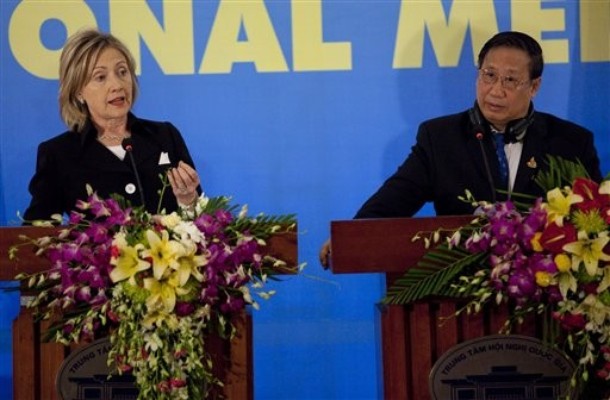
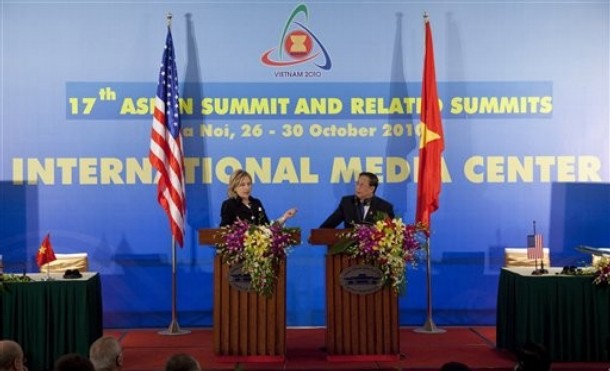
Secretary Clinton's Remarks With Vietnamese Foreign Minister Pham Gia Khiem


Remarks With Vietnamese Foreign Minister Pham Gia Khiem


Hillary Rodham Clinton
Secretary of State
Remarks following signing ceremonies
Hanoi, Vietnam
October 30, 2010


PARTICIPANT: Ladies and gentlemen, the first signing ceremony with the agreement between the Ministry of (inaudible) and the State Department of the United States of America. (Inaudible.) And may I invite the Deputy Prime Minister of Vietnam Pham Gia Khiem and Secretary of State of America Madam Hillary Clinton to take to the stage and to witness the signing of the agreement.

(The agreement was signed.) (Applause.)

We invite (inaudible) from Vietnam Airlines and Mr. Seborn (ph) from Boeing to take the stage and may I invite (inaudible) from the Ministry of Information and Communication and Mr. Markel (ph) from Microsoft to take to the stage. And now with the presence of the Deputy Prime Minister Pham Gia Khiem and Secretary Clinton, we are witnessing the signing of the agreement for the Boeing 787-9 between Vietnam Airlines and Boeing. (Applause.) For the next signing, may I also invite Minister Le Doan Hop, Minister of Information and Communication of Vietnam. With the signing of these agreements, we are looking at an increase of trade between our country and (inaudible). (Applause.) Thank you very much and now the signing ceremony ended. We now invite Madam (inaudible) to begin the press conference. Thank you very much.

MODERATOR: (In Vietnamese.)

FOREIGN MINISTER KHIEM: (In Vietnamese.)

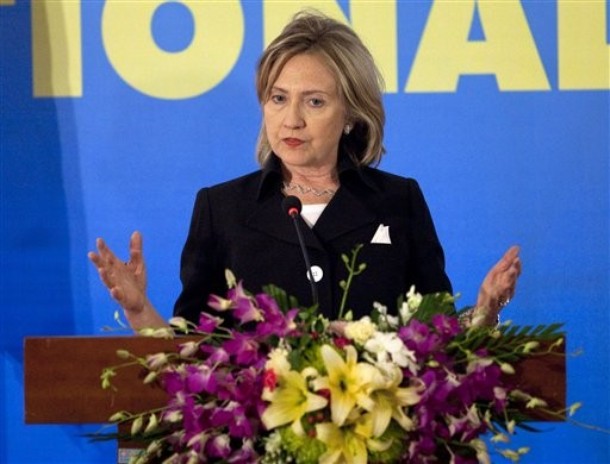
SECRETARY CLINTON: Thank you very much, Foreign Minister. It is a pleasure to be back in Hanoi again and to have the honor of witnessing the completion of the major agreement between our nations. Boeing and Microsoft are two of America's great companies and the partnerships you have cemented today will provide tangible benefits both to Vietnamese and to Americans.

I'm also very pleased to see the agreement regarding the United Nations Convention Against Torture signed. This convention represents a decades-long commitment by the international community to respect human rights and dignity. The United States is honored to support the people of Vietnam as they reaffirm their commitment to this cause by ratifying this convention.

The agreement is a direct result of the dialogue on human rights between our two countries. Further proof that discussions of even difficult issues can produces real results.

As some of you know, this is my second visit to Hanoi this year and it is a sign of the importance that the United States places on our relationship with Vietnam, with Southeast Asia and with the entire Asia Pacific region. This week marks the first time ever that the United States has participated in an East Asia summit and I would like to thank Prime Minister Dung for inviting me to be a guest of the chair at this gathering. President Obama is looking forward to joining the East Asia Summit next year in Indonesia.

The United States is committed to engaging with the East Asia Summit over the long term, because we believe it can and should become a key forum for political and security issues in the Asia Pacific. The EAS also provides and opportunity to consult directly with leaders from across the region. I had a number of productive meetings last night and today with my counterparts and other leaders from South Korea, Russia, China, India, Vietnam, and others. I'd like to give a brief readout from my discussions both with the prime minister and the foreign minister.

It is clear that our countries have reached a level of cooperation that would have been unimaginable just a few years ago. We have moved beyond a painful past and built a relationship that is built on mutual respect, friendship, and a common interest in a stable, secure, and prosperous Asia Pacific region. In our discussions, we reaffirmed our shared interest in working toward a strategic partnership and we covered a wide range of other issues. We talked about the importance of our growing cooperation on maritime security, search and rescue operations, and disaster relief.

This year's typhoons have been particularly devastating for the Vietnamese people, making our joint efforts in this area more urgent than ever. And like all friends of Vietnam, we were saddened by the tragic loss of life in the recent floods here and I want to extend my sincere condolences to those who have lost loved ones, homes, and businesses. As we cooperate more closely on disaster relief, we are broadening our security exchanges to include three annual dialogues that will strengthen our military to military ties and result in concrete benefits for the Vietnamese people.

We also had an excellent meeting this morning on the Lower Mekong Initiative and Vietnam is a real leader in looking for ways we can cooperate to mitigate against the environmental damage that is occurring in the Lower Mekong Basin.

On trade, our two countries have already made great progress. Fifteen years ago, our bilateral trade was about $450 million. Last year it was more than $15 billion. And the foreign minister and the prime minister and I talked about how to expand this trade relationship, including through the Transpacific Partnership. The United States, Vietnam, and seven other countries finished a third round of negotiations on the TPP this month and we hope that Vietnam can conclude it in internal process and announce its status as a full member of the partnership soon.

In health, the United States has provided substantial funding for Vietnam's efforts to strengthen its health system, and combat HIV/AIDS, Avian Flu, and emerging pandemic threats. Next year, we will start work on a $34 million project to remove the dioxin from the soil at Da Nang Airport, a legacy of the painful past we share, and a sign of the more hopeful future we are building together.

Climate change, as we head into negotiations in Cancun this November, we hope to work with Vietnam and other countries to build on the progress that we made in Copenhagen. In addition, at the meeting of the Lower Mekong Initiative, we discussed how to work together to adapt to the effects of a changing climate. And we had a very constructive discussion about the potential impact of building dams on the Lower Mekong. The United States has recommended a pause before major construction continues, and we will sponsor a study of this issue.

Now, although the partnership between our two countries is strong and getting stronger, as with all friends we have areas of disagreement. One of those areas concerns human rights. While the agreement we witnessed being signed today is certainly a step in the right direction, the United States remains concerned about the arrest and conviction of people for peaceful dissent, the tax on religious groups, the curbs on Internet freedom, including of bloggers. Vietnam has so much potential, and we believe that political reform and respect for human rights are an essential part of realizing that potential.

The last time I was here, in July, we celebrated 15 years of relations between Vietnam and the United States. This time we celebrate 1,000 years for Hanoi as the capital of Vietnam. And I want to extend my congratulations to the citizens of this beautiful city, and my best wishes to all of the people of Vietnam. I look forward to working with you, and with the people of Vietnam, to expand our work, our partnership, and our friendship in the years to come. Thank you so much.

(Applause.)


MODERATOR: (In Vietnamese.)

QUESTION: (In Vietnamese.)

FOREIGN MINISTER KHIEM: (In Vietnamese.)

SECRETARY CLINTON: Well, thank you, because we too believe that education is one of the most important parts of our relationship. And it is one where we have seen positive growth.

For the past three years, we have brought together Vietnamese and American academics, government leaders, private sector entrepreneurs to discuss how we can better collaborate in promoting education. During that time, the number of Vietnamese students studying in the United States has nearly tripled, rising to more than 13,000. And we are strongly supporting educational exchanges and academic collaboration, including through the Fulbright program and our English language program.

We also are committed to working with Vietnam as Vietnam reforms its education system, and fostering private U.S.-Vietnam education programs, including an American style university.

So, we think there is unlimited potential here. And in my two trips over the last four months I have had a number of young people tell me that they would love to study in the United States, they would love to learn English, and we want to help those young people achieve their goals.

MODERATOR: Thank you. (In Vietnamese.)

QUESTION: Hi, good afternoon. I am with NPR. China's government has expressed some displeasure about the U.S. role in the Diaoyu or Senkaku Islands dispute, including your remarks with Japanese Foreign Minister Maehara. I am wondering. Given the situation, what can the U.S. do, if anything, to act as a mediator or a broker in this situation?

I am also wondering if Foreign Minister Yang had any reassurances or clarifications to offer, as its been reported, on China's rare-earth exports policy? And also, does he have any suggestions of what China can do to break the impasse of North Korean nuclearization? Thank you.

SECRETARY CLINTON: Well, first, with respect to the Senkaku Islands, the United States has never taken a position on sovereignty, but we have made it very clear that the islands are part of our mutual treaty obligations, and the obligation to defend Japan. We have certainly encouraged both Japan and China to seek peaceful resolution of any disagreements that they have in this area or others. It is in all of our interest for China and Japan to have stable, peaceful relations. And we have recommended to both that the United States is more than willing to host a trilateral, where we would bring Japan and China and their foreign ministers together to discuss a range of issues.

On the rare-earth minerals matter, the foreign minister, Minister Yang, clarified that China has no intention of withholding these minerals from the market. He said that he wanted to make that very clear. Now, the fact is that they're called rare-earth for a reason; they are rare. And the United States, along with other allies -- Japan and Europe and elsewhere -- are going to be looking for more resources and looking for more sources of these rare-earth minerals. So, while we're pleased by the clarification we received from the Chinese Government, we still think that the world, as a whole, needs to find alternatives and to find new sources, which we will be pursuing.

And, finally, I spoke at length with both President Lee of South Korea, with my Japanese counterpart when I met with him in Honolulu, and with Minister Yang on North Korea. This is a matter of great concern to all of us, and we continue to urge the North Koreans to return to the negotiating table, to pursue what they began in 2005, which were a series of commitments to take irreversible steps for denuclearization of the Korean Peninsula. So we stay in very close touch with our Japanese, Korean, Chinese, and Russian counterparts to do what we can to try to move North Korea on to a more productive path.

MODERATOR: Thank you. (In Vietnamese.)

QUESTION: (In Vietnamese.)

SECRETARY CLINTON: Well, when President Obama came into office and I became Secretary of State, one of our highest priorities was to reaffirm our commitment to the Asia-Pacific region. The United States is uniquely situated in the world as both an Atlantic and a Pacific power. And we not only wanted to deepen our bilateral relations, as we are with Vietnam, and as we have with other countries in the region, but we wanted to participate more actively in the regional institutions like ASEAN.

So, one of the very first trips that I made -- actually, the first trip I made as Secretary of State -- was to East Asia, including going to the ASEAN headquarters in Jakarta, and committing that the United States would accede to the Treaty of Amity and Cooperation, so that we could be a participant in the activities of the ASEAN regional forum, and make a real commitment to the ASEAN nations organization.

We also believe that the East Asia Summit, where you bring other countries in addition to the core ASEAN countries together to discuss political and security matters, is a very important forum for the United States to be part of. I said earlier today at the East Asia Summit meeting with the leaders that where issues of a political, economic, and security consequence are being discussed in the region, the United States wants to be there.

We were very pleased that Vietnam, as the chair of ASEAN in 2010, has facilitated our participation, and invited us as a guest of the Chair. And we were delighted when we were offered the chance, along with Russia, to join. The United States has deep, lasting relationships in the Asia-Pacific, and we want to be a good partner, a good friend, a good neighbor. And I think one of the ways we can demonstrate that is by being an active participant in organizations like the East Asia Summit.

MODERATOR: Thank you. (In Vietnamese.)

QUESTION: Thank you. This is a question for Secretary Clinton and Foreign Minister Khiem.

You mentioned you raised human rights issues and these recent arrests with the foreign minister. I am just interested in what he told you, and how you accepted the response. And maybe the foreign minister can talk about that.

And also, an interesting part of the evolving U.S.-Vietnamese relationship is the civil nuclear cooperation agreement. I was interested in what the status is of those negotiations, and if the U.S. will allow Vietnam to produce its own nuclear fuel enriched uranium, an element of that agreement. And I was interested in where that stands. Thank you.

SECRETARY CLINTON: Well, we are (inaudible).

PHAM GIA KHIEM: (In Vietnamese.)

SECRETARY CLINTON: Human rights is an issue of great importance to the United States, and we regularly raise our concerns, as I did last evening with the Prime Minister, and again today with the Deputy Prime Minister and Foreign Minister. We not only raise this in general, but specifically with concerns regarding severe sentences for political activists, attacks on bloggers, restrictions on Internet freedom, and religious freedom, tightening control over research organizations and the media. We raise these at all levels, both here in Hanoi, and in Washington, including through our dialogue on human rights.

And as I said in my opening remarks, the signing of the Convention against Torture arose directly out of our dialogue on human rights. And I have been very reassured by the comment that the Prime Minister and the Deputy Prime Minister and Foreign Minister have made, that they want to engage with the United States on these issues, that they want to hear from us and our views on these matters. And we will continue doing so consistently and over time, as we make the case that Vietnam's rise, which was so impressive in the economic arena, will become even more dramatic and sustainable as those economic gains are matched by improvements in political freedom and in human rights.

With respect to the status of the 123 negotiations, we concluded a memorandum of understanding on nuclear cooperation in March. And we are continuing our efforts to expand civil nuclear cooperation. We have not yet opened formal negotiations on the 123 agreement, but we look forward to doing so. In fact, President Obama's invitation to the Prime Minister to attend the nuclear security summit in Washington last April was one indication of the importance we attach to our cooperation with Vietnam in this area, and we look forward to making progress on it.

MODERATOR: Thank you very much. (In Vietnamese.)


# # #