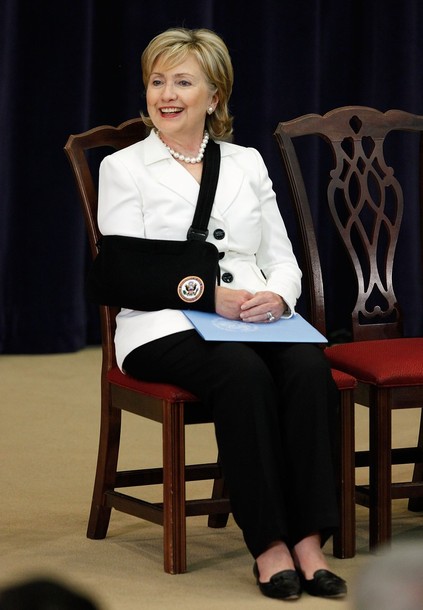
Hillary saw the need to incorporate technology in diplomacy early on
and begins this chapter at TechCamp Vilnius, the third of these
training camps her State Department had held by June 2011. It
consisted of two days of eleven-hour sessions devoted to showing how
pro-democracy activists could circumvent government opposition tactics
thwarting their organizing efforts.
Hillary first referred to what she came to call 21st century statecraft in two commencement addresses in New York in May 2009 and rapidly followed those with a Youtube on the subject.
When
I graduated from college, diplomacy was mainly conducted by experts
behind closed doors. They were primarily men. And very little of what
they did was really visible to the rest of us. Today, diplomacy is no
longer confined to the State Department or to diplomats in pin-striped
suits. In this global age, we are engaging in 21st century statecraft,
and it is carried out beyond the halls of government – in barrios and
rural villages, in corporate boardrooms and halls of government as well,
but also church basements, hospitals, union halls, civic and cultural
centers, and even in the dorms and classrooms of colleges like this. The
diplomacy of this age is fueled by personal engagement and
interpersonal connections. And that’s where all of you come in. With new
tools and technologies and with the first-rate education you’ve
received, you now have the capacity to influence events in ways that no
previous generation ever has... ...with these social networking
tools that you use every day to tell people you’ve gone to get a latte
or you’re going to be running late, you can unite your friends through
Facebook to fight human trafficking or child marriage, like the two
recent college graduates in Colombia – the country – who organized 14
million people into the largest anti-terrorism demonstration in history,
doing as much damage to the FARC terrorist network in a few weeks than
had been done in years of military action. (Applause.)And
you can organize through Twitter, like the undergraduates at
Northwestern who launched a global fast to bring attention to Iran’s
imprisonment of an American journalist. And we have two young women
journalists right now in prison in North Korea, and you can get busy on
the internet and let the North Koreans know that we find that absolutely
unacceptable. (Applause.)These new tools are
available for everyone. They are democratizing diplomacy. So over the
next year, we will be creating Virtual Student Foreign Service
Internships to partner American students with our embassies abroad to
conduct digital diplomacy. And you can learn more about this initiative
on the State Department website.
Fully aware
of the darker uses of technology, she explains that the idea was to
use mobile technology and social media to promote American values and
interests, and to help civil society across the globe hold governments
accountable, document abuses, and empower marginalized groups. Hillary
reviews technology abuses by some governments such as shutting down the
internet in times of upheaval as well as uses made by civil society
during such periods - among them those recounted here in relation to the chapter on Iran.
Technology was integral to her Quadrennial Diplomacy and Development Review (QDDR).
The
Wikileaks publication of confidential documents and emails in 2010
precipitated a diplomatic firestorm that required what came to be called
Hillary's "charm offensive." Some world leaders took things in
stride. Others needed her personal reassurance.
The
United States strongly condemns the illegal disclosure of classified
information. It puts people’s lives in danger, threatens our national
security, and undermines our efforts to work with other countries to
solve shared problems. This Administration is advancing a robust foreign
policy that is focused on advancing America’s national interests and
leading the world in solving the most complex challenges of our time,
from fixing the global economy, to thwarting international terrorism, to
stopping the spread of catastrophic weapons, to advancing human rights
and universal values. In every country and in every region of the world,
we are working with partners to pursue these aims. So let’s be clear:
this disclosure is not just an attack on America’s foreign policy
interests. It is an attack on the international community – the
alliances and partnerships, the conversations and negotiations, that
safeguard global security and advance economic prosperity... Now, I am
aware that some may mistakenly applaud those responsible, so I want to
set the record straight: There is nothing laudable about endangering
innocent people, and there is nothing brave about sabotaging the
peaceful relations between nations on which our common security depends.
There have been examples in history in which official conduct has been
made public in the name of exposing wrongdoings or misdeeds. This is not
one of those cases. In contrast, what is being put on display in this
cache of documents is the fact that American diplomats are doing the
work we expect them to do. They are helping identify and prevent
conflicts before they start. They are working hard every day to solve
serious practical problems – to secure dangerous materials, to fight
international crime, to assist human rights defenders, to restore our
alliances, to ensure global economic stability. This is the role that
America plays in the world. This is the role our diplomats play in
serving America. And it should make every one of us proud.
You may recall that in chapter 16 about Libya
Hillary mentions having had to recall former ambassador Gene Cretz
because of credible threats against him. These she lays at the feet of
Manning, Assange, and Wikileaks.
We
stand for a single internet where all of humanity has equal access to
knowledge and ideas. And we recognize that the world’s information
infrastructure will become what we and others make of it. Now, this
challenge may be new, but our responsibility to help ensure the free
exchange of ideas goes back to the birth of our republic. The words of
the First Amendment to our Constitution are carved in 50 tons of
Tennessee marble on the front of this building. And every generation of
Americans has worked to protect the values etched in that stone.
Franklin Roosevelt built on these ideas when he delivered his Four
Freedoms speech in 1941. Now, at the time, Americans faced a cavalcade
of crises and a crisis of confidence. But the vision of a world in which
all people enjoyed freedom of expression, freedom of worship, freedom
from want, and freedom from fear transcended the troubles of his day.
And years later, one of my heroes, Eleanor Roosevelt, worked to have
these principles adopted as a cornerstone of the Universal Declaration
of Human Rights... As I speak to you today, government censors somewhere are working furiously to erase my words from the records of history...*
Some
countries have erected electronic barriers that prevent their people
from accessing portions of the world’s networks. They’ve expunged
words, names, and phrases from search engine results. They have violated
the privacy of citizens who engage in non-violent political speech.
These actions contravene the Universal Declaration on Human Rights,
which tells us that all people have the right “to seek, receive and
impart information and ideas through any media and regardless of frontiers.”**
We'll
leave it here, with this speech, as Hillary does, knowing that every
day, and probably especially again today as I post that link, people in
countries where indeed authorities have tried to *erase her words" and **"erected electronic barriers"
will find the words here even though they may be unable to access te
State Department site.
__________________________________________________________
Resolution on the Promotion, Protection, and Enjoyment of Human Rights on the Internet
Press Statement
Hillary Rodham Clinton Secretary of State
Washington, DC
July 5, 2012
Today, the UN Human Rights Council adopted
by consensus a resolution with the message that there can be no division
or double standard regarding human rights online. The landmark
resolution makes clear that all individuals are entitled to the same
human rights and fundamental freedoms online as they are offline, and
all governments must protect those rights regardless of the medium.
The
free flow of news and information is under threat in countries around
the world. We are witnessing an alarming surge in the number of cases
involving government censorship and persecution of individuals for their
actions online – sometimes for just a single tweet or text message.
This
resolution is a welcome addition in the fight for the promotion and
protection of human rights and fundamental freedoms online, in
particular the freedom of expression, as well as the freedoms of
religion or belief, assembly and association, and the right to be free
of arbitrary interference with privacy.
The United States was
proud to work with the main sponsor, Sweden, and over 80 co-sponsors,
including Brazil, Turkey, Nigeria, and Tunisia, to help pass this
resolution. We will continue to stand with our partners to address
challenges to online freedom, and to ensure that human rights are
protected in the public square of the 21st century.
Well,
good evening, and it’s wonderful to be back in The Hague. I want to
thank my colleague and friend, Foreign Minister Rosenthal, a longtime
friend, and co-conspirator from time to time, Eric Schmidt. Also, thanks
to Leon Willems, the director of the Free Press Unlimited, and to those
of my colleagues whom I know are here, namely Carl Bildt, an incredibly
connected foreign minister, along with other ministers, ambassadors,
the diplomatic community, and ladies and gentlemen.It’s a pleasure to
join you here today to discuss this issue, because we think it is
vitally important to every nation represented and every nation in the
world; namely, internet freedom. And I want to thank Uri and the
Netherlands for hosting this conference, which is a reflection of your
long tradition of defending and advancing people’s human rights and
fundamental freedoms everywhere, including online. And thanks as well to
the representatives of nearly two dozen other governments here, all of
whom I know will be working to get real solutions and recommendations
agreed to tomorrow. I’m pleased we also have representatives from the
private sector and civil society. So it all adds up to a
multi-stakeholder event.
Now, in two days, on December 10th,
we’ll celebrate Human Rights Day, which is the anniversary of the
adoption of the Universal Declaration of Human Rights. And in the 63
years since that achievement, the world has been implementing a global
commitment around the rights and freedoms of people everywhere, no
matter where they live or who they are. And today, as people
increasingly turn to the internet to conduct important aspects of their
lives, we have to make sure that human rights are as respected online as
offline. After all, the right to express one’s views, practice one’s
faith, peacefully assemble with others to pursue political or social
change – these are all rights to which all human beings are entitled,
whether they choose to exercise them in a city square or an internet
chat room. And just as we have worked together since the last century to
secure these rights in the material world, we must work together in
this century to secure them in cyberspace.
This is an urgent task.
It is most urgent, of course, for those around the world whose words
are now censored, who are imprisoned because of what they or others have
written online, who are blocked from accessing entire categories of
internet content, or who are being tracked by governments seeking to
keep them from connecting with one another.
In Syria, a blogger named Anas Maarawi was arrested on July 1st
after demanding that President Asad leave. He’s not been charged with
anything, but he remains in detention. In both Syria and Iran, many
other online activists – actually too many to name – have been detained,
imprisoned, beaten, and even killed for expressing their views and
organizing their fellow citizens. And perhaps the most well known
blogger in Russia, Alexei Navalny, was sentenced on Tuesday to 15 days
in jail after he took part in protests over the Russian elections.
In
China, several dozen companies signed a pledge in October, committing
to strengthen their – quote – “self-management, self-restraint, and
strict self-discipline.” Now, if they were talking about fiscal
responsibility, we might all agree. But they were talking about offering
web-based services to the Chinese people, which is code for getting in
line with the government’s tight control over the internet.
Now,
these and many other incidents worldwide remind us of the stakes in this
struggle. And the struggle does not belong only to those on the front
lines and who are suffering. It belongs to all of us: first, because we
all have a responsibility to support human rights and fundamental
freedoms everywhere. Second, because the benefits of the network grow as
the number of users grow. The internet is not exhaustible or
competitive. My use of the internet doesn’t diminish yours. On the
contrary, the more people that are online and contributing ideas, the
more valuable the entire network becomes to all the other users. In this
way, all users, through the billions of individual choices we make
about what information to seek or share, fuel innovation, enliven public
debates, quench a thirst for knowledge, and connect people in ways that
distance and cost made impossible just a generation ago.
But when
ideas are blocked, information deleted, conversations stifled, and
people constrained in their choices, the internet is diminished for all
of us. What we do today to preserve fundamental freedoms online will
have a profound effect on the next generation of users. More than two
billion people are now connected to the internet, but in the next 20
years, that number will more than double. And we are quickly approaching
the day when more than a billion people are using the internet in
repressive countries. The pledges we make and the actions we take today
can help us determine whether that number grows or shrinks, or whether
the meaning of being on the internet is totally distorted.
Delivering
on internet freedom requires cooperative actions, and we have to foster
a global conversation based on shared principles and with the right
partners to navigate the practical challenges of maintaining an internet
that is open and free while also interoperable, secure, and reliable.
Now, this enterprise isn’t a matter of negotiating a single document and
calling the job done. It requires an ongoing effort to reckon with the
new reality that we live in, in a digital world, and doing so in a way
that maximizes its promise.
Because the advent of cyberspace
creates new challenges and opportunities in terms of security, the
digital economy, and human rights, we have to be constantly evolving in
our responses. And though they are distinct, they are practically
inseparable, because there isn’t an economic internet, a social
internet, and a political internet. There is just the internet, and
we’re here to protect what makes it great.
Tomorrow’s sessions
provide the opportunity for us to make concrete progress. At this
kickoff event, I’d like to briefly discuss three specific challenges
that defenders of the internet must confront.
The first challenge
is for the private sector to embrace its role in protecting internet
freedom. Because whether you like it or not, the choices that private
companies make have an impact on how information flows or doesn’t flow
on the internet and mobile networks. They also have an impact on what
governments can and can’t do, and they have an impact on people on the
ground.
In recent months, we’ve seen cases where companies,
products, and services were used as tools of oppression. Now, in some
instances, this cannot be foreseen, but in others, yes, it can. A few
years ago, the headlines were about companies turning over sensitive
information about political dissidents. Earlier this year, they were
about a company shutting down the social networking accounts of
activists in the midst of a political debate. Today’s news stories are
about companies selling the hardware and software of repression to
authoritarian governments. When companies sell surveillance equipment to
the security agency of Syria or Iran or, in past times, Qadhafi, there
can be no doubt it will be used to violate rights.
Now, there are
some who would say that in order to compel good behavior by businesses,
responsible governments should simply impose broad sanctions, and that
will take care of the problem. Well, it’s true that sanctions and export
controls are useful tools, and the United States makes vigorous use of
them when appropriate; and if they are broken, we investigate and pursue
violators. And we’re always seeking to work with our partners, such as
the European Union, to make them as smart and effective as possible.
Just last week, for example, we were glad to see our EU partners impose
new sanctions on technology going to Syria.
So sanctions are part
of the solution, but they are not the entire solution. Dual-use
technologies and third-party sales make it impossible to have a
sanctions regime that perfectly prevents bad actors from using
technologies in bad ways. Now, sometimes companies say to us at the
State Department, “Just tell us what to do, and we’ll do it.” But the
fact is, you can’t wait for instructions. In the 21st century, smart companies have to act before they find themselves in the crosshairs of controversy.
I
wish there were, but there isn’t, an easy formula for this. Making good
decisions about how and whether to do business in various parts of the
world, particularly where the laws are applied haphazardly or they are
opaque, takes critical thinking and deliberation and asking hard
questions. So what kind of business should you do in a country where it
has a history of violating internet freedom? Is there something you can
do to prevent governments from using your products to spy on their own
citizens? Should you include warnings to consumers? How will you handle
requests for information from security authorities when those requests
come without a warrant? Are you working to prevent post-purchase
modifications of your products or resale through middlemen to
authoritarian regimes?
Now, these and others are difficult
questions, but companies must ask them. And the rest of us stand ready
to work with you to find answers and to hold those who ignore or dismiss
or deny the importance of this issue accountable. A range of resources
emerged in recent years to help companies work through these issues. The
UN Guiding Principles on Business and Human Rights, which were adopted
in June, and the OECD Guidelines for Multinational Enterprises both
advise companies on how to meet responsibilities and carry out due
diligence. And the Global Network Initiative, which is represented here
tonight, is a growing forum where companies can work through challenges
with other industry partners, as well as academics, investors, and
activists.
And of course, companies can always learn from users.
The Silicon Valley Human Rights Conference in October brought together
companies, activists, and experts to discuss real life problems and
identify solutions. And some participants issued what they called the
Silicon Valley Standard for stakeholders to aspire to.
Working
through these difficult questions by corporate executives and board
members should help shape your practices. Part of the job of responsible
corporate management in the 21st century is doing human
rights due diligence on new markets, instituting internal review
procedures, identifying principles by which decisions are to be made in
tough situations, because we cannot let the short-term gains that all of
us think are legitimate and worth seeking jeopardize the openness of
the internet and human rights of individuals who use it without it
coming back to haunt us all in the future. Because a free and open
internet is important not just to technology companies but to all
companies. Whether it’s run with a single mobile phone or an extensive
corporate network, it’s hard to find any business today that doesn’t
depend in some way on the internet and doesn’t suffer when networks are
constrained.
And also I would add that, in this day, brand and
reputation are precious corporate assets. Companies that put them at
risk when they are careless about freedom of the internet can often pay a
price.
So I think it’s particularly appropriate and important
that the private sector is strongly represented at this meeting and that
Google is co-hosting tonight’s event. In both securing the promise of a
free and open internet and managing the risks that new technologies
raise, the private sector is a crucial partner.
But even as
companies must step up, governments must resist the urge to clamp down,
and that is the second challenge we face. If we’re not careful,
governments could upend the current internet governance framework in a
quest to increase their own control. Some governments use internet
governance issues as a cover for pushing an agenda that would justify
restricting human rights online. We must be wary of such agendas and
united in our shared conviction that human rights apply online.
So
right now, in various international forums, some countries are working
to change how the internet is governed. They want to replace the current
multi-stakeholder approach, which includes governments, the private
sector, and citizens, and supports the free flow of information, in a
single global network. In its place, they aim to impose a system
cemented in a global code that expands control over internet resources,
institutions, and content, and centralizes that control in the hands of
governments.
Now, in a way, that isn’t surprising, because
governments have never met a voice or public sphere they didn’t want to
control at some point or another. They want to control what gets printed
in newspapers, who gets into universities, what companies get oil
contracts, what churches and NGOs get registered, where citizens can
gather, so why not the internet? But it’s actually worse than that. It’s
not just that they want governments to have all the control by cutting
out civil society and the private sector; they also want to empower each
individual government to make their own rules for the internet that not
only undermine human rights and the free flow of information but also
the interoperability of the network.
In effect, the governments
pushing this agenda want to create national barriers in cyberspace. This
approach would be disastrous for internet freedom. More government
control will further constrict what people in repressive environments
can do online. It would also be disastrous for the internet as a whole,
because it would reduce the dynamism of the internet for everyone.
Fragmenting the global internet by erecting barriers around national
internets would change the landscape of cyberspace. In this scenario,
the internet would contain people in a series of digital bubbles, rather
than connecting them in a global network. Breaking the internet into
pieces would give you echo chambers rather than an innovative global
marketplace of ideas.
The United States wants the internet to
remain a space where economic, political, and social exchanges flourish.
To do that, we need to protect people who exercise their rights online,
and we also need to protect the internet itself from plans that would
undermine its fundamental characteristics.
Now, those who push
these plans often do so in the name of security. And let me be clear:
The challenge of maintaining security and of combating cyber crime, such
as the theft of intellectual property, are real – a point I underscore
whenever I discuss these issues. There are predators, terrorists,
traffickers on the internet, malign actors plotting cyber attacks, and
they all need to be stopped. We can do that by working together without
compromising the global network, its dynamism, or our principles.
Now,
there’s a lot to be said about cyber security. I won’t go into that
tonight. I’ll be talking about it more, but my basic point is that the
United States supports the public-private collaboration that now exists
to manage the technical evolution of the internet in real time. We
support the principles of multi-stakeholder internet governance
developed by more than 30 (inaudible) all over the world. So to use an
American phrase, our position is, “If it ain’t broke, don’t fix it.” And
there’s no good reason to replace an effective system with an
oppressive one.
The third and final challenge is that all of us –
governments, private (inaudible) – building this global coalition is
hard, partly because, for people in many countries, the potential of the
internet is still unrealized. While it’s easy for us in the United
States or in the Netherlands (inaudible) so we have to work harder to
make the case that an open internet is and will be in everyone’s best
interests. And (inaudible) we have to keep that in mind as we work to
build this global coalition and make the case to leaders of those
countries where the next generation of internet users live. These
leaders have an opportunity today to help ensure that the full benefits
are available to their people tomorrow, and in so doing, they will help
us ensure an open internet for everyone.
So the United States will
be making the case for an open internet in our work worldwide
(inaudible) here tonight, Mongolia, (inaudible), Chile, also
represented, I saw, Indonesia and others, (inaudible) are sure to be
effective at bringing other potential partners on board who have
(inaudible) perspectives that can help us confront and answer difficult
questions. And new players from (inaudible) governments, the private
sector, and civil society will be participating in managing the internet
in coming decades, as billions more people from all different regions
(inaudible) items on your agenda for tomorrow.
The first will be
to build support for a new cross-regional group (inaudible) that will
work together in exactly the way that I’ve just discussed (inaudible)
based on shared principles, providing a platform (inaudible) for
governments to (inaudible) hope others here will do the same, and going
(inaudible) forward, others will endorse the declaration that our Dutch
hosts (inaudible) have prepared. It’s excellent work, Uri, and we thank
you for your leadership.
(Inaudible) who are threatened by their
repressive governments. The (inaudible) Committee to Protect Journalists
recently reported that of all the writers, editors, and
photojournalists (inaudible) and I was pleased that the EU recently
announced new funding for that purpose. And I know that other
governments, including the Netherlands, are also looking for ways to
help out.
By coordinating our efforts, we can make them go further
and help more people. Earlier, (inaudible) I heard what the foreign
minister here is proposing. And we have talked about creating a digital
defenders partnership to be part of this global effort. We hope
tomorrow’s meetings will give us a chance to discuss with other
potential partners how such a partnership could work.
So while we
meet here in the Netherlands in this beautiful city to talk about how to
keep the internet (inaudible) walls between different activities online
(inaudible) economic exchanges, political discussions, religious
expression, social interaction, and so on. They want to keep what they
like and which doesn’t threaten them and suppress what they don’t. But
there are opportunity costs for trying to be open for business but
closed for free expression (inaudible) costs to a nation’s education
system (inaudible) political stability, (inaudible) to maintain.
Our
government (inaudible) will continue to work very hard to get around
every barrier that repressive governments put up. Because governments
that have erected barriers will eventually find themselves boxed in, and
they will (inaudible) keeping them standing by resorting to greater
oppression, and to (inaudible) escalating the opportunity cost of
missing out on the ideas that have been blocked (inaudible) and the
people who have (inaudible) disappeared.
I urge countries
everywhere (inaudible) instead of that alternative, dark vision, join us
(inaudible). This is not a bet on computers or mobile phones. It’s a
bet on the human spirit. It’s a bet on people. And we’re confident that
together, with our partners and government, the private sector, and
civil society around the world, who have made this same bet like all of
you here tonight, we will preserve the internet as open and secure for
all.
On the eve of Human Rights Day, this meeting reminds us of
the timeless principles that should be our north star. And a look at the
world around us and the way it is changing reminds us there is no
auto-pilot steering us forward. We have to work in good faith and
(inaudible) engage in honest debate, and we have to join together to
solve the challenges and seize the opportunities of this exciting
digital age. Thank you all for being committed to (inaudible).
Secretary Clinton to Kick Off U.S. Participation in the Freedom Online Internet Freedom Conference
Media Note
Office of the Spokesperson
Washington, DC
December 7, 2011
The
United States, along with 22 other countries and other non-governmental
participants, will take part in the Freedom Online conference hosted by
the Dutch Ministry of Foreign Affairs in The Hague.
Secretary of
State Hillary Rodham Clinton will kick off the conference with keynote
remarks on December 8, and Assistant Secretary for Democracy, Human
Rights, and Labor Michael Posner will lead the U.S. Government
delegation on December 9. Coordinator for Cyber Issues Chris Painter and
Deputy Assistant Secretary for Democracy, Human Rights, and Labor
Daniel Baer will be part of the senior-level delegation.
The
conference will launch an international coalition of states committed to
working with businesses, civil society, and relevant stakeholders to
take concrete actions to advance Internet freedom worldwide. Twenty
three countries will participate in the conference, as well as prominent
activists and bloggers and representatives from leading NGOs,
companies, and international organizations.
The Freedom Online
conference and the creation of a global coalition of countries committed
to Internet freedom is an important step in establishing international
support and joint action for the protection of freedom of expression,
assembly, and association online for people worldwide.
Secretary Clinton’s remarks will be live-streamed and available for viewing at: www.humanrights.gov.
The Secretary’s speech will be rebroadcast at a 2:00 pm EST satellite
event hosted by the Embassy of the Netherlands and Google at the Newseum
in Washington, DC on Thursday, December 8, at which Under Secretary for
Democracy and Global Affairs Maria Otero will deliver keynote remarks.
In addition, Ambassador Philip Verveer, U.S. Coordinator for
International Communications & Information Policy, will participate
in a panel discussion at the Newseum event.
For more information about the Freedom Online conference, visit: http://www.minbuza.nl/en/ministry/conference-on-internet-freedom. Follow the conversation on Twitter under the hashtag: #iFreedom.
We are deeply concerned by reports that Internet service has been shut down across much of Syria, as have some mobile communication networks. We condemn any effort to suppress the Syrian people’s exercise of their rights to free expression, assembly, and association.
Two weeks ago, the White House released the International Strategy for Cyberspace, which noted that “States should not arbitrarily deprive or disrupt individuals’ access to the Internet or other networked technologies.” We condemn such shutdowns in the strongest terms.
The Syrian government has a history of restricting the Internet in an attempt to prevent the Syrian people from accessing and sharing information. The Syrian government must understand that attempting to silence its population cannot prevent the transition currently taking place. We believe that even in the face of significant obstacles, the Syrian people will -- and should -- find a way to make their voices heard.
The United States stands for universal human rights, including freedom of expression, and we call on all governments to respect them.
There was a tussle when a man in the audience caused a disturbance and was removed (apparently by university security) while the SOS was speaking. Here is a snippet of the incident with the heckler. Thank God he was only heckling!
Remarks on Internet Rights and Wrongs: Choices & Challenges in a Networked World
Remarks
Hillary Rodham Clinton Secretary of State
George Washington University
Washington, DC
February 15, 2011
Thank you all very much and good afternoon. It is a pleasure, once again, to be back on the campus of the George Washington University, a place that I have spent quite a bit of time in all different settings over the last now nearly 20 years. I’d like especially to thank President Knapp and Provost Lerman, because this is a great opportunity for me to address such a significant issue, and one which deserves the attention of citizens, governments, and I know is drawing that attention. And perhaps today in my remarks, we can begin a much more vigorous debate that will respond to the needs that we have been watching in real time on our television sets.
A few minutes after midnight on January 28th, the internet went dark across Egypt. During the previous four days, hundreds of thousands of Egyptians had marched to demand a new government. And the world, on TVs, laptops, cell phones, and smart phones, had followed every single step. Pictures and videos from Egypt flooded the web. On Facebook and Twitter, journalists posted on-the-spot reports. Protestors coordinated their next moves. And citizens of all stripes shared their hopes and fears about this pivotal moment in the history of their country.
Millions worldwide answered in real time, “You are not alone and we are with you.” Then the government pulled the plug. Cell phone service was cut off, TV satellite signals were jammed, and internet access was blocked for nearly the entire population. The government did not want the people to communicate with each other and it did not want the press to communicate with the public. It certainly did not want the world to watch.
The events in Egypt recalled another protest movement 18 months earlier in Iran, when thousands marched after disputed elections. Their protestors also used websites to organize. A video taken by cell phone showed a young woman named Neda killed by a member of the paramilitary forces, and within hours, that video was being watched by people everywhere.
The Iranian authorities used technology as well. The Revolutionary Guard stalked members of the Green Movement by tracking their online profiles. And like Egypt, for a time, the government shut down the internet and mobile networks altogether. After the authorities raided homes, attacked university dorms, made mass arrests, tortured and fired shots into crowds, the protests ended.
In Egypt, however, the story ended differently. The protests continued despite the internet shutdown. People organized marches through flyers and word of mouth and used dial-up modems and fax machines to communicate with the world. After five days, the government relented and Egypt came back online. The authorities then sought to use the internet to control the protests by ordering mobile companies to send out pro-government text messages, and by arresting bloggers and those who organized the protests online. But 18 days after the protests began, the government failed and the president resigned.
What happened in Egypt and what happened in Iran, which this week is once again using violence against protestors seeking basic freedoms, was about a great deal more than the internet. In each case, people protested because of deep frustrations with the political and economic conditions of their lives. They stood and marched and chanted and the authorities tracked and blocked and arrested them. The internet did not do any of those things; people did. In both of these countries, the ways that citizens and the authorities used the internet reflected the power of connection technologies on the one hand as an accelerant of political, social, and economic change, and on the other hand as a means to stifle or extinguish that change.
There is a debate currently underway in some circles about whether the internet is a force for liberation or repression. But I think that debate is largely beside the point. Egypt isn’t inspiring people because they communicated using Twitter. It is inspiring because people came together and persisted in demanding a better future. Iran isn’t awful because the authorities used Facebook to shadow and capture members of the opposition. Iran is awful because it is a government that routinely violates the rights of its people.
So it is our values that cause these actions to inspire or outrage us, our sense of human dignity, the rights that flow from it, and the principles that ground it. And it is these values that ought to drive us to think about the road ahead. Two billion people are now online, nearly a third of humankind. We hail from every corner of the world, live under every form of government, and subscribe to every system of beliefs. And increasingly, we are turning to the internet to conduct important aspects of our lives.
The internet has become the public space of the 21st century – the world’s town square, classroom, marketplace, coffeehouse, and nightclub. We all shape and are shaped by what happens there, all 2 billion of us and counting. And that presents a challenge. To maintain an internet that delivers the greatest possible benefits to the world, we need to have a serious conversation about the principles that will guide us, what rules exist and should not exist and why, what behaviors should be encouraged or discouraged and how.
The goal is not to tell people how to use the internet any more than we ought to tell people how to use any public square, whether it’s Tahrir Square or Times Square. The value of these spaces derives from the variety of activities people can pursue in them, from holding a rally to selling their vegetables, to having a private conversation. These spaces provide an open platform, and so does the internet. It does not serve any particular agenda, and it never should. But if people around the world are going come together every day online and have a safe and productive experience, we need a shared vision to guide us.
One year ago, I offered a starting point for that vision by calling for a global commitment to internet freedom, to protect human rights online as we do offline. The rights of individuals to express their views freely, petition their leaders, worship according to their beliefs – these rights are universal, whether they are exercised in a public square or on an individual blog. The freedoms to assemble and associate also apply in cyberspace. In our time, people are as likely to come together to pursue common interests online as in a church or a labor hall.
Together, the freedoms of expression, assembly, and association online comprise what I’ve called the freedom to connect. The United States supports this freedom for people everywhere, and we have called on other nations to do the same. Because we want people to have the chance to exercise this freedom. We also support expanding the number of people who have access to the internet. And because the internet must work evenly and reliably for it to have value, we support the multi-stakeholder system that governs the internet today, which has consistently kept it up and running through all manner of interruptions across networks, borders, and regions.
In the year since my speech, people worldwide have continued to use the internet to solve shared problems and expose public corruption, from the people in Russia who tracked wildfires online and organized a volunteer firefighting squad, to the children in Syria who used Facebook to reveal abuse by their teachers, to the internet campaign in China that helps parents find their missing children.
At the same time, the internet continues to be restrained in a myriad of ways. In China, the government censors content and redirects search requests to error pages. In Burma, independent news sites have been taken down with distributed denial of service attacks. In Cuba, the government is trying to create a national intranet, while not allowing their citizens to access the global internet. In Vietnam, bloggers who criticize the government are arrested and abused. In Iran, the authorities block opposition and media websites, target social media, and steal identifying information about their own people in order to hunt them down.
These actions reflect a landscape that is complex and combustible, and sure to become more so in the coming years as billions of more people connect to the internet. The choices we make today will determine what the internet looks like in the future. Businesses have to choose whether and how to enter markets where internet freedom is limited. People have to choose how to act online, what information to share and with whom, which ideas to voice and how to voice them. Governments have to choose to live up to their commitments to protect free expression, assembly, and association.
For the United States, the choice is clear. On the spectrum of internet freedom, we place ourselves on the side of openness. Now, we recognize that an open internet comes with challenges. It calls for ground rules to protect against wrongdoing and harm. And internet freedom raises tensions, like all freedoms do. But we believe the benefits far exceed the costs.
And today, I’d like to discuss several of the challenges we must confront as we seek to protect and defend a free and open internet. Now, I’m the first to say that neither I nor the United States Government has all the answers. We’re not sure we have all the questions. But we are committed to asking the questions, to helping lead a conversation, and to defending not just universal principles but the interests of our people and our partners.
The first challenge is achieving both liberty and security. Liberty and security are often presented as equal and opposite; the more you have of one, the less you have of the other. In fact, I believe they make it each other possible. Without security, liberty is fragile. Without liberty, security is oppressive. The challenge is finding the proper measure: enough security to enable our freedoms, but not so much or so little as to endanger them.
Finding this proper measure for the internet is critical because the qualities that make the internet a force for unprecedented progress – its openness, its leveling effect, its reach and speed – also enable wrongdoing on an unprecedented scale. Terrorists and extremist groups use the internet to recruit members, and plot and carry out attacks. Human traffickers use the internet to find and lure new victims into modern-day slavery. Child pornographers use the internet to exploit children. Hackers break into financial institutions, cell phone networks, and personal email accounts.
So we need successful strategies for combating these threats and more without constricting the openness that is the internet’s greatest attribute. The United States is aggressively tracking and deterring criminals and terrorists online. We are investing in our nation’s cyber-security, both to prevent cyber-incidents and to lessen their impact. We are cooperating with other countries to fight transnational crime in cyber-space. The United States Government invests in helping other nations build their own law enforcement capacity. We have also ratified the Budapest Cybercrime Convention, which sets out the steps countries must take to ensure that the internet is not misused by criminals and terrorists while still protecting the liberties of our own citizens.
In our vigorous effort to prevent attacks or apprehend criminals, we retain a commitment to human rights and fundamental freedoms. The United States is determined to stop terrorism and criminal activity online and offline, and in both spheres we are committed to pursuing these goals in accordance with our laws and values.
Now, others have taken a different approach. Security is often invoked as a justification for harsh crackdowns on freedom. Now, this tactic is not new to the digital age, but it has new resonance as the internet has given governments new capacities for tracking and punishing human rights advocates and political dissidents. Governments that arrest bloggers, pry into the peaceful activities of their citizens, and limit their access to the internet may claim to be seeking security. In fact, they may even mean it as they define it. But they are taking the wrong path. Those who clamp down on internet freedom may be able to hold back the full expression of their people’s yearnings for a while, but not forever.
The second challenge is protecting both transparency and confidentiality. The internet’s strong culture of transparency derives from its power to make information of all kinds available instantly. But in addition to being a public space, the internet is also a channel for private communications. And for that to continue, there must be protection for confidential communication online. Think of all the ways in which people and organizations rely on confidential communications to do their jobs. Businesses hold confidential conversations when they’re developing new products to stay ahead of their competitors. Journalists keep the details of some sources confidential to protect them from exposure or retribution. And governments also rely on confidential communication online as well as offline. The existence of connection technologies may make it harder to maintain confidentiality, but it does not alter the need for it.
Now, I know that government confidentiality has been a topic of debate during the past few months because of WikiLeaks, but it’s been a false debate in many ways. Fundamentally, the WikiLeaks incident began with an act of theft. Government documents were stolen, just the same as if they had been smuggled out in a briefcase. Some have suggested that this theft was justified because governments have a responsibility to conduct all of our work out in the open in the full view of our citizens. I respectfully disagree. The United States could neither provide for our citizens’ security nor promote the cause of human rights and democracy around the world if we had to make public every step of our efforts. Confidential communication gives our government the opportunity to do work that could not be done otherwise.
Consider our work with former Soviet states to secure loose nuclear material. By keeping the details confidential, we make it less likely that terrorists or criminals will find the nuclear material and steal it for their own purposes. Or consider the content of the documents that WikiLeaks made public. Without commenting on the authenticity of any particular documents, we can observe that many of the cables released by WikiLeaks relate to human rights work carried on around the world. Our diplomats closely collaborate with activists, journalists, and citizens to challenge the misdeeds of oppressive governments. It is dangerous work. By publishing diplomatic cables, WikiLeaks exposed people to even greater risk.
For operations like these, confidentiality is essential, especially in the internet age when dangerous information can be sent around the world with the click of a keystroke. But of course, governments also have a duty to be transparent. We govern with the consent of the people, and that consent must be informed to be meaningful. So we must be judicious about when we close off our work to the public, and we must review our standards frequently to make sure they are rigorous. In the United States, we have laws designed to ensure that the government makes its work open to the people, and the Obama Administration has also launched an unprecedented initiative to put government data online, to encourage citizen participation, and to generally increase the openness of government.
The U.S. Government’s ability to protect America, to secure the liberties of our people, and to support the rights and freedoms of others around the world depends on maintaining a balance between what’s public and what should and must remain out of the public domain. The scale should and will always be tipped in favor of openness, but tipping the scale over completely serves no one’s interests. Let me be clear. I said that the WikiLeaks incident began with a theft, just as if it had been executed by smuggling papers in a briefcase. The fact that WikiLeaks used the internet is not the reason we criticized its actions. WikiLeaks does not challenge our commitment to internet freedom.
And one final word on this matter: There were reports in the days following these leaks that the United States Government intervened to coerce private companies to deny service to WikiLeaks. That is not the case. Now, some politicians and pundits publicly called for companies to disassociate from WikiLeaks, while others criticized them for doing so. Public officials are part of our country’s public debates, but there is a line between expressing views and coercing conduct. Business decisions that private companies may have taken to enforce their own values or policies regarding WikiLeaks were not at the direction of the Obama Administration.
A third challenge is protecting free expression while fostering tolerance and civility. I don’t need to tell this audience that the internet is home to every kind of speech – false, offensive, incendiary, innovative, truthful, and beautiful.
The multitude of opinions and ideas that crowd the internet is both a result of its openness and a reflection of our human diversity. Online, everyone has a voice. And the Universal Declaration of Human Rights protects the freedom of expression for all. But what we say has consequences. Hateful or defamatory words can inflame hostilities, deepen divisions, and provoke violence. On the internet, this power is heightened. Intolerant speech is often amplified and impossible to retract. Of course, the internet also provides a unique space for people to bridge their differences and build trust and understanding.
Some take the view that, to encourage tolerance, some hateful ideas must be silenced by governments. We believe that efforts to curb the content of speech rarely succeed and often become an excuse to violate freedom of expression. Instead, as it has historically been proven time and time again, the better answer to offensive speech is more speech. People can and should speak out against intolerance and hatred. By exposing ideas to debate, those with merit tend to be strengthened, while weak and false ideas tend to fade away; perhaps not instantly, but eventually.
Now, this approach does not immediately discredit every hateful idea or convince every bigot to reverse his thinking. But we have determined as a society that it is far more effective than any other alternative approach. Deleting writing, blocking content, arresting speakers – these actions suppress words, but they do not touch the underlying ideas. They simply drive people with those ideas to the fringes, where their convictions can deepen, unchallenged.
Last summer, Hannah Rosenthal, the U.S. Special Envoy to Monitor and Combat Anti-Semitism, made a trip to Dachau and Auschwitz with a delegation of American imams and Muslim leaders. Many of them had previously denied the Holocaust, and none of them had ever denounced Holocaust denial. But by visiting the concentration camps, they displayed a willingness to consider a different view. And the trip had a real impact. They prayed together, and they signed messages of peace, and many of those messages in the visitors books were written in Arabic. At the end of the trip, they read a statement that they wrote and signed together condemning without reservation Holocaust denial and all other forms of anti-Semitism.
The marketplace of ideas worked. Now, these leaders had not been arrested for their previous stance or ordered to remain silent. Their mosques were not shut down. The state did not compel them with force. Others appealed to them with facts. And their speech was dealt with through the speech of others.
The United States does restrict certain kinds of speech in accordance with the rule of law and our international obligations. We have rules about libel and slander, defamation, and speech that incites imminent violence. But we enforce these rules transparently, and citizens have the right to appeal how they are applied. And we don’t restrict speech even if the majority of people find it offensive. History, after all, is full of examples of ideas that were banned for reasons that we now see as wrong. People were punished for denying the divine right of kings, or suggesting that people should be treated equally regardless of race, gender, or religion. These restrictions might have reflected the dominant view at the time, and variations on these restrictions are still in force in places around the world.
But when it comes to online speech, the United States has chosen not to depart from our time-tested principles. We urge our people to speak with civility, to recognize the power and reach that their words can have online. We’ve seen in our own country tragic examples of how online bullying can have terrible consequences. Those of us in government should lead by example, in the tone we set and the ideas we champion. But leadership also means empowering people to make their own choices, rather than intervening and taking those choices away. We protect free speech with the force of law, and we appeal to the force of reason to win out over hate.
Now, these three large principles are not always easy to advance at once. They raise tensions, and they pose challenges. But we do not have to choose among them. Liberty and security, transparency and confidentiality, freedom of expression and tolerance – these all make up the foundation of a free, open, and secure society as well as a free, open, and secure internet where universal human rights are respected, and which provides a space for greater progress and prosperity over the long run.
Now, some countries are trying a different approach, abridging rights online and working to erect permanent walls between different activities – economic exchanges, political discussions, religious expressions, and social interactions. They want to keep what they like and suppress what they don’t. But this is no easy task. Search engines connect businesses to new customers, and they also attract users because they deliver and organize news and information. Social networking sites aren’t only places where friends share photos; they also share political views and build support for social causes or reach out to professional contacts to collaborate on new business opportunities.
Walls that divide the internet, that block political content, or ban broad categories of expression, or allow certain forms of peaceful assembly but prohibit others, or intimidate people from expressing their ideas are far easier to erect than to maintain. Not just because people using human ingenuity find ways around them and through them but because there isn’t an economic internet and a social internet and a political internet; there’s just the internet. And maintaining barriers that attempt to change this reality entails a variety of costs – moral, political, and economic. Countries may be able to absorb these costs for a time, but we believe they are unsustainable in the long run. There are opportunity costs for trying to be open for business but closed for free expression – costs to a nation’s education system, its political stability, its social mobility, and its economic potential.
When countries curtail internet freedom, they place limits on their economic future. Their young people don’t have full access to the conversations and debates happening in the world or exposure to the kind of free inquiry that spurs people to question old ways of doing and invent new ones. And barring criticism of officials makes governments more susceptible to corruption, which create economic distortions with long-term effects. Freedom of thought and the level playing field made possible by the rule of law are part of what fuels innovation economies.
So it’s not surprising that the European-American Business Council, a group of more than 70 companies, made a strong public support statement last week for internet freedom. If you invest in countries with aggressive censorship and surveillance policies, your website could be shut down without warning, your servers hacked by the government, your designs stolen, or your staff threatened with arrest or expulsion for failing to comply with a politically motivated order. The risks to your bottom line and to your integrity will at some point outweigh the potential rewards, especially if there are market opportunities elsewhere.
Now, some have pointed to a few countries, particularly China, that appears to stand out as an exception, a place where internet censorship is high and economic growth is strong. Clearly, many businesses are willing to endure restrictive internet policies to gain access to those markets, and in the short term, even perhaps in the medium term, those governments may succeed in maintaining a segmented internet. But those restrictions will have long-term costs that threaten one day to become a noose that restrains growth and development.
There are political costs as well. Consider Tunisia, where online economic activity was an important part of the country’s ties with Europe while online censorship was on par with China and Iran, the effort to divide the economic internet from the “everything else” internet in Tunisia could not be sustained. People, especially young people, found ways to use connection technologies to organize and share grievances, which, as we know, helped fuel a movement that led to revolutionary change. In Syria, too, the government is trying to negotiate a non-negotiable contradiction. Just last week, it lifted a ban on Facebook and YouTube for the first time in three years, and yesterday they convicted a teenage girl of espionage and sentenced her to five years in prison for the political opinions she expressed on her blog.
This, too, is unsustainable. The demand for access to platforms of expression cannot be satisfied when using them lands you in prison. We believe that governments who have erected barriers to internet freedom, whether they’re technical filters or censorship regimes or attacks on those who exercise their rights to expression and assembly online, will eventually find themselves boxed in. They will face a dictator’s dilemma and will have to choose between letting the walls fall or paying the price to keep them standing, which means both doubling down on a losing hand by resorting to greater oppression and enduring the escalating opportunity cost of missing out on the ideas that have been blocked and people who have been disappeared.
I urge countries everywhere instead to join us in the bet we have made, a bet that an open internet will lead to stronger, more prosperous countries. At its core, it’s an extension of the bet that the United States has been making for more than 200 years, that open societies give rise to the most lasting progress, that the rule of law is the firmest foundation for justice and peace, and that innovation thrives where ideas of all kinds are aired and explored. This is not a bet on computers or mobile phones. It’s a bet on people. We’re confident that together with those partners in government and people around the world who are making the same bet by hewing to universal rights that underpin open societies, we’ll preserve the internet as an open space for all. And that will pay long-term gains for our shared progress and prosperity. The United States will continue to promote an internet where people’s rights are protected and that it is open to innovation, interoperable all over the world, secure enough to hold people’s trust, and reliable enough to support their work.
In the past year, we have welcomed the emergence of a global coalition of countries, businesses, civil society groups, and digital activists seeking to advance these goals. We have found strong partners in several governments worldwide, and we’ve been encouraged by the work of the Global Network Initiative, which brings together companies, academics, and NGOs to work together to solve the challenges we are facing, like how to handle government requests for censorship or how to decide whether to sell technologies that could be used to violate rights or how to handle privacy issues in the context of cloud computing. We need strong corporate partners that have made principled, meaningful commitments to internet freedom as we work together to advance this common cause.
We realize that in order to be meaningful, online freedoms must carry over into real-world activism. That’s why we are working through our Civil Society 2.0 initiative to connect NGOs and advocates with technology and training that will magnify their impact. We are also committed to continuing our conversation with people everywhere around the world. Last week, you may have heard, we launched Twitter feeds in Arabic and Farsi, adding to the ones we already have in French and Spanish. We’ll start similar ones in Chinese, Russian, and Hindi. This is enabling us to have real-time, two-way conversations with people wherever there is a connection that governments do not block.
Our commitment to internet freedom is a commitment to the rights of people, and we are matching that with our actions. Monitoring and responding to threats to internet freedom has become part of the daily work of our diplomats and development experts. They are working to advance internet freedom on the ground at our embassies and missions around the world. The United States continues to help people in oppressive internet environments get around filters, stay one step ahead of the censors, the hackers, and the thugs who beat them up or imprison them for what they say online.
While the rights we seek to protect and support are clear, the various ways that these rights are violated are increasingly complex. I know some have criticized us for not pouring funding into a single technology, but we believe there is no silver bullet in the struggle against internet repression. There’s no app for that. (Laughter.) Start working, those of you out there. (Laughter.) And accordingly, we are taking a comprehensive and innovative approach, one that matches our diplomacy with technology, secure distribution networks for tools, and direct support for those on the front lines.
In the last three years, we have awarded more than $20 million in competitive grants through an open process, including interagency evaluation by technical and policy experts to support a burgeoning group of technologists and activists working at the cutting edge of the fight against internet repression. This year, we will award more than $25 million in additional funding. We are taking a venture capital-style approach, supporting a portfolio of technologies, tools, and training, and adapting as more users shift to mobile devices. We have our ear to the ground, talking to digital activists about where they need help, and our diversified approach means we’re able to adapt the range of threats that they face. We support multiple tools, so if repressive governments figure out how to target one, others are available. And we invest in the cutting edge because we know that repressive governments are constantly innovating their methods of oppression and we intend to stay ahead of them.
Likewise, we are leading the push to strengthen cyber security and online innovation, building capacity in developing countries, championing open and interoperable standards and enhancing international cooperation to respond to cyber threats. Deputy Secretary of Defense Lynn gave a speech on this issue just yesterday. All these efforts build on a decade of work to sustain an internet that is open, secure, and reliable. And in the coming year, the Administration will complete an international strategy for cyberspace, charting the course to continue this work into the future.
This is a foreign policy priority for us, one that will only increase in importance in the coming years. That’s why I’ve created the Office of the Coordinator for Cyber Issues, to enhance our work on cyber security and other issues and facilitate cooperation across the State Department and with other government agencies. I’ve named Christopher Painter, formerly senior director for cyber security at the National Security Council and a leader in the field for 20 years, to head this new office.
The dramatic increase in internet users during the past 10 years has been remarkable to witness. But that was just the opening act. In the next 20 years, nearly 5 billion people will join the network. It is those users who will decide the future.
So we are playing for the long game. Unlike much of what happens online, progress on this front will be measured in years, not seconds. The course we chart today will determine whether those who follow us will get the chance to experience the freedom, security, and prosperity of an open internet.
As we look ahead, let us remember that internet freedom isn’t about any one particular activity online. It’s about ensuring that the internet remains a space where activities of all kinds can take place, from grand, ground-breaking, historic campaigns to the small, ordinary acts that people engage in every day.
We want to keep the internet open for the protestor using social media to organize a march in Egypt; the college student emailing her family photos of her semester abroad; the lawyer in Vietnam blogging to expose corruption; the teenager in the United States who is bullied and finds words of support online; for the small business owner in Kenya using mobile banking to manage her profits; the philosopher in China reading academic journals for her dissertation; the scientist in Brazil sharing data in real time with colleagues overseas; and the billions and billions of interactions with the internet every single day as people communicate with loved ones, follow the news, do their jobs, and participate in the debates shaping their world.
Internet freedom is about defending the space in which all these things occur so that it remains not just for the students here today, but your successors and all who come after you. This is one of the grand challenges of our time. We are engaged in a vigorous effort against those who we have always stood against, who wish to stifle and repress, to come forward with their version of reality and to accept none other. We enlist your help on behalf of this struggle. It’s a struggle for human rights, it’s a struggle for human freedom, and it’s a struggle for human dignity.
Following a live webcast of Secretary Clinton’s speech: “Internet Rights And Wrongs: Choices & Challenges In A Networked World,” Alec Ross, the U.S. Department of State's Senior Adviser for Innovation, and Dan Baer, Deputy Assistant Secretary of State for Democracy, Human Rights and Labor, will participate in worldwide webchat on Internet freedom through the Department of State’s CO.NX program.
CO.NX is an online diplomacy team in the U.S. Department of State’s Bureau of International Information Programs that engages audiences around the world through interactive webchat programs. Each program provides a dynamic forum for open discussion. Online participants interact with experts, opinion makers, U.S. Government officials and community activists on U.S. policy, society and values.