Remarks With Armenian Foreign Minister Eduard Nalbandian
Remarks
Hillary Rodham Clinton
Secretary of StatePresidential PalaceYerevan, ArmeniaJune 4, 2012
FOREIGN MINISTER NALBANDIAN: Dear Madam Secretary of State, dear Hillary, it’s a great pleasure for me to welcome you again in Armenia. Your last visit to Yerevan coincided with July the 4th, the national day of the United States of America. This visit coincides with the 20th anniversary of the establishment of diplomatic relations between our countries. The coincidence contains a positive symbolism. Less than two years we have passed since your previous visit to Armenia, but during this period we have had several opportunities to meet in Washington, in different cities, in the frameworks of international conferences. Independent of the months or the year or the place those meetings were held, they were exclusively warm, meaningful, fruitful, containing important and positive messages.
Your visit to Armenia, to the region, testifies to the United States authority special attention to the South Caucasus. The meetings between the Armenian and American leaderships – I would underscore the Washington meeting between Presidents Sargsian and Obama in April 2010 – reflects our strong will to deepen our relations. More than a century-long friendship between our two nations in which the American Armenian community has had a special role was naturally reflected in the two-decades long interstate relations.
Madam Secretary, the mutual trust and understanding existing between our two countries, thanks to our common efforts, thanks to your personal, invaluable input, are the best pillars for expanding our friendly partnership. The bilateral cooperation between the United States and Armenia, which has reached the highest point in its history, concerns such important domains as institutional reforms, deepening of democracy, rule of law, modernization of economy.
We have also close interaction in the international arena, covering regional and international security, nonproliferation of weapons of mass destruction, fight against all forms of terrorism, peacekeeping cooperations from Kosovo to Afghanistan, and other global challenges. The United States, as a co-chair country of OSCE group, has provided its permanent support to the process of the peaceful settlement of the Nargorno-Karabakh conflict. This process has been under the constant attention of the President and the State Secretary of the United States of America. Together, with the two other co-chair countries, the United States deployed intensive efforts and adopted several high-level important joint statements on the settlement of that issue.
Dear State Secretary, more than once we have expressed our common approach on the normalization of the Armenian-Turkish relations. That position has been and remains the normalization of relations without preconditions. You have made an exclusive contribution to this process. Thank you very much. Unfortunately, the ball continues to remain in the Turkish court.
Twenty years ago, Secretary James Baker noted that free, democratic, independent Armenia and the United States of America shares the same values: democracy, liberty, market economy, defense of human rights. During those 20 years, the United States has strongly supported Armenia. Today, humanitarian assistance is gradually turning into development projects and mutually beneficial cooperation.
Dear Secretary, we express our gratitude to the President Obama’s Administration and to you personally for your commitment and remarkable contribution to strengthening of Armenian-American friendly partnership. I hope that the celebration of the 20th anniversary of diplomatic relations will open new, wider horizons in bilateral relations.
I would like once again to welcome you, State Secretary, and your delegation to Armenia. The floor is yours.
SECRETARY CLINTON: Thank you very, very much, Minister Nalbandian. I feel very pleased that I could be back here in Armenia once again, and I am very grateful for the warm and gracious hospitality offered by the president and yourself. And it is fitting that I would be here as we celebrate 20 years of U.S.-Armenia relations. Anniversaries like this provide an opportunity to look back on how far we have come and also to look down the road toward what kind of future we want of our relationship and Armenia’s position in the world 20 years from now. The president, the foreign minister, and I discussed this at length.
Regarding regional and global security, I thanked the president for Armenia’s contributions to our shared mission in Afghanistan and to peacekeeping operations in Kosovo. We also discussed ways to improve Armenia’s ties with its neighbors and increase stability and security throughout the region. To that end, we are committed to seeing Armenia and Turkey normalize relations, because we think this is a path forward to a better future for the citizens of both countries and we strongly support ratification of the Turkey-Armenia protocols without preconditions. We commend Armenia and President Sargsian for the leadership they have shown on this issue.
Twenty years ago, Armenia had just begun its transition to democracy. There have been positive steps, and now we need to take more. We know from experience that democracy must be built over time. It isn’t about just one campaign or even one election. It is an ongoing project. And we are pleased to see Armenia continuing to work to strengthen your democratic institutions to promote transparency, advance the rights of a free press, root out corruption, respect universal rights and freedoms.
Earlier today, I met several Armenian human rights activists who are working with courage and determination to help make reforms possible and to promote the democratic aspirations of the Armenian people. And we stand committed to working with Armenia as you continue the hard work of democratization.
I am very – I was very pleased at the reports from international monitors about Armenia’s parliamentary elections last month being generally competitive and inclusive, where candidates were able to campaign for the most part without interference. There were some electoral problems that were identified, and we hope that Armenia will work with the OSCE and others to ensure that the next election is even better.
Private sector investors are looking for an open business climate with predictable rules; an independent judiciary; transparent regulations, taxes, and customs. And we are pleased at the progress Armenia has made, and we encourage that even more progress occur this year. I am convinced that unleashing the Armenian people’s entrepreneurial energy can transform the economy, and we look forward to being your partner in doing that.
Of course, the president and I had a serious discussion of Nagorno-Karabakh, including the most recent incidents along the front lines. While I had only just learned of these incidents, I am very concerned about the danger of escalation of tensions and the senseless deaths of young soldiers and innocent civilians. The use of force will not resolve the Nagorno-Karabakh conflict, and therefore force must not be used. And we are calling on everyone to renounce force as well as refraining from violence. I assured the president that I would make these points in Baku when I am there the day after tomorrow.
Now, these incidents underscore the necessity to try to keep making progress on the peace process. As a co-chair of the Minsk Group, the United States is committed to working with all the parties to find a way forward. And I am very committed that there has to be a way forward. And it’s not only the actions of leaders; it must be the actions of citizens as well to try to find a way to enable people of the region to live together in peace and dignity.
So there is a lot of work ahead of us, but I am very pleased to have this opportunity to have come to catch up with my friend and colleague, Eduard, as well as to see the president again to review very broadly regional and global matters as well as our bilateral relations. And I think it’s important that we keep working together, because I believe Armenia has a very positive and bright future ahead.
Thank you.
QUESTION: Secretary Clinton, you’re visiting three South Caucasus nations at a time of great economic and political change as well as great challenges: Armenia-Azerbaijan, Armenia-Turkey, Azerbaijan-Iran, Georgia-Russia. What does the United States doing to try to open up some of those relationships, especially here in Armenia where there’s trade neither with Turkey nor Azerbaijan?
SECRETARY CLINTON: Well, our greatest interest is to see Armenia and Turkey move together toward normalization. We strongly support the efforts that have been made. We have urged the ratification of the normalization protocols without preconditions. As I said when I was here two years ago, the ball remains in Turkey’s court. And I am encouraged that there is more public discussion in Turkey and Armenia about these issues, because I think honest, open, constructive conversations are important for both sides to move forward.
With respect to Armenia and Azerbaijan, there is no linkage between the protocols process and the Nagorno-Karabakh negotiations. Those are separate. But we are equally engaged and pushing hard to try to achieve a peaceful resolution of the Nagorno-Karabakh matter.
So on both of these issues in the region, the United States has been and will remain very actively involved. We believe that these are countries that should have open borders, should work together, should trade, should have people-to-people exchanges, because we think that it would be mutually beneficial to all concerned. And one of the reasons for my visit today is to continue working on these two separate but very important processes.
MODERATOR: (Inaudible.)
QUESTION: (In Armenian.)
SECRETARY CLINTON: Well, as I said, I am very concerned by these incidents and have called on all parties, all actors, to refrain from the use or threat of force, because there is no military solution to this conflict. It can only be resolved at the negotiating table. And of course, there is a danger that it could escalate into a much broader conflict that would be very tragic for everyone concerned.
And so the United States, along with the Minsk Group, is committed to doing everything we can. And I discussed some specific ideas with the president and the foreign minister today. I made it clear to the president that the United States believes that a peace settlement must be based upon Helsinki principles, the non-use of force or the threat of force, territorial integrity, and the equal rights and self-determination of peoples. And you can’t take one out. They have to be an integrated whole in order to arrive at a sustainable solution.
So we will continue with our efforts. Later this month, the foreign ministers will be meeting. And we’re going to be putting ideas forth, because we think it’s in everyone’s interest to focus on achieving a breakthrough solution and avoiding the escalation of violence.
FOREIGN MINISTER NALBANDIAN: (In Armenian.)
SECRETARY CLINTON: Thank you.

RESIST, INSIST, PERSIST, ENLIST.” - HILLARY RODHAM CLINTON
Showing posts with label Armenia. Show all posts
Showing posts with label Armenia. Show all posts
Monday, June 4, 2012
Hillary Clinton with Armenian Foreign Minister Eduard Nalbandian **Video Added**


Hillary Clinton with Families and Staff at Embassy Yerevan
The picture is not from this event, but, as always, Mme. Secretary
met with Embassy personnel and families in Yerevan today before
departing Armenia.


Remarks at Meeting With Embassy Yerevan Staff and Families
Remarks
Hillary Rodham Clinton
Secretary of StateU.S. Embassy YerevanYerevan, ArmeniaJune 4, 2012
Well, it is such a pleasure to be back here in Yerevan. And I want thank all of you for your hard work and commitment. This is a special year as we celebrate the 20th anniversary of U.S.-Armenian relations. And I saw the posters on the wall as I turned into the compound.
In the early days, 20 years ago, there were only six American officers here. They ran the Embassy out of a hotel. When the charge needed to send a cable, he’d open his hotel room window and hold an antenna outside – (laughter) – until he got a good satellite connection. So I think we’re making progress, don’t you?
I really appreciate the ambassador’s efforts Tweeting about what happens here. (Laughter.) And I think it’s fair to say that what you’re doing every single day is helping us – (laughter) – build an even stronger and deeper relationship between our two countries.
I’d also note that you started interviewing Iranian student visa applicants, something this embassy is uniquely positioned to do. We have been, from the very beginning, saying that we wanted better relations with the people of Iran and more student exchanges and other people-to-people contacts, and you are helping us do that.
I’d also like to especially recognize the local staff, who are the backbone of this and every embassy. I am very grateful to all of our Armenian local staffs and thank you for your dedicated service to this important mission.
And I want, finally, to thank the families. I just got to see some very attractive young people and took a picture with them. And I know that many of you are away from your families. I know that in many instances your families are right by your side, helping you every step of the way. But for me, it’s a family that serves. And so I thank all of you for that.
This is an exciting time in the world. It’s unpredictable. There are lots of changes, but I think it’s important for us all to keep working for greater peace, progress, and stability and prosperity in the world, and we’re going to do everything we can to help Armenia continue to develop a vibrant democracy, a strong economy, and better futures for the Armenian people. Thank you very much.
Hillary Clinton at the Universal Rights Award Event in Yerevan
Remarks at the Universal Rights Award Ceremony
Remarks
Hillary Rodham Clinton
Secretary of StateU.S. Embassy YerevanYerevan, ArmeniaJune 4, 2012
Thank you very much, Ambassador, and it is such a pleasure to be here in Yerevan at the U.S. Embassy. Let me acknowledge some of the partners that the Ambassador was speaking about. Can you hear me? Okay. I want to acknowledge the governments and organizations here: the OSCE, the European Union, the British Embassy, the NGO Counterpart International, all steadfast partners in the effort to promote and protect human rights worldwide.
The men and women we honor here today have toiled and sacrificed to make human rights a reality for the people of Armenia. Their stories show us that solutions to big problems can start with the actions of one or a few people. Change begins with a group of courageous activists who fight to stop environmental degradation so Armenians can live healthier lives, begins with journalists who raise awareness about human rights violations, and a dedicated public servant who pushes the police force to reform.
The United States knows from long experience that if you want to have a stable, prosperous society, you need an accountable, effective government, you need a dynamic, free economy, and you need a civil society that supports the rights and dignity of all people. The United States believes that accountable government and leaders are one of the most important elements of successful societies.
So although we honor these men and women tonight for defending human rights, we also acknowledge them as committed to building a stronger Armenia. The United States will stand with those who defend the rights of men and women, who work toward a future where every person can live up to his or her God-given potential, and for democracy that holds such great promise for Armenia’s future. The United States and I personally believe strongly that Armenia can have a very bright future filled with opportunities for all of your people.
So let us all keep working together to forge the partnerships that carry us toward the goal of a time here in Armenia and around the world where all people are given that chance and where governments protect the rights of their people, look toward the future to determine the best path forward, create peace, prosperity, and progress for all. Thank you all very much. (Applause.)
- US Secretary of State Hillary Clinton (R) speaks during a ceremony honoring local Armenians with Universal Rights Awards at the US Embassy in Yerevan, Armenia, Monday June 4, 2012. (AP Photo / Saul Loeb, Pool)

###
Photos: Hillary Clinton in Armenia
No public schedule has been posted for today, but in these photos we see Mme. Secretary attending a rights award ceremony
at the U.S. Embassy Yerevan; meeting with President Serzh Sarkisian
prior to a dinner with him; and participating in a press conference with
Foreign Minister Edward Nalbandian prior to her nighttime departure for Batumi, Georgia.


Hillary Clinton:Wheels Down Armenia
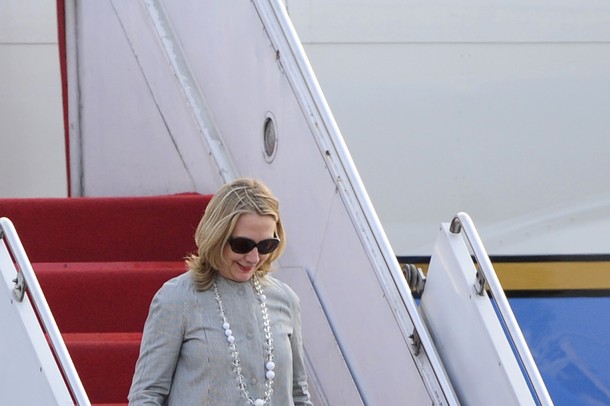
Here she is arriving in Yerevan and being greeted with beautiful flowers by Armenia's Foriegn Minister Edward Nalbandian.


Friday, May 25, 2012
Upcoming: On Hillary Clinton's Agenda
On Wednesday of the past week, before the Senate Foreign Relations Committee, Secretary Clinton emphasized the urgency and importance of U.S. accession to the Law of the Sea Convention. The nature of her first stop in this itinerary underscores remarks she made at the time. Yes, we do meet and negotiate with members on various oceanic councils, such as the Arctic Council, but our heft in these meetings is negatively affected by our absence at the convention table. We would come from a position of additional strength were we to ratify the treaty and take our place among member states.Secretary Clinton To Travel to Denmark, Norway, Sweden, Armenia, Georgia, Azerbaijan and Turkey
Press Statement
Victoria Nuland
Department Spokesperson, Office of the SpokespersonWashington, DCMay 25, 2012
Secretary of State Hillary Rodham Clinton will travel to Denmark, Norway, Sweden, Armenia, Georgia, Azerbaijan and Turkey from May 31-June 7. In Copenhagen, Denmark, Secretary Clinton will hold bilateral meetings with senior Danish officials. She will also participate in the kick-off event for Green Partnerships for Growth, a bilateral initiative to promote green technology through public and private sector partnerships.
On June 1, Secretary Clinton will travel to Oslo, Norway, where she will meet with senior Norwegian officials and give keynote remarks at a global health conference hosted by the Norwegian government titled, “A World in Transition – Charting a New Path in Global Health.” On June 2, the Secretary will be in Tromso, north of the Arctic Circle and home of the Arctic Council Permanent Secretariat, for discussions of U.S.-Norwegian cooperation in the Arctic, including on climate change and the sustainable development of untapped resources.
On June 3, Secretary Clinton will travel to Stockholm, Sweden, for meetings with senior Swedish officials to discuss a range of issues, including green energy, Internet freedom, Afghanistan and the Middle East. In Stockholm she will also participate in a Climate and Clean Air Coalition event on short-lived climate pollutants.
The Secretary will travel to the Caucasus from June 4 to 7. In all these countries, she will discuss important issues of regional security, democracy, economic development and counterterrorism.
In Armenia on June 4, the Secretary will meet with President Sargsian and other senior Armenian officials. She will also meet with Armenian civil society leaders.
On June 5, the Secretary will open the U.S.-Georgia Strategic Partnership Commission plenary session in Batumi, Georgia. She will meet also with President Saakashvili and hold discussions with a broad range of political actors and civil society representatives.
The Secretary will travel on June 6 to Azerbaijan to meet with President Aliyev as well as Azerbaijani civil society leaders.
On June 7, the Secretary will co-chair the Global Counterterrorism Forum Ministerial in Istanbul, Turkey and consult with senior Turkish officials on a range of foreign policy challenges, including Syria and Iran.
In anticipation to her visits to Georgia and Azerbaijan, the secretary released the following greetings to the people of those countries in celebration of their imminent national days.
So as to exclude no one, I include the secretary's greetings to the people of Ethiopia on their upcoming national day as well. We have no information regarding upcoming plans for a visit there, however.Georgia Independence Day
Press Statement
Hillary Rodham Clinton
Secretary of StateWashington, DCMay 25, 2012
On behalf of President Obama and the people of the United States, I am delighted to send best wishes to the people of Georgia as you celebrate your independence this May 26.
In a few days I will have the chance to visit Batumi to experience the warmth of the Georgian people and reaffirm our commitment to Georgia's future. This year marks the twentieth anniversary of U.S.-Georgian bilateral relations. Since regaining its independence, Georgia has made impressive progress fighting corruption, developing modern state institutions, and enhancing global security.
The United States is committed to helping Georgia deepen Euro-Atlantic ties and strengthen the institutions of your democracy, and we remain steadfast in support of Georgia’s territorial integrity. We stood with the Georgian people 20 years ago at the dawn of your renewed independence, and we stand with you today.
As you celebrate this special day, we look forward to working with the Georgian government and people to build a more peaceful and prosperous world.
Republic of Azerbaijan's National Day
Press Statement
Hillary Rodham Clinton
Secretary of StateWashington, DCMay 25, 2012
On behalf of President Obama and the people of the United States, I am delighted to send best wishes to the people of Azerbaijan as you celebrate Republic Day this May 28th.
I am looking forward to my trip to Baku in a few days where I will have the chance to talk to civil society and government leaders about Azerbaijan's challenges and opportunities, and how the United States can support a brighter future for both our people. We will discuss new ways to partner together to promote regional security and stability, enhance energy security, and strengthen economic and political reforms.
As you celebrate your national day, know that the United States stands with you. Congratulations and best wishes for a peaceful and prosperous year to come.
Ethiopia's National Day
Press Statement
Hillary Rodham Clinton
Secretary of StateWashington, DCMay 25, 2012
On behalf of President Obama and the people of the United States, I am delighted to send best wishes to the people of Ethiopia as you celebrate your national day this May 28th.
The United States and the people of Ethiopia share a strong history as friends and partners. Together, we are working to enhance food security, improve health services, strengthen education, promote trade, and expand development. The United States applauds Ethiopia’s dedication to maintaining security in the region, including through important and effective peacekeeping missions in Sudan and South Sudan. I hope the coming year will yield a more vibrant civil society and private sector to help shape a brighter future for Ethiopia.
The United States is committed to helping Ethiopia achieve a more peaceful and prosperous future for all its people, and we look forward to continuing to work together toward common goals in Africa and around the world. As you gather with family and friends to celebrate your national day, know that the United States stands with you.
Thursday, May 19, 2011
Video: Secretary Clinton's Remarks with Armenian FM Nalbandian
No public schedule was posted today, sorry. But we do have this.
Remarks With Armenian Foreign Minister Edward Nalbandian Before Their Meeting
RemarksHillary Rodham Clinton
Secretary of StateTreaty Room
Washington, DC
May 19, 2011
SECRETARY CLINTON: Foreign Minister Nalbandian and I have met many times and it is once again a delight to welcome him to the State Department. The United States and Armenia have many connections and relationships that span politics and go into family and so much else that is very important to us. And we have many, many important issues ahead of us, and I look forward to continuing the important conversation that we’ve been carrying out.
So welcome, Foreign Minister.
FOREIGN MINISTER NALBANDIAN: Thank you. Thank you very much, Madam Secretary, for a very warm welcome. I’m very glad to be in Washington and to meet with you again. The frequency of our meetings proves our commitment to deepen and to strengthen Armenian-American relations. Due to our joint efforts, we elevated our relationship to a qualitatively new level during the last years, and I would like to thank you very much, Madam Secretary, for your contribution, for your efforts, for your engagement. I am sure that this meeting will be another occasion to enhance our friendly partnership between United States and Armenia. Thank you again.
SECRETARY CLINTON: Thank you very much, my friend. Thank you.
FOREIGN MINISTER NALBANDIAN: Thank you.
SECRETARY CLINTON: Thank you.
Monday, July 5, 2010
Secretary Clinton's Joint Press Availability With Armenian Foreign Minister Eduard Nalbandyan
This was yesterday. Released today. I found this video clip. It is short. It is not from this PA.
Joint Press Availability With Armenian Foreign Minister Eduard Nalbandyan
Hillary Rodham Clinton
Secretary of StatePresidential PalaceYerevan, ArmeniaJuly 4, 2010
FOREIGN MINISTER NALBANDYAN: Dear Madam Secretary of State, dear Hillary (continues via translator) dear colleague, I am glad to welcome you on your first visit to Armenia. It is a particular honor that you are in Yerevan on the Fourth of July, the Independence Day of the United States, on which I cordially congratulate you and all the Americans. The founding fathers of your country, adopting the Declaration of Independence 234 years ago, have proven, by establishing the United States, that nothing can deprive people of their right to independence.
We Armenians have proven it as well, by restoring independent statehood only two decades ago. Since the first days of our independence, the Americans have been by our side. The relations between Armenia and the United States have been continuously deepening. High-level contacts between our two countries in recent years are noticeable, due to their frequency and broadness of content. President Sargsian's latest visit to Washington, D.C. and meeting with President Barack Obama became an important milestone, in terms of deepening our mutual understanding and developing relations.
The American-Armenian community (inaudible). It is necessary to exert all efforts in order to obtain exclusively peaceful settlement of the Nagorno-Karabakh conflict based on the principles of international law, particularly non-use of force or threats of force, equal rights of peoples, self-determination of peoples, and territorial integrity. We share the vision that it is necessary to create an atmosphere of tolerance in the region, instead of belligerent behavior. We share the vision that the Armenian-Turkish relations should be normalized without any preconditions. We share the vision of enhancing economic cooperation in the region. We share the vision of a market economy and development of democratic values.
We believe there is great potential, which should be utilized in order to further develop and expand the Armenian-American cooperation. We have agreed on pursuing further strengthening and deepening of our friendly partnership. During the meeting between the President of the Republic and the Secretary of State, the above-mentioned issues, as well as issues concerning further fostering of our cooperation were discussed. International and regional issues of mutual interest were raised. There was discussion of boosting economic cooperation.
Dear Madam Secretary, we too highly commend your personal contribution in qualitatively raising the Armenian-American relations to a new level. We have had several meetings with you in various formats in different platforms. But hosting you here in Yerevan is a particular pleasure for me. I once again welcome you and the members of your delegation accompanying you. Welcome to Armenia.
And I will -- it is my pleasure to pass the floor to you. Please.
SECRETARY CLINTON: Thank you very much, Foreign Minister. It is a real pleasure for me to be here in the Republic of Armenia. And I want to thank you and your president and the people of this country for your hospitality and friendship.
When Armenia became independent again in 1991, the United States was cheering you on, and we have been your friend and partner ever since. Today we celebrate the 234th year of the founding of our country and the declaration of our independence. And we know how sacred and precious the gift of independence is.
Armenia is a nation with both a proud history and a promising future. We are grateful in the United States for the many contributions of Armenian Americans to the cultural and economic life of our country. And we believe that a democratic and prosperous Armenia can be a force for progress in the region and beyond. So, the United States is strongly committed to supporting the Armenian people and your aspirations.
Today I discussed with your president how we can work together. We focused on the building blocks of Armenia's long-term development and security, the importance of advancing democracy at home, and peace and reconciliation with your neighbors. We discussed, in depth, the conflict in Nagorno-Karabakh, and the Minsk Group process that is working to resolve it. As I said earlier today in Baku, the United States remains committed to a peaceful resolution based on the Helsinki Principles of non-use of force or threat of force, territorial integrity, and the equal rights and self-determination of people.
President Obama reaffirmed this commitment in a joint statement with President Medvedev and President Sarkozy at the recent G8 summit in Canada. We stand ready to help both Armenia and Azerbaijan achieve and implement a peace settlement. We know this will not be easy. But we think it is the necessary foundation for a secure and prosperous future.
We also discussed the pursuit of normalization between Armenia and Turkey. I expressed my admiration for the president's courageous decision to pursue a vision of peace. The United States believes that normalization promises tremendous benefits for both Armenia and Turkey, as well as the wider region. And we are committed to doing everything we can to help the parties move forward.
We also discussed our commitment to strengthening democracy and the rule of law in Armenia. The United States has worked closely with successive Armenian governments for many years to support the country's democratic development. We have done so openly and honestly, because we see democratization and respect for human rights as vital to Armenia's long-term security, stability, and prosperity. And, as a friend and a partner who believes in Armenia's future, we will continue to support Armenia's civil society and efforts to promote good governance and transparency.
When we look at Armenia, we see a tremendous set of assets residing in the quality, the hard work of the people. And we know that the future of this country, as is the future of every country, is in the hands of the people themselves. And we believe that we can work together to improve the economy, to create greater opportunities, to look to see whether it's possible to develop independent energy resources, such as shale gas, how we can continue to work with the government and people of Armenia on behalf of that common vision of the kind of tomorrow in which every boy and girl has a chance to live up to his or her God-given potential.
So, again, let me thank you. Foreign Minister and I have spent many hours together. And I greatly appreciate his interactions and his expertise and experience. And I wish to thank the president for not only a warm welcome and a candid conversation, but an excellent meal that concluded with a large red, white, and blue July 4th cake. It could not have been a warmer experience. And I look forward to continuing to work closely with you in the future.
QUESTION: (Inaudible), AFP. Madam Secretary, you have spent a lot of energy today discussing Nagorno-Karabakh. Having talked to both presidents, are you any more hopeful?
And, Foreign Minister, in Baku the Secretary of State has said that there has been some progress on this issue. Your president met recently President Aliyev in St. Petersburg. So can you be specific about this progress? Thank you.
SECRETARY CLINTON: Well, it is promising that the Minsk Group process is engaged very intensively. And in addition to the statement put out by the three presidents of Russia, the United States, and France last week, who serve as the Minsk Group co-chairs, there is a recognition on the part of both Armenia and Azerbaijan that any settlement must be based on the Helsinki Principles. There have been many very serious consultations between both the President of Armenia and the President of Azerbaijan, most recently two weeks ago in St. Petersburg with President Medvedev. And now, we would hope to see real progress made on the -- completing the basic principles to enable the drafting of a final peace settlement.
Everyone knows these are difficult steps to take. But we believe that they are important ones. And we have expressed our concern to both presidents today that the return to violence is unacceptable. We regret the incidents of the last several weeks. And it is in the interest, first and foremost, of the people of Nagorno-Karabakh, but certainly of Azerbaijan, Armenia, and the greater region, to work as hard as we can together to come up with an acceptable lasting settlement of this conflict.

You know that several days ago the co-chairs were visiting with us. We discussed with them the continuation of the peace talks based on this very understanding. We have also discussed the potential of a meeting, the possibility of a ministerial meeting on the 16th of July on the sidelines of the unofficial meeting of OSCE foreign affairs ministers. A key milestone in this process -- one may even say support to this process -- has come from the latest statement by the presidents of the three co-chair countries, which is Obama, Medvedev, and Sarkozy, during the G8 summit. In line with one of these understandings, we ought to carry on our joint efforts with the co-chairs in the near future.FOREIGN MINISTER NALBANDYAN: (Via translator) After the St. Petersburg meeting, I stated that yet another important milestone has been reached in the peace talks. The sides have agreed to continue the talks, based on achievements to date. In other words, as of the date of the St. Petersburg summit, the new version of the Madrid proposal was shared with the sides.
QUESTION: (Via translator) (Inaudible) Media Television. My question is for Madam Clinton.
Azerbaijan, with its arbitrary interpretation, is rejecting two of the three important principles of Madrid. The right to self-determination and the principle of non-use of force or threats of force have been denied by Azerbaijan. One should also be much concerned about the arms race initiated by Azerbaijan, the (inaudible) statements, and destabilizing measures, which are clearly aimed at jeopardizing the peace talks.
During your visit to Baku, did you bring up these issues? Thank you, Madam Secretary.
SECRETARY CLINTON: The United States strongly condemns the use of force or the threat to use force. And we regret the loss of life that results as the use of force is used. These are unacceptable violations of the 1994 cease fire agreement. And it is also contrary to the stated commitments of both sides.
So, we have called upon everyone to refrain from the use of force or the threat of force because we, number one, do not want to see loss of life or injury; we do not want to see further dislocation of individuals or families; and we do not want to see the peace process harmed. So, my message is the same to everyone: the United States condemns the use or threat of use of force.
QUESTION: Yes, Lucian Kim from Bloomberg News. Madam Secretary, even as the reset continues to relax relations between Russia and the U.S., Russia isn't giving up on its concept of having a sphere of privileged interests, including in the Caucasus region.
You often talk about focusing on areas of mutual concern. But how will you tackle thorny issues like Russia's presence in its so-called (inaudible), and in particular in Georgia, where two years ago we saw how a frozen conflict turned into a war? Inevitably, there are many people in Moscow who don't look very approvingly on this trip in the Caucasus region.
SECRETARY CLINTON: Well, we have made very clear for the last 18 months that we want to improve our relations with Russia, and I think there is evidence that we have done so with the new START treaty, with the new sanctions against Iran's nuclear weapons program, with increasing cooperation in the Minsk process, or in Afghanistan. I think there is a lot of evidence that the United States and Russia are actually looking for ways to find common ground.
But that doesn't mean we're going to agree on everything. No two nations agree on everything. We do not agree on what happened in Georgia, or the current continuing occupation by Russian forces of South Ossetia and Abkhazia. And we have said so, and I have said it everywhere, not just in the Caucasus.
But we think it's possible to pursue a comprehensive common agenda, as we are doing with Russia, without the disagreements freezing our relationship. We think it's not only in the interest of the United States and Russia, we think it's in the interest of the world that Russia and the United States continue to try to build confidence and trust between one another.
Obviously, we saw when we were in Ukraine that the new government in Ukraine is trying to balance, trying to have improved relations with Russia while seeking integration into Europe and deepening the Euro-Atlantic alliance with the United States. That is Ukraine's right to choose. They are a sovereign nation.
I will be in Georgia tomorrow. And Georgia continues to stand up for itself and to make decisions that are in their own interests, as they define it, and we applaud that.
So, it is not at all unusual that we would have common ground, as we do in the Minsk process, where we are co-chairs, trying to resolve Nagorno-Karabakh, and not agree with respect to other concerns like what has happened in Georgia. I think that's a sign of a very mature, candid relationship. And I think the -- not only this part of the world, but across the world, people ought to be relieved that the United States and Russia have developed that kind of ability to engage and go on, despite continuing disagreements.
QUESTION: (Via translator) (Inaudible) Agency. My question is for Madam Secretary of State. Madam Secretary of State, although in one of the recent interviews the President of Armenia said that Turkey's policy of zero problems with neighbors is yielding zero results, we have recently witnessed Turkey's swift resolution of Iran's nuclear problem. Then, they managed to duplicate Palestine. They have stabilized Iraq, after all.
In this context, how do you view the fact that Turkey is not living up to its commitment of normalizing relations with Armenia, which Turkey undertook in your presence? Thank you.
SECRETARY CLINTON: Well, the United States commends the Governments of Armenia and Turkey on their signing of the historic protocols on normalization of relations last October in Zurich. I was honored to be there, along with your foreign minister. And it was a visionary and courageous agreement by the leaders of both countries to try to move forward toward full normalization of relations.
We believe -- the United States believes -- that this kind of rapprochement between Armenia and Turkey will foster increased stability and greater prosperity through more open borders, increasing trade and investment, and will, in the long run, be a great advantage to Armenia.
However, as you know, that has not yet been realized. And there have been problems and obstacles along the way. I was very pleased when President Sargsian announced that, despite the problems that Armenia saw coming from Turkey, that Armenia stood ready to continue normalization, but that it would suspend its efforts until the Turkish side was ready to move forward again. We applauded your president's decision, because that was a decision to continue, despite the obstacles, to work toward peace, stability, and reconciliation.
And we urge Turkey to take the steps that it promised to take, and that both sides continue to try to find the opportunity to open the door to reconciliation and normalization. But Armenia's decision last April was very statesmanlike and very impressive. And now, as they say in sports, the ball is in the other court.
FOREIGN MINISTER NALBANDYAN: I take this opportunity, having heard your question, to thank the United States and the Secretary of State herself for her personal contribution, for the enormous support rendered throughout the process of Armenian-Turkish normalization. We concur with the United States that the relationship has to be normalized without preconditions. The agreements have to be honored. We will be ready to move forward when Ankara also once again demonstrates readiness to move forward towards normalization without preconditions. Thank you.
SECRETARY CLINTON: Thank you, Eduard.


Secretary Clinton's Remarks at a Reception with Armenian Civil Society Leaders
This is from earlier today, before she left for Georgia. What a beautiful venue!
**UPDATE** Thanks to Pcfs we have this video which she posted in an earlier thread of comments. H/t Pcfs!
Remarks at a Reception with Armenian Civil Society Leaders
Hillary Rodham Clinton
Secretary of StateCafesjian CenterYerevan, ArmeniaJuly 5, 2010
AMBASSADOR YOVANOVITCH: Hello, everybody, Secretary Clinton, distinguished guests, bari luis, good morning and welcome. I know I speak for all of us when I say we are all excited to have you here, Madam Secretary, especially in Armenia for America's Independence Day and Armenia's Constitution Day today. The observance of these holidays, especially here in Khanjyan Hall, which celebrates Armenia's long but ultimately successful struggle for independence, reminds us that democracy in action requires a vibrant civil society to promote the rights and freedoms of its citizens.
Secretary of State Clinton, throughout her distinguished career, has been a passionate human rights advocate and promoter of democratic values. From her work with women and children in Arkansas, to her pledge as Secretary of State to advance a comprehensive human rights agenda, she embodies America's long tradition of making human rights a human reality. And today you have an opportunity to share with her how you all pursue these goals right here in Armenia.
So now, please join me in welcoming Secretary of State Hillary Rodham Clinton.
(Applause.)
SECRETARY CLINTON: Thank you very much, Ambassador. And thank you to each and every one of you for joining me this morning at this absolutely stunning arts center, here in Khanjyan Hall. I wanted to meet during my visit to Yerevan with civil society activists and journalists and human rights advocates and members of organizations promoting education, health, and opportunities for all Armenians.
This weekend, Americans around the world celebrated our 234th anniversary of independence. I chose to spend this holiday visiting countries whose independence has come recently, and often only after long struggles. As with my own country's democracy, I know how hard and frustrating the struggle to realize the ideals of freedom, justice, and equality can be. So I am here to encourage you to keep up your hard work. Democracy requires not just elections, but open dialogue, a free exchange of ideas, government transparency and accountability, and above all, an empowered citizenry, who constantly work together to make their country fairer, juster, healthier, and freer.
Two days ago, at the Community of Democracies meeting in Poland, I spoke about the importance of civil society in promoting good governance and transparency through peaceful means. The United States believes that when members of civil society are respected and allowed to work free of intimidation, democracies flourish and societies prosper.
In my meetings with President Sargsian and other high officials yesterday, I reiterated my support for Armenian democracy, and raised concerns about media freedom. I know many of you are concerned about the government's recent changes to the law on TV and radio. And these are concerns that the United States, the OSCE, and the European Union share. I raised this issue and was told that the government is open to amending the law this fall. And we will look forward to working with the Armenian Government on this specific issue and, more generally, to strengthen protections for journalists so that the Armenian people can receive the information they and you need to contribute to building a stronger future.
And I thank many of you for your work in reaching out beyond your borders. I know that NGOs and journalists have been working for years to strengthen bonds between people of the different countries here in the Caucasus, including Georgia and Azerbaijan, as well as reaching out to Turkey. Whatever specific work you are doing, whether it be for fair, free elections, or better access to health care, or greater flow of information, or trying to heal the wounds of history, I thank you and urge you to continue. The challenges that you are facing are not greater than the challenges that Armenia has already overcome. And please know that the United States and the Obama Administration and the American people are standing with you as you help lead your country into that future of promise and potential that every Armenian deserves.
Thank you very much. And now I look forward to meeting some of you, and having a chance to exchange our views.
(Applause.)

Secretary Clinton's Remarks at Meeting With Staff and Families of Embassy Yerevan
I do not have pictures of this or any idea who the speaker is, but I agree 100%. The picture is from a different event.
Remarks at Meeting With Staff and Families of Embassy Yerevan
Hillary Rodham Clinton
Secretary of StateU.S. Embassy Yerevan
Yerevan, Armenia
July 5, 2010SPEAKER: I know I speak for everybody here, and I know you all agree with me, when I say that whether it's here, in the absolute best embassy in the world, or whether it's in Washington, or whether it's elsewhere, what a difference one woman can make. And that woman is right here, the woman who needs no introduction, Secretary of State Hillary Rodham Clinton.
(Applause.)
SECRETARY CLINTON: Thank you so much. Wow, I am delighted to see all of you, and especially in this new complex here. We haven't had a visit by a Secretary of State for 18 years. Every Armenian I have met has reminded me of that. So I am delighted that I could be here on your watch, along with Masha and all of you who are working so hard on behalf of our very important relationship between the United States and the Republic of Armenia.
I was delighted to join in celebrating your work last year with the Diplomacy for Freedom Award, and I just came from meeting a number of human rights activists and journalists and other advocates who are trying to promote human rights and democracy right here in Armenia. And it's especially appropriate, since yesterday was our Fourth of July, and today is Armenian Constitution Day. So it's a good reminder of all of the connections between the American and Armenian people.
Now, I have seen many, many embassies over the years, probably more than I can remember or count. But this is such a beautiful setting. There is no doubt that Embassy Yerevan lucked out in the planning and sitting process. But I think it's only appropriate, because I expect that the work that is done in these buildings will really help to broaden and deepen the relationship between our two countries.
I know that we have here both Armenians and Americans, and I want to thank each and every one of you, and I want to thank your families. The ambassador told me that the children take advantage of the recreational facilities just down the hill there, and I am grateful to know that each and every one of you and your families are serving the purpose of our efforts to improve and strengthen our relationship.
I want to thank foreign service and civil service. I want to thank State and USAID, and every government agency. I particularly want to thank our locally-engaged staff, who are truly the backbone of the embassy. As the ambassador knows, and as I certainly know, Secretaries of State and ambassadors come and go, but the locally-engaged staff seem to stay, year after year, providing continuity, giving us a real sense of the direction that we should be heading.
I am proud of what we have accomplished together. We have had very intensive diplomatic efforts, moving toward the goals of normalization between Armenia and Turkey. We are at a suspended period now, that -- I still hope it's a door that both countries can walk through for their mutual benefits. The Peace Corps volunteers, who are establishing a summer camp to promote girls' self esteem and leadership, the work that is being done to alleviate poverty, the Defense team that is working on our shared mission in Afghanistan, and this, and so many ways I am not only aware of, but appreciative of your efforts.
But we still have a lot to do. And as I told the government leadership last night, and as I told the activists today, the government of Armenia has to do more to implement democratic and economic reform. The people of Armenia are entrepreneurial, hard-working, intelligent, creative, the whole package. And they deserve a chance to fully compete in the economic future, not just of the southern Caucuses, but of the entire European community.
So, I want to do everything I can to support the Armenian people to realize the vision of democracy and free markets that have been at the root of America's success. Probably every Armenian has relatives in the United States. And I think you know how successful many of your relatives are. There is no reason why Armenians at home can't be equally successful. But you have to create the conditions for good investment and business climate. You cannot attract business if they think that their efforts are going to go into corruption, or that their contracts will not be protected. So, take heart from what Armenians across the world and the Diaspora have done, from Australia to Los Angeles, and begin to try to think of ways we can create those same conditions right here, in the Republic of Armenia.
So, thank you so much for your hard work on behalf of U.S.-Armenian relations, and on behalf of peace and prosperity in this region. I know that you work hard every day. And I know that when somebody like me shows up, that adds to the workload. So I hope that you will get a little time just to rest and relax when my plane takes off and I become Georgia's responsibility for several hours.
But I am very pleased that we could have this trip during such an important time in our efforts, and do everything we can to make that an even stronger bond in the years to come. Thank you all very much.

Sunday, July 4, 2010
Secretary Clinton's Remarks at the Top of her Meeting with President Sargsian
Remarks at the Top of her Meeting with President Sargsian
Hillary Rodham Clinton
Secretary of StatePresidential PalaceYerevan, ArmeniaJuly 4, 2010PRESIDENT SARGSIAN: (Via translator) I am confident that this long-waited-for visit by State Secretary of the United States of America to the Republic of Armenia (inaudible). And I am also confident it will also serve (inaudible) peace and security (inaudible).
I would also like to (inaudible) congratulate the people of the United States of America on the (inaudible) occasion of the Independence Day of the United States of America, and to wish peace, prosperity, and well being for the United States.
I wish to thank the Administration of the United States of America, and you personally, for the long-standing and continuous support (inaudible) politically, economically, and in all (inaudible).
And I would like to emphasize two particular aspects. For a long period of time, the United States of America has been bringing a significant contribution to the search for peace in the Nagorno-Karabakh conflict. The single most important issue that is faced by the people of the Republic of Armenia and by the Armenians is the issue of the settlement of the Nagorno-Karabakh conflict on the basis of principles of (inaudible). The people of Nagorno-Karabakh have a right for free development and (inaudible). And the right for people for self-determination is one of the most fundamental principles of international law which has been at the basis of independence for many -- most countries in the world.
And I thank you for your support on the matter of the Nagorno-Karabakh conflict. I would also like to thank you and President Obama for your continued support on the issue of Armenian (inaudible) relations between Armenia and Turkey. And while Turkey was not ready -- is still not ready -- to establish relations without (inaudible) conditions, it has been very important for us to feel the support of the U.S. Administration.
I would like to once again re-emphasize that the Republic of Armenia (inaudible) relations with the United States of America, in which such high-level relations is an important contribution to the political and economic advancement of our country, as well as to the stability and peace in our region.
Once again, welcome and (inaudible).
SECRETARY CLINTON: Mr. President, it is a particular pleasure and honor for me to be here in the Republic of Armenia. It would be so on any day, but it's especially appropriate to be here on the celebration of our Independence Day. And I understand tomorrow is your Constitution Day. So it's another connection between the United States and Armenia.
I appreciate the very kind words about the efforts of the United States Government and the Obama Administration to work with you and bring about a peaceful, durable solution to the situation in Nagorno-Karabakh, based on the Helsinki Principles.
And I also appreciate the effort that you personally, along with your government, have expended on behalf of normalization of relations with Turkey. As you and I have discussed on previous occasions, the United States hopes to be able to support the eventual successful resolution of that, as well. We continue to believe that resolving these matters is in the best interests of the development and opportunities for greater regional peace and stability for the people of Armenia.
So, I look forward to our meeting today, and I thank you for the very kind invitation for me and my delegation to be here with you on our Fourth of July.

Hillary Clinton is Wheels Down in Yerevan
In case you missed this in my last post, the Secretary of State has already arrived in Armenia. Below she is seen being greeted by President Sargsyan.

Read more>>>U.S. Secretary of State Hillary Clinton arrives in Yerevan
By Times.am at 4 July, 2010, 7:32 pm
On July 4, U.S. Secretary of State Hillary Clinton arrived in Yerevan. At the airport she was met by Armenian Foreign Minister Edward Nalbandian, RA Deputy Foreign Minister Arman Kirakosyan, U.S. Ambassador to Armenia Marie Yovanovitch, Armenian Ambassador to the U.S. Tatul Margaryan.
Secretary Clinton's Interview With CBS Sunday Morning's Tracy Smith
Darn! Not only did I miss this, I cannot find the video. If I do, I will post it here. She is already in Armenia (below with President Sargsyan) . *running in high heels to catch up with the Turbo-SOS*

Interview With CBS Sunday Morning's Tracy Smith
Hillary Rodham Clinton
Secretary of StateWashington, DCJune 15, 2010
SECRETARY CLINTON: For an American performer or group to come gives people a chance to – in their own imagination, at least, think about what might be.
MS. SMITH: Secretary of State Hillary Clinton.
Are there times when a musician can do your job better than you can?
SECRETARY CLINTON: Well, I think that there are certainly times when music conveys American values better than a speech.
MS. SMITH: It’s not a new idea. Beginning in the 1950s, the State Department sent musicians like Duke Ellington, Dizzy Gillespie, Louis Armstrong, and others to diplomatic hotspots overseas.
SECRETARY CLINTON: The interesting thing is at that time a lot of those guys didn’t agree with the policies of our government, but they still represented our government overseas.
PARTICIPANT: Right, because they weren’t representing the government; they were representing the people and they recognized that many times a government does not necessarily act with the will of its people.
MS. SMITH: Why would the State Department pay to send a hip-hop band overseas?
SECRETARY CLINTON: Hip-hop is America. I mean – and so is jazz, and so is every other form of music with American roots that tell a story.
[CUT AWAY TO ANOTHER AUDIO ARTIST]
SECRETARY CLINTON: I know it sounds like it’s very basic, but sometimes you’ve got to get back to basics and we have to rebuild the image of our country – who we are as a people. We are the most incredibly diverse, successful, freedom-loving people in the history of the world, and I want everybody to understand that.
MS. SMITH: You say it sounds a little basic. To some people it sounds a little kumbaya – like, oh, come on, let’s go to Syria and throw on a free concert and join hands in peace.
SECRETARY CLINTON: It may be a little bit hopeful, because I can’t point to a change in Syrian policy because Chen Lo and the Liberation Family showed up. But I think that we have to use every tool at our disposal. So we move a lot of different pieces on the chessboard every day. It’s multi-dimensional chess, if you will. Hip-hop can be a chess piece, absolutely.
Tuesday, June 29, 2010
Special Briefing on Secretary Clinton's Upcoming Travel
Hmmmm. Yes, Thursday! P.J. Gave me a start there with his "tomorrow!"
Special Briefing on the Secretary's Upcoming Travel
Philip H. Gordon
Assistant Secretary, Bureau of European and Eurasian AffairsMichael H. Posner
Assistant Secretary, Bureau of Democracy, Human Rights, and LaborWashington, DCJune 29, 2010
MR. CROWLEY: Exciting conclusion to the latest entry of the World Cup. Good afternoon and welcome to the Department of State. Secretary Clinton departs tomorrow for an important trip to Central Europe and --
QUESTION: Thursday?
MR. CROWLEY: Huh?
QUESTION: Thursday?
MR. CROWLEY: Thursday. Right? Yes. Let me start again. The Secretary departs on Thursday for an important trip to the – to Central Europe and the Caucasus. And here to go through both the schedule and our stops along the way is Assistant Secretary for European Affairs Phil Gordon. And at the heart of the trip is an important speech the Secretary will give on Saturday at the 10th anniversary of the Community of Democracies, and Assistant Secretary Mike Posner will kind of go through what the heart of her address will be. And they will be here to answer questions afterwards.
Phil.
ASSISTANT SECRETARY GORDON: Thanks, P.J. Good afternoon, everybody. Let me just maybe walk you through the schedule and then I’m sure you’ll have questions. The Secretary will be traveling to Kyiv, Krakow, Baku, Yerevan, and Tbilisi, in that order, from July 1st to 5th. Starting on Thursday, this will be the Secretary’s fourth visit to Ukraine, although the first in her capacity as Secretary of State. She visited in 1995, in 1997 as First Lady, and in 2005 as senator.
Her focus in Ukraine is on the strategic partnership between the United States and Ukraine. She’ll be following up on President Obama’s meeting with President Yanukovych at the Nuclear Security Summit, where Ukraine took the historic decision to get rid of all of its highly enriched uranium. That was a very significant step in our efforts to prevent nuclear terrorism worldwide. And that decision is being implemented as we speak, and the Secretary will have a chance to follow up on how that is proceeding.
The Secretary will meet with President Yanukovych and Foreign Minister Hryshchenko and she will also participate in the second meeting of the U.S.-Ukraine Strategic Partnership Commission, which was created during Vice President Biden’s visit to Kyiv exactly a year ago.
We have a broad relationship with Ukraine and expect that they will discuss economic and energy issues, defense cooperation, the development of democracy, among other topics.
The Secretary will also in Kyiv meet with former Prime Minister Tymoshenko and she will meet with media leaders, civil society groups, and give remarks at a town hall meeting at Kyiv Polytechnic University.
The symbolism of Ukraine’s democratic progress still matters for the region and beyond, and the Secretary will be highlighting our hopes for the protection and advancement of democracy in Ukraine.
In Krakow on the 3rd, the Secretary will participate in the celebration of the 10th anniversary of the founding of the Community of Democracies. Assistant Secretary Posner will be able to talk about that event in more detail. I would just underscore that she and Polish Minister Sikorski are pleased to be marking this anniversary together. It was their predecessors, Secretary Madeleine Albright and Foreign Minister Geremek, who kicked off the Community of Democracies 10 years ago.
Secretary Clinton will also meet bilaterally with Foreign Minister Sikorski. I expect that they will discuss Afghanistan, Iran, European security, economic and energy issues, and our common interest in promoting good governance and human rights, especially in terms of the European Union’s Eastern Partnership.
Also in Poland, the Secretary will visit the Schindler Museum, the factory where during World War II German businessman Oskar Schindler saved hundreds of Jewish workers from the Holocaust.
After Krakow, the Secretary will be visiting three South Caucasus countries, where she will have the opportunity to emphasize the importance of our bilateral relations with Azerbaijan, Armenia, and Georgia, and to promote efforts to resolve regional conflicts and strengthen regional peace and stability.
She’ll arrive in Baku on July 4th to meet with President Aliyev and Foreign Minister Mammadyarov. She will also have a chance to talk with young people about media freedom and other political participation issues.
She then proceeds to Yerevan later on July 4th, where she’ll meet with President Sargsian and Foreign Minister Nalbandian. She’ll discuss human rights, democratization, and media freedom with civil society representatives in Yerevan.
On July 5th, the Secretary continues to Tbilisi, where she will meet President Saakashvili, Foreign Minister Vashadze, and members of the political opposition, as well as representatives of civil society and women’s leaders. She will review the progress of the U.S.-Georgia strategic partnership as well as the results of the recent municipal elections.
That’s the basics of the schedule. Let me turn it over to Assistant Secretary Posner and then I’ll be happy to come back for any questions.
QUESTION: (Off-mike.)
ASSISTANT SECRETARY GORDON: I’m sorry?
QUESTION: (Off-mike.)
ASSISTANT SECRETARY GORDON: Mike.
ASSISTANT SECRETARY POSNER: Thanks a lot, Phil. Just a few words about the meeting of the Community of Democracies. As Assistant Secretary Gordon said, this is the 10th anniversary in Krakow. It’s a meeting of approximately 75 governments, representatives of civil society, and really very much in keeping with the President and Secretary Clinton’s commitment to democracy promotion and principled engagement. The Secretary’s speech will focus on human rights and, in particular, on the role of civil society. Very much again in keeping with the recent National Security Strategy which focused on values as one of four principal focal points for this Administration, her speech will explore both the ways in which civil society is key to a broad notion of democracy, but also focus on a range of challenges that human rights and other advocacy groups face around the world in doing their work.
So this will be an opportunity for us both to articulate in a public context but also in a setting where governments committed to democracy and civil society gather to try to strategize and figure out ways to advance promotion of democracy globally. Let me stop there.
QUESTION: Two questions. One, do you believe that the arrest of the ten alleged Russian spies in the United States will harm, impede, disrupt, undermine, in any way effect the U.S.-Russian relationship and the reset?
And then secondly, on the trip, can you address the extent to which you believe the Ukrainian – the new Ukrainian Government is interested in continued and extended cooperation with the United States? Obviously, there’s been a tilt in another direction, and I wonder to what extent you believe they still have significant interest in better bilateral ties.
ASSISTANT SECRETARY GORDON: Thanks, Arshad. On the first, when President Obama announced the new approach to Russia 18 months ago, he made clear that we had common interests with Russia that we wanted to pursue in nuclear nonproliferation, Afghanistan, disarmament, economics, and we were determined to pursue those where we had concrete common interests, and we would; and there would be other issues that we disagreed on, but we were not going to forego the opportunity to pursue our common interests because there were things we disagreed on. And I think you should see this spying issue in that context.
We feel we have made significant progress in the 18 months that we have been pursuing this different relationship with Russia. We think we have something to show for it, and that was clear at the meeting of the two presidents last week. And all along, we have made clear that there are still things we disagree on. President Obama never fails to bring those things up when he sees his Russian counterpart. We will continue to do that in the future, but I think you can expect that we will also continue to work diplomatically and successfully with Russia in these areas where we have already demonstrated we both gain from doing so.
QUESTION: Do you have any reason to think that they might – although I realize that these are not Russian diplomats who have been declared persona non grata, but have you had any signals or anything to suggest that the Russians may be looking to make reciprocal arrests or take action against alleged U.S. spies in Russia?
ASSISTANT SECRETARY GORDON: Nothing I’m aware of. We’ll have to see how this plays out.
QUESTION: Just as a follow-on to that, Phil, can you address whether you’ve had any contact or this Department has had any contact with Russian diplomats here in Washington?
ASSISTANT SECRETARY GORDON: We are in touch with the Russian Government, of course. I mean, both here and in Moscow, we’re talking about the issue.
QUESTION: Have you called in the ambassador? What kind of contacts have – has there been in Washington?
ASSISTANT SECRETARY GORDON: I won’t get into details of precisely who’s talking to whom, but suffice it to say that we’re engaged with the Russian Government on the issue.
QUESTION: Can I –
ASSISTANT SECRETARY GORDON: I have Arshad’s question about Ukraine.
QUESTION: Sure.
QUESTION: We can get to that later, if you want. (Laughter.)
ASSISTANT SECRETARY POSNER: That was just to sort of give the – go ahead Elise, yeah.
QUESTION: I just want to go to the Russian Foreign Ministry statement that said that – kind of questioning why the Department of Justice made this public and that such incidents, the statement said, have occurred when relations were on the rise. And given that the reset is taking place, the ministry kind of thought that it was inappropriate for you to make such a public showing of this. I mean, do you think that kind of the way that it was done maybe will upset the relations, not necessarily the arrests per se?
ASSISTANT SECRETARY GORDON: No, as I say, we have from the start focused on the reason for the reset and the relations and the common interests, and I think we will continue to do so. I think the timing underscores that the Department of Justice is in a different channel and they are moving on the appropriate timetable and we are moving on the diplomatic issues.
QUESTION: But, Phil, is it really a reset if kind of some of the activities that we’ve long criticized Russia for doing, such as spying, are still taking place? I mean, maybe there are some areas where you’re continuing to cooperate, but it seems as if kind of the suspicions that have long been held between the U.S. and Russia still exist.
ASSISTANT SECRETARY GORDON: Look, we would like to get to the point where there is just so much trust and cooperation between the United States and Russia that nobody would think of turning to intelligence means to find out things that they couldn’t find out in other channels. We’re apparently not there yet. I don’t think anyone in this room is shocked to have discovered that. And so yes, we are moving towards a more trusting relationship. We’re beyond the Cold War. I think our relations absolutely demonstrate that. But as I say, I don’t think anyone was hugely shocked to know that some vestiges of old attempts to use intelligence are still there.
I’ll answer Arshad’s Ukraine question and then I wouldn’t be surprised myself if people want to come back to other issues.
You asked about the issue of balance in Ukraine’s foreign policy. We are very clear Ukraine is a sovereign, independent country. When the new president was elected, he made clear that Ukraine didn’t see its future as one choosing between East and West. Indeed, he very symbolically made his first visit to Brussels and he declared that his foreign policy was one of pursuing good relations with Russia – and Ukraine has every right to want to have good relations with Russia – but also pursuing good relationships with Europe and the United States. And that’s what we would like to see happen.
It’s related to the first point about the relationship with Russia. We want to get beyond the notion that European diplomacy and security is a zero-sum game and that countries in Central Europe need to choose whether they’re going to be pro-Russian or pro-American. Indeed, one of the things we’ve said about the relationship with Russia is that when we have a better and the United States has a better relationship with Russia, that is actually a benefit to countries in Central Europe because they don’t feel obliged to choose or orient one way or another. And it certainly applies to Ukraine. So we – the Secretary will have a chance to discuss Ukrainian foreign policy with Ukraine’s leaders, and she’ll make clear what we’ve made clear from the start: that we don’t see these two things as in competition with each other and we hope and expect Ukraine will pursue good relations with Europe and the United States even as it pursues good relations with Russia.
Yes.
QUESTION: Mr. Gordon, I got a couple of questions on South Caucasus. Let me start with Karabakh, obviously a very big issue during the trip to South Caucasus. I wonder if the joint statement by the presidents of Minsk Group Co-chair countries sort of predetermine Secretary Clinton’s conversation on Karabakh in Baku and Yerevan. Will she be talking along the elements that were outlined in that statement?
ASSISTANT SECRETARY GORDON: Well, yes. Certainly in the sense – the presidents noted the progress that has been made up till now and the principles that should guide the discussions among the parties. And the United States is firmly committed to those principles and determined to work with the parties to encourage them down the same path. I think the G-8 leaders made the statement, as they had in L’Aquila the previous year, demonstrating their commitment at the highest levels to the Minsk Group process and our desire to see progress on this issue.
It – I think we’ve seen in some of the violence that has appeared in the region lately that we can’t take stability for granted, and Armenia and Azerbaijan would both benefit from moving forward in the Minsk Group process. And the Secretary will have a chance in both countries to underscore what the presidents said in Toronto the other day.
QUESTION: I want to follow up on that. In terms of the violence that you mentioned, there’s been a spike in violence and also you had Azerbaijan add another half a billion to its military budget. There was some of the rhetoric again just a couple of days ago. How concerned are you about those developments, and are you following up with Azerbaijani Government? Is that going to be a subject of conversations in Baku?
ASSISTANT SECRETARY GORDON: Well, we’re concerned any time violence is – takes place anywhere. And certainly, as I just noted, nobody can take stability for granted when you have an armed standoff and disagreements like we have here, which underscores again why we are so committed to the Minsk Group process and the need for diplomacy. And that is the purpose of the Secretary’s -- one of the purposes of the Secretary’s trip to talk to both parties about how to move that process forward.
QUESTION: Sure. But in terms of your analysis, is the situation getting worse than it used to be or is it the same or is there any change to the status quo there?
ASSISTANT SECRETARY GORDON: Well, the situation has been stuck for a lot longer than we would want it to be, and any time there’s an uptick in violence to any degree, it’s something that we’re very concerned about.
QUESTION: There was a proposal of the Armenian President Serzh Sargsian to Azerbaijani side to sign an agreement of not using force. Because we negotiate self-determination and territorial integrity, but still, there is not a point of not using force which co-chairman support, and the Armenian president made an offer. What’s the position of the United States Government regarding this, and is Secretary Clinton supposed to discuss this topic?
ASSISTANT SECRETARY GORDON: Well, I think both sides have made clear their commitment to the Helsinki Principles, the first of which is non-use of force or threat of force. We’ll look to them to reiterate their commitment to all of the Helsinki Principles as part of this process.
QUESTION: Mr. Gordon, the statement – the joint statement also calls – actually mentions the withdrawal of Armenian forces from the regions around Nagorno-Karabakh. Is it something – is it the message that Secretary Clinton will take to Yerevan when she talks to President Sargsian?
ASSISTANT SECRETARY GORDON: I think all of the principles that the presidents noted in their statement in Toronto – all of them together are very important to us and we would like to see movement on all of them and commitment to all of them.
Mary Beth.
QUESTION: Hi, Phil. Can you talk a little more broadly about what the Secretary hopes to get out of this trip beyond the forceful statement on democracy and the different bilateral issues? I mean, is it – would it be fair to say that there’s kind of a regional thing here? This is a region maybe that’s felt a little bit neglected or that worries with the reset. I mean, are there sort of broader themes?
ASSISTANT SECRETARY GORDON: I mean, yes. Any trip like this in multiple countries you have multiple goals, and Mike can talk some more about the particular focus on democracy and human rights, but there are some common themes. I mean, first of all, this is a chance to engage bilaterally with some country she hasn’t yet visited as Secretary of State. In Ukraine, you have a new president who she had the chance to meet when he was here for the Nuclear Security Summit, but she’ll be able to go and meet him in his country and spend the full day in Ukraine. She hasn’t as Secretary of State been to Georgia, Armenia, and Azerbaijan. These are countries with which we have important bilateral relationships. She has engaged and met with the leaders of all of them, but there’s something different about going to the country, hearing from them about their perspectives on this full range of regional and bilateral issues.
I think a common theme that stretches across all of them is this theme of democracy. In that sense, the trip being built around the Community of Democracies is a nice package. I mentioned some of these countries have had recent elections: Georgia just went through municipal elections. We noted that the election in Ukraine, the OSCE and others judged it free and fair. You had a peaceful transition of power. Poland is in many ways a model for a transition from what was in that case a communist governance system to a democracy that over the course of 20 years has developed and stabilized and was able to face after the terrible tragedy in Smolensk, where the lives of so many leaders and elite parliamentarians and officials from that country tragically lost their lives, the institutions of Poland were strong enough, the democracy of Poland was strong enough to withstand that. And so this theme, I think, applies in all of the stops and the United States’ strong and continued support for democratic development.
ASSISTANT SECRETARY POSNER: I would just add, at least the portion of the trip in Krakow that’s at the Community of Democracies, as I said before, there’s 75 governments coming from all parts of the world. And I think it’s fair to say this is an initiative 10 years old that we’re trying to reenergize. And part of what we’re doing, part of what I think is interesting about the current phase, is that – there are some working groups that are being set up. For example, on empowerment of women, Melanne Verveer is sharing that for the United States. The Canadians are sharing a working group that’s looking at threats to civil society. So there’s an effort in a very practical way across regions to look at how do democracies reinforce each other and help emerging democracies flourish. Democracy is being challenged in large parts of the world, and this is an effort to kind of rally the forces that are trying to make democracy a reality.
QUESTION: Is it fair or is it – is it fair to regard the trip, at least insofar as Ukraine, Georgia are concerned, as at least partly an effort to reassure people who might feel that their interests may be getting sold short because of the reset? However wrong-headed you may view that perception as being, is that at least part of the broader theme for the trip?
ASSISTANT SECRETARY GORDON: I suspect in both places the Secretary will talk to her counterparts about Russia, but I wouldn’t see it as the purpose of the trip. We don’t think, as I’ve explained here and elsewhere, that anybody should have any concerns about the new and better relationship with Russia. And be it as I said a few minutes ago, we think that some of Russia’s neighbors benefit when the United States and Russia have a more trusting, open relationship and some of them have told us that. But to the extent that anyone has concerns about our Russia policy, we’re happy to discuss them and, again, I’m sure in Poland, Ukraine, Georgia, Armenia, Azerbaijan, the issue of Russia will come up and it will be a good opportunity for the Secretary to explain how we’re thinking about the reset, how we’re thinking about European security, regional security.So I wouldn’t see it as a sort of reassurance tour. You can ask them how they see it. But we don’t detect that – a lack of understanding of what we’re trying to do with Russia. Because again, as we’ve made absolutely clear from the start, the better relationship with Russia does not come at the expense of our relationship with sovereign, independent countries that are near Russia. And this is going to be an opportunity for the Secretary to reiterate and demonstrate that.
QUESTION: Can I follow up quick –
QUESTION: I got a question – go ahead.
QUESTION: Just one thing on the Ukraine. In your introductory remarks, you said one of the themes there was the protection and advancement of democracy in Ukraine. Can you tell me where, if at all, you see any backsliding or diminution in political and other rights in Ukraine? For example, have you seen the media behaving, perhaps, in a more intimidated way toward the Yanukovych government? Because you’re focusing a lot of (inaudible) and it makes me wonder, well, what are you seeing there that makes you worry about this?
ASSISTANT SECRETARY GORDON: Again, this is a theme that I think we will bring up not just in Ukraine, but we bring it up traditionally in many countries that we go to. Ukraine is a country that has, in the recent past, had contested elections and some questions about the elections. And we think they’re on the right track, but, inevitably, in all of these areas, democratic openness, media freedom, it’s not a perfect situation. And so this will be a chance and that’s why the Secretary, as she always does, will make it a point not just to see the government, but to hear from others in civil society to get a better sense, precisely, Arshad, of the answer to the question that you ask. And to the extent that we can learn more about the concerns of those who think that there are shortcomings in these areas, that will help us identify and focus on them.
QUESTION: If we can get back briefly to the Russian spy case, is there any indication that any of these suspects had contact with State Department officials? And was there any indication of State Department sensitive information having been compromised?
ASSISTANT SECRETARY GORDON: Not that I’m aware of, but I’ll refer you to the Department of Justice on that one.
QUESTION: Can you discuss the Georgia issue? Just briefly, where do we stand? Are we dissatisfied with Russia’s compliance with the ceasefire, et cetera?
ASSISTANT SECRETARY GORDON: Sure. I participated about two weeks ago in the 11th round of the Geneva talks on Georgia, which was a chance for us to speak to the Georgians, Russians, and others about that situation. And we put out a statement after that that sort of sums up our view on the matter. We are dissatisfied with the situation there and we’ve made this clear. The President made it clear to President Medvedev last week and we’ve been consistent in noting that we respect Georgia’s sovereignty and territorial integrity and we call on Russia to abide by its commitments in the August, 2008 ceasefire, which not only called for the nonuse of force and an end to hostilities, but called upon the parties to move their military forces back to where they were before the conflict began. And that hasn’t been done. And we’ve been absolutely clear and consistent from the start that we believe that should happen. There should be more transparency. You have transparency in undisputed Georgia. You have the EU monitoring mission. And I think that provides the world a window into what’s going on there.
In South Ossetia and Abkhazia, you don’t have an international presence. You previously had the OSCE present in South Ossetia. You had the UN in Abkhazia and we don’t anymore. So we have raised this consistently with the Russians. We have a different view on it. But again, it fits into what I began with, that we’re pursuing a better relationship with Russia. In many areas, we’re advancing our cooperation. We have a significant disagreement on this issue. And we’ve made that clear to the Russians. And there will be a chance in Tbilisi to engage with the Georgians on the subject.
QUESTION: On Russia, a follow-up – every now and again, Georgian officials complain that they are unable to use M-4 rifles and get resupplied for their contingent in Afghanistan. Will the issue of the arms embargo come up in the talks with the Secretary and specifically if they can get access to these Humvees and M-4s that they complain about every now and again to reporters like myself?
ASSISTANT SECRETARY GORDON: Let me first clarify that we don’t have an arms embargo on Georgia. We are pursuing security cooperation with Georgia. Georgia is making a very significant contribution in Afghanistan, which we value. The Georgians, in Afghanistan, have performed admirably. And we very much appreciate their support. And we are helping them with training for that mission. So we have security cooperation with Georgia. And as I’ve noted, Georgia’s a sovereign, independent country. We don’t have an embargo on Georgia. We’ve said that all sovereign, independent countries in Europe and elsewhere have the right to self-defense and to seek the alliances of their choosing without a third party having a veto over it.
QUESTION: What about the M-4s?
ASSISTANT SECRETARY GORDON: I don’t have an answer for you on the specific – you can check with the –
QUESTION: I mean, does – can the U.S. sell them the M-4s?
ASSISTANT SECRETARY GORDON: I don’t have an answer on M-4s. You can talk – I’m sure I can get you one or you can check with the Pentagon. But as I said, there’s no arms embargo on Georgia.
QUESTION: But it is the case that the United States has not fulfilled any of Georgia’s requests for arms over the last couple of years.
ASSISTANT SECRETARY GORDON: Over the last couple of years, what we’ve been focused – there was a war in Georgia in the summer of 2008. And we have been focused, in the last couple of years, in reducing tensions, trying to get more transparency, trying to get the Russians to, in the first place, withdraw their forces to where they were before the conflict; in the second place, to respect Georgia’s sovereignty and territorial integrity and not have any troops in Georgia at all.
That’s what this Geneva process is about: to minimize tension, set up mechanisms, to avoid the types of issues that can spill over into conflict. We have engaged very closely with our friends in Georgia to develop their democracy and prosperity because we believe that the real long-term situation – solution in Georgia is not going to be a military one based on the sale of this or that military equipment. There’s not a military fix to this problem. It is, through Georgia, becoming a stronger democracy, a more prosperous country, so that the residents of South Ossetia and Abkhazia agree that they should be part of that unified Georgia. That is what our focus has been on. That’s what this trip will focus on, and we don’t think that arms sales and military equipment is the path to the situation in Georgia that we’re trying to get to.
QUESTION: Would the Armenia-Turkish relations be on their agenda of upcoming trip to Yerevan? And also, Azerbaijan has some reservations regarding the reopening of the border gates. I wonder if the American side works with the Azerbaijani counterparts with this topic. Thank you.
ASSISTANT SECRETARY GORDON: I’m sure the Armenia-Turkish relationship will be discussed. As you know, we have been supporters of the protocols that the Secretary Clinton participated in the finding of in last October in Zurich because we think that normalization of relations between Armenia and Turkey would be good for Turkey and good for Armenia and good for the regional situation. Those protocols haven’t been ratified. As you know, President Sargsian announced this past spring that he was suspending his pursuit of ratification. But that when Turkish partner was ready to move forward on ratification, Armenia would be as well. So this will be a chance for the Secretary to speak to President Sargsian and the Armenians about how they see that situation. We continue to believe it would be a good thing for the protocols to ratified and implemented and have an open border with Turkey that would benefit both Armenia and Turkey.
MR. CROWLEY: This is the last question or two and –
QUESTION: Well, there are those conversations about opening the Armenia-Turkey border since Turkey – since they’re so close, it restricts its relations with Israel closing air space according to recent reports. Any reaction to this closure of air space to civilian Israeli aircraft going over Turkey?
ASSISTANT SECRETARY GORDON: Yeah, I mean, it’s a setback, of course. We have said one of the more positive things in the broader Middle East in recent years or decades has been the Turkey-Israel relationship with such close cooperation between them. And since the flotilla incident, we’ve seen tensions in that relationship and talk of specific steps. And any steps away from what had been a really flourishing security, diplomatic, tourism, and economic relationship is a setback and is unfortunate.
MR. CROWLEY: Last one.
QUESTION: Let me just ask quickly too, how much energy is going to be part of this trip? And President Obama, at his latest letter to President Aliyev mentioned that he’s aware of some serious issues in U.S.-Azerbaijani relations. How does State Department define those issues and which ones you’re trying to address during this trip?
ASSISTANT SECRETARY GORDON: Sure, I think, without fail, energy is a high priority issue for all of – in one way or another, for all of the countries the Secretary will be visiting. Our Special Envoy for Eurasian Energy issues Ambassador Dick Morningstar will be on the trip in Ukraine and Poland. In the Caucasus, energy is a critical issue and it absolutely will be a key part of the discussions. I think serious issues with Azerbaijan are clear. These are all serious issues. Energy is a key issue with Azerbaijan, the relationship with Armenia in Nagorno-Karabakh is a serious issue, regional security. So, yes, the agenda will be full of serious issues to discuss and that’s why the Secretary’s going is because there’s lots to talk about.
QUESTION: Sir, by serious issues, does the President mean serious disagreements? It sounded as if there were disagreements in between U.S. and Azerbaijan.
ASSISTANT SECRETARY GORDON: Well, I would define them as serious issues. These are all high stakes. They’re very important to Azerbaijan and they’re important to us. They are serious matters and I didn’t say serious disagreements, just serious issues for us to discuss.
MR. CROWLEY: Thank you very much.
# # #
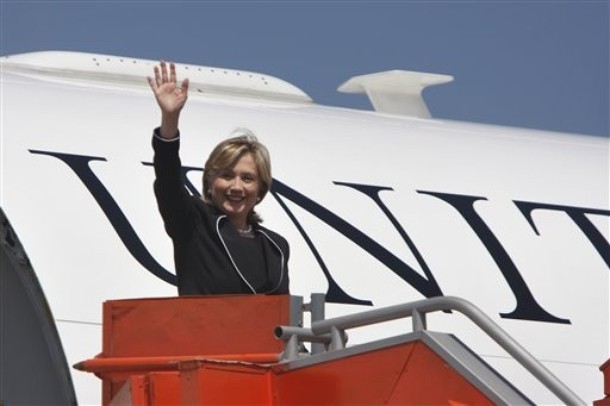
Subscribe to:
Posts (Atom)