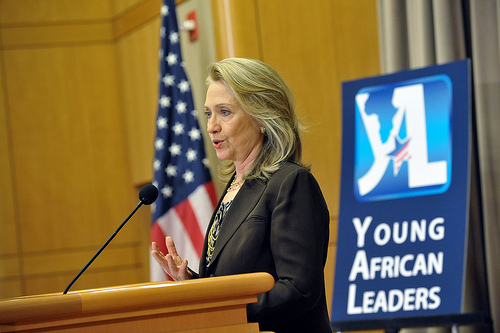
Innovation Summit and Mentoring Partnership With Young African Leaders
Remarks
Hillary Rodham Clinton
Secretary of StateGeorge C. Marshall CenterWashington, DCJune 13, 2012
Well, good morning, and it is wonderful to see all of you here today, and I’m delighted to welcome you to the State Department and to the United States. And I hope this is the beginning of what will be an unforgettable three weeks. As Assistant Secretary Carson just said, we believe strongly in the future of Africa, of you as individuals, of your communities, and your countries. And our goal is to be a partner and a friend as you lead the way into the kind of future that is so well deserved. You’ve traveled here from more than 40 nations, and you are here because of what you have already achieved. You are leaders in many fields: the arts and business, technology, education, journalism, and civil society. And so we have a bet on you. And that bet is that you will use your talents and your skills to help bring greater prosperity, progress, and a better future to all of the people whose efforts so desperately need to be supported.
You are here because of your potential. And as President Obama has said, Africa is not a world apart; it is a fundamental part of our interconnected world. And we want to do a better job of making those interconnections and then supporting and nurturing them, because we believe to strengthen the global economy we should look to Africa, one of the fastest growing regions in the world. There are so many opportunities for entrepreneurs and businesses, for trade and investment that would be beneficial for Africans and for Americans.
We want to support the rise of democracies and give more people the chance to live under governments of their own choosing. And to do that, we look to Africa, where new democracies are growing stronger every day and where citizens have found innovative methods to promote good governance and hold leaders accountable.
And to make progress on the defining challenges of our time, like climate change and clean energy, global health and education, preventing violent extremism, defending human rights, once again, we look to Africa, because African communities have been on the frontlines of these issues for years.
For all these reasons, President Obama and his Administration has made building strong partnerships with the nations and people of Africa a key element of our foreign policy, because we are convinced that the story of the 21st century will be written in large part by you and your fellow citizens. So we want to be of help to you on your journeys and to support you as you chart that new future.
And the fact is you are young leaders at a time when young people are increasingly at the heart of world events. In Africa, 60 percent of the population is under 25. Now, that can either be a daunting statistic or a cause for celebration. It will be daunting if they are not educated, if they don’t have healthcare, if there are no jobs, if they cannot participate in the political lives of their societies. But it will be cause for celebration if young people can begin to have their voices heard, their votes counted, and help to chart a new beginning. And we think success will depend upon whether or not the youth of Africa, like many places around the world, have a chance to contribute to their own countries.
Now, we have benefited greatly in the United States because of Africans who have left Africa to come here, who have then been business leaders, doctors and nurses and teachers, academics and have given so much to the United States. But we hope that that kind of emigration will reverse and that more and more people will return home.
When I had my daughter many years ago, the midwife who worked with my doctor was from Ghana, and I remember talking to her about why she would come so far away. And she said, “I can have a better opportunity for myself and my children.” Just recently, she returned to Ghana. We want to see that happen throughout the continent, where people with skills and education and experience and expertise go back home to join you in making a difference.
There are many people here who have already made a difference. One of the people here, just to cite a few examples, is Refiloe from South Africa – where is Refiloe? Ah, Refiloe – who created a nonprofit organization called 18twenty8, which provides young women from poor backgrounds with educational and personal development so they then can have the confidence and the skills to have the kind of future they deserve.
Erikson is here from Namibia. Where is Erikson? He started making homemade chili and barbeque sauces – I’m getting hungry. (Laughter.) – then created a company to market them. Now they’re sold in stores throughout your hometown, and soon, if all goes well, across your country.
Thierno is here from Guinea. Where is Thierno? Aww, Thierno. As a radio journalist, his investigations of drug trafficking made him known throughout the country. Now he is creating a farm radio station to broadcast the voices of Guinea’s many farmers.
Clarisse has joined us from Rwanda. Clarisse, hello. She is the CEO of HeHe Limited, one of East Africa’s leading mobile development companies, which Clarice helped found while she was a student at the Kigali Institute of Science and Technology.
There are people here publishing books in Ethiopia, producing shoes in Ghana, promoting foreign investment in Tanzania, monitoring high school students in Nigeria, supporting agricultural diversity in Guinea-Bissau, making bead and paper craft products in Cameroon, and on and on. You get the idea. You are amongst high achievers. You are amongst people who are already making their marks. The initiative and ingenuity that you all share cannot be taught or imparted; it does come from within. You have a drive, a desire, to do something with your lives and to make that difference. But that can be nurtured, and that is what we hope to do in the next few weeks.
In Washington, Chicago, and other cities you will visit, you’ll have the chance to form relationships with each other and with professional mentors, and you’ll have the chance to see more of America. And I hope that you take it all in, because we want to see this group of young leaders turn into a thriving network that stretches across Africa, across the Atlantic, to America.
And we also want to learn from you. What can we do better to help you, to help your communities, to help your countries? Assistant Secretary Carson is a man of great wisdom and long experience. It has been an honor for me to be working with him as his colleague. We are very open to hearing what you believe we need to hear. This is not a one-way broadcast. We’re looking for the opportunity to get feedback at all levels, from the Assistant Secretary and myself to everyone with whom you will interact.
So let me close by saying this: In your time here in America, you’ll meet many Americans who have never been to Africa, let alone your home countries. Many of them will not know anything about what has been happening in Africa, all the changes that have been occurring, everything that you and so many others have worked so hard to achieve. They will not know about the rising prosperity, the explosion of new businesses and technologies, the new and more secure freedoms, the opportunities for women and girls. But they should know.
So in effect, I am deputizing you for the next three weeks to be ambassadors, to help educate those with whom you come into contact. As you learn, help others to learn so that we break down the walls of ignorance and indifference, because whether we like it or not, we are all in this together. And I believe strongly that you represent the promise and possibility of Africa’s present and future, and I believe that what we can do together truly will make the world a better place. Thank you and Godspeed.
Showing posts with label Young African Leaders. Show all posts
Wednesday, June 13, 2012
Hillary Clinton with Young African Leaders
Sunday, June 10, 2012
Upcoming: On Hillary Clinton's Agenda
Here are a few of the events on Mme. Secretary's calendar for the upcoming week.
____________________________________________________________________________Secretary Clinton To Deliver Remarks at the Opening of the Inaugural Women in Public Service Institute
Notice to the Press
- WASHINGTON, DC - DECEMBER 15: U.S. Secretary of State Hillary Clinton addresses the Women In Public Service Project at the Department of State December 15, 2011 in Washington, DC. According to the State Department, the project will work with the Seven Sisters Colleges of Barnard College, Bryn Mawr College, Mount Holyoke College, Smith College, and Wellesley College "to identify and educate a new generation of women committed to public service, create an infrastructure of support and mentoring, and help enable more women to enter public service and political leadership." (Photo by Chip Somodevilla/Getty Images)
Office of the SpokespersonWashington, DCJune 8, 2012
On June 11th, Secretary of State Hillary Rodham Clinton will deliver remarks at the opening day of the Inaugural Women in Public Service Institute at Wellesley College. The institute is hosted by Wellesley College, in partnership with the U.S. Department of State and the nation’s leading women’s colleges. The Institute is a first-of-its-kind, two-week program that will train the next generation of women leaders, and part of a global project to get world leadership from 17.5% female to “50% by 2050.”
The delegates attending the Institute were selected from 21 nations in the process of political and social transformation, including countries that are drafting new Constitutions and undergoing major reform. Many of the women are from the Middle East North Africa (MENA) region and were involved in the Arab Spring.
The women will gather at Wellesley for training and networking sessions with their peers and with established leaders, including Madeleine Albright, former U.S. Secretary of State; Jane Harman, former Congresswoman and President of the Woodrow Wilson Center; Mu Sochua, Minister for Women’s Affairs and leader of the Opposition in Cambodia; Honorable Judge Nancy Gertner, Ambassador Melanne Verveer, and many more.
Secretary Clinton’s remarks will be streamed live at www.state.gov.
________________________________________________________________________________U.S. Secretary of State Hillary Clinton and Israeli President Shimon Peres to Participate in a Discussion Hosted by the Saban Center for Middle East Policy at Brookings on June 12
Notice to the Press
- JERUSALEM, ISRAEL - MARCH 3: In this handout from the Israeli U.S. Embassy Tel Aviv, U.S Secretary of State Hillary Clinton meets with Israeli President Shimon Peres on March 3, 2009 in Jeruslaem, Israel. Hillary Clinton is at the start of a two day visit to the region where she will also be holding talks with Israeli Foreign Minister Tzipi Livni and Prime Minister Designate Binyamin Netanyahu before meeting with Palestinian Authority President Mahmood Abbas. (Photo by Matty Stern/U.S. Embassy Tel Aviv via Getty Images)
Office of the SpokespersonWashington, DCJune 8, 2012
On June 12, the Saban Center for Middle East Policy at Brookings will host U.S. Secretary of State Hillary Rodham Clinton and Israeli President Shimon Peres for a discussion as part of a celebration marking the 10th anniversary of the center. The discussion will be moderated by Martin Indyk, Brookings Vice President and Director of Foreign Policy.
The Peres-Clinton discussion will take place on June 12 at approximately 12:00 p.m. at the Hay Adams Hotel (800 16th Street, NW), in the Top of the Hay venue.
State Department Hosts Innovation Summit and Mentoring Partnership With Young African Leaders
Media Note
Office of the SpokespersonWashington, DCJune 5, 2012
On June 13, Secretary Hillary Clinton will welcome more than 60 young African leaders to the Innovation Summit and Mentoring Partnership with Young African Leaders, a three-week professional development program sponsored by the U.S. government in collaboration with implementing partner, Meridian International Center. On June 14, Under Secretary of Political Affairs Wendy Sherman opens the program at the Innovation Summit in Washington, D.C. This program is part of the President’s Young African Leaders Initiative, the Obama Administration’s long-term program to engage Africa’s young leaders who are actively promoting positive change in their communities. The President’s Initiative, which began with President Obama’s Forum with Young African Leaders in 2010, has included more than 2,000 U.S government-sponsored programs for young leaders across Sub-Saharan Africa in addition to the First Lady’s Young African Women Leaders Forum, held in South Africa in June 2011.
The Innovation Summit will serve as the opening event, bringing together high-profile business leaders, inspirational speakers, and international and local civil society activists. After the two-day event, participants will travel to business internships in Seattle, Charlotte, Philadelphia, Pittsburg, Miami, Huntsville, Denver, Chicago or Cincinnati for the Mentoring Partnership with U.S. companies and non-profit organizations. The two weeks in U.S. cities will provide a hands-on experience in the American workplace and exposure to cultural aspects of American life. Closing ceremonies will take place in Chicago on June 29 and 30. The Innovation Summit and Mentoring Partnership will stress social and business entrepreneurship as a tool for harnessing Africa’s intellectual capital to create jobs and sustainable, equitable opportunities. Looking to the future, these programs aim to enhance a U.S.-Africa collaboration to promote business innovation, investment, and social responsibility activities in Africa.
Friday, February 11, 2011
Hillary Clinton: Stalwart Advocate of the Social Nets
On January 28, 2011, three days into the revolutionary protests in Egypt, I re-posted Secretary Clinton's speech only 15 days earlier at Forum for the Future in Doha, Qatar, warning Arab leaders of the potential unrest inherent in governing 21st century populations with the strategies of the 19th century.
I consider that speech one of the most important, if not the most important speech she has ever made. Many ignored the speech, not the least of whom among them were the Arab leaders. Within weeks, we saw first Tunisia and then Egypt (among other North African and Arab states) erupt in what some have referred to as Twitter and/or Facebook Revolutions.
Tuesday, as the previous post informs, Mme. Secretary will once again address the issue of internet freedom, and many will refer to her speech of January 21, 2010 on internet freedom delivered at the Newseum. Yes, that was an important policy speech, but it was not the first time Mme. Secretary had highlighted the importance of the world wide web and social networks.
Today, and for the past several weeks, I have been remembering her commencement address at Barnard on May 18, 2009. It was not a widely publicized speech. It did not gain a lot of attention. Nevertheless it was pithy, and set forth what would become a recurring theme as our SOS traveled the world, spoke with foreign officials, and met with youth and members of civil society around the world.
She would go on, of course to make her very well-known Internet Freedom speech of January 21, 2010. The theme would resonate once again in her Remarks to Young African Leaders on August 3, 2010. There was strong advice in that speech to take advantage of our available technology for the betterment of all cultures and countries and for the support of incipient democracy the world over. That was a great speech. I encourage you to view it if you never have or if the message did not impress you at the moment.
Yet for me, that Barnard speech was what set it all off. I suggest you view the whole thing because it is rich with her signature issues and themes. Here, I will re-post the portion that I have been remembering since Tunisia's Twitter Revolution. As it happens, there was a recent post relative to Mme. Secretary's Op-Ed in Glamour Magazine. The portion of the Barnard speech the I am re-posting begins with the tale of that little girl whom Secretary Clinton had met when they both were honored by Glamour.
I think we are all impressed that a huge and peaceful coup was carried out in 18 days and was organized using the social networks our SOS values so highly. We all congratulate the Egyptian people this evening. I, for one, am looking forward to Mme. Secretary's Tuesday speech. She is most assuredly on the side of the democratic use of and openness for the social media.
A cautionary tale, however, lurks in an article from HuffPo dated, June 25, 2010. Perhaps you missed it. I did.
I consider that speech one of the most important, if not the most important speech she has ever made. Many ignored the speech, not the least of whom among them were the Arab leaders. Within weeks, we saw first Tunisia and then Egypt (among other North African and Arab states) erupt in what some have referred to as Twitter and/or Facebook Revolutions.
Today, and for the past several weeks, I have been remembering her commencement address at Barnard on May 18, 2009. It was not a widely publicized speech. It did not gain a lot of attention. Nevertheless it was pithy, and set forth what would become a recurring theme as our SOS traveled the world, spoke with foreign officials, and met with youth and members of civil society around the world.
She would go on, of course to make her very well-known Internet Freedom speech of January 21, 2010. The theme would resonate once again in her Remarks to Young African Leaders on August 3, 2010. There was strong advice in that speech to take advantage of our available technology for the betterment of all cultures and countries and for the support of incipient democracy the world over. That was a great speech. I encourage you to view it if you never have or if the message did not impress you at the moment.
Yet for me, that Barnard speech was what set it all off. I suggest you view the whole thing because it is rich with her signature issues and themes. Here, I will re-post the portion that I have been remembering since Tunisia's Twitter Revolution. As it happens, there was a recent post relative to Mme. Secretary's Op-Ed in Glamour Magazine. The portion of the Barnard speech the I am re-posting begins with the tale of that little girl whom Secretary Clinton had met when they both were honored by Glamour.
Some months ago here in New York, I had the privilege of meeting a young girl from Yemen. Her name is Nujood Ali. When she was nine years old, her family offered her into marriage with a much older man who turned out to be violent and abusive. At ten years old, desperate to escape her circumstances, she left her home and made her way to the local courthouse where she sat against a wall all day long until she was finally noticed, thankfully, by a woman lawyer named Shada Nasser, who asked this little girl what she was doing there. And the little girl said she came to get a divorce. And thanks to this lawyer, she did.Incarnations of these words of encouragement echo through her remarks when she speaks all over the world. Despite the attempted interference, Chinese students did manage to access the Internet Freedom speech of 01/21/10. When I followed the path they took to my blog, I ended up at an American site that allows you to bypass the firewall at your school. It appears pretty clear now that the youth of Tunisia and Egypt found access to her words in Doha. I am not saying she set this off, but it appears to me that they knew their idea had some kind of support in the administration.
Now in another time, the story of her individual courage and her equally brave lawyer would not have been covered in the news even in her own country. But now, it is beamed worldwide by satellites, shared on blogs, posted on Twitter, celebrated in gatherings. Today, women are finding their voices, and those voices are being heard far beyond their own narrow circumstances. And here’s what each of you can do. You can visit the website of a nonprofit called Kiva, K-i-v-a, and send a microloan to an entrepreneur like Blanca, who wants to expand her small grocery store in Peru. You can send children’s books to a library in Namibia by purchasing items off an Amazon.com wish list. You can sit in your dorm room, or soon your new apartment, and use the web to plant trees across Africa through Wangari Maathai’s Green Belt movement.
And with these social networking tools that you use every day to tell people you’ve gone to get a latte or you’re going to be running late, you can unite your friends through Facebook to fight human trafficking or child marriage, like the two recent college graduates in Colombia – the country – who organized 14 million people into the largest anti-terrorism demonstration in history, doing as much damage to the FARC terrorist network in a few weeks than had been done in years of military action. (Applause.)
And you can organize through Twitter, like the undergraduates at Northwestern who launched a global fast to bring attention to Iran’s imprisonment of an American journalist. And we have two young women journalists right now in prison in North Korea, and you can get busy on the internet and let the North Koreans know that we find that absolutely unacceptable. (Applause.)
These new tools are available for everyone. They are democratizing diplomacy. So over the next year, we will be creating Virtual Student Foreign Service Internships to partner American students with our embassies abroad to conduct digital diplomacy. And you can learn more about this initiative on the State Department website.
This is an opportunity for all of us to ask ourselves: What can I do? I’m heading off to my first job or I may be going to travel for a while or I have some other ideas that I’m exploring. But no matter what you’re doing, you can be a citizen activist and a citizen diplomat. You’ve already begun to make the connections and partnerships that will give you support throughout your lives. And therefore, I invite you to forge those connections beyond this class.
You’ve learned here at Barnard that in spite of our differences, we are all connected. And we need to be looking for ways to find inspiration from our daily lives. Just a few weeks ago, I read President Spar’s column in the Wall Street Journal, in which she bravely attempted to write her own application essay for Barnard. She described a typical day in her life, one that involved coordinating her kids’ carpooling, fixing dinner, answering emails, dealing with a mischievous cat, writing a speech on – what else – women and leadership. As I read about the controlled chaos of your president’s life, I thought this sure sounds familiar. And as I look out in the audience today, I see a lot of mothers and grandmothers and fathers and grandfathers and family members and friends, and I know that you too have had these experiences.
But no matter how we come to this commencement, we leave knowing that another class of extraordinary young women, who will have the manner and the education to go and not only pursue their own dreams but help bring along others as well, has occurred within this remarkable institution. We all have an opportunity today to do so much more than I even dreamed possible when I sat where you are sitting all those years ago.
I think we are all impressed that a huge and peaceful coup was carried out in 18 days and was organized using the social networks our SOS values so highly. We all congratulate the Egyptian people this evening. I, for one, am looking forward to Mme. Secretary's Tuesday speech. She is most assuredly on the side of the democratic use of and openness for the social media.
A cautionary tale, however, lurks in an article from HuffPo dated, June 25, 2010. Perhaps you missed it. I did.
Internet 'Kill Switch' Approved By Senate Homeland Security CommitteeGiven what we have seen over the past 18 days in Egypt, the precious ability to access the internet in a time of national crisis is clear. To obstruct such access in a national emergency seems a dangerous extension of power indeed. Our government, particularly our SOS pleaded with Egyptian authorities to restore access. Our own government, however, could potentially deny us that access. Hypocritical and downright unconstitutional, I think, in the freest country in the world, the one that stands as an icon, a beacon of hope, to people fighting for freedom all over the globe.
The Senate Committee on Homeland Security and Governmental Affairs has approved a cybersecurity bill, Protecting Cyberspace as a National Asset Act (PCNAA), that would give the president far-reaching authority over the Internet in the case of emergency.
As The Hill explains, the bill, sponsored by Sens. Joe Lieberman, Susan Collins, and Tom Carper, would give the president "emergency authority to shut down private sector or government networks in the event of a cyber attack capable of causing massive damage or loss of life." The original bill granted the president the authority to "indefinitely" shut down networks, but an amendment to the PCNAA, approved yesterday, mandates that the president "get Congressional approval after controlling a network for 120 days."
Read more>>>>
Subscribe to:
Posts (Atom)