Showing posts with label Indonesia. Show all posts

Thursday, September 20, 2012

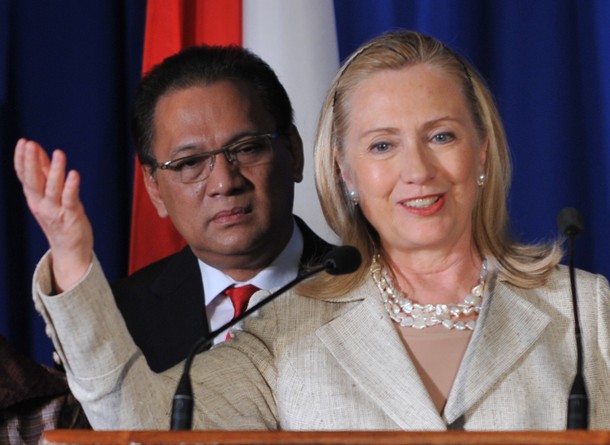
Hillary Clinton with Indonesian FM Marty Natalegawa


Remarks With Indonesian Foreign Minister Raden Mohammad Marty Muliana Natalegawa After Their Meeting


Remarks

Hillary Rodham Clinton
Secretary of State
Treaty Room
Washington, DC
September 20, 2012


SECRETARY CLINTON: Good afternoon, everyone. And it’s such a pleasure, as always, to welcome the Indonesian Foreign Minister, and I believe the largest delegation that has ever come from Indonesia, for the purpose of our third meeting of the U.S.-Indonesia Joint Commission. This commission is the result of a vision by our two presidents for a comprehensive partnership, and the agreement to that effect was signed in 2010. Thanks to this partnership, the United States and Indonesia are working more closely than ever on a range of issues from global security to clean energy and climate to regional trade and commerce.
And today, Marty and I had the chance to take stock of where our teams have come in the time of the last year, because we had our meeting in Bali a year ago. And I must say, I was very impressed. We covered a great deal today.

But before I start, I’d like to say a few words about the protests in several countries around the world. We have condemned in the strongest possible terms the violence that has erupted from these protests. And as I have said, the video that sparked these protests is disgusting and reprehensible, and the United States Government, of course, had absolutely nothing to do with it.
But there is no justification for violence, and I want to thank the Foreign Minister and his government for speaking out against violence. We have to look to reasonable people and responsible leaders everywhere to stand up to extremists who would seek to take advantage of this moment to commit violent acts against embassies and their fellow countrymen.
Today’s meetings have highlighted the strong foundation that we have built together. And one of our most important concerns is promoting peace and stability in the Asia Pacific. Today, I’m announcing that the Obama Administration has informed Congress of the potential sale of eight AH-64D Apache Longbow helicopters to the Indonesian Government. This agreement will strengthen our comprehensive partnership and help enhance security across the region.

On growth and prosperity, we are increasing our trade relationship that topped $26 billion last year. Investments in transportation, energy, and infrastructure are creating jobs and supporting economic growth in both countries. For example, the deal between Lion Air and Boeing alone represents $21 billion in trade over the next decade. Indonesia’s Government has announced half a trillion dollars in infrastructure improvements, and we recently signed a memorandum of understanding to make it easier for American companies to bid on these projects.
And yesterday, we signed an agreement for implementing our Millennium Challenge Corporation Compact with Indonesia. Over the next five years, the United States will invest $600 million in clean energy development, child health and nutrition programs, and efforts to help make Indonesia’s Government more transparent and open.
The United States is also looking forward to Indonesia hosting APEC in 2013, and we are confident that Indonesia will come to this role with a commitment to promote greater economic integration across the Asia Pacific.
Both the Foreign Minister and I believe that strong education is essential to compete in a modern global economy. That’s why the United States has expanded the Fulbright Program and supported partnerships between dozens of American and Indonesian universities. Academic exchanges between our countries are up and applications from Indonesian students to visit the United States have increased by one third. USAID has recently expanded its basic education program to provide $83 million for teacher training and literacy programs for young children. And we’re providing $20 in scholarship funding for Indonesian graduate students.
I also thanked the Minister for Indonesia’s leadership in ASEAN. The Foreign Minister’s personal leadership has helped lay the groundwork for diplomacy between ASEAN and China as it relates to the South China Sea. And we continue to support ASEAN’s six-point principles, which we believe will help reduce tensions and pave the way for a comprehensive code of conduct for addressing disputes without threats, coercion, or use of force.

Finally, Indonesia and the United States have stood together on a range of global challenges, from democratic reform in Burma to combating climate change, to working to end the violence in Syria. We are also coordinating efforts to further develop south-south and triangular cooperation, such as enhancing disaster preparedness in Burma and convening a conference on women’s empowerment.
We believe that as the second and third-largest democracies in the world, the United States and Indonesia have a special responsibility to promote democracy and human rights. And for the last four years, Indonesia has hosted the Bali Democracy Forum to promote peaceful, democratic transitions through example and open dialogue. Last year, more than 80 countries attended. And once again, the United States will be sending a high-level delegation.

So, Minister, thank you for everything. Thank you for the great partnership we’ve had between us and between our countries.
FOREIGN MINISTER NATALEGAWA: Thank you very much, Madam Secretary. I’d like to begin by, once again, before members of the media, this afternoon to acknowledge and to thank you personally and as well, of course, through you, the government and the – of United States, and the delegations of the United States, for welcoming us in such a fine manner here in Washington.
I concur with you fully in your description of the state of Indonesia-U.S. relations. It is, as it is often described, a comprehensive partnership, comprehensive – underscore the fact that our relations is a very broad ranged one covering many areas and sectors and fields of endeavor and cooperation. And throughout this morning, and of course throughout the year, as a matter of fact, the working groups established for the purpose of promoting our comprehensive partnership have precisely done that. They have worked very hard and we have heard just now, throughout our meeting this morning, the kind of progress – concrete, real, progress has been made in the areas of common concern, whether it be on trade, on education, on promotion of democracy and human rights, and many other fields – including, especially, and not least, in the defense and security area as well.
What remains for us now is, based on the discussion that we’ve had today, to ensure the working groups and the Joint Ministerial Commission continue to be enhanced, continue to sustain the pace of its work so that once we meet again next year in Indonesia, we can similarly enjoy and raise witness important progress in the promotion of our bilateral relations.
The point that I wanted to make at this occasion, Madam Secretary, is to reinforce and recall and reaffirm the fact that the importance of Indonesia-U.S. relations extends beyond the bilateral. Our two countries now have worked very closely in a very productive and very mutually beneficial way, not only bilaterally, but increasingly within the regional setting as well.
Just now, Secretary Clinton was so kind enough to acknowledge the kind of efforts Indonesia is trying to make in trying to create an environment in our region that is peaceful and stable and thus, therefore prosperous, as well. But is a process, it is a common endeavor by all of us, and I have to say that over the recent years, the United States engagement in the Asian Pacific have truly been part of that creation of such a benign, peaceful and stable environment.
But much work remains ahead of us. We have, of course, the New York United Nations meeting coming up this coming week. No doubt Indonesia and the United States will continue to work very closely. During the course of our discussion today, both in the plenary and especially in the more tete-a-tete setting, we discussed many a global issues, regional issues as well, whether it be in Southeast Asia, in East Asia, Asia Pacific, as well as, for example, in the Middle East, including the developments in Syria. What I wanted to say, basically and essentially, is that the strength of our bilateral relations is one that is becoming even more evident and it is a relations that is not only beneficial to the United States, beneficial to Indonesia, but no doubt I am sure beneficial to the region as well.
Thank you very much, Secretary Clinton, for welcoming us to Washington, and I look forward to continuing our strong partnership. Thank you. Thanks very much.
SECRETARY CLINTON: Thank you so much, Marty. Thank you very much.
MS. NULAND: We’ll take two questions today, we’ll start with Ros Jordan of Al Jazeera English.
QUESTION: Thank you, Madam Secretary, Mr. Foreign Minister. Madam Secretary, my question is about the ongoing investigation into last week’s attack at the consulate in Benghazi. You are meeting this afternoon with members of Congress to discuss the progress and the concerns that they understandably have. First, there is the federal mandate to establish an accountability review board. Have you done so? Who would you like to see chair it? Are there certain questions that you desperately want to have answered in order to safeguard the safety of Foreign Service Officers around the world?
And related to this, given the political instability and the successes of the past year and a half, are you satisfied that in light of those political changes, enough was done to protect those working in the Middle East and North Africa? And then finally – and this is perhaps going into the area of rumor and speculation – but there is at least one report suggesting that Ambassador Stevens felt that he was on a, quote, “al-Qaida hit list.” Is this a scurrilous rumor? Is this gallows humor when one is working in a period of difficulty and great challenge, or is there something more to what he allegedly – and I stress that word – said?
SECRETARY CLINTON: Well, first, let me say I’m looking forward to the opportunity to go up to the Congress today. I will be briefing in two separate sessions, the House and the Senate, in a classified setting, along with my interagency colleagues, as we continue to work together, and with governments around the world, to ensure that our people and our facilities are safe. I will be joined today by the Director of National Intelligence, General Clapper, by the Deputy Secretary of Defense, Ash Carter, by the Vice Chairman of the Joint Chiefs of Staff, Sandy Winnefeld, along with experts from the FBI, the State Department, and elsewhere in the government.
Now, I anticipate that this briefing will cover our security posture before and during the events, and the steps we have taken since to do everything we can with host governments to protect our people and our embassies and consulates. The Director of National Intelligence will speak to the intelligence issues surrounding these events in Libya. Deputy Secretary Carter will brief on the superb support we have had from the U.S. military in the wake of these events, and we are at the very early stages of an FBI investigation. The team from the FBI reached Libya earlier this week. And I will advise Congress also that I am launching an accountability review board that will be chaired by Ambassador Thomas Pickering.
I will also talk about the importance of the broader relationships with these countries in light of the events of the past days. There are obviously very real challenges in these new democracies, these fragile societies, but as I said last week, the vast majority of the people in these countries did not throw off the tyranny of a dictator to trade it for the tyranny of a mob. And we are concerned first and foremost with our own people and facilities, but we are concerned about the internal security in these countries because ultimately, that puts at risk the men, women, and children of these societies on a daily ongoing basis if actions are not taken to try to restore security and civil order.
And let me just conclude by saying that there can be no doubt where the United States stands. We continue to support those who are fighting for universal values – values that we see at work in Indonesia – the third largest democracy in the world. We believe that these values of universal rights, of justice and accountability, of democracy, are there for every person regardless of where that person might live. So I will look forward to having a chance to talk with members of Congress.
As to your final question, I have absolutely no information or reason to believe that there’s any basis for that.
QUESTION: Thank you.
MS. NULAND: Last question. Victoria Sidjabat from Tempo Magazine, please.
QUESTION: Yes. Madam, thank you. My question is: Starting today, U.S. Embassy and Consulate are closed in Indonesia as the Muslim movie become wild fireball, which could be designed as a weapon to attack U.S. by raising sentiment anti-U.S. from the countries which has Muslim majority population like Indonesia.
Madam Clinton, how do you see this threat as on the long run? If it’s continuing happen, it’s – obviously could give impact to the implementation of (inaudible) program in Indonesia. What is the reason U.S. Government closed the Embassy and Consulate in Indonesia? What is your expectation from Indonesia Government, for my Minister Marty Natalegawa? How Indonesia Government respond to the closing of this Embassy and Consulate, it’s starting today? Is U.S. – Indonesia Government has capability to protect U.S. Embassy and Consulate. So the (inaudible) program implemented – could be implemented successfully in Indonesia. Thank you.
SECRETARY CLINTON: Well, let me begin by saying how grateful we are for the excellent cooperation we have received from the Government of Indonesia, and in particular, from the law enforcement and security institutions in Indonesia. We are very grateful for not only the cooperation and protection that has been provided to our facilities, but also to the strong statements condemning violence from the President, the Foreign Minister, and others.
In consultation with the Government of Indonesia, we have temporarily, for tomorrow, closed our facilities. We want to be sure that law enforcement in Indonesia has the ability to do what it needs to do to make sure that there is no disruption of civil order and security. So we are cooperating completely, and we’re very grateful for the strong leadership provided by Indonesia.
FOREIGN MINISTER NATALEGAWA: Hello, (inaudible), if I may just also respond. Precisely as the Secretary had said, the decision by the United States Government to close temporarily its embassies and consulates tomorrow in Indonesia is a decision that’s been made based on communication and conversation between the authorities in Indonesia and the United States as well. So in other words, it is an informed decision, a decision that is not intended to show any unfriendly intent on the part of anyone, but it is what it is, and it’s quite some – it’s the kind of step that governments actually carry out when situations requires it, even in our case. Some of our embassies abroad, when the situation requires us to have a temporary closing of the embassy, we do that as well. So it is something that is quite regular and something that is actually coordinated as well.
But if I may just broaden the subject matter, I think as our President had said in the past, Indonesian Government – the Indonesian people, even, obviously cannot and would not condone the – any acts of violence against diplomatic premises, against diplomatic personnel, because that is, truly – would be a challenge to the efficient and a proper conduct of relations among states. So that’s our point of departure.

At the same time, of course, beyond the immediate issue of protection of the embassies, we have still ahead of us the challenge of how to prevent the kind of situations where we are now at in terms of the kind of incendiary and the kind of statements or, in this instance, films that cause – that is now we have all deplored and condemned for these kind of activities not to be repeated. So we have a lot of homework to work towards in the future as well.
SECRETARY CLINTON: Thank you all very much.
FOREIGN MINISTER NATALEGAWA: Thank you.
# # #

Video: Hillary Clinton at the Third Annual U.S.-Indonesian Joint Commission Meeting


Remarks at the Third Annual U.S.-Indonesian Joint Commission Meeting


Remarks

Hillary Rodham Clinton
Secretary of State
Indonesian Foreign Minister Raden Mohammad Marty Muliana Natalegawa
Washington, DC
September 20, 2012


SECRETARY CLINTON: Hello, everyone, good morning. My goodness, we have quite a wonderful turnout, and we are so grateful to our friends and colleagues from Indonesia for being part of this ongoing and very important effort. Ambassador, very good to see you, and the Minister and I just had an opportunity to cover a few issues, because we have so much work to report on today, and I thank all of my colleagues and partners from across our government. So we are gathered here today for our third joint commission meeting. You were such gracious hosts when I have been in Indonesia, in Jakarta a few weeks ago, in Bali for our last meeting, and we are so pleased to be able to host you here today.
As the Minister and I were just discussing, the United States and Indonesia have strengthened our ties through the Comprehensive Partnership agreement signed by our two presidents. And since then, this commission has been the vehicle for advancing that partnership through collaboration on regional stability, global security, trade, commerce, education, health, such a long list of areas that we have been working on together. I think we have a lot to show for our efforts, and we will soon hear from the chairs of the six working groups on their accomplishments over the last year.
But first let me just stress the importance of our relationship with Indonesia, and highlight a few particular successes that have resulted from recent collaboration. As the second and third largest democracies in the world, we are natural partners, and the United States looks to Indonesia as a cornerstone for stability in the Asia Pacific region. A major part of the engagement that we have been pursuing is the promotion of economic growth through trade and development, which is so important not only for both our nations and our people, but the region.
Our economic ties with Indonesia are a strong foundation for that economic growth. Since the year 2000, our bilateral trade has more than doubled, topping $27 billion last year. The $21 billion agreement between Lion Air and Boeing is the largest in Boeing’s history. America’s natural gas sector has drawn investments from Indonesian energy companies here in this country. A new Memorandum of Understanding between the Indonesian Government and Celanese, an American company, may lead to a new billion-dollar facility that will convert coal to ethanol.
And just yesterday, we signed the implementation plan for the Millennium Challenge Corporation Compact, and over five years, we will invest $600 million in clean energy development, healthcare, and nutrition programs for children, and a project to support more open and efficient governance. I’m looking forward to hearing from our working groups on the plan’s progress and other new initiatives.
Another major focus of our partnership has been promoting education, which is a key to both economic growth and personal advancement. Since 2010, we’ve expanded the Fulbright Program and supported partnerships between dozens of American and Indonesian universities. More than 1,000 students and scholars have taken part in academic exchanges, and the United States is supporting primary education and English language programs in Indonesia.
Since we started working together on education issues, the number of applications by Indonesian students for American visas has increased by one-third. These direct, person-to-person ties are critical to deepening the friendship between the American and Indonesian people. That is something President Obama is personally very committed to, based on his own relationships. And we should look for more ways to promote these exchanges.
We also greatly appreciate Indonesia’s leadership as ASEAN chair in supporting America’s engagement with ASEAN. When Indonesia hosted the East Asia Summit last year, President Obama became the first American president to attend.
I also want to thank the Foreign Minister for laying the groundwork for diplomacy through ASEAN with regard to the South China Sea. We support ASEAN’s six-point principles to help reduce tensions and pave the way to a comprehensive code of conduct for addressing disputes. And we support a solution through which all concerned parties can resolve any disputes without threats, coercion, or the use of force.
Indonesia and the United States have collaborated to help open markets across the region to greater trade and investment, working to discourage protectionist policies that serve as roadblocks to greater economic integration, and as Indonesia prepares to host APEC in 2013, we hope that under Indonesia’s leadership, we will continue to see greater openness and economic opportunities for more people in more places.
Finally, I want to acknowledge Indonesia’s role in helping to meet regional and global challenges. As you know, Aung San Suu Kyi has been in Washington the last two days. I personally am grateful for Indonesia’s leadership in bringing about the openness and the reforms that are currently taking place in her country. I want to publicly acknowledge the role that President Yudhoyono has played in reaching out to the leadership as well as the Foreign Minister and his colleagues in helping to move that important development forward.
We’ve stood together on issues from nonproliferation to climate change to working to end the violence in Syria, and the United States will again be sending a high-level delegation to the Bali Democracy Forum to build on our efforts to promote democracy and human rights. I am so appreciative of the progress that we have made in so many ways in our partnership, and it’s been a great privilege serving with the Foreign Minister.
So now let me ask him to provide some remarks.
FOREIGN MINISTER NATALEGAWA: Thank you very much, Excellency and a dear colleague, Secretary of State Madam Hillary Clinton, co-chair of this third Joint Commission meeting. And of course, I’d like to acknowledge and to express how pleased I am to be back here in Washington with my colleagues – of course, the members of the Indonesian delegation – and especially to thank your able and very dedicated delegation, Secretary Clinton, for the important work they have been achieving.
Let me, therefore, begin once again in a manner that is, I think, appropriate by thanking all concerned for the very gracious hospitality, for the warm welcome all of us have received here ever since our arrival in Washington.
Most of all – most of all – I wish to thank Secretary Clinton just now for her comprehensive opening remarks – not only thanking her, but especially and most of all in echoing precisely, basically all the sentiments the Secretary have expressed in describing the state of the United States-Indonesia relations. You have described our state relations, Secretary, in a matter that I wish to describe as well, a relations that is very solid and very sound and strong, robust, and whose implications and whose importance now extends beyond bilateral relations to the region at large.
However, before I go any further, I wish to seize this opportunity, Madam Secretary, to once again extend our most deepest of condolences to the government and people of the United States on the tragic incident that took place in Libya recently that took the lives of Ambassador John Christopher Stevens and three members of the United States Embassy staff. The inviolability, the security, and the safety of diplomatic missions and staff the world over, whatever countries, are ever more critical in this day and age where we have to deal with very complex issues. And all of us without exception – all of us without exception – are in great mourning and express our sympathy and condolences to the government and people of the United States, as well, of course, to the families of the persons concerned.
Most of all, Secretary, as we had just now discussed during our tete-a-tete, the tragic incidents calls upon all of us – calls upon all of us – to reaffirm, to renew, and to strengthen our commitment to the building of a culture of peace, a culture of understanding across peoples of different faiths and cultures as well, and to sustain a true dialogue across faiths that effectively reaches people at the grassroot level. Of course, in condemning the movie trailers concerned, which constitute religious defamations and the – we are reminded that the exercise of freedom of expression is framed within the context of moral values and public interest, as also enshrined in the Universal Declaration of Human Rights.
Madam Secretary, you will recall just a little bit over two weeks ago I had the pleasure of welcoming you in Jakarta. That occasion afforded us the opportunity, much like previous meeting and conversations that we’ve had, to reinforce the bilateral comprehensive partnership between our two countries and not least to enhance our contribution to the region’s peace, stability, and prosperity.
Indeed, the fact that we’ve had a series of close consultations over such a short span of time, I believe reflects the strength of U.S.-Indonesia Comprehensive Partnership, a partnership that is mutually beneficial and at the same time extends well beyond the bilateral level, anchored in and driven by a strong belief in the common interest of countries in the region for peace, for stability, and prosperity in the Asia Pacific.
Madam Secretary, our meeting today, this joint commission, is very important, in fact a fundamental component of that partnership. Through this JC meeting we will take stock of the progress of our partnerships thus far, and not least, identify ways and means of making further progress. In this regard, I am pleased that the six working groups continue to make progress in their respective areas, and indeed, and important aspect of our bilateral mechanism is the fact that each of the working groups strives to yield concrete deliverables. And I am certain that this will ensure the enhancement of our partnership over the years to come.
As I have said on several occasion, Madam Secretary, the term comprehensive partnership denotes a cooperation which covers a wide range of issues and a relationship that is mutually beneficial, a partnership that will enable both nations to prosper and to progress. And we are, therefore, challenged to ensure that this JC meeting actually delivers concrete results. Indeed, we have much – achieved much progress since our last meeting in Bali in November, 2011. But I’m sure all of you would recognize there’s actually plenty more room for further progress.
I look forward, Madam Secretary, to work closely with you this morning to precisely ensure that we achieve our common goals as elucidated in the comprehensive partnership between our two countries. Thank you once again for welcoming us to Washington.
SECRETARY CLINTON: Thank you very much, Marty, and let me thank you for your expressions of condolence and solidarity. And I want to thank your government and the people of Indonesia for their support during this time. As you rightly say, there cannot be any justification, despite the strong feelings people have in response to material that is, as I have said, offensive and very disgusting in so many ways – but there can be no justification for the use of violence. And your law enforcement, your government, have been very responsive, and we’re very grateful to you.
Now we want to begin to hear from our working groups. And I will begin by inviting Under Secretary Otero and Ambassador Fachir to provide a report from the democracy and civil society working group.
# # #

Tuesday, September 4, 2012

Hillary Clinton with Staff and Their Families at Mission Indonesia

Meeting with Staff and Their Families at Mission Indonesia

Remarks
Hillary Rodham Clinton
Secretary of State
Scot Marciel
Ambassador to Indonesia
Shangri La Hotel
Jakarta, Indonesia
September 4, 2012


MR. MARCIEL: Good morning, everybody. The Secretary of State, her fourth trip to Indonesia since becoming Secretary of State. She doesn't have a whole lot of time, so I'm just going to turn the microphone over to her. But please, everybody, give Secretary of State Hillary Clinton the warmest Embassy Jakarta welcome you can. Thank you. (Applause.)
SECRETARY CLINTON: Well, it is great to be back, and to have a chance, once again, to thank you for the great service that you do on behalf of our country, and on behalf of this important relationship. I want to thank both ambassadors for their leadership, both with our bilateral mission and our mission to ASEAN. They form a dynamic duo in making sure that we promote Americans' interests, values, and security.
This is, for me, a very important country with a lot of work for us to do. We are proud that our comprehensive partnership is really taking our relationship deeper and broader. I will be welcoming the Foreign Minister and his large delegation to Washington in a few weeks. And this team has been instrumental in furthering that relationship. And as many of you know, I was strongly in favor of deepening our relationship with ASEAN. And we are pleased that Ambassador Carden was our first-ever ambassador to ASEAN. So, in both of these important missions, we see a lot of progress and opportunity.
It could not happen without all of you. Your work is really paying off in tangible ways. There is so much to be mentioned. But just a few of the highlights: the education work that you are doing, and I announced more USAID support for that; the Millennium Challenge Corporation contract, which has such potential for really improving the lives and the economic opportunities of the Indonesian people; so much on the People to People front; defense cooperation; energy security, and so much more.
So, let me really be very clear in expressing gratitude to both our American team and the great Indonesians who work with us. I don't know what we would do without our local staff. They are truly the backbone of Mission Indonesia and Mission ASEAN. Ambassadors, DCMs, Secretaries of State come and go. But the locally-employed staff provides the memory bank and the nerve center for ongoing activities. And there are a few of you -- I don't know how many are here today -- who have worked at Embassy Jakarta for more than 30 years. Anybody here who has worked for more than 30 years? (Applause.) Oh, my goodness. You started as a child, I can tell by looking. (Laughter.)
Well, thank you. And thank all of you. And thank you, too, to the families who are here. Both American and Indonesian families are important members of our embassy mission community.
So, for me, this is just a brief stop, but a heartfelt appreciation for everything you do and everything you will do, because we believe that there is no more important future relationship in the way that we interact with and cooperate with on a comprehensive level, across the board, of not only government-to-government, but people-to-people relationships, than this one between the United States and Indonesia.
Now, I'm hearing that you've been pretty deluged by visits. I mean Scot said this is my fourth visit. I have lost track. The President has been here twice. You may be the most visited country; I am not sure. (Laughter.) So I think you deserve a deep breath and a little relaxation after I am finally out of your air space. (Laughter.) But let me now take a few minutes to say hello to as many of you as I can. And again, to Scot, David, and to the teams, thank you for really representing the United States so well. Take care. (Applause.)

Hillary Clinton at ASEAN


Meeting with ASEAN Secretary General Surin


Remarks
Hillary Rodham Clinton
Secretary of State
ASEAN Secretariat
Jakarta, Indonesia, Indonesia
September 4, 2012


ASEAN SECRETARY GENERAL SURIN: Secretary Hillary Rodham Clinton, chair of ASEAN program representative, Excellencies, members of the CPR, it is a great privilege for us to welcome the Secretary here for the second time in her term. And I remember very well on the 18th of February you were here. Your first trip to the world you came to Asia. You came to the ASEAN Secretariat. You became the highest ranking ever official of the United States Government to visit us. And ever since, this place has been a routine destination for visiting dignitaries to ASEAN, to the Republic of Indonesia.
At that time you promised many things. You promised full engagement with ASEAN, with Southeast Asia. You promised to accede to our Treaty of Amity and Cooperation. You have promised the highest presidential engagement. You have promised to come to attend our post-ministerial (inaudible) conference, ARF. And I am glad to say that you have delivered it all. Thank you very, very much. Along the way we were a bit skeptical and we asked you -- we challenged you we would believe in the change when you delivered everything that you had promised us. And you did. And we certainly feel very much honored to welcome you here.
Now, let me just say that most of the diplomats we work with, they are counterparts. And you have turned your counterparts here in Southeast Asia, in ASEAN, into your friends. And friendship is extremely important for the region and for the region's diplomacy. We count you not as counterpart, but as a true friend. That is why today is very special. And we hope that we will accomplish many more things together into the future with the United States and ASEAN.
Madam, warmly welcome, please.
SECRETARY CLINTON: Thank you so much, my friend. And let me express what a pleasure it is to be back in Jakarta and to have this second opportunity to visit the ASEAN Secretariat.
As Dr. Surin has said, I came here in February of 2009 with the intention of deepening and broadening and elevating the relationship between the United States and ASEAN. And we have worked to do just that. I believe our relationship is stronger and more effective. And that is all to the good, because the United States views ASEAN as central to regional stability and economic progress in the Asia-Pacific.
We did sign the Treaty of Amity and Cooperation, as I said we would, and I visited back in February of 2009. We were the first dialogue partner to open a mission to ASEAN. And I am pleased that others are also doing that. We appointed our first resident U.S. Ambassador, and Ambassador Carden holds regular meetings with his counterparts in the ASEAN Committee of Permanent Representatives, whom we soon will welcome on their first official visit to the United States. We have engaged with ASEAN at the highest levels, with President Obama attending three U.S.-ASEAN leaders meetings, as well as the East Asia Summit, here in Indonesia last year.
Later this month, I will host my ASEAN counterparts in a meeting on the margins of the UN General Assembly. We have devoted resources to supporting ASEAN's goal of economic and political integration through the Advance program to narrow the development gap among ASEAN nations, and to promote and protect human rights. We are increasing our People-to-People ties through the ASEAN Youth Volunteers program and the U.S.-ASEAN Fulbright program, which we are now launching.
In short, we are making a sustained, all-out effort to build an enduring, multi-faceted relationship between ASEAN and the United States. We want to do all we can to advance ASEAN's goal of integration, because we have an interest in strengthening ASEAN's ability to address regional challenges in an effective, comprehensive way.
And we really invite and need ASEAN to lead in crafting strong, regional responses to challenges like climate change and trans-national crime, which require collective actions. And we need ASEAN to lead in upholding a system of rules and responsibilities that will protect regional stability and guide the region to greater political and economic progress.
So, Dr. Surin, it is a great honor for me now to have returned for a second visit to conduct, if you will, a progress report among partners and friends, and to state once again what I have said in other contexts. The United States believes in ASEAN centrality, and ASEAN centrality is essential to ASEAN unity. So I am looking forward to our exchange today and the dialogue among us, looking forward to continuing to work on behalf of the U.S.-ASEAN relationship.
ASEAN SECRETARY GENERAL SURIN: Thank you very much. (Applause.)
# # #

Monday, September 3, 2012

Hillary Clinton with Indonesian FM Marty Natalegawa


Remarks With Indonesian Foreign Minister Raden Mohammad Marty Muliana Natalegawa


Remarks
Hillary Rodham Clinton
Secretary of State
Ministry of Foreign Affairs
Jakarta, Indonesia
September 3, 2012


FOREIGN MINISTER NATALEGAWA: (In Indonesian.)
I will say a few words in Bahasa, and for those who are not proficient in Bahasa (inaudible.)
(Via interpreter.) I am pleased to be able to have welcomed Secretary of State Madam Hillary Clinton to Indonesia today. Our meeting today constitutes a continuation of the series of consultations and conversations we have had over the recent past, including at the sidelines of the recently concluded ASEAN Regional Forum in Phnom Penh in July 2012. As a matter of fact, in just a little over two weeks time, I will once again meet Her Excellency Secretary Clinton, this time within the context of the third Indonesia-U.S. Joint Commission Meeting in Washington, D.C. on the 20th of September, 2012.
Such intensive consultations reflect the robust state of the two countries’ relations. In keeping with its designation as a comprehensive partnership, comprehensive suggests the broad range of issues covered in our bilateral relations, including cooperation in economic and development, social, cultural, educational, scientific and technological as well as political and security affairs, whereas partnership entails a relationship that is mutually beneficial. I can convey that and can inform you and pleased that this evening, during the course of our meeting this evening, we were able to take stock of the state of our bilateral relations, which efforts have certainly yielded results.
Both ministries have identified a number of products that we have received both in the Joint Commission Meeting in Washington, D.C. to come. Our meeting today as certainly injected a strong momentum in such directions. No doubt, of course, our discussion today extends beyond bilateral issues. We were able to have had a very productive and thorough exchange of views on regional and global issues. This reflects the fact that the significance of Indonesia and the U.S. relations extend beyond bilateral dimension. It has ramifications to the region and beyond, most especially in the same way that Indonesia’s relationship with other key partners in the region, the relation between Indonesia and the U.S. have proven to be a strong contributor to the region’s peace, stability, and prosperity.
More specifically, we were able to exchange views, for example, on ASEAN-U.S. relations, the importance of the region’s architecture building, including the East Asia Summit, as well as developments on the Korean Peninsula and maritime issues, such as the South China Sea.
On the latter, I believe the two countries continue to share the view that the overlapping claims between the parties concerned must be resolved peacefully – I repeat, must be resolved peacefully – and also by diplomatic means, based on the principles of international law and the Law of the Sea. In particular, I believe both sides recognize the importance of making further progress on the what is called code of conduct on the South China Sea. Indonesia, for its part, will certainly continue and, indeed, enhance its diplomatic efforts on this issue. In essence, I believe both the United States and Indonesia recognize the importance of continuing to maintain peace and stability in the Asia Pacific, a condition which has been instrumental in promoting the region’s prosperity and the region’s progress.
I and the Secretary of State of the U.S. also discussed a number of global developments of common concern, including that in the Middle East, more specifically on the development in Syria. I have also informed the Secretary of State of the role of the President of the Republic of Indonesia as a co-chair of the High-Level Panel on the Post-2015 Development Agenda and its forthcoming chairmanship of APEC 2013.
The Secretary of State of the U.S. and I will continue discussions on the above issues in the working dinner following this press conference. Tomorrow, God willing, in (inaudible) the Secretary of State of the U.S. will pay a call on President Susilo Bambang Yudhoyono. And of course, in a few days time, I shall have the occasion of working closely with the Secretary of the U.S. at the forthcoming APEC meeting at Vladivostok.
I would like to continue now. I invite her Excellency, the Secretary of State, to deliver, to convey her remarks.
SECRETARY CLINTON: Well, let me begin by thanking the Foreign Minister for his very warm welcome and let me express how pleased I am to be back in Indonesia. As the Minister said, we had a long, comprehensive, very constructive conversation on a full range of issues. That is what I have come to expect from the Minister. Minister Natalegawa is highly respected in representing his nation on behalf of the President, the government, and the people.
Before I address the issues that Marty raised, let me just very clearly condemn the attack on our consulate personal in Peshawar, Pakistan. We pray for the safe recovery of both American and Pakistani victims and once again we deplore the cowardly act of suicide bombing and terrorism that has affected so many people around the world, and which we all must stand against.

Here in Indonesia, one of the very first countries I visited as Secretary of State, we have seen our relationship grow stronger and deeper. The U.S.-Indonesia Comprehensive Partnership is a foundation for America’s renewed engagement in the Asia Pacific, and I’m looking forward to welcoming the Foreign Minister and the Indonesian delegation to Washington in just a few weeks.
One focus of America’s engagement here is promoting economic growth through trade and development. The Indonesian Government has announced more than half a trillion dollars in planned infrastructure improvement, and our government and our businesses strongly support this commitment by the Indonesian Government. We want to do even more in working to enhance jobs and economic growth for both our countries and the people of them. We think Indonesia’s growth, which continues to be so strong, is essential not only for Indonesia but regionally and globally.

We also believe that education remains the cornerstone of economic growth and individual advancement in the 21st century economy. To that end, I’m pleased to announce that USAID will invest $83 million during the next five years to support primary education in Indonesia, and we also providing a $20 million fund for graduate training for Indonesian students in the United States. These kinds of educational exchanges reflect the model of partnership that the United States is pursuing based on shared values, delivering concrete benefits for our people, and enhancing our partnership.
On regional issues, I expressed to the Minister our gratitude to Indonesia for supporting stronger American engagement in the Asia Pacific. It was during Indonesia’s chairmanship of ASEAN that President Obama became the first American president to attend the East Asia Summit. I’m confident that as Indonesia looks ahead to becoming the host of APEC next year, it will bring the same expertise and commitment to consensus building and results as the chair of that important group as well.
I thank the Minister for the efforts that Indonesia has undertaken following this year’s ASEAN Regional Forum. I expressed our appreciation for Indonesia’s and the Minister’s personal efforts to advance ASEAN unity. We believe that the U.S.-ASEAN relationship is one of our most important and we want to support ASEAN unity in this region. The recent U.S.-ASEAN Economic Ministers Meeting in Cambodia and the largest ever U.S.-ASEAN Business Forum, which I hosted in July in Cambodia, are evidence of that. As we intensify our engagement with ASEAN, we look forward to working with our dialogue partners to strengthen the ASEAN Secretariat.
We discussed developments in the South China Sea, and I commended, again, the Minister for his personal leadership under the President’s guidance. The United States has a national interest, as every country does, in the maintenance of peace and stability, respect for international law, freedom on navigation, unimpeded lawful commerce in the South China Sea. As I have said many times, the United States does not take a position on competing territorial claim over land features, but we believe the nations of the region should work collaboratively together to resolve disputes without coercion, without intimidation, without threats, and certainly without the use of force.
That is why we encourage ASEAN and China to make meaningful progress towards finalizing a comprehensive code of conduct in order to establish rules of the road and clear procedures for peacefully addressing disagreements. And we endorse the recent ASEAN six-point principles on the South China Sea. We will continue to support the work that ASEAN is doing, and in particular the leadership of Indonesia, to clarify and pursue claims in accordance with international law, including the Law of the Sea Convention.
The world looks to Indonesia as the leading democracy in the region – as indeed the third largest democracy in the world – to promote democracy and human rights, and we will work together on behalf of those important principles. We both agree strongly that there should be no discrimination against minorities on any basis – religious or communal, sectarian, ethnic – and that we should promote freedom and tolerance for all.
In pursuit of our shared democratic values, we’re pursuing plans for our Triangular Cooperation program, which aims to strengthen democratic institutions in countries such as Burma. Once again, the United States will be sending a high-level delegation to the Bali Democracy Forum to strengthen democratic reform and civil society and to stand up for the human rights that democracies are pledged to protect.
And finally, the Foreign Minister and I exchanged views on Iran and Syria. On Iran, we believe – and we share this common position – that Iran has a right to the use of peaceful nuclear energy. But Iran must abide by its international obligations and cannot be permitted to get a nuclear weapons.
On Syria, both our countries remain committed to three priorities: putting an end to the violence, responding to humanitarian need, and helping to facilitate a political, democratic transition that will benefit the Syrian people.
So again, Minister, I thank you for these very substantive discussions. I thank you for yours and the President’s leadership on behalf of regional and global issues of great importance to us all. I look forward to seeing you in Vladivostok in a few days, and welcoming you to Washington in a few weeks. Thank you.
FOREIGN MINISTER NATALEGAMA: Thank you very much, Hillary, for your remarks. I wonder whether we can allow some of our colleagues to pose one or two questions before we proceed to the working dinner that we had planned.
Yes.
QUESTION: Thank you for the opportunity to ask. My name is (inaudible). I’m from an English language daily newspaper, Jakarta Globe. I would like to ask Mrs. Clinton if the U.S. Government proposal to sell air-to-ground sales have been approved by U.S. Congress to accept the F-16 jet fighters Indonesia? And what other defense system that U.S. will provide assistance for Indonesia? And why would the U.S. want to sell missiles to Indonesia despite human rights records in Papua? Thank you.
SECRETARY CLINTON: Well, let me begin by saying that we support Indonesia’s security, including its defense, and we believe strongly that Indonesia has a right to enhance its security. We obviously work closely with Indonesia on a range of issues, particularly on counterterrorism cooperation. And we commend the Indonesian Government for the law enforcement-led approach to counterterrorism and believe that Indonesia has made great strides in protecting its citizens and citizens more generally who visit and travel for business or recreation to Indonesia, which is such a wonderful country to be able to see.
Regarding the very important question on the situation in Papua, we support the territorial integrity and that includes Papua and West Papua provinces. We believe strongly that dialogue between Papuan representatives in the Indonesian Government would help address concerns that the Papuans have and assist in resolving conflict peacefully, improving governance and development. We think there should be inclusive consultation with the Papuan people and implementation of the special autonomy law for Papua. And of course, we deplore violence of any sort in Papua, and when it does occur there should be full and transparent investigations under the rule of law and make sure that lessons are learned from that.

So we think that there’s been an enormous amount of good work done by the Indonesian Government, and we’re going to continue to work with them and raise issues as that becomes necessary.
FOREIGN MINISTER NATALEGAWA: Let me just – although the question was not directed to me per se, but one thing to underscore, the point that I was trying to make at the beginning, U.S.-Indonesia relations is a comprehensive one. If one was to simply pick an issue, as you have just now identified, you can get acute impression of what the full breadth of Indonesia-U.S. relations. And whenever we have issues that we must discuss, as fellow democracies, countries that enjoy very comprehensive and stable and stronger bilateral relations, we have been able to discuss this matter in a very frank and open and candid manner, in a problem-solving manner as well.
So I mean, that’s how it is, and we respect and we thank the consistent position by the United States with respect to the territorial integrity of Indonesia. I think that has been a given. And it’s also, at the same time, (inaudible) additional sense of responsibility to ensure that we live up not only to the international community’s expectations but most of all – most of all – to the expectation of our own people in terms of how we conduct ourselves as a democracy nowadays.
MODERATOR: Next question, the gentleman from Reuters.
QUESTION: Andrew Quinn from Reuters. Firstly, if I could go back to the South China Sea. For you both, following the Phnom Penh conference, there was a lot of concern that ASEAN had not unified its position on how to approach China. After your talks today, are you both convinced that ASEAN does indeed have a unified and strong position and will take on China collectively on these various territorial disputes?
And Madam Secretary, when you’re in Beijing, what’s going to be your message to the Chinese over specific moves, such as establishing a garrison in disputed territory?
And finally, Madam Secretary, if there’s anything more you could tell us on the Peshawar incident, specifically if we have any indication who might be behind it or if it’s related to the drone strikes.
FOREIGN MINISTER NATALEGAWA: I guess I can – I’ll take the first question, the first part of your question.
On the ASEAN unity, it’s important to underscore ASEAN unity is not meant to be at the expense of any other party. It’s not about us rallying around to counter or to put any other country on the spot or to put them in a corner. ASEAN unity over the years, over the decades, has been instrumental, has been critical even, in ensuring the stability and the prosperity, as the result therefore, of the region.
So when we, Indonesia, we worked hard a few weeks ago to restore ASEAN unity on the South China Sea, it was very much imbued with that sense of how ASEAN cohesion and unity is instrumental and essential if we are to make progress on the diplomatic track on the South China Sea. That is why a few weeks ago I had a very good, frank, and candid discussion with my Foreign Minister of China colleague here in this very same building to call on him to revert back to the diplomatic process.
I think the track is quite clear what’s ahead of us, namely we must apply ourselves to have the code of conduct done. Absent a code of conduct, absent a diplomatic process, we can be certain of more incidents and more tension for our region. So it is a win-win and relationship – it is not only right that ASEAN must be united, but it is also the smart thing to do, because absent an ASEAN unity, the question will become like a loose cannon in the way the issue is being discussed.
So in the weeks to come, we will have with all our partners – all our partners, I must emphasize that – and in trying to bring about a diplomatic management and solution to the problem.
SECRETARY CLINTON: Well, I can only echo and reinforce what the minister said, because he has led the diplomacy for the adoption of the six-point statement of principles by ASEAN on July 20th. That showed unity was very important, and the United States endorses those principles. We believe too, along with ASEAN, that it is critical for the work that has begun on the code of conduct to continue. The United States believes very strongly that no party should take any steps that would increase tensions or do anything that could be viewed as coercive or intimidating to advance their territorial claims. It’s important that there be, as the minister said, a mechanism for resolving the potential for the outbreak of conflict or miscalculation by any party. Because remember, there are many claimants. It’s not just ASEAN members claiming vis-a-vis China. There are claims within ASEAN members themselves.
So this is in everyone’s interest, and it is time for diplomacy. We have the East Asia Summit coming up in Phnom Penh in November. This should be the goal that diplomacy pursues to try to attain agreement, as the Minister is doing, on a robust code of conduct to begin to try to literally calm the waters and enable people to work together toward better outcomes.
And I will be discussing these matters in Beijing with Chinese leaders. I think we can make progress before the East Asia Summit, and it certainly is in everyone’s interest that we do so.
Regarding your second question, it is still early in the investigation of the incident. It appears that a van filled with both American and Pakistani personnel, as well as locally employed staff at the Embassy site, were targeted by a suicide bomber who drove a vehicle into this van with the consequence there were injuries to both Pakistanis and Americans in the van and on the ground. The information I have is that the Pakistani authorities responded very appropriately to the scene, and we don’t have any further information at this point. The injured are being taken care of. Some have been airlifted to Islamabad hospitals. But we appreciate the support we are getting from the Pakistani law enforcement and government personnel.
But I would just end by saying Indonesia has been a victim of terrorism. So many countries have now. And it’s deeply regrettable that there are those who pursue political goals through terrorism. I mean, that’s what’s so important about a democracy like Indonesia. I mean, as big a country with as diverse a population as Indonesia has, people have an outlet. They can compete in the political process. They can put their ideas forward. They can ask for the votes of their fellow citizens. And in the 21st century, that is what we all should be doing. And we have to stand against terrorism and move toward political change and democracy everywhere.
Thank you.
FOREIGN MINISTER NATALEGAWA: Thank you, Hillary. Let me also, on that note, one thing to express in the clearest manner possible our strong condemnation of terrorist acts, whomever committed against and whomever propagated by. And Indonesia, as Hillary – as Secretary Clinton has said, has itself been victims of terrorist acts, and we remain side by side with all our democratic partners in wanting to overcome the price of terrorism. And we are sympathetic, and we hope those who have been injured by this latest incident can recover quickly and that the perpetrators are brought to justice.
I think that that concludes our press statement, and I would like to thank you very much once again, Hillary, for being (inaudible) to continue in our discussions.
SECRETARY CLINTON: Thank you.


Seriously, in her years of mutual visits between Hillary Clinton and Marty Natalegawa, I have never seen all those other names that he has!

Hillary Clinton: Wheels Down Indonesia

Refueling in Brisbane Hillary Clinton Sets ASEAN Agenda

Here is a tweet from @endacurran : Hillary Clinton stopped off in Brisbane Monday enroute to Jakarta. @AP has the details

Here is the story.

Clinton to press for ASEAN unity in South China Sea disputes with Chinese

By Associated Press, Published: September 2

BRISBANE, Australia — U.S. Secretary of State Hillary Rodham Clinton is calling for Southeast Asian states to present a united front to the Chinese in dealing with territorial disputes in the South China Sea.
SNIP
She wants “to strengthen ASEAN unity going forward,” a senior U.S. official told reporters on board Clinton’s plane as she flew from the Cook Islands to Australia for a brief refueling stop en route to Indonesia.
Read more >>>>

Sunday, September 2, 2012

SECRETARY HILLARY RODHAM CLINTON: Public Schedule for September 2, 2012

I don't know when the State Department posted this.  It did not arrive in my inbox, so it is going up late, but for what it is worth, here was today's schedule.  We do know she is due in Jakarta late afternoon their time according to tweets.  It is late morning there as I type.

US Secretary of State Hillary Clinton delivers remarks during a Pacific Island post-forum dialogue in Rarotonga, Cook Islands. Clinton vowed Friday the United States would remain active in the South Pacific for the "long haul" but said the region was big enough for a rising China. (AFP Photo/Jim Watson)

Public Schedule for September 2, 2012


Public Schedule
Washington, DC
September 2, 2012


SECRETARY HILLARY RODHAM CLINTON

Secretary Clinton is on foreign travel to the Cook Islands. Secretary Clinton is accompanied by Ambassador Marshall, Spokesperson Nuland, Director Sullivan, and VADM Harry B. Harris, Jr., JCS. Please click here for more information.

#IsawHillary Shopping @CookIslands!


While visiting the Cook Islands as the head of the U.S. Delegation to the Pacific Islands Forum,  Hillary Clinton did a little shopping on the sidelines  at the  Avarua markets in Rarotonga.   Locals were so excited about her visit that they started a Twitter hashtag  #IsawHillary and posted Twitpics  at the Twitter account @CookIslands .  A woman presented her with this traditional floral headpiece.  She looks like a Pacific Island princess.


Here is one of the Twitpics.


Tomorrow she is due to arrive in Jakarta, Indonesia.

Tuesday, August 28, 2012

Just Confirmed: Hillary Clinton to Visit Cook Islands, Indonesia, China, Timor-Leste, Brunei, and Russia


Secretary of State Hillary Rodham Clinton's Travel to the Cook Islands, Indonesia, China, Timor-Leste, Brunei, and Russia


Press Statement
Victoria Nuland
Department Spokesperson, Office of the Spokesperson
Washington, DC
August 28, 2012


Secretary of State Hillary Rodham Clinton departs for the Cook Islands, Indonesia, China, Timor-Leste, Brunei, and Russia on August 30.
In the Cook Islands, Secretary Clinton will attend the Pacific Islands Forum (PIF) Post Forum Dialogue on August 31 as part of our intensive engagement and ongoing collaboration with the Pacific Islands. Her visit will emphasize the depth and breadth of American engagement across economic, people to people, strategic, environmental, and security interests. The visit also represents a concerted effort to strengthen regional multilateral institutions, develop bilateral partnerships, and build on alliances – three core elements of U.S. strategy toward the Asia-Pacific. She will lead the highest-level U.S. interagency delegation in the 41-year history of the Forum with senior officials from the Departments of State, Defense, and Interior.
In Jakarta on September 3, Secretary Clinton will discuss with senior Indonesian officials the U.S.-Indonesia Comprehensive Partnership and our respective engagements on regional global issues.
In Beijing September 4-5, Secretary Clinton will meet with senior Chinese leaders. Discussions are expected to cover a wide range of issues of importance in the U.S.-China relationship as part of our efforts to build a cooperative partnership, including preparations for Asia-Pacific Economic Cooperation (APEC) and other upcoming multilateral meetings and numerous bilateral, regional, and global issues.
On September 6, Secretary Clinton will be the first Secretary of State to travel to Dili, where she will emphasize U.S. support for the young democracy of Timor-Leste in her meetings with senior officials.
In Brunei, Secretary Clinton will meet with senior officials to emphasize the importance of the increasingly vibrant U.S.-Brunei relationship. She will also highlight the U.S.-Brunei ASEAN English Language initiative and discuss Brunei’s 2013 chairmanship of ASEAN.
The final stop on Secretary Clinton’s trip will be Vladivostok, where she will lead the U.S. delegation to the APEC Economic Leaders’ Meeting September 8-9. The Secretary will discuss trade liberalization, food security, and green growth including initiatives to fight wildlife trafficking, with heads of state and other regional leaders, including business representatives. She will engage on many areas of bilateral cooperation with Russia including with Foreign Minister Lavrov.

Tuesday, December 6, 2011

Secretary Clinton Welcomes Indonesia's Ratification of the Comprehensive Nuclear Test-Ban Treaty


US Secretary of States Hillary Clinton (R) gestures while delivering a speech as Indonesian Finance Minister Agus Martowardojo (L) listens at a signing ceremony during the East Asia Summit in Nusa Dua, on the resort island of Bali, on November 19, 2011. US Secretary of State Hillary Clinton announced $600 million USD in aid for Indonesia November 19, most of it for "green prosperity" in the world's third-biggest greenhouse gas emitter. AFP PHOTO / Bay ISMOYO (Photo credit should read BAY ISMOYO/AFP/Getty Images)

Indonesia Ratifies the Comprehensive Nuclear Test-Ban Treaty


Press Statement
Hillary Rodham Clinton
Secretary of State
Washington, DC
December 6, 2011


2011/2069

STATEMENT BY SECRETARY CLINTON


The United States welcomes Indonesia’s ratification of the Comprehensive Nuclear Test-Ban Treaty (CTBT). We thank President Yudhoyono and the Government of Indonesia for their leadership in this global effort to reinforce the nuclear nonproliferation regime. Ratification by Indonesia – one of the countries whose ratification is required for the Treaty’s entry into force – reinforces the international norm against nuclear explosive testing and sends an encouraging message to the global effort to prevent the spread of nuclear weapons.

The United States, which has observed a moratorium on nuclear explosive testing since 1992, is committed to the ratification of the Comprehensive Nuclear Test-Ban Treaty and to its early entry into force. We will continue to work closely with all members of the United States Senate to help achieve advice and consent to this important international agreement.  The United States calls on all governments to declare or reaffirm their commitment not to conduct explosive nuclear tests, and we urge all states that have not yet ratified the treaty to join us in this effort.

Saturday, November 19, 2011

Secretary Clinton's Remarks at Millennium Challenge Corporation Signing Ceremony


Remarks at Millennium Challenge Corporation Signing Ceremony

Remarks
Hillary Rodham Clinton
Secretary of State
Grand Hyatt
Bali, Indonesia
November 19, 2011


SECRETARY CLINTON: Thank you very much, Daniel, and thanks for all of your work directing the Millennium Challenge Corporation, and to all who worked with you in order to achieve this very impressive compact.

The MCC embodies the United States' commitment to work in partnership with nations around the world to support economic growth and deliver results that make a difference in people's lives. So it is an honor to join the finance minister and so many other distinguished ministers, representatives of the Indonesian Government, ambassadors, and friends of -- in the Indonesia-United States comprehensive partnership. This signing will further deepen the relationship between us. And I am very committed to doing all that we can to make sure that this compact represents the very best of that partnership.
As you know, the MCC and the Government of Indonesia have worked for almost three years to develop this $600 million compact, one of our largest ever, to reduce poverty and promote economic growth hand-in-hand with the Indonesian Government and people. This is truly a milestone for us all.

The size and scope of this compact over the next five years makes it an essential part of the U.S.-Indonesia comprehensive partnership that our presidents launched one year ago. The three projects in this compact reflect our shared values, and Indonesia's priorities. And each support the economic and development pillar of our comprehensive partnership.


First, green development and efforts to mitigate climate change have long been rich areas of cooperation between our countries. We both understand that unsustainable land use practices threaten natural resources. Illegal logging, polluting of water resources undercuts Indonesia's long-term economic growth, as does a lack of access to affordable, reliable electricity. So we want to work together to find ways to foster low carbon development in local communities. And I mentioned to the ambassador to the United States that I was so impressed by President Yudhoyono's composition lauding the efforts on behalf of climate change and cooperative commitment to preserving the great beauty of Indonesia at the gala dinner last evening.

Under this compact, over half of the 600 million is devoted to the Green Prosperity Project. This will help provide viable renewable energy alternatives, and help support natural resource management. While we see this as an end in itself, we are particularly excited, because we think that rural people will be able to raise their incomes while reducing their reliance on fossil fuels and on logging. And it will complement Indonesia's efforts to meet its international commitment of reducing projected greenhouse gas omissions 26 to 41 percent by 2020.


I am also pleased that Indonesia will have the first-ever MCC compact with a focus on early life nutrition. Ensuring adequate nutrition during the 1,000-day window from a woman's pregnancy to a child's second birthday is the single most effective investment we can make in a child's physical and cognitive development. The scientific research is overwhelmingly clear: If you want a healthier, better educated workforce, it starts in those very early months of life. And ultimately, an early focus on nutrition can reduce poverty, promote broader prosperity, and improve the security and stability of communities and nations.

Indonesia is already making critical investments in this area, and we welcome Indonesia's strong interest in joining the UN-sponsored SUN, Scaling Up Nutrition, movement. The Scaling Up Nutrition movement, called SUN, helps countries target under nutrition more effectively, and reach more people by coordinating investments, resources, and programs.

The Community-Based Nutrition to Prevent Stunting Project that we will be working on under the compact recognizes the importance of this investment, and that it pays dividends for generations. This project is expected to help as many as 2.9 million children and their families in 7,000 villages where the rates of childhood under-nutrition and stunting are especially high. We are very eager, not only to partner with Indonesia, but to learn from Indonesia's progress, and together to help carry these lessons on to mothers and children all over the world.


The third leg of this compact reflects Indonesia's commitment to being a leader in open and transparent government. The Procurement Modernization Project will support two of Indonesia's presidential regulations to reform and improve the government's system for making purchases on behalf of the people, everything from office supplies to maintenance contracts. We thinking, working with our Indonesian partners, that this proposal has the potential to save as much as $15 billion annually for the government and people of Indonesia, and it will help develop the Indonesian Government's human resources by supporting career paths for civil servants who have the authority and incentive to do their jobs well.

And Indonesia, as one of the co-founders of the Open Government Partnership and a member of its steering committee, is positioned to really help demonstrate modernizing government practices to countries not only throughout the region but far beyond. Open government practices save money, reduce corruption, improve efficiency and accountability, and produce results for citizens. And we think Indonesia will help shape the international community's thinking on procurement reform.

So, each of these projects represents a significant step forward in our partnership, and we are so excited about this Millennium Challenge Corporation's compact. I look forward to signing it in just a few minutes with my counterpart, Minister Martowardojo, and I invite him now to please take the podium to share his thoughts. Thank you. (Applause.)


 "I look forward to signing it in just a few minutes with my counterpart, Minister Martowardojo...."

Before she made her "21st Century Economic Statecraft" speech in New York last month, knowing  the main points, I called her "Secretary of Everything." The Minister of Finance is her counterpart?  LOL!  HRC is Mother Nature!  She abhors a vacuum and rapidly fills it!  You have GOT to love her!   She has never met a vacuum she didn't fill.

Slideshow: Encore! Hillary Rocks ASEAN Bali!

Secretary Clinton and Indonesian Finance Minister Agus Martowardojo signed a five-year, US$600 million Millennium Challenge Corporation agreement on the sidelines of the ASEAN Summit on Saturday. We see her with Sergei Lavrov as well, and, of course, with President Obama.

 Just a few personal comments. Not to be shallow or anything, but she has always rocked this oatmeal-colored linen pantsuit, so I am glad to see it return. Some of these pictures are reminiscent of of Eva Peron and remind me how lucky we are to have HRC. Poor Argentina. They lost Evita way too young. Finally, it is difficult to miss how this entire week at ASEAN has had the appearance of an introduction, or coming-out party for President Obama. He has, for years, depended entirely on HRC doing all the legwork. These are people she knows very well and communicates with regularly. He appears to be what he is ... the new kid on the block. It is as if she is bringing her little brother to his first day of school. What does that mean? Perhaps that she is in stage one of leaving DOS. No matter who replaces her, no one will do the job she has for him. IF he is reelected he will have to assume much of the diplomatic work that she has been doing. No one has her rock-star sparkle that simply wins over both officials and the civil sector the world over. That is my two cents, for what it is worth.

Friday, November 18, 2011

Secretary Clinton’s Remarks at ASEAN Business and Investment Summit **Video**


Remarks at ASEAN Business and Investment Summit

Remarks
Hillary Rodham Clinton
Secretary of State
Bali International Convention Center
Bali, Indonesia
November 18, 2011

Thank you so much, and I am so excited about being back here today, and I want to recognize all of the distinguished guests. I know Minister Gita Wirjawan was here, and I know he had to go to a meeting at the – has already left with some distinguished officials. But to all of you public and private sector representatives, organizations, executives from within ASEAN and beyond, it is a great honor for me to be representing the United States.

We had a whirlwind tour through the Asia Pacific region. As you might know, President Obama and I were together at the APEC leaders meeting in Honolulu. Then, of course, President Obama went to Australia, I went to the Philippines and Thailand, and now here we are in beautiful Bali. And I am excited that – (applause) – President Obama will be the first American President ever to attend the East Asia Summit, and that is a big tribute to you. (Applause.)

Now we, I think, each recognize that economic policy is foreign policy, and foreign policy is economic policy. And by strengthening the diplomacy and presence abroad, we can strengthen our economies back home, and actually, vice versa. And the United States recognizes that, so we are making a pivot, a pivot toward the Asia Pacific region, where we intend to be a diplomatic, economic, and strategic force for the 21st century.
And it is especially important that we work toward the integration of the Asia-Pacific region, because the potential here matters more than ever, first and foremost to the people who live here, but indeed to those living across the globe. This region has the world’s fastest rising economies, with GDP growth at an average of better than 6.5 percent a year despite the global slowdown. And with natural resources, untapped markets, a massive consumer base, and unlimited human potential, we expect that to continue to grow.

But we still have more work to do between the United States and ASEAN countries. Trade between the United States and Southeast Asia has tripled over the past 20 years, but it is still just 6 percent of our global trade. And even though American investments in ASEAN countries more than doubled last year, we know we can do better.

How do we grow together to maximize broad, inclusive, sustainable growth that provides real benefits for all of our people? Well, we have to start by insisting on economic competition that is open, free, transparent, and fair. That means taking on rules that prevent foreign investors from competing with local businesses to produce better goods and services. It means lowering trade barriers that stop the flow of ideas, information, products, and capital across borders. It means letting outside investors compete under the same rules as the inside players. And it makes it absolutely imperative that everyone knows what the rules are. When any of these principles are ignored, when people no longer believe they can trade, invest, create jobs, or improve their lives on an even playing field, then the absence of fairness undermines economic growth.

Now let me describe briefly four ways that we want to work with you: first, by lowering trade barriers; second, by strengthening the investment climate; third, by pursuing commercial diplomacy; and fourth, by supporting entrepreneurs. We’re excited about the innovative trade agreement called the Trans-Pacific Partnership, or TPP. That would bring economies from across the Pacific, developed and developing alike, into a single trading community, not only to create more growth, but better growth. Not just to lower tariffs, but raise standards on the environment, protections for workers, intellectual property, and innovation. We want to create a cutting-edge trading community that promotes the free flow of information technology and the spread of green technology that helps us harmonize our regulations and build more efficient supply chains together.
We are also working to ensure that the TPP is the first trade pact designed specifically to reduce barriers for small and medium-sized enterprises, and that all companies are treated fairly, regardless of their size, or whether their owners sit in boardrooms or government ministries.

But lowering barriers is not enough, and that’s why we share ASEAN’s vision for strengthening the roads, rails, ports, power stations, and other infrastructure required for the efficient flow of goods and services. When it – this was, I have to say, very surprising to me, just one of many examples that I was given, but this one I chose because we’re in Indonesia – when it is cheaper and easier for an Indonesian shipping company to send its cargo almost a thousand miles away to Singapore than to one of its own islands which has inadequate ports and facilities, that is a breakdown of connectivity. So we are very pleased that the Government of Indonesia has unveiled its plan to improve transportation links among its 17,000 islands, and to other points around the region. And we encourage other ASEAN nations. Through the U.S.-ASEAN connectivity cooperation initiative, we are supporting project designs to build infrastructure that can support economies and create jobs.

The second element is investment. Improvements in Indonesia’s investment climate have encouraged American companies like Caterpillar to build new plants here. We think that is a benefit for both sides. Indonesian entrepreneurs who participated in the regional entrepreneurship summit that I addressed last July recently went to Silicon Valley to talk with their counterparts about venture capital. And companies in ASEAN continue to look for new opportunities in the U.S. as they become more global in their operations.
Third is commercial diplomacy. We have to advocate for businesses, and make sure that they do compete on a level playing field. It is somewhat strange that when a young hawker of goods on the streets of Manila can sell a bootleg copy of a major Hollywood movie on the very day of its release, then we have to stand up for intellectual property.
And when governments impose unfair terms on our companies just to enter or expand into a new market, we need to push back. For example, a remanufacturing plant that American Caterpillar recently opened in Singapore would not have gone forward without a year of negotiations and support from our Embassy officers there.

And we were very pleased that the kind of advocacy to make sure that people are getting a fair shake recently led to some positive outcomes for American companies. For example, Boeing finalized the sale of aircraft worth more than $3 billion to Thai Airways. And just this week, we have these developments: Boeing and Lion Air, here in Indonesia, have agreed on a $21.7 billion deal for a supply of 240 new model 737 aircraft. GE Aviation is signing a $1.3 billion contract with Garuda Airlines for the supply and maintenance of new aircraft engines. And GE and Indonesian rail company PT Kereta Api has just announced an agreement to supply 100 trains to Java. Now that’s win-win for both sides. And we also are looking not just out for our big companies, but also our small and medium-sized ones as well.

Fourth, we must support entrepreneurship. That’s in America’s DNA. It’s part of what defines us. And we are very excited about entrepreneurship emphasis in the Obama Administration. And certainly as we look across the Asia Pacific, there are so many young people who are so tech-savvy, they have the potential to become one of the biggest drivers of prosperity in the world.

But too often we don’t see entrepreneurs and small businesses getting the same kind of help that they need. We have to be very careful about that in our own country. That’s why we created something called the Small Business Administration, because we know that large companies very often will get the door open and get through it before small companies even know there is a contract to be had. And we think governments need to be very self-conscious about not giving so many preferences to large companies.
So that’s one of the reasons we established the Global Entrepreneurship Program, another initiative called Partnerships for a New Beginning, because we want to advocate not only for our own small businesses, but for small businesses elsewhere, because after all, small businesses provide employment for far more people than all the big businesses in the world combined. So we, as governments, have to pay more attention to small businesses and entrepreneurs. So there is a lot of work ahead of us. The Global Partnership Initiative, which works to connect governments and the private sector, is another way that we’re trying to break through red tape and bureaucracy and just get connected, people to people.

You can tell from my remarks we are very excited about the future of this region, and also the future of the partnership between the United States and ASEAN. I was privileged, in my very first month of office, to go to Indonesia, to go to Jakarta, to go to ASEAN headquarters, and to sign the Treaty of Amity and Cooperation, because I knew how important it was for the United States to be all in, totally committed to ASEAN. This is a network, an organization of countries that we have good relations with on many levels, but we know there is so much more to be done.

So let’s use our resources, our networks, and renew our commitment to the kind of growth that will really benefit the vast majority of people. I’m sure you have followed in the news a lot of what’s going on in our country on the 99 percent versus the 1 percent. Well, I think that is a feeling much more broadly felt than just in the United States. I think people – especially young people – they are impatient, they are demanding, and they are totally connected up. They know what is happening. I couldn’t say that about my generation, or generations before, because we didn’t have the internet. We didn’t know, living in Jakarta, what was going on in New York, or, living in LA, what was going on in Bangkok or Manila or anywhere else.

So it is time for those of us in positions of responsibility, in both the public and the private sector, to realize that it’s not only smart economics to create broad-based prosperity that includes everyone, men and women, big companies, medium-sized and small, older and younger, everyone – break down the barriers, open the doors, and watch what happens. And I don’t think any region in the world will be more benefited than right here in the countries that comprise ASEAN.
Thank you very much. (Applause.)
Just a comment from yours truly: I have posted on this blog dozens, perhaps more than a hundred (I do not have the time to fact-check this) speeches like this that Mme. Secretary has made over nearly three years as SOS.  She has spoken all over the world on this topic to governments, civil groups, associations, both foreign and domestic, and NGOs.  So I hope no one minds if I take exception to President Obama's comment that we have been "lazy" over the last couple of decades in advertising our American brand internationally. Perhaps he has been too busy to notice the diligence with which his top diplomat has been doing exactly what he said we have not.

I could be wrong (feel free to correct me if I am) , but until this year, I do not think Mr. Obama has attended ASEAN.  For the past two years it has been the SOS who has led the delegation.   His remark was neither made nor meant in the context that Rick Perry and Mitt Romney have placed it.  In the actual context, however, it remains an unfortunate comment. Some Americans actually do know what his Libya policy was and is. We know how and when it was formed. We also know a few things about what his Secretary of State has been doing since January 2009 as he appears not to.  Does anybody on his staff  brief him on what his cabinet is doing?  Does no one care?  What on earth will he do when she is no longer there working this hard? I cannot help but wonder.