Showing posts with label Turkey. Show all posts

Saturday, July 16, 2016

Hillary Clinton on the Situation in Turkey

Clinton Statement on Situation in Turkey

Hillary Clinton released the following on the situation in Turkey:
“I am following the fast-moving developments in Turkey tonight with great concern.  We should all urge calm and respect for laws, institutions, and basic human rights and freedoms – and support for the democratically elected civilian government.  All parties should work to avoid further violence and bloodshed, and the safety of American citizens and diplomatic missions must be ensured.”
Statements-Fact-sheets

Tuesday, June 28, 2016

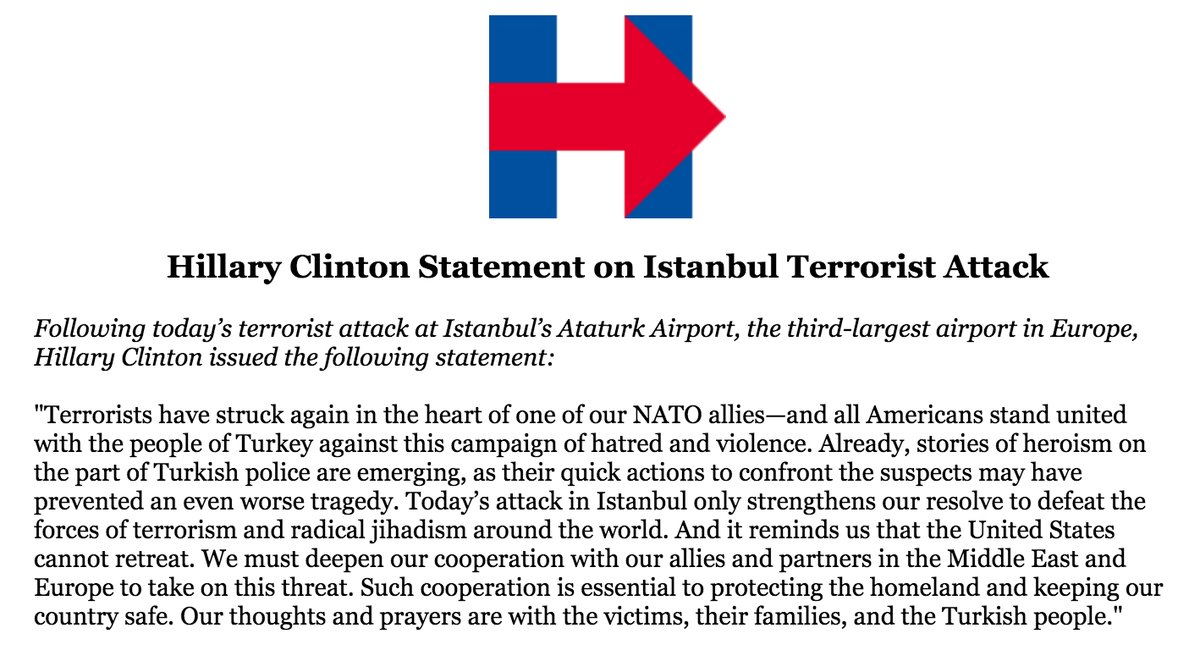
Hillary Clinton's Statement on the Terrorist Attacks in Turkey

"All Americans stand united with the people of Turkey against this campaign of hatred and violence." —Hillary
turkeyattack

Wednesday, December 5, 2012

Hillary Clinton's Last Press Availability From NATO HQ As SOS

Over the past few weeks and months we have seen many "lasts."  It is bittersweet since we have loved following Mme. Secretary's diligent service, but having we watched also have an idea of how the physical investment has  weighed on her.  There are only a few weeks left for her in this post, and here, to the press, she uses the word "final" perhaps for the first time.


Press Availability Following Ministeral Meetings at NATO Headquarters

Press Availability
Hillary Rodham Clinton
Secretary of State
NATO Headquarters
Brussels, Belgium
December 5, 2012

SECRETARY CLINTON: Well, good afternoon. Well, today marks my final attendance at a NATO foreign ministerial. I’ve spent a good amount of time in this building during the past four years, and I think it was time well spent. The alliance has made great strides, and we’ve seen, just in the past 24 hours, how much ground member-states can cover when we are working together. And it proves, once again, why this alliance is one of the greatest forces for security and stability in history.
Yesterday, at the meeting of the North Atlantic Council, we reached a decision to augment Turkey’s air defenses to protect against a threat of ballistic missiles from Syria and reinforce our commitment to Turkey’s security. The United States expects to make a contribution to this essential NATO mission.
At yesterday’s meeting of the NATO-Russia Council, we reviewed our extensive cooperation with Russia in places like Afghanistan and also spoke frankly about the areas of disagreement that continue to exist between NATO and Russia, including Georgia’s sovereignty and territorial integrity and the need for a political transition in Syria.
At today’s meeting with our non-NATO ISAF partners, we reviewed the situation on the ground in Afghanistan as the transition to 2014 continues, when the Afghan National Security Forces will have full responsibility for Afghanistan’s security, with the U.S. and ISAF forces in a supporting role. And we discussed the need for an efficient, transparent, accountable mechanism to channel the international community’s contributions to the Afghan forces.
At the NATO-Georgia Commission meeting this morning, we continued our conversation with Georgia about how it can keep making progress toward NATO, especially by continuing to strengthen democratic institutions, reform their armed forces, and contribute to our common security.
When you take a step back and consider all the important issues that we covered in a single ministerial meeting here at NATO, it reveals, again, how critical our alliance is. After more than 60 years, it keeps us safe; it projects security and stability globally. And through our partnerships, we’re able to do more in more places. For the United States, we find it extremely valuable to be able to consult closely with our European allies on challenges from Syria to the Middle East to North Korea.
When I think back on the past four years and all we have accomplished together, it really is quite impressive: summits in Strasberg, Lisbon, and Chicago that put forth very substantive outcomes; a new strategic concept to guide NATO in the 21st century; a major successful operation in Libya; a plan to protect all allies from ballistic missiles; a substantive dialogue with Russia started again after having been frozen; chartering a course for the transition in Afghanistan; and of course, enlarging the alliance to include Albania and Croatia.
So the United States is grateful to NATO. We believe it’s needed more than ever, and therefore we believe we all must continue to invest in it, politically, financially, diplomatically, and communicate to our people the value that NATO brings, because these investments are worth it.
And finally, on a personal note, I’ve been very proud to work with Secretary General Rasmussen and the extraordinary team here at NATO, along with my foreign ministerial colleagues. And I thank all of them for the excellent working relationship that we’ve enjoyed the past four years.
MS. NULAND: We’ll take three today. We’ll start with AP, Brad Klapper, please.
QUESTION: Yes. Thank you. Madam Secretary, you and National Security Advisor Donilon have spoken with your Egyptian counterparts about Egypt’s constitution process, but you’ve expressed no public concern, despite what some people in your Administration warn is the draft’s attempts to roll back the rights of women, religious minorities, freedom of speech, and the press. Madam Secretary, what shortcomings do you see in the draft constitution, and what would be the repercussions of the constitution entering into force on the democratic transition? Thank you.
SECRETARY CLINTON: Well, Bradley, first let me say we have been watching very closely this process as it is unfolding in Cairo with concern. We’ve expressed that repeatedly over the last weeks. Because almost two years the Egyptian people took to the streets because they wanted real democratic change. And they, therefore – not the Americans, not anyone else but the Egyptian people – deserve a constitution that protects the rights of all Egyptians, men and women, Muslim and Christian, and ensures that Egypt will uphold all of its international obligations. They also want and deserve a constitutional process that is open, transparent, and fair and does not unduly favor one group over any other.
So the upheaval we are seeing now, once again in the streets of Cairo and other cities, indicates that dialogue is urgently needed, and it needs to be a two-way dialogue, not one side talking at another side, but actual, respectful exchanges of views and concerns among Egyptians themselves about the constitutional process and the substance of the constitution. It’s also important that Egypt’s courts be allowed to function during this period.
So we call on all stakeholders in Egypt to settle their differences through democratic dialogue, and we call on Egypt’s leaders to ensure that the outcome protects the democratic promise of the revolution for all of Egypt’s citizens. Ultimately, it is up to the Egyptian people to chart their way forward. But we want to see a process that is inclusive and a dialogue that is truly open to a free exchange of ideas that will further the democratic process in Egypt.
MS. NULAND: Next will be Javid Hamim from Pajhwok News Agency, Afghanistan.
Please.
SECRETARY CLINTON: Oh, here? Here.
QUESTION: Thank you. What is the latest development of negotiation about bilateral security agreement with Afghanistan, and what’s its impact on negotiation and reconciliation?
SECRETARY CLINTON: Well, I think we are off to a productive start about the bilateral security agreement. It follows, as you know, on the Strategic Partnership Agreement that we signed between the United States and Afghanistan last May. And with the launching of the talks on a bilateral security agreement, we’ve had the first round of negotiations November 15th. There is an agreed date to have the next round with the goal being to conclude an agreement within one year. And these talks really illustrate our commitment to a post-2014 Afghanistan that can secure itself and to a political process that is able to move Afghanistan further toward democracy and stability that respects the rights of all Afghans, and which puts into writing the partnership that the United States and Afghanistan enjoy.
We also continue to support an Afghan-led, Afghan-owned reconciliation process. Ultimately, we believe there has to be a political resolution to the ongoing disputes among themselves. So the United States strongly supports that and we would like to see progress made. We think the two are reinforcing, because we want everyone in the region to know that the United States intends to stand by the people of Afghanistan, and that we want to see all Afghans enter a political process, lay down their arms, absolutely denounce violence, and work together for the betterment of their country.
MS. NULAND: Last one today will be Alexandra Mayer DPA, Germany.
QUESTION: Right here, Madam Secretary. Just to get back on the Patriot missiles, how worried are you that this deployment could actually intensify tensions in the region rather than calm down the situation? And is the United States ready to go further if there are chemical weapons used inside Syria or against neighbors? Thank you.
SECRETARY CLINTON: Well first, I think it’s a great tribute to NATO that this decision to deploy the Patriots was taken, because it’s very much in line with our solidarity among all of the members. This is for defensive purposes; that’s made absolutely clear in the statement that was agreed upon. It is solely for the defense of Turkey. It will have no offensive or other purpose. I don’t believe that it necessarily brings any greater attention to the tragedy unfolding in Syria, but it does send a clear message to the Syrians that Turkey has the full support of all its NATO allies.
And I have to say again what I said on Monday, what President Obama has said repeatedly: We’ve made our views absolutely clear to the Syrians, to the international community, through various channels – public, private, direct, indirect – that this is a situation that the entire international community is united on. And our concerns are that an increasingly desperate Assad regime might turn to chemical weapons or might lose control of them to one of the many groups that are now operating within Syria. And so as part of the absolute unity that we all have on this issue, we have sent an unmistakable message that this would cross a redline and those responsible would be held to account. And we intend to make that view as clear as we possibly can.
Now ultimately what we should be thinking about is a political transition in Syria and one that needs to start as soon as possible. Now that there is a new opposition formed, we are going to be doing what we can to support that opposition. I’m looking forward to the Friends of the Syrian People meeting next week in Marrakesh, where we will explore with likeminded countries what more we can do to try bring this conflict to an end. But that will require the Assad regime making the decision to participate in a political transition, ending the violence against its own people. And we hope that they do so because we believe, as you know, that their fall is inevitable. It’s just a question of how many people will die until that date occurs.
So on Syria there’s great concern here at the alliance but a great solidarity in defending Turkey and sending a clear message to the Assad regime and in trying to work toward the day when we can see the conflict come to an end.
MS. NULAND: Thank you all very much.
12-05-12-Y-001

Sunday, August 12, 2012

Bits and Pieces: Hillary Clinton in Turkey

We all hope that Mme. Secretary has arrived home from this marathon trip and is starting a well-deserved rest and vacation in East Hampton. Here are a few pictures from her visit to Turkey yesterday. She met with Syrian refugees, with Prime Minister Erdogan, President Gul at the Tarabiya Palace, and, of course, with her counterpart, Ahmet Davutoglu with whom she gave a press availability.


Saturday, August 11, 2012

Hillary Clinton: Wheels Up Istanbul

U.S. Secretary of State Hillary Clinton waves as she leaves Istanbul, August 11, 2012. REUTERS/Jacquelyn Martin/Pool (TURKEY - Tags: POLITICS)
We hope she is FINALLY headed home. Awesome work, Mme. Secretary! You reassured our friends in Africa and warned those who might consider election tampering there.  Your visit to Nelson Mandela warmed our hearts.  Malawi  - what can we say?  They loved you,  and we love them for how they received you.  This was an eminently successful trip ending with some very strong partner decisions on Syria.  Brava!  Now please come home safely and take what is left of your vacation!  We love you!

(It's really hard to ignore the fact that Mme. Secretary is simply adorable.  Adorable!)

Hillary Clinton's Remarks On Syria With Turkish Foreign Minister Davutoglu

Remarks With Foreign Minister Davutoglu After Their Meeting

Remarks
Hillary Rodham Clinton
Secretary of State
Conrad Hotel
Istanbul, Turkey
August 11, 2012

FOREIGN MINISTER DAVUTOGLU: (Via translator.) Today (inaudible) Her Excellency, the Secretary of State of America, Ms. Hillary Clinton. This is the (inaudible) time that she (inaudible) visit to -- the second time that we were able to visit together. (Inaudible) and anti-terrorism, and she (inaudible). Recently we also attended United Nations initiatives in Paris and Geneva.
Today we came together again in order to (inaudible) recent developments, particularly within the conflict with Syria. Some very important developments took place concerning Syria there recently (inaudible). Unfortunately, the transition plan that we (inaudible) Geneva (inaudible), unfortunately, and diplomatic activities were interrupted significantly.
(Inaudible) international community efforts in order to (inaudible) contribute to peace-building process in the Middle East. However, the resignation of Kofi Annan had negative repercussions on the diplomatic efforts in the region. And the humanitarian situation in the Middle East and Syria, particularly, is not very promising. Now we have more than 55,000 refugees (inaudible) in Turkey. And every day 3,000 refugees want to enter from Turkish borders. We always want to open our doors to our Syrian brothers and sisters, and we have been mobilizing our resources in order to help them as much as we can. But this increasing number of refugees is a clear indicator of the deteriorating humanitarian conditions in Syria. And we expect that broader collaboration on the part of the international community in order to resolve this issue.
As long as the Syrian conflict continues, the humanitarian situation will deteriorate even further. So, as soon as possible, we need to take decisive steps in order to stop the deterioration of humanitarian conditions in Syria. What is going on in Aleppo is particularly very sad. The air strikes do not only cause humanitarian but also social and historical damage. So the international community needs to take some very decisive steps in order to stop it. And we talked about (inaudible) Ms. Hillary Clinton. The transition process in Syria needs to be completed as soon as possible. And there should be no room for power vacuum in the transition process, because terrorist organizations like PKK will try to benefit from a possible power vacuum. That is why we need to take joint efforts in order to prevent the power vacuum from being formed.
We will take up some joint efforts, of course, under the leadership of the United States of America. We will closely follow the developments in Syria and in the broader region. And we will keep evaluating the situation on the ground. In the United Nations General Assembly, the Security Council, and as friends of Syria, we will also take some steps in the future. We talked about (inaudible) as well. We will look at the reality on the ground, international aid, and also the humanitarian situation. So, Ms. Clinton's visit is indeed a very timely one. And from that one we will also keep following the situation together through conference calls and through delegations.
We also talked about (inaudible) Egyptian soldiers, which is a very sad development. And Syria has also problems with its neighbors right now, like Tunisia.
And I would like to say welcome to Ms. Hillary Clinton again. The floor is yours.
SECRETARY CLINTON: Thank you very much, Minister. And again, it is a great pleasure for me to be here in Istanbul. I want to begin by expressing my condolences for the injuries and loss of life sustained in the PKK's vicious attack on a Turkish military bus two days ago.
I want to thank you for the opportunity for these consultations. Since the Friends of Syrian People met over a month ago in Paris, the crisis has deepened significantly. As the opposition has gained strength, the regime has responded with brutal violence. Even many of the regime's previous supporters are now distancing themselves and there have been a series of high-level defections. The United Nations General Assembly overwhelmingly passed a resolution condemning the Assad regime and calling for a peaceful political transition. Unfortunately, Russia and China blocked needed action in the Security Council.
Today we met to discuss what the United States and Turkey can do together, along with our international partners and our friends inside and outside of Syria, to respond to this growing humanitarian and political crisis. In particular, we had detailed conversations about three urgent priorities. First, supporting the opposition and their efforts to end the violence and begin the transition to a free and democratic Syria without Assad. The United States continues to provide the opposition with communications equipment and other forms of non-lethal assistance and direct financial assistance. We are coordinating our efforts with others who are also providing various forms of support.
Today we compared notes between the American and Turkish teams on support for the opposition, developing a common operational picture, and discussing how we can enhance our collaboration between ourselves and along with others to hasten the end of the violence.
As we work to help the opposition inside Syria, we are continuing to increase pressure from outside. Yesterday in Washington we announced sanctions designed to expose and disrupt the links between Iran, Hezbollah, and Syria that prolonged the life of the Assad regime. We urge other governments to support our sanctions with additional actions of their own.
Second, even as we seek to hasten Assad's fall, we are also responding to the massive emergency humanitarian crisis that he has caused. United Nations estimates that approximately two million people inside Syria need assistance, and more than 140,000 others have fled to Syria's neighbors. As you heard the minister say, around 50,000 to 55,000 of them are here in Turkey, and more are likely on the way.
I have to thank the government and the people of Turkey for your very generous hospitality to these men, women, and children who are fleeing for safety. Turkey has literally not only opened your borders, but your arms and your hearts.
And just now the minister and I met with a small group of Syrian women living in the Turkish camps. I have been in many meetings with refugees. I never have been in a meeting where all of the refugees uniformly praised their host government for the wonderful reception and support they have received. We heard their terrible stories. One woman fled after the regime's forces burned down her village. Another came after they broke into her home, beat her and her children. And I simply cannot say enough about what Turkey is doing to support the victims of this unrelenting cruelty. The government is providing Syrians in the Turkish camps with shelter, food, access to health and education services at a very great financial cost.
As the need continues to grow, so does our response. Today I am announcing we plan to contribute an additional $5 million to the United Nations High Commission for Refugees, and $500,000 to the International Organization for Migration to support displaced Syrians inside Turkey. With these contributions, the United States is now providing nearly $82 million for food, emergency healthcare, blankets, hygiene kits, and other humanitarian relief.
Now, no one can predict how soon this regime will finally be brought to an end. But we know the day will come. So our third urgent task is to prepare for what comes next. The Syrian people will, of course, and must leave the transition, and they will need to maintain the integrity of the state's political institutions. They will need to stabilize and eventually rebuild their economy to establish security, safeguard, and eventually destroy the country's most dangerous weapons, including its chemical weapons. They will need to protect the rights of all Syrians, regardless of religion, gender, or ethnicity. And they will need to address the ongoing human and humanitarian challenges. All of this will need careful planning and support from the international community.
Last month major opposition groups came together in Cairo to voice their support for a detailed transition plan and a vision of Syria that is united, pluralistic, and democratic. They have since begun to rally support for this plan inside Syria. Today we consulted with each other on how we can all support that plan and, at the same time, prepare for a range of contingencies. From here, we will engage other partners as we get ready for the upcoming international meetings in the coming weeks.
I also met with a group of activists -- legal experts, journalists, student leaders -- to hear about their efforts, and to discuss what more the United States can do to support them.
And finally, we again expressed our solidarity with Turkey in confronting the PKK terrorists, and our condolences to the families of those who have fallen to such cowardly attacks. We share Turkey's determination that Syria must not become a haven for PKK terrorists, whether now or after the departure of the Assad regime.
Now, I think it is important to state that we have a difficult road ahead us, but the real difficulty is for the Syrian people themselves. But in each of the areas I have mentioned, and so much more, Turkey is a leader. And we are proud that Turkey is our partner.
I thank the minister once again for his efforts to help the Syrian people. I am looking forward to discussing this and other issues with the prime minister and president later this afternoon. But again, let me thank you for these very important consultations at such a critical time.
FOREIGN MINISTER DAVUTOGLU: Thank you.
MODERATOR: We will take a few questions and then (inaudible).
QUESTION: Madam Secretary, for you, can you tell us a little bit more in detail about your meeting with the opposition activists? Did you get a better sense of whether they are really prepared to be able to be involved in leading a transition? What kind of questions did you ask them about who is actually doing the fighting on the ground? And what kind of answers did you get?
And then, for both of you, there has been a lot of talk about this common operational picture. What exactly is that common operational picture? Does it involve the potential of this corridor from Aleppo, north to the border here, turning into some kind of safe haven? And does it include anything on how to deal with the chemical weapons that everyone has expressed concern about? Thank you.
SECRETARY CLINTON: Well, first, with respect to the activists with whom I met, I listened carefully to their descriptions of what each was doing. One young man had just come out of Aleppo, and was intending to return. They, to a person -- there were both men and women there -- are committed to a pluralistic, democratic, inclusive Syria. And each is doing his or her part.
There is work going on about telling the story. There is no free media inside Syria, as there is, very evidently, here in Turkey. So how does the story get out in an authoritative way?
And another talking about the work being done on justice and accountability, documenting the abuses that are occurring so that there will be no impunity when there finally is a new government and a new opportunity for the Syrian people to hold those who perpetrated these abuses accountable.
A lot of attention, particularly from the women, to what is happening to women inside Syria, the abuses that they are subjected to by the regime, the need for women to be partners in a new Syria, to be heard and to participate as they try to form the basis for a transition.
We heard from the representatives of the students who are still peacefully protesting on university campuses and trying to organize and support the opposition. There was concern expressed about the apparent lack of unity among the outside opposition and a hope that, as one young man said, the opposition will rise to the occasion and be able to present a unified front, both inside and outside of Syria, going forward.
We heard firsthand, as I said, from the young man who had just been in Aleppo about the tremendous courage of those who are withstanding the assaults from tanks and aircraft, and how important it is to work for ways to support those on the ground without making the suffering worse. There is a very clear understanding about the need to end this conflict quickly, but not doing it in a way that produces even more deaths, injuries, and destruction.
So, I came away very impressed by these young activists, and very committed to increasing the assistance we are already providing. Several of those present have already received support from the United States. As you know, we are providing $25 million in non-lethal aid, mostly communications, to civil society and activists. And I don't want to go into any further details as to how we are helping people, at the risk of endangering them at this time.
Regarding the planning, what the minister and I agreed to today was to have very intensive operational planning. We have been closely coordinating over the course of this conflict. But now we need to get into the real details of such operational planning. And it needs to be across both of our governments. Certainly our two ministries are coordinating much of it. But our intelligence services, our military, have very important responsibilities and roles to play. So we are going to be setting up a working group to do exactly that.
And both the minister and I saw eye to eye on the many tasks that are ahead of us, and the kinds of contingencies that we have to plan for, including the one you mentioned in the horrible event that chemical weapons were used. And everyone has made it clear to the Syrian regime that is a red line for the world, what would that mean in terms of response and humanitarian and medical emergency assistance, and of course, what needs to be done to secure those stocks from every being used, or from falling into the wrong hands.
FOREIGN MINISTER DAVUTOGLU: (Via translator.) Concerning our joint efforts, Ms. Clinton already informed extensively. There are two main focal points for us. One the one hand, again, some possible worst-case scenarios. We are going to be (inaudible) to plan how we are going to react as the international community and as United States of America and Turkey.
Recent developments in Aleppo have shown that a gigantic wave of migration can result from all these atrocities. And there might also be some groups who might try to benefit from a possible power vacuum. And we have seen signs of this recently in certain regions in Syria. And another potential threat is the chemical weapons, as we have already mentioned. So, against all the possible worst case scenarios, we decided to work together and of course include some other international actors as well.
If there is a huge wave of refugee migration, then we need to maybe establish a mechanism within Syria in order to ensure humanitarian protection. Of course, we might try to protect people if they seek refuge in our territory. But they have to (inaudible) bombardment every day in Syrian territory. If they are exposed to air strikes every day and bombardments every day, this might even be considered war crime. So, in such a case, an international community can no longer keep its silence, and there are certain measures that need to be taken up, in addition to UN-level negotiations.
Turkey is putting utmost effort in order to ensure the protection of Syrian people. Turkey and the United States of America have been working in a coordinated manner already, but we need to brace for impact. So we need to focus on more practical, more pragmatic, and to-the-point solutions. This is the decision that we have taken.
And after the transition period, a new Syria will emerge. And we will have to establish law and order and public order in that new Syria. We need to ensure that the transition is a smooth one, and there will be no room for ethnic conflicts in Syria. So we need to prepare for this future Syria today, as international community, in order not to encounter some unpleasant surprises in the future. So we need to be ready for any possible crisis, and we need to prepare for the future of Syria.
We had already been working in a coordinated manner with United States of America. But now our coordination will become even more systematized and structured. Today's meeting has been a very fruitful one in order to lay the foundation for this.
QUESTION: Hi. (Inaudible.) Madam Secretary, you mentioned you met Syrians this morning. But Syrians I have spoken to inside or outside Syria are extremely frustrated with international -- what they see as the international community's lack of response. And they basically feel left alone at this point.
You talked about non-lethal aid. You talked about post -- day-after planning. You talked about helping refugees. But in terms of given that Aleppo is being bombarded, and given that there is a huge suffering inside major cities and about roughly over 100 people die every day, have you also discussed actionable, tangible steps, whether it is safety zones, no-fly zones, Security Council resolutions, or other forms of assistance that could impact their day-to-day life?
And quickly, I wanted to follow up, if you don't mind, just -- there is a good deal of anxiety in Turkish public about the Kurdish presence and potential PKK presence in the northern parts of Syria. In your assessment, is this something that concerns you? And, you know, have you looked into the PKK presence or power? And what is your assessment on that? Thank you.
SECRETARY CLINTON: Thank you. As to your first question, the issues you posed within your question are exactly the ones that the minister and I have agreed need greater in-depth analysis. It is one thing to talk about all kinds of potential actions. But you cannot make reasoned decisions without doing intense analysis and operational planning. And we share not only the frustration, but the anger and outrage of the Syrian people at what this regime continues to do. But we also are well aware that its brutality seems to know no bounds. And there is no -- you know, there is no doubt in the minds of the minister or myself that anything we do should be to hasten and lessen bloodshed, not to catalyze even greater and more horrible kinds of assaults.
So, really doing contingency planning, sorting this out, is what we have agreed to do. We have a very long list that we have gone through this morning on all kinds of issues, both before the inevitable fall of Assad and after. But we have to be very careful, and we have to do it in a way that always keeps in mind our goal, number one, is to hasten the end of the bloodshed and the Assad regime. That is our strategic goal. And we have to analyze everything against that goal. And then, of course, we want to be good partners in helping the Syrian people build the kind of democratic, pluralistic society and government that will respect human rights and restore a better future. So, this is how we are proceeding.
Regarding the PKK, let me just underscore that the United States remains strongly committed to the defense of our Turkish ally. Together we are working to root out violence extremism and to address the many regional security issues we face. And amongst those we stand firmly with Turkey against the PKK.
Now, your question was is there reason to worry about enhanced PKK activity arising out of the vacuum created by violence and the brutality of the regime within Syria, and the answer is yes. We worry about terrorists, PKK, al-Qaeda, and others taking advantage of the legitimate fight of the Syrian people for their freedom to use Syria to promote their own agendas, and even to perhaps find footholds to launch attacks against others.
So, we are absolutely committed to supporting Turkey against the PKK, and we will do so in any way that protects Turkey and the people of this nation from this kind of terrorism.
FOREIGN MINISTER DAVUTOGLU: (Speaks in Turkish.)


In Turkey Hillary Clinton Talks No Fly Zones Over Syria


Visit NBCNews.com for breaking news, world news, and news about the economy


If she manages to get another NFZ, remember that you heard it first here. 

US, Turkey explore no-fly zones over Syria

By NBC News staff and wire services
ALEPPO, Syria -- The United States and Turkey indicated on Saturday they might impose no-fly zones in Syria as battles between rebels and President Bashar al-Assad's forces shook Aleppo and fighting erupted in the heart of Damascus.
U.S. Secretary of State Hillary Clinton said after meeting her Turkish counterpart Ahmet Davutoglu in Istanbul that Washington and Ankara should develop detailed operational planning on ways to assist the rebels fighting to topple Assad.
"Our intelligence services, our military have very important responsibilities and roles to play so we are going to be setting up a working group to do exactly that," she said.
Read more >>>>

SECRETARY HILLARY RODHAM CLINTON: Public Schedule for August 11, 2012


Public Schedule for August 11, 2012


Public Schedule
Washington, DC
August 11, 2012


U.S. DEPARTMENT OF STATE
PUBLIC SCHEDULE
SATURDAY, AUGUST 11, 2012

SECRETARY HILLARY RODHAM CLINTON


Secretary Clinton is on foreign travel to Istanbul, Turkey. Secretary Clinton is accompanied by Counselor Mills, Assistant Secretary Gordon, Acting Assistant Secretary Jones, Spokesperson Nuland, Director Sullivan, and VADM Harry B. Harris, Jr., JCS. Please click here for more information.

10:30 a.m. LOCAL Secretary Clinton meets with Syrian activists, in Istanbul, Turkey.
(CLOSED PRESS COVERAGE)

11:30 a.m. LOCAL Secretary Clinton meets with Turkish Foreign Minister Ahmet Davutoglu, in Istanbul, Turkey.
(POOLED CAMERA SPRAY)

12:30 p.m. LOCAL Secretary Clinton meets with Syrian refugees, in Istanbul, Turkey.
(CLOSED PRESS COVERAGE)

1:30 p.m. LOCAL Secretary Clinton holds a joint press availability with Turkish Foreign Minister Ahmet Davutoglu, in Istanbul, Turkey.
(OPEN PRESS COVERAGE)

2:00 p.m. LOCAL Secretary Clinton meets with Turkish Prime Minister Tayyip Erdogan, in Istanbul, in Turkey.
(POOLED CAMERA SPRAY)

4:00 p.m. LOCAL Secretary Clinton meets with Turkish President Abdullah Gul, in Istanbul, in Turkey.
(POOLED CAMERA SPRAY)

Sunday, August 5, 2012

Hillary Clinton's Trip Extended **Updated with More Bits and Pieces**

It appears that Mme. Secretary's current trip will be extended into next weekend.  The original itinerary posted by DOS had her departing  South Africa for home on Friday August 10.  Last night I shared an article from a Liberian  source stating that HRC and Ellen Johnson Sirleaf would, on August 10, be in Ghana for the funeral of the late President John Atta Mills.


Now Voice of America is announcing that next Saturday,  Mme. Secretary will be in Istanbul over issues related to Syria.
Clinton to Turkey
U.S. Secretary of State Hillary Clinton is expected to visit Turkey next Saturday to discuss the deteriorating situation in Syria.
State Department spokeswoman Victoria Nuland said in Malawi, Clinton's latest stop on her African tour, that the U.S. top diplomat is going to Istanbul "for bilateral consultations with the Turkish government on Syria, as well as to cover other timely issues."
Read more >>>>
Will she ever get off that plane and have some summer vacation time?

EDITED TO ADD THIS:  In three-and-a-half years of  following Mme. Secretary's travels on this blog I have never encountered the level of intrigue and rumor engendered by this Africa trip.  Now there is this.

Hilary Clinton visits Nigeria on August 9

Sunday, 05 August 2012 12:38 Agency Reports

President Goodluck Jonathan’s Special Adviser on Media and Publicity, Dr. Reuben Abati has confirmed that the American Secretary of State, Mrs. Hillary Clinton, will be visiting  to Nigeria on Thursday.
Abati who urged Nigerians to disregard the rumour that Mrs. Clinton had excluded Nigeria from the list of African countries she was billed to visit, said the American Secretary of State is expected to meet President Jonathan.
Read more >>>>
Well, yes, Nigeria was among the countries she was expected to visit, but was not on the itinerary released by DOS on July 30, and that itinerary has not been  updated officially.  The Turkish leg of the trip is reliably sourced by VOA, but this source is unverified.  Nothing from DOS or any other U.S. government source confirms this nor do we have any official announcement as to exactly why Nigeria was excluded in the first place - rumors swirl around that issue as well.  After a false report last night put her erroneously on the ground in South Africa, this also raises some skepticism.  Why, if she were going to visit Nigeria, would she not have stopped there on the east African leg of her trip?  Why double back?  (Unless President Jonathan indeed was himself on a trip when she was in the region last week.) 

It is highly unlikely that there will be another Africa trip in these  waning days of Mme. Secretary's tenure at State.  Apparently every African head of state would like to be able to host her before she steps down.

Sunday, June 24, 2012

Hillary Clinton Condemns Syrian Downing of Turkish F-4 in the Strongest Possible Terms

Syrian Shoot-Down of Turkish Aircraft


Remarks
Hillary Rodham Clinton
Secretary of State
Washington, DC
June 24, 2012

I spoke with Turkish Foreign Minister Davutoglu yesterday to convey our grave concern about the downing of a Turkish F-4 fighter jet by Syrian forces on June 22. I also told him that our thoughts and prayers are with the missing pilots and their loved ones. The Foreign Minister briefed me on the specifics of the incident, including that the Syrian military shot its plane down without warning. The United States condemns this brazen and unacceptable act in the strongest possible terms. It is yet another reflection of the Syrian authorities' callous disregard for international norms, human life, and peace and security.
The United States reaffirms its strong support for the Turkish Government and its solidarity with the Turkish people in the wake of this incident. We will maintain close contact with Turkish officials as they continue to investigate the incident and determine Turkey's response, including in the Security Council. We will work with Turkey and other partners to hold the Assad regime accountable.
Turkey has been a leader in the international community's effort to address the Syrian regime's violence against its own people. We will continue our close cooperation with Turkey as part of our broader efforts to promote a democratic transition in Syria. This work is urgent, and we will be consulting in New York with the Security Council, in Brussels with NATO and the EU, and in Geneva with Special Envoy Kofi Annan on next steps.

Thursday, June 7, 2012

Hillary Clinton With Turkish Foreign Minister Ahmet Davutoglu


Remarks With Foreign Minister Ahmet Davutoglu After Their Meeting


Remarks

Hillary Rodham Clinton
Secretary of State
Istanbul, Turkey
June 7, 2012

MODERATOR: (In Turkish.) We will now begin the award ceremony. United States Ambassador to Turkey Francis Ricciardone will officiate.
AMBASSADOR RICCIARDONE: Thank you very much. Our country owes a great debt of gratitude to Turkey and especially to Ambassador Sahinkaya for his tenacious advocacy and support for Americans in distress during the assisted departure of American citizens from Libya last year. Ambassador Sahinkaya and his skillful and persistent efforts on behalf our four New York Times journalists in March of 2011 testify to the durability and the importance of the Turkish-American friendship. At a time of considerable peril and uncertainty, we were very fortunate to have a diplomatic Ambassador Sahinkaya’s fortitude and integrity and skill tending to our shared interest during the Libyan crisis. And so Madame Secretary, if you would be so kind to hand the plaque over to Ambassador Sahinkaya.
(Applause.)
Thank you very much.
FOREIGN MINISTER DAVUTOGLU: (In Turkish.)
SECRETARY CLINTON: Well, thank you very much, Ahmet. And thank you and your team for the excellent preparations for this first ministerial meeting of the Global Counterterrorism Forum. You just heard from the minister an overview of all that we have been working on. The United States views this forum as an excellent opportunity to pursue our common goal of making the world safe from terrorism, but doing it in a way that is in keeping with human rights and the rule of law. And the announcements that Ahmet just related about continuing work that we will do evidences the approach that we are taking, and I’m very pleased that in just the few short months of its existence, the Global Counterterrorism Forum has already helped generate smart and achievable strategies for combating terrorism, and the United States looks forward to continuing our work.
On a few other issues, I want to thank the minister for the meeting that he hosted last night, the ad hoc meeting on Syria intended to intensify our efforts to support the Syrian people, given the urgency of the situation. The regime-sponsored violence that we witnessed again in Hama yesterday is simply unconscionable. Assad has doubled down on his brutality and duplicity, and Syria will not, cannot be peaceful, stable, or certainly democratic until Assad goes. So even as we intensify the sanctions pressure, because as we were meeting in Istanbul, the sanctions working committee of the Friends of the Syrian People was meeting in Washington, the time has come for the international community to unite around a plan for post-Assad Syria. And last night we discussed a number of the steps that we intend to take together.
I will just mention a few of the key elements and principles that are focusing our work. First, the Syrian Government must implement all six points of the Annan initiative, including a real ceasefire agreed to and observed by all parties. Second, Assad must transfer power and depart Syria. Third, an interim representative government must be established through negotiation. And we are firm in our core principles, and we believe we have to keep faith and do justice to the aspirations of the Syrian people. The transition phase must lead to a democratic, representative, and inclusive government. There must be civilian control of the military and security forces and respect for the rule of law and equality before the law for all Syrians regardless of background.
We know that many still cling to the Assad regime because they fear change more. And we have consistently made clear that we support a positive, inclusive democratic transition roadmap. And we have to bring people to that vision and, in effect, move them away from the Assad regime so that they can’t imagine a better future for themselves and Syria.
And secondly, we have to unite the international community behind a plan that is achievable and keeps faith with those inside Syria who are protesting and demonstrating, suffering, and dying for their universal human rights.
We said last night we are prepared to work with any country, including all members of the UN Security Council, and we will do so so long as any such gathering starts from the basic premise that Assad and his regime must give way to a new democratic Syria, and we have to continue to put more pressure and we urge all nations to impose and implement sanctions and close loopholes in existing measures. And we also pledge to improve coordination among the countries that are working with the Syrian opposition. We look forward to a meeting of experts on this subject with representatives of the civilian opposition, hosted by Turkey again in Istanbul at the end of next week. I will be meeting with Kofi Annan tomorrow in Washington. I’ve asked my special advisor on Syrian affairs to go to Moscow tomorrow to discuss the need for a political transition with the Russian Government, and I think we are resolute. None of us is satisfied that the killing continues, but we are determined to move forward together and we reaffirmed that commitment yesterday.
Finally, the foreign minister and I and also the Deputy Prime Minister Ali Babacan and I had an opportunity to review the range of issues our countries are confronting together, including strengthening the economic partnership and cooperation on the transitions in the Middle East and North Africa. And I want to underscore – it probably goes without saying, I said it this morning, I think I’ve said it on every trip to Turkey – the United States stands strongly with Turkey in your fight against the PKK whose long campaign of violence has claimed tens of thousands of lives. And again, let me thank the Ambassador on behalf of the American people for your excellent work in a very difficult time and place.
The United States and Turkey have such a strong and far-ranging relationship that every time Ahmet and I get together, we run out of time before we run out of things to discuss. So I’m grateful for the strong partnership we have, and I look forward always to continuing to deepen and strengthen it in the months and years ahead. Thank you.
FOREIGN MINISTER DAVUTOGLU: Thank you.
SECRETARY CLINTON: Thank you, my friend. (Applause.)
MODERATOR: We will take four questions and we’ll start with the American press. Anyone from the American press?
QUESTION: Yes, Elise Labott.
SECRETARY CLINTON: Elise?
MODERATOR: Yes, ma’am. Elise.
QUESTION: Thank you. This question is for both of you. A lot of the points that you have laid out in this vision for a roadmap are not necessarily new. You’ve been talking about them since you called on President Assad to step down. So what about this vision do you think is even going to help the Russians – convince the Russians to squeeze President Assad to step down? And if they don’t, at what point do you say this violence, as you said, is unconscionable, we need to move ahead without the Russians?
And specifically for the foreign minister, do you believe that, as Kofi Annan is suggesting and as Russia is suggesting, that Iran should be part of international mediation efforts? Thank you.
SECRETARY CLINTON: Well, let me start. And I think it’s clear to everyone that the violence continues; in fact, if anything it seems to worsen. And we have not been successful yet in bringing about the kind of international action that will make a difference to the Assad regime, but I believe that we are continuing to move in that direction. And clearly, we have to reiterate our unity, we have to send a clear message to other nations that are not yet working with us or even actively supporting the Assad regime, that there’s no future in that. And indeed, planning for an orderly transition, we think, will be an important step, because as I said, there are still many inside Syria – and this is human nature – this is totally understandable – who are not yet convinced that there can be a transition that would not make the situation worse for them, their families, their group, their location.
And so we recognized in our meeting last night we have to do more. We also have to do more with the opposition. The opposition has work to do, and that’s why I mentioned that Turkey will convene a meeting of the opposition. Many of us have been working – both Turkey and the United States have – with elements of the opposition. Now it’s difficult for those inside Syria to leave Syria to come to a meeting, but we have to do more to help organize and focus the opposition.
And finally, we think it is important for us to give Kofi Annan and his plan the last amount of support that we can muster, because in order to bring others into a frame of mind to take action in the Security Council, there has to be a final recognition that it’s not working. And he will be addressing the Security Council today and, as I said, I will see him tomorrow.
And on your last point, regarding Iran, it is hard, for the United States certainly, to imagine that a country putting so much effort into keeping Assad in power, and in effect – as I said yesterday in Baku – helping to stage-manage the repression on the people of Syria, would be a constructive actor. And we think that would not be an appropriate participant at this point to include.
FOREIGN MINISTER DAVUTOGLU: (In Turkish.)
QUESTION: (In Turkish.)
SECRETARY CLINTON: Well, first, as to the transition in Syria, there are a number of examples that I would point to, but perhaps the most recent is the transition in Yemen. It took, frankly, more than a year. It took a lot of international effort. And finally, then-President Saleh gave up power because the pressure, the sanctions, the isolation was just too much. And so he – actually, after clashes and deaths and threats of civil war, he left power. There is now a new president, and there seems to be some consolidation of social stability and security going on in Yemen. It’s too soon to make predictions, but the transition occurred.
So this is a recent example in the region that we can point to. It’s not at all out of the question that something like that could be presented. But in any event, we know that keeping the pressure up, the economic pressure, the isolation, building the case, making the argument to those who are worried about the alternative or supporting Assad, is the hard work of diplomacy. Ahmet and I would like to be able to stand up here and make a pronouncement and save the lives of innocent Syrians. We’re disgusted by what we see happening. But we know that the hard work ahead requires getting more and more people to agree with us that there must be a transition and to help facilitate it.
With respect to our fight against terrorism, we work very closely together, and in fact, we are learning every week how we can be more closely knit together to cooperate and to support Turkey’s fight against the PKK. I will not discuss potential arms transfers that have not been formally notified to Congress, but I will say that the extensive assistance that we currently provide is going to intensify through closer cooperation and planning, and both the foreign minister and I are committed to making sure both of our governments are as focused and coordinated as we can be going against those that threaten Turkey and Turkish lives.
MODERATOR: I think he has a question over there.
SECRETARY CLINTON: Yeah.
QUESTION: Yes. Madam Secretary, thank you. You met with many of the most concerned allies here not only about Syria, but about Iran. With just a little over 10 days to go until your meeting in Moscow, I was wondering if you could say what you expect from Iran and what will happen if you do not reach – if you do not see the concrete actions that you have hoped for. Thank you.
SECRETARY CLINTON: Well, let me start by restating our objective. It’s one that Turkey and the United States and the international community share, and that is to prevent Iran from acquiring a nuclear weapon. And that is why we’ve always pursued a two-track policy of pressure and diplomacy. And the United States is committed to finding a peaceful resolution, but as I have said, looking toward the meeting in Moscow, we want Iran to come to that meeting to begin the serious work necessary to take place in order to reach a diplomatic solution.
So we want them to come prepared to take concrete steps, particularly in the area of 20 percent enrichment, and we have said – and this is a unified position of the international community and those of us in this negotiation, which include Russia and China – that in response to their actions, we are prepared to take actions of our own. I am convinced that one of the reasons that Iran came back to the negotiating table was because of the success of our pressure strategy, and I want to express publicly our appreciation to Turkey. This is not easy to work to reduce global reliance on Iranian oil, to unwind business dealings with the Central Bank of Iran.
But from what we hear from many, many sources, the fact that the international community was so united made it difficult for Iran to escape the realization that they were either going to have to come to the table to negotiate or remain very isolated with economic consequences that would be detrimental to their country. So we look for Moscow to show concrete steps that can be taken, and I’m not going to prejudge the outcome. Everyone’s working very hard to try to make it a positive meeting.
QUESTION: (In Turkish.)
FOREIGN MINISTER DAVUTOGLU: (Laughter.) The question is hard. (In Turkish.)
SECRETARY CLINTON: That was a very thorough answer. (Laughter.) I will not add anything to that other than, once again, to say thank you.
FOREIGN MINISTER DAVUTOGLU: Thank you. Thank you very much.

Hillary Clinton's Opening Remarks at the Global Counterterrorism Forum


Opening Remarks at the Global Counterterrorism Forum


Remarks

Hillary Rodham Clinton
Secretary of State
Conrad Hotel
Istanbul, Turkey
June 7, 2012

Thank you very much, Ahmet, and once again, thank you for hosting us in this beautiful city and for being a steadfast champion of this forum. I want to recognize all of our colleagues around the table. It is often easier to focus on the concerns and crises of the moment, but the long-term partnership we are building through this forum, we believe, will pay off for years to come.
In recent years, the international community has made important strides in the fight against violent extremism in all its forms. We’ve worked together to disrupt terrorist financing; pass new and more effective counterterrorism laws; tighten border, aviation and maritime security; and improve international coordination. Over the past decade, more than 120,000 suspected terrorists have been arrested around the world, and more than 35,000 have been convicted. Usama bin Ladin is dead, al-Qaida’s core leadership ranks have been devastated, and many of its affiliates have lost key operatives. Our citizens are safer because of the work we have done together.
But despite this progress, the danger from terrorism remains urgent and undeniable. The core of al-Qaida that carried out the 9/11 attacks and other attacks in countries represented here today may be on the path to defeat, but the threat has spread, becoming more geographically diverse as groups associated with al-Qaida expand their operations. Terrorists now hold territory in Mali, Somalia, and Yemen. They are carrying out frequent and destabilizing attacks in Nigeria and the Maghreb. Here in Turkey, the PKK continues its long campaign of terror and violence, which has claimed tens of thousands of lives. The United States stands strongly with Turkey in its fight against the PKK. And groups are now actively encouraging lone wolf terrorists like those responsible for recent killing sprees in Europe.
That’s why this forum and the international cooperation it represents are so vital. Just as the threat we face crosses borders and oceans, so must our response. We need a strategic, comprehensive approach to counterterrorism that integrates both military and civilian power that uses intelligence, law enforcement, diplomacy, development, humanitarian assistance, and every possible partner and asset.
Because we have learned that to defeat a terrorist network, we need to do more than remove terrorists from the battlefield. We need to attack finances, recruitment, and safe havens. We need to take on ideology and diminish its appeal, particularly to young people. We need to improve conditions for women, because their security is a bellwether for societies’ security, and we need to help build the capacities of nations that have the political will to take on this fight.
The Global Counterterrorism Forum emphasizes strengthening civilian institutions as a critical part of our strategy. And we’re already taking important steps to put this into practice, building new partnerships with the United Nations and other multilateral bodies, and knitting together far-flung counterterrorism efforts that need better focus and organization.
Let me just highlight two areas where it is essential we continue to make progress.
First, we have to continue working together to defeat extremist ideology, blunt the spread of radicalization, and slow the flow of recruits to terrorist networks. Last summer, the UAE took an important step when it announced it would host the first-ever international center developed to combat extremism and develop those best practices that will do so. I am pleased to announce that the United States will support this effort with both funding and expertise, and that the center, I’m told, will open its doors in Abu Dhabi later this fall, although it already has its own brochure, which is a good step to demonstrate the concreteness of the work that will be done at the center.
Think of what the center can do: Bring together experts on communications who understand how to undermine terrorist propaganda; the smartest minds on law enforcement, who can help governments and communities learn to ward off extremism and expose intruders; scholars of education, who can devise curricula free of hatred and give teachers the tools to protect at-risk children from recruitment by extremists.
The second area I want to mention is the rule of law. Experience tells us that democracies are better equipped than autocracies to stand up against terrorism. They offer constructive outlets for political grievances, they create opportunities for mobility and prosperity that provide alternatives to violent extremism, and they tend to have more effective governing institutions.
The protests of the Arab Awakening struck a devastating blow to the extremists’ ideology. Citizens in the Middle East and North Africa claiming their universal rights, demanding more accountable governments, seeking broader economic opportunities, all without the rhetoric of hate and destruction that al-Qaida claimed was the only way to achieve change. Now the transitions underway have the potential to transform and improve counterterrorism efforts across the region. This forum is helping make that happen.
Last year as a group, we pledged more than $90 million to provide rule of law training for police, prosecutors, judges, and prison officials in countries seeking to turn their backs on more repressive approaches to counterterrorism. I am pleased that today this forum will adopt two sets of sound practices – one for the criminal justice sector, the other on rehabilitation and reintegration of violent extremist offenders in prison. These will advance our work, and I am proud to announce the United States is contributing $15 million to support training initiatives in these areas, and to launch new partnerships with the UN and others to make sure our assistance gets to those officials on the front lines who need it most.
And I am here today also to underscore that the United States will work with all of you to combat terrorists within the framework of the rule of law. Now some believe that when it comes to counterterrorism, the end always justifies the means; that torture, abuse, the suspension of civil liberties – no measure is too extreme in the name of keeping our citizens safe.
But unfortunately, this view is short-sighted and wrong. When nations violate human rights and undermine the rule of law, even in the pursuit of terrorists, it feeds radicalization, gives propaganda tools to the extremists, and ultimately undermines our efforts. The international community cannot turn our eyes away from the effects of these tactics because they are part of the problem.
I know that the United States has not always had a perfect record, and we can and must do a better job of addressing the mistaken belief that these tactics are ever permissible. That is why President Obama has made our standards very clear. We will always maintain our right to use force against groups such as al-Qaida that have attacked us and still threaten us with imminent attack. And in doing so, we will comply with the applicable law, including the laws of war, and go to extraordinary lengths to ensure precision and avoid the loss of innocent life.
We view this forum as a key vehicle for galvanizing action on these fronts and for driving a comprehensive, strategic approach to counterterrorism. And I’m very pleased that in this short period of time, as Ahmet said, the forum is already living up to its promise to emphasize results, not rhetoric, and to spark the innovation that is essential for keeping up with an ever-changing, dynamic threat.
And so I thank the members of the forum for taking on the changing methods that terrorists use to fund their efforts. For example, because of our coordinated pressure, terrorists are increasingly abandoning the formal financial system and funding their operations through criminal activities. Kidnapping for ransom has emerged as a favored tactic; it’s most acute in the Sahel, has long been a concern in Latin America, and is now spreading worldwide. We need to intensify our international cooperation to deal with this issue by finalizing this fall the guidelines discussed at the meeting in Algiers earlier this spring so countries have the best tools available for dealing with hostage-taking and extortion.
The work we need to do, whether on stopping kidnapping for ransom, countering violent extremism, or strengthening rule of law, require focus and tenacity. Now those of us around the table are here for a few hours, but the experts who are working with us work day in and day out. And it is a true honor to have this venue for policymakers and practitioners, because after all, we’re here because we face implacable foes who are determined to kill civilians, disrupt societies, and spread their ideology of hate. And we cannot afford to work at cross-purposes or to pursue policies that obstruct cooperation or fuel radicalization. All of us share a commitment to take on this challenge, and the United States is very proud to continue working with you to further our common efforts.
Thank you very much.