Friday, July 6, 2012

Photoshow: Hillary Clinton in Paris with President Hollande

Many here will remember that when Libya was boiling over in March, 2011, Mme. Secretary visited Paris twice in a week (with trips in between to Cairo and Tunis). On March 19, her second visit,  she greeted then-President Sarkozy triumphal in having convinced President Obama to cooperate in establishing a no-fly zone over Libya:  Hillary Clinton à Paris : Chapitre Deux.

Reminiscent of those scenes in the courtyard of the Elysée Palace, was her greeting there today from new French President François Hollande and  Foreign Minister Laurent Fabius while yet another Arab nation faces crisis.   She is in Paris participating in a meeting of Foreign Ministers at the Friends of the Syrian People initiative.


Hillary Clinton at the Friends of the Syrian People Ministerial Meeting


Remarks at the Friends of the Syrian People Ministerial Meeting


Remarks

Hillary Rodham Clinton
Secretary of State
Ministerial Conference Center
Paris, France
July 6, 2012

Thank you very much, and thanks to the Government of France for hosting this. I want to support what Minister Davutoglu just said, because the Friends of Syria has been a very useful device to build pressure against the Syrian regime and to build international support for the Syrian people. For more than a year, those who spoke for the Syrian opposition said they did not want any foreign intervention. And we respected that. And it is something that we took seriously. Starting in Tunis and then in Istanbul and now in Paris, we are focused on determining what we can do to try to hasten the end of this regime and to provide the circumstances for an effective process of transition and reconciliation.
What was accomplished in Geneva by the action group was, for the very first time, to enlist not only all five permanent members of the Security Council including Russia and China, but also important leaders in the region and in the Arab League in support of such a transition. The issue now is to determine how best to put into action what was accomplished there and is continuing here. And I really hope everyone reads the communique from Geneva, because for example, one of the earlier speakers from Syria expressed concern there was nothing about political prisoners. Well, indeed there is. And a call for the release from detention. So it would be very helpful to get everybody on the same page if we’re going to work together about what we have already done and what we need to be doing as we move forward.
Under the Geneva communique, the opposition is for the first time put on an even basis with the government. They are given equal power in constituting the transition governing entity that will have, as we just heard, full executive authority. That could not have been imagined three months ago, let alone a year ago.
So although none of us here is satisfied or comfortable with what is still going on inside of Syria, because it is against every norm of international law and human decency for a government to be murdering its own people, there has been in the last several months, starting in Tunisia, a steady, inexorable march toward ending this regime. What we need to do is to follow through on what each of us can contribute to the end of the Assad regime and the beginning of a new day for Syria.
I applaud what was accomplished in Cairo a few days ago. It was the largest, most inclusive gathering of opponents to the Assad regime ever convened. They came together to support a detailed transition plan that builds on Kofi Annan’s guidelines. They created a follow-up committee, including some of Syria’s brightest young people – after all it is their future that we are hoping to improve – and we expect the Syrian opposition now to begin to implement that transition plan.
We also think it is imperative to go back to the Security Council and demand implementation of Kofi Annan’s plan, including the Geneva communique that Russia and China have already agreed to. So we now have them on record supporting a transition. And we should go back and ask for a resolution in the Security Council that imposes real and immediate consequences for non-compliance, including sanctions under Chapter VII.
Now what can every nation and group represented here do? I ask you to reach out to Russia and China and to not only urge, but demand that they get off the sidelines and begin to support the legitimate aspirations of the Syrian people. It is frankly not enough just to come to the Friends of the Syrian People, because I will tell you very frankly, I don’t think Russia and China believe they are paying any price at all – nothing at all – for standing up on behalf of the Assad regime. The only way that will change is if every nation represented here directly and urgently makes it clear that Russia and China will pay a price, because they are holding up progress – blockading it – that is no longer tolerable.
And let me also add that confronted with the regime’s non-compliance, it is difficult to imagine how the UN supervision mission can fulfill its responsibilities without a Chapter VII enforcement mechanism. I think General Mood and his team have performed an extraordinary task, but it is clear unarmed observers cannot monitor a ceasefire that does not exist.
Next, what can you all do? You can tighten the financial vise, squeezing the regime. The second meeting of the sanctions working group in Washington last month called for all states to take additional steps to freeze the assets of regime officials, restrict transactions with the commercial and central banks, and embargo Syrian oil. Since then, Switzerland, the European Union, Japan, and Australia have all announced additional measures. And the regime is becoming more isolated, which will help to hasten its end because its business support will finally turn on it.
Syria’s currency and foreign reserves have collapsed. Sanctions on oil alone have deprived Assad of billions of dollars in lost revenues, and his ability to finance his war grows more difficult by the day. What’s keeping him afloat is money from Iran and assistance from Russia and the failure of countries represented here to tighten and enforce sanctions. You cannot call for transition on the one hand and give the regime a free pass on sanctions on the other. So we need to push for even stronger implementation at the working group meeting next to be held in Doha on sanctions.
I am also pleased that the Syrian Justice and Accountability Center is now up and running, compiling evidence of serious violations of human rights, because, after all, there can be no impunity and we need the evidence in order to make sure there is none.
So increasing pressure in all these ways is critical because no transition plan can progress so long as the regime’s brutal assaults continue. And we cannot ask the opposition to unilaterally give up their struggle for justice, dignity, and self-determination. The United States will continue providing non-lethal assistance to help those inside Syria who are carrying the fight to organize and better communicate.
Now what else can we do? We can increase our humanitarian relief. The United States is providing more than $57 million to support humanitarian organizations, but unfortunately, the Syrian Humanitarian Response Plan is only 20 percent funded so far. So we all need to do more – not only now but in the future to assist with the reconstruction.
And although the stakes for the Syrian people are literally life and death, they are also significant for the entire world, because if Syria spirals further into civil war, not only will more civilians die, more refugees will stream across the borders, but instability will spread far beyond Syria.
This is a regime with a massive war machine. I’m sure many of you followed the back and forth I had with the Russian Government over sending the attack helicopters they were refurbishing back to Syria. And I thank the United Kingdom and other European countries for very clearly expressing their refusal to allow that ship to go forward. But there are still those who are funding the regime and providing war materiel. And they have shown no hesitance in continuing to do that. In fact, the Syrian Government itself has only escalated their violence over time.
Given their behavior – and the chemical weapons they possess – it is imperative that they understand their international responsibilities. So yes, what can we do? Right now, leaving this meeting, there are a number of things every one of us can do. And I hope that we will commit to doing so, because clearly our message must be: We are united in support of the Syrian people and in our absolute resolve to see the end of the Assad regime and a transition to a democratically-elected, representative government that gives the Syrian people a path forward. And I think that means we, at this time, must be firm and united in support of Special Envoy Kofi Annan’s plan and act accordingly.
Thank you very much. (Applause.)


SECRETARY HILLARY RODHAM CLINTON: Public Schedule for July 6, 2012


Public Schedule for July 6, 2012


Public Schedule
Washington, DC
July 6, 2012


U.S. DEPARTMENT OF STATE
PUBLIC SCHEDULE
FRIDAY JULY 6, 2012

SECRETARY HILLARY RODHAM CLINTON

Secretary Clinton is on foreign travel in Paris, France. The Secretary is accompanied by Assistant Secretary Gordon, Ambassador Robert Ford, Spokesperson Nuland, Director Sullivan, VADM Harry B. Harris, Jr., JCS, and Special Assistant to the President for National Security Affairs and Senior Director for European Affairs Liz Sherwood Randall. Please click here for more information.

8:15 a.m. LOCAL Secretary Clinton meets with French Foreign Minister Laurent Fabius, in Paris, France.
(CAMERA SPRAY PRECEDING MEETING)

8:30 a.m. LOCAL Secretary Clinton meets with Syrian opposition leaders, in Paris, France.
(CAMERA SPRAY PRECEDING MEETING)

9:00 a.m. LOCAL Secretary Clinton participates in the Friends of the Syrian People Ministerial Meeting, in Paris, France.
(OPEN PRESS COVERAGE)

1:15 p.m. LOCAL Secretary Clinton meets with Palestinian Authority President Mahmoud Abbas, in Paris, France.
(CAMERA SPRAY PRECEDING MEETING)

3:00 p.m. LOCAL Secretary Clinton meets with French President Francois Hollande, in Paris, France.
(CAMERA SPRAY PRECEDING MEETING)

4:00 p.m. LOCAL Secretary Clinton holds a press availability, in Paris, France.
(OPEN PRESS COVERAGE)

Thursday, July 5, 2012

Hillary Clinton Commends Human Rights Council Resolution on Internet Protection

Resolution on the Promotion, Protection, and Enjoyment of Human Rights on the Internet


Press Statement
Hillary Rodham Clinton
Secretary of State
Washington, DC
July 5, 2012


Today, the UN Human Rights Council adopted by consensus a resolution with the message that there can be no division or double standard regarding human rights online. The landmark resolution makes clear that all individuals are entitled to the same human rights and fundamental freedoms online as they are offline, and all governments must protect those rights regardless of the medium.
The free flow of news and information is under threat in countries around the world. We are witnessing an alarming surge in the number of cases involving government censorship and persecution of individuals for their actions online – sometimes for just a single tweet or text message.
This resolution is a welcome addition in the fight for the promotion and protection of human rights and fundamental freedoms online, in particular the freedom of expression, as well as the freedoms of religion or belief, assembly and association, and the right to be free of arbitrary interference with privacy.
The United States was proud to work with the main sponsor, Sweden, and over 80 co-sponsors, including Brazil, Turkey, Nigeria, and Tunisia, to help pass this resolution. We will continue to stand with our partners to address challenges to online freedom, and to ensure that human rights are protected in the public square of the 21st century.

Hillary Breaks Up Bottleneck - Supply Lines Reopen

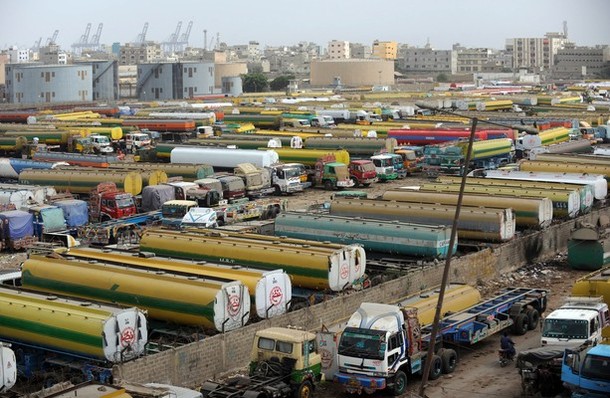
As she flies to Paris on the first leg of yet another marathon journey, Secretary Clinton is being credited with saving NATO nations an estimated $100 million a month as a result of her apologetic phone call to Pakistan's Foreign Minister Hina Rabbani Khar.  These are not pretty pictures of our Hillary, but rather of the supply bottleneck that our Secretary of State managed to break up with that phone call.


Hillary Clinton's Travel Itinerary July 5 - 17 2012

Well finally the State Department has released details about Mme. Secretary's current travel itinerary.  Here goes - it is extensive - just under two weeks. 

Secretary of State Hillary Rodham Clinton's Travel to France, Japan, Mongolia, Vietnam, Laos, Cambodia, Egypt and Israel


Press Statement
Victoria Nuland
Department Spokesperson, Office of the Spokesperson
Washington, DC
July 5, 2012

Secretary of State Hillary Rodham Clinton will travel to France, Japan, Mongolia, Vietnam, Laos, Cambodia, Egypt and Israel departing Washington, D.C. on July 5.
In Paris on July 6, Secretary Clinton will attend the third meeting of the Friends of the Syrian People. At that meeting, the Secretary will consult with her colleagues on steps to increase pressure on the Assad regime and to support UN-Arab League Special Envoy Annan’s efforts to end the violence and facilitate a political transition to a post-Assad Syria. Secretary Clinton will consult with French leaders regarding next steps on Syria as well as on a number of other key areas of global concern. As part of her ongoing consultations with senior Palestinian and Israeli leaders, the Secretary will also meet with Palestinian Authority President Mahmoud Abbas to discuss both parties’ efforts to pursue a dialogue and build on President Abbas’ exchange of letters with Prime Minister Benjamin Netanyahu.
The Secretary will then travel to Tokyo to attend the July 8 Conference on Afghanistan, where she will reaffirm our enduring commitment to the Afghan people and join the international community in supporting Afghanistan’s development needs for the “transformation decade” to begin in 2015. As part of the mutual commitments made by the international community and Afghanistan at the Bonn conference last December, the Afghan Government in turn will lay out its plan for economic reform and continued steps toward good governance. She will also have discussions with Japanese Government counterparts on bilateral, regional, and global issues of mutual concern.
In Ulaanbaatar on July 9, Secretary Clinton will meet with President Elbegdorj and Prime Minister Batbold and address the meeting of the Governing Board of the Community of Democracies, as well as an international women's conference.
In Hanoi on July 10, the Secretary will meet with senior Vietnamese leaders. She will witness the signing of several agreements covering education exchanges and commercial contracts and meet with representatives of U.S. and Vietnamese business communities.
Secretary Clinton will arrive in Vientiane on July 11. This groundbreaking visit to Laos marks the first by a Secretary of State in 57 years. The Secretary will meet with Prime Minister Thongsing Thammavong and other senior government officials to discuss a variety of bilateral and regional issues, including the Lower Mekong Initiative and ASEAN integration efforts.
Secretary Clinton will arrive in Phnom Penh on July 11 to participate in regional conferences, to both chair and attend ministerial events and to participate in bilateral meetings with Cambodian officials. Regional conferences include the ASEAN Regional Forum, the East Asia Summit Foreign Ministers Meeting, and the U.S.-ASEAN Post-Ministerial Conference. Secretary Clinton will co-chair the Lower Mekong Initiative (LMI) Ministerial as well as chair the Friends of the Lower Mekong Ministerial Meeting. Secretary Clinton will also participate in bilateral meetings with senior Cambodian leadership. After Phnom Penh, Secretary Clinton will travel to Siem Reap to lead the largest delegation of U.S. business representatives to Cambodia for an ASEAN event at the ‘Commitment to Connectivity - U.S.-ASEAN Business Forum.’ While in Siem Reap, Secretary Clinton will deliver the keynote address at the Lower Mekong Initiative Gender Equality and Women’s Empowerment Dialogue on July 13.
On July 14, Secretary Clinton will travel to Egypt to express the United States’ support for Egypt’s democratic transition and economic development. From July 15-16, she will meet with senior government officials, civil society, and business leaders, and inaugurate the U.S. Consulate General in Alexandria.
This will be followed by a stop in Israel on July 16-17, where she will be meeting with the Israeli leadership to discuss peace efforts and a range of regional and bilateral issues of mutual concern.

SECRETARY HILLARY CLINTON: Public Schedule for July 5, 2012


Public Schedule for July 5, 2012


Public Schedule
Washington, DC
July 5, 2012


SECRETARY HILLARY RODHAM CLINTON

Secretary Clinton is on foreign travel.

Wednesday, July 4, 2012

Hillary Clinton Honored by LGBT Community on Independence Day


For many years our Hillary has fought the good fight for women, children, and families.  She made them the centerpiece of her efforts as our top diplomat from the outset of her tenure at the State Department and found a way to weave their well-being into diplomatic and development initiatives that others might have seen as far removed from the daily lives of women and their children.

Shortly after arriving at Foggy Bottom, she held a town hall with the employees there.  She was open to questions, comments, and suggestions and also established an electronic suggestion box in an effort to bring every voice  into the conversation.  One question that arose at that town hall was whether the new secretary, who so clearly cared about families, would be willing to extend the same benefits to partners and children of gay unions as were enjoyed by straight family members.  She promised to explore that possibility, and in June of that year, Pride Month, she announced that they indeed had examined the issue, found it doable, and were going ahead and doing it.  From that moment on she never failed to include LGBT folks and families among her efforts to raise standards of inclusion worldwide.  The rights of LGBT people became part of her drive for full and equal human rights for all.  On this issue, she has remained perpetually ahead of the curve for three-and-a-half years of this administration.

There have been times when I have scolded the LGBT community here on these pages for not recognizing her leadership on these issues, so I am gratified to be able to report, on this Independence Day, that the LGBT community has honored her efforts in a special way.

Hillary Clinton gets gay flag tribute ahead of 4 July


LGBT US flag tribute to Secretary of State Hillary Clinton on 4 July
| By Tris Reid-Smith
New artwork given to Hillary Clinton for her gay rights work.

US Secretary of State, Hillary Rodham Clinton, has been honored with a unique work of art for her gay rights work.
International gay organization Kaleidoscope Trust has given her a huge American flag with the full text of her historic speech to the United Nations, where she called for global LGBT rights, sewn into it.
The US ambassador to the United Kingdom, Louis Susman, received the flag at the American embassy today in advance of Independence Day, 4 July tomorrow.
Read more >>>>

Artist's flag goes international

Artwork will be presented in London as part of World Pride

5:45 PM, Jul 3, 2012   |
Sam Gassman adds finishing touches to a flag June 25 at the Studio Arts Building. The flag will be presented today in London in honor of Hillary Clinton. The hand-sown flag was made from T-shirts.

Sam Gassman adds finishing touches to a flag June 25 at the Studio Arts Building. The flag will be presented today in London in honor of Hillary Clinton. The hand-sown flag was made from T-shirts. / David Scrivner / Iowa City Press-Citizen
Written by
Adam B Sullivan
Iowa City Press-Citizen
Does the right wing have a monopoly on the American flag?
Iowa-native Sam Gassman thinks so. And his latest piece of art being unveiled in London today aims in part to reverse that.
Gassman came to the University of Iowa earlier this summer to work on the piece — a giant flag featuring text of a speech about gay marriage by U.S. Secretary of State Hillary Clinton. Instead of 50 stars, Gassman’s flag — made from repurposed T-shirts — has one star for each of the almost 200 sovereign nations in the world. Most of the stars are white, but more than 70 are blue to identify countries with inhumane policies against gay citizens. The piece features references to each of the U.S. states that allow gay marriage, including Iowa.
Read more >>>>

Happy Independence Day, Mme. Secretary, and thank you for your tireless service! 

​Happy 4th of July to everyone here!

Tuesday, July 3, 2012

Just for Jen: Hillary Clinton at the Catherine Palace in St. Petersberg

When Hillary actually was in St. Petersberg, most of these photos were not available.  Now that they are, I want to post them especially for Jen who wanted to see her at the Catherine Palace.


Secretary Clinton's Call With Pakistani Foreign Minister Khar


Statement by Secretary Clinton on her Call With Pakistani Foreign Minister Khar


Press Statement
Hillary Rodham Clinton
Secretary of State
Washington, DC
July 3, 2012


This morning, I spoke by telephone with Pakistani Foreign Minister Hina Rabbani Khar.
I once again reiterated our deepest regrets for the tragic incident in Salala last November. I offered our sincere condolences to the families of the Pakistani soldiers who lost their lives. Foreign Minister Khar and I acknowledged the mistakes that resulted in the loss of Pakistani military lives. We are sorry for the losses suffered by the Pakistani military. We are committed to working closely with Pakistan and Afghanistan to prevent this from ever happening again.
As I told the former Prime Minister of Pakistan days after the Salala incident, America respects Pakistan’s sovereignty and is committed to working together in pursuit of shared objectives on the basis of mutual interests and mutual respect.
In today’s phone call, Foreign Minister Khar and I talked about the importance of taking coordinated action against terrorists who threaten Pakistan, the United States, and the region; of supporting Afghanistan’s security, stability, and efforts towards reconciliation; and of continuing to work together to advance the many other shared interests we have, from increasing trade and investment to strengthening our people-to-people ties. Our countries should have a relationship that is enduring, strategic, and carefully defined, and that enhances the security and prosperity of both our nations and the region.
The Foreign Minister and I were reminded that our troops – Pakistani and American – are in a fight against a common enemy. We are both sorry for losses suffered by both our countries in this fight against terrorists. We have enhanced our counter-terrorism cooperation against terrorists that threaten Pakistan and the United States, with the goal of defeating Al-Qaida in the region.
In addition, I am pleased that Foreign Minister Khar has informed me that the ground supply lines (GLOC) into Afghanistan are opening. Pakistan will continue not to charge any transit fee in the larger interest of peace and security in Afghanistan and the region. This is a tangible demonstration of Pakistan’s support for a secure, peaceful, and prosperous Afghanistan and our shared objectives in the region. This will also help the United States and ISAF conduct the planned drawdown at a much lower cost. This is critically important to the men and women who are fighting terrorism and extremism in Afghanistan. Foreign Minister Khar has informed me that, consistent with current practice, no lethal equipment will transit the GLOC into Afghanistan except for equipping the ANSF. In concluding the call, I reiterated our deep appreciation to the Government and the people of Pakistan for their many sacrifices and their critical contribution to the ongoing fight against terrorism and extremism.

SECRETARY HILLARY CLINTON: Public Schedule for July 3, 2012


Public Schedule for July 3, 2012


Public Schedule
Washington, DC
July 3, 2012


SECRETARY HILLARY RODHAM CLINTON

Secretary Clinton has no public events.

Monday, July 2, 2012

SECRETARY HILLARY CLINTON: Public Schedule for July 2, 2012

Public Schedule for July 2, 2012


Public Schedule
Washington, DC
July 2, 2012

SECRETARY HILLARY RODHAM CLINTON

9:15 a.m. Secretary Clinton meets with the assistant secretaries, at the Department of State.
(CLOSED PRESS COVERAGE)

Sunday, July 1, 2012

Hillary Clinton: Interviews from Geneva

Typically, these interviews come in multiples, but they arrive sporadically. These are he first to appear. If more come in I will add them to this post.
U.S. Secretary of State Hillary Rodham Clinton attends a dinner hosted by Swiss authorities after a meeting of the Action Group for Syria at the European headquarters of the United Nations, in Geneva, Switzerland, Saturday, June 30, 2012. (AP Photo/Laurent Gillieron, Pool)


Interview With Michele Kelemen of NPR


Interview
Hillary Rodham Clinton
Secretary of State
Geneva, Switzerland
July 1, 2012

QUESTION: Thank you for joining us here. Kofi Annan called it a serious agreement, this push for a new transitional government, but it seems quite vague. He said that it can include current government officials and opposition figures, as long as there’s mutual consent. But aren’t you worried that this just is a new recipe for more conflict? I mean, how do warring parties come to an agreement on who’s in the government?
SECRETARY CLINTON: Well, the transition plan that we have adopted in this document makes very clear that the Special Envoy will be working to determine who can be in a transitional governing body based on mutual consent, which means people with blood on their hands or jihadi extremists are not going to be at the table.
And I think it’s important to just pause and say – I am familiar, intimately, with a few peace processes, and you do not sit down in the beginning with people that you even want to talk to or see. It was so remarkable this week that Martin McGuinness shook Queen Elizabeth’s hand. He was a commander in the IRA. And so you don’t know how this is going to all play out unless you get started. And my point is: Let’s get started. And we couldn’t get started until we had an agreement of the most interested parties, which of course included Russia and China. We now have such an agreement, and we’re fully behind Kofi Annan’s effort.
QUESTION: You spent a lot of time talking to Russian Foreign Minister Sergey Lavrov when we were in St. Petersburg. Do you get the sense that the Russians are really ready to lean on Bashar al-Assad? And do you think the Russians have influence with him?
SECRETARY CLINTON: I think the answer to the first question is yes, I believe they are ready to lean. They have told me that. They have made clear they have no continuing strategic interest in Assad remaining in power. So I have every reason to believe – both on what I was told by Minister Lavrov yesterday and what he said in our meeting all day today – that they will make the case that there needs to be this transition.
Whether he has influence and leverage to the extent that we would want to see won’t be known until it is tested. But at least now we’re in a position where we can together be pushing the Assad regime and the opposition.
Michele, there are so many terrible things about this violence that has gone on for so long: the fact of the violence, the loss of life, the destruction, the government abusing and killing its own people. But I think today it became very clear that everyone, including Russia and China, is worried about it spreading. So the motivation and the focus today was very clear to me. Now we just have to work to see what we can do with it.
QUESTION: And the fact that Turkey was there, and just had this incident with the Turkish plane being downed, did that influence that aspect of the conversation?
SECRETARY CLINTON: I think it did. Because in my remarks, for example, at the plenary this morning, I was able to point at Iraq sitting there, I was able to point at Turkey sitting there, mentioned Lebanon, Jordan, Israel, the countries in the region that are already dealing with the repercussions of the violence and instability in Syria. And everyone around that table knew that we could – if we didn’t act today and get behind this transition plan – be sitting in six months with a literal war in the region on our hands that was destabilizing country after country. And Turkey was very clear about its worries that that was one of the outcomes if we failed.
QUESTION: But Kofi Annan had very strong words – that history is a somber judge; it will judge us harshly if we prove incapable of taking the right path. How is this crisis weighing on you?
SECRETARY CLINTON: Well, I not only think about it and worry about it, I work on it a lot. I mean, in the last 24 hours, between St. Petersburg and Geneva, it has been the principle focus of all of my efforts. And it’s because I care deeply about the kind of abuses that no people should suffer in the 21st century. That is absolutely one of my highest priorities, is to work as hard as I can to end these kinds of terrible conflicts.
But it’s also because I am very worried that, in the absence of the leading nations that were gathered here today and the others we can bring on board doing everything we can to send a message to both the government and the opposition that they’ve got to begin negotiating about a transition, we will see some really serious and dangerous consequences for the region, for U.S. interests, and in fact, as one of my colleagues said, for the whole world.
QUESTION: Just one quick thing. I mean none of his plan has worked so far, so what makes you think --
SECRETARY CLINTON: I want to be caught trying. I can’t, sitting here today, tell you whether Assad is ready to stop killing his own people. Usually you don’t get to a peace table, negotiate transition, until something happens and those with the guns, on whatever side they are, finally decide that there’s got to be a better way. I mean, we negotiated for more than a year in Yemen. We had former President Ali Abdullah Saleh up to the signing desk three or four times, and he would back off every time. So there’s nobody anywhere that is more aware of all of the problems we have going forward.
But I am 100 percent convinced that we have to begin changing the reality in the minds and on the ground. And having Russia and China sign up to this lengthy list of guidelines and principles will, I believe, give us the opening to do just that.
QUESTION: Thank you so much for your time today.
SECRETARY CLINTON: Thank you, Michele.
_____________________________________________________________

Interview With Indira Lakshmanan of Bloomberg


Interview
Hillary Rodham Clinton
Secretary of State
Geneva, Switzerland
July 1, 2012

QUESTION: Thank you, Secretary Clinton, so much for making the time. I know it’s been a very long day. (Laughter.) All right. Can we get started? Great.
So today in Geneva this political transition plan that has been endorsed didn’t have the strongest language that the U.S. had hoped for. What makes you think that Russia and China are committed to pulling their support for Assad? What makes you think this is going to work?
SECRETARY CLINTON: Well, I believe it did have strong language. We can always, in any document, worry over and argue over words, but the bottom line is that it pledged to support a transitional governing body whose members can only be put on that body by mutual consent. So as I said in the meeting when we were working together, I don’t think you have to be up on current events to know that no member of the opposition is going to have Assad or anyone else with blood on their hands on the transition body.
So I think the important achievement was to get a unified P-5, plus the permanent members of the Security Council, plus other key actors to really endorse Kofi Annan’s guidelines and principles so that he was empowered. He can now go to the Assad regime and say we have to start talking about a transition and not be met with well, we don’t have to do that, because Russia and China don’t agree with us. And I believe that it was a significant step forward in giving him the tools that he needs to test whether it is possible to mediate this very bloody, violent conflict.
QUESTION: So not everything you had hoped for, but better than it could have been?
SECRETARY CLINTON: Oh, I didn’t know that we were going to be able to get anything when we started. There was every reason to believe that we would never get the Russians and the Chinese on board or that we would ever satisfy the legitimate anxieties of the region about what is happening on their doorstep. Turkey, of course, was here today. And I think the fact we did demonstrated a recognition by the Action Group of the high stakes.
I mean, it’s not enough just to wring our hands and make impassioned speeches about how terrible the Assad regime is and how they are deteriorating into a civil war that will have regional consequences. We needed to put some flesh on the bones. And the only way to do that within the existing framework was to empower Kofi Annan. That’s what he was asking for; that’s what he wanted. And I really judge the success by the fact that he believes – and I agree with him – that he now has a stronger hand to play then he did yesterday.
QUESTION: So the challenge, as you said, is in the implementation. Now, you’ve publicly criticized Russia for selling arms to the Syrian regime. So if an arms embargo were agreed to, would Russia abide by it? And could the U.S. force its allies – Saudi Arabia and Qatar – to stop arming the opposition?
SECRETARY CLINTON: I think that’s one of the issues that we’re going to have to be discussing further as we go forward. Clearly, the United States believes that ending the arming of the Assad government is the first order of business. The Russians continue to claim that they are not providing anything that can be used to suppress internal dissent. We beg to differ.
But nevertheless, I think where we are today gives us the basis for going to the UN Security Council to discuss what consequences have to be considered and imposed if after empowering Kofi Annan he comes to the Security Council and reports to us – as he said he will do – that the government’s not cooperating, that other parties are not cooperating, that he’s not making progress. Then I think we will have to act. And I believe we will be building the case as to why the Security Council should take such action.
QUESTION: Well, that’s actually what I wanted to move to. Is the next step proposing a Chapter 7 mandate at the UN Security Council that could mandate sanctions or authorize military force to stop the slaughter? And would China and Russia agree to that?
SECRETARY CLINTON: Well, I think we are going to test first whether we can get the agreement we reached today implemented. And we are certainly going to consider any and all appropriate action through the Security Council as circumstances require. So I don’t want to answer a hypothetical, because we’ve just finished a very long day of very hard negotiations, and the fact that we came out united and determined to empower Kofi Annan has to be given some time to be tested.
But I said – and I said it again in my press avail after the session today – that we, the United States, are perfectly free to propose whatever we believe is necessary in the Security Council, and we will listen closely to Kofi Annan’s reports to us.
QUESTION: Let me just turn for a moment to Iran’s nuclear program. You recently sat for an interview with former Secretary of State James Baker in which he said that at the end of the day, if pressure and talks don’t work, we ought to take them out. You said that the end of the day might be next year. How much time are you giving for diplomacy and sanctions?
SECRETARY CLINTON: Well, what I meant was that we’ve always had a two-track policy. The President’s been very clear on that. The pressure track is our primary focus now, and we believe that the economic sanctions are bringing Iran to the table. They are going to continue to increase and cause economic difficulties for them. But the President has said no option is off the table. We obviously, clearly, prefer that we resolve the international community’s dispute with Iran over their nuclear program through the diplomatic channels that we are pursuing. That is what we’re focused on and that’s what we’re going to do everything we can to make successful.
QUESTION: Last question on Pakistan. It’s been seven months since the accidental attack that killed some Pakistani soldiers and the Pakistanis shut their supply lines. Relations have been frozen since. Why not just apologize and try to move on?
SECRETARY CLINTON: Well, we have a number of issues with the Pakistanis that we are continuing to consult with them over. It goes on constantly. It may not be in the headlines, but there is a constant exchange of military and civilian experts. And I want to look at this comprehensively. And there are a number of issues that are important to the United States, and there are issues that are important to Pakistan, but it has to be negotiated in order to resolve any of them. And we’re still in the process of trying to do that.
QUESTION: Is an apology still possible?
SECRETARY CLINTON: Well, I’m not going to get into the specifics, because there are a lot of things we want from them, and they want things from us, and we’re just going to have to see what is possible to get the relationship moving. As I’ve said many times, I think this is a consequential relationship. I think it has great impact on America’s national security interests, on the regional interests. And so we are continuing to work as hard as we can to try to resolve the ongoing differences between us.
QUESTION: Thank you so much, Madam Secretary.
__________________________________________________________

Interview With Jill Dougherty of CNN


Interview
Hillary Rodham Clinton
Secretary of State
Geneva, Switzerland
July 1, 2012

QUESTION: Secretary Clinton, thank you very much. I know it’s been a very long and intense day.
Let’s begin with that critical point that you’ve talked about so many times, that Assad has to step down, leave. Now, it appears that the Russians won that point. There is no direct demand that Assad go.
SECRETARY CLINTON: Well, Jill, I couldn’t disagree with you more. I think that what the agreement clearly states is that there has to be a transitional governing body that will be constituted of people who are there by the mutual consent of the government and the opposition. Now, unless I am wildly off base, there is no way anyone in the opposition would ever consent to Assad or his inside regime cronies with blood on their hands being on any transitional governing body.

But I said weeks ago that Assad going could be an outcome as well as a precondition, and what was important is that we were on a path with an empowered Special Envoy with the full support of all the P-5 members, including Russia and China, with an approach that absolutely guarantees, if there is a transition that is still the hard work ahead, Assad will not be part of it.
And we’ve had lots of experience in this. I mean, we just went through more than a year with Ali Abdullah Saleh in Yemen, and he kept saying he would go, then he wouldn’t go. And people just kept bearing down and pushing forward and eventually were successful.
But until today, we did not have the kind of roadmap in specifics, with concrete actions, that you could telegraph to Damascus, where I believe they are shocked that Russia and China have signed onto this agreement, which so clearly says goodbye to them in this transition.
QUESTION: But the timing. In other words, this could be down the road; this could be a year from now. What?
SECRETARY CLINTON: Well, of course, making peace is really hard. And when it happens and how it happens is dependent on so many factors. And what we did today was to make clear that, for the first time, we had agreed-upon approach that satisfied the Russians and the Chinese and the neighbors, who are very anxious, for understandable reasons, about what’s going on in Syria.
Jill, there’s no guarantee that we’re going to be successful. I just hate to say that, because it’s the fact. But I am very grateful that we now have a roadmap that has everybody on board with a clear path towards transition, with a clear set of expectations that have to be fulfilled. And now I believe the internal reality within both the regime and elements of the opposition will begin to move in a direction that, I hope, puts us on an inevitable path.
QUESTION: But how do you get to that transitional body? Because people are fighting.
SECRETARY CLINTON: Right.
QUESTION: I mean, isn’t it unrealistic to think that you’re going to get the body that you say will strip him of his power?
SECRETARY CLINTON: No, because I just look at history. I look at the conflicts that I’m familiar with. I have to smile thinking about Queen Elizabeth shaking the hand of Martin McGuinness, an IRA commander, just this past week. Whenever you start with a process like this, number one, there’s neither a guarantee as to the outcome nor as to the timing, but you are beginning to change the international calculations of everybody who is a party to the conflict.
And that’s what I think will really give Kofi Annan the support he needs. Because now when he goes to Damascus and he says, “I have been instructed by all Security Council members, including the Russians and the Chinese, to begin talking to you about appointing an empowered interlocutor to meet with me and meet with representatives of the opposition. Who are you going to appoint?” and they’re not going to be able to say, “Well, there’s division in the international community, and there are a lot of people who are on our side.” They are pretty much left with Iran.
QUESTION: Do you really believe that the Russians can convince Assad?
SECRETARY CLINTON: Jill, I think that’s a great question, because one of the points that became clear, both in my long conversations with Foreign Minister Sergey Lavrov last night in St. Petersburg and then in our larger group today – they have committed to trying, but they’ve also admitted that they may or may not have enough leverage to convince not just one man but a family and a regime that their time is over. But what was important was to get them on board to make this effort on their own, using their leverage, and in support of Kofi Annan. And I think it’s a significant step forward in our efforts to try to figure out the least violent, disruptive, destabilizing way to end this conflict and give the Syrian people a chance at a different future.
QUESTION: So if the Russians are supposed to influence Assad, you are supposed to influence the opposition. How do you do that? What do you say to them?
SECRETARY CLINTON: Well, not just me, but others as well. I mean, we will have an American presence at the meeting of the opposition in Cairo next week. But the Turks, the Qataris, the Arab League, all who were part of our negotiations to reach this agreement today, will all be there. Because what’s the alternative? I mean, what are they going to do? Just continue to have meeting after meeting, or are they going to buckle down to the hard work of choosing someone to – or several people – to represent them in a transitional governing body to engage in the negotiation. And they’re going to have to finally make a decision about what it means to take responsibility for trying to end a conflict and lead a nation.

We went through this in Libya. The Transitional National Council had both members of the Qadhafi regime, who had fairly recently left, along with longtime oppositionists. So we have seen how important it is to have an organizing focus. We now have that. So at the meeting of the opposition in Cairo, they will hear from a number of different voices that you have to make some decisions about how to be part of this process.
QUESTION: There are some people who say that the Russians want to play this out, that they look at the election schedule in the United States, November there’s an election, they realize that there’s little appetite either in Washington or practically any other capital for military action, and so they’re just playing it out, banking on the fact that nobody is going to really take any type of strong military step. What do you say to that?
SECRETARY CLINTON: Well, I’d say that if we were talking a week ago, based on what we were hearing from the Russians, from the very highest levels, from President Putin on down, we would never have even had the meeting in Geneva, they would not have come under any circumstances, and they would not have participated in reaching the agreement that we reached today. So what happened?
I think they have begun to realize that they are trying to ride two horses at the same time, so to speak. They are constantly saying we have no love lost for Assad, we don’t have any stake in him staying, but we are afraid of the violence and what will come after. So the argument I have made to them consistently is that their failure to be part of the solution is the surest way to ensure we have a civil war with sectarian conflict that spills over the borders.
And I can’t speak for them. I can’t put myself into their internal discussions. But I believe, based on my lengthy conversation last night and our discussions today, they’ve decided to get on one horse, and it’s the horse that would back a transition plan that Kofi Annan would be empowered to implement.
QUESTION: Okay. Could I ask you a quick question on Egypt? President – incoming President Morsi wants to ask the United States to extradite Sheikh Omar Abdel Rahman from the World Trade Center attack in 1993 on the basis of – humanitarian basis. What would the U.S. do in that case?
SECRETARY CLINTON: Well, I think it’s very clear that he was given due process. He was tried and convicted for his participation in terrorist activities, most particularly the bombing of the World Trade Center in 1993. The evidence is very clear and convincing, and he was sentenced to life in prison, and we have every reason to back the process and the sentence that he received and will do so.
QUESTION: Madam Secretary, thank you very much.
SECRETARY CLINTON: Thank you, Jill.