Wednesday, January 16, 2013

Seth Meyers Names Mme. Sexetary to GQ's 100 Hottest List

Apparently Hillary Clinton's Smart Power and Charm Offensives over her four-year tenure at State did more than win friends among nations that were neglected and win back those that were alienated over eight years of the Bush administration.  It seems she has won domestic hearts as well.  Her approval rate has remained consistently high over these years, that we knew.
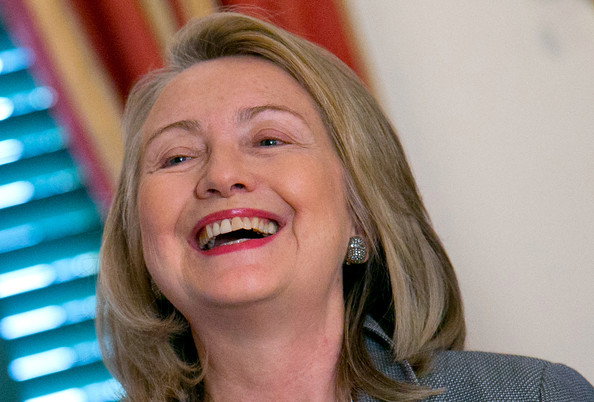
Hillary bloggers know that we must be very careful on the keyboard not to strike that key  to the left of "c" when typing about Mme. Secretary unless we intend to (and sometimes it was intentional).  But now it appears official.  Having been tapped by GQ Magazine to offer one nominee for their "100 Hottest Women of the 21st Century" issue, Seth Meyers of SNL named our Mme. Sexetary.  We agree!  She is hot!  She always has been. 
From HuffPo

Seth Meyers: Hillary Clinton 'Getting Sexier Every Year'

The Huffington Post  |  By
"Saturday Night Live" Head Writer Seth Meyers was one of the male celebrities GQ tapped to nominate a woman to their "prestigious" list. His choice? Why, Secretary Of State Hillary Clinton, of course
"I think somebody who is getting sexier every year is Hillary Clinton. Every year she seems better at whatever she's doing. By the end of the millennium, she's gonna have it locked down," Meyers writes in the February 2013 issue.
Read more >>>>
 
This is one element of her performance as SOS that we just don't think John Kerry can measure up to.  

Hillary Clinton with Saudi Interior Minister Prince Mohammed bin Naif bin Abdulaziz

With Mme. Secretary's days at the State Department numbered and the transition in progress, it is becoming difficult to find up to date photos.  The department issued these today from her bilateral with Saudi Interior Minister Prince Mohammed bin Naif bin Abdulaziz,  The captions note that there was a signing ceremony, but there were no specifics on what was being signed.  If  fact sheet or statement is release at a later time, I will update this post.  For now, we have these pictures.
01-16-13-S-0101-16-13-S-0201-16-13-S-03

Hillary Clinton: Disappearance of Sombath Somphone

US Secretary of State Hillary Clinton (L) listens to Laotian Prime Minister Thongsing Thammavong (R) at their meeting at the prime minister's office in Vientiane on July 11, 2012. Clinton became the first US secretary of state to visit Laos for 57 years, on a trip focused on the damaging legacy of the Vietnam War and a controversial dam project. AFP PHOTO / POOL / Brendan SMIALOWSKI              (Photo credit should read BRENDAN SMIALOWSKI/AFP/GettyImages)
US Secretary of State Hillary Clinton (L) listens to Laotian Prime Minister Thongsing Thammavong (R) at their meeting at the prime minister's office in Vientiane on July 11, 2012. Clinton became the first US secretary of state to visit Laos for 57 years, on a trip focused on the damaging legacy of the Vietnam War and a controversial dam project. AFP PHOTO / POOL / Brendan SMIALOWSKI (Photo credit should read BRENDAN SMIALOWSKI/AFP/GettyImages)

Disappearance of Lao Civil Society Leader Sombath Somphone


Press Statement
Hillary Rodham Clinton
Secretary of State
Washington, DC
January 16, 2013

We are deeply concerned about the well-being of Lao civil society leader Sombath Somphone, who disappeared one month ago. Reports indicate that Mr. Sombath went missing on December 15, 2012 after being stopped at a police checkpoint in the capital city of Vientiane. We call upon the Lao government to pursue a transparent investigation of this incident and to do everything in its power to bring about an immediate and safe return home to his family.
Since receiving his education in the United States, Mr. Sombath has worked tirelessly to promote sustainable development in Laos and he inspired a new generation of young leaders. He founded the Participatory Development Training Center, which trains Lao youth and local government leaders in community development and poverty reduction. His disappearance has generated a tremendous amount of concern from his family, friends and colleagues around the world. We urge his immediate return home and send our thoughts and prayers to his family and loved ones.

SECRETARY HILLARY RODHAM CLINTON: Public Schedule for January 16, 2013

Hillary Rodham Clinton

Public Schedule for January 16, 2013


Public Schedule
Washington, DC
January 16, 2013


DEPARTMENT OF STATE
PUBLIC SCHEDULE

WEDNESDAY, JANUARY 16, 2013

SECRETARY HILLARY RODHAM CLINTON

9:30 a.m. Secretary Clinton hosts the swearing-in ceremony for U.S. Ambassador to Kenya Robert Godec, at the Department of State.
(CLOSED PRESS COVERAGE)

10:00 a.m.
Secretary Clinton holds a bilateral meeting with Interior Minister of Saudi Arabia, Prince Mohammed bin Naif bin Abdulaziz, at the Department of State.
(CAMERA SPRAY PRECEDING MEETING)

Tuesday, January 15, 2013

That Was Hillary Clinton's First Husband!


When Amy Poehler  said, at the Golden Globe Awards Sunday night, "That was Hillary Clinton's husband!"   She did not mention that Bill Clinton considers himself her first husband!
I have heard President Clinton say this before, so when someone shared it an another post thread earlier, I thought it was the original remark I heard about three years ago, but this is new.  I think he actually augmented the number of husbands.  The last time, I believe it was two after him. 
Watch More News Videos at ABC | Technology News | Celebrity News

Also from ABC News.

More Husbands for Hillary?
Former President Clinton made a bold prediction about his wife, Secretary of State Hillary Clinton. Despite her recent health problems, Clinton said his wife is so healthy she’ll outlive him. “I tell her that she still has time to have three more husbands after me. I think she’ll live to be 120,” he said. “I always know that she’s thinking about that whenever I’m stubborn about something — in her constant quest for my self-improvement she refers to me as her first husband.” Clinton also revealed that before Hillary’s recent hospital stay she had only spent the night one other time and that was to deliver daughter Chelsea. 

Of course if Hillary Clinton does decide to run for President again, no pressure from me - she deserves to retire, teach, whatever she wants - he would be the "First Husband."  No question.  She would win.

Video: Hillary Clinton with Liberian President Ellen Johnson Sirleaf


Remarks at the U.S.-Liberia Partnership Dialogue Signing Ceremony


Remarks

Hillary Rodham Clinton
Secretary of State
Liberian President Sirleaf
Treaty Room
Washington, DC
January 15, 2013

SECRETARY CLINTON: Well, welcome to the Treaty Room. I am delighted to have this occasion, once again, to host President Sirleaf, a very good partner over many years, and especially, I would say, over the last four years it has been a great personal pleasure for me to work with her to strengthen that partnership between the United States and Liberia. And I also am grateful, as well, for her personal friendship. Today, we are taking another important step to deepen the partnership between our nations and to support Liberia as it continues down the path of democratic and economic reform. The partnership dialogue we are about to sign will expand the cooperation between our countries and ensure high-level engagement for years to come.
This agreement establishes working groups in three key areas – first, agriculture and food security; helping Liberia’s farmers use their land more effectively and get their crops to markets more efficiently will be critical to improving the health and prosperity of people throughout Liberia. This working group will review progress under the Feed the Future Initiative, look for new opportunities to attract private investment in the agriculture sector, and recommend policies to promote food security and better nutrition.
Second, energy and power infrastructure. We know that access to affordable, reliable energy is essential to creating jobs and sparking growth that helps to build a strong economy. So we will take stock of outstanding needs for the generation, transmission, and distribution of energy, promote a regulatory environment that’s friendly to new investments in energy, and look for ways to accelerate the development of a well-governed and inclusive energy sector.
And finally, we want to look at human development with a real emphasis on creating more economic opportunity for the people of Liberia to expand access to education and employment so that many more Liberians have a chance to not only better themselves and their families, but make a contribution to their nation.
I think it is more than fair to say that this last decade has been a success story for Liberia. The people of Liberia have emerged from a time of violence and lawlessness and have made tremendous commitments to both economic and political reform. The United States has stood by Liberia during this challenging process, but I think it is also more than fair to say it was aided considerably by the leadership, the determination of a woman who understood in every fiber of her being what was at stake. And so, Madame President, let me, on behalf of the United States, thank you for the great progress under your leadership, pledge our continuing support and partnership and friendship to you and to the people of your country. (Applause.)
PRESIDENT SIRLEAF: Secretary of State Clinton, members of the Administration, ladies and gentlemen, I am honored to be here today for several reasons. First, I feel privileged to have been invited to the State Department this week, one of the last weeks that you, Madame Secretary, will be in office, to say thank you for all that you have done for Liberia and the Liberian people, to say thank you for always being there for Liberia.
Second, for me personally, it was important to be here today to see that you have fully recovered – (laughter) – from your recent illness, to embrace you, and to let you know that all of Liberia prayed for your speedy recovery.
Third, I have always seen Liberia’s progress as underpinned by its special relationship with the United States. The launching today of the U.S.-Liberia Partnership Dialogue is an historic achievement, one that will cement the strategic cooperation between our two countries for generations to come regardless of the occupants of the White House or the Executive Mansion. Dear friends, today for us marks an historic day for the Government and people of Liberia, the fulfillment of a wish first articulated last June for the institutionalization of the longstanding bilateral relationship between Liberia and the United States of America.
Just seven months ago, we made the rounds among congressional and U.S. Government officials. We put forward proposals on how the United States could work with Liberia as a partner to consolidate its gains. One proposal called for the establishment of a joint United States-Liberia bi-national commission established (inaudible) in the 1960s, which aimed to ensure that the partnership would endure for 50 years or more.
I recall vividly when I made the case to you, Madame Secretary, your support was instantaneous. You assured me that you would figure out how to embed such a relationship in our governments and countries, and here we are today for the signing of the statement of intent, Liberia’s chance with the United States as a reliable partner in the region. The U.S.-Liberia Partnership Dialogue would allow our two countries to look at our relationship strategically with a view towards the long term and focus on those areas that encourage broad-based economic growth, including agriculture and food security, energy and power infrastructure, and human development.
We look forward to carrying out the first meeting of the U.S.-Liberia Partnership Dialogue under the leadership of Secretary of State designate, Senator John Kerry, who also has been an essential supporter of Liberia during his long service on the Senate Foreign Relations Committee, including his time as chairman. We recognize that this will not just be a job for our two governments, but also for the business communities of both countries and other stakeholders in Liberia.
Madame Secretary, I’m especially pleased that we were recently declared eligible for compact status by the Millennium Challenge Corporation. Coming just two years after being awarded a threshold program and seven years after the reestablishment of democracy in Liberia, this is one of Liberia’s proudest achievements. I would like to recognize the presence here of MCC President Daniel Yohannes and to promise you that we will deliver a compact program that will be comprehensive and resulting.
I take this opportunity to thank Assistant Secretary of State Johnnie Carson for his steadfast leadership on Africa policy over the past four years. Ambassador Carson, we wish for you the best and hope you will continue to find a way to stay engaged with us in Liberia. We also congratulate President Barack Obama on his forthcoming inauguration to a second term of office. We trust that we can count on him and on Africa’s continued support under his leadership to Liberia and to Africa.
Madam Secretary, Hillary – (laughter) – you’ve been a true friend of Liberia and to me personally. We are pleased that in the history of our bilateral relationship, which spans more than a century and a half, you made two trips to Liberia while in office as Secretary of State. You have supported our country’s progress, championed our political process, and pushed to settle Liberia’s external debt. As we bid you farewell, I remain convinced that in this era of economic challenge, history will show that your support and the investment of the U.S. Government and the American people in Liberia will return significant dividends.
We’ll continue to guard the peace, promote reconciliation, build strong democratic institutions, and show good governance and transparency, and encourage broad-based economic development. We will continue to strive to be a post-conflict success story. For that, Madam Secretary, is America’s success also. Thank you. (Applause.)
MODERATOR: Secretary Clinton and President Sirleaf are signing a statement of intent between the United States and the Republic of Liberia to establish a partnership dialogue. The U.S.-Liberia Partnership Dialogue will ensure sustained high-level bilateral engagement on issues of mutual interest.
(The document was signed.) (Applause.)
SECRETARY CLINTON: Thanks to everyone who helped work on this. I see a lot of the faces from across the State Department. Let’s get a picture with everybody coming up behind us, perhaps.
# # #

Remarks at the U.S.-Liberia Partnership Dialogue Signing Ceremony


Remarks

Hillary Rodham Clinton
Secretary of State
Liberian President Sirleaf
Treaty Room
Washington, DC
January 15, 2013


SECRETARY CLINTON: Well, welcome to the Treaty Room. I am delighted to have this occasion, once again, to host President Sirleaf, a very good partner over many years, and especially, I would say, over the last four years it has been a great personal pleasure for me to work with her to strengthen that partnership between the United States and Liberia. And I also am grateful, as well, for her personal friendship. Today, we are taking another important step to deepen the partnership between our nations and to support Liberia as it continues down the path of democratic and economic reform. The partnership dialogue we are about to sign will expand the cooperation between our countries and ensure high-level engagement for years to come.
This agreement establishes working groups in three key areas – first, agriculture and food security; helping Liberia’s farmers use their land more effectively and get their crops to markets more efficiently will be critical to improving the health and prosperity of people throughout Liberia. This working group will review progress under the Feed the Future Initiative, look for new opportunities to attract private investment in the agriculture sector, and recommend policies to promote food security and better nutrition.
Second, energy and power infrastructure. We know that access to affordable, reliable energy is essential to creating jobs and sparking growth that helps to build a strong economy. So we will take stock of outstanding needs for the generation, transmission, and distribution of energy, promote a regulatory environment that’s friendly to new investments in energy, and look for ways to accelerate the development of a well-governed and inclusive energy sector.
And finally, we want to look at human development with a real emphasis on creating more economic opportunity for the people of Liberia to expand access to education and employment so that many more Liberians have a chance to not only better themselves and their families, but make a contribution to their nation.
I think it is more than fair to say that this last decade has been a success story for Liberia. The people of Liberia have emerged from a time of violence and lawlessness and have made tremendous commitments to both economic and political reform. The United States has stood by Liberia during this challenging process, but I think it is also more than fair to say it was aided considerably by the leadership, the determination of a woman who understood in every fiber of her being what was at stake. And so, Madame President, let me, on behalf of the United States, thank you for the great progress under your leadership, pledge our continuing support and partnership and friendship to you and to the people of your country. (Applause.)
PRESIDENT SIRLEAF: Secretary of State Clinton, members of the Administration, ladies and gentlemen, I am honored to be here today for several reasons. First, I feel privileged to have been invited to the State Department this week, one of the last weeks that you, Madame Secretary, will be in office, to say thank you for all that you have done for Liberia and the Liberian people, to say thank you for always being there for Liberia.
Second, for me personally, it was important to be here today to see that you have fully recovered – (laughter) – from your recent illness, to embrace you, and to let you know that all of Liberia prayed for your speedy recovery.
Third, I have always seen Liberia’s progress as underpinned by its special relationship with the United States. The launching today of the U.S.-Liberia Partnership Dialogue is an historic achievement, one that will cement the strategic cooperation between our two countries for generations to come regardless of the occupants of the White House or the Executive Mansion. Dear friends, today for us marks an historic day for the Government and people of Liberia, the fulfillment of a wish first articulated last June for the institutionalization of the longstanding bilateral relationship between Liberia and the United States of America.
Just seven months ago, we made the rounds among congressional and U.S. Government officials. We put forward proposals on how the United States could work with Liberia as a partner to consolidate its gains. One proposal called for the establishment of a joint United States-Liberia bi-national commission established (inaudible) in the 1960s, which aimed to ensure that the partnership would endure for 50 years or more.
I recall vividly when I made the case to you, Madame Secretary, your support was instantaneous. You assured me that you would figure out how to embed such a relationship in our governments and countries, and here we are today for the signing of the statement of intent, Liberia’s chance with the United States as a reliable partner in the region. The U.S.-Liberia Partnership Dialogue would allow our two countries to look at our relationship strategically with a view towards the long term and focus on those areas that encourage broad-based economic growth, including agriculture and food security, energy and power infrastructure, and human development.
We look forward to carrying out the first meeting of the U.S.-Liberia Partnership Dialogue under the leadership of Secretary of State designate, Senator John Kerry, who also has been an essential supporter of Liberia during his long service on the Senate Foreign Relations Committee, including his time as chairman. We recognize that this will not just be a job for our two governments, but also for the business communities of both countries and other stakeholders in Liberia.
Madame Secretary, I’m especially pleased that we were recently declared eligible for compact status by the Millennium Challenge Corporation. Coming just two years after being awarded a threshold program and seven years after the reestablishment of democracy in Liberia, this is one of Liberia’s proudest achievements. I would like to recognize the presence here of MCC President Daniel Yohannes and to promise you that we will deliver a compact program that will be comprehensive and resulting.
I take this opportunity to thank Assistant Secretary of State Johnnie Carson for his steadfast leadership on Africa policy over the past four years. Ambassador Carson, we wish for you the best and hope you will continue to find a way to stay engaged with us in Liberia. We also congratulate President Barack Obama on his forthcoming inauguration to a second term of office. We trust that we can count on him and on Africa’s continued support under his leadership to Liberia and to Africa.
Madam Secretary, Hillary – (laughter) – you’ve been a true friend of Liberia and to me personally. We are pleased that in the history of our bilateral relationship, which spans more than a century and a half, you made two trips to Liberia while in office as Secretary of State. You have supported our country’s progress, championed our political process, and pushed to settle Liberia’s external debt. As we bid you farewell, I remain convinced that in this era of economic challenge, history will show that your support and the investment of the U.S. Government and the American people in Liberia will return significant dividends.
We’ll continue to guard the peace, promote reconciliation, build strong democratic institutions, and show good governance and transparency, and encourage broad-based economic development. We will continue to strive to be a post-conflict success story. For that, Madam Secretary, is America’s success also. Thank you. (Applause.)
MODERATOR: Secretary Clinton and President Sirleaf are signing a statement of intent between the United States and the Republic of Liberia to establish a partnership dialogue. The U.S.-Liberia Partnership Dialogue will ensure sustained high-level bilateral engagement on issues of mutual interest.
(The document was signed.) (Applause.)
SECRETARY CLINTON: Thanks to everyone who helped work on this. I see a lot of the faces from across the State Department. Let’s get a picture with everybody coming up behind us, perhaps.
# # #


What Your State Department Does For You

As Mme. Secretary prepares to turn over the reins of State to Senator Kerry, this fact sheet, a handy list of what the State Department does, arrives as a concise reminder of the bang the citizens of the U.S. get for their buck.  I am sure I saw something similar when our girl was preparing to step onto this world stage.  Regrettably (and no I have never been a "no regrets" person - I have my regrets), during the first six months of her tenure at State, I was somewhat negligent about posting here on this blog, wasting some of my time and some information at the now defunct Hillary's Village Forum.  I did follow her travels pretty regularly then, but could have been more responsible posting her D.C. activities here rather than at the forum. 


It is water under the bridge now.  Fortunately for me and for the blog, those first six months at Foggy Bottom were the days when, in true HRC fashion, she was keeping a low profile with her nose to the grindstone learning as much as she could about the department, so there was not a lot to share anyway.  Her presence was so rare that you might remember voices clamoring to know where she was, why Obama was keeping her "in the shadows," and suggesting she was being hidden. In those days I argued that she was studying briefs, treaties, MOUs, and essentially "eating the paper off the walls."  Turned out I was right about that and by the time she emerged the forum had gone down for good and this blog is where I shared all that came to my inbox. 

So, as she pulls up stakes and moves on (as will we from State to wherever she goes next) here is one of my favorite pictures from that first year along with a reminder for all who think we spend too much on foreign aid, of all that the State Department does for a little more than one percent of our budget.  Annie Liebowitz posed her perfectly in this ruffly pantsuit that I have always loved on her.

annie_liebowitz2009

Ten Things You Should Know About the State Department


Fact Sheet
Bureau of Public Affairs
January 10, 2013


What do the U.S. Department of State and the U.S. Agency for International Development (USAID) do for the American people? With just over one percent of the entire federal budget, we have a huge impact on how Americans live and how the rest of the world engages America. For example:
1. We create American jobs. We directly support 20 million U.S. jobs by promoting new and open markets for U.S. firms, protecting intellectual property, negotiating new U.S. airline routes worldwide, and competing for foreign government and private contracts.
2. We support American citizens abroad. In 2011, we provided emergency assistance to U.S. citizens in countries experiencing natural disasters or civil unrest. We assisted in 9,393 international adoptions and worked on more than 1,700 child abduction cases -- resulting in the return of over 660 American children.
3. We promote democracy and foster stability around the world. Stable democracies are less likely to pose a threat to their neighbors or to the United States. In South Sudan, Libya and many other countries we worked through various means to foster democracy and peace.
4. We help to make the world a safer place. Together with Russia, under the New START Treaty, we are reducing the number of deployed nuclear weapons to levels not seen since the 1950s. Our nonproliferation programs have destroyed stockpiles of missiles, munitions and material that can be used to make a nuclear weapon. The State Department has helped more than 40 countries clear millions of square meters of landmines.
5. We save lives. Strong bipartisan support for U.S. global health investments has led to worldwide progress against HIV/AIDS, tuberculosis, malaria, smallpox and polio. Better health abroad reduces the risk of instability and enhances our national security.
6. We help countries feed themselves. We help other countries plant the right seeds in the right way and get crops to markets to feed more people. Strong agricultural sectors lead to more stable countries.
7. We help in times of crisis. From earthquakes in Haiti, Japan and Chile to famine in the Horn of Africa, our dedicated emergency professionals deliver assistance to those who need it most.
8. We promote the rule of law and protect human dignity. We help people in other countries find freedom and shape their own destinies. Reflecting U.S. values, we advocate for the release of prisoners of conscience, prevent political activists from suffering abuse, train police officers to combat sex trafficking and equip journalists to hold their governments accountable.
9. We help Americans see the world. In 2011, we issued 12.6 million passports and passport cards for Americans to travel abroad. We facilitate the lawful travel of international students, tourists and business people to the U.S., adding greatly to our economy. We keep Americans apprised of dangers or difficulties abroad through our travel warnings.
10. We are the face of America overseas. Our diplomats, development experts, and the programs they implement are the source of American leadership around the world. They are the embodiments of our American values abroad. They are a force for good in the world.
For a very small investment the State Department and USAID yield a large return by advancing U.S. national security, promoting our economic interests, and reaffirming our country’s exceptional role in the world.

Video: Chelsea Clinton says her mom is "doing great"

On the Today Show this morning, Chelsea Clinton talked to Matt Lauer about her mother.


Visit NBCNews.com for breaking news, world news, and news about the economy

SECRETARY HILLARY RODHAM CLINTON: Public Schedule for January 15, 2013

hillary_clinton_thg_121212_wmain

Public Schedule for January 15, 2013


Public Schedule
Washington, DC
January 15, 2013


DEPARTMENT OF STATE
PUBLIC SCHEDULE

TUESDAY, JANUARY 15, 2013

SECRETARY HILLARY RODHAM CLINTON

10:00 a.m. Secretary Clinton holds a bilateral meeting with Foreign Minister of Colombia Maria Angela Holguin Cuellar , at the Department of State.
(CAMERA SPRAY PRECEDING MEETING)


11:30 a.m. Secretary Clinton holds a bilateral meeting with Liberian President Ellen Johnson Sirleaf, at the Department of State.
(CLOSED PRESS COVERAGE)

12:05 p.m.
Secretary Clinton holds a U.S.-Liberia Partnership Dialogue signing ceremony with Liberian President Ellen Johnson Sirleaf, at the Department of State.
(OPEN PRESS COVERAGE FOR SIGNING AND STATEMENTS)

Monday, January 14, 2013

Update on Hillary Clinton's Schedule: Testimony on The Hill and Visiting Dignitaries

During today's press briefing, Victoria Nuland deferred to the Congressional committees to announce the schedules for Secretary Clinton's testimony on Benghazi and offered some insight as to what her testimony will include. In addition, she provided a peek at some of Mme. Secretary's bilaterals this week.  Here is a snip of the transcript.
01-09-13-Z-01
QUESTION: Do you have any update on when the Secretary might testify? And could you also tell us how her preparation is going, what she’s doing to prepare for that testimony on Capitol Hill?
MS. NULAND: Well, with regard to the consultations that we’ve had with the Congress on the timing, I’m going to defer to the two committees to announce the hearings when they’re ready to do so. But we did talk about these happening after both houses come back into session next week. So we will defer to them on any formal announcements.
Secretary is doing what she always does. She is going through all the steps that this Department is taking to implement the recommendations of the Accountability Review Board. I think you’re aware that – well, first and foremost, as you know, she’s made a commitment that all 29 recommendations will be implemented and that the implementation should be well in train before she finishes here. So I think she’ll want to update the committees on implementation.
As you know, Deputy Secretary Nides is leading an implementation process here in the building. I think he’s having his 11th meeting with the various stakeholders this week to get that work – as many of the short-term recommendations completed as possible, the medium-term ones well underway, and the longer-term ones well set up. So I think you’ll hear a good accounting from her on all those things when she testifies.
QUESTION: And this is an important week because it’s the week before the inauguration. I think you were mentioning that perhaps we might see some meetings that she would have with foreign visitors. Can you – is there any schedule information that you can share with us at this point about what the Secretary will do this week?
MS. NULAND: I think we did put out some scheduled things over the course of the week.
QUESTION: Yeah, you did, but I mean anything --
MS. NULAND: She’s going to see Ellen Sirleaf Johnson of Liberia tomorrow. She’s also seeing her Colombian counterpart. I think that one is tomorrow as well. As we said, the Somali President will be here on Thursday. We’ve already announced the visit of the new Foreign Minister – Foreign Secretary of Japan – Mr. Kishida will be here on Friday. So it’s a busy diplomatic week.
QUESTION: So these would be more – let’s call them working on the relationship issues in the relationship, as opposed to farewell, right?
MS. NULAND: Oh, all of these are working visits of foreign ministers or heads of state continuing the bilateral and regional work that we do together, yes.


Edited to add:
Apparently Congress was willing to accommodate the State Department by not waiting to be back in session.  CNN’s Jill Dougherty just posted this on Facebook.
Rep. Ed Royce (R-CA), Chairman of the House Foreign Affairs Committee, announced that Secretary of State Hillary Clinton will testify before the Committee on Wednesday, January 23 to answer questions about the September 11, 2012 terrorist attack on U.S. diplomatic facilities in Benghazi, Libya. In the attack, terrorists killed Ambassador Chris Stevens, Sean Smith, Tyrone Woods, and Glen Doherty.

SECRETARY HILLARY RODHAM CLINTON: Public Schedule for January 14, 2013

01-09-13-Z-05


Public Schedule for January 14, 2013


Public Schedule
Washington, DC
January 14, 2013

DEPARTMENT OF STATE
PUBLIC SCHEDULE
MONDAY, JANUARY 14, 2013

SECRETARY HILLARY RODHAM CLINTON


9:15 a.m. Secretary Clinton meets with the assistant secretaries, at the Department of State.
(CLOSED PRESS COVERAGE)

11:50 a.m.
Secretary Clinton meets with Turkish Under Secretary Feridun Sinirlioglu, at the Department of State.
(CLOSED PRESS COVERAGE)

2:30 p.m.
Secretary Clinton meets with President Obama, at the White House.
(MEDIA DETERMINED BY WHITE HOUSE)

Sunday, January 13, 2013

Video: Hillary Clinton's Husband's Surprise Appearance at the Golden Globe Awards


From Mediate.
An excited Amy Poehler came on stage after clips from the film were played and exclaimed, “Wow, what an exciting special guest. That was Hillary Clinton’s husband!”

Saturday, January 12, 2013

Hillary Clinton, We've Got Your Back!

As the Secretary of State has, after a serious series of health issues culminating an a disturbing blood clot in her head,   returned to D.C. to oversee the State Department transition,  there are articles floating around the interwebs that take a decidedly nasty position vis á vis her performance as Secretary of State, her recent health scare, and her return to work.  I have ignored them until today when I read one that was so reprehensibly acidic as to completely dissolve all of my self-restraint.
The Seattle Times ran an op-ed by syndicated columnist Froma Harrop that made my blood boil.

Can Hillary Clinton pace herself?

Secretary of State Hillary Clinton works hard, writes Froma Harrop, but doesn’t working smart mean pacing oneself so that you don’t fall apart in the last mile of the marathon? Clinton was asking for it.
OK, let's start there.  What originally felled the Secretary of State was a norovirus, very contagious, and no amount of "pacing" guards one against it.   She was "asking for it?"  Really?  Yes, let's blame the victim.  For Ms. Harrop's information there is a serious outbreak of norovirus in the northeast right now competing with the near-epidemic flu outbreak that is filling hospitals in 47 states.  Were these victims asking for it?
During one famous 48-hour period, she met with Palestinian officials in Abu Dhabi, Israeli Prime Minister Benjamin Netanyahu in Jerusalem and, after doing an all-nighter in Morocco, a group of Arab leaders.
Of course, she got sick. Who wouldn’t?
Completely ignoring the fact that she did not fall ill on the heels of this particular trip,  Ms. Harrop also betrays her ignorance of the effect of the all-nighter which resulted in a brilliant speech delivered the next day to Arab elders that foreshadowed events that began unfolding in Tunisia a year later.  In her Forum for the Future speech on November 3, 2009, Secretary Clinton demonstrated a familiarity with Arab populations, borne of her insistence on meeting with civil society at every stop in her travels.  She conveyed to the elders the need for changes,  economic, political, and even cultural, which she outlined, without which regimes would fall.  Indeed, her message unheeded (perhaps resented), in December 2010 the dominoes began to topple.
Lots of otherwise healthy Americans come down with a nasty bug after just one transatlantic fight to London. Add to that constant time-zone changes, rich banquets, minimal exercise, lack of sleep and stress-filled meetings. Clinton wasn’t there to stroll around museums. What’s not cute about all this is the underlying — shall we say? — irresponsibility of so overstuffing the agenda.
Yes, as I said above, the overstuffing, which typically consisted of Town Halls, "Townterviews," meetings with civil and business groups, opposition parties,  women's organizations, in addition to the routine formalities in the ministerial halls, that "irresponsible" packing of her schedule is how she knew what those Arab elders did not - the grievances among their own populations - the young, the women.   Very irresponsible, Mme. Secretary.  For shame!  Sacrificing yourself for the voiceless that way!  Tsk - tsk - tsk!
All that racing around Mideast capitals sometimes took on the air of a personal endurance test rather than effective management of foreign policy. (You’ll note that the Arab-Israeli conflict remains unresolved.)
Why this charge is leveled mystifies me, and it is not Harrop alone who has brought it up.  Every Secretary of State since the creation of the State of Israel has been called upon to deal with this conflict.  It is part of the job.
Make no mistake: Clinton has been a fine secretary of state. Few would argue otherwise. Still, we’re kind of lucky there wasn’t a major new international crisis in December.
Telegram: She was working from home the whole time. She was on the phone with her counterparts in other countries, with her staff, and she both read the ARB Report and wrote an extensive cover letter to accompany the report to Congress while she was home.  The letter is unmistakeably Hillary Clinton's work - if you know her work.  It is not clear that Ms. Harrop knows anything much about her at all.
It pains me to bring up the woman angle here, but you wonder whether a man would have overscheduled to the point of collapse.
Yes, well, it pains me that you brought this up, too, Ms. Harrop.  The collapse was due to dehydration from a virus that is attacking many right now and against which there is no defense.  You make it sound like she collapsed from exhaustion.  Not the case. As to men performing in this role, your chance is coming up! I trust you will be observing Secretary Kerry with the same care and detail  you have afforded Secretary Clinton (my tongue deeply in my cheek).
It’s no small irony that Clinton’s recent illness has led some Democrats eager for a strong female presidential candidate in 2016 to start looking beyond Hillary.
*Sigh* As if she owes this country or the Democratic Party another minute of service.  The irony is that so many of those calling her name are the Super Delegates from 2008 that either supported Obama over her or, worse, switched allegiances early in the 2008 primaries.   What, exactly, does Hillary Clinton owe any of them?
While she will never embody the cool and outward serenity of Barack Obama, Clinton didn’t have to become the spinning top that put her in a sick bed.  Even there, she noted — not without pride — her difficulty in becoming a “compliant patient.” If Clinton does run for president, she must show more dedication to self-preservation. Martyrs don’t necessarily make great managers.
This is way outside the foul line.  Hillary's work ethic was one of the reasons  President Obama cited for nominating her in the first place.  Hillary Clinton has given many brilliant speeches as Secretary of State, but what her loyalists know about her is that she is a supremely well-organized woman of action.  "Spinning top" indeed!  And "martyr?"  Seriously?  Last I saw she was back on the job with her bright, sunny smile. 
As for great management, she has completely transformed the State Department, streamlined operations among agencies,  and brought it into the 21st century with her QDDR and 21st Century Statecraft, but then I would not expect such a dabbler in things Hillary Clinton to be aware of that.
Finally, the hideous sketch that accompanies the op-ed, gaunt, wrinkled,  exhausted,  bears no resemblance to the actual Hillary Clinton who returned to her office this week looking like this. 
01-09-13-Z-04a
She looks lovely.  We've got your back, Hillary, and we always will.
Cross-posted at The Department of Homegirl Security.

Friday, January 11, 2013

Heads up! Hillary Clinton with Greta Tonight On the Record!

10 p.m. EST.

TONIGHT’s SPECIAL ON THE RECORD at 10pm: GOVERNOR SARAH PALIN, SECRETARY OF STATE HILLARY CLINTON, REVEREND FRANKLIN GRAHAM and so much more!

by

You really will not want to miss tonight’s ON THE RECORD at 10pm!  Be inspired by what people working together can do!!

Haiti Three Years After: What Hillary Clinton's State Department Has Done

The Secretary called her return to Foggy Bottom to close down her operations "bittersweet."  Indeed it is for those of us who have closely followed her tenure. Many will remember how, notified of the earthquake in Haiti,  she cancelled a trip to Asia and flew back to D.C. from Hawaii three years ago.  She was the first foreign official on the ground in Port-Au-Prince just days after the quake.  On this third anniversary of the earthquake that devastated  a country dear to Secretary Clinton's heart, the State Department issued this amazing fact sheet of what her State Department has done to help.

U.S. Government Investments in Haiti's Rebuilding and Renewal


Fact Sheet
Office of the Haiti Special Coordinator
January 11, 2013


In early 2009, Secretary of State Hillary Rodham Clinton made Haiti a foreign policy priority and committed to working to change the way we partnered with Haiti. For more than three and a half years, the U.S. Government (USG) has worked closely to be a good partner to the government and people of Haiti. After the devastating earthquake of 2010, the U.S. worked to support the Government of Haiti (GOH) and meet the most immediate life saving and life sustaining needs on the ground. For some time the U.S. pursued two tracks of engagement and has ensured that they complement one another: the first to address immediate humanitarian and emergency aid needs; and the second to continue to pursue a strategy to promote long-term sustainable development in Haiti.
Below is a high-level overview of some of the U.S. contributions to help Haiti on a path to economic prosperity and political stability.
Government Stability and Capacity Building: The United States and other donors supported the Government of Haiti’s free and fair presidential and legislative elections in late 2010 and early 2011. These elections paved the way for the complete re-establishment of all three branches of government. The U.S. provided capacity building support, including the provision of experts to work within the Government of Haiti and the provision of temporary office space. As a result, the Government of Haiti has been able to lead more effectively in many areas of governance, including efforts to: combat crime; prepare for emergency responses to Hurricanes Tomas, Tropical Storms Isaac and Sandy; collect taxes; increase transparency; alleviate housing shortages; promote foreign direct investments; and expand basic services for Haitians, including in education and health services.
Energy: Only 12 percent of the population has regular legal access to electricity. The Martelly Administration has made access to energy one of its priorities and views it as a necessary step in Haiti’s economic development.
  • The U.S. Government, through USAID, is funding the services of an experienced management firm to help improve the commercial and operational sustainability of Haiti's electric utility EDH. The firm is working with the utility to expand active customers by a third. Progress to date shows significant improvements in the utility’s financial performance and service delivery, having added over 20,000 households and business as active customers.
     
  • The USG is helping to improve the reliability of electricity in Port-au-Prince through renovation of five electricity sub-stations. The project is expected to be complete by the end of February 2013.
     
  • The USG commissioned a 10 mega-watt power plant in the north, contributing to reliable power for the tenants of the Caracol Industrial Park as well as houses around the park. The first households in the northern town of Caracol, which never had electricity before, were connected to the grid of the power plant in October 2012, designed to provide reliable power to residences and industry.
     
  • The USG also launched a competitive tender in December 2012 [available online at www.FBO.gov] to design, build, and operate Haiti’s first industrial scale solar facility. This is part of an ongoing effort to work with Haitian partners to harness renewable energy opportunities.
Housing: The United States has worked to address immediate shelter needs, including the removal of rubble to make space for shelter, as well as the construction of permanent housing settlements.
  • To date, the Government of Haiti, the international community, private firms, and individual households have removed approximately 7.4 million cubic meters of rubble, or 74 percent of the rubble created by the earthquake. The USG has removed one third of this total. USAID-funded programs helped some 65,700 households (roughly 328,000 individuals) find safer housing through the construction of temporary shelters (29,000), rental vouchers, and housing repairs (6,000).
     
  • The United States is currently constructing two new settlements, with construction underway of 750 homes in the north near Caracol and 156 homes near Port-au-Prince in the Saint Marc region. The next five settlements of approximately 1,250 houses, where all engineering designs, environmental studies and water tests have been completed and tenders are due to be launched shortly, will be developed together with a diverse set of partners such as the Qatar Haiti Fund, the Inter-American Development Bank, and the American Red Cross, enabling the United States to leverage resources for greater impact.
Business and agricultural loans: Eighty percent of the credit available in Haiti is used by only ten percent of the borrowers.
  • The United States has partnered with Haiti’s existing banks, credit unions, and other lenders to provide credit guarantees and help design new ways to lend to entrepreneurs and farmers.
     
  • The United States has supported efforts to computerize data and processes for loan officers, in order to support approximately $21.7 million in loans disbursed to over 6,500 businesses.
Agriculture: With more than 60 percent of Haitians reliant on agriculture for income, the United States has expanded its support in the sector through its global food security initiative, Feed the Future.
  • To date the United States has worked with more than 9,700 farmers, introducing improved seeds, fertilizer, and technologies.
     
  • 2012 results include a 58 percent increase in rice yields, 341 percent increase in corn, 100 percent increase in bean yields, and 21 percent increase in plantain yields. Our goal is to increase incomes for 100,000 farmers in three geographical focus regions over five years.
     
  • Additionally, Feed the Future just launched the bean planting season at a cost of another $1 million, which will provide farmers with seeds and other inputs.
Transformation of Haiti’s North: The United States is partnering with the Government of Haiti, the Inter-American Development Bank, and the private sector to create access to jobs, housing, electrification, transportation, and agricultural development in Haiti’s north. These types of investments, when married with the entrepreneurial spirit of the Haitian people, are helping to catalyze growth in the region. As part of this partnership, by 2015, the United States will have helped create:
  • New housing settlements for over 13,000 people complete with electricity, water, social services, and job opportunities nearby;
     
  • 15,000 new formal jobs at the Caracol Industrial Park, one of the Caribbean’s largest industrial parks, which is projected to grow to 20,000 jobs by 2016;
     
  • Reliable electricity to up to 100,000 people and businesses that currently have none; and,
     
  • Rehabilitated health clinics and reference hospitals in regional towns.
The first tenant of the Caracol Industrial Park, Sae-A, one of the largest garment manufacturers in the world, already has 1,300 employees, most of them women who have never had a formal sector job before. Many are graduates of a new, nearby vocational training center that the USG built and supports. Sae-A is on track to reach the goal of creating 20,000 jobs by 2016. A second tenant, a Haitian company, has moved in September of 2012 and a third tenant is due to start operations shortly. Additionally, a new U.S.-funded power plant opened this year to serve the industrial park and surrounding communities. Nine buildings, including factories, warehouses, and offices, have been built. At least twelve new buildings are scheduled for completion in 2013, more than doubling the industrial park’s capacity.
Health Services: Prior to the earthquake, the United States was providing access to health care for approximately 50 percent of the Haitian population; after the earthquake, the United States has been able to maintain this level of care. The United States provides a basic package of health services (primarily maternal and child health) and more sophisticated HIV/AIDS prevention and treatment services.
  • The Haitian Ministry of Health and Population is working to achieve a sustainable network of health facilities. To help them realize this goal, the United States entered into the Health Partnership Framework with the Haitian government, which promotes sustainability by emphasizing country ownership and leadership, and includes a five-year plan that encompasses contributions of the government, civil society, the private sector, and other donors.
     
  • The United States supports 251 primary care and 52 secondary care sites nationwide.
     
  • The United States increased the number of eligible patients on anti-retroviral (ARV) treatment from 60 percent in March 2012 to 65 percent in June 2012. We are working with the Global Fund to Fight HIV/AIDS, tuberculosis, and malaria to reach universal coverage of ARVs for all eligible patients by June 2015.
     
  • The United States recently convened the two largest umbrella networks of disabled people organizations to coordinate a single national strategy and move forward with plans to strengthen local advocacy groups. In addition, work is underway to establish four to six disabled service centers nationwide and to build government capacity to promote inclusion of people with disabilities in policy and legislation.
     
  • Through June 2012, the United States provided expertise and more than $95 million during the emergency phase of the cholera response.
Education: President Martelly has identified free and universal education as one of the key priorities of his administration.
  • Since January 2010, the United States has constructed more than 600 semi-permanent furnished classrooms and provided teaching and learning kits enabling more than 60,000 children and 1,200 teachers to return to school.
     
  • Over the next two years, the United States will partner with the Haitian Ministry of Education to develop and test an instructional model in over 300 schools, reaching 28,000 students, and training 900 teachers.
Improving Access to Justice and Legal Assistance: The rule of law, as supported by justice and security institutions, is a basic foundation of citizen security and economic growth. The United States is committed to supporting a responsive, just, and effective Government in Haiti. Our efforts include:
  • Supporting the formation of the Superior Judicial Council (CSJP), a new body which will provide oversight of the judiciary – a major step towards judicial independence in Haiti;
     
  • Providing legal assistance to over 2,700 individuals in Cite Soleil, Martissant, Saint-Marc, and Petit-Goave since October 2011;
     
  • Renovating corrections facilities; and
     
  • Providing equipment and technical assistance to reduce pre-trial detention and improve case management in targeted jurisdictions.
Strengthening the Security Sector: The Haitian National Police (HNP) is Haiti’s sole indigenous security force. Improving and expanding the capacity of the HNP is critical to the Government of Haiti’s ability to maintain public order and protect vulnerable populations.
  • The United States is supporting the recruitment and training of new officers, bolstering the counternarcotics unit, and providing communications equipment.
     
  • The UN Stabilization Mission in Haiti (MINUSTAH) also helps promote a secure and stable environment in Haiti. U.S. support includes 100 UN police officers, 10 corrections officers, and nine military officers seconded to MINUSTAH.
Protecting Human Rights and Vulnerable Populations: Increasing protection of human rights and vulnerable populations is key to U.S. assistance in Haiti. The United States is funding a number of initiatives to provide services to victims of abuse, and empower vulnerable populations. Efforts include:
  • Supporting economic opportunities for women and survivors of sexual violence through microcredit and short-term jobs programs; and
     
  • Providing job skills training, health services, and reintegration and repatriation assistance to Haitian migrants.

SECRETARY HILLARY RODHAM CLINTON: Public Schedule for January 11, 2013

01-10-13-Z-04

Public Schedule for January 11, 2013


Public Schedule
Washington, DC
January 11, 2013


SECRETARY HILLARY RODHAM CLINTON

10:00 a.m. Secretary Clinton joins President Obama’s meeting with Afghan President Hamid Karzai, at the White House.
(MEDIA DETERMINED BY WHITE HOUSE)

12:00 p.m.
Secretary Clinton participates in a working lunch with President Obama for Afghan President Hamid Karzai, at the White House.
(MEDIA DETERMINED BY WHITE HOUSE)

****

Thursday, January 10, 2013

Hillary Clinton with Hamid Karzai

There were no public remarks scheduled to be delivered from the meetings with President Karzai this evening, but there are pictures and this raw video from AP.  Victoria Nuland delivered a summary at today's press briefing.

MS. NULAND: Well, this late afternoon, this evening, as you know, the Secretary will host President Karzai here in the Department. She’ll have her own meeting with him, and then she’s going to host a working dinner. Defense Secretary Panetta is going to be here, National Security Advisor Donilon, and she’s obviously very much looking forward to seeing President Karzai. And then as you know, he’ll be at the White House tomorrow, as Ben Rhodes outlined.
Here at the State Department, we think a full range of issues are going to be discussed. Obviously, aspects of the security transition, the elections in 2014 and preparing for them, the economic transition, regional integration, support for the Afghan reconciliation efforts. Those will all be central themes in the discussions this evening.
With regard to where we are precisely on reconciliation, I think we are looking forward to hearing from President Karzai how he sees things. As you know, we have had some modest steps forward in recent months, including a commitment by Pakistan to support Afghan-Afghan reconciliation, some of the work we’ve been doing in the Core Group U.S.-Afghanistan-Pakistan to pave the way and ease the conditions for those Taliban who might need safe passage to go have conversations. As we’ve discussed here, we also had some track two discussions, Afghans and Taliban in Paris about a month and a half ago that could potentially be built on.
So I think first and foremost, we want to hear from President Karzai what he sees as the next steps and take it from there. So we’ll probably have – I’m expecting you’ll hear more about that aspect after the discussions here, but as importantly, the discussions tomorrow at the White House with the President. And I think you know the two presidents will have a press conference tomorrow afternoon.
01-10-13-Y-0101-10-13-Y-0201-10-13-Y-0301-10-13-Z-01

01-10-13-Z-04

01-10-13-Z-03

01-10-13-S-01 01-10-13-S-02 01-10-13-S-03 01-10-13-S-04 01-10-13-S-05 01-10-13-S-06 01-10-13-S-0701-10-13-Z-02

SECRETARY HILLARY RODHAM CLINTON: Public Schedule for January 10, 2013

01-09-13-Z-04a

Public Schedule for January 10, 2013


Public Schedule
Washington, DC
January 10, 2013


SECRETARY HILLARY RODHAM CLINTON

9:15 a.m. Secretary Clinton meets with the regional bureau secretaries, at the Department of State.
(CLOSED PRESS COVERAGE)

12:00 p.m. Secretary Clinton meets with Chinese Vice Foreign Minister Cui Tiankai, at the Department of State.
(CLOSED PRESS COVERAGE)

4:30 p.m. Secretary Clinton holds a flag ceremony for U.S. Ambassador to South Africa Donald Gips, at the Department of State.
(CLOSED PRESS COVERAGE)

4:55 p.m. Secretary Clinton participates in a presentation by the Library of Congress to the Government of Afghanistan, at the Department of State.
(CLOSED PRESS COVERAGE)

5:00 p.m.
Secretary Clinton meets with Afghan President Hamid Karzai, at the Department of State.
(MEDIA TO BE DETERMINED)

6:00 p.m. Secretary Clinton hosts a working dinner for Afghan President Hamid Karzai, at the Department of State.
(MEDIA TO BE DETERMINED)

****

Wednesday, January 9, 2013

January 22 Date for Hillary Clinton's Testimony on The Hill Remains Unconfirmed

At today's press briefing, Victoria Nuland reported that the date for Mme. Secretary's visit to Capitol Hill has yet to be set.
01-09-13-Z-04a
QUESTION: Can I ask you about Benghazi – excuse me – the Secretary’s testimony? There was a date floated out yesterday by Senator Corker. I think it was January 22nd, if I’m correct. Has that been confirmed?
MS. NULAND: It is not yet. We are continuing to work with both the House and the Senate. As I said, we can’t do it before that week, obviously, because they are out of session. But we have to – we have not yet closed with the committees on the precise date.
QUESTION: But you could do the House the week earlier? Do you anticipate it would be the same day?
MS. NULAND: Yeah, I mean --
QUESTION: Like how it usually is?
MS. NULAND: Yeah, that she would go up once, she would do the House and the Senate is usually the way we do it. Yeah.