Wednesday, January 23, 2013

Video: Hillary Clinton's Testimony to the Senate Foreign Relations Committee


Testimony

Hillary Rodham Clinton
Secretary of State
Opening Remarks Before the Senate Foreign Relations Committee
Washington, DC
January 23, 2013

Thank you very much, Mr. Chairman, Ranking Member, members of the committee, both older and new. I’m very grateful for this opportunity and I thank you very much for your patience to give me the chance to come and address these issues with you.
As both the Chairman and the Ranking Member have said, the terrorist attacks in Benghazi on September 11th, 2012 that claimed the lives of four brave Americans – Chris Stevens, Sean Smith, Tyrone Woods, and Glen Doherty – are part of a broader strategic challenge to the United States and our partners in North Africa. Today, I want briefly to offer some context for this challenge, share what we’ve learned, how we are protecting our people, and where we can work together to not only honor our fallen colleagues, but continue to champion America’s interests and values.
Any clear-eyed examination of this matter must begin with this sobering fact: Since 1988, there have been 19 Accountability Review Boards investigating attacks on American diplomats and their facilities. Benghazi joins a long list of tragedies for our Department, for other agencies, and for America: hostages taken in Tehran in 1979, our Embassy and Marine barracks bombed in Beirut in 1983, Khobar Towers in Saudi Arabia in 1996, our embassies in East Africa in 1998, consulate staff murdered in Jeddah in 2004, the Khost attack in 2009, and too many others. Since 1977, 65 American diplomatic personnel have been killed by terrorists.
Now of course, the list of attacks foiled, crises averted, and lives saved is even longer. We should never forget that our security professionals get it right more than 99 percent of the time, against difficult odds all over the world. That’s why, like my predecessors, I literally trust them with my life.
Let’s also remember that administrations of both parties, in partnership with Congress, have made concerted and good faith efforts to learn from these attacks and deaths to implement recommendations from the review boards, to seek the necessary resources, and to do better in protecting our people from what has become constantly evolving threats. That is the least that the men and women who serve our country deserve. It’s what, again, we are doing now with your help. As Secretary, I have no higher priority and no greater responsibility.
As I have said many times, I take responsibility, and nobody is more committed to getting this right. I am determined to leave the State Department and our country safer, stronger, and more secure.
Now, taking responsibility meant moving quickly in those first uncertain hours and days to respond to the immediate crisis, but also to further protect our people and posts in high-threat areas across the region and the world. It meant launching an independent investigation to determine exactly what happened in Benghazi and to recommend steps for improvement. And it meant intensifying our efforts to combat terrorism and figure out effective ways to support the emerging democracies in North Africa and beyond.
Let me share some of the lessons we’ve learned, the steps we’ve taken, and the work we continue to do.
First, let’s start on the night of September 11th itself and those difficult early days. I directed our response from the State Department, stayed in close contact with officials from across our government and the Libyan Government. So I saw firsthand what Ambassador Pickering and former Chairman Mike Mullen called timely and exceptional coordination; no delays in decision making, no denials of support from Washington or from our military. And I want to echo the Review Board’s praise for the valor and courage of our people on the ground, especially the security professionals in Benghazi and Tripoli. The board said the response saved American lives in real time, and it did.
The very next morning, I told the American people that heavily armed militants assaulted our compound, and I vowed to bring them to justice. And I stood with President Obama in the Rose Garden as he spoke of an act of terror.
It’s also important to recall that in that same period, we were seeing violent attacks on our embassies in Cairo, Sana’a, Tunis, Khartoum, as well as large protests outside many other posts where thousands of our diplomats serve. So I immediately ordered a review of our security posture around the world, with particular scrutiny for high-threat posts. I asked the Department of Defense to join Interagency Security Assessment Teams and to dispatch hundreds of additional Marine Security Guards. I named the first Deputy Assistant Secretary of State for High Threat Posts so missions in dangerous places get the attention they need. And we reached out to Congress to help address physical vulnerabilities, including risk from fire, and to hire additional Diplomatic Security personnel.
Second, even as we took these steps, I hurried to appoint the Accountability Review Board led by Ambassador Pickering and Admiral Mullen so we could more fully understand from objective, independent examination what went wrong and how to fix it.
I have accepted every one of their recommendations. I asked the Deputy Secretary for Management and Resources to lead a task force to ensure that all 29 of them are implemented quickly and completely, as well as pursuing additional steps above and beyond the recommendations.
I also pledged in my letter to you last month that implementation would begin, and it has. Our task force started by translating the recommendations into 64 specific action items. They were assigned to bureaus and offices with clear timelines for completion. Eighty-five percent are now on track to be completed by the end of March; a number are already completed. And we will use this opportunity to take a top-to-bottom look and rethink how we make decisions on where, when and whether people operate in high-threat areas, and then how we respond to threats and crises.
We are initiating an annual High Threat Post Review chaired by the Secretary of State, and ongoing reviews by the Deputy Secretaries, to ensure that pivotal questions about security do reach the highest levels. We will regularize protocols for sharing information with Congress. These are designed to increase the safety of our diplomats and development experts and reduce the chances of another Benghazi happening again.
We’ve also been moving forward on a third front: addressing the broader strategic challenge in North Africa and the wider region, because, after all, Benghazi did not happen in a vacuum. The Arab revolutions have scrambled power dynamics and shattered security forces across the region. Instability in Mali has created an expanding safe haven for terrorists who look to extend their influence and plot further attacks of the kind we saw just last week in Algeria.
And let me offer our deepest condolences to the families of the Americans and all the people from many nations who were killed and injured in that recent hostage crisis. We are in close touch with the Government of Algeria. We stand ready to provide assistance. We are seeking to gain a fuller understanding of what took place so we can work together with Algerians and others to prevent such terrorist attacks in the future.
Concerns about terrorism and instability in North Africa are of course not new. They have been a top priority for the entire Administration’s national security team. But we have been facing a rapidly changing threat environment, and we have had to keep working at ways to increase pressure on al-Qaida in the Islamic Maghreb and the other terrorist groups in the region.
In the first hours and days, I conferred with leaders – the President of Libya, Foreign Ministers of Tunisia and Morocco – and then I had a series of meetings at the United Nations General Assembly where there was a special meeting focused on Mali and the Sahel. In October, I flew to Algeria to discuss the fight against AQIM. In November, I sent Deputy Secretary Bill Burns to follow up in Algiers. And then in December, in my stead, he co-chaired an organization we started to respond to some of these threats: the Global Counterterrorism Forum, which was meeting in Abu Dhabi, as well as a meeting in Tunis of leaders working to build new democracies and reform security services.
We have focused on targeting al-Qaida’s syndicate of terror – closing safe havens, cutting off finances, countering extremist ideology, slowing the flow of new recruits. And we continue to hunt the terrorists responsible for the attacks in Benghazi and are determined to bring them to justice. We are using our diplomatic and economic tools to support these emerging democracies and to strengthen security forces and help provide a path away from extremism.
But let me underscore the importance of the United States continuing to lead in the Middle East, in North Africa, and around the world. We’ve come a long way in the past four years, and we cannot afford to retreat now. When America is absent, especially from unstable environments, there are consequences. Extremism takes root; our interests suffer; our security at home is threatened.
That’s why I sent Chris Stevens to Benghazi in the first place. Nobody knew the dangers better than Chris, first during the revolution, then during the transition. A weak Libyan Government, marauding militias, terrorist groups; a bomb exploded in the parking lot of his hotel, but he did not waver. Because he understood it was critical for America to be represented there at that time.
Our men and women who serve overseas understand that we accept a level of risk to protect the country we love. And they represent the best traditions of a bold and generous nation. They cannot work in bunkers and do their jobs. So it is our responsibility to make sure they have the resources they need, and to do everything we can to reduce the risks.
For me, this is not just a matter of policy. It’s personal. I stood next to President Obama as the Marines carried those flag-draped caskets off the plane at Andrews. I put my arms around the mothers and fathers, the sisters and brothers, the sons and daughters, and the wives left alone to raise their children.
It has been one of the great honors of my life to lead the men and women of the State Department and USAID. Nearly 70,000 serving here in Washington; more than 270 posts around the world. They get up and go to work every day, often in difficult and dangerous circumstances, because they believe, as we believe, the United States is the most extraordinary force for peace and progress the world has ever known.
And when we suffer tragedies overseas, as we have, the number of Americans applying to the Foreign Service actually increases. That tells us everything we need to know about what kind of patriots I’m talking about. They do ask what they can do for their country, and America is stronger for it.
So today, after four years in this job, traveling nearly a million miles, visiting 112 countries, my faith in our country and our future is stronger than ever. Every time that blue and white airplane carrying the words “United States of America” touches down in some far-off capital, I feel again the honor it is to represent the world’s indispensible nation. And I am confident that, with your help, we will keep the United States safe, strong, and exceptional.
So I want to thank this committee for your partnership and your support of diplomats and development experts. You know the importance of the work they do day in and day out. You know that America’s values and vital national security interests are at stake. And I appreciate what Ranking Member Corker just said: It is absolutely critical that this committee and the State Department, with your new Secretary and former Chairman, work together to really understand and address the resources, support, and changes that are needed to face what are increasingly complex threats.
I know you share my sense of responsibility and urgency, and while we all may not agree on everything, let’s stay focused on what really matters: protecting our people and the country we love. And thank you for the support you personally have given to me over the last four years.
I now would be happy to answer your questions.
###


Full testimony.

SECRETARY HILLARY RODHAM CLINTON: Public Schedule for January 23, 2013


Public Schedule for January 23, 2013


Public Schedule
Washington, DC
January 23, 2013


DEPARTMENT OF STATE
PUBLIC SCHEDULE

WEDNESDAY, JANUARY 23, 2013

SECRETARY HILLARY RODHAM CLINTON

9:00 a.m. Secretary Clinton testifies before the Senate Foreign Relations Committee, on Capitol Hill.
(MEDIA DETERMINED BY SFRC)

2:00 p.m. Secretary Clinton testifies before the House Foreign Affairs Committee, on Capitol Hill.
(MEDIA DETERMINED BY HFAC)

4:30 p.m.
Secretary Clinton attends a meeting at the White House.
(MEDIA DETERMINED BY WHITE HOUSE)

Tuesday, January 22, 2013

Hillary Clinton's Debt Retired

Despite this, I am not removing HillaryClinton.com from the sidebar.  I would miss it too much.

Over four years later, Hillary Clinton's 2008 debt retired

Then-candidate and U.S. Sen. Hillary Clinton (D-NY) greets supporters as she arrives at her Puerto Rico primary night party June 1, 2008 in San Juan, Puerto Rico.
Then-candidate and U.S. Sen. Hillary Clinton (D-NY) greets supporters as she arrives at her Puerto Rico primary night party June 1, 2008 in San Juan, Puerto Rico. / Photo by Justin Sullivan/Getty Images

More than four years after ending her first run for president and a few years out from her potential 2016 bid, Secretary of State Hillary Clinton has paid off all outstanding debts from her 2008 campaign, according to FEC forms submitted today.
Read more >>>>

SECRETARY HILLARY RODHAM CLINTON: Public Schedule for January 22, 2013

01-18-13-Y-09

Public Schedule for January 22, 2013


Public Schedule
Washington, DC
January 22, 2013


SECRETARY HILLARY RODHAM CLINTON

Secretary Clinton has no public events.

****

Monday, January 21, 2013

Bill & Hillary Clinton at the Inaugural Luncheon

This was a very exclusive event held in Statuary Hall in the Capitol Building.  Only about 220 people were invited.  Here are a few pictures.

01-21-13-Z-09 01-21-13-Z-10 01-21-13-Z-11

Pictures: Bill & Hillary Clinton at the Inauguration

The crowd exploded when they stepped out.

01-21-13-G-06a01-21-13-Y-0101-21-13-Y-0201-21-13-Y-0301-21-13-Y-0401-21-13-Y-0501-21-13-Y-0601-21-13-Y-0701-21-13-Z-0101-21-13-Z-0201-21-13-Z-0301-21-13-Z-0401-21-13-Z-0501-21-13-Z-0601-21-13-Z-07
01-21-13-Z-08

Sunday, January 20, 2013

From CNN's Kate Bolduan: Inside Hillary Clinton's World


Philippe Reines: "I felt sorry for the blood clot." Says he learned a long time ago not to make predictions when it comes to Hillary Clinton.

CNN Youtube

Friday, January 18, 2013

Video: Hillary Clinton with Japanese Foreign Minister Fumio Kishida

Remarks on the situation in Algeria are included in the lead-off.


Remarks With Japanese Foreign Minister Fumio Kishida After Their Meeting


Remarks

Hillary Rodham Clinton
Secretary of State
Benjamin Franklin Room
Washington, DC
January 18, 2013


SECRETARY CLINTON: Good afternoon, everyone, and welcome to the Ben Franklin Room here in the State Department. And of course, let me warmly welcome the Foreign Minister here for the first time in this new capacity on behalf of the new Government of Japan. Before we start, I’d like to say a few words about the situation in Algeria. The United States extends our condolences to all the families who have lost loved ones in this brutal assault, and we remain deeply concerned about those who remain in danger. I spoke with the Algerian Prime Minister again this morning to get an update on this very difficult situation and to underscore, again, that the utmost care must be taken to preserve innocent life. We are staying in close touch with our Algerian partners and working with affected nations around the world to end this crisis.
More broadly, however, it is absolutely essential that we broaden and deepen our counterterrorism cooperation going forward with Algeria and all countries of the region. I made clear to the Prime Minister that we stand ready to further enhance the counterterrorism support that we already provide. We have been discussing this with the Algerian leadership both when I traveled to Algeria this past year in October specifically to discuss counterterrorism issues, and again when Deputy Secretary Burns visited as the head of an interagency delegation in November. As the Foreign Minister and I discussed, we must all remain vigilant in our efforts to combat violent extremism and terrorism around the world.
Now, when I became Secretary of State nearly four years ago, I broke with tradition and took my first overseas trip not to Europe but to Asia, because I recognized that America needed to reengage in the region where much of the history of the 21st century is being and will be written. And there was no question as to which country I would visit first on that trip. It was Japan. As I said when I arrived in Tokyo, our alliance with Japan remains the cornerstone of American engagement in the region.
After four years and many more trips across the Pacific, our countries enjoy unprecedented collaboration. We address regional issues from North Korea to those in ASEAN, we meet global challenges together from Afghanistan to Iran, and we worked to respond to the earthquake and tsunami. Our people have stood side by side, and we have strengthened this alliance which has endured for more than six decades.
So as my time as Secretary of State comes to an end, I want to thank the people and leaders of Japan for their partnership and commitment to this alliance. And I want to thank you, Foreign Minister, for a final opportunity to discuss our many shared concerns. And we had a broad-based, comprehensive discussion. We started down the list and kept going.
On North Korea we shared our joint commitment to strong action in the UN Security Council. I also assured the Foreign Minister that we would continue to support Japan’s efforts to return Japanese citizens who have been abducted by the DPRK. With regard to regional security, I reiterated longstanding American policy on the Senkaku Islands and our treaty obligations. As I’ve said many times before, although the United States does not take a position on the ultimate sovereignty of the islands, we acknowledge they are under the administration of Japan and we oppose any unilateral actions that would seek to undermine Japanese administration and we urge all parties to take steps to prevent incidents and manage disagreements through peaceful means.
We also discussed how we can do more to strengthen our already strong alliance. We discussed base realignment issues. We both want to reduce the impact of our bases on host communities while maintaining the ability to defend Japan’s territory and people and preserve stability and security. We are confident that we can make progress on force realignment in Okinawa, including moving ahead with construction of the Futenma replacement facility.
We also discussed the Trans-Pacific Partnership and we shared perspectives on Japan’s possible participation, because we think this holds out great economic opportunities to all participating nations.
We also covered an issue important to both of our nations’ people, the Hague Abduction Convention that allows parents to seek a lawful, timely, and just resolution when a child is abducted by the other parent. And we hope that there will be action in the upcoming session of the Diet to pass the necessary legislation.
Now, I am very pleased to announce that we have extended an invitation to Prime Minister Abe to come to Washington to meet with President Obama in the third week of February. And there will be a lot of work to do between now and then to ensure that this high-level summit is extremely successful for both of our governments and our nations. But again, Foreign Minister, thank you for making this very early trip here and for your continuing commitment to our alliance.
FOREIGN MINISTER KISHIDA: (Via interpreter.) Secretary Clinton, thank you for those words. If I may, allow me to make a few comments. Upon the kind invitation from Secretary Clinton, I have come here on my first visit to the United States after the change of government had taken place in Japan. At the outset, I would like to touch upon the abduction incident that occurred in Algeria, the hostage-taking of foreign nationals in Algeria.
First of all, prior to my meeting with Secretary Clinton, because of the arrangements kindly made by the security, intelligence brief was given to me on this incident. Upon receiving that briefing, I embarked upon the bilateral meeting, and on that occasion I told Secretary Clinton that first of all, Japan takes the position that terrorism is definitely intolerable and impermissible and explained the position of the Japanese Government that the Government of Japan has been requesting the Government of Algeria to place utmost priority on ensuring the safety of the lives of the hostages.
We have been conducting collection of information and the Secretary and I agreed that the Japan and the United States will continue to collaborate in all areas, including information collection. We expect that we will continue to seek the cooperation of the United States in various areas pertaining to this incident. Having been able to directly discuss the issue with the Secretary to confirm that our positions are aligned was extremely valuable.
And in the meeting, we mainly discussed the foreign policy of the Abe Administration. I explained the foreign policy and security policies to Secretary Clinton and conducted candid exchange of views on the direction of strengthening the Japan-U.S. alliance.
While the security environment is becoming ever more challenging in the Asia Pacific, in order to ensure regional peace and stability, the Government of Japan recognizes that close Japan-U.S. cooperation in all areas is indispensible. The new government positions the strengthening of the bond of the Japan-U.S. alliance as the cornerstone of our foreign policy. In light of such view, we welcome the strategy of the United States of placing focus on the Asia Pacific. Secretary Clinton and I confirmed the necessity for Japan and the United States to cooperate closely to ensure peace and stability in the region.
Further, as was already mentioned by Secretary Clinton, we received the invitation for Prime Minister Abe to visit the United States during the third week of February. We truly hope that at the Japan-U.S. summit will clearly manifest the importance of an even stronger Japan-U.S. relations and we confirmed the necessity to accelerate preparations on both sides of the Pacific.
On the security front, Japan is prepared to fulfill our responsibility along with the United States for the peace and stability of the Asia Pacific. While reinforcing Japan’s own defense capabilities, in order to further upgrade deterrents presented by the Japan-U.S. security regime, we shall promote the Japan-U.S. security and defense cooperation in wide-ranging areas, and I have conveyed this strong determination of Japan to Secretary Clinton.
On the realignment of U.S. forces in Japan, the new Japanese administration intends to follow the currently existing Japan-U.S. agreement and maintain deterrents while at the same time reducing the impact on Okinawa. Both Japan and the United States will expedite the work to come up with a plan for consolidation of facilities and areas in Okinawa. Such fundamental concept was also explained by our side to Secretary Clinton.
And on the economic front, Secretary Clinton and I confirmed the importance of promotion of free trade and investment and cooperation in such areas as energy. On TPP, I explained the view of the new government and the debate ongoing currently in Japan and confirmed with the Secretary that we will maintain close contact on this matter.
Further, on the situation in the Asia-Pacific region, first of all, with regards to China, the Japan-Sino relationship is one of the most important bilateral relationships for our nation. The Abe Administration intends to respond from a broad perspective towards promotion of mutually beneficial relationship based on common strategic interest to China, and I conveyed that policy of Japan to the Secretary.
Further, while Japan will not concede and will uphold our fundamental position that the Senkaku Islands are an inherent territory of Japan, we intend to respond calmly so as not to provoke China. I conveyed to Secretary Clinton that Japan very much values the commitment shown by the United States over the Senkaku Islands based on the Japan-U.S. Security Treaty and the commitment that the United States will go against any unilateral action that will infringe upon the administration rights of Japan.
As for Japan’s ties with the ROK are concerned, I indicated our determination to further deepen our relationship with South Korea, taking the opportunity of birth of new governments in both Japan and South Korea.
On North Korea, we confirmed that close collaboration be continued between Japan and the United States, as well as between Japan, United States, and South Korea. Specifically referring to the missile launch last December, we agreed to continue with our close cooperation so that the United Nations Security Council takes effective measures as expeditiously as possible.
Further, I explained to the Secretary how seriously the new administration is taking with the abduction issue, and sought continued understanding and cooperation by the United States. Secretary Clinton responded by saying that the United States supports the resolution of the abduction problem.
Syria, Iran and other global challenges were raised at the table, and we confirmed the necessity to continue close collaboration on these issues as well.
Thank you for your kind attention.
MS. NULAND: We’ll take two questions today. We’ll start with CNN. Jill Dougherty, please.
QUESTION: Madam Secretary, thank you. We know that there are U.S. citizens being held hostage in Algeria. Is there anything that you can please tell us more specifically about their condition, their status? How confident are you that you can get them out?
And there’s significant criticism coming from this Administration and from others, the Europeans, about what some are referring to as a pretty brutal operation. You had no advance notice of that operation either before it started, as far as we understand. Should Algeria have accepted military help from the United States to carry out this mission?
SECRETARY CLINTON: Well, Jill, when I spoke with the Prime Minister again this morning, I urged the utmost care be taken in the protection of the hostages, Algerian and expatriate foreign hostages. He made clear that their operation was still ongoing, that the situation remained fluid, that the hostages remain in danger in a number of instances. But in interest of their security, I am not going to provide any further details at this time.
As I said yesterday and at the beginning here today, this is an extremely difficult and dangerous situation. No one knows better than Algeria how ruthless these groups are. After all, they fought a very terrible war against them for a number of years, with great loss of life. So we are staying in close touch with our Algerian partners and working with affected nations like our Japanese friends around the world to help end this crisis.
But let’s not forget this is an act of terror. The perpetrators are the terrorists. They are the ones who have assaulted this facility, have taken hostage Algerians and others from around the world who were going about their daily business. And it is absolutely essential that while we work to resolve this particular terrible situation, we continue to broaden and deepen our counterterrorism cooperation, something that the Foreign Minister and I discussed at some length. It is not only cooperation with Algeria, it is international cooperation against a common threat.
And that’s one of the reasons why I went to Algeria in October, why we have been working with a number of the countries in that region to help them improve their counterterrorism capabilities. It’s why I launched the Global Counterterrorism Forum. We will not rest until we do as much as we can, alone and in concert with our partners, to restore security to this vital region and to bring those who would terrorize and kill innocent people to justice.
So we are going to follow this very closely and we are going to do everything we can, working with our partners, to help resolve it. And then when finally we have brought that to a conclusion, working with others, we have to look to see what more needs to be done in order to protect everyone from these ongoing threats from these very dangerous extremists.
MS. NULAND: Last one today, from (inaudible) Matsumura from Yomiuri Shimbun, please.
QUESTION: (Via interpreter.) I have a question to Secretary and Ministry. China is becoming ever more active in Senkaku Islands and the surrounding area. The missile launch by DPRK also manifests the ever more challenging situation and security environment in the region. In order to enhance the alliance between Japan and the United States, how do you intend to overcome the pending issues between the two countries, such as Futenma relocation, The Hague treaty, and TPP? And how do you intend to utilize the gains from this foreign ministerial meeting to the future of these two – the relationship between the two countries?
FOREIGN MINISTER KISHIDA: (Via interpreter) Then if I may take the floor, first of all, first and foremost, the security environment in the Asia Pacific region is becoming ever more challenging and difficult, and in order to ensure the peace and stability of the region, we not only need to closen ties in the areas of economy and security, but in all areas such as culture and people-to-people exchange to reinforce Japan-U.S. alliance.
On the security front, it is necessary that we further uplift the level of deterrence under the Japan-U.S. security regime. We will coordinate with the strategy of the United States, placing focus on the Asia Pacific to further enhance cooperation in this area.
On the economic front, both Japan and the United States place importance on promotion of free trade as well as cooperation in the area of energy. And today, I was able to confirm the importance of these points with Madam Secretary. On TPP, I have utilized this opportunity to communicate to Secretary Clinton the views be held by the new administration. We confirmed that Japan and the United States will continue to keeping close contact as we tackle this issue.
Further, on the security front, if I may add one other point related to security, on Futenma, Futenma should never become a permanent base. So under the policy of maintaining deterrence while at the same time reducing the impact on Okinawa, we will work together towards the realignment of U.S. forces in Japan, based upon such policy.
Further, the following point was confirmed with Madam Clinton, and the signing of the Hague Convention is of great importance. The Government of Japan is intending to go through the necessary procedures for early signing of the treaty. By taking steady steps towards the implementation of these measures shall lead to further reinforcement of the Japan-U.S. relationship, and that, in turn, I believe, will lead to the stability and prosperity of the totality of the Asia-Pacific region.
On the occasion of the Prime Minister’s visit to the United States, we truly hope that his visits will be extremely productive in covering all of these areas, and Japan and the United States will continue to closely collaborate.
Thank you.
SECRETARY CLINTON: Well, I will echo what the Minister said about the very extensive agenda that we will be working on to prepare for the summit meeting between the two leaders. There are so many issues of bilateral, regional, and global importance where the United States and Japan work together, cooperate, and we will have a full review of all of those important matters.
As I said at the outset, we certainly discussed the Senkaku Islands today. And I reiterated, as I have to our Chinese friends, that we want to see China and Japan resolve this matter peacefully through dialogue, and we applaud the early steps taken by Prime Minister Abe’s government to reach out and begin discussions. We want to see the new leaders, both in Japan and in China, get off to a good start with each other in the interest of the security of the entire region.
And we have also, as I said earlier, made clear that we do not want to see any action taken by anyone that could raise tensions or result in miscalculations that would undermine the peace, security, and economic growth in this region. So certainly, we are hopeful that there can be an ongoing consultation that will lower tensions, prevent escalation, and permit China and Japan to discuss the range of other issues on which they have important concerns.
Thank you all very much.
MS. NULAND: Thank you all.


###

SECRETARY HILLARY RODHAM CLINTON: Public Schedule for January 18, 2013

01-17-13-S-04

Public Schedule for January 18, 2013


Public Schedule
Washington, DC
January 18, 2013


DEPARTMENT OF STATE
PUBLIC SCHEDULE

FRIDAY, JANUARY 18, 2013

SECRETARY HILLARY RODHAM CLINTON

9:15 a.m. Secretary Clinton meets with U.S. Ambassador to the UN Susan Rice, at the Department of State.
(CLOSED PRESS COVERAGE)

11:00 a.m.
Secretary Clinton attends a meeting at the White House.
(MEDIA DETERMINED BY WHITE HOUSE)

1:00 p.m.
Secretary Clinton holds a bilateral meeting with Japanese Foreign Minister Fumio Kishida, at the Department of State.
(CLOSED PRESS COVERAGE)

1:15 p.m. Secretary Clinton holds a working lunch with Japanese Foreign Minister Fumio Kishida, at the Department of State.
(CLOSED PRESS COVERAGE)

2:05 p.m. Secretary Clinton holds a joint press availability with Japanese Foreign Minister Fumio Kishida, at the Department of State.
(OPEN PRESS COVERAGE)

Upcoming: On Hillary Clinton's Agenda

01-17-13-Z-10

Thursday, January 17, 2013

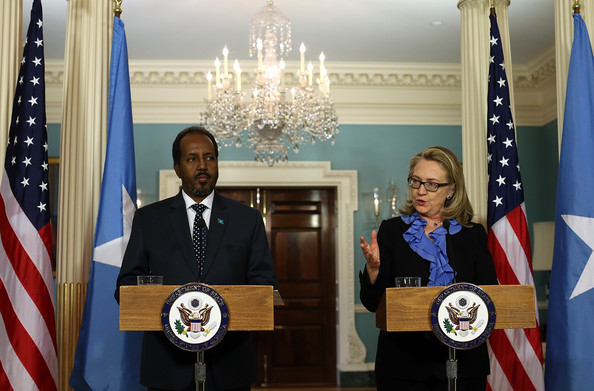
Video: Hillary Clinton with President Hassan Sheikh Mohamud of Newly Recognized Government of Somalia

Note: Remarks about the situation in Algeria included here.


Remarks With President of Somalia Hassan Sheikh Mohamud After Their Meeting


Remarks

Hillary Rodham Clinton
Secretary of State
Treaty Room
Washington, DC
January 17, 2013


SECRETARY CLINTON: Good afternoon, everyone. It is a great privilege for us to be welcoming President Hassan Sheikh and his delegation here to the State Department. Today’s meeting has been a long time in the making. Four years ago, at the start of the Obama Administration, Somalia was, in many ways, a different country than it is today. The people and leaders of Somalia have fought and sacrificed to bring greater stability, security, and peace to their nation.
There is still a long way to go and many challenges to confront, but we have seen a new foundation for that better future being laid. And today, we are taking an important step toward that future. I am delighted to announce that for the first time since 1991, the United States is recognizing the Government of Somalia.
Now before I talk about what comes next for this partnership, it is worth taking a moment to remember how we got here and how far we have come together. When I entered the State Department in January 2009, al-Shabaab controlled most of Mogadishu and south and central Somalia. It looked at the time like it would even gain more territory. The people of Somalia had already endured many years of violence and isolation, and we wanted to change that. We wanted to work together, not only with the people of Somalia but with governments across the region, the international community, and other likeminded friends.
In early 2009, the final Transitional Federal Government began its work. Somali security forces, supported by the African Union Mission in Somalia, and troops from Uganda and Burundi and now Kenya and Djibouti began to drive al-Shabaab out of cities and towns. Humanitarian aid finally began getting to the people in need. Local governments resumed their work. Commerce and travel began to pick up. Now progress was halting at times, but it was unmistakable. And today, thanks to the extraordinary partnership between the leaders and people of Somalia, with international supporters, al-Shabaab has been driven from Mogadishu and every other major city in Somalia.
While this fight was going on, at the same time, Somalia’s leaders worked to create a functioning democratic government. Now that process, too, was quite challenging. But today, for the first time in two decades, this country has a representative government with a new president, a new parliament, a new prime minister, and a new constitution. Somalia’s leaders are well aware of the work that lies ahead of them, and that it will be hard work. But they have entered into this important mission with a level of commitment that we find admirable.
So Somalia has the chance to write a new chapter. When Assistant Secretary Carson visited Mogadishu in June, the first U.S. Assistant Secretary to do so in more than 20 years, and when Under Secretary Sherman visited a few months ago, they discovered a new sense of optimism and opportunity. Now we want to translate that into lasting progress.
Somalia’s transformation was achieved first and foremost by the people and leaders of Somalia, backed by strong, African-led support. We also want to thank the African Union, which deserves a great deal of credit for Somalia’s success. The United States was proud to support this effort. We provided more than $650 million in assistance to the African Union Mission in Somalia, more than 130 million to Somalia’s security forces. In the past two years, we’ve given nearly $360 million in emergency humanitarian assistance and more than $45 million in development-related assistance to help rebuild Somalia’s economy. And we have provided more than $200 million throughout the Horn of Africa for Somali refugee assistance.
We’ve also concentrated a lot of our diplomacy on supporting democratic progress. And this has been a personal priority for me during my time as Secretary, so I’m very pleased that in my last weeks here, Mr. President, we’re taking this historic step of recognizing the government.
Now, we will continue to work closely, and the President and I had a chance to discuss in detail some of the work that lies ahead and what the government and people of Somalia are asking of the United States now. Our diplomats, our development experts are traveling more frequently there, and I do look forward to the day when we can reestablish a permanent U.S. diplomatic presence in Mogadishu.
We will also continue, as we well know, to face the threat of terrorism and violent extremism. It is not just a problem in Somalia; it is a problem across the region. The terrorists, as we have learned once again in the last days, are not resting, and neither will we. We will be very clear-eyed and realistic about the threat they continue to pose. We have particular concerns about the dangers facing displaced people, especially women, who continue to be vulnerable to violence, rape, and exploitation.
So today is a milestone. It’s not the end of the journey but it’s an important milestone to that end. We respect the sovereignty of Somalia, and as two sovereign nations we will continue to have an open, transparent dialogue about what more we can do to help the people of Somalia realize their own dreams.
The President had a chance to meet President Obama earlier today at the White House, and that was a very strong signal to the people of Somalia of our continuing support and commitment. So as you, Mr. President, and your leaders work to build democratic institutions, protect human rights and fundamental freedoms, respond to humanitarian needs, build the economy, please know that the United States will be a steadfast partner with you every step of the way. Thank you.
PRESIDENT HASSAN SHEIKH: Thank you.
SECRETARY CLINTON: Thank you, sir.
PRESIDENT HASSAN SHEIKH: Thank you, Madam Secretary, for the great words that you expressed on the realities on the ground in Somalia and the future of Somalia and the future of the relationship between Somalia and the United States.
First of all, I would like to thank the Government and the people of the United States of America for the warm welcome accorded to me and to my delegation for the last two days. I am very pleased and honored to come to Washington and to meet Madam Secretary to discuss on bilateral issues and the mutual interests of our two countries. And Somalia is very grateful for the unwavering support from the United States to the people of Somalia. U.S. is a major donor to Somalia, which include humanitarian assistance and help toward security. We both have common interests and common enemy, which we must redouble our efforts to bring peace and stability in Somalia.
Somalia is emerging from a very long, difficult period, and we are now moving away from the chaos, instability, extremism, piracy, an era, to an era of peaceful and development. We are aiming to make a valuable contribution to the region and the world at large.
Today I provided an update of the huge progress made in the areas of security, political development, social services, and establishing reliable and credible governance institutions to Madam Secretary. This is an excellent time to me to visit the U.S.A. and to meet with U.S. leaders here in Washington, as Somalia is entering a new phase which requires from all of us to work hard with a very few to bring peace with a heart and view to bring peace and stability in Somalia.
Today, we had fruitful and frank discussions on many subjects that are of mutual interest to all of us and to the world at large. I am encouraged by the (inaudible) the energy, the willingness of interest shown to me and my country, and I am hopeful that Somalia will reclaim its role in the international landscape and play a more active and useful member of the nations of the world.
We are working for a Somalia that is at peace with itself and with its neighbors, where its citizens can go about their daily lives in safety, provided their families with confidence and gratefulness. Instability, violent extremism, and crime in Somalia are a threat not only to Somalia, but to the region and the world at large. We look to the future with hope, pride, and optimism.
And finally, I wish Madam Secretary all of the best for her future, and we all miss her greatly, and a warm welcome to the new Secretary of State and the new administration that will take over. Somalia will remain grateful to the unwavering support from the United States Government in the last 22 years that Somalia was in a difficult era. We remain and we will remain grateful to that (inaudible). And I say in front of you today thank you, America.
SECRETARY CLINTON: Thank you so much, Mr. President. (Applause.)
MS. NULAND: We’ll take two questions today. We’ll start with CBS News, Margaret Brennan, please.
QUESTION: Madam Secretary, it’s good to have you back at the podium.
SECRETARY CLINTON: Thank you, Margaret. I’m glad to be back.
QUESTION: A question for you. Is there anything you’d like to see the Algerians do differently in response to the hostage situation that’s underway? And more broadly, are there security or policy implications for Westerners, Americans in the region because of what’s happening in Mali?
SECRETARY CLINTON: Well, Margaret, thanks for asking that very timely question, and let me start off by saying that I spoke with the Algerian Prime Minister Sellal yesterday. I expect to speak with him again this afternoon. Our counterterrorism experts have been in close contact with their Algerian counterparts throughout the last days. And we’ve also been in close consultation with partners around the world, sharing information, working to contribute to the resolution of this hostage situation as quickly as possible.
Now let me say the situation is very fluid. It’s in a remote area of Algeria near the Libyan border. The security of our Americans who are held hostage is our highest priority, but of course we care deeply about the other Algerian and foreign hostages as well. And because of the fluidity and the fact that there is a lot of planning going on, I cannot give you any further details at this time about the current situation on the ground. But I can say that more broadly, what we are seeing in Mali, in Algeria, reflects the broader strategic challenge, first and foremost for the countries in North Africa and for the United States and the broader international community.
Instability in Mali has created the opportunity for a staging base and safe haven for terrorists. And we’ve had success, as you know, in degrading al-Qaida and its affiliates, leadership, and actions in Afghanistan and Pakistan. We’ve seen the great cooperation led by African troops through the UN mission that we were just discussing in Somalia. But let’s make no mistake: There is a continuing effort by the terrorists, whether they call themselves one name or al-Qaida, to try to destroy the stability, the peace and security, of the people of this region.
These are not new concerns. In fact, this has been a top priority for our entire national security team for years. We’ve worked with the Government of Yemen, for example, in their efforts against al-Qaida in the Arabic Peninsula. We’ve worked in something called the Trans-Sahara Counterterrorism Partnership, which works with 10 countries across the region. So we have been working on these problems, trying to help build capacity, trying to create regional networks to deal with problems in one country that can spill over the border of another, and working to provide American support for the disruption of these terrorist networks.
At the UN General Assembly in September, we made the situation in Mali an international priority with a central focus on working to have an international response. I certainly am among a number of officials in our government who’ve met and worked on this issue over the last weeks. In fact, in October, I flew to Algeria for high-level talks with the President and others in responsible positions in this security area trying to determine what more we could do to strengthen our security ties. In November, I sent Deputy Secretary Burns and a team to Algeria to really get into depth about what more we could be doing. And then in December, we began to reach out more broadly in the ongoing counterterrorism discussions that we have.
Now, I say all of this because I think it’s important that we put this latest incident into the broader context. This incident will be resolved, we hope, with a minimum loss of life. But when you deal with these relentless terrorists, life is not in any way precious to them. But when this incident is finally over, we know we face a continuing, ongoing problem, and we’re going to do everything we can to work together to confront and disrupt al-Qaida in the Islamic Maghreb.
We’re going to be working with our friends and partners in North Africa. We are supporting the French operation in Mali with intelligence and airlift. We’re working with a half a dozen African countries, as we did with respect to Somalia over so many years, to help them be prepared to send in African troops. In fact, by this weekend, U.S. trainers will be on the continent to offer pre-deployment training and sustainment packages for ECOWAS troops. And we are prepared to fund airlift for those troops into Mali.
This is difficult but essential work. These are some of the most remote places on the planet, very hard to get to, difficult to have much intelligence from. So there is going to be lot of work that has to go into our efforts. But I want to assure the American people that we are committed to this work, just as we were committed to Somalia. There were so many times, Mr. President, over the last four years when some people were ready to throw up their hands and say al-Shabaab made an advance here and this terrible attack in Mogadishu. And we kept persisting, because we believed that with the kind of approach we had taken we would be standing here today with a democratically elected president of Somalia.
So let me just say that this is about our security, but it is also about our interests and our values and the ongoing work of how to counter violent extremism, to provide likeminded people who want to raise their families, have a better future, educate their children, away from extremism and to empower them to stand up against the extremists. And I think it’s something that we will be working on for some time, but I am confident that we will be successful over that time to give the people of these countries, as we have worked to give the people of Somalia, a chance to chart their own future, which is very much reflective of the values and interests of the United States.
MS. NULAND: Last question today, Somalia Service of VOA, Falastine Iman, please.
QUESTION: Thank you. And I have question, one for the Somali President and one for Madam Secretary. For Somali President, how would you describe the U.S.-Somali relationship at this moment?
My other question is: Madam Secretary, sometime ago you announced a dual-track policy, which means dealing Somali Government and regional administrations. Are you still going to pursue these two approaches?
SECRETARY CLINTON: Could you just repeat the end of that? I think I lost a little bit.
QUESTION: You announced dual-track policy, which means dealing with the government and the regional administrations. So are you still going to pursue these two approaches?
PRESIDENT HASSAN SHEIKH: Yeah. Thanks, Falastine. Regarding for Somalia, I think this is a new era, and the United States Government and Somalia serving our relationships in this – the independence of Somalia in 1960s, and the signs and the symbols and the remains of this long-term relationship is still visible in Somalia. The schools built by the Peace Corps in the early 1960s is still functional in Somalia. These schools are still used by different people and different parts of Somalia. And from then onward, the support that the United States Government give to Somalia is still visible in Somalia.
And the last one I was telling is the last 22 years that Somalia was in a difficult times, the United States has always been the country that never left Somalia and have been engaging Somalia with difficult times at different levels, including when the existence of Somali nation was threatened in early ’90s. It was the United States forces that saved more than 300,000 lives of Somalis. Had that intervention not been there, it would have been difficult and different today, the situation in Somalia. So that relationship is there and the commitment and the unwavering support of the United States has always been.
And Somalia is part of the international community and part of the world. Somalia – United States is a role model country for the democracy, for the freedom of people, for the development of human capital. And this model we are going to pursue, of course, as the rest of the world. So the relationship was there in the past. It’s now there. And today, I am here standing in front of you to further improve that relationship in the context of the current realities in Somalia, in the region, and the continent of Africa. So it’s there and it will be there in the future.
SECRETARY CLINTON: Thank you very much for those very strong words, Mr. President. Today, we are taking a new step in our engagement with the recognition of the government. We believe strongly that the successful conclusion of Somalia’s political transition – with a new president, a prime minister, a parliament, a constitution – marks the beginning of a new era of Somali governance. And therefore one of the reasons we wanted the President to come was to discuss the way forward.
Now, we still have the excellent work by U.S. Special Representative for Somalia Ambassador Swan, who leads a team, as you know, committed to working with the Government and people of Somalia. But our position now is the work that we did to help establish a transitional government, to support the fight against al-Shabaab, to provide humanitarian assistance, is now moving into a new era, as the President said. I believe that our job now is to listen to the Government and people of Somalia, who are now in a position to tell us, as well as other partners around the world, what their plans are, how they hope to achieve them.
So we have moved into a normal sovereign nation-to-sovereign nation position, and we have moved into an era where we’re going to be a good partner, a steadfast partner, to Somalia as Somalia makes the decisions for its own future.
Thank you all very much.


###

SECRETARY HILLARY RODHAM CLINTON: Public Schedule for January 17, 2013

01-16-13-S-04

Public Schedule for January 17, 2013


Public Schedule
Washington, DC
January 17, 2013

DEPARTMENT OF STATE
PUBLIC SCHEDULE

THURSDAY, JANUARY 17, 2013

SECRETARY HILLARY RODHAM CLINTON

9:15 a.m. Secretary Clinton meets with the regional bureau secretaries, at the Department of State.
(CLOSED PRESS COVERAGE)

10:00 a.m.
Secretary Clinton meets with Japanese Ambassador to the U.S. Kenichiro Sasae, at the Department of State.
(CLOSED PRESS COVERAGE)

1:30 p.m.
Secretary Clinton meets with the President of Somalia Hassan Sheikh Mohamud, at the Department of State.
(FOLLOWED BY JOINT PRESS AVAIL AT APPROXIMATELY 2:05 PM)