Sunday, January 27, 2013

Reminder to Hillary Clinton Supporters: 60 Minutes Tonight

This just came in from the Democratic Headquarters,  and it serves as as good a reminder as any that you might want to tune in to 60 Minutes on CBS this evening.  It is kind of odd, though, that while Mme. Secretary has been consistently brilliant, assiduous, self-sacrificing, dedicated, and indefatigable  throughout her tenure at State,  this is the first email I have received from HQ even mentioning her.  I have been on their email list since 2004.  Seems they just figured out that she is a Democrat.  How bizarre is that?  Well she certainly does deserve their thanks, and ours.

Thank you, dear Mme. Secretary,  for everything you have done!
Friends -- did you hear?
President Obama and Secretary of State Clinton will be on "60 Minutes" tonight.
You should definitely tune in. It could be the last time they appear together before Hillary steps down as Secretary of State, and it's truly the end of an era.
By the way, have you signed our card thanking Hillary for almost 30 years of service to our nation? We have almost 300,000 signatures!
Last chance: Add your name to Hillary's "Thank You" card >>
Click here to say congrats >>
We're all going to miss Hillary and I know you are too.
Let's make sure she knows how much we appreciate her.
http://dccc.org/Thank-You-Hillary
Don't forget to watch "60 Minutes" tonight at 7pm ET/PT on CBS.
Thanks,
Democratic Headquarters
Dear Headquarters,

 I don't think you have any idea how much we will miss her much less how much you will.

Best,

S4H

Saturday, January 26, 2013

Dear Hillary, Thank You Again!!!

Here is a second card to sign.  This one is from the DSCC.   You can also leave a message on this one.  Philippe Reines said she loves to be loved.  Let's show our girl some more love! 

As Secretary of State and as a Senator – and long before that – Hillary Clinton has fought tirelessly for what we believe in.
Sign our card and thank Hillary Clinton for all that she has done to move our country – and the world – in the right direction.

Thank You, Hillary!!!!!

Just in case you have not received this in your inbox, here is where thousands are adding their names to thank our amazing Secretary of State for the brilliant and prodigious job she has done during her life in public service. She is truly one of a kind.  Click here to add your name.

Thank you, dear Hillary. We are going to miss you.

602824_10151229359106545_990745217_n

Tell Hillary: Thank You For Your Service

Add your name to tell Secretary Clinton that she did a great job!
Hillary Clinton is stepping down as Secretary of State, and taking a well-deserved break after years of service to America.

Let's take a moment and thank her for her service as Senator, Secretary of State, and a strong voice for justice in an ever-changing world.

Help us reach 250,000 strong thanking Hillary for her service to our country.

Upcoming: On Hillary Clinton's Agenda

01-25-13-Z-05

Secretary Clinton To Host the Announcement of the Open Book Project


Office of the Spokesperson
Washington, DC
January 25, 2013


On Monday, January 28th, Secretary of State Hillary Rodham Clinton will host the announcement of the Open Book Project. The Open Book Project is an initiative of the U.S. Department of State, the Arab League Educational, Cultural, and Scientific Organization and leading education innovators to expand access to free, high-quality open educational resources in Arabic, with a focus on science and technology and online learning. Open educational resources are materials released under open licenses that allow free use, sharing, and adaptation to local context. Offering access to these resources will help to create educational opportunity, further scientific learning, and foster economic growth.
The initiative will:
  • Support the creation of Arabic-language Open Educational Resources (OERs) and the translation of existing OERs into Arabic.
  • Disseminate the resources free of charge through our partners and their platforms.
  • Offer support to governments, educators, and students to put existing resources to use and develop their own.
  • Raise awareness of the potential of open educational resources and promote uptake of online learning materials.

The event will begin at 10:30 a.m. in the Benjamin Franklin Room of the Department of State. 
For more information on the Open Book Project, please visit http://www.state.gov/p/nea/rls/203276.htm or send an email to openbook@state.gov.

Friday, January 25, 2013

Video: Hillary Clinton and James Baker Launch State Department Diplomacy Center


Secretary of State Hillary Rodham Clinton and Former Secretary of State James Baker Host the Launch of the Diplomacy Center


Remarks
Hillary Rodham Clinton
Secretary of State
Franklin Room
Washington, DC
January 25, 2013


SECRETARY BAKER: Thank you very much, Bill, for those generous words, and thank you as well for your superb, extremely superb service to our country. And I know that Secretary Clinton would join me in that comment.
I also want to thank Pat Kennedy. Pat Kennedy was here way back in the dark ages when I was here. (Laughter.) He’s been here ever since. He’s done a remarkable job for this Department, and particularly for his country. And Elizabeth Bagley; and let me tell you something. Without Elizabeth Bagley, there would be no Diplomacy Center. She’s been absolutely critical and instrumental to its creation and to its future. And I want to say a word, too, to all of you out there who are supporting this center. Thank you for what you’re doing. Without you, there would be no Diplomacy Center.
Since the days of our founding, we have been very blessed here in this country by the practice of adroit diplomacy. It was successful diplomacy, after all, that allowed us to strike the Treaty of Paris, the picture of which is over there on the other side of this hall. It was diplomacy that made possible the Louisiana Purchase. It was diplomacy that formulated and implemented the Marshall Plan. It was diplomacy that made sure – practiced under all presidents from Truman to George H.W. Bush – that made sure that the Cold War ended with a whimper and not a bang. Throughout our history, our nation has been strengthened and protected through strong, diplomatic alliances and agreements.
Diplomats such as Ben Franklin, John Jay, Dean Acheson have all played roles that are every bit as important to our nation’s security and well-being as the roles played by generals such as Winfield Scott and John Pershing and Norman Schwarzkopf. So I think it is very fitting that this Diplomacy Center is being built, because it will tell, as both Elizabeth and Bill Burns said, the amazing stories of the brave men and women who have served on the front lines of American diplomacy. Although too often overlooked, their tales of heroism really are inspiring.
But this center is going to do something else as well, something equally important. It’s going to explain why diplomacy matters to every single citizen. Diplomats negotiate everything from peace treaties to international trade pacts to agreements that keep our air clean. As a former American ambassador once said, “Foreign policy can raise or lower the cost of your home mortgage, it can give you a job, or it can take that job away. Foreign policy can affect the air you breathe. Foreign policy can determine the future of American security, and it can determine the fate of American ideals.”
The lessons that this center will teach are particularly important for all Americans to know and to understand. America’s might cannot be properly exercised without the support of citizens who appreciate our nation’s role in the world and its relationship with other countries, because that’s simply how our democracy works.
One lesson that this center will hopefully teach, I hope, is that it is important to talk to your adversaries. You don’t make peace, after all, with your friends. You make peace with your enemies. The diplomat’s role in establishing effective lines of communication with hostile nations is a critical component of our safety just as it was, frankly, during the entire 46 years of the Cold War when we maintained an embassy in Moscow.
Of course, diplomacy is best practiced with a mailed fist. All you diplomats out there know that. It’s nice to have the 101st Airborne in your pocket when you’re negotiating. (Laughter.) And so we have to always maintain a strong military. But America’s security and foreign policy interests are best advanced when we use all of the tools at our disposal, and of course diplomacy is one of the most important and most effective.
And so, ladies and gentlemen, I personally look forward to the grand opening of this U.S. Diplomacy Center. It’s going to remind us of the great diplomats in our past, and it’s going to remind us of the importance of diplomacy to our future.
And now, it is an extreme pleasure for the 61st Secretary of State of the United States to introduce the very able 67th Secretary of State, who in a few days will join the small club of six former Secretaries of State. And let me say in introducing her: Thank you, Madam Secretary, for your service to the nation. And by the way, welcome to the club. (Laughter, applause.)
SECRETARY CLINTON: That’s so great. Oh, thank you all very much. Thank you. Well, Jim, I’m honored to be a member of that club with you, and I’m so grateful to you for your years of service to our country and especially today for your generous support of the U.S. Diplomacy Center. It is a real joy to have you and Susan and your family here with us.
And I want to thank everyone who is here this afternoon on a snowy day in Washington, because you have really made a commitment to do exactly what Jim Baker just said, to help us tell the story. Donors, staff, partners from across the government, the Foreign Affairs Museum Council, I thank you all.
It is exciting to see this project being launched, and there are many people who have really made a contribution. I thought that Secretary Baker’s comments need to be recorded and included somewhere in the Diplomacy Center. That was an excellent quick summary of exactly why we are here today. (Applause.) And I do think that it’s important to remind ourselves as we do this work that although we do occasionally get some notice – I’m thinking of the film, Argo, actually – (laughter). In fact, I’ve been told we have a few of the diplomats who lived through that harrowing experience in Iran and endured the entire hostage crisis with us today.
But most of the time, the work that is done is not going to end up in a movie. It’s under the radar, so to speak. And as Pat Kennedy rightly said, many people still don’t fully understand what we do here at the State Department and at more than 275 posts around the world. Many Americans, especially children growing up, know about our military and what a great force for peace and stability it is. And the role that diplomats play in so much of what built our country, starting with Benjamin Franklin, since we are, of course, in the Ben Franklin room, is maybe taught in school, but it’s not as fully understood as we want it to be.
So that’s why this center is so important today. Now, the center and my commitment to it really began when I first learned about it, because I guess I missed that 1999 announcement and wasn’t aware of all the work that was being done to try to bring the center to fruition. And when I learned about it, I thought, “This needs to be a focus for all of us,” and got a briefing, as I often do, from Pat Kennedy, who has a great overview of what has been and is happening here at State, and learned more about the mission.
And then I asked Ambassador Elizabeth Bagley to once again take on a special project. She’d been the person driving our participation in building a pavilion at the Shanghai Expo after I made my first trip to Asia in February of ’09. And I was sitting at the bilat with all the Chinese delegation, which was a very large one, and one of the first things the Foreign Minister said, “Well, it is such a shame that the United States will not be represented at the Shanghai Expo.” And I’m sitting there, flipping through my notes, “the Shanghai what?” (Laughter.) Nobody had told me about the Shanghai Expo.
I said, “Well, yes, Minister, that is a challenge.” I’m sitting there thinking, “What is this about,” right? (Laughter.) He goes, “Yes, America will be the only country not represented.” So I got back to Washington, and I said, “What is the Shanghai Expo, and why are we not there?” And of course the reason is our government doesn’t support American participation. It has to be one of those public-private partnerships that this Diplomacy Center is. So I asked Ambassador Bagley to take on that responsibility, and we were pretty far behind all of the rest of the world, but we got it done. We had a great presentation there and were not left out.
I think that when we look at what the Foreign Service, what our diplomats and our development experts do around the world, we need to connect it to what happens here at home. People need to understand how an economic officer in Cambodia is helping to create jobs not only there, but in the United States; how helping women farmers in Africa sell more of their crop at markets makes the region the more stable and prosperous and gives us the opportunity to really expand our bilateral and regional relationships.
How we work to help others understand our commitment really does matter to the American people and people around the world. During the past four years, I have been very fortunate in being assisted by a great team of people. As I have focused on diplomacy and development alongside defense as pillars of our foreign policy and the strategic investments that we need to make, I know that every day nearly 70,000 people are getting up and going to work to do just that.
Now, what started as an idea and a handful of objects in a single file cabinet drawer back in 1997 has grown into what will be, as you can see, a beautiful pavilion and exhibition halls housing more than 6,000 artifacts, including items that date back to our earliest days as a nation. In fact – I know Mr. Franklin would approve – one of the original printings of the Treaty of Amity and Commerce that he helped negotiate with France in 1778 will have a permanent home in this collection, one of the first treaties we signed as a fledgling nation that helped America win our independence.
But this center is not just about the past. It captures the living work of American diplomacy and all the creative ways that our diplomats carry out their missions. Visitors to this center will get to experience for themselves what it’s like to be part of a diplomatic simulation, stepping into the shoes of a diplomat in Darfur, for example, trying to defuse a crisis. They can take a practice run at a mock Foreign Service exam. They can even poke around an exhibit called, “Inside the Secretary’s Day.” And, fair warning, it’s not all that glamorous, but it’ll give you an idea of what Jim and I and our other colleagues have done, and to learn for themselves how challenging, valuable, and rewarding diplomacy can be.
Now, we are fortunate to have leaders in this department who exemplify that every day. Deputy Secretary Tom Nides has championed our economic statecraft initiative, along with many other tasks as our Deputy Secretary for Resources and Management. And he also was instrumental in helping us reach this point. And Tom, I’m very appreciative to you. And Bill Burns, who really is our exemplar of what an American diplomat can and should be, has been an indispensable partner to me from the moment that I walked in the door. And I am very grateful to him for his expertise, his experience, and his wry, good humor at what often happens in the world we try to understand.
And so many others who I look out and see in this audience, diplomats of today and yesterday and, I hope, of tomorrow. I think it’s important for you to see this center as a mutual project that we want you to be involved in not just today, but going forward. It’s been one of the great honors of my life to lead the men and women of the State Department and USAID to understand even more than I did before what they do for us and oftentimes how unsung their contributions have been.
I said when I was before the Congress the other day that we’ve actually seen a spike in people wanting to take the exam for potential membership in Foreign Service. We’ve seen young people exhibit a great curiosity about what is happening in the Foreign Service. We will be launching next week a new education program that will go hand in hand with this center to try to explain not only to Americans, first and foremost, but to people around the world, why diplomacy is at the center of who we are as a nation.
So this is a project whose time has come and one we must see through. Like Jim Baker, I look forward to returning for the grand opening, the ribbon cutting. I hope it’s pretty soon and not too far off because we have a great story to tell. And we need to get about telling it. Thank you very much. (Applause.)
01-25-13-Z-01 01-25-13-Z-02 01-25-13-Z-03 01-25-13-Z-04 01-25-13-Z-05 01-25-13-Z-06 01-25-13-Z-07 01-25-13-Z-08 01-25-13-Z-09

Even after she leaves, I am going to continue to receive the press releases because there will be events for which she will return, and I will want to know.  I also know that if LOST is ever ratified she will be back at Foggy Bottom in a NY minute to celebrate with John Kerry.  I would not be surprised to see Dick Lugar join them join them in that event.

###

Heads-Up! 60 Minutes Sunday: Hillary Clinton with Barack Obama

Check your local listings.  Set your DVRs.


Obama, Hillary Clinton Doing First-Ever Joint Interview For '60 Minutes'


President Obama and outgoing Secretary of State Hillary Clinton will speak to "60 Minutes" together in their first-ever joint interview, the White House announced Friday.
Communications director Dan Pfeiffer said that the interview will air Sunday. "60 Minutes" noted that it will be Obama's first interview with anyone besides Michelle Obama.
Read more >>>>

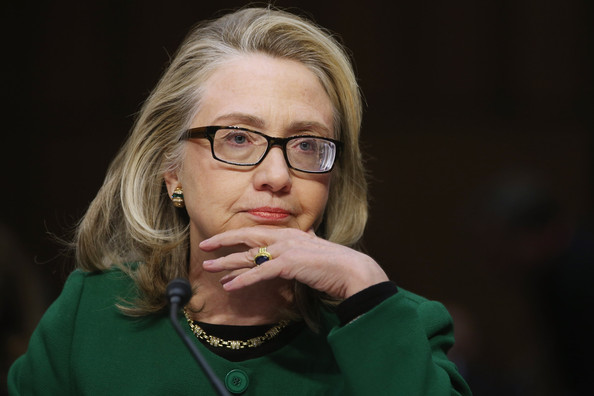
Hillary Clinton's Glasses Not A Fashion Statement

Sharp-eyed readers here noticed that the lenses in HRC's glasses were more complex than the usual coke-bottle ones we are accustomed to seeing on her.

We knew she used her considerable persuasive skills to return to work somewhat earlier than her doctors might have wished due to remarks she made in a conference call while she was still recuperating at home. We also know she wants to close out her time at State on an up note with some special events. That's our girl, and no one is going to change that about her.

All of us here continue to pray for her complete recovery and future safety and good health - even if she is in hiding from us as she contemplates her next project.


Hillary Clinton's Glasses Are For Concussion, Not Fashion


The thick glasses Hillary Clinton has been wearing in public since returning from a concussion and blood clot last month are the result of lingering effects of her health problems, a Clinton aide confirms.
"She'll be wearing these glasses instead of her contacts for a period of time because of lingering issues stemming from her concussion," said spokesman Philippe Reines. "With them on she sees just fine."

Read more >>>>

01-23-13-Z-08 

SECRETARY HILLARY RODHAM CLINTON: Public Schedule for January 25, 2013

01-23-13-Z-58

Public Schedule for January 25, 2013


Public Schedule
Washington, DC
January 25, 2013


DEPARTMENT OF STATE
PUBLIC SCHEDULE

FRIDAY, JANUARY 25, 2013

SECRETARY HILLARY RODHAM CLINTON

9:15 a.m. Secretary Clinton meets with the regional bureau secretaries, at the Department of State.
(CLOSED PRESS COVERAGE)

3:00 p.m. Secretary Clinton and former Secretary of State James A. Baker, III host the launch of the Diplomacy Center, at the Department of State. Please click here for more information.
(OPEN PRESS COVERAGE)

Thursday, January 24, 2013

Hillary Clinton Introducing John Kerry, Her Successor Designate


Remarks Introducing Nominee for Secretary of State, Senator John Kerry at His Senate Foreign Relations Committee Confirmation Hearing


Testimony

Hillary Rodham Clinton
Secretary of State
Hart Office Building
Washington, DC
January 24, 2013

Thank you, Mr. Chairman. It’s very good to be back and to have this opportunity to join with Senator Warren and Senator McCain in introducing President Obama’s nominee to be the next Secretary of State. I was very honored when John asked me to take part in this because John is the right choice to carry forward the Obama Administration’s foreign policy, and I urge his speedy confirmation. As we’ve heard from both the Chairman and the Ranking Member and just now Senator Warren, he will bring a record of leadership and service that is exemplary. He has a view of the world that he has acted on, first as that young returning veteran from Vietnam who appeared before this committee, through the time that he served with such distinction as its chairman. He’s been a valued partner to this Administration and to me personally. He has fought for our diplomats and development experts. He understands the value of investing in America’s global leadership. And as we work to implement the Accountability Review Board’s recommendations, he is committed to doing whatever it takes to prevent another attack and protect our people and posts around the world.
Now, working together, we’ve achieved a great deal. But the State Department and USAID have a lot of unfinished business, from Afghanistan to nonproliferation to climate change to so much. We need to sustain our renewed engagement in the Asia Pacific, continue ramping up economics as a tool for advancing American interests and jobs, pressing forward with unleashing the potential of the world’s women and girls, keep championing the kind of smart power that looks to innovation and partnerships with governments and people alike to promote peace and stability.
John has built strong relationships with leaders in governments here and around the world, and he has experience in representing our country in fragile and unpredictable circumstances. He was in Pakistan and Afghanistan a few years ago, and we were consulting over the phone. He played an instrumental role in working with President Karzai at that time to accept the results of the election and to move forward. I had to call Harry Reid and ask Harry not to schedule any votes so that John could continue to stay there to see that mission through. But that’s what he does. He is a determined and effective representative of the United States, has been as a senator, will be as Secretary.
Let me close by saying that leading our diplomats and development experts is a great honor. And every day, as I testified yesterday, I’ve seen firsthand their skill, their bravery, their unwavering commitment to our country. I’ve been proud to call them colleagues and to serve as Secretary of State. And I’m very pleased that John will be given the chance, subject to confirmation, to continue the work of a lifetime on behalf of our country.
Thank you.


###

Video: Hillary Clinton at the 100,000 Strong Foundation Launch


Remarks at Launch of the 100,000 Strong Foundation


Remarks
Hillary Rodham Clinton
Secretary of State
Ben Franklin Room
Washington, DC
January 24, 2013


Thank you. Well, we’re all getting a little emotional and sentimental around here – (laughter) – with about a little over a week to go in my tenure. And I am so pleased to welcome all of you here. I see many, many familiar faces and some good friends in this audience. And I particularly want to thank Assistant Secretary Kurt Campbell for driving not only this program, but so much that we have accomplished in the last four years to deepen and strengthen our relationship with China and others in the region, but particularly with China, as it is such a consequential relationship, one that we believe so strongly in. Ambassador Zhang, once again, welcome to the State Department. Because it is, for us, a way of making clear that our relations, government-to-government, are obviously essential. But it is those people-to-people ties that are going to determine the quality of the relationship for the future.
Our engagement with China today deals with a wide range of the most pressing challenges and the most exciting opportunities. And when we began looking at ways to make our exchanges with China more productive, we of course ramped up our diplomatic engagement. We took delegations of investors and entrepreneurs to China. We institutionalized the Strategic and Economic Dialogue. We are very clear that what we’ve tried to build, an architecture that will stand the test of time regardless of what is going on in either of our countries, has been an essential effort.
And in 2010, we launched the 100,000 Strong Initiative. And as Kurt said, this is aimed at increasing the number of American students studying in China to 100,000 over four years. We focused on student exchanges because we believe that the future is very clearly in the hands of the young people of both of our countries. And the more we can foster exchanges and understanding, mutual trust, the better off not only the relationship will be, but each of our countries individually. We have to have far more than conversations with diplomats or journalists or leaders or businesspeople. There’s nothing more important than trying to build a structure of exchanges between us when it comes to students and other young people.
Now, we’ve made tremendous progress since 2010. We’ve already expanded study abroad programs. We’ve supported scholarship funds to help American students from underserved communities study in China. We’ve worked with EducationUSA to provide tools and resources for Chinese students seeking to study here. And the number of students coming between our two countries continues to grow. But we still have a lot of room for improvement.
So I’m happy today that we’re launching a permanent, independent nonprofit organization focused not only on our goal of 100,000 American students in China by 2014, but on continuing to strengthen the student exchanges for years to come. And I’m so grateful to all of our State Department partners who are here today who have helped put the 100,000 Strong Foundation together.
As I think back on the four years that I’ve been privileged to serve as Secretary of State, there are moments that just jump out of my memory bank. And one of them is when I finally got to our pavilion at the Shanghai Expo, which, as a number of you know, I am very proud to be called the mother of whenever I go to China because of the circumstances in which it was birthed. (Laughter.) But when I did get there for this magnificent expo that had been built up with pavilions from around the world and a magnificent Chinese pavilion, I was thrilled that the main attraction of our USA Pavilion were American students who had been studying Chinese, who were our designated hosts and greeters.
And I had the best time watching long lines of Chinese citizens who were coming to see our pavilion like they had been coming to see all of the pavilions looking surprised when some little African American girl would come up and start talking to them in Chinese, or some big tall Hispanic youngster would give them directions about how to go through the pavilion, or some other child – child; I’m so old, they’re all children – (laughter) – but some other student would come up and say something similar. And it was wonderful to watch the interchange. And I talked to some of the students. “Where were you from?” “Oh, from LA.” “Where are you from?” “Oh, from New York City.” And so many of these young people were first-generation college students in America who had just become taken with China, and so they were studying Chinese and now they were there as official representatives of the United States Government.
I say that because that’s what we want to see more of. We want to see Chinese youngsters here, American youngsters in China, and we want to see them breaking down the barriers that exist between any peoples from different cultures and experiences and histories and backgrounds. And I think that will happen because in ways that were unimaginable just a few years ago, young people in both China and the United States are global citizens. They are communicating with new tools of technology that were not even dreamt of a decade ago. And so they are already building cyber or Internet relationships, and we want to give them a chance to form the real deal – getting to know each other, getting to understand each other.
So I’m thrilled that we’re announcing this foundation. I thank everyone here at the State Department and all of our partners who are making this possible. And I’m also very excited because this is a perfect example of a public-private partnership, and nobody does it better than the United States. We really are good at this because we have a long tradition of understanding that we have to have both government action and government involvement, but where most of life takes place in our country is not there; it’s outside of government. It’s in these other institutions – colleges and universities, foundations and philanthropies, individual efforts of all kind. So we are deeply grateful that you have understood our vision for 100,000 Strong and are making it a reality.
And with that, let me turn it back to Assistant Secretary Campbell. Thank you all. (Applause.)
###

SECRETARY HILLARY RODHAM CLINTON: Public Schedule for January 24, 2013

01-23-13-Z-10

Public Schedule for January 24, 2013


Public Schedule
Washington, DC
January 24, 2013


SECRETARY HILLARY RODHAM CLINTON

10:00 a.m. Secretary Clinton introduces nominee for Secretary of State, Senator John Kerry, at his Senate Foreign Relations Committee confirmation hearing, on Capitol Hill.
(MEDIA DETERMINED BY SFRC)

2:15 p.m.
Secretary Clinton hosts the launch of the 100,000 Strong Foundation, at the Department of State. Please click here for more information.
(OPEN PRESS COVERAGE)


3:00 p.m. Secretary Clinton attends a meeting at the White House.
(MEDIA DETERMINED BY WHITE HOUSE)

4:35 p.m. Secretary Clinton attends a meeting at the White House.
(MEDIA DETERMINED BY WHITE HOUSE)

Wednesday, January 23, 2013

Tomorrow: On Hillary Clinton's Agenda

01-23-13-Z-35

Secretary Clinton To Deliver Remarks at 100,000 Strong Foundation Event


Office of the Spokesperson
Washington, DC
January 23, 2013


On January 24, Secretary of State Hillary Rodham Clinton will host an event to celebrate the launch of the 100,000 Strong Foundation as an independent nongovernmental organization. Announced by President Barack Obama in 2009 as the 100,000 Strong Initiative and until now a part of the Department of State, the new 100,000 Strong Foundation will work to achieve the goal of having 100,000 American students study in China by 2014. Thursday’s event will underscore the importance of study abroad in China and the benefits to our strategic relationship with China as well as the personal benefits individuals receive through these exciting experiences.
The event will begin at 2:15 p.m.  There will be a panel discussion after the Secretary’s remarks.

Video: Hillary Clinton Before the House Foreign Affairs Committee on Benghazi


Terrorist Attack in Benghazi: The Secretary of State's View


Testimony

Hillary Rodham Clinton
Secretary of State
Opening Remarks Before the House Foreign Affairs Committee
Washington, DC
January 23, 2013


Thank you very much, Mr. Chairman, and I thank you and the Ranking Member and members of the committee, both of longstanding tenure and brand new members, and I appreciate your patience for me to be able to come to fulfill my commitment to you, actually to the former chairwoman, that I would be here to discuss the attack in Benghazi. I appreciate this opportunity. I will submit my full testimony for the record. I want to make just a few points. First, the terrorist attacks in Benghazi that claimed the lives of four brave Americans – Chris Stevens, Sean Smith, Tyrone Woods, and Glen Doherty – are part of a broader strategic challenge to the United States and our partners in North Africa. I think it’s important we understand the context for this challenge as we work together to protect our people and honor our fallen colleagues.
Any clear-eyed examination of this matter must begin with this sobering fact: Since 1988, there have been 19 Accountability Review Boards investigating attacks on American diplomats and their facilities. Since 1977, 65 American diplomatic personnel have been killed by terrorists. In addition to those who have been killed, we know what happened in Tehran with hostages being taken in 1979, our Embassy and Marine barracks bombed in Beirut in 1983, Khobar Towers in Saudi Arabia in 1996, our embassies in East Africa in 1998, consulate staff murdered in Jeddah, Saudi Arabia in 2004, the Khost attack in Afghanistan in 2009, and too many others.
But I also want to stress the list of attacks that were foiled, crises averted, and lives saved is even longer. We should never forget that the security professionals get it right more than 99 percent of the time, against difficult odds, because the terrorists only need to get it right once. That’s why, like all my predecessors, I trust the Diplomatic Security professionals with my life.
Let’s also remember that, as the Chairman and the Ranking Member pointed out, administrations of both parties, in partnership with Congress, have made concerted and good faith efforts to learn from the tragedies that have occurred, to implement recommendations from the Review Boards, to seek the necessary resources to better protect our people in a constantly evolving threat environment.
In fact, Mr. Chairman, of the 19 Accountability Review Boards that have been held since 1988, only two have been made public. I want to stress that because the two that have been made public, coming out of the East Africa Embassy bombings and this one, are attempts, honest attempts by the State Department, by the Secretary – Secretary Albright and myself – to be as transparent and open as possible. We wanted to be sure that whatever these independent, nonpartisan boards found would be made available to the Congress and to the American people, because, as I have said many times since September 11th, I take responsibility, and nobody is more committed to getting this right. I am determined to leave the State Department and our country safer, stronger, and more secure.
Now, taking responsibility meant not only moving quickly in those first uncertain hours and days to respond to the immediate crisis, but also to make sure we were protecting our people and posts in high-threat areas across the region and the world. It also meant launching an independent investigation to determine exactly what happened in Benghazi and to recommend steps for improvement. And it also meant intensifying our efforts to combat terrorism and support emerging democracies in North Africa and beyond. Let me share briefly the lessons we have learned up until now.
First, let’s start on the night of September 11th itself and those difficult early days. I directed our response from the State Department and stayed in close contact with officials from across our government and the Libyan Government. So I did see firsthand what Ambassador Pickering and Chairman Mullen called timely and exceptional coordination – no delays in decision making, no denials of support from Washington or from our military. And I want to echo the Review Board’s praise for the valor and courage of our people on the ground, especially our security professionals in Benghazi and Tripoli. The board said our response saved American lives in real time, and it did.
The very next morning, I told the American people, and I quote, “heavily armed militants assaulted our compound,” and vowed to bring them to justice. And I stood later that day with President Obama as he spoke of an act of terror.
Now you may recall, at this same time period, we were also seeing violent attacks on our embassies in Cairo, Sana’a, Tunis, and Khartoum, as well as large protests outside many other posts, from India to Indonesia, where thousands of our diplomats serve.
So I immediately ordered a review of our security posture around the world, with particular scrutiny for high-threat posts. And I asked the Department of Defense to join Interagency Security Assessment Teams and to dispatch hundreds of additional Marine Security Guards. I named the first Deputy Assistant Secretary of State for High Threat Posts so that missions in dangerous places get the attention they need. And we reached out to Congress to help address physical vulnerabilities, including risks from fire, and to hire additional Diplomatic Security Personnel and Marine Security Guards.
Second, even as I took these steps, I quickly moved to appoint the Accountability Review Board because I wanted them to come forward with their report before I left, because I felt the responsibility and I wanted to be sure that I was putting in motion the response to whatever they found; what was wrong, how do we fix it.
I have accepted every one of their recommendations. Our Deputy Secretary for Management and Resources, Deputy Tom Nides, who appeared before this committee last month, is leading a task force to ensure all 29 are implemented quickly and completely, as well as pursuing additional steps above and beyond the board.
I pledged in my letter to you last month that implementation has now begun on all 29 recommendations. We’ve translated them into 64 specific action items. They were all assigned to specific bureaus and offices with clear timelines for completion. Fully 85 percent are on track to be completed by the end of March, with a number completed already. But we are also taking a top-to-bottom look to rethink how we make decisions on where, when and whether our people should operate in high-threat areas, and how we respond.
We are initiating an annual High Threat Post Review chaired for the first time in American history, I suppose, by the Secretary of State, and ongoing reviews by the Deputy Secretaries, to ensure that pivotal questions about security reach the highest level. And we will regularize protocols for sharing information with Congress.
Now, in addition to the immediate action we took and the review board process, we’re moving on a third front: addressing the broader strategic challenge in North Africa and the wider region. Benghazi did not happen in a vacuum. The Arab revolutions have scrambled power dynamics and shattered security forces across the region. Instability in Mali has created an expanding safe haven for terrorists who look to extend their influence and plot further attacks of the kind we just saw last week in Algeria.
And let me offer our deepest condolences to the families of the Americans and all the people from many nations killed and injured in the Algerian hostage crisis. We remain in close touch with the Government of Algeria, ready to provide assistance if needed, and also seeking to gain a fuller understanding of what took place so we can work together to prevent such terrorist attacks in the future.
Now, concerns about terrorism and instability in North Africa are not new, of course. Indeed, they have been a top priority for this entire national security team. But we need to work together to accelerate a diplomatic campaign to increase pressure on al-Qaida in the Islamic Maghreb and the other terrorist groups in the region.
I’ve conferred with the President of Libya, the Foreign Ministers and Prime Ministers of Tunisia and Morocco. Two weeks later, after the attack, I met with a very large group of regional leaders at the UN and was part of a special meeting focused on Mali and the Sahel. In October, I flew to Algeria to discuss the fight against AQIM. In November, I sent Deputy Secretary Bill Burns on an interagency group to Algiers to continue that conversation. And then in my stead, he co-chaired the Global Counterterrorism Forum that was held in Abu Dhabi and a meeting in Tunis working not only on building new democracies but reforming security services.
These are just a few of the constant diplomatic engagements that we are having focused on targeting al-Qaida’s syndicate of terror – closing safe havens, cutting off finances, countering their extremist ideology, slowing the flow of new recruits. We continue to hunt the terrorists responsible for the attacks in Benghazi and are determined to bring them to justice. And we are using our diplomatic and economic tools to support the emerging democracies, including Libya, in order to give them the strength to provide a path away from extremism.
But finally, the United States must continue to lead in the Middle East, in North Africa, and around the globe. We’ve come a long way in the past four years, and we cannot afford to retreat now. When America is absent, especially from unstable environments, there are consequences. Extremism takes root; our interests suffer; and our security at home is threatened.
That’s why Chris Stevens went to Benghazi in the first place. I asked him to go. During the beginning of the revolution against Qadhafi, we needed somebody in Benghazi who could begin to build bridges with the insurgents and to begin to demonstrate that America would stand against Qadhafi. Nobody knew the dangers or the opportunities better than Chris, first during the revolution, then during the transition. A weak Libyan Government, marauding militias, even terrorist groups; a bomb exploded in the parking lot of his hotel. He never wavered. He never asked to come home. He never said, “Let’s shut it down, quit, and go somewhere else.” Because he understood it was critical for America to be represented in that place at that pivotal time.
So Mr. Chairman, we do have to work harder and better to balance the risks and the opportunities. Our men and women who serve overseas understand that we do accept a level of risk to represent and protect the country we love. They represent the best traditions of a bold and generous nation. They cannot work in bunkers and do their jobs. But it is our responsibility to make sure they have the resources they need to do those jobs and to do everything we can to reduce the risks they face.
For me, this is not just a matter of policy. It’s personal, because I’ve had the great honor to lead the men and women of the State Department and USAID, nearly 70,000 serving here in Washington and at more than 275 posts around the world. They get up and go to work every day, often in difficult and dangerous circumstances thousands of miles from home, because they believe the United States is the most extraordinary force for peace and progress the earth has ever known.
And when we suffer tragedies overseas, the number of Americans applying to the Foreign Service actually increases. That tells us everything we need to know about the kind of patriots I’m talking about. They do ask what they can do for their country, and America is stronger for it.
So today, after four years in this job, traveling nearly a million miles and visiting 112 countries, my faith in our country and our future is stronger than ever. Every time that blue and white airplane carrying the words “United States of America” touches down in some far-off capital, I feel again the honor it is to represent the world’s indispensible nation. And I am confident that, with your help, we will continue to keep the United States safe, strong, and exceptional.
And now I would be very happy to answer your questions.


###