
Background Briefing on the Secretary's Upcoming Travel
Special BriefingOffice of the SpokesmanSenior State Department OfficialsVia Conference CallWashington, DCJanuary 7, 2011OPERATOR: Welcome, and thank you for standing by. At this time, all participants are in a listen-only mode. During the question-and-answer session, please press *1, make sure your phone is un-muted, and record your name when prompted. I would now like to turn this meeting over to Mark Toner. Thank you. You may begin.
MR. TONER: Thank you. Good morning, and thanks for joining us. As you know, the Secretary of State will head out tomorrow for a trip to the United Arab Emirates, Oman, and Qatar. That will be from January 8th, tomorrow, through the 13th. She’ll also, in Qatar, participate in the Seventh Forum for the Future, which is a joint initiative of the countries of the broader Middle East and North African region and the industrialized countries of the G-8.
Just in that vein, just to give you a little bit more detail and granularity on the trip and speak to her agenda, we’re joined by two [senior State Department officials]. Just a reminder, the ground rules here are on background, so [the senior State Department officials] will henceforth be known as Senior Official Number One and Number Two – Senior State Department Official.
Without further ado, I’ll hand it over to Senior State Department Official Number One. [Senior State Department Official One], go ahead.
SENIOR STATE DEPARTMENT OFFICIAL ONE: Thank you very much, Mark, and thank you so much for giving us the opportunity to talk a little bit about the Secretary’s trip to the Gulf. We’re very pleased that she’s going back out. As you may recall, she was in Bahrain a month ago for the Manama Dialogue. Now she’s going to go out and showcase our emphasis on partnership with civil society. And I’ll let my colleague talk a little bit more about that.
But I think what’s important about the trip is, in addition to this opportunity to really get some bounce with this idea that civil society has a role, has a very important role to play in the region, she’s going to have an opportunity to build on the very good personal relations that she has with a number of these leaders in the UAE, in Oman, and in Qatar. And she’s going to have the opportunity to talk about key regional issues. This agenda, obviously, is very familiar to all of you listening. It includes Iraq, Iran, the Middle East peace process, Lebanon, Yemen.
And we have a very robust bilateral agenda (inaudible) visiting. These are countries that we have worked with very closely over the years, and we’re going to have the opportunity for the Secretary to talk about our commercial relationships, to talk about people-to-people relationships that are so important to highlight some of the things that are of interest to us and to our friends in the Gulf.
We’re very pleased, for instance, that she’s going out to Masdar in the UAE, the green town that you may have read about recently. She’s going to spend some time in Dubai, where I understand she’s never been.
In Oman, she’s going to help mark the 40th anniversary of the Sultan of Oman, who is a longtime friend of the United States and a valued partner who’s made enormous changes on the ground in his country in the past 40 years. And I know that she’s looking forward to that opportunity.
And of course, in Qatar, the showpiece of the centerpiece of the trip is the Forum for the Future. But we also have a longstanding relationship with the Qataris. We have a very robust dialogue on a variety of issues, including African issues such as Sudan and Yemen. And we’re looking forward to having some real exchanges there as well.
I think I’ll turn it over to [Senior State Department Official Two] to talk a bit more in detail about Forum for the Future and the overall theme of the visit.
SENIOR STATE DEPARTMENT OFFICIAL TWO: [Senior State Department Official One], thanks so much, and Mark, and thank you all for joining us. Typically, when the Secretary is traveling to our part of the world, she is doing a lot of business on these core relationships, on important regional security issues, on conflict resolution, and these are the Middle East issues that I know most of you folks end up writing about when you write about U.S. engagement in our region.
But we have a lot more going on across the region, and this trip is really an opportunity to showcase that these other dimensions of U.S. engagement in the Middle East and in the Gulf, particularly the emphasis that we’ve placed on building partnerships beyond the government-to-government level, reaching out to civil society, reaching out to the private sector, and treating – and really viewing them as essential partners in progress in the region, in developing and building a vision for the future of this region that’s dynamic, that’s prosperous, that’s progressive, that provides opportunity for young people. And this is a region where a majority of the population is under 25. So that’s really the key goal for everything that she’s doing on the trip.
The second element here that’s driving this travel comes out of the Secretary’s commitment to civil society. And those of you who were in Krakow and those who were not heard her in her address there at the Community of Democracies talk at length about civil society and the way she views this sector as an essential partner alongside governments in democracy and development, and laying out in Krakow her commitment and U.S. Government support for the work of civil society actors around the world.
So this trip is really meant to manifest that very concretely. In every stop she is going to have direct engagement with civil society actors who have been involved in all kinds of creative ways in activities to tackle social issues like child marriage or domestic violence, as well as to work on cutting-edge innovation, promoting business development, working with young people, working in education. And she’s going to be engaging at each stop with civil society actors on those questions.
And this culminates, of course, in her engagement at the Forum for the Future, where the three legs of the stool she talked about in Krakow – government, civil society, and business – all come together in this multilateral meeting to talk about how together they can work to advance political, economic, and social reform across the region.
And the Forum is something that I think really has gained steam over the last couple of years. It’s got strong support from a number of regional governments and there are a lot of concrete commitments from the G-8 states that have flowed out of the partnership represented by the Forum for the Future. So all of that will be highlighted at the Forum, and the Secretary will be participating at the Forum in a session that really symbolizes this engagement between government, business, and civil society. She’s going to be part of a conversation with a foreign minister from the region, a civil society representative, and a business representative. And so that will be her final day on the trip before we come home.
MR. TONER: Thank you both. With that, we’ll open it up to questions. And just a reminder, as Caroline will tell you as well, if you could just give your name and media affiliation. And we’ll open it up to questions now.
OPERATOR: Thank you. We will now begin the question-and-answer session. If you’d like to ask a question, please press *1, make sure your phone is un-muted, and record your name and affiliation when prompted. To withdraw your request, you may press *2. Once again, if you have a question or a comment at this time, please press *1 and record your name and affiliation. One moment for our first question.
Our first question comes from Josh Rogin from Foreign Policy. Your line is open.
QUESTION: Hi, good afternoon, and thank you so much for taking the time to talk with us today. I’m wondering if you could please give us the list of – I understand that the Secretary’s trip is focused on civil society and civic engagement, but could you please give us the list of senior officials in each of those three countries that Secretary Clinton will be meeting with and what the main agenda items might be? And also, I see that Secretary Clinton will meet this evening with Saudi King Abdullah and Lebanese Prime Minister Hariri. Could you please also talk a little bit about the goals and the agenda for those two meetings? Thank you so much.
SENIOR STATE DEPARTMENT OFFICIAL TWO: Well, let me first talk about the meetings this evening. The Secretary will be going up to New York to make a courtesy call on King Abdullah, who, as you know, has been in the United States for medical reasons over the last couple of months. This really is strictly a courtesy call. Obviously, the King’s health has been such that he hasn’t been able to receive many visitors up until now, so I think the Secretary is very pleased to have this opportunity.
We understand, and I frankly have not seen the latest schedule, that she’s tentatively scheduled also to see Hariri. We would obviously like to hear how things are going in Lebanon, particularly as we prepare for what we think will be the next round of events associated with the special tribunal on Lebanon.
With regard to the individuals that she’s going to meet in the region, pretty much who you would expect. In the UAE, obviously, she will meet Muhammad bin Zayed and his brother Abdul Aziz bin – excuse me, Abdallah bin Zayed. Muhammad bid Zayed is the Crown Prince of the UAE. Abdallah bin Zayed is the foreign minister of UAE.
She will travel to Dubai and have an opportunity to meet with the ruler of Dubai, Muhammad bin Rashid. In Oman, of course, she will meet with the Sultan of Oman and offer her congratulations on his 40th anniversary of his accession to the throne. And in Qatar, she will meet with Amir Hamad bin Khalifa, who is someone that she has met with most recently, I believe, in February.
In terms of the issues on her agenda in each place, obviously it’s going to be driven by the regional context. She’s going to want to talk about Iraq. We have a government now on the ground in Iraq, and all three of these countries have made public note of that. We obviously want to have them – we want to encourage them to be as supportive as possible to the new Iraqi Government. There have been some bumps in the road in those relationships in the past, as you’re well aware of. But I think that she will look forward to hearing from her interlocutors how they see things evolving in Iraq and how they might be able to assist the new Iraqi Government.
On the peace process, I think that it’s time once again for the Secretary to take stock on what is happening. We have had some visits both here and in the region. Senator Mitchell was just out recently. I think that she will want to have the opportunity with the three leaders, as well as any of the other foreign ministers that she has an opportunity to meet with around the fringes of the Forum – she’ll want to talk a bit about where the Arab Peace Initiative is certainly, and she’ll want to perhaps get a better sense of how the region sees the situation on the ground, both in terms of the Palestinian Authority but also in terms of the talks.
We continue to look for ways to engage on the peace process, as you are all well aware. The parties have indicated to us they want to continue contacts with us indirectly. And we are very eager to see progress made, but it’s an uphill battle and we look forward to talking to the rulers of the area to see how they can play a positive role.
On Iran, well, as you know, the Istanbul meeting is tentatively on the agenda for the near term. And certainly, given the very intense interest in the region in the Gulf, in Iran, the close proximity to Iran – I mean, I don’t need to tell any of you that – we particularly value our opportunities to talk with rulers in the Gulf about Iran, about Iran – what it’s doing, what it’s up to, what might be most effective to get it to a place at these talks at the P-5+1 talks in Istanbul, that would try and unknot this problem that we find ourselves in internationally with the Iranians and their nuclear ambitions.
The Gulf states obviously have a vested interest in this. And over the years, we’ve had very good and very robust discussions with them. I think that also in her meetings, she’ll want to take stock where we are on the sanctions regime. Obviously, given the countries in the region and their commercial interests, this is of particular interest to them.
Lebanon – I’ve already touched briefly on some of the issues that are emanating out of Lebanon. I have to say that Assistant Secretary Feltman is probably one of the world’s experts on Lebanon; regretfully, he is not here. But we are certainly watching very closely about what is happening on the ground in Lebanon with particular interest to – with regard to the special tribunal and some of the political discussions that are underway.
A full menu of regional issues, and then, as I said earlier, there’s also a number of bilateral issues on the agenda. So she’s going to have her work cut out for her and an awful lot of talking points.
OPERATOR: Does that conclude your question or comment?
QUESTION: Yes, thank you so much.
OPERATOR: Thank you. Our next question or comment comes from Jill Dougherty from CNN. Your line is open.
QUESTION: Yes, hello. I wonder if you could give us some background on our off-the-record stuff.
SENIOR STATE DEPARTMENT OFFICIAL TWO: I’m sorry, I’m not in a position to say anything.
OPERATOR: Thank you. Our next question or comment comes from Jay Solomon from Wall Street Journal. Your line is open.
QUESTION: Hi, thanks for taking the call. Do you think – you talked about how much focus there’ll be on civil society and democracy. Is Egypt and the serious allegations of fraud and rigging of the last vote – is this likely to be something Clinton raises publicly while she’s in the region? And if not, why wouldn’t she be raising it considering how much focus there’ll be on the democracy front at these events?
SENIOR STATE DEPARTMENT OFFICIAL TWO: Jay, thanks. This is [Senior State Department Official Two]. Look, obviously, there are significant concerns about the conduct of the Egyptian elections that we’ve already, I think, made our views pretty clear on. This – the nature of the trip and the Forum itself is, yes, to discuss democracy and civil society and also economic and social reforms, all of which are designed to advance human development and improve the lives of people of the region. And the role of civil society in political processes like elections is an important component of that.
At the Forum, there are going to be gathered delegates from civil society all across the region, from Morocco to Afghanistan, and they face a variety of different operating environments. Some of them face some challenges in operating, and a group of them will be meeting – a representative group of them will be meeting with the Secretary at the Forum. I’m sure that they will have some specific issues that they want to raise with her.
And I think that she wants to be there and wants to engage with them both publicly and in these more intimate meetings to have the opportunity to hear directly from them about the work that they’re trying to do about some of the challenges that they face and about what we can do to help them do their work.
OPERATOR: Thank you. Our next question or comment comes from Kim Ghattas from BBC. Your line is open.
QUESTION: Thank you both for taking the call. I’m struck by the fact that you’re emphasizing how much the Secretary will engage with civil society, the importance of partnering with civil society. I mean, she has done that on almost every trip over the last two years, including the trips that she’s taken to the Middle East. I’m wondering what is perhaps new about what’s on the agenda or how she is going to engage with civil society.
And [Senior State Department Official Two], you just said that economic and social reforms help advance human developments in the Arab world, so I was wondering what you had to say about the unrest that we’re seeing in Tunisia and today in Algeria. I’m struck by the fact that there’s been very little comment coming out of the State Department about what’s happening there.
SENIOR STATE DEPARTMENT OFFICIAL TWO: Okay. Kim, thanks. I think on the question of what’s different, you’re right. The Secretary makes a point of meeting with civil society groups on all her overseas trips, and that itself is flowing out of this issue that’s very close to her heart, that’s part of her political resume, and it’s something she feels very strongly about.
So it’s not a change. I think the point I’m making is simply that it’s the organizing principle for this trip rather than an element added on. And I think that the schedule, the engagements that she’s going to be having both with civil society actors in smaller meetings but also in her public engagements and in her government meetings – a lot of the emphasis is going to be on how governments and civil society can partner on behalf of progress for people in the region.
And there are a number of specific examples. There are some that have been built with a U.S. role, and there are others that have sort of developed organically. But I think that there is – that’s really the organizing principle for the whole trip and for her participation in the Forum.
On the country-specific questions, let me turn it over to [Senior State Department Official One].
SENIOR STATE DEPARTMENT OFFICIAL ONE: Well, we’re certainly watching what’s happening both in Tunisia and Algeria with a great deal of interest. We did call in the Tunisian ambassador yesterday and expressed our concern about both what is happening with regard to the demonstrations and encouraged the Tunisian Government to ensure that civil liberties are protected, including the freedom to peacefully assemble.
We also raised the issue of Tunisian – what looks like Tunisian Government interference with the internet, most notably Facebook accounts. Frankly speaking, we’re quite concerned about this and we’re looking at the best and most effective way to respond and to get the result we want.
In Algeria – this is something I actually watched with a great deal of personal interest having served there as ambassador for three years – it’s frankly too soon to tell exactly what is happening here. There have been, as you are well aware, price increases as well as an acute housing shortage, which have not been well-managed by the government. And as a result, people are taking to the streets. We understand that there was some additional demonstration and rioting today. We don’t know the extent of it. But we’re also looking there about what’s the most effective and immediate thing to say and do.
QUESTION: Thank you.
OPERATOR: Thank you. Our next question or comment comes from Mina Al-Oraibi from Asharq Al-Awsat newspaper. Your line is open.
QUESTION: Hi, thanks for doing this. I have a couple of questions. First is regarding Iraq. What do you expect from the three countries in terms of the Secretary’s talks on Iraq? What sorts of support? Will she be discussing the upcoming Arab summit to be held in Baghdad in March?
And my second question is about the Forum for the Future. I mean, this is the seventh Forum. What would you say is the biggest outcome so far of these meetings beyond having the opportunity to sit and network or talk for the day and a half that people are there?
SENIOR STATE DEPARTMENT OFFICIAL ONE: Well, this is [Senior State Department Official One]. Let me take the Iraq question and then I’ll hand it over to [Senior State Department Official Two].
Listen; on Iraq, what we’re really hoping to do is elicit more expressions of support for the Iraqi Government. We do now have a government on the ground in Iraq after a very long and somewhat tortuous process. It is important for the region to step up and provide them support. It is important for Iraq, frankly, to be reintegrated back in the region. That’s not only in our interest and the Iraqis’ interest, but we think it’s in the interest of the countries of the area. We’re going to urge, I think, countries that have not already opened embassies to open embassies in Baghdad. That’s certainly a strong signal of support by a government for the newly formed government.
I mean, we’re not looking exactly for financial support or anything like that. What we’re looking for are the types of public statements and public gestures, including the attendance, obviously, at the Arab summit. That will demonstrate that Iraq is back. We understand that there are reservations in certain corners of the Gulf. We certainly appreciate that. But we think that those barriers can be broken down over a period of time as the countries of the Gulf continue to reengage.
[Senior State Department Official Two]?
SENIOR STATE DEPARTMENT OFFICIAL TWO: Thanks, [Senior State Department Official One]. And then Mina, on the Forum, yeah, I mean, this initiative, as you probably know, was generated when the U.S. held the chairmanship of the G-8 states in 2004. And the idea was to help bring governments in the region and civil society in the region, which was at a much more nascent stage at that time, into dialogue about the challenges of reform.
And I think what we see today is a significant evolution of civil society and of that conversation. There were five civil society representatives at the first Forum for the Future in 2004, and there are going to be 50 civil society delegates out of hundreds, literally, who were involved in the Forum process over the course of this year. Fifty were selected to participate in the Forum itself.
And the civil society role has really grown and expanded over that period of time, so that this year, the civil society groups and this civil society part of the process is something that the United States has supported actively with our own funding through the MEPI program, the Middle East Partnership Initiative. The civil society groups organize for themselves three workshops – one political, one social, and one economic issue over the course of the year. And then they also – and developed recommendations at those workshops that they wanted to bring to the governments in Doha. And then they also held seven national seminars in countries around the region to bring the results of their workshops to a much broader array of NGOs.
So as the civil society landscape in the region has blossomed, I think their contributions to the Forum process have blossomed as well, and we see that very – a number of the governments over the course of this year, in preparation for the Forum, have remarked how constructive, how mature the civil society participation and contribution has become.
In terms of even more concrete outcomes, I think you can see several major outputs from the Forum process over the years. One of the biggest is the Foundation For The Future, which is based in Jordan and which is an independent NGO that supports civil society development throughout the BMENA region. It’s supported by a bunch of governments, both regional governments and Western governments, including just over $22 million from the United States over the years.
And then just in the last year on an initiative from civil society, the Forum conducted a study and decided to establish a Gender Institute, a BMENA Gender Institute, which Morocco has offered to host and which has pledges of support from the United States – Secretary Clinton announced at last year’s Forum – and from the United Arab Emirates and also from the Foundation for the Future.
So those are two institutions that have been created out of this government-civil society dialogue. There are also from the G-8 states tens of millions of dollars, maybe even hundreds of millions – I haven’t added it all up – from the various G-8 states in commitments to literacy and education, to civil society and good governance, to private sector development and women’s empowerment, that have come directly out of initiatives brought forward at the Forum. All of the facts and figures on that have been compiled by this year’s G-8 chair, the Canadians, and they’re going to be distributing all of that information in Doha.
MR. TONER: I think we have time for just a couple more questions.
OPERATOR: Okay, our next question or comment comes from Camille Elhassani from Al Jazeera. Your line is open.
QUESTION: Yes, hi. Thank you for doing this call. I wondered if you could give us a more detailed schedule of the Secretary’s activities, like which days she’ll be in which country.
SENIOR ADMINISTRATION OFFICIAL ONE: Mark, are we in a position to do that or not? [Senior Administration Official One.]
MR. TONER: Sorry, I had my mute button on. I think you’ve talked broadly about who she’s meeting with and the purpose of those meetings, but I’d refrain from getting into too much detail.
SENIOR ADMINISTRATION OFFICIAL ONE: All right, well, as I said, she is going to be going to the UAE, to Oman, and to Qatar. She will be meeting the prime minister of – the Crown Prince, rather, of the UAE, Crown Prince Mohammed bin Zayed and the Foreign Minister Abdullah bin Zayed in Abu Dhabi. She will travel to Dubai and meet with Mohammed bin Rashid, the ruler of Dubai. In Oman, obviously, she will meet with Sultan Qaboos to mark his 40th anniversary. And then in Qatar, she will meet the Amir of Qatar Hamad bin Khalifa. So her meetings with these individuals obviously are subject to change in terms of the schedule, but those are sort of the top of the – the top of each visit.
OPERATOR: Does that conclude the question or comment? Our next question or comment comes from Lachlan Carmichael from AFP News Agency. Your line is open.
QUESTION: Yes, thanks for doing this. I wanted to pick up where you mentioned the taking stock of sanctions on Iran. Do you need more work from the Emiratis, the Qataris, and Omanis to stop smuggling? How bad is the smuggling? How much is getting through to Iran?
And the second question is: Much has been made about how – from the U.S. Administration about how the WikiLeaks revelation showed that the Gulf Arabs were in your side. But isn’t the reality different, that they are nervous about Iran and therefore tend to play along with their needs? And that’s the question.
SENIOR ADMINISTRATION OFFICIAL ONE: Well, let me address the issue of sanctions. Obviously, this is going to be one of the focuses of the Secretary’s discussions with the leaders in the region. Sanctions are an important part of our Iran policy, in fact, of the international community’s approach to Iran. As we try and find ways to influence Tehran’s behavior, to try and get them to the table with some serious discussions about what they’re doing with their nuclear material and how they can live up to the responsibilities of a nuclear power, we want to make sure that we have as many tools in our kit bag as possible. And sanctions is one of them. I mean, sanctions, frankly speaking, we understand do hit hard countries that have had economic and commercial relations with the country being sanctioned. These countries in the case of the UAE, they’re right across the water. Bandar Abbas is 150 miles from Dubai. So undoubtedly this regime is going to have an impact on these countries.
And so we appreciate the opportunity to talk frankly about what is working, what is not working, how we can help them better adhere to the UN sanctions. There may be areas in which we can provide technical assistance. We may be able to provide training. I’m speculating here, frankly. But we are willing to put pretty much anything on the table in terms of helping these countries meet their UN obligations to enforce sanctions against Iran.
In terms of the amount, I mean, we’ve seen all sorts of reports in the press and elsewhere, and I’m not an Iran expert, so I can’t tell you what works, what doesn’t work. I mean, we hear anecdotal evidence that the sanctions are beginning to bite in Tehran and Iran in general. Again, I’m not in a position at this point to assess that. But certainly one of the things I think the Secretary would welcome the opportunity hearing from those in the business community when she’s out there is how the sanctions are affecting them and what they see and hear. So she’ll have a good dialogue in each country.
On Iran in general, because this is an issue of great concern to the states of the Gulf and to these particular countries in general, we have had previous conversations and they’re going to continue. They’ve been very frank and open. So in terms of assessing what’s working, what’s not working, how much is getting through, how much is not getting through, I really can’t give you that. What I can tell you is we’re going to talk about it, and we certainly welcome input from the other side. So we’ll look forward to having those conversations – the Secretary will.
In terms of WikiLeaks, you can read anything that you want into the release of those alleged cables. So I’m not going to sort of engage on that. The fact of the matter is that both publicly and privately the countries of this region have expressed concern about the direction in which Iran is going. They’ve expressed concern about the impact of what is happening with the Iran nuclear program on their countries and on their future. And those are concerns that we and others in the international community share. And so that’s going be high on the Secretary’s agenda.
QUESTION: Thank you.
MR. TONER: Great. I think there’s time for just one more question.
OPERATOR: Okay, thank you. Our next question or comment comes from Hisham Melhem from Al Arabiya Television. Your line is open.
QUESTION: Yes, thank you for doing this. Again, I hate to beat a dead horse, but I have to go back to civil society. I mean, this is the seventh Forum, and you’re talking about reviving on the civil society, or the civil society in the Arab world is blossoming. I think that’s the word that was used. At the same time, you see that civil society is under tremendous assault from the various governments in the region, including governments that are friendly towards the United States, governments that receives support – financial and material and military from the United States from Egypt to Yemen to Tunisia, Jordan.
And when you add to that the sectarian violence that we’ve seen against the Christian communities in both Iraq and in Egypt, it seems to me that all of this focus on civil society, the states that are involved, the governing structures that are involved, including those that depend on U.S. support, are not listening to us. And I think I don’t have to tell you this, but this also carries with it a certain element of not only moral responsibility, but political responsibility, because those forces, especially the extreme religious elements, are using this to mobilize support against the United States because they are accusing the United States of supporting these governments that are not listening to their own people.
SENIOR STATE DEPARTMENT OFFICIAL TWO: Hisham, that’s the question?
QUESTION: It’s a comment and it’s a question, because I’m sure you are frustrated, like most of us who are – who would like to see civil society truly blossoming, but it’s not blossoming, in part – mainly, probably – because of the actions, the repressive actions, of these governments. And many of them depend on U.S. support, and one would argue that those people who do not wish the United States well in the Middle East, the extremist religious elements in particular, are using this relationship between the United States and these various governments to put also the blame on the United States. So – and I think it’s incumbent on the United States to take a tougher – maybe a tougher position against these governments.
SENIOR STATE DEPARTMENT OFFICIAL TWO: Hisham, thanks for the question and for the comment, and I understand where you’re coming from.
QUESTION: Is this [Senior State Department Official Two]?
SENIOR STATE DEPARTMENT OFFICIAL TWO: Yes, this is [Senior State Department Official Two].
QUESTION: That’s why – you know where I come from. Thanks. (Laughter.)
SENIOR STATE DEPARTMENT OFFICIAL TWO: Hisham, look, I think the Secretary’s been quite frank about her concern on freedom of association issues globally and a backlash against civil society, and that’s precisely why she raised that issue in Krakow and made that her priority and a focal point in her remarks there because she sees this as a significant challenge to democracy and to the growth of democracy globally. And the Middle East, I don’t think, presents an exception to that broader, very unfortunate global trend.
She discussed in Krakow some specific cases and countries, including Egypt, where she saw steps taken against civil society that were of concern to her. And I think the fundamental point that drove the creation of the Forum for the Future and this G-8/BMENA partnership is the fundamental point that she’s going to be carrying with her when she goes out there, which is that this is a region that is facing tremendous challenge, rising demand from a wired and motivated young generation that’s very aware of the world around them and of the trends in other regions. They want to be a part of that, and they’re putting increasing demands on government to create more opportunities for them and to help them create opportunities for themselves. They want to play a role.
There is also – as you noted, there are those in the region who are ready to put forward a narrative that says there is no hope, there is no opportunity, and are putting forward a sort of dark vision for the future of the region. But there are those in the region, including many very brave and dynamic civil society leaders and including many government leaders and business leaders, who are putting forward a dynamic and positive vision of the future. And what we want to do is support that.
And I think the Secretary’s call throughout her trip and at the Forum is going to be that in order to take on the challenge of integrating this rising young generation and all the potential that it represents, in order for us to succeed at this – and the stakes are quite large, as I think you pointed out – we, government, business, and civil society need to work together in partnership, not to view each other as competitors or as adversaries, but to work together in partnership to solve problems, to hold each other accountable for commitments, and to create real opportunities, meaningful opportunities, politically, socially, and economically for the people of the region.
So that’s very much the message she’s carrying. That’s why she’s going. And that’s what all the work that we’re going to be highlighting during the trip by actors on the ground, that’s what it’s directed toward.
QUESTION: Thanks.
MR. TONER: Thank you. And thanks especially to both of our senior State Department officials for joining us today and for walking us through the trip and providing a level of detail that I think will help journalists who are traveling as well as reporting from here on it. And this concludes the call. A reminder again that all these comments were on background, again, as senior State Department officials. Happy Friday and have a good morning.
OPERATOR: That concludes today’s conference call. Thank you for your participation. You may disconnect at this time.
# # #

RESIST, INSIST, PERSIST, ENLIST.” - HILLARY RODHAM CLINTON
Friday, January 7, 2011
Background Briefing on the Secretary Clinton's Upcoming Travel


SECRETARY OF STATE HILLARY RODHAM CLINTON: Public Schedule for January 7, 2011
Awwwww...! All closed to the press today!

Public Schedule for January 7, 2011
Public Schedule
Washington, DCJanuary 7, 2011
SECRETARY OF STATE HILLARY RODHAM CLINTON
10:00 a.m. Secretary Clinton meets with Ambassador to the UN Susan Rice, at the Department of State.
(CLOSED PRESS COVERAGE)11:15 a.m. Secretary Clinton meets with the senior development team, at the Department of State.
(CLOSED PRESS COVERAGE)12:00 p.m. Secretary Clinton conducts a swearing-in ceremony for Ambassador to Syria Robert Ford, at the Department of State.
(CLOSED PRESS COVERAGE)1:30 p.m. Secretary Clinton attends a meeting at the White House.
(MEDIA DETERMINED BY WHITE HOUSE)7:00 p.m. Secretary Clinton meets with Saudi King Abdullah Bin Abdulaziz, at the Plaza Hotel in New York City.
(CLOSED PRESS COVERAGE)TBD Secretary Clinton meets with Lebanese Prime Minister Saad Hariri, in New York City.
(CLOSED PRESS COVERAGE)
Today: On Hillary Clinton's Agenda

Clinton to meet Saudi King
Jan 7, 2011 6:37 AM | By Sapa-AFP
Secretary of State Hillary Clinton will meet with Saudi Arabia's King Abdullah in New York Friday, where he is recovering from two back surgeries, says the State Department.
Read more>>>>>
Thursday, January 6, 2011
Secretary Clinton's Remarks with Japanese Minister of Foreign Affairs Seiji Maehara After Their Meeting

Remarks with Japanese Minister of Foreign Affairs Seiji Maehara After Their Meeting
Remarks
Secretary of State

SECRETARY CLINTON: Good afternoon. It is a great pleasure once again to be hosting my colleague and counterpart. Minister Maehara and I have had a very comprehensive, wide-ranging discussion on a number of critical issues to our bilateral relationship and to regional and global security and prosperity. I am looking forward to the 2+2 meeting that will be held with Secretary Gates and with the minister and his counterpart, the defense minister, in the coming months. And I am delighted that we will host Prime Minister Kan on his official visit to the United States later this spring.
Because of the minister’s schedule requiring him to be at the White House shortly, I will issue the rest of my statement in a press release* and allow the minister to make his statement and then we will answer your questions.
FOREIGN MINISTER MAEHARA: (Via interpreter) Well, it’s been only four months, or less than four months, since I assumed office as foreign minister, but this was my fourth meeting with Secretary Clinton and we spent a lot of time today to discover a broad ground and I was most happy to have had this meeting. And in the run-up to Prime Minister Kan’s visit to the United States, we had very useful and meaningful discussions on numerous significant issues, especially in the security area, which is the core of the deepening of our Japan-U.S. relations. I think it was very good that we could engage in discussions on various matters related to that. And since time is short, I will, through an appropriate person, provide a briefing to the press later on and tell you what sort of points we discussed.
In any case, on each of such matters that we discussed, we deepened our common understanding and we agreed that we will accelerate the work that – preparations towards the prime minister’s visit and achieve results on various issues. Thank you.

MR. CROWLEY: First question, Arshad Mohammed, Reuters.
QUESTION: Thank you. Secretary Clinton, as you know, Prime Minister Gillani of Pakistan earlier today announced that he’s reversing the – Prime Minister Gillani of Pakistan today said that he’s reversing the fuel price hikes that went into effect on the 1st of the year. We have a Pakistani official estimating that these – this could cost – excuse me, an economist estimating this could cost the government as much as $58 million a month.
Given your publicly expressed view that Pakistan needs to do more to increase its revenues, what do you think about this decision? Are they putting – is the government putting political stability ahead of economic stability?

SECRETARY CLINTON: Well, Arshad, as I have said on many occasions, we believe that the Government of Pakistan must reform its economic laws and regulations, including those that affect fuel and its cost. We have made it clear, as I did in a meeting with their Ambassador, that we think it is a mistake to reverse the progress that was being made to provide a stronger economic base for Pakistan, and we will continue to express that opinion.
MR. CROWLEY: (Off-mike.)
QUESTION: (Via interpreter) (Inaudible) with Asahi Shimbun. A question on Futenma relocation. Earlier, Secretary Clinton referred to 2+2 and the agreement on 2+2. I wonder if this will be an agreement on the site for relocation of Futenma. Minister Maehara stated that he will not set a deadline for that movement. I wonder what your views is.
And Secretary Clinton, have you reached an understanding with regard to Japanese position of not setting any deadline?
FOREIGN MINISTER MAEHARA: (Via interpreter.) At an appropriate time, we shall be holding a 2+2 meeting. We have agreed on that. Now, the – with regard to the content that is spelled out in the May 28th joint statement, we will advance whatever items that we can advance, and we agreed on that as well.
What is important is that on the Futenma relocation issue, we advance the work in accordance with the May 28th agreement, but this needs to be done with the agreement of the local community in Okinawa. We are seeing various provocative behavior of the DPRK and also, the security situation in the areas surrounding Japan and our region are changing, how we respond to that. The U.S. engagement will be very important in this regard. And the core of that U.S. presence is the U.S. Forces Japan, and we need to firmly maintain their presence. That is most important. So we will work on reducing (inaudible) on Okinawa and maintain deterrence with the presence of the U.S. forces, and we’ll strive to maintain both aspects.

SECRETARY CLINTON: Well, I agree with the minister’s assessment that we have a challenging security environment in the East Asia region now. The United States is firmly committed to our alliance with Japan, and we continue to work on the full range of significant issues that are part of this bedrock security alliance, and of course, Futenma is part of that.
MR. CROWLEY: Jill Dougherty, CNN.
QUESTION: Thank you. Madam Secretary, the Congress, new Congress, came in – in fact, I’m sure you’ve been watching. And there could be some headaches ahead for you. Ileana Ros-Lehtinen is going to be chairing the House Foreign Affairs Committee. She has said she’s against a lot of increases in foreign aid, and in fact, has a lot of doubts about it in general. She wants to cut the State Department budget. We also could have more China bashing. How do you expect or plan to work in this changed environment?
And then just one quick question – it’s been floating around today – this supposed arrest of an American woman in Iran, very conflicting information, but if there’s anything you could add, we’d appreciate it.

SECRETARY CLINTON: Well, Jill, as you know, I served for eight years in the Senate. I served part of that time in the majority and part of that time in the minority, and I continued to work across the aisle with my colleagues on matters of importance to our country. That’s exactly what I intend to do with the new leadership and members of this Congress. I have a good working relationship with the Republican leadership, including the chairwoman of the committee in the House, and I think we’ll find a lot of common ground. There will be areas that – questions will be raised, and I intend to be always available to answer them.
With respect to the reports that we’ve seen about an arrest of an alleged American citizen, we have asked the Swiss, who are our protecting power in Iran, to please obtain as much information as possible, as soon as possible, to report to us whatever facts they can determine.
MR. CROWLEY: Last question from (inaudible) of Kyodo News.
QUESTION: (Via interpreter) I’m (inaudible) of Kyodo News Service. A question for both of you with regard to DPRK. You had the trilateral Japan-U.S.-ROK foreign ministers meeting, and it’s been one month since that meeting. Still, the tension between North and South continues. For the solution through a dialogue, what sort of actions do you think DPRK, China, and other countries concerned will need to take place? And I wonder what sort of exchange of views you had in the meeting today?

FOREIGN MINISTER MAEHARA: (Via interpreter) In the meeting today, we did, of course, spend time on DPRK-related issues. Last December, thanks to Secretary Clinton’s initiative, the foreign ministers of the three countries – Japan, U.S., and Republic of Korea – met together, engaged in in-depth exchange of views, and sought – shared our views that we will seek concrete actions by DPRK. And I think that was very meaningful, and following that meeting, Jim Steinberg visited Washington – Beijing and put the request to China from Japan. Mr. Saiki, director general of the Asian Affairs Bureau, visited Beijing and Moscow to share our views, and that – we agreed on working on DPRK through coordination among five countries, and I think this was very good.
I believe what is important is for DPRK to take concrete actions with sincerity, with good faith. And we believe that in the first place, North-South dialogue should take place, and if North Korea takes concrete actions, then I think – the Six-Party Talks that China is suggesting, there will be no reason for us to reject that. In any case, to seek a peaceful solution, we believe that the DPRK, which is engaging in provocative actions, refrain from further provocative – provocations and face the international community. And we would like to continue to confirm that point.

SECRETARY CLINTON: I agree with the minister. We are consulting very closely, even today. Ambassador Bosworth is in Tokyo to report on his recent visits to both Seoul and Beijing. But we are determined to move forward, to end the provocative behavior, and to once again focus on the denuclearization of the Korean Peninsula. Thank you.


*Her prepared remarks are below. She did not have time to deliver all of this.
Remarks With Japanese Minister of Foreign Affairs Seiji Maehara After Their Meeting (As Prepared)
RemarksHillary Rodham Clinton
Secretary of StateWashington, DCJanuary 6, 2011It is a great pleasure once again to be hosting my colleague and counterpart, Foreign Minister Maehara. Mr. Minister, I am looking forward to the 2+2 meeting with Secretary Gates and your Minister of Defense in the coming months, and I am delighted that we will host Prime Minister Kan on his official visit to the United States this spring.
The U.S.-Japan alliance continues to underwrite peace and stability in the Asia-Pacific region—and it continues to drive regional economic growth and dynamism. Since the end of the Second World War, our relationship has evolved to address the most pressing regional and global challenges.
As we begin the second half-century of our alliance, we also are beginning a new era in our strategic cooperation. Over the course of this year, and in preparation for the summit between President Obama and Prime Minister Kan, we endeavor to strengthen all of the dimensions of our alliance to better seize the opportunities and confront the challenges of the 21st century.
This begins with deepening our bilateral security alliance, but it by no means ends there. The United States and Japan will also enhance cooperation on the full range of global and strategic issues, from nuclear proliferation to maritime security, and from global economic recovery and growth to energy security and climate change.
These efforts are not only necessary but mutually reinforcing and will ensure the alliance remains what it has been for 50 years: the cornerstone of our strategic engagement in Asia.
Curbing the spread of nuclear weapons will continue to be a prominent feature of our strategic cooperation. North Korea’s unprovoked attack on the island of Yeonpyeong and the recent revelation of its uranium enrichment program highlight the fragility of peace in Northeast Asia and the ongoing threat to regional security. We affirmed the need for North Korea to take meaningful steps to engage the Republic of Korea, restart the Six-Party Talks, and fulfill its commitments under the September 19, 2005 Joint Statement. We also agreed on finding more opportunities to hold trilateral meetings with South Korea, as we did last December.
Minister Maehara and I also discussed Iran. We underscored the resolve of the international community to persuade Iran to abide by its international obligations, participate in the negotiations process with seriousness, and address forthrightly the international community’s concerns over its nuclear ambitions.
We both reiterated our commitment to the dual-track approach of pursuing both negotiations and pressure, and we agreed on the importance of the pressure track, to achieve these objectives. The United States welcomes the steps that Japan has taken in this regard.
The joint efforts between our two countries extend well beyond nuclear nonproliferation—and we’ve continued to expand the areas in which we’re cooperating. The Minister and I reviewed our efforts in Afghanistan, where our nations remain the two largest contributors to reconstruction. We deeply appreciate Japan’s contributions to promoting peace and stability in Afghanistan.
We also discussed our views on the Middle East peace process, and mutual steps to enhance the capacity of the Palestinian Authority.
In Southeast Asia, we will seek more opportunities to enhance cooperation by helping the people of the Lower Mekong region build up their capacity to deal with disasters, pandemics, and development needs. In the Pacific Islands, we are identifying new ways to help farmers and others respond to the effects of climate change. With China and India, we seek to work together to forge greater energy security as their economies continue to grow. And both Foreign Minister Maehara and I reiterated the importance of having strong and productive bilateral relationships with China.
I also look forward to seeing the Minister in July at the ASEAN Regional Forum and enhancing our consultations on the East Asia Summit.
We are taking steps to deepen our bilateral engagement on economic policy, to set a path toward more economic growth and job creation in the years ahead. Our joint efforts in multilateral fora such as the G-20 are also critical. And, as you know, the United States will be hosting APEC in 2011, so we are working closely with Japan to build off their chairmanship and efforts in 2010 to achieve further substantive progress on shaping and accelerating regional economic integration.
Beyond economic and strategic issues, we also discussed a bilateral matter that is very important to the United States—the issue of international child abduction. Next week, senior officials from the U.S. Government will meet with American parents whose children were wrongfully, and in some cases illegally, taken to Japan. I encouraged Minister Maehara and the Government of Japan to work toward ratification of the Hague Convention on the Civil Aspects of International Child Abduction.
Finally, we discussed an issue that is particularly important to people in both countries and throughout the region: The Foreign Minister and I agreed that our defense posture must continue to evolve in order to deal with the emerging strategic environment. We reiterated our firm intention to continue to implement existing agreements on base realignment issues, including the replacement facility for Futenma.
The goal of our two governments remains unchanged: Both countries want arrangements that are operationally viable and politically sustainable. That means the United States will reduce the impact of our bases on their host communities while, at the same time, maintaining the capabilities that we need to meet our commitment to defend the Japanese people and the security of the region. We look forward to working with the Government of Japan to move this important process forward.
And I might also add: this is an example of how effective cooperation in our bilateral relationship reinforces our cooperation on regional and global issues. By enabling our regional security architecture to evolve, we are better able to deal with emerging strategic challenges.
Foreign Minister Maehara, I look forward to continuing to work with you on both these tracks, so we can maintain stability, security, and prosperity for the region and continue to deepen our ties and enhance the lives of the people of our countries.
Thank you.

Secretary Clinton's Travel to the United Arab Emirates, Oman, and Qatar

Secretary Clinton's Travel to the United Arab Emirates, Oman, and Qatar
Press StatementPhilip J. Crowley
Assistant Secretary, Bureau of Public AffairsWashington, DCJanuary 6, 2011Secretary of State Hillary Rodham Clinton will travel to the United Arab Emirates, Oman, and Qatar from January 8-13. At each stop, Secretary Clinton will consult with government officials on a full range of regional and bilateral issues, and emphasize the importance of government-civil society engagement. In addition to these meetings, the Secretary will engage with civil society and community leaders in each country working to help citizens realize shared aspirations for progress. This engagement underscores the U.S. commitment to support civil society and promote partnerships that lead to prosperity for the people of the region.
In Qatar, the Secretary will participate in the Seventh Forum for the Future, a joint initiative of the countries of the Broader Middle East and North Africa region (BMENA) and the industrialized countries of the Group of Eight (G-8). The ministerial event brings together civil society representatives and government officials to discuss and exchange ideas on how to best work together to foster progress and expand opportunities for the people of the region.
SECRETARY OF STATE HILLARY RODHAM CLINTON: Public Schedule for January 6, 2011

Public Schedule for January 6, 2011
Public ScheduleWashington, DCJanuary 6, 2011
SECRETARY OF STATE HILLARY RODHAM CLINTON
9:15 a.m. Secretary Clinton meets with the Assistant Secretaries of the Regional Bureaus, at the Department of State.
(CLOSED PRESS COVERAGE)
1:30 p.m. Secretary Clinton meets with Japanese Foreign Minister Maehara, at the Department of State.
(JOINT PRESS AVAILABILITY FOLLOWING BILATERAL MEETING IN THE BEN FRANKLIN ROOM AT APPROXIMATELY 3:00 P.M.)
5:00 p.m. Secretary Clinton attends a meeting at the White House.
(MEDIA DETERMINED BY WHITE HOUSE)
Wednesday, January 5, 2011
Slideshow: Secretary Clinton with Chinese FM Yang Jiechi
Secretary Clinton's Remarks With Chinese Foreign Minister Yang Jiechi Before Their Meeting
Remarks With Chinese Foreign Minister Yang Jiechi Before Their Meeting
RemarksHillary Rodham Clinton
Secretary of StateTreaty Room
Washington, DC
January 5, 2011SECRETARY CLINTON: Good afternoon. It’s once again a great pleasure for me to welcome the foreign minister. I’ve had the honor of working with him on a very regular basis ever since I became Secretary of State. We are preparing diligently for the upcoming state visit by President Hu Jintao. It’s very much anticipated and looked forward to. And both the minister and I feel a great sense of responsibility to ensure that it continues the positive, cooperative, comprehensive relationship between our two countries.
So again, Minster Yang, welcome.
FOREIGN MINISTER YANG: Thank you. Thank you, Madam Secretary, for your very warm remarks and very sincere remarks as well. And we would like to thank President Obama, thank Secretary Clinton, and thank all my American colleagues for working so hard with the Chinese side for the preparation of the state visit to be paid by President Hu Jintao to the United States later this month. This visit will occur against the ever-evolving international situation and it will happen during the first year of the second decade of this great new century and will happen on the 40th anniversary of the opening of China-U.S. relationship.
I think China-U.S. relationship is on the right track. We are confronted with common challenges and we are enjoying common opportunities. It is in the best interests of China and the United States and the world for us to continue to work better so that our relationship will bring more benefits to both our two peoples and to the people of the world.
I believe that the preparation is proceeding very well, and my job here is to do my little part for a successful visit. And I thank the American Government, particularly the President and Madam Secretary and Mr. Donilon for their warm hospitality, and let’s all work hard for an even more beautiful tomorrow of China-U.S. relationship.
Thank you, Madam Secretary.
SECRETARY CLINTON: Thank you very much, Minister. Thank you all very much.
SECRETARY OF STATE HILLARY RODHAM CLINTON: Public Schedule for January 5, 2011

Public Schedule for January 5, 2011
Public ScheduleWashington, DCJanuary 5, 2011
SECRETARY OF STATE HILLARY RODHAM CLINTON
10:00 a.m. Secretary Clinton chairs a Millennium Challenge Corporation (MCC) Board Meeting, at the Department of State.
(CLOSED PRESS COVERAGE)
12:30 p.m. Secretary Clinton holds a bilateral meeting with Chinese Foreign Minister Yang, at the Department of State.
(CAMERA SPRAY PRECEDING BILATERAL MEETING IN THE TREATY ROOM)
3:45 p.m. Secretary Clinton meets with President Obama at the White House.
(MEDIA DETERMINED BY WHITE HOUSE)
Tuesday, January 4, 2011
Memo from Secretary Clinton to Staff: A Busy Year Ahead

Secretary Clinton began the new year with a memo to staff signaling an even busier upcoming year than the one just behind us, with new as well as continuing diplomatic challenges, all against the backdrop of implementing the Quadrennial Diplomacy and Development Review (QDDR). Here are her words.
THE SECRETARY OF STATE
WASHINGTON
Dear Friends & Colleagues,
We ended 2010 on a sad note with the passing of Ambassador Richard Holbrooke. Many of us lost a dear friend, and America lost one of its most dedicated servants. But as we move into the New Year, Richard's life serves as inspiration for what we do at the State Department and USAID. Richard knew that public service is difficult but necessary work, and he would have joined me in expressing appreciation for all you have done these past 12 months. Where we have succeeded, often against long odds, it has been because of your hard work and dedication. You are the backbone of America's civilian power and our leadership in a rapidly changing world.
As I said at the Council on Foreign Relations in September, now is the time to make this our American Moment-when our global leadership must find resourceful and efficient ways to help solve the most complex challenges of our time.
In 2010, we faced challenges on almost every front, and our diplomacy and development efforts were put to the test. From the Middle East to the Korean peninsula and beyond, old conflicts continued to churn. Natural disasters devastated Haiti and displaced more than 20 million people in Pakistan. Around the world, millions of people-particularly women and children-suffered the ravages of war, famine, poverty and disease. As always, the year did not lack for the unexpected, from the volcanic ash that disrupted much of the world's air travel, to the Wikileaks disclosures that threatened our efforts to safeguard America's security and advance prosperity everywhere.
We approached these and other problems as we always do-with dedication, zeal, and commitment. I see that every day in the work that is done at home; and in 220,000 miles of travel to 55 countries during the past 12 months, I had the privilege to see, first hand, the hard work that is done overseas.
We strengthened our bilateral relationships with countries on every continent, especially our most trusted allies in Europe and the Pacific. We deepened engagement with emerging centers of influence and other key partners. For example, we began a Strategic Dialogue with Pakistan that brought together experts from across both our governments to tackle an unprecedented range of issues.
We also continued to build up our multilateral relationships. This year, for the first time ever, the United States participated in the East Asia Summit. Our strong support for NATO continued at the summit in Lisbon, where we agreed on a new Strategic Concept that will modernize the Alliance and put it in the best position to face the challenges of the 21st century. And, working with fellow members of the United Nations Security Council, including Russia and China, we put into place the strongest and most comprehensive set of sanctions ever assembled against Iran to hold it accountable for its actions.
In Haiti, we joined with more than 140 nations to mount one of the largest rescue and relief efforts in history. In Pakistan, we provided some $500 million in relief support, evacuated nearly 23,000 people, and delivered more than 16 million pounds of relief supplies. And we continued to advance global health around the world by bringing life-saving prevention, treatment, and care to more people in more places; to fight poverty, hunger, and disease; and to safeguard the rights and the roles of girls and women everywhere.
We worked with the other major economies on national commitments to curb carbon emissions and, in Cancun, joined with 190 nations to advance those core elements and drive a broader global response to climate change.
On all of these issues and more, we've made good progress. But every step forward opens up new opportunities and reveals fresh challenges. The advances we made in 2010 leave us with a full agenda for 2011. We will continue to strengthen our bilateral and multilateral ties, and remain focused on our many critical priorities around the world, from rebalancing the global economy, to thwarting international terrorism, to stopping the spread of catastrophic weapons, to advancing democracy and human rights.
Our diplomatic agenda extends to every continent. We will continue working with the Israelis and Palestinians towards a lasting peace with security and prosperity for everyone in the region, and maintaining pressure on the governments of Iran and North Korea to honor the obligations that they must meet as members of the international community. And on the development front, we remain committed to the United Nations' Millennium Development Goals to extend hope and opportunity to millions of people in the developing world.
We will also continue to improve the way we work-with a particular focus on implementing the reforms in the Quadrennial Diplomacy and Development Review (QDDR). When I announced the QDDR in 2009, I wanted it to be a sweeping review of our work. Everywhere I went, I heard from State and USAID employees that we could improve the way we do business, finding innovative solutions and building cross-agency partnerships to achieve measurable results. I am confident that the QDDR, which we released last month, has charted a course for achieving those goals. But it is only a blueprint for change. Each of us has to help make it real.
For instance, one of the central recommendations of the QDDR is to tap the vast array of skill sets and expertise across the government and private sector. If you work in the Foreign Service, you can partner with other agencies or the private sector to advance specific goals and projects in your country or area of expertise. And if you are a Civil Servant, you can identify another agency or agencies that you need to know more about, whose expertise can help advance the work you do at State or USAID.
If you are a manager, you can find ways to reward your people for showing collaborative leadership and working together to get things done.
If you are a development professional, you can ask yourself what changes you can make personally to make AID more efficient and allow us to deliver even more powerful results for the American people and the countries we support.
If you are new to State or USAID, you can draw on your outside experience and your observations of how we could do business more efficiently and effectively.
And whether you're at State or USAID, you can be building bridges between our two organizations so that development and diplomacy can be mutually reinforcing pillars of American foreign policy.
Imagine the impact of 271 missions around the world, development professionals in more than 100 nations, and experts from other U.S. government agencies, all working together to advance America's core interests. I have no doubt that, if we take this path together, we will seize that American Moment and continue to lead the world toward a more peaceful and prosperous future.
Thank you again for your service to our country. I hope you and your family have a safe and happy 2011.
Sincerely,
Hillary Rodham Clinton
SECRETARY OF STATE HILLARY RODHAM CLINTON: Public Schedule for January 4, 2011

Public Schedule for January 4, 2011
Public ScheduleWashington, DCJanuary 4, 2011
SECRETARY OF STATE HILLARY RODHAM CLINTON:
9:30 a.m. Secretary Clinton delivers remarks to the Human Resources Bureau’s quarterly staff meeting, at the Department of State.
(CLOSED PRESS COVERAGE)
12:00 p.m. Secretary Clinton meets with Secretary of Defense Bob Gates and National Security Advisor Tom Donilon, at the White House.
(MEDIA DETERMINED BY WHITE HOUSE)
3:00 p.m. Secretary Clinton meets with Millennium Challenge Corporation CEO Daniel Yohannes and Deputy Secretary Nides, at the Department of State.
(CLOSED PRESS COVERAGE)
3:30 p.m. Secretary Clinton meets with Pakistani Ambassador Hussain Haqqani, at the Department of State.
(CLOSED PRESS COVERAGE)
Monday, January 3, 2011
SECRETARY OF STATE HILLARY RODHAM CLINTON: Public Schedule for January 3, 2011

Public Schedule for January 3, 2011
Public ScheduleWashington, DCJanuary 3, 2011
SECRETARY OF STATE HILLARY RODHAM CLINTON:
9:15 a.m. Secretary Clinton meets with the Assistant Secretaries, at the Department of State.
(CLOSED PRESS COVERAGE)
Saturday, January 1, 2011
Secretary Clinton at the Inauguration of Dilma Rousseff
Finally some pictures are trickling in of the SOS at this event. Rousseff is Brazil's first woman president. Of course, for the photographers, the interesting pictures involved Mme. Secretary with Hugo Chavez. The last time she encountered him she looked like she was arresting him. Remember this?
- In this photo released by Miraflores Press Office, Venezuela's President Hugo Chavez, right, and U.S. Secretary of State Hillary Clinton, left, speak during the 5th Summit of the Americas in Port of Spain, Trinidad and Tobago, Saturday April 18, 2009. (AP Photo/Miraflores Press Office, Marcelo Garcia)

Here are a few from today. As always, Mme. Secretary looks very pretty!
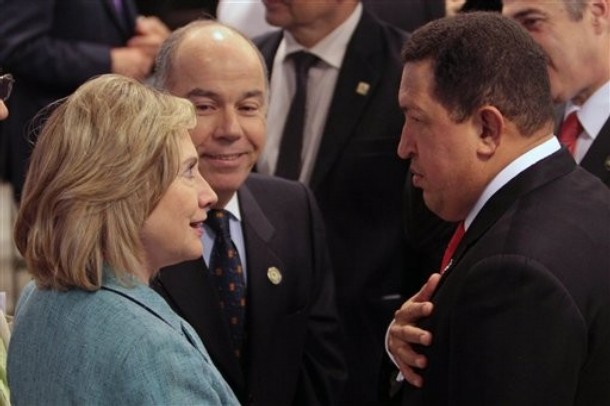
- U.S. Secretary of State Hillary Clinton, left, speaks with Venezuela's President Hugo Chavez during the swearing-in ceremony of Brazil's President Dilma Rousseff, unseen, at the Planalto presidential palace in Brasilia, Brazil, Saturday, Jan. 1, 2011. The man at center is unidentified. (AP Photo/Eraldo Peres)
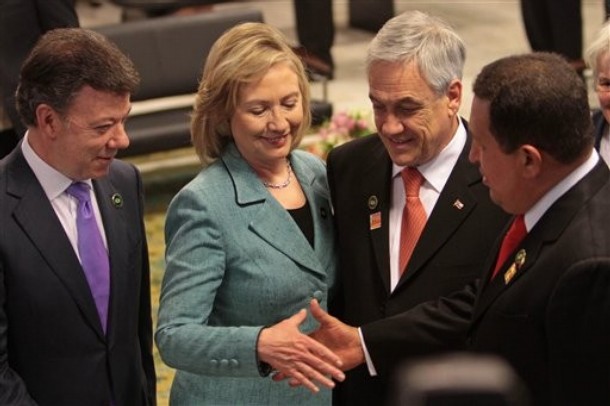
- U.S. Secretary of State Hillary Clinton, second left, shakes hands with Venezuela's President Hugo Chavez, right, next to Colombia's President Juan Manuel Santos, left, and Chile's President Sebastian Pinera during the inauguration ceremony of Brazil's President Dilma Rousseff, unseen, at the Planalto presidential palace in Brasilia, Brazil, Saturday, Jan. 1, 2011. (AP Photo/Eraldo Peres)


- Former Brazilian President Luiz Inacio Lula da Silva (R) talks with U.S. Secretary of State Hillary Clinton as his wife Marisa Leticia stands with them, during a reception for Lula's successor Dilma Rousseff at Planalto Palace in Brasilia January 1, 2011. Rousseff is the first woman to become Brazil's president, taking the reins of an emerging giant with a booming economy, vast new oil reserves and growing international diplomatic clout. REUTERS/Ricardo Moraes (BRAZIL - Tags: POLITICS)

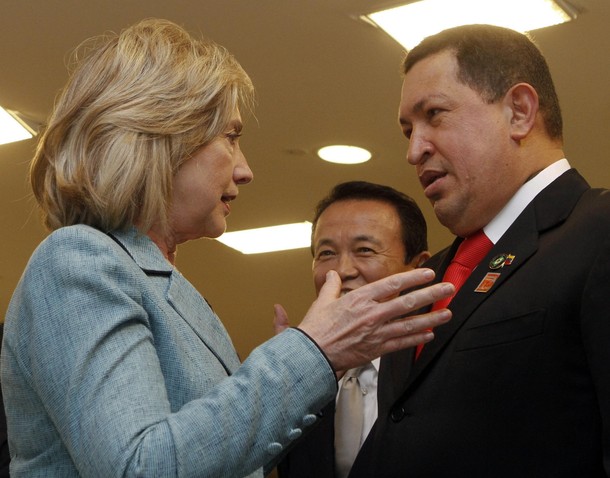
- U.S. Secretary of State Hillary Clinton (L) talks with Venezuela's President Hugo Chavez during a reception for the newly inaugurated Brazilian President Dilma Rousseff at Planalto Palace in Brasilia January 1, 2011. REUTERS/Handout (BRAZIL - Tags: POLITICS)
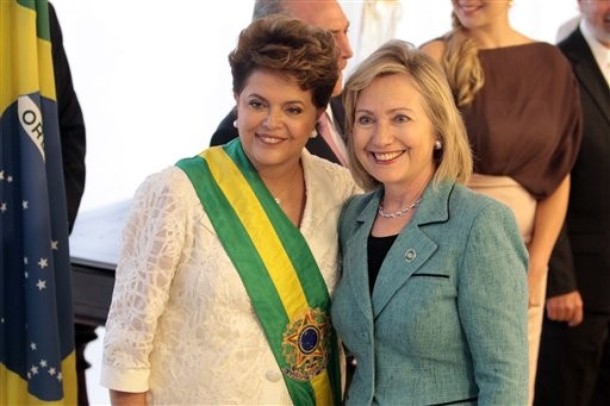
- U.S. Secretary of State Hillary Clinton, right, poses for a picture with newly sworn-in Brazilian President Dilma Rousseff at the Planalto presidential palace in Brasilia, Brazil, Saturday Jan. 1, 2011. Rousseff was inaugurated as Brazil's first female president. Rousseff, a former rebel who was imprisoned and tortured during the nation's 21-year military dictatorship, was sworn in as Brazil's first female president Saturday. (AP Photo/Eraldo Peres)


Friday, December 31, 2010
Secretary Clinton's Remarks on the Republic of Haiti's Independence
Mme. Secretary releases statements on every country's national day, but Haiti holds a special place in her heart and mine.
Republic of Haiti's Independence Day
Press StatementHillary Rodham Clinton
Secretary of StateWashington, DCDecember 30, 2010On behalf of President Obama and the people of United States, I join with the people of the Republic of Haiti to honor the 207th anniversary of your independence this January 1.
When Haiti cast off the bonds of slavery and declared its freedom from France in 1804, it made history, setting a precedent for independence in Latin America and creating the first post-colonial black-led nation in the world. Today, we see the courage of that struggle – from the leadership of Jean Jacques Dessalines and Toussaint L’Ouverture to the strength and unity of the Haitian people – reflected in Haiti’s response to the devastating earthquake of January 12, 2010. In the wake of a disaster that took the lives of more than 200,000 people, Haitians and volunteers from more than 140 nations came together overnight to pull survivors from the rubble and administer critical care and assistance. I witnessed this testament to our common humanity first hand in the days immediately following the earthquake, and I have seen it grow throughout the year as countries around the world continue to help Haiti recover and rebuild.
Despite all Haiti has endured, Haitians have shown an unflagging strength, will, and passion to forge ahead and build a more prosperous nation. The people and Government of the United States stand firmly with the people of Haiti, and we are committed to helping ensure that your voice determines the way forward for your nation and government. We will continue deepening the partnership and friendship between our nations to achieve a brighter future for all our people.
I wish all Haitians a happy Independence Day and New Year. I look forward to working with you to make 2011 a year filled with peace and progress.
Thursday, December 30, 2010
HAPPY NEW YEAR!
In one of her last public appearances as Senator from New York, Hillary Clinton joined her husband and Mayor Mike Bloomberg to drop the ball in Times Square and welcome in the year 2009.