Wednesday, August 12, 2009

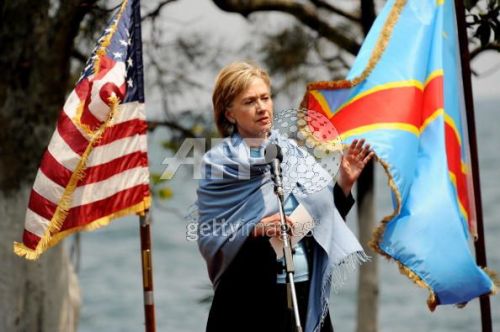
Hillary Clinton With Nigerian Foreign Minister Ojo Maduekwe

US Secretary of State Clinton is escorted by Nigerian FM Maduekwe after addressing a news conference in Abuja

Remarks With Nigerian Foreign Minister Ojo Maduekwe


Remarks
Hillary Rodham Clinton
Secretary of State
Abuja, Nigeria
August 12, 2009


MODERATOR: The Secretary of State of the United States and (inaudible) Maduekwe.
FOREIGN MINISTER MADUEKWE: Well, ladies and gentlemen of the media, we are delighted here to (inaudible). We had a very, very wonderful session with the Secretary of State of the United States of America, both as – in our own personal capacity (inaudible) of Nigeria.
And of course, we have, with the Secretary of State – I had the privilege of an early meeting with her at the State Department. We spoke on the phone. She called me for this (inaudible) office. There is no more powerful symbolism. A very busy Secretary of State, a very powerful foreign minister, (inaudible) desire to wage (inaudible) with Nigeria as – in the spirit of dealing with Nigeria. And of course, she is here, but at a very difficult time, speaking of (inaudible) meeting (inaudible) officials (inaudible).
SECRETARY CLINTON: Well, thank you so much, Minister, and I greatly appreciate the opportunity that you have afforded me today, first for an important bilateral meeting on matters of foreign affairs, and then a larger extended meeting with many ministers, members of parliament, and even a representative, the chair of the governors’ forum.
I appreciate also the opportunity to meet here in Nigeria and to develop even stronger ties of friendship and partnership between the people of our two nations. The United States views Nigeria as a friend, an ally, and a partner on so many important issues, as well as an important country in Africa and increasingly, globally. Nigeria is Africa’s most populous nation, its largest producer of oil, its largest contributor of peacekeepers, a significant trading partner for the United States, and the largest recipient of American direct investment by the private sector in Sub-Saharan Africa.
So given all that, it is critical for the people of Nigeria, first and foremost, but indeed for the United States, that Nigeria succeeds in fulfilling its promise. And in our meeting, I reiterated our appreciation for the strong role that Nigeria has played on the continent. I think it’s important to emphasize that without Nigeria, Liberia might not be a free country, Sierra Leone might not have ended decades of war. The role that Nigeria is playing in the Sudan – the recent commander of the peacekeepers in Sudan was, of course, a Nigerian.
On so many important issues, Nigeria reaches out to the African continent to provide technical assistance and advice. And Nigeria has been particularly active on key international and regional issues from Zimbabwe to Niger, and spoke out strongly against the coups in Mauritania and Guinea. Nigerian peacekeepers are increasingly viewed around the world. I saw some of them yesterday in eastern Congo as among the best that can be provided. This puts a burden on the Nigerian Government, which we recognize and express our appreciation for.
Nigeria is also a very strong partner with the United States on the military-to-military front. We’re increasingly working together on maritime security in the Gulf of Guinea, one of the most critical and dangerous places because of the combination of rebel movements, drug traffickers, gun runners, and other criminal elements.
We also appreciate the increasing cooperation we’ve received from Nigeria on counterterrorism, on our joint efforts against the scourge of drugs. And I want to applaud Nigeria for the progress that it made in a relatively short period of time moving up to Tier 1 in our annual report on human trafficking. We know that was a concerted commitment by the Nigerian Government, and they really stepped up.
Now we know too that Nigeria faces a range of tough challenges, including the challenges of government capacity and the rule of law and corruption and keeping this large, diverse country moving forward. And therefore, we strongly support and encourage the Government of Nigeria’s efforts to increase transparency, reduce corruption, and provide support for democratic processes in preparation for the 2011 elections. I noted that the president, who has been pushing an agenda that includes electoral reform, security in the Niger Delta, has really put himself out there to try to deliver. And we support these efforts and talked specifically about how the United States might be able to encourage the electoral forums, including the creation of an independent electoral council in preparation for the next elections.
We also support the Nigerian Government’s comprehensive political framework approach toward resolving the conflict in the Niger Delta. This process, as it was explained to me by several of the ministers who were present, is incorporating the region’s stakeholders as absolutely essential, focusing on the region’s development needs, separating out the militants and the unreconcilables from those who deserve amnesty and want to be part of building a better future for that part of Nigeria. And we have offered, again, our support and that of the international community.
The minister and I agreed to establish a bi-national commission that will look at the broad range of issues not only at the federal government, but I particularly appreciated the minister’s invitation to the chair of the governors’ forum. Because coming from our country, we know how much work gets done at the state and local level. And therefore, we see an opportunity to have this bi-national commission work at the federal and national level, as well as on the local and state level.
So it’s a pleasure to be here and to pursue and further develop this strong relationship that means so much to both of our countries.
FOREIGN MINISTER MADUEKWE: Thank you, Secretary. Before we take on some – a few questions for (inaudible) program, (inaudible) the fact that there is a national consensus strongly in favor of all the issues that the Secretary of State has raised, and other concerns which have been expressed. We do offer (inaudible) of the famous statement by (inaudible) politicians, like (inaudible), who once said that – seriously, (inaudible). And (inaudible) we do recognize that where we get the same strength from our own people, not all those criticisms are intended to annoy or provoke (inaudible). Rather, they are based on a genuine concern that maybe we should do better, (inaudible).
And we extend that feeling also to our friends, our development partners in the original sense. I also wish to underscore the prime minister of Nigeria that it is a national concern too – very strongly in favor of issues of – that has democracy, a deep commitment to rule of law, electoral reforms, and as I told the Secretary of State, if there’s any doubt to those commitments in terms of promise and performance, those matters can be addressed (inaudible) within the context of building state capacity, which has been permitted over time for all those history (inaudible).
And that is where the bi-national commission is of such useful and (inaudible) importance, as it’s – there you have a warehouse for global best practices that enable us (inaudible) capacity of our time. And we’ll definitely make all of the difficulties and problems become history as Nigeria marches to its manifest destiny. (Inaudible.)
MODERATOR: We shall take two questions from the Nigerian press as well as two from the American traveling press. I’m going to start with (inaudible).
QUESTION: (Inaudible).
SECRETARY CLINTON: Yeah. (Laughter.)
QUESTION: Yes. My question is to the Secretary of State. You’ve said over and over again that corruption remains endemic on the continent and, by extension in Nigeria. My worry is this: The West, as you may (inaudible) position (inaudible), and there appears to be no initiative whatsoever – suggestions going forward. Consider the leadership of America (inaudible), to ensure that funds from this part of the world (inaudible).
SECRETARY CLINTON: This is an area that I want to work on with the minister and with the government. I’ll just give you a quick example. It’s one that I’ve used across Africa, because it’s an African example, and that is the country of Botswana. Botswana, as you may know, has a very vibrant democracy. It’s a very stable country. And it has used the revenues from its natural resource, which, in its case, happens to be diamonds, and put it into a fund, protected that fund from exploitation by foreigners and exploitation by citizens. It said to the countries that were exploiting the diamonds, and to their companies, you have to have an agreement with us that leads to investments in the people of Botswana.
So for example, when you buy a diamond from De Beers, part of that money still today goes to help build and maintain roads and clean water systems in Botswana. You can drive anywhere in that country and you can see services that have been paid for by a legal framework, strong regulations, and a national consensus that the money from the earth and its riches should be spent on the people of Botswana.
Now, companies still make a profit doing business there. Individuals still do well. But they have protected their national patrimony, and I think it’s an example for the rest of the continent, and I think we will explore some of these ideas, and of course, it is up to the people of Nigeria to determine what is best for you. But I want to be sure that I do what I can to put forth ideas that will protect the natural resources of Africa for the African people.
MODERATOR: Susan Pleming from Reuters.
QUESTION: This is a question for Mr. Minister. Violence has been crippling production in the Delta, with Angola actually surpassing Nigeria as an oil producer. When do you expect levels to go up? And what – you’ve offered amnesty to some of the rebels. What guarantee do you have that they’re not going to take up arms again and that will set down production levels again and that you’ll be in the same position?
And then another second question is: What’s happening with the oil laws? That was drawn up when oil was $140 a barrel. It’s still not gone through parliament. But where do you see that going, and how are you going to sustain investor confidence in that oil law?
FOREIGN MINISTER MADUEKWE: Good questions. In dealing with the Niger Delta challenge, evidently, the same (inaudible) amnesty, we clearly understood that there was (inaudible) in dealing with that. All the talks, we’re not going to be putting off a belief they may have (inaudible). They will need to take a leap of faith. And that leap of faith is demonstrated by a president’s generosity, the president’s willingness to say yes, even though terrible things have happened in terms of criminality (inaudible).
And without justifying the violence that (inaudible) to those (inaudible) activities – define those activities – there is an issue of justice, an issue of degradation (inaudible) that is a historic injustice over time.
And so where some of those who (inaudible) is therefore away from the (inaudible), because (inaudible) love for evidence and of pure personal profit and criminal profiting (inaudible), it would be hard to reset – reset the computer, so to speak, unless that problem were (inaudible).
Now the president is very optimistic and we want to believe there is a place for that optimism, that by the end of the year, the political traction with the amnesty is still (inaudible). The response to it should be able to bring about a restoration of peace and a decrease and --
QUESTION: (Inaudible) about --
FOREIGN MINISTER MADUEKWE: A restoration of peace and decrease and a sharp reduction in violence. Now you asked – by nature, not really, but (inaudible) and what has been the operation resulting from the violence and decrease? (Inaudible) the civil war where was it – and it ended, the civil war ended, and the (inaudible) close to that. We believe – we’re optimistic that by the end of this year, (inaudible).
On the second point you made, the second thing you asked, yes, right now, that view is national (inaudible). That view, again, is very (inaudible), it’s very detailed, it’s very comprehensive, and that view, in many ways, reflects some of the best practices that have fallen (inaudible) by the Secretary of State.
QUESTION: What about oil levels? When are you expecting the (inaudible) the situation (inaudible)?
FOREIGN MINISTER MADUEKWE: Already, it’s coming up. It’s improving. In terms of near perception that this is coming back, amnesty’s working, (inaudible) gradually coming up.
MODERATOR: (Inaudible) Nigeria.
QUESTION: Still going back to United (inaudible) issues (inaudible), I wanted to know how far the American Government and (inaudible) the Nigerian Government in dealing with (inaudible) to come back instead (inaudible) foreign companies (inaudible) America (inaudible)?
SECRETARY CLINTON: Well, the defense minister was present at the second larger meeting that the foreign minister convened, and he had some very specific suggestions as to how the United States could assist the Nigerian Government in their efforts, which we think are very promising, to try to bring peace and stability to the Niger Delta. We will be following up on those. There is nothing that has been decided. But we have a very good working relationship between our two militaries.
So I will be talking with my counterpart, the Secretary of Defense, and we will, through our joint efforts, through our bi-national commission mechanism, determine what Nigeria would want from us for help, because we know this is an internal matter, we know this is up to the Nigerian people and their government to resolve, and then look to see how we would offer that assistance.
MODERATOR: And last person on the list, Jeffrey Gettlemen of The New York Times.
QUESTION: Thank you for that introduction.
SECRETARY CLINTON: Does he know you? (Laughter.)
QUESTION: (Inaudible.) I wanted to ask about the religious violence a couple weeks ago. And this first part of the question is for both of you, please. How concerned are you that this is part of a broader trend of Islamic extremism sweeping across North Africa? And is there any evidence that there was foreign links to what happened here, either al-Qaida or other groups operating in (inaudible)?
And then the second part of the question is for you, Madame Secretary. What did you think of the way they responded? And do you condone how they handled the uprising?
FOREIGN MINISTER MADUEKWE: Let me say, please, about Nigerians – whether of this Muslim faith, the (inaudible) part of Nigeria or the Christian faith, we have (inaudible) Christian heritage a part of (inaudible) too. And our population is (inaudible) by Islam (inaudible).
One thing you can say about Nigerian believers of any of the (inaudible) faiths is that they have a deficit in societal impulses. We are far from being fanatics by nature. For one, we love life. We love there is heaven, but we don’t want to get there by doing stupid things before we get there. So I can say this on record, that the kind of fundamentality that defies the wishes of the Almighty God, by taking other people’s lives, and there’s nowhere in the Quran or in the Bible where that (inaudible), that kind of fanaticism can never take hold in the culture of Nigeria.
But I must admit that from time to time, there has been this spasm of violence which comes across in the name of religion that really is not based on religion. It’s not – (inaudible) for political reasons that some young impressionable people are rather exploited by some power with (inaudible). Nothing can justify it. (Inaudible) is being confronted. We have (inaudible) – in this government, and that’s what the rule of law is about – and we are moving beyond the old matter of saying, well, look for peace first, look for settlement, perhaps if you punish back to (inaudible), no. Well, look (inaudible) that work out.
Our determination is to punish through the process of rule of law when there is this kind of incidents. So about the recent one that happened or because of external (inaudible) securities, look here at (inaudible). Is it possible that some fanatical group which is alien to our culture are beginning to try to (inaudible)? We know that the entire world is faced with those possibilities, and we don’t want to be naïve to think that Nigeria is not on the radar of such extremist groups. And then again, where there’s so much (inaudible) and fighting and importance for us to work very closely with (inaudible), since we all face common concerns (inaudible).
SECRETARY CLINTON: Well, Jeffrey, my view on this is that the balance within Nigeria between religions and among ethnic groups is very important to maintain, and I think you heard the minister’s words about that and certainly, the society’s commitment to that. I don’t know enough to comment on the specifics of any operation with respect to the reaction to the extremist-generated violence.
But I would say this: I think there is no doubt from our assessments that al-Qaida has a presence in Northern Africa, in the Sahel. There is no doubt in our mind that al-Qaida and like organizations that are part of the syndicate of terror would seek a foothold anywhere they could find one. And whether that is the case here or whether this is a homegrown example of fundamentalist extremism, that’s up to the Nigerians to determine.
But I understand the very important priority that the Nigerians place on keeping this balance of religion and ethnic groups in place. And I know that this is a challenge we all face, as the minister said, and I assume that the government will look at its own actions as well as continue the investigation into what might have, if anything, been involved or behind what we saw in the (inaudible) incident. Thank you.
MODERATOR: (Inaudible), we come to the end of this briefing, and Madame Secretary, (inaudible) and members of the American delegation (inaudible). Thank you.

Joint Press Availability With Foreign Minister Ojo Maduekwe


Remarks
Hillary Rodham Clinton
Secretary of State
Abuja, Nigeria
August 12, 2009
Video Link

Excerpt from AP video of Secretary Clinton’s Joint Press Availability with Foreign Minister Ojo Maduekwe
SECRETARY CLINTON: And therefore we strongly support and encourage the government of Nigeria's efforts to increase transparency, reduce corruption, provide support for democratic processes in preparation for the 2011 elections.
SECRETARY CLINTON: Al Qaida has a presence in northern Africa, in the Sahel. There's no doubt in our mind that al Qaida and like organisations that are part of the syndicate of terror would seek a foothold anywhere they could find one, and whether that is the case here or whether this is a home-grown example of fundamentalist extremism, that's up to the Nigerians to determine.

Hillary Clinton at Interfaith Outreach Roundtable in Nigeria

Remarks at Interfaith Outreach Roundtable


Remarks
Hillary Rodham Clinton
Secretary of State
Yar’Adua Center, Abuja, Nigeria
August 12, 2009

SECRETARY CLINTON: Let me introduce to you, those who have not met her, our Ambassador, Robin Sanders, and our Assistant Secretary for Africa, Ambassador Johnnie Carson. Please. Thank you.
AMBASSADOR SANDERS: Good afternoon. (Speaking in different languages.) I have the singular pleasure this afternoon to not only welcome and introduce to you the Secretary of State of the United States of America, Secretary Hillary Clinton, but I also have the double honor of introducing you, the leaders of the interfaith community of Nigeria, this great nation, to her.
I would also like to recognize Assistant Secretary Carson. As you know, the Secretary is here to have an interactive session with you about all of the wonderful things that you’re doing in the interfaith community, and certainly in areas of development. I know that from your hard work, you’re very focused on the respect for the diversity of religion, ethnicity, and certainly of community. I know that you have said to me that you are focused on this issue because we are all one. And with that, I will turn it over to Madame Secretary.
SECRETARY CLINTON: Thank you very much, Ambassador, and thank you again to each and every one of you for coming this afternoon. I am very grateful that you would be with us and we would have this opportunity, as the ambassador just said, to discuss and mostly for me to listen to those of you who are working in the interfaith efforts here in Nigeria.
I think promoting understanding between and among faiths is one of the most important tasks ahead of our world. And certainly, here in Nigeria, that is something that you have undertaken with great commitment. And for me also, it is a pleasure to be in Nigeria. I’ve had excellent conversations with the elected officials and the ministers with whom I have met today.
And there has been a constant theme running through our discussions that Nigeria is at a crossroads, and it has been a path of great effort that has brought this country to this point through independence, persevering through war and difficulties, and seeing the peaceful transfer of power from one civilian elected government to another. But that the road ahead has many, many challenges that have to be addressed in order for Nigeria to realize its full potential.
So I know that the press is going to be leaving us and perhaps before they go, we could hear an opening prayer. The press – we should pray for the press as well as we pray for everyone else. (Laughter.) And I think Sheikh Lamu, you were perhaps going to offer the invocation. Is that correct?
MODERATOR: Yes, yes, yes.
PARTICIPANT: (Speaking in different language.) On that note, I’d like to ask you – we stand to God for all his greats, for all his blessings, with all his mercy on this day in particular, other nations, and humanitarian (inaudible). We pray to God to continue the dialogue that (inaudible) in various countries and lead us steadily to make the interrelationship better and the relationship – international relationship is for coexistence, and so that there is – in every incarnation.
We stand to God, who has brought Your Excellency safely to our nation. We pray God to return you and your (inaudible) and all other stakeholders, there is (inaudible) destiny, (inaudible) in view of the role you are playing in the international peace, in international unity, and mutual understanding. We pray for – to guide you, guide you (inaudible), guiding (inaudible), and guiding of all citizens of both Nigeria and America.
Finally, we pray God to return each one of us safely (inaudible) destination, and please, happiness and thankfulness to God, the Almighty. (Speaking in different language.)
SECRETARY CLINTON: Thank you so much, Sheikh Lamu. I’m very grateful that both you and the archbishop are here joining us today. I know that the future of this country certainly depends upon good governance, adherence to the rule of law, the fight against corruption and impunity and the struggle for transparency and accountability in government.
But it also requires respect and understanding among religions, and particularly between Islam and Christianity, the two large religions almost evenly divided in Nigeria. And to many people who look at Nigeria with the very extraordinary balance that you have managed, it is fair to say that some see a miracle. But I see a lot of hard work and a lot of efforts by clerics and other religious leaders, by the sheikhs and the pastors and the reverends and others who are here around this table and so many more, because there is no doubt in my mind that the miracle of Nigeria rests on the individual actions taken millions of times a day to promote understanding and respect.

Hillary Clinton's Town Hall in Nigeria

Town Hall with Civil Society Representatives on Good Governance and Transparency


Remarks
Hillary Rodham Clinton
Secretary of State
Yar'Adua Center
Abuja, Nigeria
August 12, 2009


MR. ERUBAMI: Your Excellency, distinguished leaders of (inaudible). I am (inaudible). (Applause.)
We are engaged in the (inaudible) democracy and (inaudible). I stand before you tonight (inaudible). We are here to honor our distinguished (inaudible) Ms. Hillary Clinton. (Applause.)
SECRETARY CLINTON: Thank you very much (inaudible). That reminded me of an old American television show where Ed McMahon used to introduce Johnny Carson by saying, “And here’s Johnny.” (Laughter and applause.)
Well, I am absolutely delighted to be here. I’m very grateful to TMG and all of the partners who helped to organize this event. I apologize for keeping you waiting. I’ve had such an extraordinary schedule of meetings today, and I just finished a very interesting and important dialogue with leaders of both the Muslim and Christian communities. And I had to listen to everyone, because everyone had something very important to say.
I want to thank you for the work that all of you do. Moshood listed off all of the different affiliations that are represented here. But you are here, in part, because you care about your country. You have worked on behalf of the public or the private sector, civil society, the faith communities, because of your commitment to a better future.
I am here on behalf of President Obama and our Administration and my country to deepen and strengthen our relationship. We have had a long history of friendship and partnership with Nigeria, and we want to do even more. But we recognize, as I have told the government officials with whom I have met today, that Nigeria is at a crossroads, and it is imperative that citizens be engaged and that civic organizations be involved in helping to chart the future of this great nation.
I started my trip in Africa about – over – about a week or so ago – I’ve lost track of time – in Kenya. I was at a town hall meeting much like this at the University of Nairobi, and one of the people in the audience was my friend and a former Nobel Prize winner, Wangari Maathai. And she said something which has stuck with me as I have traveled across this extraordinary continent. She said, “Africa is a rich continent. The gods must have been on our side when they created the planet, and yet we are poor.”
I have seen the best and the most distressing of what is happening in Africa today. Yesterday, I was in eastern Congo, one of the most beautiful landscapes on earth, yet one that is replete with human misery. Today, I am in Nigeria, a country that produces 2 million barrels of oil a day, has the seventh-largest natural gas reserves of any country in the world, but according to the United Nations, the poverty rate in Nigeria has gone up from 46 percent to 76 percent over the last 13 years.
Now, there are many reasons why Nigeria has struggled. There is the destructive legacy of colonialism, there are wars, including a devastating civil war. There are other external forces. But as President Obama said in Ghana in his historic speech, the future of Africa is up to the Africans, and the future of Nigeria is up to the Nigerians. The most immediate source of the disconnect between Nigeria’s wealth and its poverty is a failure of governance at the local, state, and federal level. (Applause.)
And some of that is due, as you know so well, to corruption, others of it to a lack of capacity or mismanagement. But the World Bank recently concluded that Nigeria has lost well over $300 billion during the last three decades as a result of all of these problems. And therefore, it is imperative that we look at where Nigeria is today and, in the spirit of friendship and partnership, of a country that has made its own mistakes, has had its own problems, we look for ways to help one another, and particularly to help the people of this country.
The raw numbers, 300 billion, 2 million barrels of oil – they’re staggering. But they don’t tell you how many hospitals and roads could have been built. They don’t tell you how many schools could have opened, or how many more Nigerians could have attended college, or how many mothers might have survived childbirth if that money had been spent differently. The lack of transparency and accountability has eroded the legitimacy of the government and contributed to the rise of groups that embrace violence and reject the authority of the state. We deplore the attacks perpetrated by any armed group, whether they be religious extremists, militias, or criminals. But addressing the challenges that they and the poverty of the country pose takes more than action by your excellent military or your police. It requires fixing Nigeria’s flawed electoral system – (applause) – establishing a truly independent electoral council.
In order to create a peaceful, stable environment that creates development among the people, citizens need to have confidence that their votes count, that their government cares about them, that democracy can deliver basic services. They need to know that officials will be replaced if they break the law or fail to deliver what they have promised. (Applause.) And they each know that Nigeria’s natural resources, particularly your oil and your gas, will be used to invest in social development programs that benefit all Nigerians, particularly the poorest. We stand ready to work with you and with your government and with civil society to help realize these goals.
The foundation of a democracy is trust. And a democracy doesn’t always behave perfectly. And a democracy is not just about elections. It’s about an independent judiciary and a free press and the protection of minority rights and an active legislative body that holds the executive accountable. It is about building those democratic institutions.
Again, to refer to President Obama’s speech, what Africa needs is not more strong men, it needs more strong democratic institutions that will stand the test of time. (Applause.) Without good governance, no amount of oil or no amount of aid, no amount of effort can guarantee Nigeria’s success. But with good governance, nothing can stop Nigeria. It’s the same message that I have carried in all of my meetings, including my meeting this afternoon with your president. The United States supports the 7-point agenda for reform that was outlined by President Yar'Adua. We believe that delivering on roads and on electricity and on education and all the other points of that agenda will demonstrate the kind of concrete progress that the people of Nigeria are waiting for.
We also believe that civil society has a very big job to do. And by civil society, I include all of the organizations that are formed by citizens, the NGOs, the faith-based groups, everyone working together. You have already helped to elevate the ideals of democracy, but now you must use the political system to encourage Nigeria’s leaders to serve the common good. There need to be watchdog groups, like NEDI to push for transparency. There need to be journalists, including many of you in this audience, who will shine a bright light on any abuses of the public trust or those who would enrich themselves at the expense of Nigeria’s citizens; independent courts and prosecutors, institutions to punish wrongdoers and deter future wrongdoing; citizens who persist and persevere often against long odds.
The capacity for good governance exists in Africa and it exists right here in Nigeria. We have seen it in many places, and we have seen it here in Nigeria. I know that it doesn’t sometimes feel like it’s possible because the climb is so high, but I have great confidence in what Nigeria is capable of doing. If you think about it, you’ve had one election that has made a peaceful transfer of civilian authority to civilian authority. And to the president – your president’s great credit, at his own inaugural address, he admitted that the election that put him in office had been flawed. (Applause.) And I think that there are the ingredients, the ingredients of determination, of effort, that must be mixed into a cake that all of Nigeria can feel they have a part in making and enjoying.
We have seen good governance in other places in your government, such as the action taken recently by all sectors of Nigerian society to fight human trafficking. We watched Nigeria make changes and moved it into the top tier of countries in the world because the society decided to solve a problem. (Applause.)
You have worked with international partners, along with my own country. We’ve seen the start of promising reforms, including reductions in trade barriers and closer cooperation on health care challenges. But there is so much more we can do together. This morning, the foreign minister and I agreed that we would create a bi-national commission to look at all of these issues, to see where the United States could provide technical assistance and support as the changes are made. There are many electoral systems, for example, that work very well in complex societies like Nigeria’s. Think about India where you have 500-600 million people voting. The poorest of the poor in remote areas with no electricity, none of the amenities, vote on computers so that when the results are announced, no one questions them. Think about Indonesia, which has only been a democracy for 10 years, a young democracy like Nigeria’s. After years of military rule and so many problems, they have just completed a hard-fought election with parties that that contested. And there was a winner, and everyone accepted it.
Now, I know a little bit about running in elections – (laughter and applause) – and I have won some elections and I have lost some elections. (Laughter.) And in a democracy, there have to be winners and losers. And part of creating a strong democratic system is that the losers, despite how badly we might feel, accept the outcome because it is for the good of the country that we love. (Applause.)
And of course, in my country, the man I was running against and spent a lot of time and effort to defeat asked me to join his government. (Applause.) So there is a – there is a way to begin to make this transition that will lead to free and fair elections in 2011. We will work with you. We believe so strongly in Nigeria’s positive future. We are grateful for what Nigeria has already done. Tomorrow, I will be in Liberia. The people of Liberia owe their freedom to you – (applause) – the Nigerians, your military, your leaders. The people across Africa owe so much to you. But now, you owe it to yourselves to make sure that your country, which I believe should be not just a leader in Africa, but a leader in the world, produces the kind of results that the intelligence and the hard work of the Nigerian people are capable of producing.
No matter how much President Obama and I want this future for you, it will be up to you to decide whether it happens or not. You are the ones with both the opportunity and the responsibility. But I want you to know, as you walk this path to a stronger democracy that produces results for your people to lift the development of Nigeria up, that you will have us by your side.
Thank you all very much. (Applause.)
MR. ERUBAMI: Thank you very much. Thank you, Madame Secretary, for that insightful (inaudible). We thank you.
Ladies and gentlemen, we are now moving to the question-and-answer session. As I announced earlier, I said Madame Secretary will participate in that. (Inaudible) when you ask a question, please just state your name, identify your affiliation, and ask one concise question. We have limited time here, but we need to give as much time as possible to our honored guests to be able to answer all your questions.
Now let me know who wants to ask the questions. (Laughter.) I will be giving the assignments to (inaudible). Yes, the man in white here. Yes.
SECRETARY CLINTON: And there’s a microphone coming toward you, sir. Here it comes.
QUESTION: Good evening. My name is Tony Uranta (ph). I’m the secretary general of the United Niger Delta Energy Development Security (inaudible). It is a coalition of all NGOs and ethnic nationalities in the Niger Delta.
Madame Secretary, I thank you for your speech. I noticed you did not mention anything about the Niger Delta. It is (inaudible) we must accept that Nigeria’s future and the world ‘s energy dependence on Nigeria depends to a large – depends to a large extent – depends to a large extent on the Niger Delta.
Now, right now, there is a process towards peace in the region. (Inaudible) like to know –
PARTICIPANT: (Inaudible.)
SECRETARY CLINTON: Let him finish.
QUESTION: What we’d like to know exactly how will the United States and the Obama Administration actively and positively help in this process of peace in this region so as to help Nigeria.
SECRETARY CLINTON: Thank you, sir. Well, of course, this was a short speech, so I did not mention everything I could have mentioned. And I have talked at great length about the Niger Delta. I met with the minister who is now responsible for the Niger Delta. I discussed the amnesty program with both the minister, the defense minister, the president, the foreign minister. And the United States supports the process going forward. We think that having a political process is absolutely essential.
We also know that there are many people who are involved in the challenges and difficulties, such as yourself, who know that there must be more development in the Niger Delta, that there has to be a dedicated stream of revenue in order to make up for some of the environmental degradation and some of the lost jobs and to create a more stable life for the people of the Niger Delta.
So from what I have been told, I think that the government, under the president’s leadership, has the right idea of having a multiply-pronged approach to dealing with the Niger Delta. Now, we are also concerned about the larger question of security in the Gulf of Guinea and the maritime security needs that are becoming more apparent. So we’ve also discussed what help we could give Nigeria on that. But the primary focus should be on trying to resolve the legitimate concerns of the people of the Niger Delta.
MR. ERUBAMI: Thank you very much. (Inaudible.) Please deliver the microphone.
QUESTION: The Secretary of State from the United State, my name is (inaudible) and I’m vice president of (inaudible) which is made up of (inaudible) possibly the largest in the continent. My question is this. (Inaudible) but I’m also (inaudible) I want to remind you that (inaudible) Nigeria was (inaudible) independent, democratic Nigeria, who had a very rich democratic heritage. (Inaudible) that election conducted (inaudible) free and fair, that the (inaudible). I mean (inaudible) very possible it would (inaudible). Now, my question is this. (Inaudible) the nature of internal democratic process (inaudible) United States (inaudible) the very living history (inaudible) living history like you (inaudible) Obama (inaudible) you know, in a free and fair election, because (inaudible) if indeed (inaudible) is so weak . I mean (inaudible) election in his own party (inaudible). So we want to share from you (inaudible) we build (inaudible) because we can’t give what we don’t have internally (inaudible). Thank you so much.
SECRETARY CLINTON: Well, that’s a very – as I understand your question about the democratic process, let me just – you are the experts on your process, but let me just make a few points. As I understand it, Nigeria has no system for registering voters. Is that right? You have no registration system.
AUDIENCE: (All at once.)
SECRETARY CLINTON: That is nationwide; is that right?
AUDIENCE: (All at once.)
SECRETARY CLINTON: Well, let me just say that one of the --
MR. ERUBAMI: Attention, please.
SECRETARY CLINTON: One of the fundamental foundations of a free and fair election system is to know who’s eligible to vote and to keep track of who is eligible to vote. And I know that the electoral commission, under your former chief justice, made a very thorough study that lasted, I think, 16 months. And they looked at election systems around the world, looked at India, South Africa, Canada, all kinds of places. And one of their recommendations is to have a nationwide registration system. That is essential, and that needs to get started soon if you’re going to have a free and fair election in 2011.
One of the services that some of your civil society organizations could provide is to begin to figure out where you have registered voters and where you don’t, and begin to try to gather that information, because it is essential. Secondly, there has to be an independent electoral system that is run by an independent group of people, whoever they might be. Different countries choose different approaches.
Now, our democracy is still evolving. We had all kinds of problems in some of our past elections, as you might remember. In 2000, our presidential election came down to one state where the brother of the man running for president was the governor of the state, so I mean, we have our problems too. But we have been moving to try to remedy those problems as we see them.
So I think having an independent electoral system, having parties that are rooted in the grassroots – and that is something that is open to you now. It’s not enough just to have leaders of parties in opposition who just make speeches. You have to do the hard work of organizing. One of the most brilliant aspects of President Obama’s campaign is how he organized and he used technology to organize. And there are a lot of people who could be organized in Nigeria politically by using technology.
So those are just some ideas about how you could begin right now, regardless of what the government does, to register voters, begin to provide political activity that will lead to grassroots organizations that will work in the election, and then to work very hard to convince your parliament to pass a strong electoral reform bill, because ultimately, that’s what has to happen. And every one of you knows people in parliament. Every one of you knows people who know people in parliament. Every one of you has influence. And use that; use your positions, your voices, to try to focus in for the next months on getting that strong electoral reform bill passed. That will provide you the platform then to build on for a free and credible, legitimate election in 2011.
QUESTION: Thank you.
SECRETARY CLINTON: We should go on this side, too. Don’t forget. (Laughter.) So many hands. It’s hard to –
PARTICIPANT: (Inaudible.)
SECRETARY CLINTON: Oh, women. Yes, next. Okay, we’re going to have gender equity after this –
MR. ERUBAMI: After this one.
SECRETARY CLINTON: Okay. This gentlemen. Then three women, Moshood. (Laughter and applause.)
Just talk into it. It’ll pick up your voice there.
QUESTION: Madame Secretary of State, my name (inaudible) Nigeria. I want to begin by saying that the your friendship and partnership (inaudible) of the United States of America has been (inaudible) and has been geared towards improving democracy on the continent of Africa (inaudible) of Nigeria. I’m glad you mentioned that there is capacity indeed in Nigeria to advance the cause of democracy and grow our nation and our people. And I’m happy to take note (inaudible) that have been undertaken now by Nigerian (inaudible) the fight against corruption (inaudible) poverty, the issue of Niger Delta –
AUDIENCE: (All at once.)
QUESTION: Pardon me, I have to clarify the (inaudible).
SECRETARY CLINTON: (Inaudible.)
QUESTION: Secretary, my question is this. My question is what the people want to hear. (Cheers.) I’ll ask it. After elections in the U.S., all hands come on deck to support the nation and its people. In Nigeria, it’s not exactly the same. After elections, there continue to be in-fight and it continues to be a lot of rancor and problem (inaudible). So what is the U.S. going to do to support Nigeria’s effort towards establishing a lasting democracy?
SECRETARY CLINTON: Well, we first of all want to encourage civil society to be very involved in working to set up the terms of the next election. We want to encourage people to be part of the political life of the country. The United States also provides aid to groups to work on democracy and governance and to be training people. So we will continue to be supportive.
I think, though, that really, President Obama’s words ought to be just remembered and repeated about what he said not only in Ghana, but what he said at the G-8 meeting in Italy. I mean, he considers himself a son of Africa. And in a very real sense, he is both a son of Africa and a son of America. It’s where his blood comes from. He has relatives still in Africa. And he believes so strongly in the future of Africa.
So I hope that is inspiration. I hope that persuades people to keep going when the going gets tough – not to give up, to feel committed to doing what you can to make your country all it can be – because that is certainly how President Obama and I see it.
QUESTION: Thank you.
MR. ERUBAMI: The lady there. The lady in the (inaudible). No, the one at your back. (Laughter.)
QUESTION: Yeah. Madame Secretary, Nigerians are generally perceived to be corrupt. Hi, my name is Tara Elatruwate (ph) and I’m a member of the Women in Business, an NGO, and I also run a beauty company called House of Tara (ph). Nigerians are perceived to be very corrupt. Every time we go to the airports with our passports we are treated shabbily, especially in the U.S., also in the embassies as well.
Unfortunately, there’s a small minority of corrupt and – corrupt Nigerians, and it’s a shame that we are all generalized, and some of us are just honest people who are just trying to do our businesses in America. What is U.S. Government (inaudible) do about this crisis? This is a crisis for us. (Applause.)
SECRETARY CLINTON: Well, I believe that it is a minority. It’s often the minority of people who, unfortunately, create a perception that affects everyone. And I think we do have to take a hard look, and I will raise this with my government, about how to zero in on any people we believe are – that pose problems of corruption or criminality without casting a broad brush that includes so many. (Applause.)
MR. ERUBAMI: Another lady there. Yes, you.
QUESTION: My name is (inaudible) for democracy. (Inaudible) when she traveled outside the country, she (inaudible) being prosecuted house from Wall Street to the other, almost (inaudible) on the White House. My question now is how can the Obama Administration (inaudible) our elected officials who still stash money into our (inaudible)? (Applause.)
SECRETARY CLINTON: Well, let me say this. I think that we will watch what happens very closely over the next months. We have made it very clear that we expect and hope that there will be an electoral reform law passed, that there will be more legal actions taken against those who commit financial corruption or abuses of power, that there will be a greater commitment to the development of the people, that the Niger Delta conflict will be resolved. We are going to be watching very carefully.
And I think that it is our hope that what we’ve been told and the commitments that we have been given will be realized. But we also know that we may be in a position where we have to take actions that demonstrate our absolute conviction that what is necessary for Nigeria is for the leaders to lead, and lead in a way that inspires confidence and trust and gives the Nigerian people a better chance. (Applause.)
There are options available to us, but at this point, we’re going to continue to urge and encourage and work with the leadership to try to get the changes made. But we want to work with a very active citizenry and active civil society, like all of you, that we’ll be pushing very hard as well. So if we can work together on a people-to-people basis, not just a government-to-government basis, we will deliver that message strongly. (Applause.)
MODERATOR: The man in the suit there. There, you. You, the man in red tie. Yeah.
SECRETARY CLINTON: Wait, wait, three women. We said three women, Mashood. Three women. No, no, we have to have one more woman.
MODERATOR: I’m going back to the ladies, please. (Laughter.)
SECRETARY CLINTON: He doesn’t want to offend any of the women. How about the woman in the pink dress, right there.
MODERATOR: Okay. (Inaudible) please.
SECRETARY CLINTON: Oh, we’ve got two women. All right.
QUESTION: Thank you. Good evening, everybody. Good evening, Secretary of State. My name is Omolio Medey (ph). I’m actually going to start by appreciating the U.S. mission. Thank you, ma’am. (Inaudible) and also I have a project that’s been supported by the U.S. mission, under the ambassador’s self-help project.
My question is actually not a question, it’s a request. I appreciate the effort of the U.S. Government to support institutions and structures in Nigeria. But I’d like to see more going into the so-called of educational institutions in terms of building more technical schools, and skills of (inaudible), because truly that is the future of this country. Without a good technical base, there’s really no future. So I know you’ve been doing well, and I really appreciate it, because I tell everybody that the support our projects have gotten from the U.S. mission – if we have gotten that for other structures in Nigeria, we will do better.
MODERATOR: Thank you very much. Thank you very much. Thank you very much. (Applause.) (Inaudible) microphone to (inaudible). The man at your back, please. The man at your back.
QUESTION: Thank you very much. Madame Secretary of State, my name is Clement Wanpoh (ph) and I am the pioneer chairman of the Transition Monitoring Group, as well as director of a policy and legal advocacy center. Part of the big problem we have at this time is the collaboration between multinational companies who join our government officials in serious acts of corruption. And a big problem, of course, mentions several international companies, including Halliburton, Siemens, and so on. While in the U.S. and in Europe, some of these companies have been brought to account in terms of the justice process. We find that in the Nigerian legal system, these companies continue to even operate and engage in deeper acts of corruption, leading to severe wastage that could, in fact, have helped to develop us here in this country.
My question is, in terms of cooperation with the Nigerian authorities, what serious efforts have been made to ensure that even when these companies are brought to account in the U.S. that these acts of corruption that they join our public officials and perpetuate in Nigeria is, in fact, brought to an end? Thank you. (Applause.)
SECRETARY CLINTON: Well, you mentioned one of the cases that we have been working on. Two executives, two employees of Halliburton, have been convicted in the United States for their role in corruption here in Nigeria. We are sharing information with the Nigerian legal system as we find it. We want to cooperate closely.
We make our companies take a pledge. They have to sign up to our anti-corruption standards. We’re one of the few countries in the world that do that. And when we find evidence of anyone in our companies who have violated our anti-corruption standards, we prosecute if we have sufficient evidence. So we will continue to provide the information and try to work with your government wherever we can.
We think its good business to eliminate corrupt practices. It is better for competition, it’s better for the trade and investment environment, it’s better for Nigeria’s reputation as a place to do business without heavy transaction costs that corruption call on a company to make. So we will do what we can to prosecute those who cross the line who have any American connection, and we want to see reinstatement of a vigorous corruption commission. The EFCC, which was doing work and then has kind of fallen off in the last year – (applause) – we would like to see it get back into business so that it would be a good partner with us.
MODERATOR: Thank you very much, Madame Secretary. The man in blue by the (inaudible).
QUESTION: Thank you very much, (inaudible) have the opportunity. Thank you, Madame Secretary of State. My name is Don Lamibasheru (ph). I represent 19 million people with disabilities in this country. I know you have 54 million in the United States. I want to first of all commend the work of the U.S. mission in Nigeria for mainstreaming people with disabilities into society, particularly in the area of making information in appropriate formats, particularly for the blind, in Braille. The electoral reform recommendations, actually, which everyone is talking about, has now been put in Braille by the U.S. mission. Thank you for that.
But we noticed that in the last election, some of our members were banned from participating in elections, those without fingers and amputees, people living affected by leprosy. Now, in the spirit of partnership, we are well aware that there is a machine in the United States, the Electronic Audio Voting Machine, which enables blind people, and all people with disabilities really, to vote by voice, which would then be captured by the machine into the computer and sent out. Now, this is widely used in many states in the U.S., especially Seattle, and (inaudible) and I notice this, I use this in Seattle. Now, how can the U.S. partner with our (inaudible) so that these machines are made available so that all Nigerians can participate actively in the voting process? Thank you. (Applause.)
SECRETARY CLINTON: That’s an excellent question. And I will work with our very good ambassador, who many of you know. We will see if there is a way. Now, it depends upon the systems that your government decides to use for elections, but we have worked very hard to
make sure that people with disabilities are not disenfranchised, because we don’t think it’s fair. I mean, people who, as you say, are blind or who have paralysis, they’re human beings and they’re citizens and they deserve to vote. So we will see if there’s any way we can be of help in that area.
MR. ERUBAMI: Thank you very much. One more question. (Inaudible.) Please. I’m sorry.
QUESTION: Thank you, Madame Secretary. Just one question. This has to do with poverty. (Inaudible) is my name. I’m president of West Africa (inaudible). (Inaudible) and the efforts of the United States Government to fight the crisis of capitalism, otherwise called economic (inaudible). Now, I discovered that the United States Government and governments of Western countries have channeled trillions of dollars to bail out their economies, to save jobs, to save mortgage institution, to save schools.
But the IMF and the World Bank, in which the United States Government has a lot of influence, go around the world (inaudible) getting governments of under-developed countries to cut jobs, to reduce and withdraw subsidies from schools, from (inaudible) and the rest of them. And this as our (inaudible) crisis of poverty in third world countries, including Nigeria. What can the United States do with (inaudible) the influence in the World Bank where your nominee is the president of the bank? How will you allow your own system now to influence the world so that we can have a new international economic order based on justice and fair play around the world?
Thank you. (Applause.)
SECRETARY CLINTON: I think that your comments reflect the real concerns that many of us have about what has happened in the global economy. It has, in many ways, created opportunities. Nigeria is our single biggest investment destination for American capital. But on the other hand, it has not shared the prosperity broadly enough. And in the crisis that we started to experience last year, it was essential that countries that could, like the United States and China and others, try to stimulate the economy to keep the economy going so that we could continue to invest and export and import all at the same time.
Now, it is really important that as we work our way out of this crisis – and we’re beginning to see signs of stability in the American economy, as you know – that we take seriously what was said at the G-20 meetings in Washington, London, and then the upcoming meeting in Pittsburgh. We have to redesign our international financial structures. They do not reflect the world of the 21st century. (Applause.) And there are great gaps in how we think about economies and how they’re regulated, what is demanded of certain economies, and how we try to work to be sure that forgiveness of debt and other kinds of international actions actually result in money getting to people. There’s just a lot that we haven’t yet thought through sufficiently.
I know that our Administration and President Obama, of course, are very committed to figuring out ways that we can have a new global architecture for the economy. And it is important that different voices be heard. I told your ministers this morning that, by all accounts, Nigeria should be in a position to be part of the G-20. (Applause.) But – big but – the corruption reputation. It’s not that corruption doesn’t exist everywhere, it does. But the fact is – you know it, that’s all you’ve been talking about tonight – it is a problem. The concentration of wealth at the top, the failure to use the wealth that God gave you to lift up the people – I mean, those are problems. But if Nigeria were to set a goal and then work and plan toward meeting that goal to deal with the corruption, to create more transparency and accountability, to develop, to do the education that the woman in pink referred to – there are schools in Nigeria with no students because people can’t afford them and there are no teachers to teach the students. There are parts of Nigeria with no healthcare. The electricity problem is one that – I mean, here Nigeria is with all this oil and gas, you would think it would be electrified across the country.
So if Nigeria takes seriously these challenges and works towards solving them, I think the sky is the limit for Nigeria. I mean, there is no doubt in my mind – and I know that we have to wrap up, but just from what I’ve seen tonight, the potential for a very vibrant democracy is alive and well in Nigeria. (Applause.) And I think that your work and your commitment and your involvement in the political process, as well as civil society, is what can make it happen.
Thank you all so much, and God bless Nigeria. (Applause.)
MR. ERUBAMI: Thank you very much, Madame. I have the honor to (inaudible) Ms. Evelyn Oputu, the managing director, CEO of Nigeria Bank of Industry, to give a word of thanks.
MS. OPUTU: Madame Secretary, excellencies, my distinguished brothers and sisters, ladies and gentlemen, it is with a lot of pride that I stand here tonight (inaudible) thank the Secretary of State and thank all of you for coming here and displaying to the Secretary of State what we are made of. You are a strong, proud, hardworking people who have been vilified over the years, and you are showing the Secretary of State here today what we really are made of.
Madame Secretary, we know that you are an advocate of Africans. We know that it was after you came here in 1994 with your daughter to Africa that the trade policy towards Africa changed. (Applause.) We want to work with you. What we ask of the United States is (inaudible) Nigeria (inaudible) development (inaudible). We thank you for your time. As a matter of fact, your presence here in Nigeria (inaudible) Obama Administration’s commitment to work with us. We have heard all what you have said about transparency (inaudible).
But we also want to thank the U.S. mission. Because as a matter of fact, I the past two years (inaudible) actually all (inaudible) to Nigeria. (Inaudible) it is the women that (inaudible) it is the women that raise the families, that run the small businesses. Madame Secretary, you are (inaudible). And so I say to you that (inaudible). We know in Nigeria what they say in the U.S. (inaudible). Thank you, Madame Secretary. (Applause.)

Tuesday, August 11, 2009

Hillary Clinton's Press Briefing En Route Nigeria

Remarks En Route Nigeria


Remarks
Hillary Rodham Clinton
Secretary of State
En Route Nigeria
August 11, 2009


QUESTION: I just want to know what your offer about -- today, especially (inaudible).

SECRETARY CLINTON: Well, you know, I've been in a lot of very difficult and terrible settings in my years. And I was just overwhelmed by what I saw, both in the camp and in the conversation (inaudible) and I had with two women who met with us.

It is almost impossible to describe the level of suffering and despair, in the camp, particularly. I've been in camps, (inaudible). It is just tragic, to see 10,000 people in that space. And still, you know, children are still, you know, dying of malnutrition, they're dying of diarrhea, they're dying of malaria, the women are getting raped, they (inaudible) the confines of the camp. It's just horrific.

And we met the two women (inaudible), incredibly, brutally, horribly attacked, and suffered extreme injuries. Thanks to that hospital, they are at least alive. As one of the women said, you know, her husband was killed. Her older children heard the guns, went out and they were killed, and she felt abandoned. So they came back into the house, her other two children that they brutally raped (inaudible).

And the other woman is a young woman living with her husband. And she was eight months' pregnant. And she was attacked. They beat her very badly, and killed the baby and left her for dead. And it wasn't quite clear -- they were telling (inaudible) people came to try to help her, and the baby was dead, and they had to -- the nearest health facility was 85 kilometers. They couldn't carry her all that way, and she would have died anyway, because of her toxemia. So they -- you know, the people around her got the baby out (inaudible) and packed her cavity with grasses, which prevented her from bleeding. And she ended up going to the hospital.

And I said, "Well, how did you end up in a hospital (inaudible)?" He said, "Well, we send people out in the forest to find these women." What an amazing guy (inaudible) going out into the forest, rescuing women who have been brutally, savaging, inhumanely attacked, and just left there. It was an incredibly emotional (inaudible).

Hillary Clinton's Day at the U.N. Internally Displaced Persons Camp, Goma, DRC

This is a particularly long day in an incredibly dangerous place.

Secretary Clinton Tours Refugee Camp

Remarks
Hillary Rodham Clinton
Secretary of State
Kinshasa, Democratic Republic of the Congo
August 11, 2009
Video Link

Excerpt from AP video of Secretary Clinton  remarks after touring Refugee Camp.
SECRETARY CLINTON: I have just come from a meeting with two survivors of sexual attacks. The atrocities that these women have suffered, which stand for the atrocities that so many have suffered. The United States condemns these attacks and all those who commit them and abet them. And we state to the world that those who attack civilian populations using systematic rape are guilty of crimes against humanity."
SECRETARY CLINTON: And today I am announcing that we will provide more than 17 million dollars in new funding to prevent and respond to gender and sexual violence in the DRC.
SECRETARY CLINTON: "I made the point that these crimes, no matter who commits them, must be prosecuted and punished. That is particularly important when those who commit such acts are in positions of authority, including members of the Congolese military.

Secretary Clinton Meets With Democratic Republic of Congo President

Hillary Rodham Clinton
Secretary of State
Goma, Democratic Republic of the Congo
August 11, 2009
Video Link

Excerpt from AP video of Secretary Clinton’s meeting with Democratic Republic of Congo President Joseph Kabila.
SECRETARY CLINTON: I offered, and the president accepted my sending a team of legal and financial and other technical experts to the DRC to provide specific suggestions about how to overcome these very serious obstacles to the potential of this country.

Roundtable With NGOs and Activists on Sexual and Gender-Based Violence Issues

Remarks
Hillary Rodham Clinton
Secretary of State
HEAL Africa
Goma, Democratic Republic of the Congo
August 11, 2009

DR. LUSI: Secretary Clinton, we are honored to have you among us. We know that you have a very tight schedule, and you have given us this time. And we are honored to receive you. We are eager to hear what you have to say to us.
SECRETARY CLINTON: Well, thank you, Dr. Lusi, and thanks to everyone here associated with HEAL Africa and all of the other groups that are working so hard. I appreciate your welcoming us here today, and I am deeply moved and admiring of the heroic work that you and your colleagues are doing.
Yesterday, I spoke with a group of young people in Kinshasa, and I said that here in Africa we can find humanity at its worst and humanity at its best. And we have seen both here, in Goma. My delegation and I have been working hard, even before we came, to see what we could do to try to assist in the ongoing efforts to end the conflict and the violence that still stalks this land, and to help the Congolese people, who have suffered enough.
I have just come from a meeting with two survivors of sexual attacks. The atrocities that these women have suffered, which stands for the atrocities that so many have suffered, distills evil into its basest form. The United States condemns these attacks and all those who commit them and abet them. And we say to the world that those who attack civilian populations using systematic rape are guilty of crimes against humanity. These acts don't just harm a single individual, or a single family, or a single village, or a single group. They shred the fabric that weaves us together as human beings. Such atrocities have no place in any society.
Amid such abject inhumanity, we have also seen the hope and the help that you represent. We have seen survivors of these attacks summon the courage to rebuild their lives and their communities. We have seen health care workers sacrifice comfortable careers so they can treat the wounded. We have seen civil society leaders come together to combat this appalling epidemic.
In the face of such evil, people of good will everywhere must respond. The United States is already a leading donor to efforts aimed at addressing these problems. And today I am announcing that we will provide more than $17 million in new funding to prevent and respond to gender and sexual violence in the DRC.
This assistance will be distributed to organizations across the Eastern Congo, and is being targeted to respond to the specific needs that you have identified, such as training for health care workers in complex fistula repair. Working through USAID, we will provide medical care, counseling, economic assistance, and legal support to 10,000 women living in North and South Kivu, and other areas.
We are dedicating almost $3 million to recruiting and training police officers, particularly women, so that they understand their duty to protect women and girls, and to investigate sexual violence. We will be sending a group of technology experts to the eastern DRC next month, as part of an effort to equip women and front-line workers with mobile devices to report abuse, using photographs and video, and to share information on treatment and legal options.
And we will be deploying a team comprised of civilian experts, medical personnel, and military engineers from the United States Africa Command to assess how we can further assist survivors of sexual violence.
We are raising this issue at the highest levels of your government. I had very frank discussions about sexual violence yesterday with your prime minister and other ministers, and today, in my meeting with President Kabila. I made the point that these crimes, no matter who commits them, must be prosecuted and punished. That is particularly important when those who commit such acts are in position of authority, including members of the Congolese military.
This problem is too big for one country to solve alone. And I am pleased also to announce a new partnership with the Norwegian government to upgrade a medical facility in North Kivu, so that health workers there will be able to provide better treatment to survivors of sexual violence and serious maternal injuries.
Our commitment to survivors of sexual and gender-based violence did not begin today, and it will not end today.
I have come here with my long-time friend and colleague, Melanne Verveer, who many of you already know. Melanne, for many years, was the chair of Vital Voices. And some of you, I know, were with us in Washington, when we made awards to heroes on behalf of women. She now serves as the United States Ambassador-at-Large for International Women's Issues. She will continue to be a voice for you inside our government, as we work together to combat this scourge.
As we provide this assistance, we are redoubling our efforts to end the fundamental cause of this violence: the fighting that goes on and on here, in the eastern DRC. We will be taking additional steps inside our own government, at the United Nations, and in concert with other nations, to bring an end to this conflict.
I am looking forward to hearing from you. But before I turn it over to each of you, I want to thank every one of you. I want to thank you on behalf of women and men everywhere, who know what you are doing, who care about your patients, who ache for the survivors. I know the hours are long, and the work is very hard. The conditions are harsh, and I am sure that, at times, the task you face can seem overwhelming.
I was told yesterday that there is an old Congolese proverb that says, "No matter how long the night, the day is sure to come." You are all helping to hasten the days coming, when thousands of Congolese women will be able to walk freely again, to go their fields, to play with their children, to walk with their husbands, to do the work of collecting firewood and water without fear.
We want to banish the problem of sexual violence into the dark past, where it belongs. I thank you very much, and I look forward to now hearing from you all. Thank you.
(Applause.)
DR. LUSI: Thank you very much, Madame Secretary. We are encouraged and heartened to know that Congo has found a friend, a friend of women. And now I would like to turn it over to the people around the table, who represent so many of the organizations who have worked hard, and long, and continually, and with great commitment. And they will add some ideas, as well, of what our friend can do to help us.
So, let me start with Justine.
SPEAKER: (Via translator.) Thank you, Madame Secretary, dear guests. Women in North Kivu would like to welcome you all, and allow us to say something about impunity, as impunity is one of the problems that we -- that the populations who are a victim of violence, sexual violence and other crimes -- is a problem that we fight, impunity.
Impunity in the DRC exists because the -- our leaders don't have much of a willingness to prosecute the authors. For instance, Aganda, and other authors of these crimes. And the weakness to implement laws, especially laws that deal with sexual violence, in particular part of the problem, and the fact that we cannot have access to criminals that belong to LRA and FLDR. Children are killed, women are raped, and the world closes their eyes.
The international justice is not (inaudible) to this -- can be (inaudible). Justice exists, can act, it's credible, but it's slow, and that's a limitation. And because it is slow, evidence disappears, and there is a limited number of trials. And there is the distance that separates, you know, the place where the crimes were committed, and the place where trials are held.
So, in view of this, we would like to propose the creation of mixed courthouses that -- be created with international courts. So these mixed chambers, or joint chambers, would be credible, because the personnel would be made of foreigners and Congolese. They are independent, and they do not suffer from interference and corruption. And they bring those who should be judged closer to justice.
Time is short. It is easy to carry out investigations that goes a little faster than when international justice alone does it. But that's better than national, domestic justice.
There is -- it doesn't -- these mixed courts do not replace entirely national justice. But I think it is a way for -- thank you very much.
(Applause.)
SPEAKER: (Via translator.) Madame Secretary of State, His Excellency the Ambassador, CARE International wants to thank -- all the intervention that were designed to fight impunity must go along with helping the victims of sexual violence.
Now, CARE International and other humanitarian agents are asking for access to health care, and also confidentiality, in the context of a strategy that is led by local authorities that could help the local people, and especially pregnant women and those who have a need for health, reproductive health.
Except and besides medical assistance, and besides help to the victims, there needs to be a psycho-social assistance that could help and assist also financially and economically, to help survivors to be helped to reintegrate into society.
CARE also commits to help in multi-sectoral areas, to help in the community, and help the women's role in society. All these interventions have the goal to prevent violence through behavioral change. And I thank you.
(Applause.)
SPEAKER: Security will come. Peace will come. But we have other challenges. The education is the main one. Somewhere, where Children's Voice are doing activities for helping children, only five percent of children have been to school. Somewhere in other activities, 95 percent of the population do not know to write or to read. Most of kids or young persons recruited in army -- I mean in armed groups -- have not been at school. And those people will be in the army and police.
Of course, the country needs to develop many things. The villages will be again full. I mean the (inaudible) will be back. But what will happen if you need -- I mean, when you want to help a country? Please think about children and young people.
Of course, we have many challenges in this country. We are very happy that you are here. The international community has already done their best, really. But very nice that you are here. And we hope that you will help the country, you will help the government of DRC, to do what is very important for people. We need to educate pupils, young men, young women, and then the development will follow.
Of course, we have many children in the street. That is because most of parents don't know what to do, how to help them, because scholarship is not there. Scholar fees are paid by the parents. Parents are not paid any more. We hope that you will be our ambassador to your country, to your government, and you will be back to help this country. Thank you.
(Applause.)
SPEAKER: (Via translator.) Madame Secretary of State, Madame Ambassador, we waited a long time for this particular moment here, and we -- for engagement against the sexual violence struggle. We need peace, we need security, and I think this is the priority of all priorities, to stop, to put an end to the cycle of violence.
The military operations are -- continue to be carried out. But these military operations are not a solution to the problem. That's why, when it comes to security, we would like that you -- the leaders of the countries of the Great Lakes -- Rwanda, Congo, and Uganda -- so that -- will take on their responsibility to protect their citizens.
We all know that it's not just a Congolese problem. So that's why we think that, for peace and security to come back, we have to pressure the neighboring countries so that they accept (inaudible), so that the (inaudible) will peacefully go back to their country --
(Applause.)
SPEAKER: -- because we now know the worst -- with villages, they are burned down, numerous cases of sexual violence, and other problems.
Still talking about security, we know that the DRC does not have a Republican Army. And therefore, it is considered like the soft belly of this region. And, therefore, it's a real base for terrorists, and this continues to be the case for as long as security measures are not taken here.
So, the situation here is a mixture of civilian and militaries of all types and categories. The people would not have the same laws.
(Applause.)
SPEAKER: The reason we ask the United States to help the DRC to form a Republican Army, united, with no roots, who could take the place of the United Nations, when it leaves. And this army should be complemented by police, a police with women
(Applause.)
SPEAKER: And thank you very much for what you said during your presentation, Madame Secretary. You said that there will be police with women here to protect civilians, and particularly women and children.
And, finally, I will also plead for the freedom of the press. Many media outlets have been banned here, in the DNC. And even a radio station, Radio Mudanga, was banned. Therefore, we ask you to please plead in favor of freedom of expression. Thank you.
(Applause.)
SPEAKER: Madame Secretary, first of all, I want to thank you for considering to come in Congo, and specifically in Goma, because it shows us that this administration considers Congo as -- and the people of Congo -- a vital component of U.S. foreign relations.
Resolution 1820 was supposed to make the United Nations more sensitive to the issue of sexual violence. But yet we still see too many women and too many children have been raped, violated, not far from those camps of UN sometimes. And we have seen cases of UN soldiers and UN staff, not only UN but even other international organizations, committing those rapes. We want to know what is happening with them. If they have been judged in the country, I think the population of Congo needs to know what the judgment has been.
(Applause.)
SPEAKER: Another problem we are having that we need to address today is the presence of this many UN staff and international NGOs. Their presence has caused the cost of life to go very high all over the country, and specifically here, in Eastern Congo. We are having problem -- local people having problem -- to even find comfortable housing, affordable housing, because ex-pat have the cash and locals don't have the cash.
We are asking that Resolution 1820 be enforced. We are asking, as well, that the rule of the international community and the UN be redefined, because if they cannot protect our women and our children, I don't see why they should stay here.
(Applause.)
SPEAKER: Madame Secretary of State, Madame Ambassador, as those who preceded me, I would like to say that we are very honored by your visit here, in the Eastern Congo.
I would like to talk about the self-congratulations of certain agencies. And I think that the obligation to protect is the obligation of international law. So that should be the first role of the United Nations.
Today -- and I am talking as someone who had come to her province, to her country after 20 years of war -- we know, we really know, the stakes. We have received many, many visitors, each more important than the one before. We have received many, many celebrities, too. At the end, we have the impression that people only came to consume human poverty, human misery. And, in the end, all that we got was a pile of business cards.
(Applause.)
SPEAKER: And after, to, you know, have good conscience -- and I am talking as a native of this country -- the only thing they had for their good conscience said that -- through the radio we heard about the millions of dollars that "we gave to the Congo," but when you went to the more distant villages, the beneficiaries didn't even have access to the aid that was given to the people themselves.
So, coming back to the responsibility to protect, in 2004, when we -- the (inaudible) was attacked, we saw the UN take care of the expatriates, rather than the Congolese, for whom they had come to the Congo for, so we were really vexed by that.
(Applause.)
SPEAKER: So, you see around this room -- you see (inaudible). That means, you know, the posters here. Women are more precious resources, but we look to the Congo for mineral resources, forgetting that our first more important resource is the woman. Woman is who gives life, the life that we're destroying here.
(Applause.)
SPEAKER: Madame Secretary of State, besides your function as Secretary of State, you are a woman, like us. We know your history, political history, and you have the chance, the fortune of -- to have at your side Ambassador Verveer, who is also our ambassador. And she represents hope.
And I want to come back to the war that we have here, in Eastern Congo. This is a stake only to really get the resources from DRC. Certain western countries that I will not mention here, because the reports are everywhere -- and those are UN reports, really -- those reports mention certain western companies, and I hope that they will not be forgotten. And I think that they will be acted upon. And the investigations must take place, so that responsibilities must be found out and responsible parties must be punished.
As Ms. Chou Chou said, the problems of Congo -- international problems, not just Congolese problems -- many western countries really manipulate certain neighboring countries because they want to take the resources here. And, Madame Secretary, we want you to be our spokesperson, our voice, Madame Secretary, so all this stops.
So, if they want to explore our minerals, but they -- let -- do it legally and adequately, so that the Congolese take a really -- reap the benefits of this (inaudible) our riches. Thank you very much.
(Applause.)
DR. LUSI: We are now going to ask Dr. Mukwege to summarize what he has heard.
DR. MUKWEGE: It's a very difficult task. Madame Secretary of State, this is a very important day for us. This is not a day to be receiving business cards, but this is a day to find a solution, and a solution that will be long-lasting to the problems that have torn this country apart. And we are honored for your visit here, in the Democratic Republic of Congo.
Those who spoke before me tried to paint the situation. And what we can remember here is the two things that have been said most often: rape and peace. And when we summarize, we see that there is sexual violence because there is no peace. There would be no solution if we don't understand why there is no peace.
Now, if you analyze what the previous speakers have said, there is a problem of a lack of commitment, political commitment of regional leaders in the Great Lakes region that do not want to stop the situation that has been going on for the last 15 years. There is also an army in the Democratic Republic of Congo that is not well trained. And with all these resources, mineral resources, there is a real problem when the army is not trained and well paid.
What we have also understood is that all the citizens, based on the international law, have the right to be protected. And the United Nations, through MONUC, are here. But the way the United Nations operate is a serious issue, because the local population are not protected as they should be.
And we believe that, Mrs. Secretary of State, the solution goes through this solving of fundamental issues. And she said that. And we suggest that the very first thing to do would be to tell regional leaders to be conscious and responsible of the populations. And it is important that we help the Democratic Republic of Congo. Because as long as there will be weakness and turmoil, soft belly in the Democratic Republic of Congo, there will always be a problem in this region.
The mineral resources of the Congo, the exploitation of those mineral resources, must be under strict rules so that we will not allow those who rape, so that they will not continue to use the mineral resources to carry on their evil tasks.
We also want organizations that take care of the socio-economic conditions of the population.
We also want to stress the fact that we do have a justice system, but there is also an international justice system through the international courts. But you understand that the international tribunal cannot take care of all the issues that are taking place in the Congo. So, my suggestion is that we will have in place a tribunal that will take care, or rule, over cases that -- or crimes that have been committed since 1983.
There is also the problem of illiteracy that makes the population that, even if there is peace in the land, and is not trained or intellectual, or cannot read or write, literate, there will always be a problem.
Mrs. Secretary of State, we are very honored, and we have understood that the first introductory words that you said were very complete. And, as Christine said, right now we will not just receive a business card, but there is going to be long-lasting solutions, because we know that you have compassion for women in the Congo. And I would like to thank you.
(Applause.)
DR. LUSI: Madame Secretary, we would like to know if you have any questions to ask the panel.
SECRETARY CLINTON: Well, first, let me tell you how grateful I am for the very specific suggestions, as well as the analysis concerning the overall situation that the people of the Congo face.
I think it is important to try to work with your government to address a lot of these. And I told President Kabila today that if he were willing, I would send a team of legal and technical and financial experts to try to provide suggestions about how to do a number of the things that you are talking about.
For example, you need new laws and regulation to protect the mineral resources of your country, for the benefit of the Congolese people. You need an army that is, as the doctor just said, well paid and well trained, that will protect the people and not feel as though it has to feed off of the people, and victimize the people.
There needs to be a process that President Kabila began with his outreach to President Kagame, which I know was controversial, but which I thought was an act of leadership. Because, as several of you have said, unless there is a regional agreement to try to end the violence and build a better future for the region, it will be difficult for the DRC to do that alone.
On each and every one of the points that you made, we will try to help. But I want to emphasize something I said yesterday, when I spoke with the young people. Just as President Obama said in his historic speech in Ghana, the future of Africa is up to the Africans. The future, ultimately, of the Congolese people is up to the Congolese people. There have to be changes, politically. There have to be changes in the impunity. There have to be changes that only the people of this country can demand, and can help bring about.
We will try to provide the help that we're both asked for and that we think could be useful. But, ultimately, that help has to be received, changes have to be implemented, people have to be committed. And I hope that we're beginning to see that, here and in the region and internationally.
I will also raise the issues that have been raised concerning the UN and the problems that come with the NGO community arriving in a location such as Goma and displacing people, and raising the cost of living. Those are very real problems that have quite severe effects on many people.
So, there is much to be done. I do not want to overpromise. I am not just here to leave a business card, but I don't have a magic wand, either. But what I do pledge to you is that we will work. We will work hard. We will work with your government, we will work with groups like many of you represent. We will work with individuals, the private sector, civil society, to try to help resolve the conflict and provide a better future.
But it is ultimately up to the people here. And I have seen so many examples of courage. I know the Congolese people do not lack in courage. And I know they do not lack in hard work or perseverance or survivorship.
So, I hope that we will see the changes from within and outside that will lead to the end of these problems so that our children will not even know what we were talking about. Thank you.
(Applause.)
DR. LUSI: I would like to say once again, in the name of everybody around the table and everybody in this room, how much we are grateful for your visit, and how we have listened with attention to what you have to say. And we know that you have listened with attention to what we are saying.
Now, Secretary Clinton will have to leave, because she has such a tight schedule. And I ask you to please stay seated in the room, please, while the delegation leaves. Thank you very much.

Remarks With Congolese Foreign Minister Alexis Thambwe


Remarks
Hillary Rodham Clinton
Secretary of State
Goma, Democratic Republic of the Congo
August 12, 2009 (August 11)


SECRETARY CLINTON: Thank you very much, Mr. Minister. And also I wish to thank the President for receiving me and my delegation today here in Goma. We had a very productive, candid, open, comprehensive discussion. As the foreign minister mentioned, I told the President that President Obama and I want to see a new era of partnership in our relationship with the DRC and the Congolese people.
We know that the DRC, its government, and people face many serious challenges, from the lack of investment and development to the problem of corruption and difficulties with governance to the horrible sexual and gender-based violence visited upon the women and children in the country. We know these are big challenges, and we are ready to help the government address them. I offered and the president accepted my sending a team of legal and financial and other technical experts to the DRC to provide specific suggestions about how to overcome these very serious obstacles to the potential of this country.
We have offered our partnership and assistance, but as I said yesterday, the future of this country, like the countries throughout Africa, is really up to the people. And we hope that there will be a better future for the Congolese people.
FOREIGN MINISTER: (In French.)
SECRETARY CLINTON: Well, thank you. We discussed in some detail with the president what the situation is now. He said that it is better than it was six months ago and a year ago and five years ago, but it is not what it needs to be yet.
I commended the president for his outreach to Rwanda and other neighboring countries, which is an important part of trying to bring peace and stability to the eastern Congo. And we have begun a discussion as to what ways we could be of help to the Congolese military, including enhancing the training that we are doing, trying to professionalize the military, trying to ensure that the soldiers get paid so that they will not feel so undisciplined.
But of course, we raised concerns about the behavior of soldiers, and I sought specifically for an update about the five senior officers who have been charged with rape. And we are going to continue to work with the government as well as our international partners, including the United Nations, to see how all of us could do more to end the reign of violence that has afflicted the people in the northern and southern Kivu province for too long.
MODERATOR: Mary Beth Sheridan –
(Question unrecorded.)
SECRETARY CLINTON: Well, we are very concerned about civilian casualties, both deaths and rapes and other injuries from the military action. We talked at length on the flight here with the United Nations representative and his team about what their forces can do to try to protect civilians. They are launching joint protection teams. We are going to be following that closely, offering whatever assistance we can. And I spoke at length with President Kabila about the steps that need to be taken by the Congolese army to protect civilians.
QUESTION: (In progress) ...or insecure?
SECRETARY CLINTON: We do support the efforts to end the militias and the violence they have visited so terribly on the people of eastern Congo. We believe that a disciplined, paid army is a more effective fighting force. We believe there can be more done to protect civilians while you are trying to kill and capture the insurgents. We believe there should be no impunity for the sexual and gender-based violence committed by so many, and that there (inaudible) prosecutions and punishment, because that runs counter to peace and stability for the Congolese people.
And I look forward to returning to Goma sometime in the future and traveling through this beautiful part of your country.
MODERATOR: Janine Zacharia from –
(Question unrecorded.)
SECRETARY CLINTON: First, with respect to companies that are responsible for what are now being called conflict minerals, I think the international community must start looking at steps we can take to try to prevent the mineral wealth from the DRC ending up in the hands of those who fund the violence here.
Of course, you know that many of the mineral producers are very small operations. They are not corporations even. They are certainly not international, so this is a very challenging problem but we’re going to address it.
With respect to Aung San Suu Kyi, she should not have been tried and she should not have been convicted. We continue to call for her release from continuing house arrest. We also call for the release of more than 2,000 political prisoners, including the American John Yettaw. (Inaudible)
(Questions unrecorded)
FOREIGN MINISTER: I would like to answer two questions that you asked, the one about China and the second (inaudible). For more than a hundred years the riches of the Congo have served to develop foreign countries but not the Congo or the people of the Congo. Geologists say that, as far as our country’s concerned, it’s a geological scandal. But it’s a geological scandal doesn’t really serve the people of the Congo. (Inaudible) so far with (inaudible) beneficial to other countries and detrimental to the Democratic Republic of Congo. The (inaudible) government to – has asked the government to study the different approaches to work with other partners who are willing and able to cooperate with us and use our mineral resources and, in turn, help us with our infrastructures.
This country is as big as Western Europe. We don’t have a single road that goes from north to south or east to west. So the government wanted to see how we could work in partnership with countries, not only with China, but with other countries that are willing to help us with our infrastructure so that we can solve problems with electricity, water, and poverty in exchange with our mineral resources. So it’s not a matter of numbers, but it’s a matter of working with anyone, any other partner who is willing and able to help us improve our infrastructures.

The reason for the U.N. planes is that the airstrip in Goma is not long enough to accommodate her 757.  As you can see, the camp is well-guarded  by U.N. forces. 

08-11-09-S-01 08-11-09-S-02 08-11-09-S-03 08-11-09-S-04 08-11-09-S-05 08-11-09-S-06 08-11-09-S-07 08-11-09-S-08 08-11-09-S-09 08-11-09-S-10 08-11-09-S-11 08-11-09-S-12 08-11-09-S-13 08-11-09-S-14 US Secretary of State Escorted by MONUC Troops at Goma Airport Goma