Monday, February 27, 2012

SECRETARY HILLARY RODHAM CLINTON: Public Schedule for February 27, 2012

Public Schedule for February 27, 2012


Public Schedule
Washington, DC
February 27, 2012


SECRETARY HILLARY RODHAM CLINTON

9:15 a.m. Secretary Clinton meets with the assistant secretaries, at the Department of State.
(CLOSED PRESS COVERAGE)

6:30 p.m. Secretary Clinton meets with Secretary of Defense Leon Panetta and National Security Adviser Tom Donilon, at the White House.
(MEDIA DETERMINED BY WHITE HOUSE)

Sunday, February 26, 2012

Hillary Clinton With Moroccan Minister of Foreign Affairs Saad-Eddine Al-Othmani


Remarks With Moroccan Minister of Foreign Affairs Saad-Eddine Al-Othmani After Their Meeting


Remarks
Hillary Rodham Clinton
Secretary of State
Rabat, Morocco
February 26, 2012


FOREIGN MINISTER AL-OTHMANI: (In Arabic.)
SECRETARY CLINTON: Thank you so much, Minister, for the warm words and the gracious welcome. It is wonderful to be back in Rabat. So much has changed since my last visit to Morocco two years ago, but what has not changed is our commitment to our partnership and friendship, which goes back to 1777 when Morocco became the very first country to recognize our new nation. And the United States and Morocco have been allies and partners ever since. We collaborate on everything from trade and economic development to joint military exercises and counterterrorism efforts. So we had a long agenda today, and I would very much look forward to continuing our conversation in Washington when the minister is able to come.
I want to say a few words about two issues in particular that are of great concern to the American and Moroccan people. First, Syria. I thank the foreign minister for the important role that Morocco has played, first within the Arab League and second within the Security Council. Morocco is in a unique position to help shape the international community’s efforts, and it is imperative that we continue working today. I visited with the minister first in London about Syria. And then in Tunis, we attended together the Friends of Syria meeting.
And I want to reiterate my message to those Syrians who still support Assad, especially members of the Syrian military and business community: The longer you support the regime’s campaign of violence against your brothers and sisters, the more it will stain your honor. If you refuse, however, to prop up the regime or take part in attacks on your fellow citizens, your countrymen and women will hail you as heroes. Assad would have the Syrian people believe that it is only terrorists and extremists standing against the regime, but that is wrong. So many Syrians are suffering under this relentless shelling. All Syrians should be working together to seek a better future. That is what we hope for the Syrian people. That is what Morocco has led us in the international community in trying to achieve.
There are three areas where concrete action is needed: providing immediate humanitarian assistance to the Syrian people, increasing the pressure on the regime to assault its own brutal assault – to stop its brutal assault on its own people, and helping to prepare for a democratic transition. And I look forward to working closely with the foreign minister on all of these issues in the days ahead.
And what’s so exciting about being here in Morocco is that Morocco stands as an example, as a model of what can be achieved. Moroccans are strengthening their own democracy. Young people are having a say in their own future. His Majesty King Mohammed VI has begun the process of reform. We see women’s rights protected and expanded, a more transparent and accountable government, establishing the Arab world’s very first truth commission on human rights.
So Mr. Minister, on behalf of my government, let me congratulate your government and His Majesty on the successful constitutional referendum and parliamentary elections that occurred during this momentous last year. The Moroccan constitution provides for an independent judiciary. It contains new protections for freedom of thought, expression, and other universal rights. I was just briefed by the new speaker of the parliament, who advised me that Morocco now has more women in public office than any other Arab country. And frankly, the percentage is as good as we have in our own country in terms of women’s representation in the parliament.
But Morocco understands, as does the United States, that democratic reform takes constant effort and unending attention. It has to lead to the institutionalizing of democratic habits and practices, and of course to tangible improvements for the Moroccan people. And we stand with the government and people of Morocco as they continue this absolutely historic effort.
Let me close with a word about the Western Sahara. The United States continues to support efforts to find a peaceful, sustainable, mutually agreed upon solution to that conflict. U.S. policy toward the Western Sahara has remained constant for many years. We have made clear that Morocco’s autonomy plan is serious, realistic, and credible, and that it represents a potential approach that could satisfy the aspirations of the people in the Western Sahara to run their own affairs in peace and dignity. And we continue to support the negotiations carried out by the United Nations, and encourage all parties to work toward a resolution.
So again, Minister, thank you for hosting me and my delegation here today, and I look forward to working closely with you as we continue to move our countries toward even more productive partnership and friendship. Thank you, sir.
FOREIGN MINISTER AL-OTHMANI: Thank you. Thank you very much.
QUESTION: (In Arabic.)
SECRETARY CLINTON: No. Our policy on Western Sahara has not changed. We continue to (inaudible) efforts to find a peaceful, sustainable, and mutually agreed solution to the conflict that respects the fundamental human rights of all parties. We commend the UN envoy, Mr. Ross, for his continued leadership of the negotiating process. And we know that Morocco’s newly elected and appointed government leaders are fully engaged in pushing this process forward to an effective resolution. And as I said in my remarks, we think Morocco’s autonomy plan is serious, credible, and realistic.
And we also are pleased to see positive actions like Morocco and Algeria’s biannual intergovernmental meetings. They are a step in the right direction. We want to see both countries expand cooperation and constructive dialogue. That is the message I delivered in Algeria at the highest levels of the Algerian Government. I shared that with the meetings I had today here in Morocco because I think it’s, in today’s world, very much in the interests of Morocco and Algeria to work together on as many areas of agreement as possible. It’s good for the two countries, it’s good for the Maghreb, it would be good for economic development, it would be good for security, so we want to see that kind of continued progress between Algeria and Morocco.
QUESTION: (Inaudible) questions for you, Mrs. Secretary of State. First one is: What’s going to be of the Moroccan prisoners that are still held in Guantanamo Bay? And the second one is: Do you think that the political changes that Morocco has undergone in the recent months meet the United States’s criteria of democracy and political reforms?
SECRETARY CLINTON: Well, as to the first question, we remain in constant consultation with the government officials here in Morocco, and we are continuing to discuss that matter with them.
In regard to your second question, we are very pleased at the progress we have seen in Morocco. We applaud the millions of Moroccans who participated in last November’s parliamentary elections. It was exciting to see Moroccan men and women take part in this democratic process. And we are ready to work, as I enjoyed today, with the new government, with the new parliament, because there’s no denying Morocco has made significant progress along the path of democratic reform, and not only with an election, because after all, one election is not democracy. It takes a lot of hard work to establish a democracy. But the significant constitutional reform that has gone on under the leadership of His Majesty King Mohammed VI has led to the voters of Morocco approving a constitutional referendum. And the building blocks are all in place.
We understand. We’ve been at the business of democracy for 236 years. And we know how hard it is, and it does not happen overnight. It takes time and it takes the participation of every Moroccan. It doesn’t end when the votes are counted. It doesn’t end when the winners are announced, it’s not a spectator sport – for some, but not for others. Everyone has to be involved, and we think that the Moroccan experience is a very good model for others who are also seeking to have their own democratic reforms.
QUESTION: Madam Secretary, if I may. The – as you know, the trial of the foreign and Egyptian NGOs (inaudible) apparently, and was postponed for two months. What happens to the Americans who have been at the Embassy now for several weeks? And more broadly, what does it say about the political transition underway in Egypt, about relations with the United States, and the question of American military aid? Thank you.
SECRETARY CLINTON: Well, Steve, we are evaluating the outcomes of the legal proceedings today. We’ll have more to say after we have finished that analysis and gathered as much information as possible, because you’re right, it was a challenging procedure. But I will wait to comment further until I am fully briefed and have reached my own understanding of what was and was not decided today.
QUESTION: I have two final questions. First question is that (inaudible) in London and Tunisia and Algeria (inaudible), and what’s going (inaudible) from this region to bring (inaudible) back to Syria? And the second question is: What kind of (inaudible) could you (inaudible)? And the last one is: What (inaudible) U.S. presume to (inaudible) and bring more (inaudible)?
SECRETARY CLINTON: Well, those are three good questions. (Laughter.) With respect to the first question, Morocco and the United States are already cooperating very closely together, as we have done on many issues between ourselves but now are doing in the Security Council. Morocco provided the leadership for the resolution that was presented. Morocco has done a great deal to reach out and consult with other countries about the way forward. So we are working very closely together, and I think the minister and I are committed to looking for solutions.
Secondly, we’ve discussed at length security in the Maghreb and the Sahara, because we know that it’s difficult to develop the way you wish to and have the kind of future that people in Morocco deserve if you don’t have security. And so we already cooperate very closely, and we’re looking to expand that cooperation. And we also believe we have to bring in more countries to be part of the discussion – the Maghreb countries, the (inaudible) countries. So we’ve been discussing ways we might do that.
And finally on business and economic relations, everywhere I go in the region and beyond, people ask me if they could have a free trade agreement like Morocco and if they can have a Millennium Challenge grant like Morocco. And I tell everyone, we did not give that to Morocco; Morocco earned it. Morocco demonstrated what it takes to be in a free trade agreement and to meet the very high standards of the Millennium Challenge Corporation. So we discussed – the minister and I together and over lunch ways that he and I, along with other officials and under the work of the prime minister here and President Obama in our country, encourage more investment and more business in Morocco. And we will take steps to try to do that.
QUESTION: Madam Secretary, I just want to follow up on Steve’s question, briefly. One is, do you know where the Americans are, or where are they, why were they not in the courtroom this morning? And does your answer to his question mean that there is no – there’s not yet any implication for the American assistance, that you are going to (inaudible) – that this decision to adjourn does not put that in jeopardy?
Then in Syria, I’d just like get your thoughts on – why is this so difficult? If it’s raining, you put up and umbrella. Why is – here you have a situation in which civilians are being killed. There is no shield or protection being offered to them.
And then lastly, on Afghanistan --
SECRETARY CLINTON: (Laughter.)
QUESTION: This not a good –
SECRETARY CLINTON: Why don’t we throw in Latin America and – (laughter).
QUESTION: Honestly.
SECRETARY CLINTON: Honestly (inaudible).
QUESTION: Well, I was only going to ask you two. Anyway, Afghanistan, it’s been a bad week. There’s another incident today in which some military trainers were injured. What is this – isn’t this a – hasn’t this (inaudible) the entire view as mission there? And how concerned are you about how things go forward? Thank you.
SECRETARY CLINTON: Well, if I can even remember all of your questions, I’ll try to answer them briefly. With respect to Egypt, I’m not going to add to what I’ve already answered because this is a fluid situation and there are a lot of moving parts that have to fully understand before I go any further than I have.
With respect to Syria, we have a very strong international group of friends of the Syrian people, and we understand how challenging the situation is when you have a government willing to shell their own people with heavy artillery, use tanks against their own cities, destroy homes, refuse to let the humanitarian workers in to remove bodies, to provide medical care. These are the kinds of terrible actions that deserve the condemnation of every country in the world. And we are consulting closely with those who are looking for ways of alleviating the suffering, first and foremost; of increasing the pressure on Assad and the people around him, because we continue to believe that those around Assad are quite concerned about the brutal attacks going on. We’re appealing to members of the Syrian army to put the people of their country first before a family or a political party. And we are pushing hard for a plan that would lead to a political transition. We welcome the help of those who are supporting the Syrian regime. We think that it would be appropriate for them to use whatever influence they have to at least get the humanitarian assistance in.
And finally on Afghanistan, Matt, look, we deeply regret the incident that has led to these protests. We are condemning it in the strongest possible terms, but we also believe that the violence must stop and the hard work of trying to build a more peaceful, prosperous, secure Afghanistan must continue.
QUESTION: (In Arabic.)
SECRETARY CLINTON: We certainly did discuss people to people relations because we believe strongly that the relationship between the American and the Moroccan people is the bedrock of our relationship. Government officials like myself come and go, but the underlying relationship between our people is what is enduring for now 235 years. So we want to increase people to people exchanges, business exchanges. There’s an excellent new program that we are very impressed by that we helped to start along with Moroccan business and government leaders to encourage entrepreneurship among Moroccans, particularly young people.
So there is a full range of such exchanges. Our ambassador and our Embassy have such a list. But we’re always looking for new ideas, and I would welcome any that any Moroccan might have.
Thank you.

Hillary Clinton at the Ground-Breaking for the New Embassy in Rabat

U.S. Secretary of State Hillary Clinton (C) participates in a groundbreaking ceremony for the new U.S. Embassy in Rabat, February 26, 2012. REUTERS/Jason Reed (MOROCCO - Tags: POLITICS)

Remarks at New Embassy Compound Ground Breaking Ceremony

Remarks
Hillary Rodham Clinton
Secretary of State
Rabat, Morocco
February 26, 2012

AMBASSADOR KAPLAN: (In progress) One important additional feature: She is a woman who is focused. She’s focused on whatever the problem is or whatever the relationship is that she has to deal with at that moment. She’s one of the most powerful women of the world, but she’s very much a woman of the people. And I’ll tell you one last thing: I was watching and listening to her very carefully today. We had several different meetings, several different discussions, several different press conferences, and the tone was there – the tone of friendship between this Secretary of State and the country of Morocco. She can change the words, she can change the text, but she can’t change the tone. The tone comes through clearly and effectively. You’re about to hear from one of Morocco’s great friends, Secretary Clinton. (Applause.)
I’m sorry. We’re now going to hear – (laughter) – the program got – we are going to hear next from the foreign minister. And I don’t pay attention because I skipped you before. (Laughter.) The foreign minister is a renaissance man. He’s a man who is a psychiatrist, he’s a man who’s a doctor, he’s a man who understands politics, and now he joins the rest of us in the world of diplomacy. It’s not easy, but you’re welcome to join us, and we’re welcome to have you with us. So it is with great pleasure that I introduce the foreign minister of the country of Morocco. (Applause.)
FOREIGN MINISTER OTHMANI: (In Arabic.) (Applause.)
AMBASSADOR KAPLAN: The mayor of Rabat is a distinguished gentleman who has served as the finance minister of this country. He has been a member of parliament on several occasions. And he is a mayor of a very difficult city to govern, because after all, this is the city of government, and there are representatives from all over the world. We are here today because of the mayor’s cooperation and the willingness of his staff to help us through the extraordinary bureaucratic issues that are arising every time you have to build a building this complex in the middle of the city.
To the members of our Embassy, he is our hero, and I’m delighted to welcome him today. (Applause.)
MAYOR OUALALOU: (In Arabic.)
AMBASSADOR KAPLAN: Now, as I was saying about Secretary Clinton – (laughter) – she’s a remarkable woman, you know. Twelve years as the first lady of the State of Arkansas, eight years as the first lady of America, eight years as a senator from our most powerful state, the State of New York, and now the Secretary of State. I only regret, because I know so many of you, that there isn’t time for her to speak to each one of you, because I know her engaging quality and I know how it is when she talks to people and she focuses on what they are saying. If that isn’t possible to do, but it’s wonderful to have her on this day and to tell you she’s one of the great Americans and she’s really one of the great people of the world. So once again, I introduce you to the Secretary of State. (Applause.)
SECRETARY CLINTON: Well, it’s wonderful being introduced by a friend and an ambassador and someone who represents our country so well here in Morocco. And I want to thank not only the ambassador but his wonderful wife, Sylvia, as well, for their tireless work on behalf of the relationship between the United States and Morocco.
I want to begin by thanking the foreign minister for the great hospitality and warm welcome he extended to me and to my delegation. I am so delighted at the prospect of working closely with him and the new government as we take our relationship to a new level of cooperation and partnership. And I look forward to welcoming you, Foreign Minister, to Washington, where we can continue our dialogue. Thank you, sir, very much.
I also wish to thank the mayor for hosting us in his beautiful city. I think there is not a city in Morocco that isn’t beautiful. Morocco is blessed by beautiful cities, and here today, on an absolute perfect day, which I’m sure the mayor helped to order up for us, we are, once again, having a chance to thank you for hosting us in this beautiful city.
And I wish to recognize all of the people here on the stage with me. I thank them for their tireless work on behalf of humanity, on women, on the law, on the rule of law, on a better Morocco, the work that is done for our embassies around the world, and *Sabi Abdul Baki*, thank you for serving not only in the United States Embassy for 40 years, but serving as a bridge between the Moroccan and the American people. We are deeply grateful.
So to all of you, thank you for joining us on this auspicious occasion. You represent many voices that will help determine Morocco’s future. And I’m looking forward not only to the partnership with the government but collaboration with many parts of Moroccan society for years to come.
As has already been said, our relationship stretches back more than two centuries. Sultan Mohammad III became the first world leader to recognize America’s independence. We entered into a treaty of friendship that has stood the test of time. And in 1820, Morocco presented the United States with a gift, a legation building in Tangier, our very first diplomatic property anywhere in the world. I don’t know how far along we would have made it without Moroccan help, so you’ve been thanked before, but let me thank you again. This is our only national landmark outside our own borders, so the connection between Morocco and the United States is deep and personal.
Now, of course, the way we conduct foreign policy has changed a great deal since those days, and I think it’s fair to say the challenges we face are far more complex, but the opportunities are greater, and the world seems smaller. But that legation building in Tangier stands as a testament to the continuity of our relationship. It has lasted through wars and upheaval. It has remained steadfast in times of crisis. Today, it is a museum and a cultural center that focuses on the rich history between our countries. But what that building in Tangiers preserves and symbolizes is the past. What we’re doing here today represents the future. And we are committed to renewing, in a profound way, our commitment in this new chapter of our long relationship.
I have talked often about how Morocco once again is leading the way, not just here in Morocco, where I have not had the privilege of being for two years, but throughout the Maghreb and the Middle East and beyond. The constitutional referendum last summer and November’s elections signaled an acceleration of reforms that began under his Majesty King Mohammad VI more than a decade ago. And the Moroccan Government is now moving forward with the momentum necessary to deliver on the promise of democratic reform.
Now, we understand, as well as any country in the world, having survived to be the oldest democracy in the world, that this is a long journey that you are taking together. But I want you to know, Minister and friends all, that the United States will stand with you on that journey. We’ve had a lot of our own ups and downs over 235 years, so we are not surprised when it is difficult to reach political compromise in the give and take of a parliament. We are not surprised when there has to be a lot of hard work done to translate into reality the promises of politics. So we will be there as you make your own way forward.
We are especially focused on efforts that will create economic opportunity and greater prosperity for all Moroccans. We are promoting entrepreneurship, because new businesses mean more jobs, faster growth, and greater innovation. We are spearheading new initiatives to bring together government officials, leaders from the private sector, and young entrepreneurs who have the vision and drive to succeed in the 21st century global economy.
Last fall, we brought a group of American business leaders here and to neighboring countries to meet aspiring young innovators, to cultivate ideas, and to share promising ideas as well. And I want to acknowledge our friends on the Moroccan board of the North African Partnership for Economic Opportunity, called NAPEO. Will you raise your hand, those who are from NAPEO who are with us? I want everyone to see our businessmen and women who are part of a public-private program called Partners for a New Beginning. It represents a concerted effort by business leaders to reach the business leaders of the next generation, to create jobs, and grow prosperity.
And we remain committed to helping in every way. So I am proud to announce today that this spring the State Department will launch our Global Entrepreneurship Program here in Morocco. We will connect investors and thinkers, mentors and pioneers, so that we can tap into the ingenuity of young Moroccan women and men, who have good ideas, who may need to know how to do a business plan, who may need advice about getting credit from the bank, but who are willing to work hard to generate economic growth from the bottom up, right here in Rabat and across Morocco.
So the building that we are breaking ground for today will serve as the new home for America’s Embassy, but it will also stand for the new chapter in our relationship. It will be state-of-the-art, because we believe that we have no more important commitment than to our first partners, going back to the very beginning of America’s journey.
And we want to do all we can to help forge an even deeper relationship and to help Morocco deliver on the vision that Moroccans have set for themselves. This is coming organically from within Morocco. It is not being imported. It is not being imposed. It is coming because of the thinking and hard work, starting his Majesty, the king, going down to the men and women who stood in line to vote in the parliamentary elections. And we are very excited by what we see happening here, and we want you to know that you can count on your long-time friend and partner in the 21st century, as we counted on you in the 18th century so long ago.
Thank you very much. (Applause.)
I am sure her country squire would have LOVED to have been with her for this event.  I remember him mentioning in an article that he had leveled a hill on his property by himself.  Many may remember the tree-planting at the White House (early in the Obama administration) when he went beyond the photo-op of planting one tree and went on do plant one or two more, telling Obama "This is the way you do it." 

Her remark about our long relationship with Morocco refers to their being the first country to recognize the United States as am independent country.  I remember her mentioning this when the newly-minted SOS was visited at the State Department by Morocco's foreign minister in 2009.

Hillary Clinton at Embassy Rabat

When Secretary Clinton met with staff and families at Embassy Rabat today, she also participated in a groundbreaking ceremony for a new embassy.
U.S. Secretary of State Hillary Clinton participates in a groundbreaking ceremony for the new U.S. Embassy in Rabat

Meeting With Embassy Staff and Families

Remarks
Hillary Rodham Clinton
Secretary of State
Rabat, Morocco
February 26, 2012

Thank you. Thank you, Sam. That was really lovely. Thank you, Sylvia. Well, I don’t need to tell you how blessed you are here at Embassy Rabat and across Morocco to have such a dynamic duo as Sam and Sylvia. I want to personally thank them in front of their Embassy family, including the cute children, Sylvia, because they’ve brought so much enthusiasm and energy to representing our country. Thank you very much, Ambassador, and thank you, Sylvia, for all you do. (Applause.)
And the Ambassador is right. I wanted to come and thank you personally when I was last in Morocco as Secretary of State in ’09. I didn’t get to Rabat, and I missed having this opportunity, so I did not want to forego it today. And I also wanted to let you know I’m well aware of how much is asked of you, particularly this last year, whether you worked as election monitors or you got ready for the construction of a new embassy whose ground we will break in a very short time from now, or just, every day, handle the myriad of tasks that you are responsible for. We see the results of your hard work.
In the last eight months, the Moroccan people have made their voices heard through a constitutional referendum and an unprecedented parliamentary election. And the United States friendship with Morocco that dates back to 1777 – I want all the young people to know that Morocco was the very first country that recognized us before we really won our revolutionary war. We were just beginning it, and Morocco believed in us and said, “We’re with you,” and we’ve had that kind of partnership ever since.
I’m excited about the groundbreaking of the new Embassy. It will finally bring together our Foreign Service and development professionals under one roof. That’s part of our – what’s called QDDR, the Quadrennial Diplomacy and Development Review, where we have to maximize the impact of U.S. Government efforts. We have the best diplomats, the best development experts in the world, and we need to multiply the impact of each. And having everyone under one roof will help us do that.
I also want to thank the Peace Corps volunteers, because wherever I go, they always can bring a crowd of enthusiasm. (Applause.) When in doubt, bring on the Peace Corps and – (laughter) – we’ll get the energy going. And I’m also very much aware that we could not do the work that we do here without the locally employed staff, all of the Moroccans who have served with us and done so much for our relationship. (Applause.)
In fact, Ambassador, I know from many years, starting back in the 1990s when I would travel alone or travel with my husband when he was president that presidents come and go, and certainly secretaries and ambassadors come and go, but the locally employed staff is here. And they remember and they help and they greet every new representative from the United States Government with the kind of background and experience that we need.
This is an exciting time to be serving in Morocco. It’s an exciting time to be representing the United States. It’s also, I think it’s fair to say, quite a challenging time. But if we stick to our values of democracy and freedom, of human rights, of women’s rights, of the kind of protections that are now enshrined in the constitution of this country, then we will be able to help not only Moroccans who are doing quite well, but using Morocco as an example, reach out to the country that I was in yesterday, Tunisia, or Algeria or Libya, countries that are also seeking their own new democratic future. And then we have to work to make sure democracy delivers jobs and opportunity for the hardworking people of the Maghreb.
So I appreciate greatly everything you have done and are doing. I think it’s fair to promise you that the rollercoaster ride is not over. There will be a lot more ahead of us. But I think we are living through such a consequential time in world history, and nowhere more so than in this region. So again, thank you, and what I would like to do is first maybe go over and take a picture with the children, if I could, because I love being – I don’t tell my daughter, but I would love to be a grandmother. (Laughter.) Anyway, don’t tell her. So I will go and get our picture with the children – they’ve been so patient – and then I’ll shake as many hands as I can before we go on to the groundbreaking.
Thank you all very much. (Applause.)
She always gets a big response when she mentions the Peace Corps. Well, she is on her way home now, and Mme. Secretary do not think for a moment that we have not been watching. We are, and we appreciate that you have gone for two weeks straight without a weekend off. You are amazing!  Thank you for all the personal sacrifices you make to serve our country. We love you!

Hillary Clinton's Interviews with BBC, CBS, and CNN

Mme. Secretary did a slew of interviews along with bilaterals and a working lunch in Rabat, Morocco today.

Interview With Kim Ghattas of BBC

Interview
Hillary Rodham Clinton
Secretary of State
Sofitel Hotel
Rabat, Morocco
February 26, 2012

QUESTION: Madam Secretary, thank you very much for speaking to the BBC. Just over a year ago, I asked you a question about Libya, and I know that Libya and Syria are very different, but in essence the question kind of remains the same. With no sign of rapid tangible action to stop the violence in Syria, if we wake up tomorrow and President Assad has leveled Homs to the ground, history will not judge the Obama Administration very kindly.
SECRETARY CLINTON: Well, I just disagree with that premise, Kim. I think that if you look at what’s happening in Syria, and it’s very different from Libya – and you’re right, a year ago we were cautiously assessing what was possible, and what became possible, because the opposition controlled territory, had a united national presence that was quite prepared to not only engage diplomatically but organize against the Qadhafi regime is not present yet in Syria. And certainly that is a condition precedent for anyone who is trying to figure out how to help these defenseless people against this absolutely relentless assault.
I wish that people inside Syria were responding as people inside Libya responded. They are not, at this point, perhaps because of the firepower and the absolute intent that we’ve seen by the Assad regime to kill whomever. But the fact is we are moving to do everything possible with the international community.
QUESTION: But if the people inside Syria can’t get organized, and the rebels don’t have the territory to organize properly, what is the responsibility of the international community to make sure that we don’t end up with a large-scale massacre?
SECRETARY CLINTON: Well, Kim, we still have a very strong opposition to foreign intervention from inside Syria, from outside Syria. We don’t have the United States Security Council approval, legitimacy, credibility that comes with the international community making a decision. We have a very dangerous set of actors in the region, al-Qaida, Hamas, and those who are on our terrorist list, to be sure, supporting – claiming to support the opposition. You have many Syrians more worried about what could come next. So I don’t want to say that nothing can be done, because I don’t believe that and I feel like we are moving to the best of everyone’s ability who is concerned as we are about this.
But I want to make clear that for anyone watching this horrible massacre that is going on to ask yourself: Okay. What do you do? If you bring in automatic weapons, which you can maybe smuggle across the border, okay, what do they do against tanks and heavy artillery? So there’s such a much more complex set of factors. But I want to assure you part of the reason for the Tunis meeting was to see whose side who was on.
QUESTION: At the Tunis meeting, the Saudi foreign minister said it was an excellent idea to arm the rebels. Others are perhaps already doing that. Are you discouraging them or encouraging them?
SECRETARY CLINTON: We are doing neither. We are only speaking on behalf of the United States.
QUESTION: But aren’t you worried that arms flowing into in the country will feed into the conflict?
SECRETARY CLINTON: Well, but that contradicts the point you were making earlier, and understandably, because it’s a very difficult set of considerations. I have no doubt that people are already trying, to the best of their ability, to get arms into those who are defending themselves. What I can’t understand is why the Syrian army is doing Assad’s bidding and taking these actions against defenseless people, staining their honor, undermining one of the institutional pillars of their country. I don’t understand that.
QUESTION: It’s starting to look like this is going to be a long conflict. Are you worried about that? Are you worried about years of conflict in Syria, perhaps something like a Lebanon scenario with regional pairs and different groupings and armies splintering?
SECRETARY CLINTON: I am worried about it. I think that there’s every possibility of a civil war. Outside intervention would not prevent that; it would probably expedite it. So I think that as you try to play out every possible scenario, there are a lot of bad ones that we are trying to assess while keeping our eye on the need to get humanitarian aid in, to try to do everything we possibly can to support the Syrian opposition, to make it credible, to have it be both inside the country and outside the country speaking on behalf of the Syrian people, inclusive, representative. And we’re trying to help push a democratic transition. It took more than a year in Yemen, but finally there was a new president inaugurated. People kept being killed all the time.
So these are very painful situations. There’s no getting around it. I feel like everyone else watching the video, and I also have the additional information that comes from all kinds of intelligence sources, so I know how terrible things are in parts of Syria. Other parts are totally unaffected. So this is a difficult but necessary engagement for the world to stay focused on.
QUESTION: In Tunis, you called the Chinese and Russian actions despicable on Syria. Is that wise? Aren’t you cutting them out of the solution? You may need them to negotiate a possible exit for President Assad.
SECRETARY CLINTON: Well, they’re free to negotiate anytime they want to try to bring this to an end. The best I can see is their negotiation is only to reinforce Assad’s existing tendencies and actions. And their actions are very distressing, because they could be part of the solution.
If you look at the Security Council resolution that they vetoed, there were no arms going into Syria under it, no foreign intervention of any kind, no basis for foreign military action, not even sanctions. What we were trying to do is to have the international community behind the Arab League’s leadership, which was to negotiate that kind of handover that proved successful with Yemen. And that is something that the Russians wouldn’t go for, so we, of course, would invite, welcome, encourage Russian and Chinese intervention that could lead to the end of the bloodshed.
QUESTION: But some argue that the United States and all the Friends of Syria are hiding behind Chinese and Russian obstructions. Because the reality is no one, as you said, is really ready to deal with the consequences that any sort of intervention to halt the violence would actually entail when it comes to Syria. This is a very complicated country. So in a way, the Russians and the Chinese are also making it easier for you to step back and see how this plays out.
SECRETARY CLINTON: No. If they had joined us in the Security Council, I think it would have sent a really strong message to Assad that he needed to start planning his exit, and the people around him, who are already hedging their bets, would have been doing the same. Because they know they’ve got Iran actively supporting them, Russia selling them arms and diplomatically protecting them, and China not wanting anybody to interfere with anybody’s internal affairs. So that gives them a lot of comfort. Those are three consequential countries, one right on their border, one nearby, and one that has a lot of influence.
So I think that we have to take the facts as we find them. I wish I could wave my magic wand and change them, but that’s not possible. So therefore, we are waiting for the Russians to play a constructive role, as they have continued to promise us. Unfortunately, that’s not been forthcoming.
And I would not be doing my job if I were not looking at the complexity. I mean, I could come on and I could do an interview with you and I could say, “Oh, we’re all for them. Let’s go get them.” But what would that mean? Because clearly I know how complex this is, and anybody who is thinking about it and having to actually consider what could happen next understands it. So what I’m trying to do is work through this with likeminded countries that so we can get to a point where there is sufficient pressure so that the people around Assad – the business community is still supporting him, the minorities, which you know so well from Lebanon, don’t know which way to jump and are scared about what might come after, the opposition, which doesn’t have any place that can really be a base of operations. I mean, there’s just so many features of what it takes to run an effective campaign against such a brutal regime that are still not in place.
QUESTION: I’m going to squeeze in a last question about Egypt. Regardless of the outcome with the issue of American NGO workers who are detained and others as well, because there aren’t only Americans who are facing charges – regardless of the outcome, it seems to show that the current political establishment, which is a result of the popular revolution, is just as opposed to the work of civil society as the government of President Mubarak was. That’s not a great result for a popular uprising.
SECRETARY CLINTON: Well, Kim, I’m not sure what it shows, because there isn’t a government yet. I mean, that’s one of the problems, is that they’re still in transition. They finished elections for the parliament. They don’t have an executive that would have such authority to be able to determine what is and is not the policy of the new Egyptian Government. So we’re in a transition. And I think that’s one of the reasons why these difficulties flare up.
QUESTION: Would you trust the judicial system in Egypt?
SECRETARY CLINTON: Well, I think we are working with the highest levels of the existing Egyptian authorities and we’re hoping to get this resolved.
QUESTION: Thank you very much.

Interview With Wyatt Andrews of CBS

Interview
Hillary Rodham Clinton
Secretary of State
Sofitel Hotel
Rabat, Morocco
February 26, 2012

QUESTION: Madam Secretary, good morning.
SECRETARY CLINTON: Good morning.
QUESTION: Thank you for doing this. Let’s get right to Syria, please. I know and respect that you think the Friends of Syria Conference on Friday was a success. But the shelling continues. I don’t think we have any evidence that humanitarian aid is going in as the conference demanded. So on what level exactly was the conference a success?
SECRETARY CLINTON: Well, Wyatt, perhaps I take a longer view than some in looking at the way that, again, the Arab League has led, which has been one of the most remarkable developments in the last year that they would take positions against fellow Arab nations on behalf of the aspirations that we all hold for the Arab Spring. The fact that so many other countries were present and all speaking with one voice – this is not to be, I think, diminished in terms of its importance. It doesn’t mean that we aren’t deeply distressed by what has continued.
QUESTION: But the world is united. I take your point, but what does that do?
SECRETARY CLINTON: Well, except that – well --
QUESTION: What does that do?
SECRETARY CLINTON: Well, I think it does several things. Sometimes, overturning brutal regimes takes time and costs lives. I wish it weren’t so. I really, really do. I wish that those around Assad would realize that it may not be tomorrow, may not be next week, but they’re done. I wish the military that serves that regime would quit staining their own honor and stand up for the rights of the Syrian people. I wish the businesspeople who are still sitting on the fence would realize that they’re going to be so tightly sanctioned that it’s going to be a big price for them to pay and so on. Because it’s not just one man; it is a regime. And we think that we’re putting a lot of pressure on that regime, and that there will be a breaking point. And we think that the regime itself is dishonoring who they are and what they stand for. They don’t represent the Syrian people anymore; they represent a family, maybe the Ba’ath Party, a small group of insiders.
And so we’re – we are pushing this day by day. But they also have very, very strong friends, if you look at Russia, China, and Iran, who are in there determined to keep Assad because he does their bidding, he buys their arms, he sells them oil. This is as clear a contrast between the values that the world now is embracing and the past.
QUESTION: But on the point of the pressure and the pressure you’re trying to apply, our correspondent in Syria yesterday was interviewing some of the people still being shelled in Homs, and there was a poignant moment in this interview where this man says, who is under the shelling, says, “Where are you, Friends of Syria?”
SECRETARY CLINTON: Right.
QUESTION: He specifically mentions the conflict. He says Baba Amr – that’s the suburb of Homs --
SECRETARY CLINTON: The – right.
QUESTION: -- is being shelled as if you did not exist, that – meaning the Friends of Syria Conference.
SECRETARY CLINTON: Right.
QUESTION: Does he have a point?
SECRETARY CLINTON: Of course he has a point, and I am deeply, deeply distressed for the people that he represents who are trapped under this artillery bombardment. But the problem for everyone is you have a ruthless regime using heavy artillery and tanks that are war weapons of the greatest impact against defenseless people. So there will be – and I’ve said this before – there will be those who are going to find ways to arm these Syrians who are under attack. But even if they are given automatic weapons against tanks, against heavy artillery, the slaughter will go on.
And what I’m at – I’m wondering is what about the people in Damascus, what about the people in Aleppo? Don’t they know that their fellow Syrian men, women, and children are being slaughtered by their government? What are they going to do about it? When are they going to start pulling the props out from under this illegitimate regime?
QUESTION: You’re sending a message to them?
SECRETARY CLINTON: Yes, I am.
QUESTION: The Administration made a point this week of suggesting that if Assad does not step down, does not stop the violence, that the U.S. would consider additional measures.
Talk to me. What are the additional measures?
SECRETARY CLINTON: Well, I’m not going to go into that, Wyatt. I think we did signal that this kind of wanton violence is just unacceptable. There are countries that are much closer with a much greater stake in the neighborhood who are looking at what they might do. Obviously, we are talking with them to see whether they intend to take action and whether they need any kind of logistical or other support, but no decisions have been made.
QUESTION: You’re suggesting nonlethal support? Or are you suggesting that the United States may support the closet backchannel arming of the rebels that’s going on now?
SECRETARY CLINTON: We have made no decisions to do any of the above. We are in consultations with others who are watching this as we are watching it, and trying to determine what more can be done.
QUESTION: When I go back to the plight of the folks being shelled and who are very plaintive in their requests of the international community to be stronger, the question is: How long does the killing go on before the additional measures you’re talking about kick in?
SECRETARY CLINTON: Well, I think, Wyatt, if you take just a moment to imagine all the terrible conflicts that go on in the world, we have seen in the last 15 years millions of people killed in the Eastern Congo in the most brutal, terrible, despicable ways. It wasn’t on TV. There were no Skype-ing from the jungles that were the killing fields. And I could point to many other places where governments oppress people, where governments are turning against their own people. And you have to be very clear-eyed about what is possible and what the consequences of anything you might wish to do could be.
I am incredibly sympathetic to the calls that somebody do something. But it is also important to stop and ask what that is and who’s going to do it and how capable anybody is of doing it. And I like to get to the second, third, and fourth order questions, and those are very difficult ones.
QUESTION: The U.S. has repeatedly said that it’s reluctant to support the direct arming of the dissidents. The U.S. has been reluctant to arm the dissidents. Why?
SECRETARY CLINTON: Well, first of all, we really don’t know who it is that would be armed. We have met some of the people from the Syrian National Council. They’re not inside Syria. This is not Libya, where you had a base of operations in Benghazi, where you had people who were representing the entire opposition to Libya, who were on the road meeting with me rather constantly, meeting with others. You could get your arms around what it is you were being asked to do and with whom. We don’t have any clarity on that. We --
QUESTION: But what’s the – Madam Secretary, what’s the fear?
SECRETARY CLINTON: Well --
QUESTION: On the ground, what is the fear --
SECRETARY CLINTON: Well, first --
QUESTION: -- of arming the rebels?
SECRETARY CLINTON: First of all, as I just said, what are we going to arm them with, and against what? You’re not going to bring tanks over the borders of Turkey, Lebanon, and Jordan. That’s not going to happen.
So maybe at the best, you can smuggle in automatic weapons, maybe some other weapons that you could get in. To whom, where do you go? You can’t get into Homs. Where do you go? And to whom are you delivering them? We know al-Qaida. Zawahiri is supporting the opposition in Syria. Are we supporting al-Qaida in Syria? Hamas is now supporting the opposition. Are we supporting Hamas in Syria?
So I think, Wyatt, despite the great pleas that we hear from those people who are being ruthlessly assaulted by Assad, you don’t see uprisings across Syria the way you did in Libya. You don’t see militias forming in places where the Syrian military is not trying to get to Homs. You don’t see that, Wyatt. So if you’re a military planner or if you’re a Secretary of State and you’re trying to figure out, do you have the elements of an opposition that is actually viable, we don’t see that. We see immense human suffering that is heartbreaking and a stain on the honor of those security forces who are doing it.
QUESTION: We’re out of time, but thank you.
SECRETARY CLINTON: Thank you.


Interview With Elise Labott of CNN

Interview
Hillary Rodham Clinton
Secretary of State
Sofitel Hotel
Rabat, Morocco
February 26, 2012

QUESTION: Madam Secretary, thanks so much for joining us. We’re here in North Africa a year after the Arab Spring. It’s a new region. Most – Islamists are in power in many of these countries. And when you were speaking in Tunis yesterday, you kind of suggested that you have concerns that maybe some of these transitions are faltering and risk being hijacked by extremists.
SECRETARY CLINTON: Well, that is certainly not my concern. It should be the concern of anyone who is watching these transitions. Let’s take a step back. On the one hand, the elections have gone well. People have been empowered and enfranchised. But democracies don’t equal elections. A lot more must be done to ensure that people’s rights are protected, women’s rights are protected, there’s no discrimination of the freedom of religion, freedom of speech, and all the freedoms that really go with a democracy. So as I’ve said, we’re going to listen to what these new governments say and we’re going to watch what they do.
QUESTION: Let’s talk about Egypt, these 16 Americans working for NGOs expected to go to trial today. You’re having talks with them. Where do they stand?
SECRETARY CLINTON: Well, Elise, we are having intense talks at the highest levels of the Egyptian Government because, obviously, we’d like to see this resolved. Our relationship with Egypt is, I think, very important to both countries, and we have a lot of work to do together. We want to support the new Egyptian Government, we want to support the aspirations of the Egyptian people, and we have to resolve this matter.
QUESTION: Are you going to surrender them for trial if you can’t resolve it?
SECRETARY CLINTON: I’m not going to go into any of the legal issues. We’re just trying to get it resolved.
QUESTION: But this is a country – I mean, how do you feel about this? Thirty years, you’ve been supporting the Egyptians, and this is what they do to the Americans?
SECRETARY CLINTON: Well, I don’t want to go making this a dramatic confrontation. It’s a problem. We have problems with a lot of our friends around the world. We’re trying to resolve it.
QUESTION: Okay. On Syria, you’re really making an effort to peel away Assad’s inner circle. Are you hearing from anybody? Is anybody contacting you?
SECRETARY CLINTON: We have a lot of contacts, as do other countries, a lot of sources within the Syrian Government and the business community and the minority communities. And our very clear message is the same to all of them. You cannot continue to support this illegitimate regime, because it’s going to fall, so be part of an opposition that can try to have a path forward that will protect the rights of all Syrians.
QUESTION: But what about the message that the Syrian National Council is sending to those inside Syria? Do you think they’re sending the right message?
SECRETARY CLINTON: Well, I think it’s very difficult to form an opposition when you have no place to operate out of inside the country you’re trying to change. In Libya, we had a very effective operation in Benghazi that gave us an address. We could deal with people. It represented Libyans across the country. We don’t have that in Syria. And the Syrian National Council is doing the best it can, but obviously it’s not yet a united opposition.
QUESTION: What are you – how far are you prepared to go to get this aid in? I mean, the shame tactic, it doesn’t seem to be working. And today – and Russian state paper Pravda is calling you the despicable one. I mean, how are you going to get that aid in if they won’t – if President Asssad won’t do it and the Russians won’t pressure him to do it?
SECRETARY CLINTON: Well, I think that that speaks for itself. I think that the Syrian people themselves need to start acting on behalf of their fellow Syrians. Where are the people inside Syria who are going to demand that men, women, and children cannot be assaulted and left to die, given no medical care, no food, no water. And look, I think that Russia has a commercial relationship, ideological relationship with Syria. It’s made its decision to stand on their side.
QUESTION: Well, are there going to be – are there consequences to the relationship with Russia if they’re not willing to at least help, use their influence to provide the aid?
SECRETARY CLINTON: Well, I mean, I think we’ve already seen some very clear disagreements played out in public between us, but at this point, we’re doing everything we can to marshal public opinion internationally and work with neighbors in the region to try to get that humanitarian aid in.
QUESTION: Let’s talk about Afghanistan. The Embassy’s in lockdown right now?
SECRETARY CLINTON: Yes.
QUESTION: And employees not allowed to go anywhere?
SECRETARY CLINTON: No.
QUESTION: Okay. Listen, President Obama’s apology has become very controversial. I mean, obviously Newt Gingrich and others have made this apology part of the campaign, but other experts in Afghanistan are saying this apology sends the wrong message, it gives the Taliban the excuse to go against us, to help use our enemies against us. And also, a lot of these attacks that are happening against Americans, these horrible attacks, seem to be in retaliation for something the U.S. is taking responsibility for.
SECRETARY CLINTON: Well, I find it somewhat troubling that our politics would enflame such a dangerous situation in Afghanistan. I well remember during the eight years of President Bush’s administration, when something happened that was regrettable, unintentional, as this incident was, President Bush was quick to say, look, we’re sorry about this, this is something that we obviously did not mean to do. That’s all that President Obama was doing, and it was the right thing to do, to have our President on record as saying this was not intentional, we deeply regret it. And now we are hoping that voices inside Afghanistan will join that of President Karzai and others in speaking out to try to calm the situation. It’s deeply regrettable, but now it is out of hand and it needs to stop.
QUESTION: On Iran and the IAEA report, damning evidence that Iran is continuing to build these underground sites. What do you think is going on at these sites, and are they playing for time? If you’re going to have these talks, is it really that they’re playing for time and those talks would lead to Iran further constituting their program?
SECRETARY CLINTON: Well, we want to know what’s going on in those sites. And the fact that they are secret, heavily protected sites seems to suggest something’s going on the Iranians don’t want the IAEA or the world to know about. That can only raise suspicions even higher than they already are. We have said that we would engage with the P-5+1 to meet with the Iranians if they came to the table prepared to talk about their nuclear program.
QUESTION: Do you think talks will happen?
SECRETARY CLINTON: Well, we’ll – we’re moving toward them. Cathy Ashton has been empowered to negotiate on our behalf, but these latest actions by the Iranian Government, not permitting the IAEA inspectors to see what they wanted to see, are certainly troubling.
QUESTION: Your envoy for North Korea, Glyn Davies, had talks in Beijing.
SECRETARY CLINTON: Yes.
QUESTION: Any glimmers of progress there?
SECRETARY CLINTON: I think modest progress. We’ve always said that we are willing to talk. This is the first time that, under this new leader, we’ve had this opportunity, and we’ll follow through.
QUESTION: Did you learn anything – the way they’re negotiating about Kim Jong Un, is there – do you think there’ll a consistent approach from the North Koreans?
SECRETARY CLINTON: Well, we’ll see, Elise. We are – yeah, there’s a lot of experience in negotiating with previous North Korean leaders, and it’s usually a challenging process, but we have some of our best, most experienced diplomats on the front lines.
QUESTION: You said yesterday that President Obama will be reelected. It’s not – it raised a lot of eyebrows. It’s not really the Secretary of State to say anything about an election, and it seemed to be kind of a campaign statement.
SECRETARY CLINTON: Well, remember the context of it. I was asked whether the comments in the primary campaign, some of which have been quite inflammatory, represented America. And I represent America, and I know what happens in campaigns. I’ve been there, done that. And I know that things are said that are not going to be put into practice or policy. But I did think I needed to point that out to the audience. And probably, my enthusiasm for the President got a little out of hand. (Laughter.)
QUESTION: Well – no political juices flowing there?
SECRETARY CLINTON: Well, I’m trying to dampen them down. I’ve tried to have them taken out in a blood transfusion, but occasionally they rear their heads.
QUESTION: Does that suggest maybe going back in at some point?
SECRETARY CLINTON: No. No. It just suggests that I want what’s best for my country.
QUESTION: Madam Secretary, you have a year left. Last year was a crazy year – (laughter) – with the Arab Spring and so much other things going on – Iran, North Korea. What, this year, do you hope you’ll accomplish? And moving towards thinking about your legacy, where do you hope to have your priorities?
SECRETARY CLINTON: Well, I’ll talk about legacy when I’m done because I don’t like looking back, I like looking forward, and we have an incredibly active year ahead of us. We are looking to consolidate a lot of the work we’ve done the prior three years – in Asia, in Latin America, is Africa, you name it. So there’s just an enormous agenda ahead of us, but we’ll stay focused on what keeps America safe, what promotes America’s values and furthers our interests. And that’s our – those are our three north stars, and we’re following them.
QUESTION: Just to wrap up, I mean, what were the – what are the key things you’d like to see happen by the end of this year?
SECRETARY CLINTON: Peace, prosperity, happiness everywhere. (Laughter.)
QUESTION: I think we all would. Thank you so much for joining us.
SECRETARY CLINTON: Thank you.
Here are some beautiful pictures from her very busy day!  Thank you for your hard work, Mme. Secretary.  Have a safe trip home!

SECRETARY HILLARY RODHAM CLINTON: Public Schedule for February 26, 2012

U.S. Secretary of State Hillary Clinton participates in a groundbreaking ceremony for the new U.S. Embassy in Rabat, February 26, 2012. With Clinton are Morocco's Foreign Minister Saad Eddine Othmani (LP) and the Mayor of Rabat, Fathallah Oualalou. REUTERS/Jason Reed (MOROCCO - Tags: POLITICS)

Public Schedule for February 26, 2012


Public Schedule
Washington, DC
February 26, 2012


SECRETARY HILLARY RODHAM CLINTON

Secretary Clinton is on foreign travel in Rabat, Morocco and is accompanied by Under Secretary Otero, Assistant Secretary Feltman and Director Sullivan. Please click here for more information.

10:45 a.m. LOCAL Secretary Clinton holds a bilateral meeting with Moroccan Royal Counselor Fassi Fihri, in Rabat, Morocco.
(POOL CAMERA SPRAY)

11:45 a.m. LOCAL Secretary Clinton holds a bilateral meeting with Moroccan Foreign Minister Saad Eddine Al-Othmani, in Rabat, Morocco.
(CAMERA SPRAY PRECEDING BILATERAL MEETING)

12:00 p.m. LOCAL Secretary Clinton attends a working lunch hosted by Moroccan Foreign Minister Saad Eddine Al-Othmani, in Rabat, Morocco.
(CLOSED PRESS COVERAGE)

1:25 p.m. LOCAL Secretary Clinton holds a joint press availability with Moroccan Foreign Minister Saad Eddine Al-Othmani, in Rabat, Morocco.
(OPEN PRESS COVERAGE)

2:00 p.m. LOCAL Secretary Clinton meets with the staff and families of US Embassy Rabat, in Rabat, Morocco.
(CLOSED PRESS COVERAGE)

2:40 p.m. LOCAL Secretary Clinton hosts a ground breaking ceremony for the new US Embassy Rabat, in Rabat, Morocco.
(OPEN PRESS COVERAGE)
Since the groundbreaking is over, I think we can suppose that she is on her way home. Travel safely, Mme. Secretary. We love you and need you!

Hillary Clinton's Town Hall in Tunisia

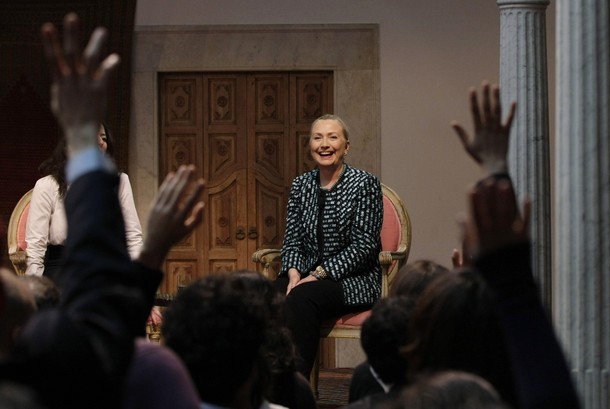
U.S. Secretary of State Hillary Clinton participates in a Town Hall meeting at the Baron d' Erlanger Palace in Carthage, Tunisia, February 25, 2012. REUTERS/Jason Reed (TUNISIA - Tags: POLITICS)

Town Hall With Tunisian Youth


Remarks
Hillary Rodham Clinton
Secretary of State
Palais de Baron d'Erlanger
Tunis, Tunisia
February 25, 2012


MODERATOR: We are very proud of the youth of our country for being the catalyst and leaders of change. Madam, the Secretary of State, we're honored to have you visit our country for the second time in less than a year. And on behalf of the attendees today, I would like to welcome you and thank you for the time you are spending with us and for the exciting opportunity to have our youth exchange with you. The floor is to you.
SECRETARY CLINTNON: Thank you so much. Well, thank you very much, and it is a pleasure to be back here in a free Tunisia and to be at this beautiful center for Arab and Mediterranean music, and I want to thank the director and everyone associated with the center. But what is most exciting to me is to have this chance to talk with all of you, and I thank you for coming, and Leila, thank you for agreeing to moderate.
It is an exciting but also challenging time here in Tunisia. The riot police are gone, and the pepper spray no longer fills the air, but it is true that building a sustainable democracy and a modern economy, guaranteeing the universal rights of all Tunisians, the freedom of speech, the freedom of press, the freedom of religion, the freedom of association, all of that takes time to firmly establish. Building a modern economy that is open to the world, that takes advantage of Tunisia’s strategic location also takes time. But what I am impressed by is not only how inspiring the revolution in Tunisia has been, but how determined the people of Tunisia are about the future you are seeking.
Now, the future is always somewhat uncertain, but what is certain to me is that it will be the young people of Tunisia who determine what the future will be. And many have asked: Why after so many years did change finally come to Tunisia and that change here in Tunisia spark change across the Arab world? And why did young people here in Tunisia strike the first blows for freedom and opportunity?
Well, the first and general answer is that the rights and dignity of human beings cannot be denied forever, no matter how oppressive a regime may be. The spirit of human rights and human dignity lives within each of us, and the universal aspirations have deep and lasting power. A second reason is that you belong to a remarkable generation of young people, not only here in Tunisia, but across the world. It is an optimistic, innovative, impatient young people that I see everywhere I travel. Because in addition to your own courage and determination, there are underlying dynamics that are affecting young people everywhere – changes in demographics and technology, economics and politics that are bringing together this unique moment in history.
Young people are at the heart of today’s great strategic opportunities and challenges, from rebuilding the global economy to combating violent extremism to building sustainable democracies. And I have fought, as some of you know – some of the women that I was just saying hello to who are leading change here in Tunisia – I have fought for years to put women’s empowerment on the international agenda. I think it’s time to put youth empowerment there as well.
Now I realize, being young, you may be skeptical. It was a long time ago, but I remember being young myself. But the needs and concerns of young people have been marginalized too long by political and economic leaders. And the fact is today, the world ignores youth at its peril, because just look at the demographics. From Latin America to the Middle East to Sub-Saharan Africa to Southeast Asia, we are seeing what experts call a youth bulge. There are now more than 3 billion people under the age of 30 in the world. Ninety percent of them live in the developing world. And the numbers continue to grow.
And you are living in a world that your parents, and certainly your grandparents, could never have imagined – satellite television, the internet, Facebook. My late mother used to say, “What is this about faces on the internet?” (Laughter.) And new communications technologies shrink your world but expand your horizons. Now everybody can see how others are living – living in prosperity, dignity, and freedom, and they rightly want those things for themselves. And we can also see, as we have seen, terribly over the last weeks, what’s happening in Syria. And I really commend the Tunisian Government for hosting the conference which was held yesterday.
So as expectations are rising, what is being done to meet them? We are making progress politically, but more needs to be done economically. Young people are three times more likely to be unemployed than older people. And more than 100 million young people are scraping by with part-time employment and insufficient wages. And right here in Tunisia, I know there are many young people who are not yet fully employed, productively employed.
So the global economy is connecting us more than ever, but young people are finding, even with graduate degrees, they may not have the skills that the global marketplace is seeking. So there is this gap. So millions of young people leave families and villages for crowded cities and don’t find what they are looking for yet. The old patronage networks that provided jobs to previous generations were reinforced by corrupt systems that are now outmoded and would not be working in today’s modern world. Young people in many countries are combining technologies and ethics to reinvigorate grassroots public service, and we’re seeing the results as they stand up against corrupt governments. Many of the ties that existed in family and community are not as strong as they used to be, and so many young people find themselves on their own. And this is all a recipe for frustration and instability that can be exploited by extremists and criminals around the world.
So what do we do? How do we link up the energy and innovation of young people with the changes that are so necessary? In fact, last January, as protests were filling the streets of this city, I traveled to Doha and warned a conference of regional Arab leaders that if they did not act quickly enough to offer young people a better vision for the future, their regimes would sink into the sand. And the young people of Tunisia proved that point.
And so political reform is proceeding. And many times in the past, much longer. In Poland, it took a decade for a trade union to dislodge a repressive communist government. In Tunisia, it took you a month to dislodge a dictator. The global story that is happening here and elsewhere requires innovative thinking and economic entrepreneurship to ensure that the democratic revolution delivers results for individuals. That is happening in lots of places, but not enough, or not quickly enough.
Now, I have made the argument that in every region of the world, the needs and aspirations of young people should be more fully recognized. As an official in India recently said, the youth bulge will be a dividend if we empower our young, but it will be a disaster if we fail to put in place a policy and a framework where they can be empowered.
So here’s what the United States is trying to do. We’re forming youth councils at our embassies and consulates to have direct contact with young people like yourselves, because for every problem, we want to seek a solution. We’ve also created an Office of Global Youth Issues in Washington to ensure ways to partner with you. And we have a young 24-year-old activist, Ronan Farrow, who’s here today, who is our advisor on global youth issues.
To paraphrase Steve Jobs, we not only need to think different; we need to think big, because if we don’t, we will miss this moment in history. Now what do young people want? I think they want the same thing as what all of us want – peace, prosperity, and dignity, a chance to participate, a chance for your voices and your votes to be heard and counted.
And there are tried and true approaches that work. In economics, we need to encourage entrepreneurship. And we have here representatives from NAPEO. Where are our NAPEO representatives? We have Tunisians who have been successful in business who are partnering with us and others to create more economic opportunities. It is focused primarily on creating jobs for young people. And we’ve created the Global Entrepreneurship Program that connects investors with young people who have good ideas and are willing to work hard to see them realized.
For example, this past fall, we sent a delegation of American investors and business leaders to Tunisia, Morocco, and Algeria to meet and mentor young entrepreneurs. One of the people they met was a 25-year-old Algerian who is pioneering new e-commerce tools for communities with limited access to financial services. He came from a poor village in Algeria, and he knew that the people in his village did not have access to credit, did not have access to markets, yet they had cell phones. So using cell phones, he is providing applications that give people access to credit, to mobile banking, to information about how to start a business and how to build a business plan. An accomplished Tunisian scientist along with other Tunisian entrepreneurs have received scholarships to study business and further develop their ideas in America.
We’re going to build a momentum by organizing a Global Youth Jobs Alliance to bring in more partners and reach more people. And one area we’re going to emphasize is expanding English language training all over the world, and especially here in Tunisia, because English has become the language of commerce, and to great extent the language of the internet, although obviously it’s available in other languages. But it serves as a port of entry into the global economy. The Peace Corps is returning to Tunisia, and they will be emphasizing speaking English. We’re using the internet to do English language instruction. We’re already helping thousands of Tunisian young people with job placement and skills training. And we want to expand university educational exchange programs between the United States and Tunisia. This spring, a team of expert educators from America will travel to the Maghreb to build new links with regional business schools and training centers.
Ultimately, we know what government needs to do. They need to crack down on corruption wherever it occurs, crack down on cronyism wherever it occurs, and diversify their economies and open their markets. I hear sometimes from leaders in this region that there is a certain fear about opening their economies, but I think that does a great disservice to the people of these countries that have so much energy, and especially to young people. Opening the economies will particularly advantage the young people of Tunisia and other places.
We also want to encourage the use of social networking tools. The social media that was used to bring down the Ben Ali regime now can be used to expose corruption, encourage transparency and good government. It’s also true that this goes hand in hand with the kind of freedom that is now available, so that it is not only to make a living but it is to enable and empower people to be participants. Because after all, dignity means being treated with respect and having a voice and having the right to participate and even lead. Your new democracy needs you. Participation is a means to an end, not an end in itself. And it really requires everyone to contribute to creating the new Tunisia.
Now, obviously, people will disagree. We’ve been disagreeing with each other for 236 years in the United States. We do not all see the world the same way. But we believe in the fundamental values that undergird our democracy. One of the most common questions I am asked as I travel around the world is how, after running against Barack Obama, would I agree to work with him as his Secretary of State? And the answer is simple. We both love our country. And yes, did we compete hard? We competed very hard. I wanted to win; he won. And therefore, I had to make a choice, because it wasn’t about me; it was about what we could do together for America.
And veterans of democratic transitions from Latin America to Eastern Europe to East Asia have learned the lessons of pluralistic democracy. All political parties, religious and secular alike, have to abide by basic ground rules: reject violence; uphold the rule of law; respect the freedoms of speech, religion, association, and assembly; protect the rights of women and minorities; give up power if you are defeated at the polls; and especially in a region with deep divisions within and between religions, avoid inciting sectarian conflicts that pull societies apart.
Now here in Tunisia, an Islamist party won a plurality of the votes in an open, competitive election which we applauded. And the party leaders promised to embrace freedom of religion and full rights for women. And in my meetings today with both the president and the prime minister, that commitment was reinforced.
Also, the job of writing a constitution and governing requires cooperation across society. No one person, no one party, has all the answers. Every country is stronger by listening with respect to those with whom we differ. So to write a constitution, the governing party now then will have to work with other parties, including secular parties, and persuade voters across the political spectrum to respect fundamental principles. And Tunisians will have to make sure to hold everybody to that promise.
Now, I know that there are those here in Tunisia and elsewhere who question whether Islamist politics can really be compatible with democracy. Well, Tunisia has a chance to answer that question affirmatively, and to demonstrate there is no contradiction. And that means not just talking about tolerance and pluralism, but living it. And it is up to you to hold all political parties to the same values.
Protecting democracy is the duty of every citizen. And for the young people of Tunisia, it is a special responsibility. We watched your courage on the front lines of the revolution, men and women alike, enduring the teargas and the beatings. It takes a different kind of courage to be a guardian of your new democracy. After a revolution, history shows it can go one of two ways. It can move in the direction you are now headed, to build a strong democratic country, or it can get derailed and detoured to new autocracy, to new absolutism. The victors of revolutions can become their victims. So it is up to all Tunisians, especially young Tunisians, to resist the calls of demagogues, to build coalitions, to keep faith in your system even when your candidates lose at the polls.
After I lost to President Obama, I had many supporters who did not want me to quit and wanted me to not cooperate and wanted me to say no to any request to help. And I said absolutely not. This is about our political system. This is about our agenda. It is not about any of us. And we have to therefore protect the core principles and institutions of democracy. I understand in Tunisia you have a saying: “Continuous effort can pierce through marble.” Well, that spirit helped protestors and dissidents withstand long years of repression and ultimately topple the old regime. And I think it’s that same spirit that can help you move forward.
So I think we’re at an especially important moment. And I want to speak directly to the young women who are here, and those you represent across Tunisia, the region, and around the world, because some of the obstacles that young women face are unique. In too many places in the world today, laws and customs make it harder for women to start a business, run for office, even make personal decisions. Tunisia has stood out as a place that protected the rights of women and sent a message that there was no contradiction between culture and religion and opportunity and empowerment. And so for the young women and the young men who are here, Tunisia will need all of its sons and daughters in order to have the success you are seeking.
Recently, one of our Supreme Court justices, Ruth Bader Ginsburg, visited Egypt and Tunisia, and she met with your judges and other high officials. And she said something which I thought was very apt: The daughters of the Middle East should be able to aspire and achieve based on the talent God gave them and not be held back by the laws of men. So please know that as you make this incredibly historic and important journey to a democracy that produces results, politically and economically for you, the United States will stand with you.
We know something about how hard it is to build a democracy. We have been working at it for a very long time. We are now the oldest democracy in the history of the world, but we had lots of obstacles along the way. We fought a civil war to free African Americans who had been slaves. We had to amend our Constitution to let women vote. We continue to try to perfect our democracy. So don’t be too impatient, but don’t be in any way complacent. You have to keep those two in mind at the same time.
Each of you deserve the same opportunity to live up to your own God-given potential. And I am very confident – I am very, very confident that Tunisia will be successful because of you. Thank you very much. (Applause.)
MODERATOR: We will now go for the questions and answers. And if you have a (inaudible). In your personal experience and given the history of other countries that (inaudible), what makes you feel that Tunisia (inaudible), and (inaudible) those transitions?
SECRETARY CLINTON: Well, Linda, I will give you some of the reasons why I am optimistic, and even confident that (inaudible). First, Tunisia has, in the past, even under dictatorship, provided a set of protections for individual rights. The code of personal conduct and other laws gave to each Tunisian, man and woman, certain rights. But the government (inaudible) some of those rights. So there is a – whoo – (laughter) – there is a tradition of personal rights and empowerment in Tunisia that did not exist in most of the countries that have undergone revolutions, particularly now in the Arab world. I think that gives Tunisia a huge example, which is why I said it’s so important you cannot let anything or anybody roll back the rights that Tunisians should have.
Secondly, Tunisia is very strategically located. You look at the map – close to Europe; in the Maghreb, a region that is economically underdeveloped, where Tunisia has on average the highest standard of living and the highest level of education; to your south, huge economic opportunities. So I think Tunisia’s geographic location is very important and gives you a chance to expand your reach economically.
Thirdly, you have the benefit of your historic revolution. Tunisia was the first. Tunisia set the pace. People look to Tunisia to continue to demonstrate how one does democracy in this region. That’s a heavy responsibility, but it’s also a great opportunity. In my meetings with the government officials, one of the things we talked about is how to provide more economic help to get you through this period. And one of the big selling points is that everyone wants the Tunisian revolution and the Tunisian democracy to succeed.
And finally, I think that, as I look at the plans of the new government for job training, for employment, as I talk to the private sector, represented by NAPEO and the businesses here who invest in entrepreneurship, I think the elements are all right. There’s not any talk of, oh, let’s go back to state ownership, let’s go back to the kind of failed economic policies of the past. Tunisia’s looking forward, both in its public and its private sector.
So for all those reasons, I think that the political reforms that you’re making built on a foundation that you inherited, that, now being carried out in a democratic context, combined with the good ideas about economic growth, are quite a good combination for success. And I’ll just end, though – it can’t happen overnight. And I would, on behalf your government, on behalf of your business sector, say there has to be good planning to avoid failure. And that will take some time. It shouldn’t take too much time, but it will take some time. So impatience is, I think, a characteristic of being young, but there is a need to be thoughtful about how we’re going to secure the political and economic success here.
MODERATOR: Thank you very much. So who would like to ask a question? Just think how many.
Go ahead, please.
SECRETARY CLINTON: Here comes the microphone.
MODERATOR: So if you could present yourself.
QUESTION: Hello. I’m Shaima and I’m from (inaudible). First of all, I want to say welcome to Tunisia. I mean, it’s a great pleasure that you are here today. My question is: I think that your vision about Tunisia changed after the revolution. So I want to ask you: What was your vision about Tunisia in the past, when Ben Ali was our president? And how the vision changed with time? Thank you.
SECRETARY CLINTON: Very good question. I visited Tunisia one time, in 1999, when Ben Ali was president, and I came away with a very contradictory picture. On the one hand, a lot of the characteristics of the Tunisian people were evident. There was a lot of, even, energy. I could see it on the streets, I could see it in the people that I met with, but there was a ceiling imposed upon the people of Tunisia that there wasn’t any way to break through because the prior regime did not favor openness, politically or economically. They engaged in crony corruption, so that people who worked hard, who had a good idea, would not necessarily ever get a chance. So that although the energy and the potential of the Tunisian people was visible to me, the oppression that prevented the full potential of Tunisia being realized was also visible. There was a lot of emphasis on appearance rather than reality.
And I think that what has happened with the revolution here has a chance to combine the potential and the reality for the first time. And I am very excited about that because I saw that it was present, but it didn’t have anywhere to go in the prior regime.
MODERATOR: Thank you.
Go ahead, please.
QUESTION: (Inaudible.)
SECRETARY CLINTON: Here comes the microphone.
QUESTION: Excuse me. I would prefer to speak French to avoid any misunderstanding. Is it okay?
SECRETARY CLINTON: I think Leila will translate for me.
MODERATOR: Yes, I will.
QUESTION: (In French.) (Laughter.) (Applause.)
MODERATOR: So the question was that (inaudible) sees that the United States played the card of a political Islam through the card of the Middle East. And the question is --
QUESTION: What's your definition of (inaudible)?
SECRETARY CLINTON: Would my definition of moderate Islam?
QUESTION: (Inaudible.) Would you consider that the (inaudible)?
SECRETARY CLINTON: Well, first of all, I think that when you have a democratic election that represents the will of the people, you have to respect that. That’s the first thing. But then the people who are elected have to also respect their people. And that is true whether it is a Christian party, a Hindu party, or a Muslim party. And I don’t know that we get to draw a conclusion because there are many aspects of political change and democratic development that should be a base no matter what party is in charge. And I mentioned those.
A party must be willing to abide by the results of an election. So you cannot have a party get elected and then say no more elections, which is what some people have done. A party that is a religious-based party has to recognize the freedom of religion, association, assembly, and speech, so that even if you disagree with the party and the party’s positions, you are free to do so, even if it is a party based on religion, which gets people sensitive in their interaction politically.
And I think that certainly you judge political parties both by what they say and what they do. Now what we are hearing said by the Nahda party here is in accordance with democratic values. And we are watching what is done. But it is less important what the United States concludes than what the people of Tunisia conclude. You must be the guardians of your democracy.
And I think that one of the biggest problems we have in the world today is people not respecting the views of others. I’m a person of faith. I’m a Christian. I believe strongly in my faith. But I do not believe I have a right to impose my faith on you or anyone else, because there’s just too much room for the human spirit, for the conscience of people to be put in any one box. So I highly respect people of religious faith that differs from me. But I expect them to respect me, and I also believe you have to respect people who are not religious because that is their right, for whatever their reasons are. So it is difficult when you represent a religiously-based political party to do that.
And it does take time to kind of get the habits of tolerance and respect when you are a political power. But I believe that any – that if you look at the Turkish example, or the Indonesian example, there you have in Indonesia a secular party in the largest Muslim nation in the world. And in Turkey, you have an Islamic-based party which is being – which is trying very hard to be tolerant of other religions and try to demonstrate that there is no contradiction. And in fact, at the conference yesterday, the Turkish foreign minister representing the Islamist party in Turkey strongly spoke out in favor of all the minorities in Syria – including the Christians, the Kurds, the Druze, the Alawites, the Sunni, everybody. And that’s what we want from religious-based political parties. You’re free to believe what you believe and to be faithful to your religion. But when you assume political power, you have a responsibility to care for every citizen of a different religion, of a different sect, of no religion at all.
So we are watching, and we will see how it develops, because other than Turkey, there is no democratically elected Islamic-based party other than in Tunisia now, and in Egypt. And we think Tunisia is proceeding in the right direction, based on what we’re seeing, but we will continue to have a dialogue that raises questions if they arise.
Here comes the microphone. Okay. Let them go first, and then we’ll come to you, sir. No, you can go first. You can go first and then we’ll come to the gentleman.
QUESTION: Ladies first.
SECRETARY CLINTON: Yeah. Ladies first. (Laughter.)
QUESTION: Okay. First of all, it’s nice to meet you, ma’am.
SECRETARY CLINTON: Nice to meet you.
QUESTION: And you are welcome. Okay. I’m (inaudible), I’m working with OTI USAID agency. Our program is called Bridge to Democracy, and we are helping Tunisian citizens on the Tunisian transition. So when we start our program here in Tunisia, we face a lot of problems, such as the anti-Americanism. And personally, I face that problem, because I was wearing the hijab, and that was a lot of talk that how she's working with the USAID agency and she's wearing the hijab. Of course, they are forcing her maybe in the office to put off her hijab, et cetera. And when I start to communicate with associations in the office and in the field also, they start to discover, oh, she's sitting with her American colleagues and she's doing an effort to help us, and she's still wearing her hijab.
So – and so it was – and after that, after seven months of hard work, we are in the point that we can say that our work is coming more easily than before because people there start understand and realize that that was wrong judgment for me. And that was working with an American agency or company, et cetera, it's just like working with a French company, et cetera.
And so I’m asking if there is any opportunity to have more projects just like ours, especially in the interior areas, that’s – and basically touching (inaudible) youth because, as we know, all youths in the interior areas faced a lot of problems and suffered and faced also marginalization in Ben Ali's regime and paid a lot to have their freedom in the revolution. So we want them to feel like they still an effective element, and we are care about them even now. I know that the revolution – so I’m asking if there is any opportunity for a concrete project, especially in the interior area. And I want to say that especially to make them feel like we all citizens here appreciate what you did in the revolution, and all – and the whole Arabic world also. So we want to make them feel that we are (inaudible). Thank you so much.
SECRETARY CLINTON: Well, the short answer to your question is we are – (laughter) – hoping to have more and more projects. But the longer answer – because you said a number of things which I think are very important – first, let me say a word about the hijab. I think, just as in our country, women have the right to wear it or not wear it if they are Muslim Americans. We have millions of Muslim Americans. Some wear it; most don’t wear it. But that’s their decision. And I think it’s very important, if you proceed with this democratic revolution, that people are not pressured to wear it or not wear it, because that should be your individual choice in a democracy. And that will be one of the important signposts – are people being forced to.
Now, personally, I think that you will face extremists who are trying to really change the Tunisian culture. And why extremists always focus on women is a mystery to me. But they all seem to. It doesn’t matter what country they’re in. They want to control women. They want to control how we dress, they want to control how we act, they want to control everything about us. This is the 21st century. You are obviously an intelligent young woman who’s made your own choice, and I respect that. And I want every woman here to make her own choice, and we should all respect that as well. That, to me, is a central absolute principle within a democracy. Don’t try to use extremist rhetoric and actions to intimidate women. And the United States strongly stands against that.
Secondly, the United States believes in freedom of religion, and we practice it. We have people who are extremists in the United States, but we basically just sort of put them down. So when you say that coming to work for an American project, people were anti-American – if you want to be a democracy, people need to look to see what works in a democracy. And as I say, we’ve been working at this for a very long time. So I think we have demonstrated that we support democracy, and we support it where it is occurring. So we want to be as supportive as possible based on the principles of what a democracy really is. And I think that anyone who believes in democracy should open their eyes to America, because this is where one learns about what makes a democracy where you have people who are different. And people are different everywhere.
And finally, we are working to help in the interior, because you’re absolutely right – it’s true in rural areas everywhere, people who are denied opportunity, who don’t have much of a chance to get educated, to have jobs, they are easy prey for extremism and for despair, and they feel left out. And oftentimes, it’s poor people like the man who started this, the young vegetable vendor who set himself on fire. It is poor people who pay the biggest price. So we want to work with people like you here in Tunisia to support projects that will help people in the interior and elsewhere.
So, thank you for all your points. And then this man in the white shirt I promised. Yes.
QUESTION: My name is (inaudible). I’m a young legal counsel. My question touches a little bit on the issue raised by the young lady here. I think that there exists among many young people in Tunisia across the region a deep feeling of mistrust towards the West in general and the United States in particular. And many observers partly explain the surge of extremism in the region and in Tunisia by this skepticism. And even among the mainstream of moderate and pro-Western youth, there is a sense of despair and fatalism when it comes to the possibility of building a real and lasting partnership that is based on mutual interests. So is the United States aware of this issue? And how do you think we can address it?
SECRETARY CLINTON: Yes. I can speak for both President Obama and myself. We are aware of it. We regret it. We feel that it doesn’t reflect the values or the policy of the United States. And there are several reasons as we understand them. Some people say, well, you supported the prior regimes in these countries. Well, those were the governments. If you’re a government, who do you deal with? You deal with the governments that are in place. And yes, we did. We dealt with the governments that were in place, just like we deal with the governments elsewhere. Right now, we’re in a big argument with Russia and China because they won’t agree to the Security Council resolution to help the poor people in Syria. But we don’t stop dealing with Russia and China across a whole range of issues because we have serious disagreements with them.
So I think part of it is to recognize the reality that governments have to deal with, and to look at the whole picture, because the United States has spent enormous amounts of money and treasure trying to help people achieve their own freedom. We did it certainly in the long Cold War against the Soviet Union and then helped millions of people under Soviet rule find their way to freedom. We’ve done it in Asia, where we protected Japan and South Korea against problems coming from communism, and they are now thriving, successful, democratic economies. We worked for a long time to help Indonesia. Indonesia has now been a democracy for more than a decade, and their economy is booming, and they are demonstrating you can be both a Muslim nation and a successful nation. We stood up against apartheid in South Africa and supported their struggle for freedom. We could go all over the world where you can see that.
But we also have to deal with the reality that we confront in trying to make decisions about how to conduct our foreign policy. And we – I mean, you remember, President Obama mentioned the Tunisia revolution in the State of the Union. I mean, we were thrilled to see Tunisia having this chance to build a democracy, and we are here to help. We are here with financial help, we are here with technical help, and looking for every way we can to make you successful.
So I always ask people to consider the source of criticism of the United States. I will be the first to say we, like any country in the world, have made mistakes. I will be the first to say that. We’ve made a lot of mistakes. But I think if you look at the entire historical record, the entire historical record shows we’ve been on the side of freedom, we’ve been on the side of human rights, we’ve been on the side of free markets and economic empowerment. And that is where the bulk of the evidence, in my view, rests.
You said you were a lawyer? (Laughter.) I used to be one. (Laughter.) So I think we can make a very strong case, and that’s what we’re doing, and that’s one of the reasons why I’m here, to do it in person.
MODERATOR: Thank you.
Okay. Go ahead, please.
QUESTION: Welcome, Secretary of State. I am (inaudible), I am a voluntary with an association to prevent prevalence and prevention of HIV and STI (inaudible) for English for communication, too. First of all, I want to say that I find that you are so elegant from the (inaudible). And then I’m going to follow with my two questions.
SECRETARY CLINTON: See why I love Tunisia? (Laughter.)
QUESTION: Thank you. We love you, too. So my first question is about collaboration.
SECRETARY CLINTON: Collaboration? Yes.
QUESTION: Yes. To which extent do you found that the collaboration between our respective nations, the United States of America and Tunisia today, is important to maintain and preserve democracy? This is from on part. From another part, the – my second question, I mean: Since freedom – liberties and freedom are involved in any and all democracies – today, there are a lot of minorities in Tunisia. We can say also sexual minorities. So what are the strategies that – may the United States of America give as advice to Tunisian Government in order to preserve freedom of these minor – sexual minorities? And so what are the ideologies and doctrines that you can give to youth today in order to reach the best level? Thank you.
SECRETARY CLINTON: Well, those are three very, very significant questions.
First on collaboration, we have received an aide memoire from the government with requests for collaboration in higher education, vocational training, health, trade, investment, business development, security, everything you can think of that is important to protect and build a good democracy. And we are looking at all of them. We’re going to help as much as we can. We’re going to reach out to other countries so that we have international collaboration. But speaking just for the United States, we are committed to improving our collaboration across a full range of important issues in Tunisia. And we want to do it in a way that involves not just the government, but the private sector, the business community, the civil society, and especially young people. So that’s the first thing.
The second thing, on the issue of the LGBT community, we believe strongly no minority, regardless of why one is a minority – whether it’s ethnic, religious, sect, sexual orientation – should be discriminated against, that in today’s modern world, we are seeing the need for everyone’s human potential to be respected. Every human being has dignity. I mean, if you believe, as the people of faith do, we are all created in God’s image, and we all have an obligation to treat one another with dignity and respect. And we think that needs to be part of the political system of any democracy. So we strongly support that. I gave a speech in Geneva a few months ago specifically addressing that because, in some parts of sub-Saharan Africa, if you are a homosexual, you can be killed, you can be imprisoned, just for being who you are. And we think that’s wrong. So we are standing strongly on behalf of human rights and human dignity for every person.
And finally, I think it’s important when you think about what needs to be done for young people in Tunisia, it’s not so different as to what needs to be done anywhere in the world for young people. Young people need to be educated. And in Tunisia, you have a lot of educated young people, and then in the interior and elsewhere, you have people who don’t have the same opportunity to be educated. So with those who are not yet fully educated, the education levels need to be raised. With people who are educated, even if you have a college degree, a university degree, it has to be marketable. So we have to take people who are educated and equip them for the modern economy. So there are skills and opportunities that must be made available even for educated Tunisians.
So I think that the education imperative, the education dividend, is what’s really important in the modern world. Secondly, you need a government that empowers you, not oppresses you. You now have such a government. Think of all the people you know who had to leave Tunisia because they were not free to speak, they were not free to act, and they had to leave. And we want Tunisians to be able to stay at home and develop their full God-given potential. And you’ve got to make sure your government empowers you to do that.
And then finally, Tunisia needs to reach out to the rest of the world. I think that a lot of Europe knows quite a bit about Tunisia, but the United States average person doesn’t know a lot about Tunisia. Latin America, Asia – you’ve got to reach out to the rest of the world, and you can do that through all kinds of social media, through all kinds of alliances. We’re going to start this Global Youth Alliance to try to create more jobs. Tunisian young people need to be in the center of the action in the world. I think having more English-speakers will help that. Not that – French and Arabic, they’re very important, but I only speak one language. I feel very disadvantaged. And I think the more we can get more English speakers throughout Tunisia, that will add to the ability to network around the world.
So I think all the ingredients are here. If you look at the indicators on Tunisia – higher than average education, higher than average income already – so you just have to put the ingredients together to bake it up, and you’re going to have a very positive outcome.
MODERATOR: Thank you. Unfortunately, we only have time for one more question.
SECRETARY CLINTON: Oh, I talked too much. I’m sorry.
MODERATOR: Sorry about that. And I’m going to go on the left, because I haven’t had the opportunity to hear them yet, so please go ahead.
SECRETARY CLINTON: I’ll stay. I’ll have one more after that. So Leila, the pressure on you. Okay.
QUESTION: My name is Ivan. After the electoral campaign starts in the United States – it started some time ago – we noticed here in Tunisia that most of the candidates from the both sides run towards the Zionist lobbies to get their support in the States. And afterwards, once they are elected, they come to show their support for countries like Tunisia and Egypt for a common Tunisian or a common Arab citizen. How would you reassure and gain his trust again once given the fact that you are supporting his enemy as well at the same time?
SECRETARY CLINTON: Well, first, let me say you will learn as your democracy develops that a lot of things are said in political campaigns that should not bear a lot of attention. There are comments made that certainly don’t reflect the United States, don’t reflect our foreign policy, don’t reflect who we are as a people. I mean, if you go to the United States, you see mosques everywhere, you see Muslim Americans everywhere. That’s the fact. So I would not pay attention to the rhetoric.
Secondly, I would say watch what President Obama says and does. He’s our President. He represents all of the United States, and he will be reelected President, so I think that that will be a very clear signal to the entire world as to what our values are and what our President believes. So I think it’s a fair question because I know that – I sometimes am a little surprised that people around the world pay more attention to what is said in our political campaigns than most Americans, say, are paying attention. So I think you have to shut out some of the rhetoric and just focus on what we’re doing and what we stand for, and particularly what our President represents.
MODERATOR: One more.
SECRETARY CLINTON: Oh, no. Too many hands.
MODERATOR: On the back, we haven’t heard anyone from the back. Go ahead.
QUESTION: Hi. My name is Emna. I’m an undergraduate of the Tunisia – at the Mediterranean School of Business. Just before you pointed out how important is entrepreneurship to the new economy in Tunisia, and as the fellow at the Tunisian Center for Social Entrepreneurship, I would like to ask you if there are any specific programs to encourage the engagement of youth in social entrepreneurship. And what are these programs if there are any? Thanks.
SECRETARY CLINTON: Well, the short answer is there are programs being made in both economic and social entrepreneurship. And we have a number of people here who are working on it. Would the NAPEO people stand up again? Just stand up. I want everyone, all the young people, to see you. Each one of these men and women are part of our entrepreneurship efforts for business. So if you are interested in that, I don’t want to impose on you, but I would love to have people to come talk to you because Tunisia will sponsor the Global Entrepreneurship Conference in 2013. And there will be opportunities for mentoring, for your ideas to get financial support, to go to the United States, to get more information about how to start a business, how to continue a business. So on the economic entrepreneurship side, we have a lot of very experienced people who are Tunisian success stories themselves that we are partnering with.
On the social entrepreneurship side, we have many programs. And I would ask our ambassador to share with our Embassy website and all of those programs listed. I assume it does, Ambassador. And that they’re – that we will have somebody available to talk with anyone who wants to know more about the social entrepreneurship program. Because from our view, there are a number of ways we can work on both the economic and the social side, and so part of our social entrepreneurship is to create more Tunisian-U.S. university partnerships, more chances for young Tunisians to study in the United States, to bring scholars and students from the United States to Tunisia to study, to have more exchanges so that we can actually meet face to face and perhaps eliminate some of the preconceptions about each other, which I think would be good.
I know that if – no two human beings are going to agree on everything, but it’s always important to try to get rid of what’s not true and focus on what is true, and if we have areas of disagreement, to narrow the areas of disagreement.
So I’m very excited about what our program, in working in collaboration with Tunisia, will be. And I will be working closely not only with the government but with the private sector and civil society, because it takes all three. When you think about a democratic society, it’s like a three-legged stool. You need an accountable, responsible, effective government. And it’s up to the citizens to hold that government accountable. You need a well-functioning and efficient business sector to create jobs, create wealth, give people opportunities. And you need a strong civil society to speak out on behalf of the needs of people – homeless people, uneducated people, discriminated-against people – and to stand up for the rights of all people against both business and the government.
So if you remove one of those legs of the stool, the stool falls over. So – and if one leg is longer than the other, if the government is too powerful, the stool falls over. If the business sector is unaccountable, corrupt, filled with cronyism, the stool falls over. If civil society is absent, the stool falls over.
So we want to work with all three legs of the Tunisian stool, try to make sure that we are helping each become strong and demonstrate, first and most important to the Tunisian people, but then to the Arab world and the entire world, what Tunisia is doing, because we believe you have a great story to tell.
Thank you all.
MODERATOR: Thank you very much. Unfortunately – (applause) –
SECRETARY CLINTON: And let me add, because I see a lot of hands, if you will send your questions to the Embassy website – right, Ambassador? Can you give them the address? What is the address of the Embassy website? Who has it? Where is it?
PARTICIPANT: We can send it to them by email. We have their emails.
SECRETARY CLINTON: Okay. If you go to the website – if you will send in your questions, I will answer all of them. Okay? So I know there were lots of hands left, and I want to answer all your questions. Thank you.
MODERATOR: Thank you very much. (Applause.)