Thursday, September 8, 2011

Video: Secretary Clinton's Remarks with Afghan National Security Advisor Spanta


Remarks With Afghan National Security Advisor Rangin Dadfar Spanta Before Their Meeting


Remarks
Hillary Rodham Clinton
Secretary of State
Treaty Room
Washington, DC
September 8, 2011


SECRETARY CLINTON: Good afternoon, everyone. It is indeed a great pleasure for me to welcome back to the State Department National Security Advisor Spanta. I have had the great honor of working with him on behalf of our respective governments when he was a foreign minister, and I’m delighted that our collaboration on behalf of peace and security and prosperity and opportunity for the people of Afghanistan continues.

So welcome once again, sir.

MR. SPANTA: Thank you, Madam Secretary. I am delighted to be back in the – in your Department to thank you very much for hospitality and collaboration of your colleague on – and receiving us here. I’m so happy to come to Washington and have meeting and exchange with American friends. Thank you very much.

SECRETARY CLINTON: Thank you so much, sir. Thank you all very much.


SECRETARY HILLARY RODHAM CLINTON: Public Schedule for September 8, 2011


Public Schedule for September 8, 2011


Public Schedule
Washington, DC
September 8, 2011


SECRETARY HILLARY RODHAM CLINTON

9:15 a.m.
Secretary Clinton meets with the assistant secretaries of the regional bureaus, at the Department of State.

(CLOSED PRESS COVERAGE)

10:00 a.m.
Secretary Clinton meets with newly credentialed Libyan Ambassador Aujali, at the Department of State.
(CLOSED PRESS COVERAGE)

12:00 p.m.
Secretary Clinton officiates the swearing-in ceremony for Deputy Secretary Bill Burns, at the Department of State.

(CLOSED PRESS COVERAGE)

2:00 p.m.
Secretary Clinton meets with Afghan National Security Advisor Rangin Dadfar Spanta, at the Department of State.

3:00 p.m. Secretary Clinton officiates the swearing-in ceremony for Ambassador-designate to Paraguay James Thessin, at the Department of State.
(CLOSED PRESS COVERAGE)

4:30 p.m.
Secretary Clinton and Secretary of Health and Human Services Kathleen Sebelius hold refugee consultations with Members of the House of Representatives, on Capitol Hill.
(MEDIA DETERMINED BY HOUSE)

5:30 p.m.
Secretary Clinton and Secretary of Health and Human Services Kathleen Sebelius hold refugee consultations with Members of the Senate, on Capitol Hill.
(MEDIA DETERMINED BY SENATE)

7:00 p.m.
Secretary Clinton attends President Obama’s address to a Joint Session of Congress.
(MEDIA DETERMINED BY WHITE HOUSE)

Wednesday, September 7, 2011

Secretary Clinton to Ring the Opening Bell at the NYSE

These pictures are from the last time she rang the opening bell, on September 21, 2009. It will be a far more solemn occasion on Friday.


Secretary Clinton to Ring the Opening Bell at the NYSE on September 9


Notice to the Press
Office of the Spokesperson
Washington, DC
September 7, 2011


On September 9, 2011, Secretary of State Hillary Rodham Clinton will join with other leaders at the New York Stock Exchange (NYSE) to remember the victims of 9/11, their families and loved ones, and those who aided the rescue and recovery effort.

Then-Senator Clinton and the ceremony’s other participants rang the NYSE opening bell on the morning of September 17, 2001, the first day the exchange reopened after the September 11th attacks.

NYSE OPENING BELL CEREMONY IN NEW YORK:
9:25 am (ET) Moment of Silence (one minute)
9:26 am (ET) “God Bless America” sung by former USMC Major Rose-Ann L. Lynch
9:30 am (ET) Opening Bell with guests from 9/17/01 Opening Bell including:
Secretary of State Hillary Rodham Clinton
U.S. Senator Charles E. Schumer
Former New York City Mayor Rudolph W. Giuliani
Former NYSE Chairman & CEO Richard A. Grasso
NYC Police Commissioner Raymond W. Kelly
72nd Secretary of the Treasury Paul H. O’Neill
53rd New York Governor George E. Pataki
26th Chairman of the SEC Harvey L. Pitt
Former New York City OEM Director Richard Sheirer
Former NYC Fire Department Commissioner Thomas Von Essen

Video: Secretary Clinton's Remarks at a Reception Marking Eid ul-Fitr


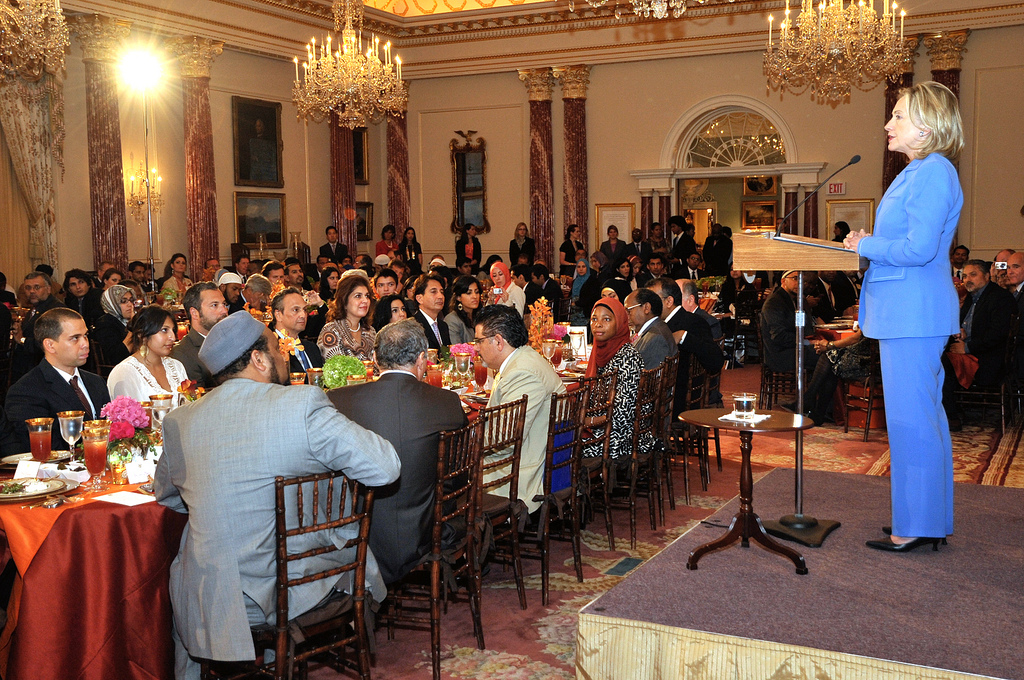
Remarks at a Reception Marking Eid ul-Fitr


Remarks
Hillary Rodham Clinton
Secretary of State
Washington, DC
September 7, 2011


SECRETARY CLINTON: Thank you, Farah. Thank you. Well, I am a wannabe athlete – (laughter) – and I have absolutely no claim to being anything other than that, but I am delighted that this evening we are going to be honoring some young people who truly are athletes and who are carving their own futures in the history of our country.

So good evening everyone. Eid Mubarak. And thank you, Farah, for your tireless efforts on behalf of the work that brings you not only to this podium but around the world.

It is a delight to see so many ambassadors from countries that I have visited and know well and to see many familiar faces here again, particularly some of the youth leaders that we honored at our last Iftar dinner. The problem with Ramadan in August is it was impossible, and so we thought, well, it’s September but we’re going forward. And so I thank you for your understanding and your being here once again.

Now, I’m told that there are two members of Congress with us, Representatives Keith Ellison and Sheila Jackson Lee, and I send a special word of welcome to them.

As Farah said, you can see through the lobby and the Diplomatic Reception Rooms some of our history of presidents affirming America’s respect for Muslims and Islam dating back to Washington, Adams, and Jefferson. And we celebrate that history, and particularly today we wanted to celebrate sports and athletic competition. Whether it be the Olympics or the World Cup, the human drive to run faster and climb higher is universal, and universally celebrated. And it’s also a way by which talent rises to the top, ability is what matters, and people are treated equally.

And that’s part of the reason the State Department sponsors sports exchange programs and sends sports ambassadors around the world. And for all the athletes joining us this evening, you may never have thought of yourself exactly as a role model, but you are. And you are not only to the students that some of you visited earlier today, but to so many beyond. And all Americans take pride in your achievements.

Now, we have some household names as well as some who will be household names. World champion boxer Amir Khan flew all the way from London to be part of this celebration. Where is Mr. Khan? Thank you so much for coming. (Applause.)

We also have a number of women athletes who are here. When Ibtihaj Muhammad fences in her hijab, when she trains 30 hours each week without missing a prayer, she’s thinking about winning and she’s thinking about the London Olympics next year. Where is Ms. Muhammad? Where is she? Right there. (Applause.) But I think it’s fair to say that, as her mother has said, many people feel pride and recognize that she is representing more than just herself in her endeavors.

Now, not everybody will go to the Olympics, but even weekend warriors can get some satisfaction out of this. And I hope many of you were able to watch the new documentary we screened earlier. And we are joined by the coach and four members of the Fordson Tractors from Dearborn, Michigan, as well as the filmmakers. Where are all of them? That was such a great documentary and a great story. (Applause.)

And I hope everybody gets a chance to meet our athletes here tonight, but that film highlighted the exceptional circumstances that the team faced, that they wanted to train hard and stay healthy while keeping the requirements of Ramadan. And so like every other high school team, they geared up for football practice in August this year with two-a-day practices, except they took the field at 11:00 p.m. and finished around 4:00. And that takes special dedication, special dedication to both your sport and your faith.

But what stood out to me is how familiar the team and the players ultimately are. The image of the pregame huddle and prayer could’ve been filmed at any high school in America. Shoulder pads and helmets crowded the locker room, and big-game nerves were somewhat evident on your faces, I have to confess. But despite the extra burdens they carried, at the end of it, it was Friday night football for a team of champions.

Now, we can’t pretend that there have not been difficulties and division. In fact, the Fordson documentary tells the story of the religious tensions in Dearborn, Michigan. But the power of America has always been anchored in our ability to come together and move forward as one nation.

This weekend, we will mark the 10th anniversary of September 11th. And we all lost something that day. In the ashes and the aftermaths, we knew that we had lost Christians, Muslims, Jews, Hindus, Buddhists, men, women, young, old. And a decade later, that unity that we felt must continue to inspire and guide us.

I’m very proud that in our country, despite the challenges, we do honor the freedom of religion. Too many countries in the world today do not, or they make it difficult and even dangerous for people to try to exercise their religion. So as difficult as it may be, the fact that we get up every day and keep trying is a real tribute to all of us. So at this time of celebration and reflection, and as we mark the end of Ramadan and the beginning of a new year of renewal and possibility, I hope we can recommit ourselves to the common cause of spreading peace, prosperity, understanding to all the people of the earth.

Now I wanted to introduce two of our athletes so that you could hear from them directly. Ephraim Salaam has played in the NFL for over a decade, but some of you may know him best for his memorable Super Bowl commercial last year. (Laughter.) And Kulsoom Abdullah is a weightlifter, forging the way for Muslim women athletes to maintain their freedom of expression and still compete at the highest level. Please join me in welcoming first Ephraim and then Kulsoom.

(Applause.)

SECRETARY HILLARY RODHAM CLINTON: Public Schedule for September 7, 2011


Public Schedule for September 7, 2011


Public Schedule
Washington, DC
September 7, 2011


SECRETARY HILLARY RODHAM CLINTON:
9:15 a.m.
Secretary Clinton meets with the assistant secretaries, at the Department of State.
(CLOSED PRESS COVERAGE)

10:00 a.m.
Secretary Clinton meets with the senior management team, at the Department of State.
(CLOSED PRESS COVERAGE)

3:00 p.m. Secretary Clinton meets with President Obama, at the White House.
(MEDIA DETERMINED BY WHITE HOUSE)

6:00 p.m. Secretary Clinton hosts a reception marking Eid ul-Fitr, at the Department of State.
(OPEN PRESS COVERAGE FOR REMARKS)

Tuesday, September 6, 2011

Upcoming: On Hillary Clinton's Agenda


Secretary Clinton to Host Eid Reception on September 7

Office of the Spokesperson
Washington, DC
September 6, 2011

Secretary of State Hillary Rodham Clinton will host an Eid ul-Fitr reception to commemorate the conclusion of the month of Ramadan on Wednesday, September 7, 2011, in the Benjamin Franklin Room at the Department of State.

Secretary Clinton will make remarks at approximately 6:00 p.m.

Eid ul-Fitr, which started August 30, is a three-day celebration of the conclusion of the month of Ramadan, typically characterized by feasting and celebrating in the days after the end of the month. Ramadan is the month Muslims believe the Qu’ran was revealed to the Prophet Mohamed. Ramadan is a time of reflection, generosity and compassion for nearly two billion Muslims worldwide.

At this event Secretary Clinton will recognize the contributions of American Muslims in sports, and guests will include several American Muslim professional, college, and amateur athletes in a variety of fields.

I posted this over the weekend, but am repeating it as her week pre-9/11 is shaping up.

Conversation with TIME's Richard Stengel to Mark "Beyond 9/11: Portraits of Resilience"

Media Note

Office of the Spokesperson
Washington, DC
August 31, 2011

On September 8, Secretary Clinton will participate in a conversation with TIME Magazine’s Managing Editor Richard Stengel, marking “Beyond 9/11: Portraits of Resilience,” a special screening and portrait exhibition hosted by TimeWarner in New York City. The conversation will begin at approximately 8:15pm.

Beyond 9/11: Portraits of Resilience” will mark the 10th anniversary of the terrorist attacks on New York City and their aftermath. The portrait exhibition and TIME/HBO documentary features untold stories - captured in words and images - from 40 women and men who led America, moved the nation, and sacrificed for it, in the hours, days and months that followed September 11, 2001.

The evening events will include: a reception marking the opening of Marco Grob’s TIME Portrait Series exhibition “Portraits of Resilience,” a special screening of the TIME/HBO documentary “Beyond 9/11,” and a conversation with Secretary Clinton and Richard Stengel.

Working with the editors of TIME, award-winning photographer Marco Grob produced the set of portraits which are coupled with oral histories from people including George W. Bush, Dick Cheney, Donald Rusmfeld, Rudolph Giuliani, Adm. William McRaven (who led the mission that killed Osama bin Laden) and, for the very first time, the only four survivors of the attack on Tower Two of the World Trade Center who were above the point of impact.

The program will be available on www.time.com. Additional broadcast details to be announced.

TIME Magazine is leading the collaboration of Time Warner outlets, including CNN and HBO, with the special package

The HBO documentary is in association with TIME and is a 60-minute film that will premiere on the network and HBO GO at 8.46 a.m. EST on 9/11.


Secretary Clinton to Deliver Remarks on the 10th Anniversary of September 11th and U.S. Counterterrorism Strategy in New York City on September 9

Office of the Spokesperson
Washington, DC
September 6, 2011


On September 9, 2011, Secretary of State Hillary Rodham Clinton will deliver remarks on the tenth anniversary of the September 11th attacks and U.S. counterterrorism strategy, at the John Jay College of Criminal Justice in New York City. The remarks will take place in the morning.

SECRETARY HILLARY RODHAM CLINTON: Public Schedule for September 6, 2011


Public Schedule for September 6, 2011


Public Schedule
Washington, DC
September 6, 2011


SECRETARY HILLARY RODHAM CLINTON:
3:00 p.m.
Secretary Clinton officiates the swearing-in ceremony for Ambassador-designate to Mexico Anthony Wayne, at the Department of State.
(CLOSED PRESS COVERAGE)

3:30 p.m.
Secretary Clinton meets with Gary Gensler, Chairman of the Commodity Futures Trading Commission, at the Department of State.
(CLOSED PRESS COVERAGE)

Monday, September 5, 2011

Bill Clinton's 65th Birthday Bash

The picture is from last year's birthday bash, so I hope something pops up from this year. This report is a little odd.


Published: Sept. 5, 2011 at 1:36 PM
MARTHA'S VINEYARD, Mass., Sept. 5 (UPI) -- Former U.S. President Bill Clinton celebrated his 65th birthday with friends and family on Martha's Vineyard in Massachusetts.

SNIP

Clinton's wife, Secretary of State Hillary Clinton also was there. Others feting the ex-president, who turned 65 on Aug. 19, included Philadelphia Eagles owner Jeffrey Lurie and his wife Christina, "Bourne Identity" producer Doug Liman and the world's richest human, Carlos Slim.

Read more >>>>

Well, first and foremost Happy Birthday to all! Secondly, that last paragraph! Really? Hillary was also there? What a surprise! I am flabbergasted! I have never heard of Carlos Slim, but this proves me right about Bill hanging with big money.

Cheney *Likes* Hillary! **Updated with Video**

OK OK OK!!!! I tried. I resisted as best I could, but, at the end of the day (literally) I must post this because, as all that has gone before here on these pages, it is part of Hillary Clinton's history. Yes, Darth Vader himself thinks she would have been a better POTUS than The One. Obama should never have allowed that epithet to root. One is not a lucky number in presidential terms - if you know what I mean.

Here's the beautiful, smart, organized, talented, and very personable HRC.


And here is what Dick Cheney said about her. Yes - at Breitbart no less!

Cheney praises Hillary Clinton over Obama

Sep 4 04:21 PM US/Eastern

Former vice president Dick Cheney Sunday praised Hillary Clintonas one of the more competent members of President Barack Obama's administration, saying it would be "interesting to speculate" on how she would perform as president.

Cheney was asked in an interview with Fox News Sunday whether the Democrats would have been better off with Clinton than Obama as their candidate in 2012.

SNIP

"I have a sense that she's one of the more competent members of the current administration and it would be interesting to speculate about how she might perform were she to be president," he said.

Read more >>>>

"Were she to be." That subjunctive is tantalizing! Not hard to look at either. Not that that should matter at all, but just sayin'. She has it all!


Woo-Hoo! And here is the Youtube!

Sunday, September 4, 2011

Media Reads on a Hillary Clinton Run: September 4, 2011 Edition

"Out of sight, out of mind," they say, but that is not the case when it comes to Secretary of State, and star of this blog, Hillary Rodham Clinton. Except for a brief resurfacing on Thursday to attend the Libya Contact Group conference in Paris, the SOS has been enjoying some well-earned off time, her first vacation since an attempt at a Bermuda trip in August, 2009 was cut short by Hurricane Bill.

Perhaps the more appropriate expression is "absence makes the heart grow fonder," if we are to use the articles making the rounds at Hillary Facebook groups today as a gauge. Here is what we have in the way of a daily Hillary Run affirmation.

This one is not new, but involves a poll, and qualifies for a mention here.

* Top Question : Will Hillary Clinton run for President in 2012?

True~Male August 31, 2011
Will Hillary Clinton challenge Barack Obama for the Democratic presidential nomination?


New Hampshire rings in with this one.

Hillary in 2012!

Andy Bourassa, Ashland

September 4, 2011

It's time for my fellow Democrats to face up to the fact that President Obama is a dud.
He hasn't kept his campaign promises: He didn't end the war - he escalated it. He didn't close Guantanamo. He has continued to let the wealthy get away without paying their fair share. He has put Medicare and Social Security on the chopping block.

Read more >>>>


Upcoming: On Hillary Clinton's Agenda

Mme. Secretary will be off to a running start this September, always a busy month for her with the U.N. General Assembly coinciding with the Clinton Global Initiative where she always makes an appearance. You may already have seen some advertisements on TV about this documentary, but you might not have known that our girl is participating in it. Here are some details.


New York Governor George Pataki (L), New York City Mayor Rudolph Giuliani (C) and US Senator Hillary Rodham Clinton (R), D-NY, tour the site of the World Trade Center

Conversation with TIME's Richard Stengel to Mark "Beyond 9/11: Portraits of Resilience"


Media Note

Office of the Spokesperson
Washington, DC
August 31, 2011


On September 8, Secretary Clinton will participate in a conversation with TIME Magazine’s Managing Editor Richard Stengel, marking “Beyond 9/11: Portraits of Resilience,” a special screening and portrait exhibition hosted by TimeWarner in New York City. The conversation will begin at approximately 8:15pm.

Beyond 9/11: Portraits of Resilience” will mark the 10th anniversary of the terrorist attacks on New York City and their aftermath. The portrait exhibition and TIME/HBO documentary features untold stories - captured in words and images - from 40 women and men who led America, moved the nation, and sacrificed for it, in the hours, days and months that followed September 11, 2001.

The evening events will include: a reception marking the opening of Marco Grob’s TIME Portrait Series exhibition “Portraits of Resilience,” a special screening of the TIME/HBO documentary “Beyond 9/11,” and a conversation with Secretary Clinton and Richard Stengel.

Working with the editors of TIME, award-winning photographer Marco Grob produced the set of portraits which are coupled with oral histories from people including George W. Bush, Dick Cheney, Donald Rusmfeld, Rudolph Giuliani, Adm. William McRaven (who led the mission that killed Osama bin Laden) and, for the very first time, the only four survivors of the attack on Tower Two of the World Trade Center who were above the point of impact.

TIME Magazine is leading the collaboration of Time Warner outlets, including CNN and HBO, with the special package

The HBO documentary is in association with TIME and is a 60-minute film that will premiere on the network and HBO GO at 8.46 a.m. EST on 9/11.

Saturday, September 3, 2011

Media Reads on a Hillary Clinton Run: September 3, 2011 Edition

One of these, the CSM one, was contributed by Bea in a thread last night and is from yesterday. The FOX News one is from August 30, but popped into my Facebook groups only today. That's how hard it is to keep up with these "Hillary Run" articles! They are like mosquitoes out there - swarming after the storm! They proliferate so abundantly, and I cannot say that I mind. Madame Secretary, you must hear this!


One thing we all know is that when HRC decided to run in 2007 she knew she was looking at working hard through 2016. She decided that she was up to it. Had she won the nomination and been elected, she would be running for a second term right now. Had she been POTUS these years, she would have been working as hard at that job as she has been as SOS. So I do not buy the "she's so tired" meme. She would have been tired anyway, and she would have been running. She has plenty left in her, and she has plenty to contribute - much more, I would argue, than anyone now on the pre-GE slates. So I say, Hillary, we are not only still here, we are organized! You really do not need to lift a pretty little finger. We will carry you in!

Here is the CSM article.

If Obama looks as if he'll lose in 2012, what about Hillary Clinton?

Approval ratings for Obama are at a historic low. Unemployment is not budging. Clinton would have to step down as secretary of State. Would it be unseemly to campaign against a president, in whose cabinet she once served? Just ask Jon Huntsman Jr.

By John Hughes/ September 2, 2011

This is a pretty dismal time for President Obama.

He campaigned on a platform to change Washington, but as he himself admitted in an interview with CNN’s Wolf Blitzer, the atmosphere there is worse since he became president.

His popularity is at an all-time low. It is no surprise that many Republicans want to give him the heave-ho in 2012. He is not exactly wowing independents, and even some Democrats, especially African-Americans, are grumbling.

Read more >>>>


Here is the one from FOX News.

Hillary On the Horizon as Obama Challenger?

By

Published August 30, 2011

| FoxNews.com

What do Lyndon B. Johnson and Barack H. Obama have in common? And where might Hillary Rodham Clinton fit into this puzzle?

Madame Secretary, we would like to be able to call you Madame President. You are the only hope this country has to retain its position of leadership in the world. We have gotten used to being the leader. We think American ingenuity and entrepreneurship cannot be beaten. We need a POTUS who believes that too! And that POTUS is YOU!

Friday, September 2, 2011

Media Reads on a Hillary Clinton Run: September 2, 2011 Edition

As far as we know, Mme Secretary returned from the Paris Libya Contact Group last night to a long holiday weekend - a rest earned many times over, She continues to dominate the interwebs, her absence notwithstanding.

Obama fading, Hillary rising, primary challenge looming?

September 2nd, 2011, 3:35 pm · 2 Comments · posted by Mark Landsbaum

The president’s hit a new low in job performance and a new high in disapproval ratings, as jobs continue not to be created at a blinding clip. Zero in the last month, according to the government, which ought to know. (Ha. I couldn’t resist that.)


Anyway, does this bode ill for Barack Obama, whose EPA policies have now crossed the ideological line when it comes to stimulating opposition (unions are now complaining as well as industrial CEOs).

James Taranto’s Best of the Web column today offers a suggestion from one of his readers. We pass it on, simply because it’s so intriguing.

Read more >>>>

Other counties heard from. These do not mention HRC or any candidate specifically,

Memo to Dems: Dump Obama before it’s too late

Published: 11:17 AM 09/02/2011 | Updated: 6:16 PM 09/02/2011

This summer has cemented it: Barack Obama is a lame duck. His administration is a failure. Democrats know it. And they only have months to act.

Their president has lost the support of Wall Street donors. He has driven high-powered Democrats to go public with humiliating criticism. One in four Democrats have told CNN they want a different nominee.

Then this.

Consumer advocate Ralph Nader, whose third-party presidential candidacy some Democrats credited with handing the 2000 election to George W. Bush, has a new model for challenging President Obama from the left in 2012.

Nader proposes to assemble a large group of Democratic candidates to take Obama to task on a variety of issues.

So-ooo! I ask who is best? Best for the country? What is best for our country?

Thursday, September 1, 2011

HIllary Clinton in Paris: The Slideshow

I thought I would post the pics separately from the press conference video because they display the lighter, friendly side of the summit and Mme. Secretary's appreciable social skills.

Also on the lighter side is this article which complements the slide show nicely.

Mallick: How to kiss a Frenchman. With great care, obviously

By Heather Mallick Star Columnist


France's President Nicolas Sarkozy welcomes U.S. Secretary of State Hillary Clinton prior to the opening of the Friends of Libya conference in Paris September 1, 2011.

France's President Nicolas Sarkozy welcomes U.S. Secretary of State Hillary Clinton prior to the opening of the Friends of Libya conference in Paris September 1, 2011.

PHILIPPE WOJAZER/REUTERS

Doesn’t it look as though Hillary Clinton and Nicolas Sarkozy are going to have a kiss-fail of Parisian proportions?

Not going to happen. These two kids at the “Friends of Libya” conference on Thursday — on French soil, mind you — can work it out. Even if Sarkozy is going for a faintworthy quadruple, a double version of the traditional air kiss on each cheek, a take-that-and-raise-you-one diplomatic face competition, Clinton can cope.

Read more >>>>


Aside from Sarkozy, we see Mme. Secretary with Mustafa Abdel Jalil, chairman of the Libyan National Transitional Council (NTC), Mahmoud Jibril, the head of Libya's rebel National Transitional Council, Ahmet Davutoglu, Turkey's Foreign Minister, and Norway's Prime Minister Jens Stoltenberg, among others.

Secretary Clinton: A New Future Dawning in Libya (Video)


Press Availability on Libya


Press Availability
Hillary Rodham Clinton
Secretary of State
Chief of Mission Residence
Paris, France
September 1, 2011


SECRETARY CLINTON: Well, this is my ninth trip to discuss the current crisis in Libya, and each time I have urged that our partners stay focused on the ultimate objective of helping the Libyan people chart their way to a better future. And today, that future is within their reach. All of us are inspired by what is happening in Libya.

Six months ago, Libyans stood up to demand fundamental rights and freedom. And when Qadhafi met their peaceful protest with violence, the Libyan people refused to back down. While their struggle is not over, the Libyan people are taking back their country. Libya’s transformation is the – largely the result of their own courage and their resilience in the face of very difficult days. The sacrifice that the Libyan people have been willing to make in order to obtain freedom and dignity has been extraordinary.

But the United States and our international partners are also proud of our own contributions. When Qadhafi threatened Benghazi, we assembled an unprecedented coalition that included NATO and Arab countries, and acted quickly to prevent a massacre. We sought and won local, regional, and international support, including the backing of the UN and the Arab League. And after deploying our unique military capabilities at the outset, the United States played a key role in a genuinely shared effort as our allies stepped up. As time went on, our coalition grew even stronger.

Today, the international community must maintain the same sense of resolve and shared responsibility. We know from experience that winning a war is no guarantee of winning the peace that follows. That is why even as we sought to protect civilians and pressured Qadhafi to step down, we have supported the Libyans as they laid the groundwork for a transition to democracy that is just, inclusive, and sustainable.

What happens in the coming days will be critical, and the international community has to help the Libyan people get it right. First, as I told my counterparts earlier today, we need to continue NATO’s military mission as long as civilians remain under threat of attack. For the sake of the Libyan people, we have called on Qadhafi and those around him to recognize that their time is over and lay down their arms. And as the new Libyan authorities consolidate power, we will support their efforts to demobilize and integrate fighters into a single security force.

Second, we need to welcome Libya back into the community of nations. Nearly 70 countries so far have recognized the TNC, including 18 African nations, the Arab League, and now Russia. It is time for others to follow suit.

Third, we must continue to support the interim Libyan authority’s efforts to meet the needs of the Libyan people. The United States and our partners have worked through the United Nations to unfreeze billions of dollars in order for Libya to get access to their state assets to meet critical needs. I am pleased to announce that by the end of today, the United States expects to have delivered $700 million to help the TNC pay for fuel and civilian operating costs and salaries, with another 800 million on the way. We are working with the TNC to ensure that these funds are disbursed in a transparent, accountable manner. It must be clear to Libyans and to the world that this money is being used to serve the Libyan people.

Fourth, the international community, led by the United Nations, needs to help the Libyan people and their leaders pave a path to peaceful, inclusive democracy – one that banishes violence as a political tool and promotes tolerance and pluralism. After 42 years of Qadhafi’s rule, it is going to take time to build institutions, strengthen civil society, write a constitution, hold free and fair elections, and put in place an elected, legitimate Libyan government. We encourage the world’s democracies to offer expertise and technical assistance along the way.

As Libya’s leaders have emphasized repeatedly, Libya’s transition must proceed in a spirit of reconciliation and justice, not retribution or reprisal. Libyans must continue to stand against violence extremism and work with us to ensure that weapons from Qadhafi’s stockpiles do not threaten Libya or Libya’s neighbors or the world.

In fact, the international community will be watching and supporting Libya’s leaders as they keep their commitments to conduct an inclusive transition, act under the rule of law, and protect vulnerable populations. And that should include enshrining the rights of women as well as men in their new constitution.

A great deal of work lies ahead to build a stable, unified, and free Libya – a Libya that has never before existed in its modern history. The challenges may be formidable, but so is the progress we have already seen. We have stood with the Libyan people in their moment of need and we must continue to stand with them for the foreseeable future.

Finally, I want to say a few words about Syria. President Asad’s brutality against unarmed citizens has outraged the region, the world, and most importantly the Syrian people themselves. The Arab League, the GCC, the Jordanian and Egyptian governments have all condemned his abuses. And after repeated warnings, Turkey’s president announced that he too has lost confidence in Asad.

The violence must stop, and he needs to step aside. Syria must be allowed to move forward. Those who have joined us in this call must now translate our rhetoric into concrete actions to escalate the pressure on Asad and those around him, including strong new sanctions targeting Syria’s energy sector to deny the regime the revenues that fund its campaign of violence. The EU has already taken important steps, and I’m pleased to hear that more are on the way.

Just as we have done in Libya, we are also encouraging the Syrian opposition to set forth their own roadmap for a tolerant, inclusive, and democratic path forward, one that can bring together all Syrians, Christians, and Alawites. Everyone who lives in Syria today must be part of the new Syria that should be developed in the months ahead. The people of Syria, like people everywhere, deserve a government that respects their rights equally and without discrimination. Syria’s transition to democracy has already begun. It is time for President Asad to acknowledge that and step aside so the Syrian people themselves can decide their own future.

It is very heartening that this year, Tunisian, Egyptian, and Libyan families will celebrate Eid at a moment of promise. May this be a year when the tide of freedom and progress rises around the world. And I want to wish Muslims everywhere an Eid Mubarak.

And with that, I will take your questions.

MS. NULAND: We have time for (inaudible). The first question, CNN, Elise Labott.

QUESTION: Thank you, Madam Secretary. I was wondering if you could speak a little bit about what the Libyans spoke to you about what it is that they need, how the international community can help. And how do you envision a UN mission working towards this end? How quickly do you think one could get on the ground? And how do you see the UN working as a coordinator of international response?

SECRETARY CLINTON: Elise, I was very encouraged by the meeting today. I want to again commend President Sarkozy and Prime Minister Cameron for bringing us all together, along with Chairman Jalil and Prime Minister Jibril. I think that what we heard today was very promising, in that the TNC has specific requests that they wish to make to the international community. They did so in my bilateral meeting with them, and of course, they did so in the larger meeting as well.

What they are looking for is, number one, continuing support to ensure that the violence ends, that there can be no credible effort by Qadhafi and those still supporting him to continue wreaking violence against Libyans. And they were very clear in their request that the NATO role continue, and NATO, in turn, was very clear that it will maintain its presence over Libya until there is no longer a need to protect civilians from attacks or the threat of attacks.

And of course, NATO is also focused on trying to do all we can to protect Libya from Qadhafi and those troops that are still under his command. Secondly, the TNC was very clear that they need to have the funds that are Libyan state funds unfrozen and released to them as soon as possible. I’m very pleased that the United States was able to persuade the United Nations to lift the sanctions and to approve the release of $1.5 billion. That is being matched by hundreds of millions of dollars coming from others who have frozen assets within their borders. And now, we’ve got to do everything possible to make sure that the TNC has the resources it needs. There are a lot of humanitarian urgent needs that have to be met.

Thirdly, we want what they want – more recognition. As I said in my opening remarks, more than 70 nations have recognized the TNC, but we want to seat the TNC, representing Libya, in every international organization, including the United Nations. We’re pleased that the Arab League had introduced that resolution and that the TNC now represents Libya in the Arab League.

Fourth, I think it’s important that they requested assistance in all kinds of areas where they need expertise, whether it is ensuring that the financial mechanism they’re setting up has the level of accountability and transparency that is required, to helping them put together an impartial, independent police force, to helping them find ways to provide housing for Libyans who have been bombed out or had their homes destroyed or who will be coming back from having sought refuge elsewhere.

And I guess, finally, the Libyans were very responsive to the long list of ideas that were presented throughout the day. And I was impressed by their openness. And they still have a huge hill to climb here. They don’t yet have their whole country secure. But they are working with the international community to secure both chemical weapon stockpiles as well as conventional weapons. They are taking action against extremism wherever they find it.

So I guess in general, I would have to stay that today’s meeting validated the confidence that all the other nations around the table had placed in the TNC. And they were realistic about how much they have to do and how much they still face in the days ahead. But it was an excellent transition from the Contact Group, which dealt primarily with protecting civilians and ending the terror of the Qadhafi regime, to the reconstruction, rebuilding, transition period.

QUESTION: What about our UN mission, Madam Secretary?

SECRETARY CLINTON: I think the UN mission is going to be put together in an expeditious manner. Ban Ki-moon met with the TNC leadership at the larger meeting. He spoke about the kinds of assets the UN could bring. All of us support the UN taking the lead in the reconstruction and transition period ahead, so they’re going to be working through all the details of that. And importantly, countries are reopening embassies. The Italians reopened their embassy in Tripoli today and have a new ambassador named. I’m sending a team to Tripoli to check out our Embassy building and see what we need to do to be able to get our diplomatic presence at the highest level again.

So there was so much discussed and so many decisions that we ticked down. It was a worthwhile and productive day.

MS. NULAND: Last question (inaudible).

QUESTION: Hi, Madam Secretary. There’s a lot of anger on Capitol Hill and in the U.S. at large about Abdel Basset al-Megrahi, the fact that he’s still at large in Libya. We understand you brought the issue up with Libya’s new leaders. Could you tell us what you asked of them and how they responded?

SECRETARY CLINTON: Well, Nicole, first I want to underscore the fact that I share the anger. As you know, I represented New York for eight years. A lot of the people who were killed came from either Syracuse University or nearby in upstate New York. And as I have said many times, the United States categorically disagrees with the decision that was made two years ago by the Scottish executive to release al-Megrahi and return him to Libya. We have never wavered from our disagreement and condemnation of that decision. He should be behind bars. We have consistently extended our deepest sympathies to those families who have to live every day with the knowledge that they lost their loved ones, and they wanted justice to prevail, and we think justice was aborted.

So we will continue to pursue justice on behalf of the victims of this terrorist attack. The United States has kept open the case concerning the Lockerbie bombing. We have raised the investigation with the TNC. We’ve conveyed the importance that the United States places on this issue. We want more information, and we want to have access to those who might have been somehow involved in the planning or execution of the bombing.

We recognize the magnitude of all of the issues that the TNC is facing, and we know that they have to establish security, the rule of law, good governance. But at the same time, they’ve assured us that they understand the sensitivities surrounding this case, and they will give the matter the consideration it richly deserves at the earliest opportunity.

Thank you all.

SECRETARY HILLARY RODHAM CLINTON: Public Schedule for September 1, 2011


Public Schedule for September 1, 2011


Public Schedule

Washington, DC
September 1, 2011


SECRETARY HILLARY RODHAM CLINTON

Secretary Clinton is on foreign travel in Paris, France. Click here for more information (EST + 6 hours).

11:00 a.m. LOCAL Secretary Clinton arrives in Paris, France.
(OPEN PRESS COVERAGE)

TBD LOCAL
Secretary Clinton holds a bilateral meeting with Libyan Transitional National Council (TNC) Chairman Jalil and TNC Prime Minister Jabril, in Paris, France.

(POOLED CAMERA SPRAY)

4:20 p.m. LOCAL
Secretary Clinton holds a trilateral meeting with French President Sarkozy and UK Prime Minister Cameron, in Paris, France.

(MEDIA TO BE DETERMINED)

5:00 p.m. LOCAL
Secretary Clinton participates in a core meeting of the Contact Group on Libya, in Paris, France.

(MEDIA TO BE DETERMINED)

6:00 p.m. LOCAL
Secretary Clinton participates in a meeting of the Contact Group on Libya, in Paris, France.

(MEDIA TO BE DETERMINED)

PM LOCAL
Secretary Clinton departs Paris en route to Washington, DC.

Background Briefing on Secretary Clinton's Trip to Paris

For those who like to get right down to the real nitty-gritty, I am sharing this just in from the State Department.


Background Briefing on Secretary Clinton's Trip to Paris


Special Briefing
Office of the Spokesperson
Washington, DC
August 31, 2011


MS. NULAND: Okay. Before we start, we’ll just go quickly through the schedule so you all know what’s happening. The Secretary will have a bilateral meeting with President Sarkozy. She will also have a bilateral meeting with TNC Chairman Jalil. There may be other bilateral meetings to be determined. Then the high-level meeting on Libya will begin at 4:30 at the Elysee Palace. It’ll go for about an hour and a half and then move directly into a dinner of the high-level group. And then the Secretary will have a press availability.

So with that, let’s go to Briefer Number One on what we expect from the meeting.

SENIOR STATE DEPARTMENT OFFICIAL ONE: Good. Thanks. I’ll just do a couple of things about what we expect from the U.S. point of view and the international community and then turn it over to Briefer Number Two on what we might hear from the TNC.

The Secretary leaves tonight for what has been described as a high-level meeting on Libya. The attendance is likely to include some 60 countries and 10 international organizations, which will include the UN, the African Union, the Arab League, the OIC, NATO, and the European Union as well as the TNC – obviously a much wider group than we’ve had in previous contact groups and that’s why this is something different. And as I’ll explain in a minute, this is really sort of a bookend of, if you will recall – and I think you were all there – the Paris and London meetings that took place before the Contact Group was set up.

What are we going to try to achieve here? First of all, we want to pay tribute to the Libyan people. And that’s one of the things we’re going to emphasize here is that the Libyans are really in the lead, and we want to hear from them about what their needs are. And so symbolically, it will underscore the role that they have played and, as I say, pay tribute to the courage they’ve shown in leading this revolution. Ultimately, they’re the ones who are going to determine the future of Libya, but it’s clear the international community can help, just as the international community has helped so far.

And this Paris meeting really should mark a transition from one important phase to another. As I say, it sort of bookends the meeting that was in President – chaired by President – in Paris chaired by President Sarkozy on March 19th, which was accompanied by then the UN Security Council Resolutions 1970 and 1973, and then the next meeting in London which established the Contact Group, which then led on, of course, to the meetings that have since been held in Doha and Rome and Abu Dhabi and Istanbul.

Obviously, the United States – Secretary Clinton, has been intensely involved in this process throughout, attending all of these meetings, leading the international community. And what we will try to accomplish here is helping the Libyans as they turn the page and mark this transition, and we want to hear from them what their needs are in the area of humanitarian assistance and in the area of financial support. And I note there – and you know how hard we’ve been working on this question of unfreezing assets and getting them financial support, going all the way back to the creation of the temporary financial mechanism; and most recently, just in the past two or three days, we have succeeded in getting the Sanctions Committee in New York to unfreeze, first, 1.5 billion in frozen assets in the U.S., and then just yesterday, another 1.6 or so from the UK. So that’s $3 billion that will be critical in helping to meet some of these needs.

So that’s really sort of the picture of what we’re trying to do, and maybe [Senior State Department Official Two] can pick up on this question of what those needs are and what the TNC, who will be asked to present first at this meeting, will have to say.

SENIOR STATE DEPARTMENT OFFICIAL TWO: Yeah. I think that with – when we look to what we expect to hear from the TNC leadership, I think there’s several things. Number one will be, obviously, an update of where they see the situation. Obviously, the situation in Tripoli looks much better today in terms of stabilization, in terms of combating pockets of resistance, than it did last week, but there still are some trouble spots.

And then obviously how they’re – how they see the situation with respect to two major areas, Sirte and Sabha, there are various processes going on – some – there are some efforts at trying to negotiate the surrenders of those place – those places. We don’t know how that will fall out, but we hope to hear from them how they see that, perhaps how they would like to deal with the Qadhafi situation, any guess of where he might be and what plans they may have with respect to him. I don’t think that they’ll go into that detail, but it may be a question that comes up in the course of the day or two.

We also – I think they’ll also want to give us a good sense of what the humanitarian situation is in Tripoli and certainly in the rest of the country to the extent that they can speak to it, because if they’re going to go forward in this, I think two things are key. Number one is that the security situation is stable, and number two that the humanitarian needs of the population, especially in Tripoli, with respect to water, power, food, gasoline, is met, because that will really be a key test in these first few days in terms of their ability to show what credibility they have.

Beyond that, I think – and we’ll then look to them to give us – I think to reaffirm the kind of image that they – vision that they have of how they see the next few days, weeks, and months going as they begin to establish authority in the country, the political process that they will hope to go through. They have laid out some comments on that. There’s a draft constitution around, and they’ve laid out kind of a staged process by which – which would hopefully end at some point down the line in elections. So I think that we’ll want to hear about that.

And then also in terms of how they intend to deal with the human rights, et cetera, these are issues – and treatment of prisoners. They know that there’s a lot of concern on the part of the international community which is already, in fact, holding them to a fairly high standard when you think about the treatment of prisoners, in terms of retributions, in terms of reconciliation, et cetera.

The third part of what I expect that we’ll hear from them is how they would like to interface with the international community now that we’re beginning to, as we look ahead to the next several weeks, assuming that the situation in Sabha and Sirte is managed and that we can move on to do what they want to do, obviously, the UN will play an important role in that, so there will be a question of how the UN effort will interface with that. And I think that we’d like to come out of Paris, I think, with at least some semblance of how the international community will deal with the various needs that the TNC has as they move forward.

And I mean, just looking, the needs are enormous, A to Z. As I’ve said before in several interviews, I mean, that Qadhafi has left them a fairly, for want of a better word, a shattered country in terms of institutions, in terms of divisions, in terms of what they have to do with respect to contracts that were let out before. So they’ve got a major challenge on their hands, and I think that what we want to do is to try to find a way to make sure that the – that we do it in the most efficient way that they want us to contribute to this. And I think that would be the third part of the message that they would give.

MS. NULAND: Great. Let’s do one round of questions. Matt, do you want to start?

QUESTION: I don’t really have anything except for – I mean, what is it that you expect the Secretary to say or do tomorrow that has been different than what has happened in the past or what the message has been from the podium and from you all in the last couple of days?

SENIOR STATE DEPARTMENT OFFICIAL ONE: I think, as we’ve tried to suggest, we’re entering a new phase here. I mean, for the past six months, there has been the agenda – there’s been one agenda, protecting civilians and enforcing the Security Council resolutions, which we all believed might necessitate Qadhafi leaving. And now he is no longer in power, so that’s clearly the end of one period and the beginning of another. The beginning of the other --

QUESTION: Right. But what is the U.S. specifically hoping or what is she specifically hoping to see or say out of this meeting that moves things forward?

SENIOR STATE DEPARTMENT OFFICIAL ONE: Well, I think there are two sets of things that, again, we’ve tried to introduce. One is to understand what – now that there has been a transition and now that the TNC is no longer the rebels or the opposition, but in the process of moving to Tripoli and establishing a government in this country, there are, understanding from them what their – these are new needs now. The humanitarian situation is different, the financial situation is different. The security situation, the police situation is different. So hearing from them what the new needs are and how we can respond to the new needs instead of the old needs. The old needs was a different set of issues. So clearly, that’s one more urgent set of – something that’s different from the past.

And secondly, we’ve been talking all along about the importance of ultimately establishing democratic, inclusive, legitimate government in Libya. That was a sort of longer-term objective until now, and now it’s before us. And that’s what we need to focus on in the present.

QUESTION: But you don’t – do you expect her to announce anything particularly – in particular towards that end, or either of those ends, from the U.S. point of view?

SENIOR STATE DEPARTMENT OFFICIAL ONE: We’ll leave any announcements to her. But I think --

QUESTION: No?

QUESTION: Can I ask something?

QUESTION: Well, wait. Should we expect her to announce something?

SENIOR STATE DEPARTMENT OFFICIAL ONE: She’ll say what she has to say. I mean, I’m not going to pre-announce an announcement.

QUESTION: Well, I mean, I’m not asking what she might announce. I’m just asking, is there going to be any news in this for us, or are we basically wasting our time going over – flying to Paris for 30 hours? I mean, come on.

SENIOR STATE DEPARTMENT OFFICIAL ONE: If you don’t want to go to Paris, Matt --

QUESTION: This is a background briefing, for God’s sakes.

MS. NULAND: Okay. Welcome to my world. (Laughter.)

I think our main objective here, as the guys have made clear, is first and foremost that we have sat with the TNC, they have done a lot of planning on what they think they might need when they get to this phase. Now that they’ve gotten to this phase, they’ve begin – begun to see what’s up and what the needs are in Tripoli and the rest of the country. We really need their report so that the international community can sit with them and plot the next steps. And with regard to how she might articulate U.S. concrete support for that, let’s let her do that tomorrow.

QUESTION: I have a couple of questions.

MS. NULAND: Andy.

QUESTION: One is that Toria from the podium has mentioned several times that Libya is a rich country, and you’re talking about all these needs that they’re expected to have. Is there, in this meeting or looking ahead, any expectation that the international community is going to be tapped for serious financial resources to help them? Or is there thinking that they’re – they’ve got enough money once they get the oil up and running that they’re going to be able to finance it themselves?

And the second question is on Sabha and Sirte. How worried are you that either of those situations could go seriously wrong? Do you think that that’s a real threat or is this just sort of an endgame that’s going to play itself out inevitably and we will get beyond that in the next week or two?

SENIOR STATE DEPARTMENT OFFICIAL TWO: I think in terms of the – this is a rich country. Yeah, I mean, there are assets that we – that the international community is beginning to try to tap into and get to them in a rational way in the first instance. And in the second instance, as you mentioned, the potential for the oil resource to come back online is going to be very important for their future. So I don’t anticipate that there’s going to be a huge donor kind of issue. The problem may be that in the beginning stages, they may need some bridge loans to help, depending on what the assessments are with respect to the rebuilding of infrastructure, because I don’t think we really have a good sense right now of what exact damage has been done. So it may be possible – and this has not been broached in any way, shape, or form yet – that there may be some kind of bridge loaning from the IMF perhaps, or from the World Bank, but I don’t see this as a huge world donor --

SENIOR STATE DEPARTMENT OFFICIAL THREE: No, no, no. Obviously, Libya has a lot of assets that have been frozen. What we’re trying to do now is to unfreeze them so that they can access their own funds, their own resources. In terms of assistance, I think what we’re likely to see is not a request for financial assistance but technical assistance. And the UN is well placed to sort of coordinate requests for this. I would anticipate the UN will be in the lead, but the Libyans will definitely be in the driver’s seat. This has got to be a Libyan-led process.

SENIOR STATE DEPARTMENT OFFICIAL TWO: Second question on Sabha and Sirte – look, you have Qadhafi and you have his two most dangerous sons, Mutassim and Saif, still at large. That, in any instance, would pose a danger. But I think that the TNC has been trying to convince those various commanders and tribal leaders in those places that enough Libyan blood has been shed, and I think they’re trying to make every effort to try to bring that to a peaceful conclusion. Again, they’ve been very clear that if it’s not brought to a peaceful conclusion, that they will have to resort to some measure to bring it to a conclusion of some kind, which they apparently – they don’t want more bloodshed, but they’ve made it clear that if it has to be, it has to be. But I think that we have to give them credit for the efforts that they’re making.

QUESTION: It’s Elise. Can I follow up on the UN?

MS. NULAND: Go ahead, Elise.

SENIOR STATE DEPARTMENT OFFICIAL ONE: Hi, Elise. Go ahead.

QUESTION: Hi. Hey, guys. Thanks for doing this. So you talked about the UN obviously being in a position to provide technical assistance but the Libyans are going to be in the driver’s seat. Do you get the sense that they kind of – I know that there’s this sensitivity that now they’re there, you don’t want to be the people coming in and telling them what to do, but do you think they really have a sense of how much international help they’re really going to need in terms of policing, in terms of building capacity, and I mean, how concrete do you think the discussions tomorrow are going to be in terms of shaping a possible UN mission?

And then also, what are you advising them on in terms of reconciliation? And I know, again, you want to leave it to them, but learning – lessons learned from Iraq and stuff like that about making sure that there are elements of the former regime, not disbanding the military, things like that. I mean, what are you advising them, keeping in mind that they’re the ones who are going to be making the decisions, just in terms of kind of keeping stability in the country?

SENIOR STATE DEPARTMENT OFFICIAL TWO: Well, you know that several times we’ve mentioned that we’ve had a fairly robust planning process here in Washington. The Europeans have had one, the UN certainly, and we’ve all been kind of lashed up together, and in conjunction with our envoys on the ground in Benghazi. But the Libyans, too, have had a very, very robust planning process as well, which we hooked onto, basically, several weeks ago.

And the answer to your question is -- are they aware of the – of what they need, I’ve been quite impressed, quite honestly, with the extent of the detailed planning that they’ve done. And in fact, we’ve had – we’ve brought the whole interagency process here to bear in terms of the expertise that we’ve had in various other – in other instances. And there’s not a lot of gaps in terms of what we came up with and with what their group came up with. So I think we all have a fairly good sense of the universal set of issues that they’re going to have to deal with on every particular aspect, whether it’s economic, political, diplomatic, or whatever.

On reconciliation, on decommissioning of arms, these are all issues that we have certainly had a discussion with them. They’re aware of it. They have their own ideas. They want it to be, obviously, Libyan-led. But at the same time, they have not, obviously, said that we don’t want any help from the outside. They’re smart enough to know that in certain areas that they’re going to need the skills that the international community can bring on these various different subjects.

There’s a sensitivity. There’s no doubt about it. And it’s a sensitivity that gets to, not only a historic sense of invaders coming into Libya and occupying them, but a sense that the TNC has to be very, very careful in these initial days because they have been accused, over the last several months, of being stooges in certain – in – from certain quarters. So they have their own domestic body politic that they have to respond to, too. But I think they’re going to be very moderate in terms of that, and I think that there will be a good symbiotic process that will be agreed to at some point between the international community, what it wants to do, and what the Libyans see as their needs.

QUESTION: But do you – just to quickly follow up, [Senior State Department Official Two], do you anticipate some concrete parameters or something of a UN mission, or is it premature?

SENIOR STATE DEPARTMENT OFFICIAL TWO: Well, I think the UN is prepared to go in and to do its assessment, and they have an idea of the kind of mission that they think they’d like, but I think that all has to be negotiated. They have to get a sense of what’s happened on the ground and then have discussions with the TNC in Tripoli itself. And I think once that happens over the next few days and weeks, we’ll have a better sense of the dimensions of what the UN will be doing and how all of us can kind of fit into that – into the overall umbrella of the UN, as well as what we might each do on a bilateral basis.

QUESTION: Thanks.

MS. NULAND: Lach.

QUESTION: Yeah. On the future role of NATO, how much of a discussion will there be on that? And what kind of role do you see NATO playing? I don’t think the rebels want peacekeepers, but what could happen?

SENIOR STATE DEPARTMENT OFFICIAL ONE: Well, first of all, this isn’t a NATO meeting, and any decisions on NATO’s future will be taken by NATO. At present, the NATO mandate is still in effect. NATO is assessing how long it should remain in effect and how to transition out of it when appropriate. For now, as you know, the NATO mission is to protect civilians from attacks and threats of attacks and to enforce a no-fly zone and an arms embargo. Obviously, as I was saying before, the situation is now fluid and in transition, and NATO is assessing when it might be appropriate to transition to another type of assistance mission, but at present that the Operation Unified Protector goes on.

There obviously will be a number of NATO countries represented in Paris who will have the opportunity to exchange views on this, but any decision about the future NATO countries represented in Paris who will have the opportunity to exchange views on this, but any decision about the future NATO operation will be for NATO to take. NATO has begun planning for potential support roles in some other capacity in support of another organization like the UN on a provisional basis, but no decisions have been taken about what type of role. But to get to specific (inaudible) we don’t envisage any peacekeepers by NATO in Libya.

MS. NULAND: Cathy?

QUESTION: Can you go back to the assets and how we’re – they’re working towards unfreezing them? If you have – at least Toria said at the podium, they need to get feet under them. What are – how long are we talking before this process goes forward?

SENIOR STATE DEPARTMENT OFFICIAL THREE: You’re talking about in addition to the 1.5 from us and the UK?

QUESTION: Right. Exactly. The rest of the assets that are still in the U.S.

SENIOR STATE DEPARTMENT OFFICIAL ONE: Well, as mentioned, because of the great financial needs, we have been working urgently to try to unfreeze some of this money. And I mentioned the Sanctions Committee already this week unfreezing more than 3 billion in the next phase, and that is to do all we can to get that money flowing. That will help in an immediate sense. There are other requests before the Sanctions Committee by other countries that include Italy --

SENIOR STATE DEPARTMENT OFFICIAL THREE: Germany, Austria.

SENIOR STATE DEPARTMENT OFFICIAL ONE: Right. And possibly the Netherlands. But in case, several other requests before the Sanctions Committee to start unfreezing. And we led the way there, putting forward a sort of model that the Sanctions Committee could consider and approve. The British used the same model, and we’re encouraged to see that other members of the Sanctions Committee are supporting that approach.

At the same time, over the longer term, there’s the discussion in New York of how to unfreeze assets more generally. And as you’ve heard, there are tens of billions of frozen – of dollars in frozen Libyan assets that could be, if the UN Security Council so decides, unfrozen more generally. But because of the urgency, we did this approach to the Sanctions Committee to start getting this money flowing. And I would just reinforce what was said earlier. In no way is this a donors conference or people looking to countries to come up with new money. The objective is to try to unfreeze the assets that the regime has, and put them to good use.

MS. NULAND: Good. Thank you very much, everybody.