RESIST, INSIST, PERSIST, ENLIST.” - HILLARY RODHAM CLINTON


Remarks to the Working Together to Combat Child Labor Conference
Hillary Rodham Clinton
Secretary of StateWashington, DC
June 8, 2010Hello everyone. Thank you for coming today to this joint conference hosted by the Departments of State and Labor. I especially want to thank you for your work to better the lives of children and families across the globe because the exploitation of children anywhere should be a concern to people everywhere.
As the global community marks World Day Against Child Labor this week, we in the United States must take stock of the progress made and the challenges that lie ahead. Ten years ago, we became one of the first countries to ratify the International Labor Organization’s convention on the Worst Forms of Child Labor, and we remain committed to ending child exploitation – including child soldiering, child trafficking, and any work that harms the health, safety, or morals of children.
The problem of child labor may be entrenched but it is also solvable. And working together, we can provide families across the world with meaningful alternatives to child labor and by doing that we address the root causes – including inequality, inadequate access to education, a lack of decent work for parents, poor enforcement of labor laws – all of which perpetuate the cycle of poverty.
Ending labor exploitation is our shared responsibility because every child born into this world deserves the opportunity to achieve his or her God-given potential. So thank you again for your work on this important issue and I give you my very best wishes that this will be a productive conference.
Daily Appointments Schedule for June 8, 2010
Washington, DC
June 8, 2010
SECRETARY OF STATE HILLARY RODHAM CLINTON:
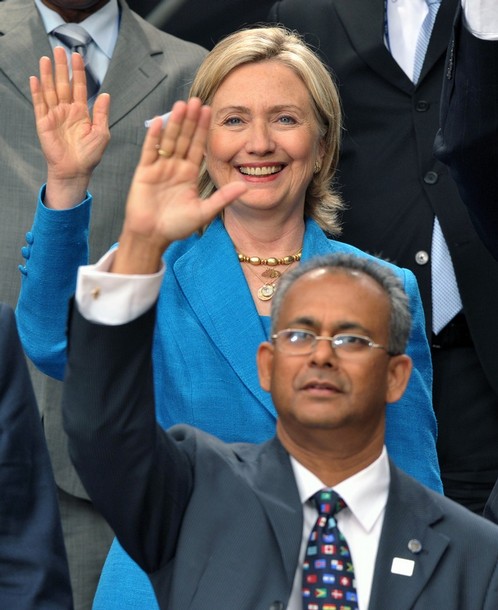
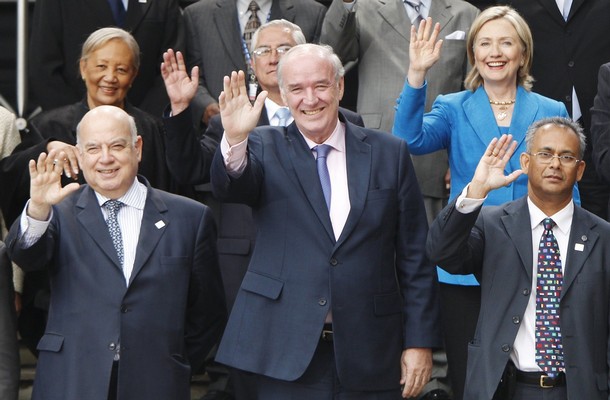
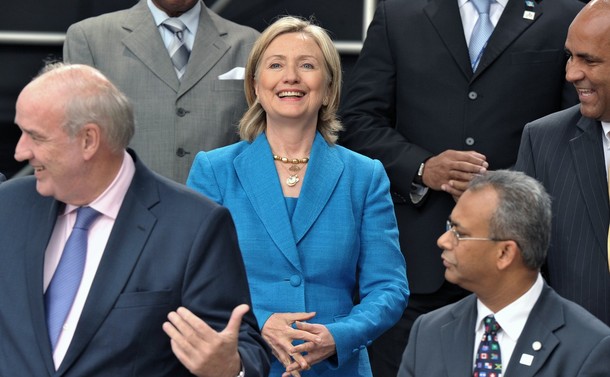
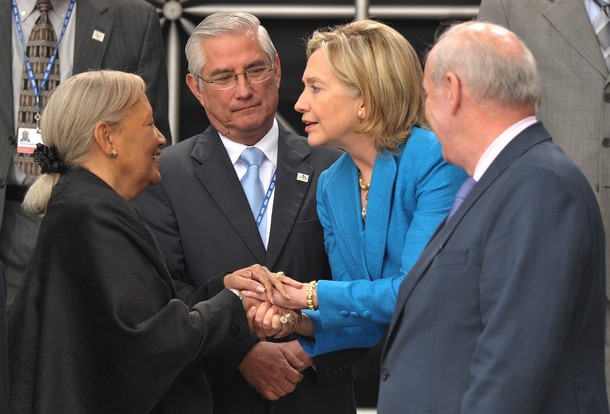
Secretary Clinton is on foreign travel in Peru, Ecuador, Colombia and Barbados through June 10. For more information, click here.
We have seen that she met with President Garcia and participated in the OAS General Assembly today. Here is a short snip from today's press briefing. Quick update, and information about tomorrow.
Alert! Turbo-Secretary on the move!
Philip J. CrowleyAssistant Secretary
Daily Press BriefingWashington, DCJune 7, 2010"... she’s also completed bilaterals with the foreign ministers of Mexico, Panama, and Bolivia, as well as the deputy foreign minister of Brazil.
Tomorrow, she will fly to Quito, Ecuador, where she will meet with President Correa and deliver remarks at the Metropolitan Cultural Center to a group of roughly 300 people, including alumni of embassy exchange programs, NGOs, youth, business leaders, members of the media, academics, and diplomats."
Hmmmm ... The Deputy Foreign Minister of Brazil. Not Amorin?
Address to the Organization of American States General Assembly
Hillary Rodham Clinton
Secretary of StateNational MuseumLima, PeruJune 7, 2010SECRETARY CLINTON: (In progress) and let me express my thanks along with all others to our hosts, President Garcia, Foreign Minister Garcia Belaunde and also to Secretary General Insulza. I think it is fitting that we meet here in Peru, which has provided a strong example in our hemisphere of delivering on the promise of democracy, reducing poverty, creating more chances for more people to live up to their own God-given potential. And so once again, we reaffirm our common values and aspirations that bind us together as a community of nations and peoples.
We are here to discuss peace, security, and cooperation, and I commend our hosts for setting an agenda that does speak to our shared vision. We do share the goals of expanding social inclusion and economic opportunity; of ensuring the safety of our citizens; of securing clean sources of energy and protecting our environment; of building effective institutions of democratic governance and accountability, while preserving and strengthening our heritage of pluralism, tolerance, and diversity. These are tremendous advantages and will become more so as this century progresses.
We are committed to strengthening our hemisphere’s mechanisms for collectively resolving disputes and for further fostering the conditions of sustained peace. And thanks to the reduction of interstate tensions in the Americas, we can look for ways to reduce excessive weapons expenditures, free up resources to enhance our economic competitiveness, and expand opportunities.
Each of us has an obligation and responsibility to meet the needs of our citizens, but we also all face transnational challenges that demand international collaboration and partnership.
We believe it is in the national interest of the United States and of every nation represented here to promote pragmatic and productive collaboration among members of the community of the Americas. That is why we welcome multilateral partnerships like UNASUR and CARICOM and SICA and the South American Defense Council’s goal of promoting greater confidence among its members and more effective cooperation to ensure security from organized crime and terrorism.
Multilateral organizations, and indeed partnerships of any kind, are useful when they make a real difference in the lives of our peoples. So our partnerships must be measured by results, the results they produce, not by the roster of members or the ideological alignment or the heated rhetoric. The United States is committed to doing our part as a full and active partner in the Americas and working with any organization committed to advancing the true welfare of people in the 21st century.
And under President Obama’s leadership, we have reengaged with robust multilateral diplomacy, and we support the Organization of American States as the foremost multilateral organization of the hemisphere. Why is that? Well, look, we all know that the OAS has not always lived up to its founding ideals. We all know there is serious work to be done to bolster the institution. But the OAS’s goals of strengthening democratic institutions, safeguarding human rights, promoting inclusive development, and enhancing multidimensional security are more important than ever. And mechanisms established by the OAS, such as the Inter-American Convention Against Corruption and the Inter-American Human Rights Commission, provide critical tools to help improve governance and respect for human rights.
We believe it is possible to build a stronger, more vibrant, more effective OAS that both serves the interests of member states and has the capacity and will to tackle regional challenges and prevent crises before they arise.
Today I would like to propose three steps to realize this OAS vision. First, we need to refocus the institution on its core mission of advancing strong democratic institutions that foster peace, citizen security, and opportunity for all.
Last year alone, the OAS conducted election observation missions in Bolivia, Mexico, Panama, El Salvador, and Ecuador. This is among the organization’s most important contributions. But the OAS suffers from a proliferation of priorities and mandates that
dilute its efforts, drain its budget, and diminish its capacity. We should align the OAS budget and staffing in accordance with its core activities, and it is critical that this happen in time for the September budget discussions.
Second, along that same line, we must work together to reform the OAS budget and take responsibility. The current path is fiscally unsustainable and threatens the viability of the organization itself. President Obama has asked the United States Congress for a three percent increase in support for the OAS, but the United States cannot do this alone. And we look to other countries to do what they can do to increase their own support.
Third, in keeping with refocusing on the core mission of the OAS, it is time to move ahead with implementing the Inter-American Democratic Charter. The United States will work with member states to jointly develop a collaborative Plan of Action to guide implementation, and we hope to see this plan adopted in time for the 10th anniversary of the Charter in September 2011. In particular, we should consider more precise guidelines for what constitutes an unconstitutional alteration and incorporate the Charter’s “essential elements” of democracy in the OAS peer review process. The creation of a Special Rapporteur for Democracy would enhance these efforts.
Our ongoing discussions about Honduras makes clear the urgency of this agenda. As we emphasized when the United States, along with the rest of the hemisphere, condemned the coup in Honduras, these interruptions of democracy should be completely relegated to the past – and it is a credit to this organization that they have become all but nonexistent in the Americas.
Now it is time for the hemisphere as a whole to move forward and welcome Honduras back into the Inter-American community. We’ve worked with many of you to help Honduras find a path back to democratic order. We saw the free and fair election of President Lobo, and we have watched President Lobo fulfill his obligations under the Tegucigalpa-San Jose Accord – including forming a government of national reconciliation and a truth commission. This has demonstrated a strong and consistent commitment to democratic governance and constitutional order.
At the same time, we must find ways to address conditions like those that led to the coup in Honduras before they turn into crises. There can be no higher priority for all of us than strengthening our institutions and mechanisms of cooperation so they effectively preserve the rule of law, basic rights, and the democratic order.
Our hemisphere stands at a crossroads today. A rising generation of young people – born in the Americas, versed in the technologies of the 21st century, and enriched by the diversity of our multicultural societies – stands poised to lead the globe in the years to come, to thrive in vibrant democratic societies and open and interconnected markets.
They will build the businesses, discover the innovations, and develop the future that we all deserve. Or we can see a different outcome. We could see another generation frustrated by democratic dreams deferred and economic potential denied. Those young people are waiting because they know that their future depends on the decisions that we all will make.
Democratic, accountable governance and human rights are the birthright of every man, woman, and child in the Americas. And responsible, democratic governance is essential to meeting all of our other challenges – widening the circle of prosperity, promoting greater economic and social inclusion, equality among all, protecting our citizens, securing clean sources of energy, and addressing the impacts of climate change.
The United States believe that the OAS has a vital role to play as a champion of democratic institutions, human rights, and the rule of law. But ultimately, the OAS reflects us. It is a product of the member states, and I believe we must come together this year to ensure that the OAS is prepared and ready to meet the challenges and seize the opportunities of this century. The United States stands ready to work with all of you to achieve this goal.
Thank you, Secretary General.
Remarks With Peruvian President Alan Garcia Perez
Hillary Rodham Clinton
Secretary of StatePresidential PalaceLima, PeruJune 7, 2010
PRESIDENT GARCIA: (Via interpreter) Ladies and gentlemen of the press, we would like to welcome the Secretary of State, Madam Hillary Clinton. We are very honored by her presence here and her visit is certainly proof that the U.S. is a friend to Peru. We are very excited by having the Secretary of State here for many reasons; first of all because she is a government official at the highest level from the United States, but beyond that because she is a woman, a woman who represents modernity, a woman who has fought a virtuous struggle for women’s rights for a very long time.
I remember listening to her in Beijing, where I heard her say that the struggle for human rights is a struggle for women’s rights, and that the struggle for women’s rights is also a struggle for human rights. This is a phrase that shows us her dedication to the issue of women and other vulnerable populations. We know of the political history and her long struggle to achieve health care reform in the United States, a struggle that at times was misunderstood. However, it was thanks to those initial efforts that have been now been realized by President Obama that those important reforms were carried out.So we know that she has a calling to serve women, to serve the poor, to serve the people. And that is why we are very happy to have her here to show that this is – her presence here shows that our friendship will continue our friendship with Peru and the United States. I hope then that her presence ratifies the importance of this event here at the General Assembly.SECRETARY CLINTON: Well, first let me thank the president for his very kind hospitality today. This is the second meeting that I have participated in with the president. The first was about a week ago in the Oval Office with President Obama, and today here in this beautiful building. At both meetings, we all talked so much that they ran way over time, because indeed, there is so much that the United States and Peru both care about and are working to achieve.
The United States applauds the progress in Peru toward economic inclusion, the reduction of poverty, and greater opportunity for the Peruvian people. The United States and Peru are working together to protect the environment, to move toward more sources of renewable independent energy to fuel the economy here in Peru. The United States and Peru are working together to provide security for people. And as President Garcia has discussed, that is security in their homes, on their streets, from crime, from drug traffickers and other threats. President Obama greatly appreciates the Peruvian Government’s support for nonproliferation, especially to send a message of unity to Iran and North Korea that their actions pose a threat to the peace and stability of the world community.
So although this is my first trip to Peru, I know it will not be my last. And I hope in my return visits to continue to see progress that is reflected in the improved lives of the people, the opportunities for children to fulfill their God-given potentials by having access to education and healthcare, the opportunity for hardworking, small businesses to access credit so that they can grow and create jobs, and to see a country that is truly on the path of destiny.So again, I thank the president for his warm hospitality. I apologize for keeping him so late that he was behind in his schedule. And now I have to depart in order to join the OAS meeting and participate in the discussions there. But thank you again for this very warm welcome to Peru.


Daily Appointments Schedule for June 7, 2010
Washington, DC
June 7, 2010
SECRETARY CLINTON:
Secretary Clinton is on foreign travel in Peru, Ecuador, Colombia and Barbados through June 10 . For more information, click here.
World Environment Day
Hillary Rodham Clinton
Secretary of StateWashington, DCJune 5, 2010The United States is proud to join with the international community to mark June 5 as World Environment Day, as we have since 1973. And I note with pleasure the selection of Pittsburgh, Pennsylvania, as North American Host City, reaffirming its leadership in regional innovation and in the transformation to a greener economy.
This year's commemoration is more important than ever as we face unprecedented environmental challenges that threaten our planet’s natural resources and biodiversity.
Today, the United States is learning firsthand how fragile our ecosystems are and how quickly a treasured landscape can become endangered. As President Obama recently stated, protecting the earth’s biodiversity, be it in the Gulf of Mexico or elsewhere, is a responsibility all of us share.
The urgency and scope of our shared responsibility is reflected in this year’s theme, “Many species, one planet, one future.”
Its is also reflected in the commitment of the United States to building global partnerships to preserve the earth’s rich biodiversity. From protecting the forests in the Congo Basin in central Africa to preserving the coral reefs in Southeast Asia, we are working together to meet our shared challenges. We are strengthening partnerships such as the Association of Southeast Asian Nations Wildlife Enforcement Network (ASEAN-WEN) and working to build similar networks in Central America and South Asia.
While we have learned a great deal about environmental conservation since the first World Environment Day 38 years ago, there is much more for us to learn and do. Let us individually and collectively redouble our efforts to protect the environment, for the benefit of generations to come.
Briefing on Secretary Clinton's Upcoming Travel to Latin America and the Caribbean
Arturo Valenzuela
Assistant Secretary, Bureau of Western Hemisphere AffairsWashington, DC
June 4, 2010
MR. TONER: Good afternoon. Welcome to the State Department. Very happy to have with us today Assistant Secretary Arturo Valenzuela. As you know, Secretary of State Hillary Clinton is going to be traveling to Peru, Ecuador, Colombia, and Barbados June 6th to 10th, and Assistant Secretary Valenzuela will be here to answer your questions and talk a little bit about the trip.
ASSISTANT SECRETARY VALENZUELA: Thanks very much. I want to remind you that on the first week of March, the Secretary did a trip to the Southern Cone in Central America. She went to the inauguration of President Mujica in Uruguay and then she went to Argentina and Chile and Brazil and then to Costa Rica to the Pathways meeting and then from there to Guatemala City to a meeting with the Central American presidents.
This trip this week will begin on Sunday and it’s to Lima, Peru, for the General Assembly of the Organization of American States. So the Secretary will lead the U.S. delegation to the Organization of American States annual meeting in Lima. And in Lima, she will also have a bilateral meeting with President Garcia, who, as you know, was in Washington last week to meet with the President as well.
From – so will be arriving on Sunday in Lima, Peru – Sunday evening. She will spend the entire day in Peru on Monday in the meetings of the OASGA. And then on Tuesday morning, she will be leaving Lima, Peru, and fly to Quito, Ecuador, where she will have a meeting with President Correa. And the meeting with President Correa will be also followed by a speech that the Secretary will give at a cultural center in Quito, where she will lay out the broad outline of the Obama Administration’s policies towards the countries of the hemisphere to the Americas.
At the end of the day in Quito, she will fly to Bogota, Colombia and arrive in the evening. And then the following day – I’m talking about Wednesday, then – she will be meeting in the morning with the two presidential candidates because, as you know Colombia is going through an electoral process. The first round of the election has already taken place, took place last Sunday, and so she will be meeting with the two presidential candidates, Santos and Mockus, and then having a meeting with President Uribe.
And then towards the end of the day, she will travel to Barbados, arriving in the evening in Barbados. And Thursday, she will be meeting, then, with countries of the Caribbean, CARICOM, in Barbados.
Let me just – I’ll start in reverse order. In Barbados, she will be discussing some of the security issues that the Caribbean faces, as well as other items on the agenda with the Caribbean countries. This is in some ways a follow-up to the recent meeting that we had here in Washington of the Caribbean Basin Security Initiative, which was the Administration’s effort to work with countries of the Caribbean to address the problems of crime and violence and narco-trafficking that the Caribbean countries face. But there will probably be other items on the agenda.
And then in Bogota, of course, she will be discussing elements of the bilateral relationship with Colombia, as well as with the two candidates, one of whom will be president of Colombia.
In Lima, at the OASGA, the Secretary will be participating in a meeting that has as its primary theme security and cooperation in the Americas. In fact, the declaration for the meeting has already been worked on by the members of the Organization of American States. They’ve come up with a draft declaration that will be issued in Lima. This is an effort on the part of the countries of the Americas at the suggestion of the Peruvians, who are the hosts, to address questions of security in a broad sense in the Americas.
So among the elements that are incorporated in this declaration are such things as the importance of confidence-building measures between countries, ensuring that there’s peaceful relationships between countries. There is a section in the declaration that also makes note of the fact that there has been a decline in military spending in the region. It calls for a greater investment, of course, in programs that are aimed at economic development and social reform, and less funding for military kinds of activities and that kind of thing. So it’s an effort to look at the state of security relationships across the board that focuses not only on interstate security questions but also on matters that affect the states in terms of internal security, questions such as crime and violence.
And I suspect also that the agenda will discuss OAS reform and steps ahead, questions of the OAS’s budget, which is a challenge right now. There are going to have to be some cuts on that and so-- and listen to the priorities of the secretary general at the OAS.
So without further ado, that’s kind of the broad outline for the trip, and I’m happy to take your questions.
Yeah.
QUESTION: (In Spanish.)
ASSISTANT SECRETAR VALENZUELA: (In Spanish.)
MR. TONER: Please, there’s a call in Spanish at 3 o’clock, so –
ASSISTANT SECRETARY VALENZUELA: Okay. Thank you.
MR. TONER: And sir, you mind just giving a –
ASISTANT SECRETARY VALENZUELA: Yes. What I said was – the question was – had to do with how we see Latin American in terms – is there an armaments race? And my answer to that was that, in fact, we don’t see this as a problem in Latin America – that, in fact, if you look at the statistics, the data, that there has actually been a significant decline in expenditures on armaments in most of the countries in the region. We value that. This is a product of the fact that since Latin American countries have returned to democracy or have been consolidated in their democratic processes, we’ve also seen significant efforts on the part of many countries to resolve boundary disputes that were dangerous.
I didn’t say this in my Spanish version, but in 1977, Chile and Argentina almost went to war and they had a large number of boundary issues which were resolved. And of course, let’s remember the important agreement between Ecuador and Peru to resolve their longstanding, also, boundary dispute. So this – these are advances and we welcome them and they show that, in fact, in Latin America, it’s much better to think about the strategies that most of the countries are pursuing which is to reduce arms – armament expenditures and invest much more in education and other social areas.
QUESTION: Andy Quinn from Reuters. (inaudible) will coincide with the Secretary’s visit specifically or not, but can you tell if the U.S. plans to seek a vote on the reintegration of Honduras and do you think you’ve got the votes to get that through?
ASSISTANT SECRETARY VALENZUELA: I think that this is an issue that’s going to be discussed on the margins of the OAS, but I’m not sure that it’s going to actually be part of the agenda. But I don’t have information on that. The – there’s still a discussion among countries in the hemisphere on the reincorporation of Honduras, where this is going to actually be taken up as an official part of the agenda. My understanding is that this is not going to be on the agenda, and the countries that have come to that conclusion. But at the margins of the agenda, this will be – of the discussions – I’m sure this is an issue that will come up.
QUESTION: Is it on the margins because the divisions over whether to readmit Honduras have not been –
ASSISTANT SECRETARY VALENZUELA: I think that that’s fair to say, that there still are some countries that believe that Honduras should take additional steps, which is a position that’s different from that of the United States where we believe that, in fact, Honduras has taken important steps to overcome the crisis that occurred with a coup from last year. Although, we are also mindful of the fact that there are continuing concerns over human rights violations in Honduras and that certain steps still need to be taken in order to bring about a process of national reconciliation, which was the objective of the Hondurans themselves when they signed the peace accord, which is the base for much of the efforts that are being undertaken now in order to reincorporate – to resolve the problems in Honduras and reincorporate Honduras into the inter-American system.
QUESTION: One thing that is on the agenda is the Malvinas. Is the U.S. prepared to support the Argentine position?
ASSISTANT SECRETARY VALENZUELA: No, our position has always been that this is a matter for both countries to address --
QUESTION: Will you support the Argentine resolution?
ASSISTANT SECRETARY VALENZUELA: No. We --
QUESTION: No?
ASSISTANT SECRETARY VALENZUELA: What we do – our position is to encourage both countries to resolve this issue in a bilateral fashion.
QUESTION: So, wait, wait. I just want to -- so, no, you do -- so that won’t get through – there won’t be a consensus on it?
ASSISTANT SECRETARY VALENZUELA: I said our position is to encourage both countries. I haven’t read any of the resolutions and I haven’t seen any resolutions that are being tabled. I’m just-- but if that question is a general question on what our position is with regard to the Falkland Islands and the Malvinas dispute, it’s that both countries need to address this matter.
QUESTION: On the --
QUESTION: It’s a follow-up?
QUESTION: Yeah, it’s just a follow-up on Honduras.
QUESTION: Okay, then go ahead.
QUESTION: Just – the secretary general of OAS, he said that some countries want former President Zelaya to go back to Honduras. Do countries think that this is an absolute necessary step to keep normalizing the situation? What is the position of the U.S.? Do you think that that should be enough?
ASSISTANT SECRETARY VALENZUELA: I understand – my understanding is that, in fact, President Lobo has taken steps to address this issue by encouraging President Zelaya. I think that he’s even made some efforts to say that he himself would encourage him to return. President Zelaya apparently at this particular point has not decided that he, in fact, wants to go back to – may not feel that the conditions are right for him to go back. But my understanding is that that is not a critical issue at this particular point. Now I understand that some countries are saying that he needs to go back. That’s true. But, as I said, again, President Lobo has made it clear that President Zelaya would be able to go back to Honduras.
And let me, on Honduras, underscore the fact that, I guess it was a week ago or so, that the Truth Commission was stood up. I think this is an important step that needs to be taken and it has been taken in Honduras. And the Truth Commission that will be headed by former Vice President of Guatemala Eduardo Stein is charged then, pursuant to the accord that both parties signed that led to setting the terms for reconciliation in Honduras, that this commission will look into what happened and provide, as the agreement itself suggests, it’ll provide those elements – elementos – to suggest some kinds of reforms in Honduras moving forward.
QUESTION: Thank you. Sonia Schott with Globovision, Venezuela. Dr. Valenzuela, Secretary Clinton is not going to Venezuela and I would like to know what is the stand of the bilateral relations between U.S. and Venezuela. And considering that one of the major issues in the street and at the OAS General Assembly will be security. I would like to know your position regarding the letter sent by the 12 senators asking the review of the Venezuelan status as a sponsoring – a terrorist sponsor country.
ASSISTANT SECRETARY VALENZUELA: Let me say that this is an Andean trip. The Secretary is not going to Bolivia either at this particular point, but this is an opportunity – your question is an opportunity for me to tell you that I was in Bolivia on Monday and Tuesday. I went down to talk to Foreign Minister Choquehuanca about the relationship between the United States and Bolivia. We’re trying to move forward and trying to overcome some of the difficulties that we’ve had.
We have a framework agreement that we’ve been working on for some time with the Bolivians in order to be able to restore our ambassadors and to normalize relationships. And I’m pleased to tell you that the meetings were extremely positive. I did a press conference with Foreign Minister Choquehuanca after our meeting, and as he expressed it, we’re 99 percent there in terms of this framework agreement. And so I think that we’re optimistic about our ability to move forward to try to strengthen the relationships between the United States and Bolivia – something that both governments want to do.
And as I say, this is-- the reason why I mention Bolivia is because this particular trip has an Andean focus. And I wanted to be sure to go to Bolivia before the Secretary traveled to Peru or Colombia or Quito to be able to sort of advance our efforts with the Bolivians. So our Andean trip is focused on that.
QUESTION: (Off-mike.)
ASSISTANT SECRETARY VALENZUELA: The reason we’re not going to Venezuela is not an Andean country and to be more specific in terms of your – while there’s been some discussion back and forth with the Venezuelans about how we might be able to also get our – strengthen our relation and get back on track, I don’t think we’re there yet.
QUESTION: And what about the reaction on the letter –
ASSISTANT SECRETARY VALENZUELA: Oh, I don’t – because I was traveling, I don’t know anything about that letter, so I’d have to find out.
QUESTION: Thanks.
QUESTION: Thank you. I’m translating –
ASSISTANT SECRETARY VALENZUELA: Let me go to somebody else, please --
QUESTION: Oh, sure.
ASSISTANT SECRETARY VALENZUELA: -- since you’re already had --
QUESTION: I’m (inaudible) with the Spanish service for (inaudible) press. In the first question, you said that most of the countries in the region are not increasing their military spending. Could you please talk about the countries that do – that –
ASSISTANT SECRETARY VALENZUELA: I don’t have the facts there at the top of my head in terms of – what I was just giving you is a general impression that --
QUESTION: Yes.
ASSISTANT SECRETARY VALENZUELA: -- in Latin America there has been a decline of military expenditures, no. Any country, of course, any sovereign country has a right to purchase equipment and particularly to modernize equipment. And so that’s something that we understand and indeed encourage if you want to modernize this equipment. The thing is that the welcome trend that we see and that is embodied by the discussion that will be had in Lima, in this declaration on issues of security there, is that there has been a decline generally in the military expenditures across the board in the region. And this is something that the declaration, in fact, does welcome as it also emphasizes the importance of investing much more in social programs and in economic development priorities than in weapons.
MR. TONER: A few more questions.
QUESTION: Can I ask you a question about Cuba? Can you bring us up to date on whether there have been any recent contacts on the oil spill issue and also any information or any update on Mr. Gross?
ASSISTANT SECRETARY VALENZUELA: On the oil spill, the Cubans were notified of the potential of the oil spill that this could be a problem. And my understanding is that they were – they appreciated the gesture of notifying them in that regard.
And I don’t have any updates on Mr. Gross except that there have been some consular visits and that we continue to be extremely concerned about that case, and we brought it to the attention of the Cubans.
QUESTION: Can I ask about-- I understand you had a meeting this morning with the general attorney of Nicaragua. I think that U.S. has expressed some concern-- worries about the situation of human rights and political rights. And was it about that? Did you stress –
ASSISTANT SECRETARY VALENZUELA: Well, that’s one of the issues that we discussed. We also discussed the property questions in Nicaragua; they’re still outstanding.
QUESTION: On the OAS –
ASSISTANT SECRETARY VALENZUELA: Just a second. Hold on.
QUESTION: Will the free trade agreement with Colombia be ratified? And what will the Secretary tell the government, then?
ASSISTANT SECRETARY VALENZUELA: Well, let me answer the second part of the question. The Secretary will tell President Uribe and Colombian interlocutors that the Obama Administration does support, as the President himself said in the State of the Union Address, in fact, the ratification of a free trade agreement with Colombia.
With regard to the first part of your question as to whether or not this is going to happen, I don’t know. And this, of course, is a matter for the Congress to decide. And – but we continue to work on this and it is something that we hope will happen soon.
QUESTION: Thank you.
QUESTION: I wanted to ask you, regarding the OAS and what you mentioned, the need for reform, could you please elaborate a little bit more on that? And what about the budget, how to do that without –
ASSISTANT SECRETARY VALENZUELA: Right. I think that --
QUESTION: -- small budget –
ASSISTANT SECRETARY VALENZUELA: This is one of those things where, as we move forward, our countries need to continue to make their contributions. Much of the OAS budget depends on additional funding that doesn’t-- that’s not the core funding that comes into the OAS. It’s funding that comes in through projects. While those are important, it’s also significant – it’s a priority for the OAS to have a core budget that is an adequate budget to be able to cover the expenditures that the organization has. And so, as the secretary – at this particular point, the secretary general is looking at trying to do some cuts to improve some of the managerial practices within the OAS to streamline the organization. And at the same time, of course, we, with other countries, are looking to see how we can appeal for additional funding to cover some of the priorities at the OAS.
QUESTION: And while she’s at the OAS, does the Secretary have hopes of having a bilateral with the Brazilian foreign minister?
ASSISTANT SECRETARY VALENZUELA: There is, I could say, a list of bilaterals. But my impression is that we still haven’t decided yet exactly which ones were going to take place. But there will be time for a few bilaterals, and a few bilaterals will be held in Lima. But I’m not – I can’t tell you which ones.
QUESTION: Well, it’s going to be – the timing is propitious for a meeting with the Brazilians, considering you’re looking to get the resolution introduced at the UN next week. I mean, is Iran going to be a factor in these meetings, either the resolution or growing influence in the region?
ASSISTANT SECRETARY VALENZUELA: I don’t think so, but – and again, I can’t comment on specifics with regard to which bilaterals are being scheduled. But there are several bilaterals that are being looked at. And so as soon as we get that information, we’d be happy to share it with you.
QUESTION: Sure. So you don’t expect, then, that the concern that has been expressed previously in public by the Secretary and others about growing Iranian influence in the –
ASSISTANT SECRETARY VALENZUELA: No, that’s certainly a concern. And that’s a concern that we’ll continue to express. But if you’re asking me to what degree this is going to become an issue in the discussions at the OAS General Assembly, I’m not sure that this is an issue that’s going to be discussed at the General-- OAS General Assembly.
Thank you very much.
QUESTION: One more on – the embargo of Cuba is going to come up for sure. They’re going to keep pressing the U.S., but you will just keep repeating the same old positions. Is that right? (Laughter.)
ASSISTANT SECRETARY VALENZUELA: Is that a leading question? (Laughter.)
QUESTION: Yeah, that’s – it’s a leading question, just to – I was helping him leave --
ASSISTANT SECRETARY VALENZUELA: I’ll let my friend, P.J. (laughter). He’s an expert at it.
MR. CROWLEY: No, but before Arturo leaves, there are many baseball fans here at the State Department. And for six and a half floors of the State Department, of course, we endorse the Boston Red Sox. But that suite in the middle is a different story. But I do think we should pay tribute to Armando Galarraga of the Detroit Tigers --
QUESTION: Venezuelan --
MR. CROWLEY: Proud son of Venezuela. And the display of grace and sportsmanship that he has given us in the aftermath of his 28-out perfect game. We certainly salute him and what he’s done for the good of the game. And he’s a proud son of Venezuela and the Detroit Tigers.
ASSISTANT SECRETARY VALENZUELA: Thanks very much.
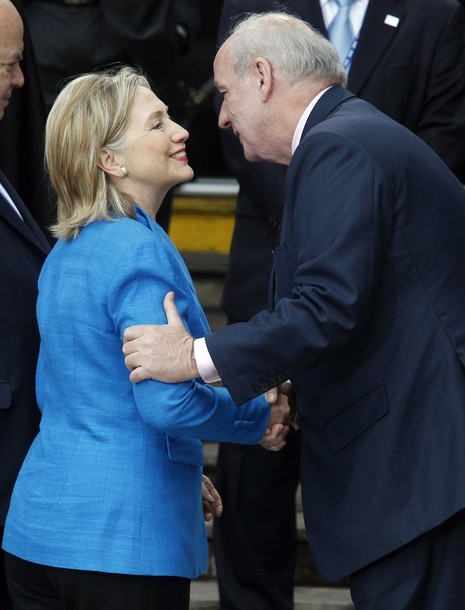
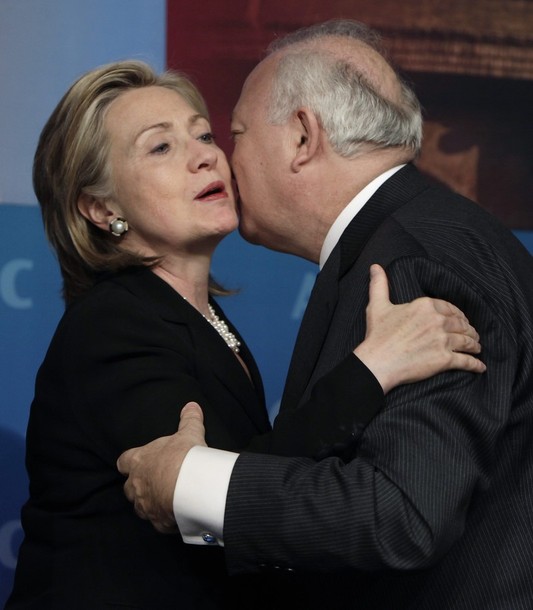
The Secretary of State is busily turning out text. This op-ed, co-written with Cathy Ashton and Miguel Moratinos, pictured with her below from an April event, addresses a rededication of the U.S. and E.U. to help reconstruct the Balkans. Next week in Sarajevo, a rededication compact will be formalized. Any one who watched the Olympics in Sarajevo and then saw those venues devastated by war would agree. The Balkans deserve this.
The Balkans Deserve This
Op-Ed By Hillary Clinton, Catherine Ashton and Miguel Angel MoratinosWashington, DCMay 30, 2010
In Sarajevo the region can embrace the new dynamic of European and Atlantic integration
Almost a century ago, a war that changed European history began in Sarajevo. Nearly 20 years ago, the city was the centre of another violent conflict that ended only with the 1995 Dayton Accords. And 10 years ago, with the memory of the Yugoslavian wars still fresh, the European Union affirmed the crucial role of Euro-Atlantic multilateral institutions in the security and stability of the Balkans. Today Sarajevo is at peace, a symbol of rebirth and reconciliation, representing all the opportunities and challenges of European and Euro-Atlantic integration.
On Wednesday the EU Spanish presidency will host a ministerial meeting in Sarajevo attended by senior leaders from EU member states, the western Balkans, the US, Russia and Turkey to reaffirm our shared commitment to the security of the Balkans through integration into European and Euro-Atlantic institutions. Integrating the western Balkans remains one of the last challenges to building a democratic and unified Europe. In Sarajevo EU ministers will recommit themselves to the Balkans' place in Europe. Ministers from the region will reaffirm their commitment to implement the reforms necessary to meet the aspirations of their people and to move their countries on the path to the Euro-Atlantic community.
As we have seen in the past two decades, the perspective of integration into the EU and NATO is a powerful driver of reform, economic prosperity and the rule of law. It means a seat at the table in European decisions, free movement of goods and people and a guarantee of security. The reforms required are also transformative. The people of the region want and deserve transparency and accountability in their governments, a level playing field for business and the opportunity to raise their children in peace and security. This is also what we want for them. The pace of global change is such that none of us can afford stagnation and "business as usual". Commitments on both sides have to be real, not rhetorical.
The rationale for this new path is clear: to replace the old dynamics of disintegration with the new dynamic of European integration. The Lisbon Treaty embodies the ambition of the EU to become a more effective global actor, and the Balkans represent an important test for the success of this ambition.
The leaders of the Balkans will have our full support as they confront the challenges of reform. Beyond complying with the political and economic Copenhagen criteria, they must commit to reconciliation among ethnic and religious communities and political groups to build a new national consensus.
The EU and the US have spared no effort in the course of these months to tackle the many fronts in the process of stabilising and "Europeanising" the Balkans, and anchoring the rule of law and good governance. The Obama Administration is committed to remain engaged in the region through completion of our shared vision.
A little over a year ago, Joe Biden, the US Vice President, and Javier Solana, the EU High Representative, visited Sarajevo with a message of hope: the doors to Euro-Atlantic institutions remain open to all the countries of the Balkans, once they meet the requirements for accession. The compact with the region, to which the EU and US will rededicate ourselves at Sarajevo on Wednesday, remains firm: we stand ready to assist the citizens and leaders of the region in building a better future together.
Hillary Clinton is the US Secretary of State; Catherine Ashton is the High Representative of the European Union for Foreign Affairs and security policy; Miguel Angel Moratinos is Spain's Minister of Foreign Affairs
###

Partnership Of Democracies
Hillary Rodham Clinton
Secretary of StateOp-Ed printed in the Times of IndiaWashington, DCJune 4, 2010This week, a delegation from India's government arrived in Washington for the first-ever strategic dialogue between India and the United States. This was no routine meeting. It was the culmination of years of intensive engagement between our countries engagement that will grow even deeper as we confront the urgent global, regional and local challenges of this era.
India is the world's largest democracy, one of its fastest growing economies and a rising power in Asia and beyond. It has vibrant democratic institutions, a free press, robust civil society, an innovative private sector and tens of millions of citizens whose talents have yet to be fully realised. It is also a model of democratic development that has lifted millions of people out of poverty by widening access to the tools of opportunity education, healthcare, food, water and jobs.
India's rise is a defining storyline of early 21st century. And as President Barack Obama has said, India is an indispensible partner to the US. Given the complexity of the challenges we face and the values we share, the US-India partnership is critical to our mutual progress.
Through our strategic dialogue, we are expanding our cooperation on global issues on which India can and must play a leading role, including climate change, nuclear non-proliferation and food security. Already, India has taken important steps. Last year, it helped shape the Copenhagen Accord and pledged to lower its greenhouse gas emissions intensity by up to 25 per cent by 2020. During Prime Minister Manmohan Singh's visit to Washington in November, he and President Obama launched the partnership to advance clean energy, to bring Indian and American scientists together to develop and deploy technologies that reduce our dependence on fossil fuels.
Our nations are advancing global security by working together on counterterrorism and nuclear non-proliferation, building on the US-India civilian nuclear cooperation initiative. At the nuclear security summit in April, Prime Minister Singh announced that India will create a Global Centre for Nuclear Energy Partnership to train scientists from other countries in nuclear safety an important contribution to our common security and to achieving a world free of nuclear weapons.
India and the US are also working together on the challenge of global hunger and food insecurity. Fifty years ago, India's Green Revolution saved millions of lives and transformed India's economy. A similar transformation is needed today in other parts of the world, especially Africa. Indian and American scientists are developing new seeds and pesticides to boost crop yields, which will save lives and lift farmers' fortunes including in India's rural regions.
Meanwhile, India is as an anchor of stability and economic growth in Asia. Its leadership will be critical to solving regional challenges most urgently, securing Afghanistan's future. India, the US and countries worldwide have a stake in a stable Afghanistan. India has provided $1.3 billion in assistance to Afghanistan; India is building the new parliament building; and Indian and American groups are working together to help Afghan engineers bring 24-hour electricity to Kabul.
India is an Asian power, and a secure, prosperous Asia is critical to a secure, prosperous world. The US wants to work with India to create an open and inclusive regional architecture that makes it possible for all countries in Asia to rise and prosper. Toward that vision, we are called to promote trade, protect vital sea lanes and respond to natural disasters.
Apart from our cooperation on global and regional issues, the US also remains committed to a strong bilateral relationship with India, built on the ties that connect our governments, private sectors, civil societies, universities and citizens.
One example is education. More than 1,00,000 Indian students study in the US. We want an equal number of Americans to study at Indian universities, and for the educational partnerships between our nations to expand. To that end, we have nearly tripled the number of Fulbright-Nehru Fellowship scholars during the last two years. The new Obama-Singh 21st Century Knowledge Initiative will build partnerships between Indian and American universities. And India is now poised to undertake a significant educational reform: allowing foreign universities to open campuses in India.
Our economic and financial partnerships are also growing, helping India move closer to its development goals. To deepen these ties, Washington and New Delhi are called to emulate the entrepreneurial spirit of Manhattan and Mumbai by reducing barriers to trade and investment, which will open markets and create jobs in both countries.
The relationship between India and the US goes back generations and has enriched the lives of millions of our people. Today, our partnership of democracies is shaping the world of the 21st century. Together, we can achieve great things for our citizens and for people everywhere. This is our opportunity and our responsibility.
The writer is US Secretary of State.
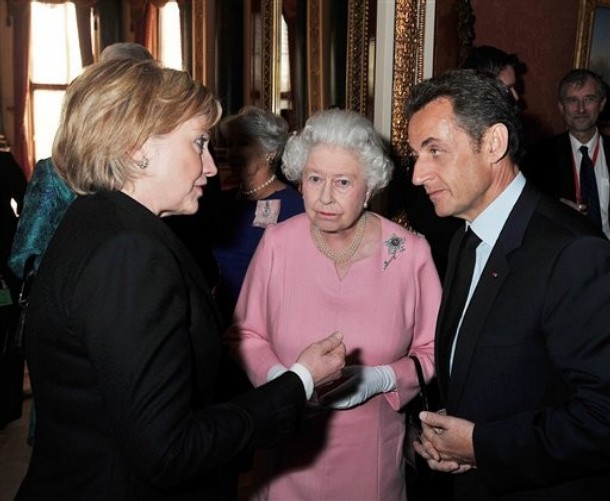
Well, this came in today, and it is special, because, you know, of the Special Relationship, but also because our Secretary of State always says exactly the right thing. The comments about WWII are perfect! It is a lovely greeting from one lovely lady to another on our behalf, and I could not be prouder of our Secretary of State if she were my own sister (which is how I think of her, anyway).
Happy Birthday, Your Majesty, and many more!!
Birthday of Queen Elizabeth II
Hillary Rodham Clinton
Secretary of StateWashington, DCJune 4, 2010
On behalf of President Obama and the people of the United States, I am pleased to wish Queen Elizabeth II a happy birthday and extend warm wishes to the people of the United Kingdom and the Commonwealth of Nations. On this celebratory occasion, we pay tribute to the Queen’s life and legacy and honor the special relationship between our two nations.
The United States and Britain have together championed the cause of peace, freedom, and global prosperity for decades. This year we commemorate the 65th anniversary of the end of World War II, when our two countries, along with our other allies, joined together to defeat Fascism and tyranny. The young princess Elizabeth helped rally her nation in the darkest days of that war, and she has remained a beacon of integrity and resolve ever since. The United States has always been grateful for her friendship and example.
Today our special relationship continues to provide a solid foundation as the United States and Britain work side by side to meet the challenges of the 21st century, from supporting the refocused mission in Afghanistan to promoting the global economic recovery to working for peace in the Middle East.
Once again, I wish Queen Elizabeth II a very happy birthday and peace and prosperity for the people of the United Kingdom in the year to come.




Remarks At Reception Honoring the U.S.-India Strategic Dialogue
Hillary Rodham Clinton
Secretary of StateRemarks with Indian External Affairs Minister S.M. Krishna
Ben Franklin Room
Washington, DC
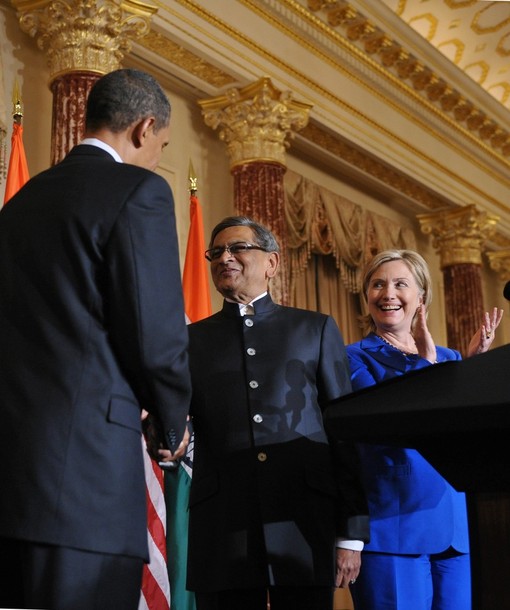
June 3, 2010SECRETARY CLINTON: Well, welcome to all of you who are joining us for this reception here at the State Department in the Ben Franklin Room. And it is a particular honor for us to welcome not only a great leader but someone who has a strong personal commitment to the U.S.-India relationship, President Barack Obama. (Applause.)
Mr. President, we’ve worked hard today and we’ve actually been working hard ever since this Strategic Dialogue was agreed to between you and Prime Minister Singh. Many of the people you see before you are the people who are actually doing the work that make Minister Krishna and I look like we’re fulfilling our responsibilities. (Laughter.)
But we so value this relationship. And I came across a quote which I think summarizes what we feel. Mark Twain once wrote, “India is the cradle of the human race, the birthplace of human speech, the mother of history, the grandmother of legend, and the great-grandmother of tradition.” And I love the fact that it’s mothers that – (laughter).
Well, given the talent, the expertise, and the enthusiasm in this room, not only from our distinguished delegation from India and all of the people here in our Government who have worked so hard, but Indian-Americans who themselves embody the importance of this relationship. We are so excited as we broaden and deepen this extraordinary partnership. And now the real work begins. We’re turning our ideas and our aspirations into actions and results and working to unleash the tremendous potential that exists for even greater opportunity, prosperity, and peace for the people of India and of the United States and of the world.
Let me now introduce Minister Krishna, who has been a wonderful colleague and, ever since we announced this strategic dialogue during my visit last year, has been so supportive and enlisted the commitment of so many of the distinguished ministers and officials from the Government of India.
Please, join me in welcoming Minister Krishna. (Applause.)
MINISTER KRISHNA: Mr. President, last year you and Prime Minister Manmohan Singh launched a new phase in the India-U.S. global strategic partnership. I bring to you from Prime Minister Dr. Manmohan Singh, who spoke with you last week. He has asked me to reiterate the importance he attaches to this Strategic Dialogue and his personal commitment to it as an instrument for strengthening of our bilateral cooperation. He recalls very warmly his meeting with you at the successful Nuclear Security Summit in April 2010. He and over one billion citizens of India look forward to welcoming you and your family later this year.
I am grateful for the warmth and gracious hospitality that has been extended by Secretary Clinton to me and to my colleagues and officers. Her commitment and involvement in working for a positive transformation of India-U.S. relations has been a key factor in the achievement of the global strategic partnership that we have established today.
Mr. President, we consider our mutually beneficial relationship with the United States to be one of our foremost foreign policy priorities. There are few relationships in the world that have so much potential as India-U.S. relations because I believe that our cooperation is not only for mutual benefit but is destined to have a strong impact on global peace, prosperity, and stability in the 21st century.
Mr. President, as India regains the momentum of her economic growth, new opportunities are emerging to empower rural communities, especially women. Time and again, we have seen in other developing countries – for example, in the pioneering efforts of Ann Soetoro, your late mother – Mr. President, to Indonesia, the transformational impact of innovation and microfinance, that is our hope for transforming our economy and society in an equitable, inclusive and sustainable manner.
My colleagues and I have had very productive meetings yesterday and today in our Strategic Dialogue. We reviewed progress in all areas of our ongoing cooperation and also focused on our vision and the roadmap for the future. We also discussed how we would work together to realize the immense potential of our cooperation across the spectrum of human endeavors, from strategic cooperation to sustainable growth and economic and developmental partnerships, to achieve real benefits for our peoples and for the world.
Mr. President, we are pleased that you, with your deep personal links with the Asia-Pacific region, are taking strong interest in the future of this rapidly evolving region. We look forward to a stable, secure, prosperous future for this region, defined by cooperation, openness, and inclusion. A peaceful and stable South Asia is critical for our development and security. We believe that India can be a dependable anchor of the region’s growth. We are supporting economic development and increasing trade and investment in several of our neighboring countries.
We remain committed to Afghanistan’s development and supporting the Afghan people in their efforts to build their capacity and assume the rightful responsibilities for governance, security, and development. With international support, they will succeed in their efforts. The United States have made great sacrifices in Afghanistan and invested in – heavily in Afghanistan and Pakistan. These are no ordinary commitments for the American people as they promote the cause of peace and resist the evils of terrorism.
My prime minister has consistently believed in the need for dialogue to seek a future of peace and cooperation with Pakistan. I will meet the foreign minister of Pakistan in Islamabad in the month of July. The trust deficit in relations between India and Pakistan needs to be specifically addressed. The continuing threat of terrorism is a cause of great concern for us in India.
Mr. President, our agenda is rich and extensive. I thank you once again for your belief in and commitment to this relationship, and look forward to your visit to India, where a very warm and heartfelt welcome awaits you and the family. Thank you so much, Mr. President. (Applause.)
SECRETARY CLINTON: Well, Mr. President, we love having you come to the State Department. And have this chance to see all of these people who have worked so hard on these people who have worked so hard on this Dialogue is for us a very great honor. And we thank you for your personal commitment, as Minister Krishna outlined, to broadening and deepening this critical relationship between India and the United States.
Ladies and gentlemen, please welcome the President of the United States.
# # #